A couple weeks ago site music writer necromoonyeti wrote up quite an article about what just makes a piece of music a “horror music”.
Using some of what necromoonyeti wrote about I decided to look at some horror and non-horror films with music that evokes that sense of terror and horror that sometimes come from music that we wouldn’t associate with such emotions. It’s a much more difficult task than one would think. Yet, while I didn’t find one of those non-traditional pieces of horror music I did come across one that I should’ve used in this segment a long time ago.
The latest “Song of the Day” is a piece of disturbing music titled “Polymorphia” by Polish composer Krzysztof Penderecki.
This musical composition has been used in two classic horror films (some would say some of the best in their genre) to help build the sense of horror and dread for the audience. The two films in question would be William Friedkin’s The Exorcist and Stanley Kubrick’s The Shining. I know that in the former it more than added to that film’s creeping dread from the moment the song came on. It made one feel like Hell itself was about to break through the screen. It’s that sense that one’s skin was sensing something evil was afoot.
I found a particular youtube video that used this song and the chosen imagery to great effect. I dare anyone to watch the video, listen to the music in a dark room and in the middle of the night while alone.
We have another new AMV of the Day for the current horror month and this time around it’s a sort of mixtape of some of the more recent horror anime.
“Yurei” pretty much takes two of the most recent horror anime in Another and Mirai Nikki and combines it with one that’s more supernatural romance than horror in Dusk Maiden of Amnesia, but still shares the previous two titles’ dark fantasy roots. The song itself is one of the musical compositions created for another horror anime, Jigoku Shoujo aka Hell Girl, by Japanese composer Takanashi Yasuharu. So, this video is pretty much horror on horror and while it’s not the full on bloodbath (though one must watch both Another and Mirai Nikki to see just how off that statement truly is) one would associate with horror nowadays it’s still quite an appropriate video for this month’s theme.
Anime:Another, Dusk Maiden of Amnesia, Mirai Nikki
Decade of last.fm scrobbling countdown:
21. Emperor (1,301 plays)
Top track (119 plays): I Am the Black Wizards, from In the Nightside Eclipse (1994)
I don’t know that I would call Emperor the most influential band in black metal, but Ihsahn and Samoth’s brainchild definitely ranks among the top 5. Without ever abandoning the sinister, aggressive atmospherics, nor dropping the tremolo guitar, blast beats and double bass, or shrill, shrieking vocals standard for the style, Emperor managed to infuse black metal with a level of technical expertise and creative song structure that appealed to listeners far beyond the isolated genre. Their progressive rock and classical flares drew in a broad fan base that never had the time for Bathory’s viking tendencies or Darkthrone and Mayhem’s bm in the raw. They were certainly one of the first black metal bands that caught my eye, at a time when their contemporaries just sounded like noise to me. It’s no wonder that at this point they’ve ascended to 21st on my decade-spanning last.fm chart.
Talent and attention did not necessarily go hand in hand in early 90s black metal. Mayhem’s music left a lot to be desired, and Burzum’s discography bears some major flops. Emperor are more the exception than the norm in that they achieved a fairly professional level of quality while actively participating in Euronymous’ circle of murder and arson. Part of that, I suspect, stems from Ihsahn’s ability to keep his hands clean in the midst of it. Ihsahn managed to say out of trouble–or at least not get caught–while Samoth, Faust, and Tchort were all doing time. Persistent similarities from In the Nightside Eclipse all the way to Ihsahn’s most recent solo works suggest that he might have done the lion’s share of the song-writing all along. (Their final album, Prometheus, was composed by him exclusively.) Whoever wrote it, the refreshing originality of Emperor’s discography has had significant consequences. They didn’t set the standard for what black metal in the 90s ought to sound like, though plenty of bands copied them. Rather, they set the standard for how the genre might progress. Emperor took a very formulaic split-off from thrash and demonstrated time and again that it could be one of the most diverse, open-ended genres of music on the market.
I suppose if I asked most people what music they identified with horror, John Carpenter’s “Halloween Theme” and Mike Oldfield’s “Tubular Bells” (The Exorcist) would come up first. After that, you’d get a lot of Rob Zombie and Glenn Danzig. So right off the bat, you’re looking at an enormous variety of sounds and styles connected mainly by association. While John Carpenter’s work was intentionally composed for the film in which it appeared, “Tubular Bells” was originally a 50 minute progressive rock opus that was anything but sinister or foreboding in its full form. Misfits was a goth punk band that happened to favor horror themes. White Zombie’s horror imagery was more a matter of crudeness and vulgarity in the spirit of GWAR; their sound was a frontrunner in the emergence of industrial groove metal, and the greatest “horror” associated with Rob was the countless terrible nu metal spinoffs. A couple of “top ten horror songs” lists I stumbled upon even list Bobby Boris Pickett’s “Monster Mash” and Richard O’Brien’s “Time Warp”. I mean, “Monster Mash” is a fun Halloween song, sure, but horror? Really? And the Rocky Horror Picture Show does make me want to vomit, but we have to draw the line somewhere.
Suffice to say, “horror” music is not a genre at all. Simply associating a song with a scene or theme is enough to relate them; Huey Lewis and the News will probably make me smile and think of Christian Bale chopping people to bits in his apartment for the rest of my life. But there are definitely certain musical attributes that conjure in us a less glitzy feeling of dread than Hellbilly Deluxe. That skittering cockroach beat in the background of Halloween is completely unnerving; Carnival music is way creepier than Stephen King’s It; Black Sabbath’s appreciation for diabolus in musica virtually invented heavy metal; and it took a firm dose of the blues in 1988 for Danzig to capture a sense of the sinister that Misfits could never convey.
I don’t believe that any particular musical formula is the coalescence of evil. The music we find most haunting is derived from association too, but it connects in more subtle ways than say, the fact that a particular song appears in a horror film or mentions witches in the chorus. The real deal distorts what comforts us, denies our sense of order, and pries upon our innocence. Through a musical medium as through any other, horror focuses on shattering the lens through which we perceive reality as an ordered, logical construct. It reminds us of the real nightmares in life while nullifying our means to counteract them. It takes us to the world of the child, where emotional extremes enhance our senses of comfort and terror alike.
The carnival tune and music box are prime targets, conjuring in our minds a time when fear was more potent. The brief piano loop, the simple hum, the monotone drone–these bring us to solitude and isolation through minimalism. Effective horror themes offer no comforting symphony or rock ensemble to encase us in a nuanced world. They surround us with something singular and far from warm, or with nothing at all. The wind chimes warn of a storm; when none is coming, the darkness is all the more unnatural. The cathedral bell, a sign of fellowship on a Sunday morning, also tolls for death. A twitch, a buzz, a repeated knocking, a bit of static–things that would otherwise annoy us–exploit the close connection between discomfort and tension.
Or else we can completely overwhelm the senses with noise that strips away the familiarity which typically diminishes extreme music’s effect, leaving us a nervous wreck. When Blut Aus Nord chose to employ programmed, industrial blast beats in their 777 trilogy, they effectively eliminated the one element of the music that would have sounded too familiar to disturb. Instead, the epileptic guitar finds companionship in a persistent, unnatural clatter designed to place us permanently on edge.
Other bands have found other means to the same end. Peste Noire’s unique “black ‘n’ roll” sound enlivens a standard formula for “evil” music with a pep and a grin, giving the brutalizer a human face in the spirit of medieval sadism. Sunn O))) are inclined to drone on for ages, developing a false sense of comfort before infusing their deep buzz with a caterwaul of shrill pitches and clattering chimes. (I actually had a guy start freaking out on me at work one day when “Cry For The Weeper”, which he didn’t even notice playing, hit the 3:55 mark.)
And lastly, we can’t forget the power of lyrics to render a song gruesome. The stereotypical lines of a black metal song–nonsense about necromoonyetis and an appeal to Satanism far less disturbing than the average Christian commentator on Fox News–are pure cheese, and they entertain us in a manner similar to your typical zombie flick. But when you first heard Smashing Pumpkin’s “x.y.u.”, you probably got a feeling more akin to Henry: Portrait of a Serial Killer.
Horror in lyrics is something a bit the opposite of horror in sound; it strikes us most deeply when we can be convinced that there is absolutely nothing supernatural about it. There are certainly a few exceptions–Townes Van Zandt’s tall tale in “Our Mother the Mountain” chills me to the bone–but generally speaking, the real atrocities committed throughout human history far exceed the limits of our imaginations. Vlad Tepes was worse than any vampire, and from Elizabeth Bathory and Ariel Castro to Hernando Cortes and Adolf Hitler, we are flooded by examples of direct personal cruelty and dehumanized mass slaughter. When a song manages to make us think of these individuals and events beyond the safety blanket of historical narrative, an authentic feeling or horror is hard to deny.
Decade of last.fm scrobbling countdown:
22. Стары Ольса (Stary Olsa, 1,257 plays)
Top track (111 plays): Танцы (Dances), from Келіх кола (Loving Cup, 2000)
Featured track: Дрыгула, from Дрыгула (2009)
I don’t know of too many bands from Belarus, but the one I’m most familiar with is amazing. It’s a bit fitting that Stary Olsa should be my first entry in this on-going series to appear within the fall season, because I actually featured both “Dances” and “Drygula” this time last year. Of course it has nothing to do with horror, but it’s firmly rooted in the traditions from which our Halloween has derived–those of a misty past dominated by perceptions and beliefs not yet subsumed by European Christian standards. I don’t know whether the songs Stary Olsa play are themselves of ancient origin, but their instrumentation certainly is, and the songs they have crafted, whether traditional or original, are convincingly and memorably medieval. You’ll hear none of that western adherence to formula here; playing slightly out of tune or hitting a wrong note is a positive property of the music I like best. It comes to life with an earthiness that strives not for order and rationality, but for a taste of those unpredictable, wild-eyed expressions that highlight the more authentic human experiences of joy and sorrow. A lot of the best folk music abandons modern society’s notions of how these feelings ought to be expressed in exchange for a more direct connection. Stary Olsa certainly aren’t unique in this regard, but they do it better than most any other ensemble I’ve heard.
For the first horror “Song of the Day” I couldn’t decide on which theme from Clive Barker’s Hellraiser I should use.
Fans of the film should know well the original theme composed by Christopher Young for the film. It’s a more orchestral theme that gives the film a sort of grand guignol grandeur. It’s an epic piece that would get used time and time again for each successive sequel. There might be some minute changes to the theme with each new film, but the basic composition remains. It’s a theme that helps one visualize forbidden texts and grimoires laying in wait for the ones brave or foolish enough to turn the page.
Then there’s the unreleased and unused theme that Barker had originally wanted to use from the industrial band Coil. This theme for the film was more about discordant melodies that harkens back to the more disturbing musical composition used for The Exorcist. It’s a theme that brings up images of the sublime and exquisite pain that Pinhead promises to those solve the Lament Configuration.
Some fans prefer the original Christopher Young suite while others have grown to love and prefer the more disturbing piece from Coil. I, for one, think both could’ve been used in the film though if I had to pick one to use as the main theme then I would go with Christopher Young’s composition.
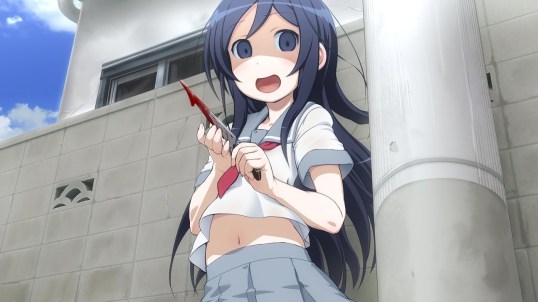
Here we are once again with the wonderful month of October. This means the place gets an extra dosage of horror in everything we can think of. For my first horror-themed post I shall go with the latest “AMV of the Day” and this time it’s an aptly titled video: “Bloody Ayase”.
This particular AMV takes the cute, romantic comedy series, Oreimo, and subverts it by way of clever editing, song choice and some additions like blood splatters to turn it into an obsessed crush. This video actually does a great job in showing the anime personality type called yandere. It’s the obsessed and mentally unhinged lover or ex-lover who doesn’t want to let go and will kill anyone, even the target of their affection, if it means keeping them away from others.
The only thing this video doesn’t have is a pot of boiling water with a rabbit inside.
Concerts have been a major part of a teenager’s transition into adulthood. Often have we begged our parents to get us tickets to our favorite band’s concert as they toured straight into our hometowns. We’d beg, cajole, promise whatever just to be able to attend that big show that we thought everyone we knew would be attending. Rock concerts have been a huge part of this coming-of-age journey. It’s the show that our parents dreaded (especially the metal shows) and the ones that pulled in the outcasts kids.
We would either outgrow this youthful event because it’s not something that interests us, but most often it’s just because we either do not have the time to attend rock concerts due to work and other adult responsibilities. While we would still go to a concert of our favorite band when time and money affords for it in the end it’s something that’s become more of a past-time to reminisce about.
Metallica: Through the Never is the latest concert film that could change all that. Filmed during Metallica’s latest world tour, the film was directed by Nimrod Antal (Armored, Predators) and turns what could’ve been just your typical concert film into a surreal mixture of excellent concert footage and an apocalyptic narrative involving one of the band’s roadies. The latter felt like an extended music video and the lack of dialogue by the film’s narrative lead in Dane DeHaan does give this part of the film it’s surreal vibe. This part of the film could easily come off as one of Metallica’s music videos. It has mayhem involving nameless rioters battling an equal number of police right up to a nameless, gas-masked horseman who ends up paying particular attention to our beleaguered roadie.
Yet, while this apocalyptic-like narrative makes for a nice sideshow the main reason to see Metallica: Through the Never is the concert footage. While Antal does a good job with the story going outside the concert it’s inside where he shines. Making use of over 20 cameras on cranes, dollies and handhelds, Antal is able to make the concert footage feel like one was actually at the show. He uses every trick in the book from close-ups of each band member to sweeping crane shots that gives a bird’s-eye view of the concert.
It’s this part of the film that may just be one way for those of us who grew up going to concerts but have lost the time to return to such events to finally experience them again. It helps that the 3D used helps give the feel of not just being there but an enhanced experience that one may not find while actually attending the show live. But it doesn’t end in just the visuals.
A concert film can only go so far on how it looks. In the end, if the film doesn’t do a great job capturing the audio of the event then why even bother watching. Metallica: Through the Never doesn’t skimp on the audio assault. It is just exactly what I mean when I say audio assault. The audio in this film brought me back to attending past metal shows from my youth in near-perfect volume and clarity.
Metallica: Through the Never needs to be experienced in as big a screen as possible and if one’s able to see it on IMAX then I recommend they do so, but if that’s not possible then I still say go out and see this unique take on the ubiquitous concert film. It might not be the same as attending a Metallica concert, but it’s the next best thing to actually attending one.
Decade of last.fm scrobbling countdown:
23. The Tossers (1,222 plays)
Top track (57 plays): The Crock of Gold, from The Valley of the Shadow of Death (2005)
My introduction to Irish punk was about as random as they come. I had “Come On Eileen” by Dexys Midnight Runners stuck in my head, and I could not for the life of me remember what it was called or who wrote it. I made a forum post asking “who wrote that song that goes too-ra-loo-rai-a?”, and someone–much to my persistent bewilderment today–responded with “Aye Sir” by The Tossers. It was through this cluttered back door that I first came to discover legends like The Pogues, The Dubliners, Dropkick Murphys, and Flogging Molly, and I owe a world of thanks to that forgotten forum poster for it.
A lot of my love for The Tossers is definitely nostalgia, because they introduced me to a world of music that has influenced my life tremendously ever since. But more significantly, I love The Tossers because they manifest an earthy side of Irish folk that bigger and brighter rock stars can never, by consequence of their fame, present quite so intimately. The drunken camaraderie, the sense of belonging, the singing and the dancing, all of the glory that one of the most persistently vibrant folk traditions in the world can bring–you certainly feel them all at a Dropkick concert, but with The Tossers it comes before an audience of a few hundred, most of whom know the songs by heart. They’re probably the best punk-minded Irish folk band drifting around America to have never made it big, and their live show is a blast every time.
The latest “AMV of the Day” comes from the creative mind of one xDieguitoAMV.
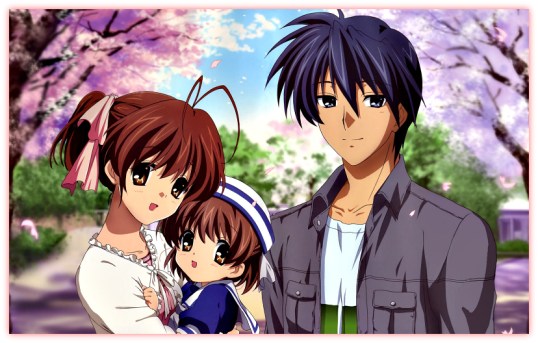
“The End of My World” takes select scenes from the anime series Clannad and Clannad: After Story and combines it with the ambient stylings of the band The American Dollar. It chronicles the life of the Tomoya Okazaki through his experiences in both series. It’s told through his point of view as he meets Nagisa Furukawa who would have such a huge impact on his life. The video actually reverse the order by which he sees his life since meeting Nagisa. How she’s changed his outlook on life even if it meant that the happiness he has with her gets balanced out by heartache.
Anyone who has seen this anime knows how the two seasons were polar opposites from each other when it came to their tone and characters. All I can say that I’ve heard anecdotes that even badass, hardened, cynical men who club baby seals for sport have broken down crying like little babies once they’ve seen the series’ After Story. This video will probably relapse them back to that bawling state.
 A couple weeks ago site music writer necromoonyeti wrote up quite an article about what just makes a piece of music a “horror music”.

 Through the Shattered Lens