Song of the Day: Johnny B. Goode (by Chuck Berry)


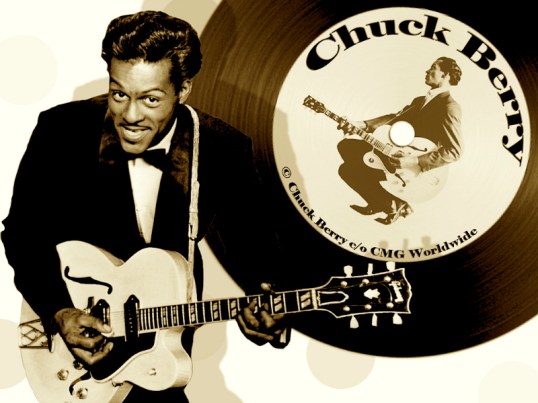
ChuckBerry

No list of great guitar riffs would be taken seriously if it didn’t include one of the greatest rock and roll songs (for some, THE greatest) with one of the most recognizable opening guitar riffs. It is this song which makes the next on the latest “Song of the Day” series focusing on great guitar riffs.

Chuck Berry’s “Johnny B. Goode” was released in 1958 by Chess Records and it quickly rose up the charts. This was the early days of rock and roll. As musicians and bands began to combine the rhythm of blues to the tempo of gospel music, more and more people began to discover what will become rock and roll. It helped that starts such as Elvis Presley would push this so-called “rebellious music” right up the mainstream public whether the moral authority accepted it or not.

One artist who would pave the way for this growing musical trend was Chuck Berry and he would never get a hit as influential and as popular as “Johnny B. Goode”. This song and it’s riff would become his signature song right up to his death and would influence countless others artists right up to this day.

The song itself would become part of another iconic pop culture event when it became a major plot device for Robert Zemeckis’ first Back to the Future. So many different musicians and bands from all corners of the musical landscape that one would be hard-pressed to find someone who didn’t know the song “Johnny B. Goode” in one for or another.

Johnny B. Goode

Deep down Louisiana close to New Orleans,
Way back up in the woods among the evergreens
There stood a log cabin made of earth and wood,
Where lived a country boy named of Johnny B. Goode
Who never ever learned to read or write so well,
But he could play the guitar like ringing a bell.

[Chorus:]
Go Go
Go Johnny Go
Go Go
Johnny B. Goode

He use to carry his guitar in a gunny sack
Or sit beneath the trees by the railroad track.
Oh, the engineers used to see him sitting in the shade,
Strumming with the rhythm that the drivers made.
The People passing by, they would stop and say
Oh my that little country boy could play

[Chorus]

His mother told him someday you will be a man,
And you would be the leader of a big old band.
Many people coming from miles around
To hear you play your music when the sun go down
Maybe someday your name will be in lights
Saying Johnny B. Goode tonight.

Great Guitar Riffs Series
Great Guitar Solos Series

Song of the Day: Back In Black (by AC/DC)


ACDC Black In Black

Last year, I did a mini-series of “Song of the Day” that featured some of my favorite rock and metal guitar solos. This time around I plan to showcase some of my favorite guitar riffs from the world of rock and metal. I’ll be limiting my choice on the metal side to the basic metal. I’m not as well-versed on the more unique and esoteric offshoots of metal. For that one must go to our resident metal intellectual necromoonyeti.

To start things off is a classic hard rock tune the began the post-Bon Scott Era (the band’s previous frontman who had tragically passed away before recording this follow-up album). The band would tap ex-Geordie frontman Brian Johnson to front the band. The rest as they say is rock history.

The Back In Black album would become one of the biggest-selling rock albums in history and it’s title track would become just one of many platinum-certified hits from that album. The song would become not just one of rock’s greatest songs, but become a pop icon as films, tv shows and event sporting events would use it’s iconic opening riff and follow-up melody to celebrate one’s rebellious nature.

Back In Black

Back in black
I hit the sack
It’s been too long I’m glad to be back
Yes, I’m let loose
From the noose
That’s kept me hanging around
I’ve been looking at the sky
and it’s gettin’ me high
Forget the hearse ’cause I never die
I got nine lives
Cats eyes
Cruisin’ every woman, never wonderin’ why

CHORUS:
‘Cause I’m back
Yes, I’m back
Well, I’m back
Yes, I’m back
Well, I’m back, back
Well I’m back in black
Yes, I’m back in black

Back in the back
Of a Cadillac
Number one with a bullet, I’m a power pack
Yes, I’m in a bang
With a gang
They’ve got to catch me if they want me to hang
Cause I’m back on the track
And I’m beatin’ the flack
Nobody’s gonna get me on another rap
So look at me now
I’m just makin’ my play
Don’t try to push your luck, just get out of my way

CHORUS

Well, I’m back, Yes I’m back
Well, I’m back, back
Well I’m back in black
Yes I’m back in black

hooo yeah
Ohh yeah
Yes I am
Oooh yeah, yeah Oh yeah
Back in now
Well I’m back, I’m back
Back, I’m back
Back, I’m back
Back, I’m back
Back, I’m back
Back
Back in black
Yes I’m back in black

Song of the Day: Sarabande from Keyboard suite in D minor (HWV 437) (composed by George Frideric Handel)


Barry_Lyndon_A

Believe it or not, I have a song of the day blog.  It’s imaginatively entitled Lisa Marie’s Song of The Day and, ever since last summer, I have used to share, on a daily basis, my appreciation of EDM and Britney Spears.  Yesterday, I shared something from The Chemical Brothers and, later today, I’ll be sharing a song from Fitz and The Tantrums.

But you know what?  I’m in a musical mood today.  Perhaps it’s because it’s Ash Wednesday and I’ve promised to give up excessive negativity for Lent.  For that reason, I’ve decided to share two songs of the day, one on Lisa Marie’s Song of the Day and one here at the Shattered Lens.

And the song that I’m sharing here is the Sarabande from Handel’s Keyboard suite in D minor (HWV 437).  Why am I sharing it?  Well, I caught the end credits of Barry Lyndon last night on TCM and I was reminded of how much I love this piece of music.  Thank you, TCM!

Enjoy and stay supple!

TAMI Part 2: The Big T.N.T. Show (1966, directed by Larry Peerce)


In 1964, American International Pictures released the first concert film, The T.A.M.I. Show.  After the success of T.A.M.I, AIP followed up with a second concert film.  This one would be shot in front of a live audience at Los Angeles’s Moulin Rouge club on the night of November 29th, 1965.  The line-up included Ray Charles, Petula Clark, The Lovin’ Spoonful, Bo Diddley, Joan Baez, The Ronettes, Roger Miller, The Byrds, Donavon, and Ike and Tina Turner.  Phil Spector was recruited to produce the show and he brought with him a live orchestra.  Conducting the orchestra and serving as the night’s emcee was The Man From UNCLE‘s David McCallum.

Originally announced as The T.A.M.I. Show Part II, the title was briefly changed to This Could Be The Night (after a song written by Spector and Harry Nilsson and performed by The Modern Folk Quartet) until AIP finally went with The Big TNT Show, an appropriate title considering the explosive performances that were recorded that night.  The Big TNT Show also recorded the growing division between the rock and roll of the 50s and early 60s and the music of the emerging counter culture, with Ray Charles, Bo Diddley, and Ike Turner sharing the same stage as The Byrds and Donavon.

In one of the show’s best moments, Joan Baez sings You’ve Lost That Loving Feeling while Phil Spector accompanies her on piano.

Other highlights include the Byrds performing Turn, Turn, Turn,

Roger Miller performing his novelty hit King of the Road,

Petula Clark singing Downtown,

The Ronettes performing Be My Baby,

Donavon’s Universal Soldier,

and Ike and Tina Turner’s entire set.

At the end of the film, the viewers are told to “be sure to tune in for next year’s show!” but, one year later, both the world and music would be very different.  The Big TNT Show captures that one final moment before things changed forever.

Venturesmania: Beloved Invaders (1965, directed by George M. Reid)


In 1965, while the British were invading the rest of the world, the Ventures were invading Japan.  Hailing from the pacific Northwest, the Ventures were one of the most popular and influential of the instrumental rock bands of the 50s and 60s.  With their debut album, 1960’s Walk, Don’t Run, they helped to define the sound of the emerging surf scene while 1964’s The Ventures in Space inspired a generation of aspiring guitar gods, including Jeff Beck.  The Ventures were phenomenally popular in Japan and they continue to regularly tour there.

Beloved Invaders is a documentary about the Ventures in Japan.  Clips of the Ventures performing in Hiroshima are mixed with footage of the group meeting with their young fans and exploring Japanese culture.  The Ventures all come across as being regular and unassuming guys but the main reason to see the film is for the amazing music.  The Ventures play almost all of their best known songs and watching them perform, you understand why they inspired so many others to pick up a guitar and make music of their own.  Sadly, very few of the great rock and roll instrumental combos of the early 60s were ever preserved on film, which makes Beloved Invaders all the more important.

Beloved Invaders was made for a Japanese audience (when the members of the Ventures speak, they are even dubbed into Japanese) and it can be difficult to track down in the United States.  For a long time, it was a popular bootleg though it was finally released on DVD in 2004 and it can be ordered from the Ventures web site.


Before Woodstock: T.A.M.I. Show (1964, directed by Steve Binder)


51cR8JMSnPL

Five years before Woodstock, there was T.A.M.I. Show.

In 1964, a concert was held over two days at the Santa Monica Civic Auditorium.  Free tickets were distributed to local high school students and the best footage from the two shows was edited into one movie.  Distributed by American International Pictures, T.A.M.I. Show was one of the first concert films.

T.A.M.I. stood for Teenage Awards Music International but no awards were given out during those two days.  Instead, 12 of the most popular music acts of 1964 performed on one stage.  The Beatles may not have been there but almost every other hitmaker of the year showed up.

Among the highlights of T.A.M.I. Show was the performance of James Brown and The Famous Flames, which many consider to be one of the best musical performances ever captured on film.

James Brown’s performance was followed by The Rolling Stones.  Though Keith Richards once claimed that trying to follow James Brown was the biggest mistake of their careers, T.A.M.I. Show was the first time that many American teenagers actually saw the Stones perform.

Also performing: The Supremes, at the height of their popularity.

The Beach Boys’ performance has become semi-legendary because, as a result of copyright issues, it was edited out of prints of T.A.M.I. Show following the initial theatrical run.

For years, T.A.M.I. Show was unavailable for home viewing but finally, in 2010, Shout Factory released this landmark of movie and music history on DVD and they even included the long censored footage of the Beach Boys.  For music lovers, T.A.M.I. Show is a must-see record of the rock scene in between the start of the British invasion and the rise of the counterculture.

Song of the Day: Tequila Sunrise (by The Eagles)


Glenn Frye

Growing up it was unavoidable that I would end up loving the rock band Eagles. It was something I pretty much had no choice in the matter. I blame my Dad for this situation. I say this with love because The Eagles is that one band that’s become part of the American pop consciousness.

The band formed in 1971 with Don Henley, Glenn Frye, Bernie Leadon and Randy Meisner. They would make their debut album a major success and follow it up with a sophomore effort that was just as critically-acclaimed as much as it was a success with the public. It was from this second album that today’s “Song of the Day” comes from and also one of my Dad’s favorite songs from the band. It was his second favorite after “Hotel California” and would be part of his regular listening rotation during long drives to and from home and work.

While I would dismiss the band in my youth as was typical of most children who wanted to branch out from their parents when it comes to what they like. In the end, as time went by I would fall in love with the band. Some looked at Don Henley as the architect of the band’s success and one would not be wrong, but I always thought that Glenn Frye was the soul of the group. As lead vocals for the band he gave the band’s song the emotion it needed to resonate with the listening audience.

This is why it was saddening news to hear that Glenne Frye passed away earlier today after a long battle with ill-health. Here’s to the soul of the Eagles as we slowly stare at another tequila sunrise as we say goodbye to Glenn.

RIP Glenn Frye

Tequila Sunrise

It’s another tequila sunrise
Starin’ slowly ‘cross the sky, said goodbye
He was just a hired hand
Workin’ on the dreams he planned to try
The days go by

Ev’ry night when the sun goes down
Just another lonely boy in town
And she’s out runnin’ ’round

She wasn’t just another woman
And I couldn’t keep from comin’ on
It’s been so long
Oh, and it’s a hollow feelin’ when
It comes down to dealin’ friends
It never ends

Take another shot of courage
Wonder why the right words never come
You just get numb
It’s another tequila sunrise,this old world
Still looks the same,
Another frame, mm…

We Can Be Heroes If Just For One Day… (David Bowie, RIP)


I have never seen the online community as united about anything as they are today in both grieving and paying honor to David Bowie.

You can read Arleigh’s thoughts on Bowie the film actor here.

Click here to read Jeff’s tribute to David Bowie the musician.

And be sure to check out Gary’s overview of Bowie’s career.

As for me, I’m just going to share two videos.  One is the trailer for the German film, Christiane F.  This trailer — which I consider one of the best trailers ever made — is scored to David Bowie’s Heroes. (Both Bowie and the song also play a large and important in the film itself.) Secondly, I want to share a scene that I love, this one from Quentin Tarantino’s Inglorious Basterds and featuring Bowie’s Theme From Cat People reimagined as an anthem of the French Resistance.

First off, the trailer:

Secondly, the scene:

David Bowie, RIP

In Memory of David Bowie


20140109-bowie-x306-1389299416

Last night, when I heard that David Bowie had died, I immediately flashed back to the summer of 2003.  I spent that summer hanging out with my friend Jay.  I was an aspiring writer and he was the musician who got all the girls.  Jay was also a David Bowie fanatic whose cover of The Man Who Sold The World was at least as good as Nirvana’s.  When I think about that summer, I remember the all-night bull sessions, smoking in Jay’s backyard, watching reruns of Hawaii 5-0 and agreeing that McGarrett was one cool dude, and the weekly poker games where I always seemed to lose.  But mostly, I remember David Bowie providing the greatest soundtrack anyone could want.

Over his 50 year career, David Bowie reinvented himself many times.  When he released his first single in 1964, he did so under his real name.  He was 17 years old when Davie Jones and the Queen Bees released Liza Jane.

By the time he released Space Oddity in 1969, Davie Jones had become David Bowie.  Space Oddity would introduce the world to Major Tom, a character to whom Bowie would return in the future.

1970’s The Man Who Sold The World is often erroneously believed to be a retelling of Robert Heinlein’s novella, The Man Who Sold The Moon.  In 1997, Bowie himself said that the song was about being young and feeling incomplete.

Life on Mars? was once described by BBC Radio 2 as being “a cross between a Broadway musical and a Salvador Dali painting.”

1975’s Golden Years, with its chorus of “run for the shadows,” is one of my personal favorites.

In 1977, David Bowie appeared on the final Bing Crosby Christmas Special.  He and Bing performed Peace on Earth/Little Drummer Boy.  At the time, Bing was quoted as saying about Bowie: “clean-cut kid and a real fine asset to the show. He sings well, has a great voice and reads lines well.”

In 1980, Major Tom returned in Ashes to Ashes.

Rather than grow stagnant as an artist, David Bowie was always reinventing himself.  In 1997, he proved he was still a force to be reckoned with when he released I’m Afraid of Americans.

In November, David Bowie released Blackstar.  In the song’s video, Major Tom made his final appearance.

Lazarus was the last single that David Bowie released during his lifetime.  The video was released three days before he died and feels like it was his way of saying goodbye.

Rest in peace, good sir.  And thank you for the music and the memories.