Future serious actor Robert Vaughn made his film debut in 1958’s TeenageCaveman. Directed by Roger Corman, TeenageCaveman tells the story of a rebellious young man (that’s Robert Vaughn) who chooses to defy his father’s warnings and venture beyond the caves and into “the forbidden zone.” He’s told that monsters roam in the forbidden zone and indeed, at least one of them does. However, neither the Teenage Caveman nor his father are prepared for what lies at the heart of the forbidden zone.
(What will he find out there, Dr. Zaius?)
Robert Vaughn later said that, out of all the bad films that he made, this was the worst. Personally, I think he was being a bit too hard on the film. It’s not good but it is definitely fun. Along with watching all of the dinosaur stock footage, you get to wonder how a caveman — especially a teenage caveman! — could possibly have such perfect hair. Even more importantly, if you stick with it, this film has a twist ending that has to be seen to be believed.
Tonight’s episode of Hammer House of Horror features antiques and cults! It’s a like a very British version of Friday the 13h: The Series. This episode is not necessarily one of my favorite episodes of this series. I always find the ending to be disappointing. The said, it does feature an intriguing story and a cast of Hammer veterans.
This episode originally aired on November 15th, 1980.
It’s hard to keep track in The Human Duplicators. Dr. Kolos (Richard Kiel) is an alien who is sent down to Earth. He thinks that he’s not an android but how can he be sure? He goes to the laboratory of Dr. Vaughan Dornheimer (George Macready) and tells Donheimer that they will be working together to create androids that are perfect duplicates for humans and that Kolos will be the “master.” But then an android is built of Dornheimer himself and android Dornhiemer declares that he is the master. Kolos is distracted because he’s fallen in love with Dornhiemer’s daughter, a blind pianist named Lisa (Dolores Faith).
Glenn Martin (George Nader) of the National Intelligence Agency is assigned to figure out what is happening at the Dornhiemer mansion and, wouldn’t you know it, there’s already an android version of Glenn. Glenn’s girlfriend is played the brassy Barbara Nichols, a comedic actress who was briefly groomed to be the next Marilyn Monroe and who comes on like the star of a burlesque show. Glenn’s boss is Austin Wells and he’s played by Hugh Beaumont, which makes this film feel like a weird episode of Leave It To Beaver where Wally has to save the world. I don’t think the bad guys ever duplicate Hugh Beaumont and that’s good because real trouble could be created by an evil version of Ward Cleaver.
The presence of Richard Kiel and Hugh Beaumont is really the only thing that The Human Duplicators have going for it. There are plenty of fights between Glenn and the androids but it turns out that the androids are easy to beat into oblivion so there’s not much suspense or excitement to be found. At times, it feels as if it’s trying to be an episode of The Avengers just without the wit of Patrick Macnee or the charm of Diana Rigg. The Human Duplicators seems to take itself very seriously and I’m not sure why.
After The Human Duplicators, Richard Kiel later went on to play Jaws in The Spy Who Loved Me and Moonraker. Hugh Beaumont retired from the movies.
For a little bit of historical perspective, Charles Bronson was an up and coming young character actor when he appeared in the 25th episode of season 1 of ALFRED HITCHCOCK PRESENTS, “There Was an Old Woman,” which originally aired March 18, 1956. Having already shared the screen with the likes of Gary Cooper, Spencer Tracy, Katherine Hepburn and Burt Lancaster, Bronson had an interesting face that would allow him to comfortably play a wide range of roles in 1950’s Hollywood, from Native Americans (DRUM BEAT and APACHE), murderous criminals (CRIME WAVE and BIG HOUSE USA), compassionate doctors (the TV series MEDIC), and even deaf mutes (HOUSE OF WAX). In the mid-1950’s, Bronson was alternating between character parts on the big screen and guest starring roles on the small screen. For someone like me, it’s fun looking back at these early years and roles when Bronson was a hungry, young actor just trying to keep working. Not blessed with matinee idol looks, he attacked his roles with a gusto that, with the benefit of hindsight, would form a foundation that would eventually lead to him becoming the most popular actor in the world a decade later.
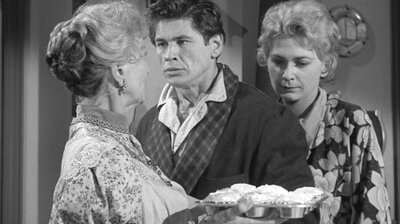
In “There Was an old Woman,” down-on-their-luck married couple, Frank Bramwell (Charles Bronson) and Lorna Bramwell (Norma Crane), are desperate for cash. While finishing off their breakfast at the local cafe, they overhear a private conversation between a milkman and the counter guy concerning the vast wealth of a local old woman named Monica Laughton (Estelle Winwood), an eccentric widow who lives alone in a grand, outdated Victorian house. The Bramwell’s think they’ve won the lottery and soon they’ve hatched a scheme to work their way into Mrs. Laughton’s home in hopes of relieving her of all that money. Once inside her home, the young couple gets much more than they bargained for when they discover that the kind and proper old woman lives in a fantasy world of imaginary people, imaginary dinner parties, and imaginary funerals. They play along with her delusions for a while and set about looking for the money, but when they can’t find it, Frank pulls out his knife and threatens to kill Mrs. Laughton and all her “guests” if she doesn’t give them her money. Needless to say, Mrs. Laughton may be nutty, but she has a few tricks up her sleeve and the Bramwell’s just may be on their way to being permanent guests!
If you enjoy entertainment that features black comedy, ironic twists of fate, and deadly danger in the most unexpected of places, you’ll enjoy this macabre gem of an episode. “There Was an Old Woman” sets the Bramwell’s up to think that they’re the ones in charge, until it’s revealed in an instant that they are in way over their head with the eccentric Mrs. Laughton. Bronson and Norma Crane are good as the married couple with bad intentions. I guess it would be more accurate to say that Bronson’s character has the bad intentions while Norma’s character just seems to have picked the wrong man. Bronson is in his amoral, bully-thug mode here, a type of role he played very well in the early years of his career. I thought Norma Crane projected a sort of innocent sweetness, and I felt sorry for her as events spiraled out of control. But the real star of the episode is Estelle Winwood as the delusional “old woman” of the title. She steals the show as Monica Laughton, delivering a fun and deceptively cunning performance as the grande dame who’s much more aware of the dangers around her than she lets on. She may be eccentric, but she’s nobody’s fool. Estelle Winwood is perfect in the role, a testament to a woman who was 73 years old when this episode aired and who would go on to work for over 20 more years, with her final role on an episode of the TV series QUINCY, M.E. that aired in 1980. One of the joys of watching older TV shows and movies is discovering more about some of these talented actors and actresses who starred in them. Winwood had an incredible, five decade career, and she would pass away in 1984 at 101 years of age.
Overall, I recommend “There Was an Old Woman” to any person who appreciates Alfred Hitchcock, vintage TV, black comedy, Charles Bronson, Norma Crane, and Estelle Winwood. It’s interesting and fun stuff!
For my money, the original Tomb of Dracula is still the best horror comic to ever show up at a newsstand. From 1975, The cover of Tomb of Dracula #41 is a classic. Credit for this goes to Gene Colan, Tom Palmer, and Gaspar Saladino.
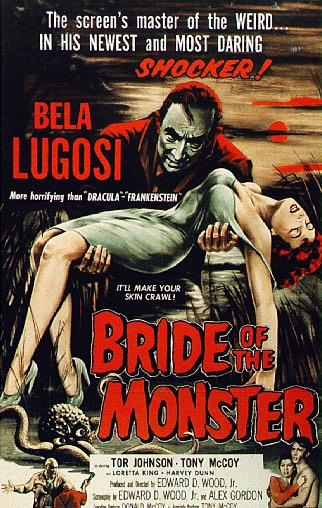
So begins the monologue that serves as the centerpiece of the 1955 Ed Wood film, Bride of the Monster. The monologue is delivered by Bela Lugosi, appearing in one of his final roles.
Far too often, people tend to be snarky about the work that Lugosi did under the direction of Ed Wood. But you know what?
He actually delivers a pretty good performance in Bride of the Monster.
Ignore all of the stuff about atomic supermen and instead, just pay attention to the way Lugosi delivers the lines. Pay attention to the pain in his voice as he says that he has no home. Pay attention and you’ll discover that Lugosi actually gave a good performance in Bride of the Monster. He delivers the lines with such wounded pride that you can’t help but think that maybe we should let him create a race of atomic supermen.
Among the old horror icons, Lugosi has always been the most underrated actor. He got typecast early and he appeared in some unfortunate films but Bela Lugosi had real talent and you can see it in this scene.
In 1977’s Looking for Mr. Goodbar, Diane Keaton plays Theresa Dunn.
A neurotic and single woman who has never emotionally recovered from her childhood struggle with scoliosis, Theresa is trying to find herself in the wild and promiscuous world of the 1970s. After losing her virginity to a condescending college professor (Alan Feinstein), Diane goes on to have relationships with a needy social worker (William Atherton) and an hyperactive petty criminal (Richard Gere). During the day, she teaches deaf children and she’s good at her job. She even manages to win over the distrustful brother (Levar Burton) of one of her students. At night, she hits the bars. She buys drugs from the neighborhood dealer (Julius Harris). She tries to read the book that she always carries with her. (Some nights, it’s The Godfather and other nights, it’s something else.) She picks up strange men and takes them to her roach-infested apartment. One of those men, Gary (Tom Berenger), turns out to both be a bit insecure about his masculinity and also totally insane….
Looking for Mr. Goodbar is an adaptation of a novel that was inspired by the real-life murder of a New York school teacher named Roseann Quinn. The book was best seller and, just as he had with a previous best-selling true crime novel, director Richard Brooks bought the rights and both wrote and directed the film. Diane Keaton, who at that point was best-known for playing Kay Adams in The Godfather and for appearing in Woody Allen’s comedies, took on the demanding role of Theresa and, whatever one may think of the film itself, it can’t be denied that Keaton gives a brave performance as the self-destructive Theresa. In fact, I would say it’s one of Keaton’s best performances, outside of her work with Woody Allen and The Godfather Part II. If she had been played by a lesser actress, Roseann could have been unbearable. As played by Diane Keaton, though, she’s everyone’s best friend who just need some time to find herself. The viewer worries about her and wants to protect her as soon as they see her, making her ultimate fate all the more tragic.
As for film itself, I’ve watched Looking For Mr. Goodbar a few times and I’m always a little bit surprised by how bad the movie actually is. The film actually gets off to a strong start. The scenes between Theresa and the professor make for a sensitive portrait of a repressed young woman finally getting in touch with her sexuality and, in the process, discovering that she deserves better than the man she’s with. But once Theresa moves into her apartment and starts hitting the bars at night, the film takes on a hectoring and moralistic tone that leaves the viewer feeling as if the film is blaming Theresa for the tragedy that’s waiting for her at the end of the story. Diane Keaton and Tuesday Weld (who plays her sister) both give excellent performances but everyone else in the film either does too much or too little. This is especially true of Richard Gere, who is very hyperactive but still strangely insubstantial in his role. (Whenever Richard Gere appears on screen, one gets the feeling that they could just walk right through him.) A scene where Gere jumps around the apartment is meant to be disturbing but it’s more likely to inspire laughter than chills.
It’s an overly long film and the moments in which Theresa has dark, sexually-charged fantasies are never quite as powerful as the film obviously meant for them to be. (Brian Dennehy makes his film debut as a doctor who kisses Theresa’s breast during one of her fantasies.) As opposed to the empathy that he brought to In Cold Blood, one gets the feeling that director Richard Brooks didn’t like anyone in this movie and that he was more interested in Theresa as a cautionary tale than as a human being. With this film, Brooks seemed to be standing athwart the Sexual Revolution and shouting, “Stop!” That said, the film’s final moments are genuinely disturbing and difficult to watch. It’s the one moment where Brooks’s lack of subtlety pays off. Those last minutes are about as horrific as anything you could expect to see.
As for Roseann Quinn, her killer was eventually arrested. John Wayne Wilson hung himself in prison, 5 months after murdering her.
Inferno (1980, dir by Dario Argento, DP: Romana Albano)
Today’s horror song of the day comes from Keith Emerson’s soundtrack of Dario Argento’s Inferno. Emerson did not have an enviable task, having to follow up Goblin’s soundtrack for Suspiria. But Emerson pulled it off, crafting a score that compliments Goblin’s earlier work while maintaining an identity of its own.
This October, I’m going to be doing something a little bit different with my contribution to 4 Shots From 4 Films. I’m going to be taking a little chronological tour of the history of horror cinema, moving from decade to decade.
Today, we look at the latter half of the 1940s.
4 Shots From 4 Horror Films
Strangler of the Swamp (1946, dir by Frank Wisbar)






 Through the Shattered Lens