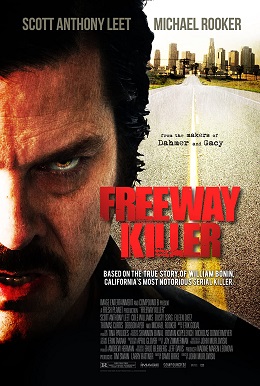
October True Crime: Freeway Killer (dir by John Murlowski)


The 2010 film, Freeway Killer, opens with a desperate woman named Ruth (Debbon Ayer) visiting a man named William Bonin (Scott Anthony Leef).

Bonin, who has a quick smile and a mustache that makes him look like a wannabe porn star, is an inmate on California’s Death Row.  In just a few days, Bonin is scheduled to be the first man to be executed by lethal injection in the state of  California.  Ruth explains that she has done everything that she can to try to save Bonin’s life.  She has written to the review board.  She had written to the governor.  She has asked that Bonin be spared and she’s even used the exact words that Bonin suggested that she use in her letters.  However, she’s gotten no response.  Still, she now wants Bonin to uphold his side of the bargain.  She wants to know if her son was among the thirty-six men that Bonin is suspected of having murdered.

William Bonin merely smirks and points out that he never actually agreed to tell Ruth anything.  He suggested that Ruth write the letters but never did he say that he would actually do anything in return.  That was just something that he allowed Ruth to assume.  Even while sitting on Death Row and facing an inevitable execution, Bonin enjoys the power that he gets from manipulating people.  Instead of telling Ruth about her son, he tells the story of his life as a serial killer.

The film flashes back to 1980, when William Bonin has already started his career as a murderer.  A Vietnam vet who has a war story for every occasion, he cruises the freeways of California and picks up young hitchhikers.  Sometimes, he is accompanied by an accomplice.  Vernon Butts (Dusty Sorg) is a self-styled occultist who wears a wizard hat at home and who knows more about Dungeons and Dragons than real life.  When they’re not killing hitchhikers, Bonin and Vernon tend to bicker.  Vernon constantly points out that Bonin was not the great war hero that he claims to have been.  Bonin makes fun of Vernon’s hobbies.  At times, they seem to genuinely despise each other but one of the few times that Bonin shows any emotion is when Vernon tries to kill himself in a pique of hurt feelings.

One night, Bonin sees a teenager named Kyle (Cole Williams) being yelled at by both his boss and his girlfriend.  As he does with all of his victims, Bonin pulls up in his van and asks Kyle if he wants a ride.  However, when Kyle gets in the van, it turns out that Bonin doesn’t want to kill him.  Instead, he sees Kyle as a kindred spirit and soon, he’s recruited Kyle as his second accomplice.  Unlike Vernon, Kyle believes all of Bonin’s stories.  However, Kyle grows more confident with each murder and soon, he’s even suggesting that Bonin should kill Vernon.  Frustrated with both Kyle and Vern, Bonin search for a third accomplice, an act that ultimately leads to his downfall.

Watching Bonin, Vern, and Kyle, I was reminded of a creepy group of older men who always seemed to be hanging out on campus when I was in college.  Though none of them were enrolled in classes and all of them were notably older than the majority of the people on campus, they still spent all of their time hanging out around the student union, smoking cigarettes, and trying to impress people who were half their age.  They approached me and my friend a few times, making awkward comments about whatever we happened to be talking about or studying at the moment.  One thing that I quickly learned was that being rude would not get rid of them.  Instead, you had to literally stand up and walk somewhere else to get away from them.  (They had no problem approaching people but were too lazy to follow after them.)  At the time, my friends and I used to joke that they were probably serial killers.  Most realistically, they were probably just three losers who didn’t want to have to grow up.  Still, they definitely gave off a bad vibe.

Based on a true story, Freeway Killer focuses on the relationship between Bonin, Vernon, and Kyle.  Though he’s their self-declared leader, Bonin is incapable of doing anything without the help of Vernon and Kyle.  At the same time, the film leaves us to wonder if Vernon and Kyle would have become killers if they hadn’t fallen under William Bonin’s influence.  One gets the feeling that if Bonin and Vernon had never met each other, they both would have spent the rest of their lives as obscure losers, living alone and working a dead-end job.  Certainly, if Bonin and Vernon had never met, Bonin would never have subsequently felt the need to recruit Kyle into their activities.  But, because they did meet, at least 30 innocent people were murdered in California.  The film is unsettling, not just because of the murders (of which only a few are discreetly portrayed) but because of the feeling that the murders themselves would never have happened if only William Bonin had not served an earlier prison sentence at the same time as Vernon Butts.

Scott Anthony Leet gives a good performance as William Bonin, playing him as man whose quick smile is just a cover for the raging feelings of inadequacy that are churning just below the surface.  Dusty Sorg and Cole WIlliams are also well-cast as, respectively, Vernon and Kyle.  Sorg, especially, makes Vernon into a monster who is frightening because it’s very easy to imagine running into him (or someone like him) in everyday life.  Michael Rooker brings his quiet intensity to a small role as the detective who investigates the Freeway Killer murders.

The real-life William Bonin was executed in 1996.  I’m against the death penalty because I don’t think we should normalize the idea of the government killing anyone but that still doesn’t mean that the world isn’t better off without William Bonin in it.
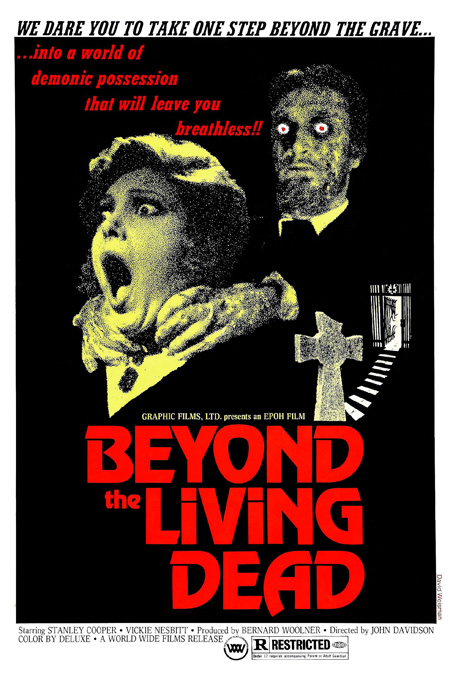
Horror Film Review: Beyond The Living Dead (dir by Jose Luis Merino)


First released in 1973 and also known as The Hanging Woman, Beyond The Living Dead is a Spanish horror film that is just incoherent enough to be intriguing.

Having inherited the estate of his uncle, Serge Chekhov (Stelvio Rosi) arrives in the town of Skopje and is stunned to discover that, even though it’s only 6:00 in the evening, there’s no one in the streets.  Everyone has retired to their homes.  Even after Serge stumbles across a woman hanging in the cemetery, no one is willing to open their doors when he pounds on them.  Serge finally finds his uncle’s place, where he discovers that the hanging woman was the daughter of his uncle’s widow, Countess Nadia Minalji (Maria Pia Conte).  While Serge speaks to the police (who seem to view Serge as being the most likely suspect), Nadia retreats to her room, performs a black magic ceremony, and sends out a mental summons to Igor (Spanish horror great Paul Nashcy), a gravedigger who is also a necrophile and who has a huge collection of photographs of naked corpses in his shack.

Once Serge is finally able to convince the police that he’s not a murderer, he helps them when they chase Igor around the village.  Later, Serge returns home and is promptly seduced by Nadia.  The next morning, Nadia’s servant, Doris (Dyanik Zurakowska), begs Serge not to fire her and her father, Prof. Droila (Gerard Tischy).  It turns out that Prof. Droila has a laboratory in the house’s basement where he’s been doing experiment on how to reanimate the dead.  Serge has Doris undress for him and then, once she’s crying, he tells her that he already talked to the professor and agreed to allow him and his daughter to remain.  WHAT THE HELL, SERGE!?

Got all that?  I hope so because the film only gets stranger from there, with multiple murders occurring and Serge falling in love with Doris just as quickly as he fell in love with Nadia.  As Igor stumbles around the village and peeps through people’s windows, Nadia holds a séance and eventually, a few decaying zombies show up.  The plot is nearly impossible to follow, which is actually something that I tend to find to be true with a lot of Spanish horror films that were released during the Franco era.  Making movies full of murder and nudity under a puritanical regime leads to a certain narrative incoherence.  That said, the film plays out at such a strange pace and contains so many bizarre red herrings that it does achieve the feel of a particularly vivid dream.

Today, Beyond The Living Dead is best-remembered for Paul Naschy’s memorably weird performance as Igor.  Naschy originally turned down the role, thinking that it was too small.  The director allowed Naschy to rewrite the script to make Igor more interesting and it was Naschy who came up with the idea of making Igor not just a grave robber but also a necrophile.  For English-speaking audiences, it can be hard for us to judge Naschy as an actor because we usually only see him in poorly dubbed films.  (The English-language version of Beyond The Living Dead was apparently dubbed by a group of cockney voice actors.)  But Naschy definitely had an imposing physical presence and this film makes good use of it.

Full of atmospheric visuals and surprisingly effective gore effects, Beyond The Living Dead does capture the viewer’s imagination, as long as one is content to not worry too much about trying to make much sense of it!

4 Shots From 4 Films: Special Jack Arnold Edition


4 Shots From 4 Films is just what it says it is, 4 shots from 4 of our favorite films. As opposed to the reviews and recaps that we usually post, 4 Shots From 4 Films lets the visuals do the talking!

This October, we’re using this feature to recognize and honor some of our favorite horror directors!  Today, we honor the one and only Jack Arnold!

4 Shots From 4 Jack Arnold Films

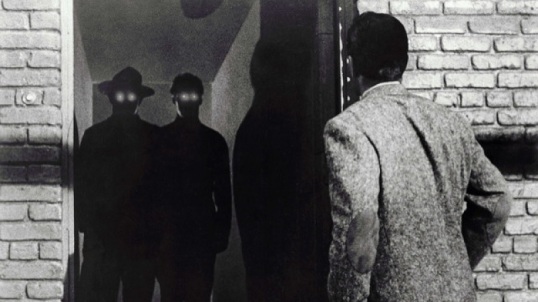
It Came From Outer Space (1953, dir by Jack Arnold, DP: Clifford Stine)

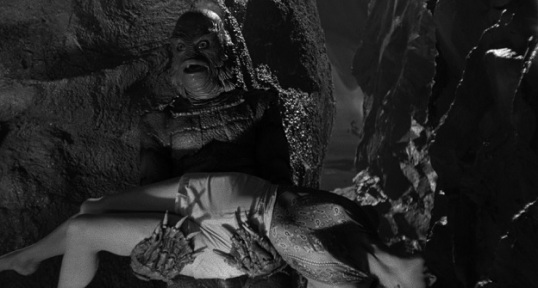
The Creature From The Black Lagoon (1954, dir by Jack Arnold, DP: William E. Snyder)

Tarantula (1955, dir by Jack Arnold, DP: George Robinson)

The Incredible Shrinking Man (1957, dir by Jack Arnold, DP: Ellis W. Carter)

Guilty Pleasure No. 65: Invaders From Mars (dir by Tobe Hooper)


The 1986 film, Invaders from Mars, opens with a dark and stormy night.

12 year-old David Gardner (Hunter Carson, son of actress Karen Black and filmmaker L.T. Kit Carson), who dreams of growing up to become an astronaut, witnesses something strange happening outside of his bedroom window.  He watches as a spaceship lands on a nearby hill and apparently drills itself into the ground.  The next morning, David convinces his father (Timothy Bottoms) to go out to the hill and see what he can find.  When his father returns, he says that he didn’t see anything strange at the hill.  However, he is now acting strangely, no longer showing emotion.

Soon, everyone in the small town is also acting strangely, from David’s mother (Laraine Newman) to his teacher (Louise Fletcher).  David notices that everyone has a mysterious mark on the back of their neck.  Even more alarmingly, he walks in on his teacher eating a mouse.  Investigating the hill himself, David discovers that his father was lying about nothing being there.  Instead, there’s a cavernous spaceship that is patrolled by aliens!  A creature with a giant brain has taken control of almost everyone in David’s life.  David discovers that the hill right outside of his house is now the headquarters of an intergalactic invasion.  It’s a war of the worlds and David is stuck right in the middle.

Fortunately, David does have a few allies.  The aliens have not managed to take control of everyone.  The school nurse (Karen Black) believes David and helps him explore the spaceship.  The surprisingly nice General Wilson (James Karen) is not only willing to launch a military operation on the advice of a 12 year-old but he also doesn’t have any problem allowing that 12 year-old to take de facto command of his soldiers.  Can David save his community from the Martians?

A remake of the 1953 sci-fi classic, Invaders from Mars was directed by Tobe Hooper, the Texas-born director who was best known for The Texas Chainsaw Massacre and Poltergeist.  At first, the deliberately campy Invaders from Mars might seem like an unexpected film from Hooper but actually, it has quite a bit in common with Hooper’s other credits.  Like The Texas Chainsaw Massacre, it plays out like an increasingly surreal dream, one with an emphasis on isolation.  Like Poltergeist, it’s ultimately a satire of suburban and small town conformity.  (Indeed, one could argue that Invaders From Mars is Poltergeist without the interference of Steven Spielberg.)  If the original Invaders From Mars was about the dangers of communism, the remake is about the danger of losing your childhood imagination and just becoming a mindless drone.

Invaders From Mars is often a deliberately silly film.  Sometimes, it’s definitely a bit too silly for its own good, hence the guilty in guilty pleasure.  That said, whenever I see it, I can’t help but smile at how quickly General Wilson starts taking orders from David.  (James Karen plays the role with such earnestness that General Wilson seems to be less concerned with David’s age but instead just happy that he has someone around who can tell him what he needs to do.)  But it makes sense when you consider that the film is meant to be a child’s fantasy of what would happen if there was an alien invasion.  Who wouldn’t want to be the one telling the adults how to save the planet?  For all the aliens and the mind control, this is a rather innocent film.  Featuring entertaining performances from Hunter Carson, Timothy Bottoms, Karen Black, and the great James Karen, Invaders From Mars is an entertaining daydream of interstellar conquest.

Previous Guilty Pleasures

  1. Half-Baked
  2. Save The Last Dance
  3. Every Rose Has Its Thorns
  4. The Jeremy Kyle Show
  5. Invasion USA
  6. The Golden Child
  7. Final Destination 2
  8. Paparazzi
  9. The Principal
  10. The Substitute
  11. Terror In The Family
  12. Pandorum
  13. Lambada
  14. Fear
  15. Cocktail
  16. Keep Off The Grass
  17. Girls, Girls, Girls
  18. Class
  19. Tart
  20. King Kong vs. Godzilla
  21. Hawk the Slayer
  22. Battle Beyond the Stars
  23. Meridian
  24. Walk of Shame
  25. From Justin To Kelly
  26. Project Greenlight
  27. Sex Decoy: Love Stings
  28. Swimfan
  29. On the Line
  30. Wolfen
  31. Hail Caesar!
  32. It’s So Cold In The D
  33. In the Mix
  34. Healed By Grace
  35. Valley of the Dolls
  36. The Legend of Billie Jean
  37. Death Wish
  38. Shipping Wars
  39. Ghost Whisperer
  40. Parking Wars
  41. The Dead Are After Me
  42. Harper’s Island
  43. The Resurrection of Gavin Stone
  44. Paranormal State
  45. Utopia
  46. Bar Rescue
  47. The Powers of Matthew Star
  48. Spiker
  49. Heavenly Bodies
  50. Maid in Manhattan
  51. Rage and Honor
  52. Saved By The Bell 3. 21 “No Hope With Dope”
  53. Happy Gilmore
  54. Solarbabies
  55. The Dawn of Correction
  56. Once You Understand
  57. The Voyeurs 
  58. Robot Jox
  59. Teen Wolf
  60. The Running Man
  61. Double Dragon
  62. Backtrack
  63. Julie and Jack
  64. Karate Warrior

Horror Film Review: The Being (dir by Jackie Kong)


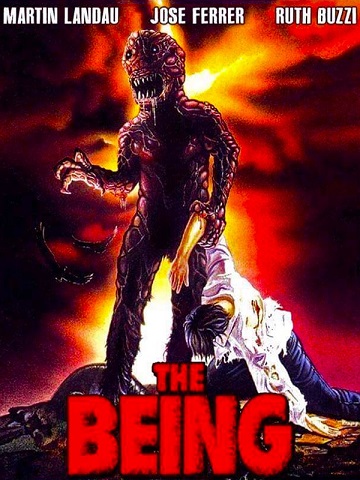
The 1983 film, The Being, takes place in the town of Pottsville, Idaho.

Pottsville is a small town with a quaint downtown, a drive-in that shows violent slasher films, and a group of neighborhood activists who have come together to take a stand against smut.  (Maybe they should start with that drive-in….)  It’s home to a quarry, several potato farms, a trailer park, a diner, a church, and a …. ahem …. nuclear waste dump.

Strange things are happening in town.  The young son of Marge Smith (Dorothy Malone) has vanished and Dorothy has become a familiar sight, wandering around the town in the middle of the night and searching for her child.  One person loses his head while fleeing an unseen assailant.  Two rednecks are killed while smoking weed at the drive-in theater.  People are dying and Detective Mortimer Lutz (Bill Osco) is determined to find out who (or what) is doing the killing.  He’s particularly concerned about the fact that a mysterious green slime is found at all of the crime scenes.

Meanwhile, Mayor Gordon Lane (Jose Ferrer) is more concerned with just covering up the crimes and the history of nuclear waste disposal because he’s got potatoes to harvest and he also hopes to be the first potato farmer in the White House.  (George Washington already beat him to that, though one could point out that Washington never actually lived in the current White House.)  While his wife (Ruth Buzzi) encourages everyone in town to take a stand against smut, Mayor Lane calls in a chemical safety engineer named Garcon Jones (Martin Landau) to investigate.

The Being is a bit of an oddity.  On the one hand, the title character is grotesque and the scenes in which the creature attacks its victims are notably gory.  On the other hand, the film has a strangely off-center sense of humor, starting with Bill Osco’s opening narration, which Osco delivers in the teeth-clenched rat-a-tat style of Rod Serling.  Halfway through the film, the action stops so that Lutz can have a rather bizarre dream in which he sees Garcon fall out of an airplane while the mayor’s wife flies by on a broomstick with blood flowing from her eyes.  This is the type of film in which the notably bloody conclusion is followed by satiric title cards that tell us what happened to each of the survivors.  The Being is a horror film that seems to be cheerfully aware of its budgetary limitations and, as a result, it’s full of moments in which it seems to wink at the audience and say, “Hey, don’t worry so much.  Sit back and have fun.”

For a low-budget, often poorly lit film about a killer mutant, The Being has an impressive cast.  Dorothy Malone, Jose Ferrer, and Martin Landau were all Hollywood veterans and all three of them give admirably straight-faced performances in their smallish roles.  (Ferrer and Malone won Oscars long before appearing in The Being.  Landau won his Oscar a decade after.)  Ferrer, in particular, does a good job of portraying the mayor’s irritation at having to actually deal with the people that he governs.  I also liked the performance of Ruth Buzzi.  Buzzi plays someone who should be very familiar to anyone who has ever lived in a small town, the person who has found a small amount of power and who is determined to never give up.

Low-budget aside, The Being is just odd enough to be watchable.

Horror Film Review: House of Dracula (dir by Erle C. Kenton)


When last we saw Dracula, the Wolf Man, and Frankenstein’s Monster, they were all coming to an untimely end in House of Frankenstein.

Dracula (John Carradine) was caught out in the sun by a group of angry villagers and ended up turning back into a skeleton while desperately trying to climb into his coffin.  The Wolf Man, also known as Larry Talbot (Lon Chaney, Jr.), was shot, presumably with a silver bullet, and finally, the world was free of having to listen to Larry whine about his unfortunate condition.  The Monster (Glenn Strange) was last seen drowning in quicksand.

Despite all of that, all three of them return in 1945’s House of Dracula.  The Monster is at least found in an underground lair, preserved in a state of suspended animation by the quicksand.  Dracula and Larry Talbot, however, just show up with neither looking the worst for wear.  I supposed that Larry could have survived being shot but Dracula’s return is bizarre because he was literally exposed to sunlight.  In the past, reviving Dracula has always required the stake to be removed from his heart.  Did someone remove the sunlight from Dracula’s skeleton?

All three of the cursed beings show up at the castle of Dr. Franz Edelmann (Onslow Stevens).  Working with two nurses, the beautiful and religious Milizia (Martha O’Driscoll) and a compassionate hunchback named Nina (Janes Adams), Edlemann is researching blood transfusions.  He believes that blood transfusions can cure just about anything.  Edelmann is so convinced that he can cure Dracula of his vampirism that he allows Dracula to move his coffin into the castle’s cellar.  Edelmann is also convinced that he use the spores of a special plant to cure Larry of his lyncanthropy.  As usual, Larry Talbot is skeptical and spends the entire movie boring everyone with the details of how much it sucks to be a werewolf.  As for Frankenstein’s Monster, he’s in the castle because Edelmann happend to come across him in an underground chamber.  Quite a coincidence, that.

Unfortunately, all of the blood transfusions in the world can’t stop Dracula from being Dracula and soon, the Lord of the Vampires is trying to turn Milizia into his queen.  Larry is also in love with Milizia, to the extent that he doesn’t realize that Nina is falling in love with him.  Meanwhile, Edelman ends up infecting himself with some of Dracula’s blood and soon, his reflection is no longer showing up in mirrors and he’s feeling the temptation to revive Frankenstein’s Monster.  A violent murder upsets the villagers, who refuse to listen to Inspect Holz (Lionel Atwill) when he begs them to let the police take care of things as opposed to laying siege on the castle with a bunch of torches.  That’s what happens when you allow your house to become the House of Dracula.

House of Dracula is a clear and marked improvement on House of Frankenstein.  While Larry Talbot is just as whiny as ever (and Lon Chaney, Jr.’s sad sack performance is a bit dull) and Frankenstein’s Monster is a bit underused, John Carradine makes for a perfect Dracula, mixing old world charm with cunning cruelty.  Director Erle C. Kenton directs the film as if it were a film noir, filling the castle with ominous shadows and giving us a cast of morally conflicted characters.  Though I think most modern viewers are a bit too jaded to be truly scared by the old horror films, the scene where Edelmann watches as his reflection disappears from the mirror is effectively creepy.  I can only imagine how audiences in 1945 reacted to it.

When first released, House of Dracula was not a hit and, as a result it was one of the final “serious” films to feature the Universal monsters.  (Chaney and Strange would reprise their signature roles in a few comedies while Carradine would play Dracula in several other non-Universal productions.)  Seen today, it seems like the perfect final chapter for the monsters that, for 20 years, defined Universal.

Previous Universal Horror Reviews:

  1. Dracula (1931)
  2. Dracula (Spanish Language Version) (1931)
  3. Frankenstein (1931)
  4. Island of Lost Souls (1932)
  5. The Mummy (1932)
  6. The Invisible Man (1933)
  7. The Bride of Frankenstein (1935)
  8. Dracula’s Daughter (1936)
  9. Son of Frankenstein (1939)
  10. The Wolf Man (1941)
  11. Ghost of Frankenstein (1942)
  12. Frankenstein Meets The Wolf Man (1943)
  13. Son of Dracula (1943)
  14. House of Frankenstein (1944)
  15. Creature From The Black Lagoon (1954)

Horror on the Lens: The Headless Horseman (dir by Edward D. Venturini)


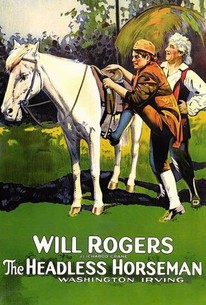
Adapted from the classic short story by Washington Irving, 1922’s The Headless Horseman tells the story of Ichabod Crane (Will Rogers), a stern schoolmaster and a student of the occult.  He comes to the town of Sleepy Hollow to serve as the new school teacher and he immediately gets on everyone’s bad side by being a bit tougher on the students than they were expecting.  When it appears that Ichabod is interested in Katrina Von Tassel (Lois Meredith), Katrina’s other suitor, Abraham Von Brunt (Ben Hendricks, Jr.) conspires to make it appear as if Ichabod is working with a coven of witches.

Of course, even if Ichabod survives the witchcraft accusations, there’s still the threat of the Headless Horseman who is said to haunt the isolated roads around Sleepy Hollow….

This was not the first film adaptation of The Legend of Sleepy Hollow.  There were two other silent versions that came out before The Headless Horseman but they are both lost films.  The Headless Horseman is the earliest surviving film version of Irving’s tale.  Historically, it’s interesting as an example of an early horror film.  To be honest, the scene in which Crane imagines what will happen to him if he is found guilty of witchcraft is more effective than the Horseman scenes.  But Will Rogers does do a good job with the role of Ichabod Crane, even if Rogers is hardly the tall and thin Crane who was described in Irving’s story.  Rogers was, of course, best-known for being a humorist and it was claimed that he “never met a man he didn’t like.”  Unfortunately, the same cannot be said of Ichabod Crane.

Enjoy!

Music Video of the Day: Anything by The Damned (1986, directed by Gerard de Thame)


Technically, it is debatable whether or not this is really a horror video but it does have all the hallmarks of the genre, from a gratuitous shower scene to a decadent dinner being held in what is either a gothic castle or the most ornate sewer known to man.  It’s close enough for me.

Director Gerard de Thame is best-known for his work on commercials but he has also directed music videos for Erasure, Bruce Hornsby and the Range, and Sting.

Enjoy!

The Unnominated: Play Misty For Me (dir by Clint Eastwood)


Though the Academy of Motion Picture Arts and Sciences claim that the Oscars honor the best of the year, we all know that there are always worthy films and performances that end up getting overlooked.  Sometimes, it’s because the competition too fierce.  Sometimes, it’s because the film itself was too controversial.  Often, it’s just a case of a film’s quality not being fully recognized until years after its initial released.  This series of reviews takes a look at the films and performances that should have been nominated but were, for whatever reason, overlooked.  These are the Unnominated.

In 1971, Clint Eastwood made his directorial debut with Play Misty For Me.

Eastwood plays Dave Garver, a DJ at a Carmel-By-The-Sea jazz station who has ambitions to some day go national.  Every night, a woman named Evelyn (Jessica Walter) calls Dave and asks him to “Play Misty for me.”  Eventually, Dave meets Evelyn in a bar and he takes her home with him.  After sleeping with her, Dave tells Evelyn that he’s only interested in having a casual relationship.  Evelyn, however, reveals that she has a far different interpretation of casual.  Soon, Evelyn is dropping by Dave’s house unannounced and acting rather clingy, even appearing to attempt suicide when Dave tries to tell her that he’s not interested in having a serious relationship with her.

At first, it’s hard not to feel bad for Evelyn.  Yes, she’s obviously unstable.  Yes, she’s clingy.  Yes, the scene in which she intentionally ruins Dave’s interview for a national job is difficult to watch.  But there’s something so sincere and desperate about her need to have someone in her life that, again, it’s hard not to have sympathy for her.  When she claims that Dave took advantage of her when they first met, she’s got a point.  Dave obviously felt that Evelyn was a one-night stand that he would never have to see again.  Evelyn feels differently.

Things chance when Dave eventually runs into his former girlfriend, Tobie Williams (Donna Mills).  Dave and Tobie tentatively restart their relationship.  When Evelyn finds out, she goes from being clingy to be homicidal.  She goes from trashing Dave’s place to attacking Dave’s housekeeper to attacking Dave and Tobie themselves.

An assured directorial debut, Play Misty For Me shows that Eastwood had a strong directorial sensibility from the start.  (It also shows, during an extended sequence in which Dave and Tobie attend a jazz festival, that Eastwood was always capable of being rather self-indulgent.)  Eastwood uses the film to deconstruct his own confident persona, with Dave going from being a somewhat callous womanizer to ultimately being terrified for his life.  The film is dominated by Jessica Walter’s performance as Evelyn.  Walter is sad and terrifying, often in the same scene.  Though the film doesn’t dig into what happened in Evelyn’s past to drive her to such extremes, Jessica Walter’s performance leaves no doubt that she’s someone who has been hurt by the world and is now so desperate for love and protection that she’ll strike out at anyone who she feels is denying it to her.

As a horror movie that was directed by an actor who, at the time, was still not a favorite of the critics, it’s perhaps not surprising that the Academy ignored Play Misty For Me.  Still, it’s a shame.  If nothing else, Jessica Walter’s performance was far more memorable that Janet Suzman’s nominated turn in the painfully dull Nicholas and Alexandra.  It’s a brave performance and one that more than deserved to be honored.

Previous entries in The Unnominated:

  1. Auto Focus 
  2. Star 80
  3. Monty Python and The Holy Grail
  4. Johnny Got His Gun
  5. Saint Jack
  6. Office Space