This was one of the earliest music videos, featuring a band that seemed to be destined to take advantage of the format. The song was written a time when Jim Morrison was going through a period of depression. While watching the sunset at Robby Krieger’s house, he suddenly had the realization that “If you’re strange, people are strange.”
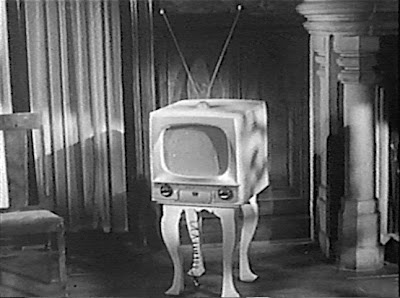
For today’s horror on television, we have a made-for-TV monster movie from 1972, Gargoyles!
What happens when a somewhat condescending anthropologist (Cornel Wilde) and his daughter (Jennifer Salt) head out to the desert? Well, they stop by a crazy old man’s shack so that they can look at his genuine monster skeleton. Before Wilde can thoroughly debunk the old man’s claims, the shack is attacked by real monsters!
That’s right! Gargoyles exist and they apparently live in Arizona! There’s nothing particularly surprising about the plot but the gargoyles are memorable creations and Bernie Casey gives a good performance as their leader. The gargoyle makeup was designed by none other than Stan Winston, who won an Emmy for his work here and who went on to win Oscars for his work on Aliens, Terminator 2, and Jurassic Park.
As well, a very young Scott Glenn shows up in the cast. I like to think that he’s playing the same character in both Gargoyles and Sucker Punch.
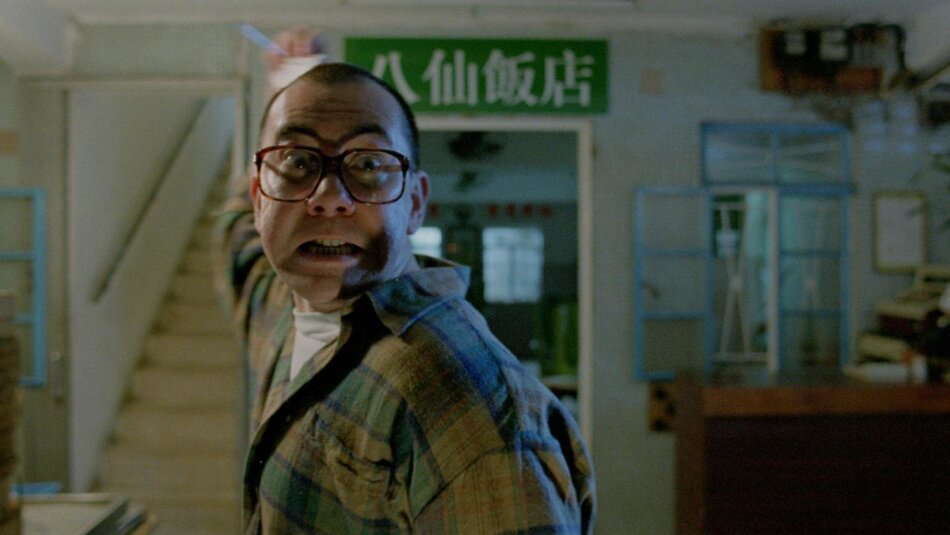
Loosely based on the real-life exploits of a serial killer in Hong Kong in the mid-80’s, THE UNTOLD STORY (1993) unfolds over a couple of different timelines. The film opens with a flashback to Hong Kong circa 1978, where we witness a horrific murder committed by Chan Chi-Leung (Anthony Wong) over a game of mahjong. In order to try to conceal the murder, we see the killer as he destroys his old identification documents and creates a completely new identity. As the opening credits end, we’re “in the present” and join a group of kids playing on the beach when they discover a plastic bag containing severed human body parts. Soon the police are on the scene, led by Inspector Lee (Danny Lee) and a ragtag team of wisecracking detectives. Their investigation leads them to the Eight Immortals Restaurant, a place that is known for its barbecued pork buns, and its seemingly polite but evasive owner, Wong Chi Hang, who just happens to be the same guy we saw committing vicious murder at the opening of the film. Wong claims he bought the place from Cheng Lam (Siu-Ming Lau), who along with his entire family, has mysteriously vanished. As the cops dig deeper, too many things just aren’t adding up, like the restaurant’s high employee turnover rate and Wong’s inability to produce ownership papers. The cops eventually arrest him and attempt to torture a confession out of him. The flashback timeline kicks back in after Wong is arrested and put through hell by his fellow jailbirds and by the police themselves. When he finally cracks, we learn the secrets of “the untold story!”
Right off the bat, I want to make the statement that THE UNTOLD STORY is not a film that’s meant for everyone. Unless you have a strong stomach and can handle extreme gore and vicious cruelty (of both a violent and sexual nature) depicted in graphic detail, you may want to stay away. As I’m definitely a squeamish viewer, I stayed away from this film for many years due to its reputation. My curiosity eventually overcame my good sense, and I gave it a watch a number of years ago. I mean, the film is a Hong Kong “Category III” rated landmark, and Anthony Wong did win the Best Actor Award at the Hong Kong Film Awards for his performance in the movie. It stands to reason that a guy who calls himself a true fan of Hong Kong cinema should give THE UNTOLD STORY a go! Let me just say this, as someone who grew up on Hollywood films, even the goriest films had certain lines that they would not cross. There are no such lines in this film. Director Herman Yau’s 1993 Hong Kong exploitation film is an unflinching punch to the gut in its willingness to go to unacceptable extremes without any apology to the viewer. Just know that going in.
Now that I’ve properly prepared you for the excessively cruel and gruesome nature of the violence in the film, I now have to try to put into words my actual thoughts on the film itself. One of the things that stood out to me as I watched the movie is the stark contrast between the horrific nature of the violence on screen and the “zany antics” of the police who are working the case. Led by THE KILLER’s Danny Lee as the distracted Inspector Lee, who always has a beautiful prostitute on his arm as he visits crimes scenes and the police station, this group of investigators spends a lot of their time acting like immature teenagers rather than serious cops. Imagine if you and your friends in high school were trying to solve a serial killer case, and we got to watch how you acted on stakeouts and in the police locker room, and you might get an idea of what I mean. My guess is that this is meant to make the violent content a little easier to swallow, as well as poke some fun at the “macho men” who are in charge of solving these kinds of crimes. In some ways it works, but there’s still no protection once Wong goes bonkers.
And speaking of Anthony Wong, he is absolutely incredible in this film as the unimaginably disturbed killer. We watch him explode with rage, commit the most heinous acts imaginable, and then just clean up his mess like he’s doing his daily household chores. I guess it helps that he’s a good cook! Hell, there’s a point near the end of the film where his performance almost leads you to having sympathy for him as the police and his fellow inmates are torturing him! Almost, because the worst flashbacks are still yet to come. Wong is one of the best actors to have ever worked in Hong Kong cinema, and his masterful acting elevates the film to a level of cinematic respectability not yet afforded to such a grisly exploitation film. This is the first of five Hong Kong Film awards won by Anthony Wong.
Overall, THE UNTOLD STORY is cinema as an endurance test, delivering an all too real depiction of a vicious killer committing unspeakable violence on screen. The goofy police squad provides some tonal relief, but this movie is not for the faint of stomach. However, for those brave viewers who can handle the graphic violence and who enjoy dramatizations of true crime from incredible actors, you will be rewarded because the filmmakers were able to come up with something special. As I type this, it’s streaming on Tubi for free!
1957’s I Was A Teenage Werewolf combines two genres that were very popular in the late 50s.
On the one hand, it’s a film about a teenage rebel. Tony Rivers (Michael Landon) is a teenager that means well but he keeps losing his temper. If he can’t learn to control his anger, he could very well be looking at a life behind bars.
On the other hand, it’s also a horror film. When Tony visits a hypnotist (Whit Bissell), the end result is Tony turning into a werewolf and going on a rampage, all while still wearing his letterman jacket.
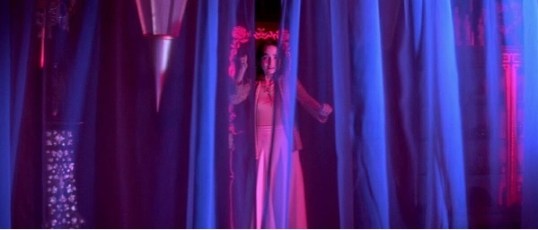
The opening of Dario Argento’s 1977 masterpiece, Suspiria, is about as perfect an opening as one could hope for. American ballet student Suzy Banyon (Jessica Harper) arrives in Frieburg, Germany. Both Argento and Harper perfectly portray Suzy’s confusion as she makes her way through the airport and, as torrential rain drenches her, attempts to hail a taxi and get a ride to the dance academy. (What Suzy doesn’t know, of course, is that the dance academy is home to the ancient witch known as Our Mother of Sighs.) With this opening scene, Argento both immediately establishes the off-center, nightmarish atmosphere of Suspiria and establishes Suzy as a character who we, as the audience, relate to and care about. Suspiria is a great film and certainly one that didn’t need a pretentious remake. The greatness of the original Suspiria all begins with this brilliant opening.
Suspiria (1977, dir by Dario Argento, DP: Luciano Tovoli)
You knew this was coming!
Today’s horror song of the day is the classic main theme to Dario Argento’s Suspiria! (The Argento version is the only version that matters.) The iconic soundtrack was composed by Goblin. I saw an interview with Claudio Simonetti in which he said he wanted the song to be “almost annoying” in its intensity. While I could never be annoyed this song, I do understand Simonetti’s point. The score is designed to be as overwhelming as the evil at the center of the film.
This October, I’m going to be doing something a little bit different with my contribution to 4 Shots From 4 Films. I’m going to be taking a little chronological tour of the history of horror cinema, moving from decade to decade.
1995’s Stolen Innocence opens with 18 year-old Stacy Sapp (Tracey Gold) trying to sneak back into her house after a long night of drinking and partying. Unfortunately for her, Stacey isn’t very good at sneaking around and she’s caught by her mother (Bess Armstrong) and her father (Nick Searcy).
“I’m 18!” Stacy argues.
“You’re going to end up pregnant!” her mother yells.
Stacy says that that her mother is just scared that she’s going to end up a loser “like you!” Well …. yeah, Stacy, that’s kind of the point. If your mother has experience with the life decisions necessary to become a loser, maybe you should listen to her warnings.
Anyway, Stacy runs away with a friend of her’s. After her friend decides to go back home, Stacy hitches a ride with a trucker. When the trucker stops off at a truck stop so he can get his brakes looked at, Stacy meets Richard Brown (Thomas Calabro, wearing a really bad wig). Richard is long-haired and has got a tough guy beard and a cheesy tattoo of a heart on his scrawny forearm. Stacy, of course, is totally smitten and she goes off with Richard and his “friend,” Eddie (Matt Letscher).
It doesn’t take long for us to figure out what Richard is bad news. He carries a gun. He’s financing his trip through stolen checks. He might not even own the truck that he’s driving. He and Eddie have a bizarre relationship in which Richard continually abuses Eddie but Eddie refuses to leave. Richard is obviously a bad guy and we can all see it. When Stacy finally calls her parents from the road, they immediately figure out that Stacy is in trouble. However, it takes Stacy forever to figure it out because Stacy’s kind of an idiot.
I cringed a lot while watching Stolen Innocence, not so much because of the film’s depiction of Richard’s criminal lifestyle but because I used to have a definite weakness for bad boys and I could kind of understand what was going through Stacy’s mind when she first met Richard. That said, I’m pretty sure that I would have figured things out a lot quicker than Stacy did. Stacy quickly goes from being a somewhat sympathetic rebellious teenager to being someone who you really start to get annoyed with. Oh, he’s threatening you with a gun? Okay, that’s when you leave! That’s when you start plotting your escape. You don’t make excuses for him. He’s financing his trip with stolen checks? I’m sorry, is that not a red flag? Add to that, as played by a miscast Thomas Calabro, it’s not like Richard is some boiling cauldron of charisma. From the first minute we see him, with his long hair and his cowboy hat and his tattoo, the guy seems like a joke.
Eventually, Stacy does figure out the truth but, by that point, Richard and her are holed up in a motel room and Richard is exchanging gunfire with the FBI. The film ends with a title card, reminding us that this was a true story. “He’s not a bad person!” Stacy wails to the police. I guess some people really are that stupid.
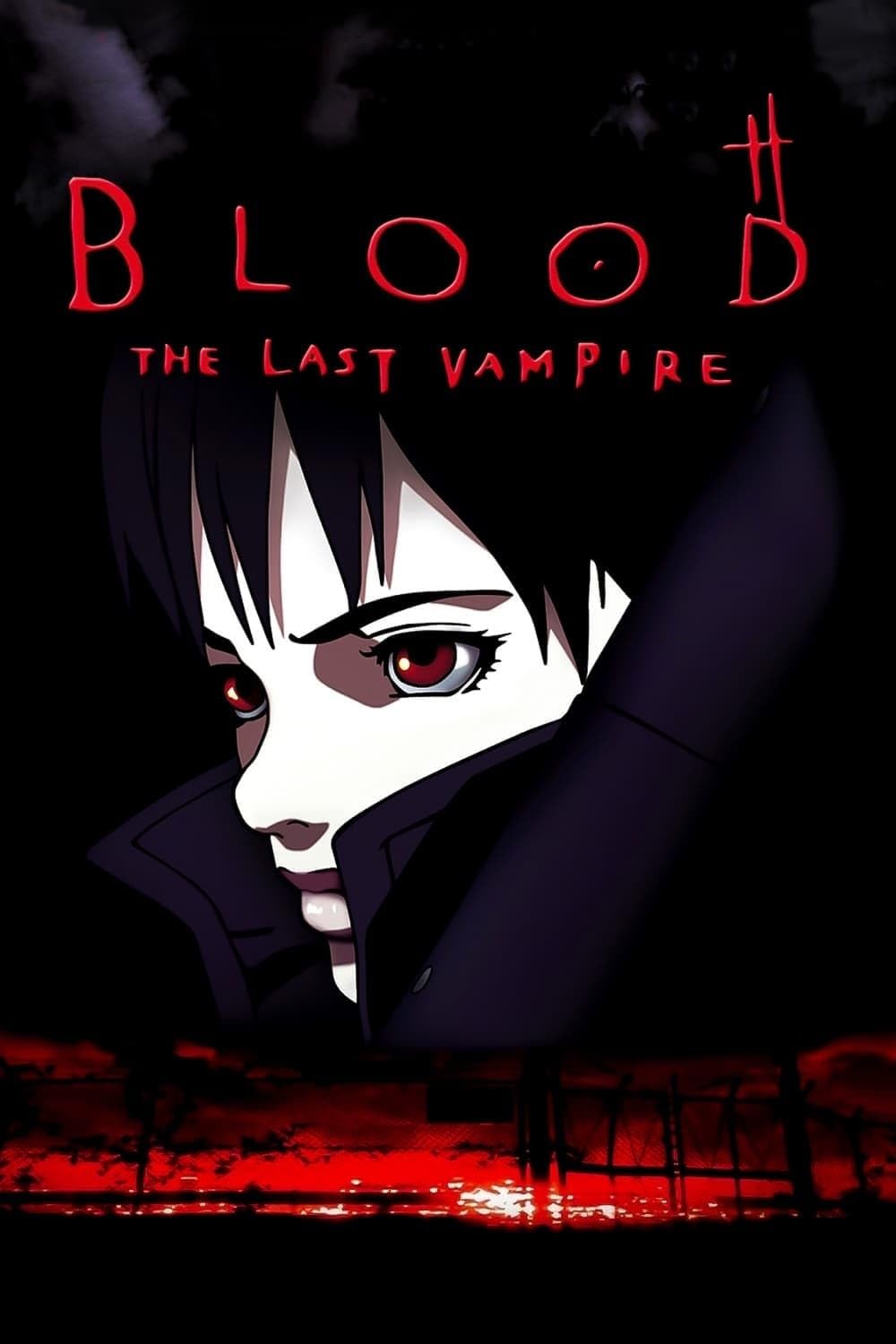
In 2000, Blood: The Last Vampire made quite an impact as a visually stunning and atmospherically intense anime horror film. It expertly combines military tension with supernatural thrills in a compact, sharply executed story. Directed by Hiroyuki Kitakubo and produced by Production I.G, this film helped define the vampire-action subgenre by delivering a haunting tale that’s as much about loneliness and identity as it is about monster hunting.
The story unfolds in 1966 at the Yokota U.S. Air Base in Japan, a setting infused with Cold War anxiety and the looming shadow of the Vietnam War. You follow Saya, a seemingly ordinary schoolgirl with a dark secret: she’s been enlisted by a secretive agency to hunt down bloodthirsty chiropterans—demons disguised as humans. Saya isn’t your typical vampire; she’s the last of her kind, wielding a katana with deadly precision while carrying the heavy burden of her immortal existence. Her cold, detached demeanor makes her an intriguing character, caught between humanity and monsterhood.
One of the film’s standout features is its incredible art and animation. Production I.G used a mix of traditional hand-drawn animation and early CGI to create a look that’s both detailed and immersive. In fact, James Cameron was an early fan, admiring the film’s innovative blend of 2D and 3D animation techniques that pushed technological boundaries to craft a visually striking experience. The backgrounds—military bases, grim hallways, and moody night scenes—feel tangible, while the fluid movements of the characters add grit and weight to every action sequence. The colors are muted but striking, with shadows dominating the frame and bold splashes of red that echo classic horror imagery.
While watching Blood: The Last Vampire, one can also spot clear influences from Western vampire horror, especially the live-action film Blade, which came out a few years prior, and the TV series Buffy the Vampire Slayer. The character of Saya shares traits with Buffy— a young, powerful woman wrestling with her role as a vampire hunter—melding gothic sensibilities with modern action heroine tropes. Director Hiroyuki Kitakubo has acknowledged in interviews that such Western influences, along with classic vampire literature like Dracula, shaped the film’s tone and character design. This fusion creates a uniquely cross-cultural vampire narrative that appeals broadly.
When it comes to horror, Blood goes for a raw, physical kind of fear rather than romanticized gothic vibes. Its monsters are grotesque and disturbing, bristling with sharp teeth and distorted faces. The fight scenes are swift and brutal, with blood sprayed in a way that’s more artful than gratuitous. The film wastes no time with filler; each moment serves to ramp up tension or deepen the mystery.
Saya herself is surprisingly well developed for such a short film. Her isolation and internal conflict give her depth beyond standard vampire tropes. You can sense the loneliness beneath her impassive exterior, along with a kind of weariness about her role as predator. Though the film leaves plenty unsaid, it effectively uses these shadows in the story to hint at a broader tragedy driving Saya on.
However, the film does have its drawbacks. Clocking in under 50 minutes, its brevity feels like a hindrance. The story’s short runtime leaves many threads underexplored, especially the wider world-building and deeper character background that fans of such a rich universe might crave. Some may find the pace hurried, with the narrative skimming over potentially fascinating lore and emotional beats. Additionally, Blood: The Last Vampire was mostly voiced in English, a decision by Production I.G. aimed at making the film more accessible to Western audiences. However, the English voice acting can be hit or miss, which may become distracting for anime viewers who prefer mostly Japanese voice acting with English subtitles.
Despite these flaws, the film’s soundtrack remains atmospheric and effective, supporting tension without overwhelming the visuals. The mix of Japanese and English dialogue fits the multicultural military setting, even if some performances falter.
Importantly, Blood: The Last Vampire served as a critical gateway for Western audiences at a time when anime was predominantly known through late-night broadcasts of child-friendly series like Sailor Moon and Dragon Ball Z. As one of the few adult-themed, violent anime films to achieve mainstream success in the West, it opened the door for a wider acceptance of mature anime stories. This paved the way for major franchises such as Attack on Titan and Demon Slayer, which have become some of the biggest and most influential anime series worldwide over the last 25 years.
Over time, Blood: The Last Vampire has gained a devoted cult following and inspired sequels like Blood+ and Blood-C, as well as live-action adaptations. Yet few have matched the original’s moody atmosphere and stylistic innovation.
All in all, Blood: The Last Vampire is a memorable and gripping piece of horror anime. It skillfully blends postwar unease, body horror, and existential themes into a sleek, powerful package that leaves a lasting impression. Whether you’re a fan of vampire tales, Japanese gothic horror, or intense animated action, this film proves that you don’t need hours to make a horror classic. It’s short, sharp, and packs a serious punch. It may not have delivered on every narrative promise, but its innovative visuals and haunting tone secure it as a must-watch for genre enthusiasts.
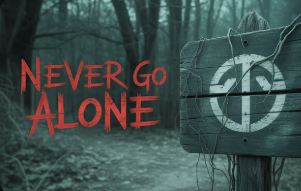
There’s the Summer of the Shark; so, this is the Horrorthon of the Terrible AI shorts. Technically, I don’t need to review these things, BUT I feel like we at the beginning of a new way to tell stories and if the technology gets better and it will, maybe it will attract some people who are good at things? Maybe?
I’m not saying that the people who create these films should be parachuted into an actively shark-infested section of the ocean wearing a meat-based wetsuit and slathered in a blood-based suntan oil, but if you’ve already left with these people and you had parachutes, the suits, and lotion ready; then, I’m not getting in your way. Who knows? Maybe stopping bad AI art could bring us together? Also, the market share for meat wetsuits is wide open for the taking!
So, let’s determine if “Whisper in the Woods” is cause for shark-time!
There is a car driving in a haunted forest. A woman sees a spooky woman standing in the road. The driver investigates. Then, a hooded figures presumably kill her. Technically, it had a beginning, middle, and an end. So, it’s as good as anything Alex Magana ever made, but I’m Team Shark!



 Through the Shattered Lens