Today’s song of the day comes from the 1971 film, Vampyros Lesbos. The Vampires’ Sound Incorporation was a band specifically formed to do the soundtrack for Jess Franco’s classic portrait of Eurotrash decadence. This song found renewed popularity in the 90s when Quentin Tarantino included it on the Jackie Brown soundtrack.
I like this song. It’s great driving music and it sounds like something that a vampire would actually listen to.
“You’re diving deeper than any sane man ever should.” — Dr. Katherine McMichaels
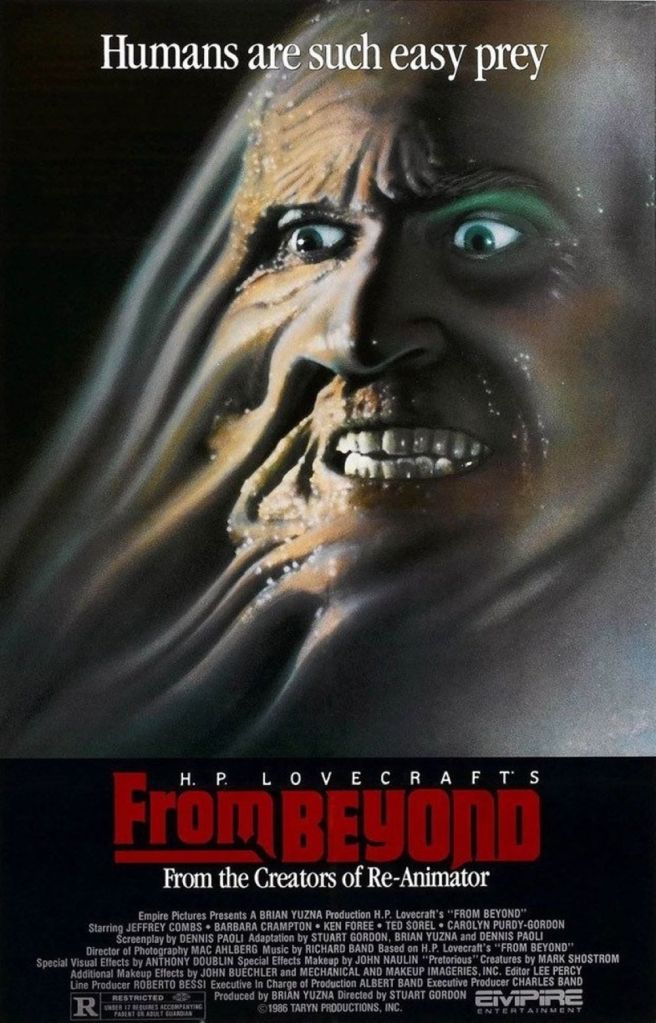
Stuart Gordon’s From Beyond (1986) stands as a darker, moodier follow-up to his breakout Lovecraft adaptation, Re-Animator (1985). At its core is the Resonator, a bizarre scientific contraption designed to stimulate the pineal gland—allowing its users to glimpse eerie creatures and dimensions normally invisible to the naked eye. When Dr. Crawford Tillinghast (Jeffrey Combs) activates the device, it unleashes horrors not just upon the world but also within the minds and bodies of those involved, blurring the line between reality and nightmare in a way both terrifying and hypnotic.
Just like with Re-Animator, Gordon used H.P. Lovecraft’s short story From Beyond as a foundation but expanded the narrative significantly by injecting his own creative vision and filling in what Lovecraft left unexplored. Lovecraft’s original story is a brief, eerie vignette about stimulating the pineal gland to perceive alternate dimensions and terrifying alien creatures—minimalistic and atmospheric, leaving much to the imagination. Gordon reimagines this premise into a fully fleshed-out narrative, adding complex characters like the obsessive Dr. Edward Pretorius and the rational yet vulnerable Dr. Katherine McMichaels. He enriches the story with body horror, psychological torment, and a deeper thematic exploration of sexuality, obsession, and the fragility of the mind. This creative expansion transforms the story into something far more personal and tangible, blending cosmic horror with primal human fears and desires.
This tonal shift stands in stark contrast to Re-Animator, which thrives on anarchic gore, slapstick comedy, and a playful mad-scientist energy. From Beyond trades much of the humor for a somber, unsettling atmosphere drenched in slime, grotesque transformations, and claustrophobic dread. The characters are more grounded in psychological trauma, and the film’s pacing emphasizes creeping unease rather than chaotic spectacle. Gordon’s use of stark, hallucinatory lighting and saturated colors enhances this otherworldly feeling, while practical effects bring a tactile horror to life that heightens the visceral and emotional impact. The horror isn’t just external—it’s internal, a fracture of reality and self.
One of the most notable ways From Beyond separates itself from Gordon’s earlier work is in its overt intertwining of sexuality and horror. The Resonator doesn’t just expose alien creatures; it unlocks primal lust and repressed desires in its users. Scenes imbued with uneasy erotic tension, especially involving Barbara Crampton’s character, make sexuality a core source of vulnerability and terror. This blend of eroticism and nightmare adds depth and psychological complexity, exploring how intimate human experiences can be distorted into something terrifying. It’s a thematic boldness that would become highly influential beyond Western cinema.
Indeed, the film’s fusion of sexual subtext, body horror, and psychological unease foreshadowed themes embraced by late 1980s and early 1990s Japanese horror hentai anime. Works such as Angel of Darkness (Injū Kyōshi) combined explicit eroticism, grotesque body transformations, and supernatural horror in ways reminiscent of From Beyond’s style and tone. This synergy helped define a subgenre of adult horror anime where the boundaries between pleasure and terror, desire and monstrosity, are constantly blurred—cementing From Beyond not only as a cult classic in horror but also as an inspirational bridge to pioneering adult animation in Japan.
Visually and atmospherically, the film is a masterpiece of practical effects and immersive storytelling. The slime-drenched creatures, anatomically warped bodies, and constant visual flow between nightmare and distorted reality create a hallucinatory experience. The climax offers a frenetic, visceral battle that embodies the film’s core themes of madness, transformation, and cosmic terror, leaving viewers with a lingering sense of unease and wonder.
Stuart Gordon’s direction also employs incredibly effective subjective perspectives, with many scenes shot from the characters’ points of view. This technique immerses viewers in the unfolding madness and heightens the sensory overload that defines the film’s experience. There is a famously unsettling point-of-view shot from the mutated Crawford as he perceives a brain inside a doctor’s head and gruesomely attacks. Such moments amplify the film’s exploration of altered perception and the treacherous expansion of human senses.
Despite these strengths, the film is not without flaws. Ken Foree’s character, Bubba Brownlee, while providing moments of grounded streetwise humor, sometimes comes off as a caricature that leans into stereotypical portrayals of Black men as taboo or outlier figures in horror cinema. This portrayal feels somewhat jarring against the film’s otherwise nuanced tone and may evoke discomfort.
Additionally, From Beyond can feel comparatively stiff and sluggish next to Re-Animator, lacking some of the earlier film’s darkly comic energy. The story often relies on a series of increasingly grotesque set pieces that feel more like shock showcases than a cohesive narrative arc. Some performances, including Jeffrey Combs’ lead, occasionally seem overly intense without sufficient emotional variation, and the film sometimes slips into melodrama that undercuts its impact. Furthermore, although ambitious in visualizing Lovecraftian horrors, budgetary constraints are occasionally evident, diminishing some of the awe those moments seek to inspire.
Ultimately, Gordon’s From Beyond is a significant Lovecraft adaptation that showcases the power of expanding upon source material with bold creativity. Moving beyond Lovecraft’s sparse prose, Gordon infuses the story with rich characters, psychological depth, explicit body horror, and mature explorations of sexuality. This results in a haunting, distinctly unsettling film that not only stands as a high point in Gordon’s career but also resonates far beyond its American horror roots, shaping international horror aesthetics and inspiring future genres. It is a disturbing, thrilling journey to the dark spaces just beyond human perception—a cinematic experience that lingers in the mind long after the screen fades to black.
This October, I’m going to be doing something a little bit different with my contribution to 4 Shots From 4 Films. I’m going to be taking a little chronological tour of the history of horror cinema, moving from decade to decade.
Today, we continue the 90s!
4 Shots From 4 Horror Films
Dellamorte Dellamore (1994, dir by Michele Soavi)
In the Mouth of Madness (1994, dir by John Carpenter)
Scream (1996, dir by Wes Craven)
From Dusk Till Dawn (1996. dir by Robert Rodriguez)
That’s the plot of this 1957 film from director Bert I. Gordon. Chicago-haters will love this film, especially the scene where General Morris Ankrum announces that he has no choice but to nuke the entire city. If you don’t hate Chicago, you can still enjoy watching Peter Graves somehow retaining his dignity while dealing with the threat of giant locusts.
For the record, I’m enough of a country girl that I fully understand just destructive locusts can be. That said, when it comes to their appearance, they’re not the most intimidating creatures out there. The worst that can be said about them is that they look like really ugly grasshoppers. A giant grasshopper still looks like a giant grasshopper. And, needless to say, locusts do not attack humans.
(I’m also enough of a Southern girl that I can remember collecting the locust exo-skeletons that would always show up in the fall and winter.)
Here is the ludicrous and entertaining BeginningoftheEnd!
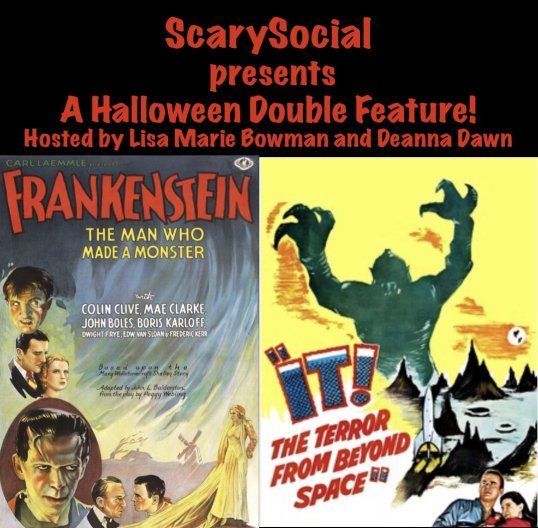
As some of our regular readers undoubtedly know, I am involved in a few weekly live tweets on twitter. I host #FridayNightFlix every Friday, I co-host #ScarySocial on Saturday, and I am one of the five hosts of #MondayActionMovie! Every week, we get together. We watch a movie. We tweet our way through it.
Tonight, we’ve got a special Halloween double feature! First up, we’ve got the original Frankenstein, starring Boris Karloff!
After Frankenstein, we will watch It! The Terror From Beyond Space!
Along the way, we will have tricks, treats, trivia, and prizes! The Halloween season is always fun at #ScarySocial!
If you want to join us on Saturday night, just hop onto twitter, start Frankenstein at 9 pm et, and use the #ScarySocial hashtag! The films are available on Prime! I’ll be there co-hosting and I imagine some other members of the TSL Crew will be there as well. It’s a friendly group and welcoming of newcomers so don’t be shy.
You can probably just look at the title and guess what is going on with this 2009 faith-based film.
Sarah Collins (Rebecca St. James) is pregnant and she’s thinking about getting an abortion. She doesn’t feel that she’s ready to become a mother. Her quasi-boyfriend works in the same office that she does and, at first, he seems more interested in just hanging out with the boys than actually doing anything that would indicate he would be a good father. Sarah is up for a promotion at work and, as her best friend (Andrea Logan White) is quick to point out, the bosses aren’t going to promote a woman who might put her family before her job.
On the other hand, Sarah keeps having visions of herself in the future, married and with a daughter who loves her. Sarah’s sister-in-law (Staci Keanan) talks about how much she loves being a mother. A local minister (Dick Van Patten) gently suggests that God might be trying to tell Sarah something. Sarah realizes that her best friend is hardly an unbiased observer when it comes to Sarah’s choice. Plus, the film takes place during the Christmas season. There’s happiness and joy everywhere!
As you probably guessed, this is an anti-abortion movie. That said, as far as faith-based anti-abortion movies go, it’s actually a bit more fair-minded than one might expect. Sarah struggles with her decision and the film is at least willing to take Sarah’s concerns seriously, as opposed to just portraying her as being either selfish or immature (which is the usual path that most anti-abortion films take). One character expresses regret for her own past abortion but, again, the film treats the character fairly. It may not seem like much but compared to something like Allison’sChoice, which featured Jesus Christ showing up and then breaking into tears while standing in an abortion clinic, Sarah’sChoice is downright moderate in its storytelling.
The truth of the matter is that there really aren’t that many subtle films made about abortion, on either side of the debate. Yes, pro-life films tend to be heavy-handed and too quick to villainize those who feel differently. But the same can be said of most pro-abortion films as well. Abortion is one of those issues that tends to bring out the extremists on both sides. When you see a film like Sarah’sChoice — a film in which no one is accused of committing murder and no one attempts to bomb anyone else — it’s almost a relief, even if you don’t agree with the film’s overall message.
Rebecca St. James gives a sympathetic performance as Sarah and Andrea Logan White brings so much-needed nuance to the role of her best friend. Dick Van Patten, with his friendly manner and nonjudgmental attitude, is the ideal counselor. Sarah’sChoice is not a film that is going to win any converts and I imagine that people who are far more politically-minded than me will find a lot to get annoyed about with this movie. I think that, overall, it’s well-acted and well-made. It’s a movie not a manifesto.
For tonight’s horror on television, we have 1973’s The Night Strangler.
This is the sequel to The Night Stalker and it features journalist Carl Kolchak (Darren McGavin) in Seattle. (After all the stuff that happened during the previous movie, Kolchak was kicked out of Las Vegas.) When Kolchak investigates yet another series of murders, he discovers that paranormal murders don’t just occur in Las Vegas and aren’t just committed by vampires.
I actually prefer this movie to The Night Stalker. The Night Strangler features a truly creepy villain, as well as a trip down to an “underground city.” It’s full of ominous atmosphere and, as always, Darren McGavin is a lot of fun to watch in the role in Kolchak.
Wow, only 6 days left! I can’t believe it, until I need to review another horrible AI short. Why am I reviewing these universally terrible films? It’s the new thing and someone needed to catalog the beginning. Of course, it had to be me; yes, I am martyring myself, but come on… you don’t want to have to watching this waste of a perfectly good two minutes of your life.
Here we go…there’s a lot of hotties with cleavage in a museum and a number of priests. I’m not sure what’s going on, but there is cleavage; so, you can ignore the terrible film that way. A strange cleavage-showing lady asks odd museum goers to look at a painting and imagine God. I would say, “Lady, I already paid to get in here can you just get out of the way of the exhibits?! Do you even work here?! Where did you get that desk/podium?! Security!!! Security!!!” Sadly, no one made this choice to call security and the film continued.
It turns out it’s a Spirit Halloween skull face that giggles, even though it does not have an obvious respiratory system. This was really dumb. I wonder if when AI gets smart, it will tell these “creators” – “you’re really bad at this….just stop and do something else.”
Today’s horror scene that I love is the opening production number of Michele Soavi’s 1987 masterpiece, Stagefright.
Not only does the opening scene wonderfully satirize both a certain type of stage production and a certain type of exploitation film, it also lets the audience know that they’re about to something that is more than just another Italian slasher film. With this opening sequence, Soavi announced his arrival as a major filmmaker.
Personally, I can’t help but laugh when the saxophone makes an appearance. Anyone who has ever been involved in a community theater will relate to the moment.





 Through the Shattered Lens