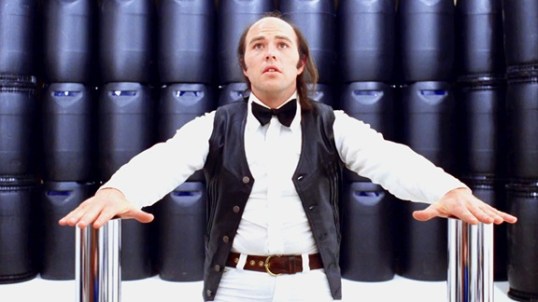
Icarus File No. 15: Glen or Glenda (dir by Edward D. Wood, Jr.)


Today is the 100th birthday of Edward D. Wood, Jr., the director who is often referred to as being “the worst director of all time.”  Personally, I’ve never really agreed with that title.  Ed Wood had a long career in Hollywood and yes, he may have worked exclusively in B-movies and yes, he eventually turned to softcore and then hardcore porn to pay the bills and yes, his life ended under rather tragic circumstances.  But, unlike most truly bad directors, his films are still being watched today and, again unlike most bad directors, his style is immediately recognizable.  You don’t need to see his name in the credits to know when a film was directed by Ed Wood.  You just have to keep an eye out for stock footage, a few familiar actors, and a lot of angora.

If anything, Ed Wood was a director whose ambitions far outweighed the money that he could usually raise for his films.  On the one hand, Plan 9 From Outer Space was a film where the strings holding the flying saucers were clearly visible and where a shower curtain was used to represent the door into an airplane’s cockpit.  On the other hand, it was also a very sincere plea for world peace and a lament that humans would rather blow themselves up with Solarnite than work out their differences.

Or you take a film like 1953‘s Glen or Glenda.  Ed Wood, who identified as a heterosexual and who was considered, by his friends, to be quite a womanizer (and it should be noted that young Ed Wood was strikingly handsome, though he was subsequently very badly aged by alcoholism and homelessness), also preferred to wear clothing designed for women and was open about it at a time when American culture was even more conformist-minded than usual.  In Glen or Glenda, Wood plays the autobiographical role of Glen, who struggles to tell his fiancée (played by Wood’s real-life girlfriend, Delores Fuller) that he dreams of being able to wear her angora sweater.  Glen’s story is told by a psychiatrist (Timothy Farrell) who is talking to a cop (veteran Hollywood character actor Lyle Talbot) who is investigating the death of a transvestite.  Among other things, Glen or Glenda is known for its bad acting, stiffly delivered dialogue, and its occasional digressions about why men go bald while women do not.  (It’s the tight-fitting hats, which cut-off blood flow to the head and not only cause men to lose their hair but also develop the Solarnite bomb.)  But, at the same time, it’s a film in which Wood attempts to handle, with sensitivity and empathy, a subject that most films in the 50s would have either ridiculed or portrayed as being a threat to the American way of life.  All of Wood’s films are sympathetic to those who are considered to be outsiders by conventional society.  This is especially true of Glen or Glenda.

Of course, Glen or Glenda is also known for Bela Lugosi randomly appearing in a laboratory and shouting things like, “Pull ze string!  Pull ze string!”  As far as I can tell, Lugosi is supposed to be playing the creator, who is not portrayed as being a stereotypical God but instead as being a mad scientist who rants and raves in his library and his laboratory.  And while it’s obvious that Bela was probably added to the film at the last minute and, more or less, allowed to do whatever the Hell he wanted, his presence adds a wonderfully bizarre touch to film’s dry style.  (I would compare him to the mysterious burned man who appears at the start of David Lynch’s Eraserhead.)  Whenever the film starts to get a bit too much like an educational film, Lugosi pops up and starts to literally shout at the audiences, frantically issuing a bunch of commands and nursery school rhymes that don’t really made any sense.  It reminds one of H.P. Lovecraft’s insistence that the universe was created by a blind idiot God who had no idea that he was actually creating anything.  The presence of Lugosi and a lengthy and increasingly surreal dream sequence in which Glen imagines himself being tormented by both his fiancée and the devil all suggest that, under different circumstances, Ed Wood could have been the American Buñuel.

Sadly, it was not to be.  Ed Wood died in alcoholic poverty and was reportedly pretty miserable during the final years of his life.  There was nothing pleasant about the end of Wood’s life.  But, on his birthday, I think the least we can do is remove the title of “worst director” from his legacy.  He was nothing of the sort.

Previous Icarus Files:

  1. Cloud Atlas
  2. Maximum Overdrive
  3. Glass
  4. Captive State
  5. Mother!
  6. The Man Who Killed Don Quixote
  7. Last Days
  8. Plan 9 From Outer Space
  9. The Last Movie
  10. 88
  11. The Bonfire of the Vanities
  12. Birdemic
  13. Birdemic 2: The Resurrection 
  14. Last Exit To Brooklyn

Horror on the Lens: Night of the Ghouls (dir by Edward D. Wood, Jr.)


GhoulsdvdToday we celebrate Ed Wood’s 100th birthday with his sequel to Bride of the Monsters.  In Night of the Ghouls, con man Dr. Alcula (Kenne Duncan) moves into Bela Lugosi’s old mansion and pretends to talk to the dead.  What Alcula doesn’t realize is that the house is actually haunted (by Tor Johnson’s Lobo, among others) and real ghosts don’t appreciate pretend ghosts.

What can you say about a film like of Night of the Ghouls?  It’s an Ed Wood film, with all that suggests.  However, how can you resist a film that starts with Criswell sitting up in his coffin and providing commentary?

The role of Dr. Alcula was originally written for Bela Lugosi.  After Lugosi’s death, veteran actor and longtime Wood friend Kenne Duncan got the role instead.  Also of note, Wood appears twice in this film.  Not only does his picture appear on a wanted poster in the police station but Wood also plays one of the ghouls.

Song of the Day: Ed Wood by Howard Shore


Today is the 100th birthday of the pioneering indie director, Edward D. Wood, Jr!

Today’s song of the day is the theme from Tim Burton’s 1994 biopic of the director.  In my opinion, this remains Burton’s first film.  Burton also directed the musical video below while the great Toni Basil choreographed.  And, best of all, the dancer is named Lisa Marie!

Happy birthday, Ed, wherever you may be.

October Positivity: Past Shadows (dir by Peter J. Eaton)


When this 2021 film started, I noticed that the only immediately familiar name in the opening credits was Corbin Bernsen, who was the third-billed member of the cast.  Bernsen’s presence in the film did not surprise me.  Bernsen has appeared in several faith-based films and he’s even directed a few.

What did surprise me was just how briefly Bernsen’s appearance actually waas.  It’s a blink-and-you’ll miss it appearance and, unless I somehow missed it, I don’t think he actually has a line of dialogue in the film.  He plays the uncle of one of the film’s main characters.  He’s an archeologist and, whenever he finds any ancient glass at the site of any of his digs, he sends it to his nephew.  The nephew eventually decides to put all that glass to good use by taping it all together and using it as the frames for his previously frameless glasses.  Suddenly, whenever he puts on the glasses, he can see the past!

That’s good because one of his professors has felt guilty ever since his grandson was kidnapped.  So now, he can just put on the glasses and see who did the abducting.  Yay!  However, another professor — a physicist — wants the glasses for himself so he drugs our hero and steals the glasses.  Luckily, everything works out in the end.  Bad professor goes to jail.  Good professor stops drinking and is reunited with his family.  And the guy with the glasses gets a recording contract in Nashville.

I guess the glasses are meant to represent faith.  And the bad scientist is meant to represent everyone who says that science is more important than faith.  I’m not sure that glasses that allow you to see into the past is the best way sell the idea of faith.  I mean, if you’re so inclined, I guess you could spend as much time as you want praying for a pair of magic glasses that will allow you to see into the past but, at some point, you’re going to have to admit that there’s no such thing as magic glasses, no matter how much you want to believe in them.  In this case, the scientist laughing at you would be proven right.

I had another thought while watching this film.  A good sound mix is really important.  If you want people to get anything out of your movie, it’s important that they be able to hear what your characters are saying.  It’s important that the characters actually sound like they’re all in the same room as opposed to just standing in a booth and reading their lines off a piece of paper.  The sound was all over the place.  Sometimes, I had to strain to hear everything.  Sometimes, I winced because the movie was too loud.  Considering how talky this film is and how often the action segues into flashback, this movie needed a much cleaner sound to it.  There’s more to making a good film than focusing the image, though this film struggled with that as well.

Anyway, the most interesting thing about this film is Corbin Bernsen showing up for 2 minutes and not saying anything.  Has Bernsen become the poor man’s Eric Roberts?

Hider In The House (1989, directed by Matthew Patrick)


After spending years in a mental hospital for murdering his abusive parents, Tom Dreyer (Gary Busey) is released and told to find somewhere else to live.  He ends up secretly living in the crawl space of the new home Julie (Mimi Rogers) and Phil Dreyer (Michael McKean).  Obsessed with Julie, he’ll do anything to be with her, including breaking up her marriage to Phil and killing anyone who comes to close to discovering him in the crawlspace, whether it’s the family dog, an exterminator, or Julie’s best friend.

Due to the distributor having financial issues, Hider In The House never got a theatrical release but it used to show up on HBO frequently in the late 80s and 90s.  I can also remember that our local video store had the film’s poster hanging on the wall near the cash register, creating the impression that Gary Busy was not only staring at Mimi Rogers but also judging whatever you decided to rent for the weekend.  Hider In The House was very popular amongst those of us who had a crush on Mimi Rogers, which was basically every guy on the planet back in the day.

It’s not a bad movie, even if it is predictable.  Both Mimi Rogers and a pre-motorcycle accident Gary Busey give good performance and it’s interesting to see Michael McKean playing a dramatic role for once.  The main problem with the movie is that it’s impossible to believe that big and hulking Busey could possibly live in someone’s attic and move around between the walls without everyone immediately noticing.  A Clydesdale would have more luck going unnoticed than Gary Busey.

Shortly after he completed filming on Hider In The House, Gary Busey was in a motorcycle accident that nearly killed him.  He fractured his skull and suffered permanent brain damage.  It’s always interesting to compare the Gary Busey of the 70s and 80s with the Gary Busey of today.  People are so used to the Busey who yells and speaks in riddles that it’s easy to forget that he was once a very good actor, even when he was appearing in something like Hider In The House.

Horror Scenes That I Love: Damien Puts A Teacher In His Place in Damien: Omen II


1978’s Damien: Omen II is a perfectly ludicrous film that mixes soapy melodrama with apocalyptic horror.  It’s a fascinating mismash that doesn’t really work and often, the most dramatic scenes are also the ones most likely to draw a chuckle from the viewer.  That said, there are a few good moments.

For instance, I’ve always liked this scene where young Damien (Jonathan Scott-Taylor) shows up one of his teachers.  It’s a good thing that Lance Henriksen stepped in when he did!


“Ring Camera”, Short Film Review, (Dir. Alex Magana), Case Wright


Happy Horrorthon, I suppose. Why am I hedging? I’m hedging because I’m reviewing an Alex Magana short. Yes, I’m watching this on purpose.

Ring camera begins with a woman in an apartment, I think the apartment is actually Alex’s residence.

At least, I hope it’s Alex’s apartment because it’s kind of a dump and I don’t think he should live in a very nice place. I’m not saying his apartment should be infested with Camel Spiders like this one:

Or 1,000 Camel Spiders that are like this breed:

This one looks feisty. I don’t want his apartment to have Camel Spiders like this one above because he makes terrible terrible art, but what about Cicadas…Cicadae? Anyway, they are pretty gross.
They don’t have teeth, but they’re annoying and terrible like his films. So, Cicadae…go forth and meet your new roomie!

Honestly Cicadae, he’ll probably cast you. How are you with terrible acting?

Back to my misery, the lady has a “Unfamiliar Face” on her ring camera. I wonder if he films these with his iPhone. The creeper approaches her apartment and starts knocking. She opens the door and it’s a delivery guy.
Ma’am, I’m not judging too hard, but that’s a large bag of food for one person. Look:

This is too much food. You should not eat your weight in food. Ma’am, the bag is half your size. Did you get fired? Is Alex making you do a 3 film deal? You can’t fill the pain Alex has created with Door Dash!
Then, she looks around and she gets killed by the evil ghost.
I know that watching this short will make you sad, but remember- maybe you’re not that good? I mean, how many good things have you actually done today? Maybe, you deserve this film more than you know? Maybe, this film will be like a Scared Straight and put you on a better path? Maybe, you just need the pain that this film provides- you weirdo! In any case, this film is for you. You know what you did!

6 Shots From 6 Films: Jess Franco Edition


4 Shots From 4 Films is just what it says it is, 4 shots from 4 of our favorite films. As opposed to the reviews and recaps that we usually post, 4 Shots From 4 Films lets the visuals do the talking!  (And yes, sometimes we do more than just 4 shots!)

Today, we honor the one and only Jesus “Jess” Franco!

6 Shots From 6 Jess Franco Films

The Awful Dr. Orloff (1962, dir by Jess Franco, DP: Godofredo Pacheco)

Count Dracula (1970, dir by Jess Franco, DPs: Manuel Merino and Luciano Trasatti)

Vampyros Lesbos (1970, dir by Jess Franco, DP: Manuel Merino)

A Virgin Among The Living Dead (1970, dir by Jess Franco, DP: anyone’s guess)

Female Vampire (1973, dir by Jess Franco, DP: Jess Franco)

Oasis of the Zombies (1981, dir by Jess Franco, DP: Max Monteillet)

Horror on the Lens: Bride of the Monster (dir by Edward D. Wood, Jr.)


Bride of The Monster (1955, dir by Ed Wood)

Since tomorrow will be the great man’s birthday, it seems appropriate that today’s horror film on the lens is Edward D. Wood’s 1955 epic, Bride of the Monster.

(Much like Plan 9 From Outer Space, around here, it is a tradition to watch Bride of the Monster in October.)

The film itself doesn’t feature a bride but it does feature a monster, a giant octopus who guards the mansion of the mysterious Dr. Vornoff (Bela Lugosi).  Vornoff and his hulking henchman Lobo (Tor Johnson) have been kidnapping men and using nuclear power to try to create a race of super soldiers.  Or something like that.  The plot has a make-it-up-as-you-go-along feel to it.  That’s actually a huge part of the film’s appeal.

Bride of the Monster is regularly described as being one of the worst films ever made but I think that’s rather unfair.   Appearing in his last speaking role, Lugosi actually gives a pretty good performance, bringing a wounded dignity to the role of Vornoff.  If judged solely against other movies directed by Ed Wood, this is actually one of the best films ever made.

(For a longer review, click here!)

October Positivity: The Friend (dir by Robert Thomason and Gary T. Smith)


Having been recently diagnosed with serious heart problems and having also recently lost his wife in a car accident, James Bragg (Gary T. Smith) collapses when he’s informed that he has been fired from his job.  When he opens his eyes, he discovers that his office is on fire.  A man in a suit (Clay Butler) claims to be an agent with the Department of Homeland Security and he explains that the building has been bombed.

“By who?” James asks.

“Al Qaeda.  Boko Haram.  Mexican drug cartels,” the man replies.

James asks for the man for his name.  The man smiles and says that must people call him Bub.

Bub leads James through the burning building, explaining that he’s taking James to safety.  However, as the flames grow higher, James hears a voice saying, “Don’t follow him.”  Bub says that the voice is just a ploy of the terrorists but James isn’t quite so sure….

As soon as I tell you that 2023’s The Friend is faith-based film, you’ll probably be able to guess where this story is going.  Will James follow Bub onto the elevator going down or will he listen to the voice telling him not to follow.  Will James remember that Bub is a nickname for Beezlebub, one of the more fearsome of the demons that are said to populate Hell?  Will James make peace with the death of his wife and find the strength to continue?  Who will James’s new friend be?  Will it be Bub or will it be the older man who always seems to be showing up in the background?

Again, you can probably guess where all this is heading but The Friend is still a well-made and surprisingly well-acted meditation on life, death, and faith and, with the exception of two scenes, it’s a film that does a good job of avoiding the preachiness that one expects to find in films like this.  Along with co-directing and co-writing the script, Gary T. Smith starts in the film and he gives a good performance as a man overwhelmed by both his mortality and the loss of the person who gave his life meaning.  Smith does a good job of showing how it’s the little things that hurt us the most when we’re missing someone.  Even an act of kindness, like a co-worker expressing sincere sympathy, can cause the pain of a recent loss to flare up.  Of course, for many viewers, the film will work because it makes Bub a government agent.  The implication, whether deliberate or not, is that an authoritarian like Bub is right at home working as a federal agent and that he has no problem using James’s understandable fear of a terrorist attack as a way to convince James to give up everything that was previously important to him.  Obviously, I don’t know that the filmmaker had any sort of political statement in mind when they made Bub an agent of Homeland Security but it does certainly provide an interesting subtext to the film.

Actually, I’m a bit surprised that Bub didn’t apply for a job with TSA.  Imagine the pain and misery he could spread there!