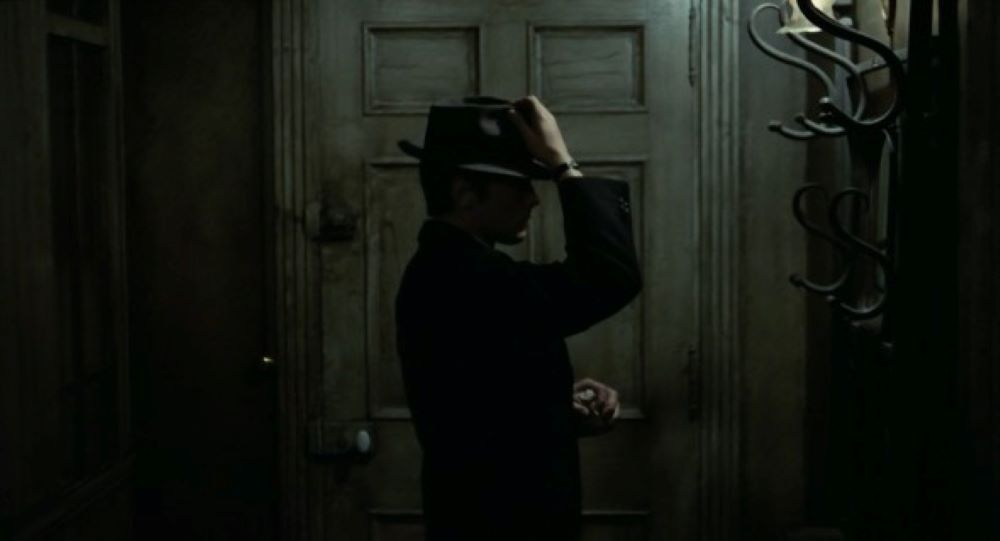
Lisa Marie Reviews An Oscar Nominee: Mississippi Burning (dir by Alan Parker)


1988’s Mississippi Burning opens on a lonely Mississippi backroad in 1964.  A car is pulled over by the police.  Inside the car are three young men, one black and two white.  Judging from their nervous expressions and the sound of the people who stopped them and the fact that they’re in Mississippi during the 60s, we can guess what is about to happen to the people in the car.

With the three men, who were civil rights activists who were involved in voter registration efforts, officially considered to be missing, the FBI sends down two agents to find out what happened.  The two agents are Alan Ward (Willem DaFoe) and Rupert Anderson (Gene Hackman).  Ward is a Northerner who does things by the book and who resents having to deal with lax Southern law enforcement.  He is serious-minded and, just in case we need a reminder of how serious he is, he wears bar-rimmed glasses that make him look like the world’s most fearsome IRS agent.  Anderson is from Mississippi.  He’s a talkative good ol’ boy who was a sheriff before he joined the FBI.  “You know what has four eyes but can’t see?” Anderson asks, “Mississippi.”  It’s a tense partnership, as Ward sometimes disapproves of Anderson’s methods and Anderson thinks that Ward doesn’t understand how things work in Mississippi.

From the first minute we meet local law enforcement, we know that they’re the killers.  Just the fact that one of them are played by Brad Dourif is evidence enough.  However, no one in town is willing to say a word against the police or their cronies.  The white citizens are either too intimidated or they agree with what happened to the three civil rights workers.  (The three men are often referred to as being “outside agitators.”)  The black townspeople live in fear of the Klan and have no reason to trust the word of white FBI agents like Ward and Anderson.

Ward and Anderson investigate the case, hoping that they can find some bit of evidence that will prove the guilt of Sheriff Stuckey (Gailard Sartain), Deputy Pell (Brad Dourif), KKK leader Clayton Townley (Stephen Tobolowsky), and maybe even the town’s mayor (R. Lee Ermey).  One advantage that the FBI has is that the murderers are incredibly stupid.  Another is that Deputy Pell’s abused wife (Frances McDormand, giving the film’s best performance) might be persuaded to testify against her husband.

Mississippi Burning is an example of both powerful filmmaking and problematic history.  Like Ridley Scott, director Alan Parker got his start making commercials and he brought the same sensibility to his movies.  He knew what audiences wanted to see and he made sure to give it to them.  Mississippi Burning looks fantastic and is full of memorable performances.  (Both McDormand and Hackman received Oscar nominations).  The action moves quickly and the villains are so hateful that watching them end up getting humiliated really does bring about a sort of emotional release.

At the same time, this is a film about the Civil Rights era that presents the FBI as being the heroes.  And while it’s true that the FBI did investigate the real-life murders that inspired this film, Mississippi Burning leaves out the fact that the FBI was just a rigorous in harassing and wire tapping Martin Luther King as they were in keeping an eye on the leaders of the Klan.  It’s a film about racism in which the heroes are as white as the villains.  Gene Hackman gives a good performance as Rupert Anderson but the film never really delves all that deeply into Anderson’s feelings about racism in the South.  We’re told that he was a sheriff in Mississippi but we never learn much about what type of sheriff Anderson was.  He’s opposed to the Klan but, historically, the same can be said of many segregationists in the 60s, many of whom felt the Klan’s activities brought unwanted federal attention to what was happening in their home states.  By not delving into Anderson’s own history as a member of Mississippi law enforcement or the FBI’s own more problematic history when it comes to the civil rights movement, the film provides viewers with the escape of viewing the bad guys as being aberrations as opposed to being the norm in 1964.  In the end, Mississippi Burning is an effective thriller with strong heroes and hateful villains.  Just don’t watch it for historical accuracy.

Mississippi Burning was nominated for Best Picture but it lost to Rain Man.

Trading Places (1983, directed by John Landis)


It all starts with a bet.

As Christmas approaches, Mortimer (Don Ameche) and Randolph Duke (Ralph Bellamy) make a bet to determine whether it’s nature or nurture that shapes someone’s future.  The fabulously wealthy owners of Duke & Duke Commodity Brokers, the brothers casually frame their director, Louis Winthrope III (Dan Aykroyd), for everything from dealing drugs to sealing money to cheating on his girlfriend (Kirstin Holby).  After Louis is kicked out of both his job and his mansion, the Dukes hire a street hustler named Billy Ray Valentine (Eddie Murphy) to take his place.  Earlier Winthrope tried to get Valentine arrested for approaching him in the street.  Now, Valentine is living in Winthrope’s mansion, with Winthrope’s butler and Winthrope’s job.

While Winthrope tries to survive on the streets with the help of a outwardly cynical but secretly kind-hearted prostitute named Ophelia (Jamie Lee Curtis, in her first non-horror starring role), Billy Ray surprises everyone by using his street smarts to become a successful, suit-wearing businessman.  The Dukes, of course, have no intention of keep Billy Ray Valentine on as their director.  Not only are the Dukes snobs but they’re racists as well.  Once their one dollar bet has been settled, they start planning to put Billy Ray back out on the streets with Winthrope.

Trading Places was Eddie Murphy’s follow-up to 48 Hrs and he again showed himself to be a natural star while playing the type of role that could have been played by Dan Ayrkroyd’s partner, John Belushi, if not for Belushi’s early death.  (Jim Belushi has a cameo as a party guest.)  Murphy gets to show off a talent for physical comedy and Trading Places is one of the few films to really take advantage of Dan Aykryod’s talents as both a comedian and actor.  Winthrope goes from being a coddled executive to being as streetwise as Valentine.  This is probably Aykroyd’s best performance and he and Eddie Murphy make for a good team.

But the real stars of the film are four actors who weren’t really thought of as being comedic actors, Denholm Elliott, Don Ameche, Ralph Bellamy, and especially Jamie Lee Curtis.  Ophelia is a much edgier character than the “final girls” that Curtis was playing in horror films and Curtis steals almost every scene that she’s in.  Ameche and Bellamy are great villains and it’s fun to watch them get their comeuppance.  What screwball comedy would be complete without a sarcastic butler?  Denholm Elliot fills the role of Coleman perfectly.

Trading Places was a box office success when it was released and it’s now seen as being one of the new Christmas classics, a film for the adults to enjoy while the kids watch Rudolph and Frosty.  I think the movie ends up going overboard towards the end with the gorilla and Dan Aykroyd wearing blackface but, for the most part part, it’s still a very funny and clever movie.

4 Shots From 4 Films: Special 1963 Edition


4 Shots From 4 Films is just what it says it is, 4 shots from 4 of our favorite films. As opposed to the reviews and recaps that we usually post, 4 Shots From 4 Films is all about letting the visuals do the talking.

Since I reviewed a film that takes place in 1963 this morning, I’m going to use today’s edition of 4 Shots From 4 Films to pay further homage to that pivotal year.  It’s time for….

4 Shots From 4 1963 Films

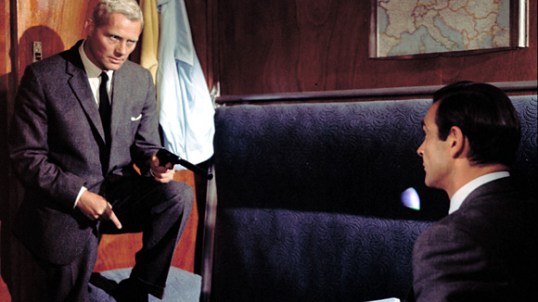
From Russia With Love (1963, dir by Terence Young, DP: Ted Moore)

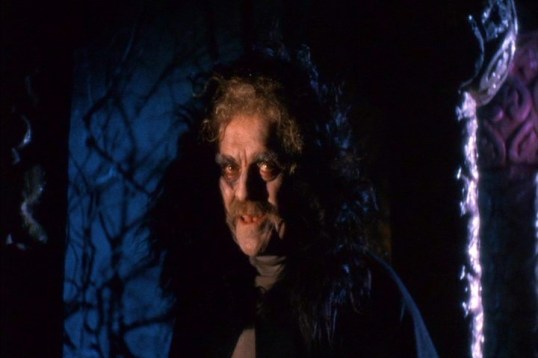
Black Sabbath (1963, dir by Mario Bava, DP: Ubaldo Terzano)

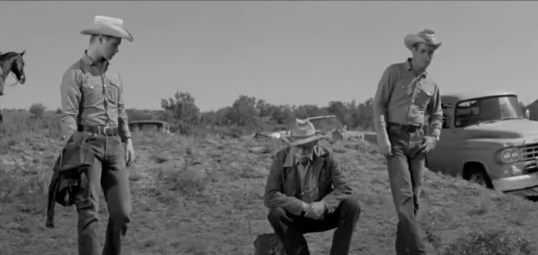
Hud (1963, dir by Martin Ritt, DP: James Wong Howe)

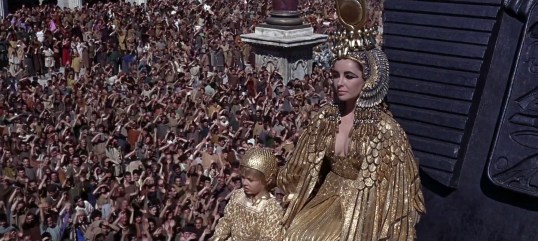
Cleopatra (1963, dir by Joseph L. Mankiewicz, DP: Leon Shamroy)

The Films of 2025: Laws of Man (dir by Phil Blattenberger)


Laws of Man opens with two U.S. marshals driving through the desert of Utah.  Tommy Morton (Jackson Rathbone) is young and impulsive, a Korean war vet who is quick to open fire.  Frank Fenton (Jacob Keohane) is older and more cautious.  He also served in the military, though his service was during World War II.  Frank is haunted by flashbacks to a particularly gruesome battle.  Tommy and Frank may spend most of their time wearing black suits in the desert but neither one breaks a sweat.

The year is 1963.  Kennedy is in the White House.  The communists are on the move.  And Tommy and Frank are busy executing arrest warrants in the most desolate part of the country.  An attempt to arrest Mormon cult leader Crash Mooncalf (Ricard Brake) leads to a bloody shootout that leaves Mooncalf and his followers dead.  Their next assignment leads them to a small town in Nevada, where Bill Bonney (Dermot Mulroney) and his violent family is suspected of killing local ranchers and stealing their land.

From the minute that Tommy and Frank arrive in Nevada, something feels off.  They stay at a cheap motel, where Tommy picks up a woman named Dinah (Ashley Gallegos) and Frank spends his time talking to a bartender named Callie (Kelly Lynn Reiter).  An old rancher named Don Burgess (Forrie J. Smith) shows off his gun and says that he would rather suffer a violent death than give up his land.  A traveling preacher named Cassidy Whitaker (Harvey Keitel) approaches Frank in the parking lot and starts talking about sin and redemption.  Meanwhile, FBI agent Galen Armstong (Keith Carradine) appears to be curiously unconcerned with the Bonneys and their reign of violence.  As for the sheriff (Graham Greene), he spending his time sitting outside a burned-out ranch house.  The charred bodies of the owners are still inside, seated around the dinner table.

An attempt to arrest Bill Bonney at his home leads to a violent shootout, one in which no one is killed but Bill is still not happy about having a bunch of bullet holes in his roof.  Tommy and Frank attempt to serve the arrest warrant, just to discover that it’s not going to be as easy as they thought.  Frank, whose World War II flashbacks are getting more and more intense, wants to leave town.  Tommy, however, is obsessed with discovering what exactly everyone is hiding.

And, through it all, people who know their history will notice that the film is taking place in November of 1963 and the 22nd is rapidly approaching….

Laws of Man gets off to a strong start but begins to meander about halfway through.  Luckily, the film’s final third features a wonderfully insane twist that recaptures the viewer’s attention.  No matter what you may think is going on in the film, it can’t prepare you for just how weird things eventually get.  Laws of Man is an entertaining film, one that is occasionally a bit too self-consciously quirky for its own good but which ultimately works.  Jackson Rathbone and Jacob Keohane both give strong performances in the lead roles and the familiar faces in the film’s supporting cast all do their best to bring the film’s often surreal world to life.  Dermot Mulroney and Keith Carradine give especially strong performance while Harvey Keitel appears to be having fun as the offbeat preacher.

Laws of Man managed to truly take me by surprise.  For fans of paranoid cinema, it’s definitely worth making time for.


Lisa Marie Reviews An Oscar Nominee: Alice Adams (dir by George Stevens)


Katharine Hepburn was famous for both her relationship with Spencer Tracy and the films that she made with him.  They were such frequent co-stars and so associated with each other that “Hepburn-Tracy” became a film genre in and of itself, one that promised a bit of comedy, a bit of drama, and some sharp-witted romance.  That said, I have to admit that one of my favorite of Katharine Hepburn’s film is one that she made not with Spencer Tracy but instead with Fred MacMurray.  Alice Adams is a Tracy-Hepburn film without Tracy.

First released in 1935 and based on a novel by Booth Tarkington (who was quite a big deal back in the day even if, like Arrowsmith‘s Sinclair Lewis, he’s somewhat forgotten today), Alice Adams stars Hepburn as the title character.  Alice is the daughter of Virgil Adams (Fred Stone) and his wife, who is only referred to as being Mrs. Adams (Anne Shoemaker).  Virgil is a sickly man who has worked as a clerk at a glue factory for several years.  Despite living in a rather large house and having a maid named Malena (Hatti McDaniel), the Adams family is not wealthy.  However, Mrs. Adams desperately wants the family to be rich and Alice carries herself with the airs of a wealthy woman, despite the fact that everyone in town knows that she’s not.  Alice love her family and is loyal to them, even if her younger brother (Frank Albertson, who later played Sam “Hee Haw” Wainwright in It’s A Wonderful Life) appears to be addicted to gambling and her mother is constantly browbeating her father for not being more ambitious.  Her family may embarrass her but we know she wouldn’t trade them for all the money in the world.  That’s why we like Alice, even if she does sometimes act like a snob.

However, when Alice meets and falls for the wealthy Arthur Russell (Fred MacMurray), she lies about her social background and tries to present herself as being just as rich as him.  When she invites Arthur and his parents to her house for a dinner party, she frantically tries to keep up the charade of being wealthy.  Meanwhile, Virgil finds himself wrongly accused of stealing from his boss (Charley Grapewin) and, as a result, the family’s financial future is put in jeopardy.

Alice Adams is a mix of screwball comedy and social drama.  On the one hand, Alice’s desperate attempts to throw the perfect party are frequently very funny.  Katharine Hepburn was always at her best when she played a flighty character and the contrast between Alice’s sophisticated airs and Alice’s actual personality makes me laugh every time that I watch the film.  At the same time, there’s a definite undercurrent of melancholy to the film.  Alice and her mother are both so desperate to be rich that they’ve both been blinded to just how wonderful their lives really are.  Alice may like Arthur and Arthur definitely likes Alice but one never forgets that a part of Alice’s attraction to Arthur is that Arthur can give her the life to which she aspires.

Alice Adams features one of Hepburn’s best performances and it’s a rare Hepburn performance to which anyone watching should be able to relate.  At some point in our lives, we’ve all felt like Alice.  We’ve all been Alice, even if we don’t want to admit it.  Fred MacMurray’s natural likability serves him well as Arthur.  He comes across like a genuinely nice guy and we definitely want him and Alice to end up together.

Alice Adams was nominated for Best Picture but it lost to a much bigger production, Mutiny on the Bounty.  Bette Davis beat Katharine Hepburn for Best Actress.  Davis later said that she felt Hepburn should have won.

Beverly Hills Cop (1984, directed by Martin Best)


Two years after teaming with Nick Nolte in 48 Hrs., Eddie Murphy returned to the action genre in what remains he best-known action comedy, Beverly Hills Cop.

We all know the story.  Eddie Murphy is Axel Foley, a streetsmart detective in Detroit whose childhood friend, Mickey (James Russo), is murdered because of something that he saw while working as a security guard in Beverly Hills.  Axel plays by his own rules and gets results even as he gives his boss, Inspector Todd (Gil Hill), heartburn.  Todd refuses to allow Foley to investigate Mickey’s death so Axel puts in for some vacation time and catches the first plane to Beverly Hills.

In Beverly Hills, he meets up with another childhood friend, Jenny (Lisa Eilbacher).  Axel thinks that Mickey’s murder was ordered by a shady businessman named Victor Maitland (Steven Berkoff).  The Beverly Hills Police Department orders Axel to leave Maitland alone and to return to Detroit.  Axel won’t go until he gets justice for Mickey.  Lt. Bogomil (Ronny Cox) assigns Taggart (John Ashton) and Rosewood (Judge Reinhold) to follow Axel in Beverly Hills.

Like 48 Hrs., the story is serious but the comedy comes from how the well-drawn characters interact with each other and from seeing how Axel reacts to the strange and wealthy world of Beverly Hills.  Axel has the same reactions that we would have but, because he’s played by Eddie Murphy, he always has the perfect response to everything that he sees, whether it’s dealing with a snooty hotel clerk or with someone like Serge (Bronson Pichot), Jenny’s co-worker who speaks with an unidentifiable accent.  Even more so than in 48 Hrs or Trading Places, Murphy reveals himself to be a natural star here.  One reason why we like Axel is because he’s not just funny but he’s also the type of confident hero that we all wish we could be.  He’s not intimidated by Beverly Hills for a second.

It’s now impossible to picture anyone else in the role of Axel Foley but, when the film’s script was first being shopped around, it was originally offered to Sylvester Stallone, who said the story had potential but was missing something.  He rewrote the script and took out all of the humor, turning it into a grim and serious action film.  (It is rumored that Stallone later turned his version of the script into Cobra.)  Fortunately, Stallone eventually dropped out of Beverly Hills Cop so that he could co-star with Dolly Parton in Rhinestone.  Producers Don Simpson and Jerry Bruckheimer, then at the start of their producing careers, then offered the role to Eddie Murphy, who took Stallone’s script and added back all of the humor.  Murphy also ended up ad-libbing several of the film’s best one-liners, improvising the hotel lobby scene and the meeting with Serge on the spot.

Beverly Hills Cop was a huge success, cementing Murphy’s status as a star and proving that Murphy could carry a movie on his own.  The film still holds up, certainly better than any of the sequels that followed.  Even though Murphy was clearly the main attraction, the movie also gave actors like John Ashton, Judge Reinhold, Ronny Cox, Bronson Pinchot, and even Paul Reiser a chance to shine.  The villainous performances of Steven Berkoff and Jonathan Banks would serve as a model for countless bad guys through the 80s and 90s.  Beverly Hills Cop is a movie that makes you happy that Sylvester Stallone didn’t have a better sense of humor.

4 Shots From 4 Films: Assassin Edition


4 Shots From 4 Films is just what it says it is, 4 shots from 4 of our favorite films. As opposed to the reviews and recaps that we usually post, 4 Shots From 4 Films is all about letting the visuals do the talking.

4 Shots from 4 Assassin Films

Le Samourai (1967, dir. by Jean-Pierre Melville, DP: Henri Decaë)
Léon: The Professional (1990, dir. by Luc Besson, DP: Thierry Arbogast)
The Killer (1989, dir. by John Woo, DP: Peter Pau and Wong Wing-Hang)
The Killer (2023, dir. by David Fincher, DP: Erik Messerschmidt)

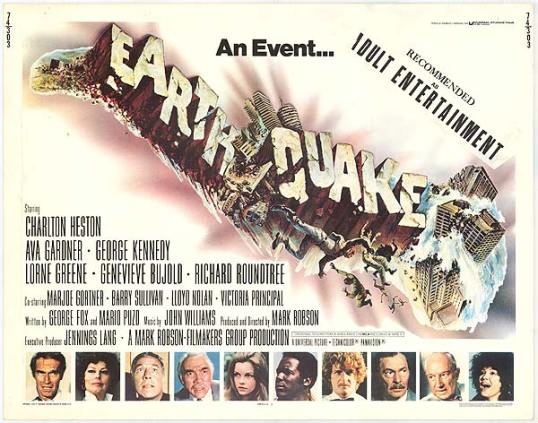
Scenes That I Love: Marjoe Gortner in Earthquake


Today is Marjoe Gortner’s 81st birthday!

The former child evangelist-turned-whistleblower-turned-recording-artist-turned-golf-tournmanet-organizer appeared in some of the most memorable exploitation films of the 70s and 80s, usually playing villains.  (Personally, I’ve always liked his heroic performance in Starcrash.)

In today’s scene, from 1974’s Earthquake, Marjoe gives au unforgettably creepy performance as the type of character who, today, would probably be called an incel.  Usually, no one takes him serious but, when an earthquake hits, he puts on his uniform and becomes a mini-tyrant.  Few actors were as effective at playing crazy as Marjoe Gortner.


The Films of 2025: Alone In Venice (dir by Jules East)


Venice is my favorite city in Italy.

I mean, it’s such a cliché, isn’t it?  Tourists always fall in love with Venice, even though the majority of us really don’t know much about the city beyond the canals and the gondolas.  I spent a summer in Italy and Venice was definitely the city that had the most American visitors.  Sadly, the majority of them didn’t do a very good job representing the U.S. in Europe.  One night, a bunch of drunk frat boys approached me, all wearing University of Texas t-shirts.  One of them asked, “Are you from Texas?”

“No,” I lied.

“You sound like you’re from Texas!” his friend said.

“No, ah’m not from Texas,” I said, “Sorry, y’all.”

That’s not something that would have happened in Florence or even Naples!  In Rome, handsome men on motor scooters gave me flowers.  In Venice, on the other hand, I had to deal with the same jerks that I dealt with back home!

I still fell in love with Venice.  And yes, it did happen while riding in a gondola.  At that moment, I felt like I was living in a work of art.  I can still remember looking over the side of the gondola and watching as a small crab ran across someone’s front porch.  That’s when I realize that, by its very existence, Venice proved that anything was possible.

It is said that Venice is slowly sinking.  That Venice has a reputation as being a dying city would probably have come to a surprise to the drunk Americans who were just looking for a girl from Texas that summer.  And yet, Venice has always been associated with death.  Just consider Thomas Mann’s Death in Venice and the subsequent film adaptation from Luchino Visconti.  Consider the controversial Giallo in Venice and Don’t Look Now.

Venice is a city that is beautiful at day and ominous and menacing at night.  That’s certainly something that’s captured in Alone in Venice.

Made for an obviously low-budget but featuring some stunning shots of its title city, Alone In Venice tells the story of Saul Larson (Apollo Luce), a young actor who has spent the last year in Venice.  He says that he was told to stay in the city by a Chinese film director who is in love with him.  He says that he’s waiting for her to come out to Venice to join him.  At one point, he says that she has even arranged for him to be classified as a permanent resident of the city so that he doesn’t have to worry about his visa expiring.  How she did that is never really explained, though its implied that, while she’s arranged for him to stay in Venice forever, she’s also trapped him there.  He can live in Venice but he can’t leave it.

A friend from America (played by Lisa Jacqueline Starrett) visits him and tells him that she thinks that he’s being used.  She points out that he’s living in a crummy apartment that doesn’t even have a good view and that the director is 1) married and 2) hasn’t contacted him in months.  A man named Tommaso (Luca Rosini) invites Saul back to his place and it’s implied that the two have a brief affair, though Saul continues to obsess  over the director and her love of orchids.  When the prostitute who lives down the hall offers herself to Saul for free, Saul appears to have a panic attack.  Saul insists that the director exists and that she will be coming for him in just a few days.

The majority of the film is made up of scenes of Saul walking around and sometimes running through Venice.  The city is the main attraction here.  At day, the city is vibrant and full of life.  At night, the city is full of shadows and a frightening clown makes an appearance.  There’s more than few shots that owe a debt to Don’t Look Now and its sequences of Donald Sutherland chasing after the figure in the red raincoat.

What does it all mean?  The film largely leaves that up to the viewer.  Whether or not the film works will depend on how much tolerance the viewer has for open-ended storytelling and unanswered questions.  (As you may have guessed, neither one is particularly an issue for me.)  Saul is committed to believing that his director is coming for him and occasionally, there’s something a bit disturbing about his obsession with her.  Throughout the film, he’s given plenty of opportunities to move on, whether it’s returning to America with his friend or pursuing a new relationship.  Instead, he chooses again and again to be alone in Venice.


CONVICTION (2010) – Hilary Swank and Sam Rockwell star in the real-life story of a sister who saves her brother from a wrongful conviction!


My wife and I love movies based on real-life stories. We were looking for something to watch this afternoon on the MAX app and came across their “Real Life Dramas” section. One of the movies we saw listed was CONVICTION (2010) starring 2-time Oscar winner Hilary Swank. My wife loves Hilary Swank so we decided to give it a spin.

Betty Anne Waters (Hilary Swank) watches as her brother Kenny (Sam Rockwell) is convicted of the murder of Katherine Brow on May 21st, 1980 in Ayer, Massachusetts and sentenced to life in prison. Even though she knows he’s a troublemaker, Betty Anne is convinced that he’s not a murderer, so she gives up everything in her life to try to prove his innocence, especially after she learns that he tried to kill himself while in custody. Her husband (Loren Dean) divorces her and takes their kids with him. This doesn’t stop her. She goes back to school, eventually making her way to law school for the sole purpose of helping to exonerate her brother. In a positive turn of events, Betty Anne realizes that the new field of DNA testing could be the key to overturning her brother’s conviction. She contacts attorney Barry Scheck (Peter Gallagher) from the “Innocence Project” who assists those who believe DNA testing can help overturn previous convictions. Will Betty Anne finally be able to prove Kenny’s innocence, or will he have to spend the rest of his life in jail for a crime she doesn’t think he’s capable of committing?

Movies like CONVICTION are such an interesting watch for me, especially since we can know how these stories play out with a simple google search. When I see a movie is based on a real story, I purposefully avoid the facts of the actual events so I can see the events depicted on screen without my own internal bias taking front and center. I enjoyed watching how the events unfolded in CONVICTION. Hilary Swank and Sam Rockwell are such good actors, and I appreciate the work they put in here. I don’t pretend that everything depicted on screen is exactly how it was in real life, but I do believe that the actors portray the essence of truth, and I must admit to a tear in my eye when that truth is finally acknowledged for Kenny Waters at the end of the film. I also enjoyed telling my wife that the director of CONVICTION is Tony Goldwyn, the bad guy in the blockbuster film, GHOST. I just thought that was kind of cool, and so did she.

The real truth of Betty Anne Waters and Kenny Waters is ultimately bittersweet, but their story is both a testament to, and an indictment of, the American judicial system. As a person who truly loves our country, I think it’s important to realize that things aren’t always perfect, even in the United States of America!

See the trailer for CONVICTION below: