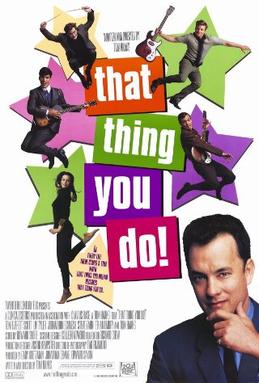
That Thing You Do! (1996, directed by Tom Hanks)


That Thing You Do! is the story of a one-hit wonder.

In 1964, an aspiring Jazz drummer named Guy (Tom Everett Scott) is a last minute addition to the a local band called the Oneders.  (It’s meant to sound like Wonders but almost everyone mispronounces it as O-Needers.)  The band’s egotistical leader, James (Jonathon Schaech) has written a slow ballad called That Thing You Do! but when Guy’s drumming causes the band to perform the song at a faster tempo, they end up with a local hit on their hands.  That local hit becomes a national hit when The Oneders are signed by Play-Tone Records.  First, Mr. White (Tom Hanks), their new manager, officially changes the name to The Wonders.  Secondly, he makes sure that every teen in America is dancing to That Thing You Do!  Third, he tells Guy to always wear sunglasses.  Fourth, he tells James that he will record and perform what Play-Tone tells him to.  Guitarist Lenny (Steven Zahn) and the unnamed Bass Player (Ethan Embry) are happy to be along for the ride but James chafes at his lack of artistic freedom.  Guy, meanwhile, falls for James’s girlfriend (Liv Tyler, at her loveliest) and dreams of meeting his idol, jazzman Del Paxton (Bill Cobbs).

That Thing You Do! was Tom Hanks’s directorial debut and, with its careful recreation of a bygone era and its collection of authentic sounding early 60s rock on the soundtrack, it was obviously a labor of love.  Considering the number of times that the song is played in the movie, it helps that it is a very good song.  That Thing You Do! is a catchy tune, one that you can’t help but tap your feet to.  At the same time, it also sounds like a one hit wonder.  It’s good but not so great as to make you expect much else from The Wonders.

Not surprisingly, Tom Hanks gets great performances from the entire ensemble cast.  Johnathon Schaech and Tom Everett Scott have never been better.  Liv Tyler is lovely and vulnerable as James’s unappreciated girlfriend.  Familiar faces like Peter Scolari, Kevin Pollak, Chris Isaak, and Clint Howard make welcome appearances.  Hanks himself is surprisingly intimidating as Mr. White.  When he says that the band will cover something the Play-Tone catalogue, it’s obvious that he’s not making a request.

The film is a tribute to being young and to loving music bit it’s also a study in the disillusionment of discovering that everything is ultimately a business.  James is frequently an arrogant jerk and he treats his girlfriend terribly but it’s hard not to sympathize with him when he says that he wants to do more than just cover songs from the Play-Tone catalogue.  To James and Guy, the Wonders are about self-expression and their love of music.  To Mr. White, the Wonders are just another band that came up with one catchy tune and who probably aren’t ever going to be heard from again.   That Thing You Do! pays tribute to all of the one-hit wonders out there, the bands who you forget about until you just happen to hear that one song on the radio or in a movie and suddenly, all the memories come flooding back.
 

Brad’s “Scene of the Day” – Brian Dennehy and James Woods in BEST SELLER (1987)!


I’m a big fan of tough guy actor, Brian Dennehy. I especially liked it when he teamed up with James Woods in the badass cop/hitman flick, BEST SELLER! In honor of Dennehy’s 87th birthday in cinema heaven, I thought I’d share him pummeling a very deserving Woods in one of the film’s many standout scenes!

Film Review: Cast Away (dir by Robert Zemeckis)


“WILSON!”

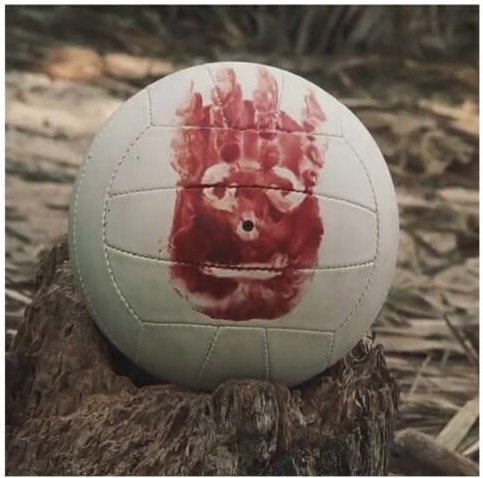
Seriously, I’m usually pretty well-behaved when I watch a movie but every time I see the 2000 film Cast Away, I find myself thinking, “Protect Wilson!  You must protect Wilson!”  And then, every time, I feel the sting of tears in my eyes as Wilson, with that red-face and that understanding attitude, goes floating away.

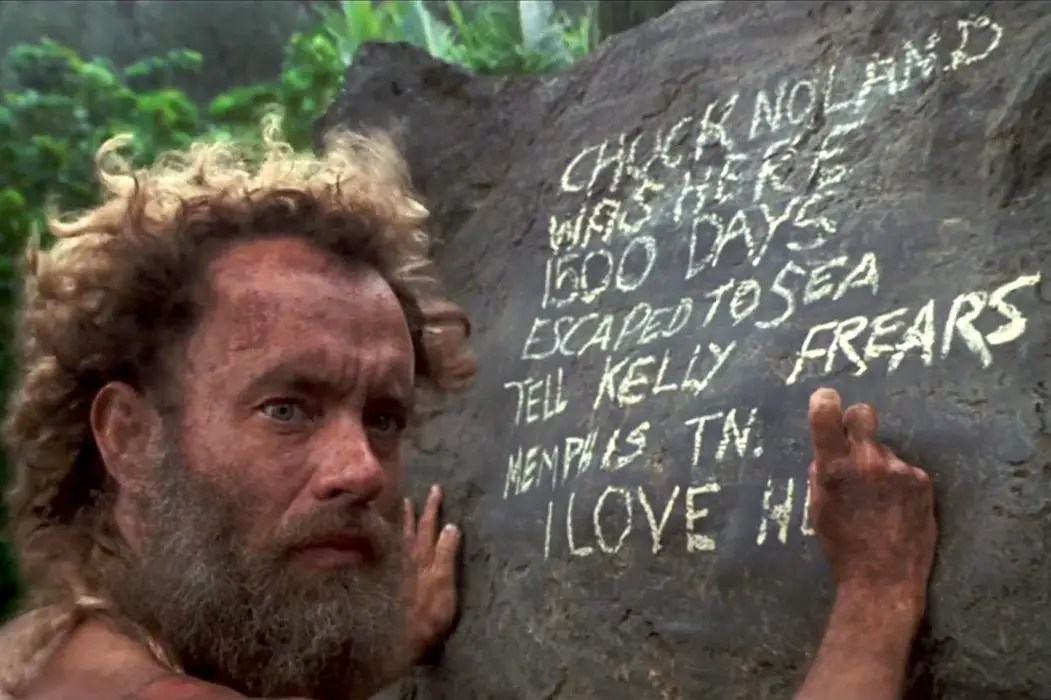
Wilson is a volleyball.  When a FedEx executive named Chuck Noland (played by Tom Hanks) finds himself stranded on a desert island, Wilson becomes his only companion.  A stain from Chuck’s bloody palm creates something that resembles a face on Wilson’s rubber surface and Chuck spends a lot of time talking to Wilson.  It’s how Chuck maintains his sanity, even as he loses weight, sheds most of his clothes, and grows a beard.

Chuck learns how to make fire.  He learns how to catch fish.  He is able to survive due to the supplies that he gathers from the FedEx packages that were being carried on the plane that crashed into the island.  But Chuck never stops dreaming of returning home to his girlfriend (Helen Hunt).  Eventually, Chuck finds the courage to try to make the journey back to civilization.  He brings Wilson with him but ultimately, this is something that Chuck is going to have to do on his own.  Of course, Chuck has failed to consider that he’s been gone for years.  He is presumed dead.  On the Island, time seemed like it was frozen.  For the rest of the world, life has continued.

Cast Away is a film that a lot of people, especially online film commentators, tend to criticize.  The complaint is usually that the film is essentially a commercial for FedEx, that it’s not believable that Tom Hanks could survive on that island for as long as he did, and that the film itself has a weak ending.  I’ll concede that the film does make FedEx look like the nicest corporation on Earth.  (FedEx’s CEO appears as himself, which should tell you something about how the company is presented.)  And I will admit that the film’s time-advancing jump cut, which abruptly takes Hanks from being clean-shaven and husky to being thin and bearded, does leave a lot of unanswered questions.  But I will always defend the film’s ending.  The film ends on a note of ambiguity but how else could it have ended?  Everyone thought Chuck Noland was dead.  His girlfriend had every right to get on with her life and, in fact, it would have been psychologically unhealthy for her if she hadn’t.  As for that final shot, it’s an acknowledgment that Chuck doesn’t know what lies ahead of him in the future.  All he knows is that he life isn’t over yet.  It’s a melancholy ending.  It’s a frustrating ending.  But it’s also the only way the film could have ended and therefore, it’s a perfect ending.

Cast Away is a film that I will always defend and it’s also a film that really only could have worked with Tom Hanks in the lead role.  He plays Chuck as being the ultimate everyman, an affable guy who was just trying to do his job and whose survival of the initial plane crash was largely due to luck.  Hanks is one of those actors who is instantly sympathetic and Cast Away uses his screen persona to good effect.  You want him to survive because he’s Tom Hanks.  He may be playing a character named Chuck Noland but ultimately, he’s Tom Hanks.  He survived being trapped in space.  Surely, he can survive being stranded on an island.  The majority of the film is just Hanks talking to himself.  This would have brought out the worst in so many actors but Tom Hanks makes it work.  And yes, he’ll bring tears to your eyes as he watches Wilson float away.  That’s the power of a good actor.

As for Wilson, I like to think that he washed up in Pensecola.  Recently, I played a little volleyball on a beautiful Florida beach.  Was that you, Wilson?


4 Shots From 4 Films: Special Tom Hanks Edition


4 Or More Shots From 4 Or More Films is just what it says it is, 4 shots from 4 of our favorite films. As opposed to the reviews and recaps that we usually post, 4 Shots From 4 Films lets the visuals do the talking!

Today, the Shattered Lens wishes a happy birthday to Tom Hanks!  It’s time for….

4 Shots From 4 Tom Hanks Films

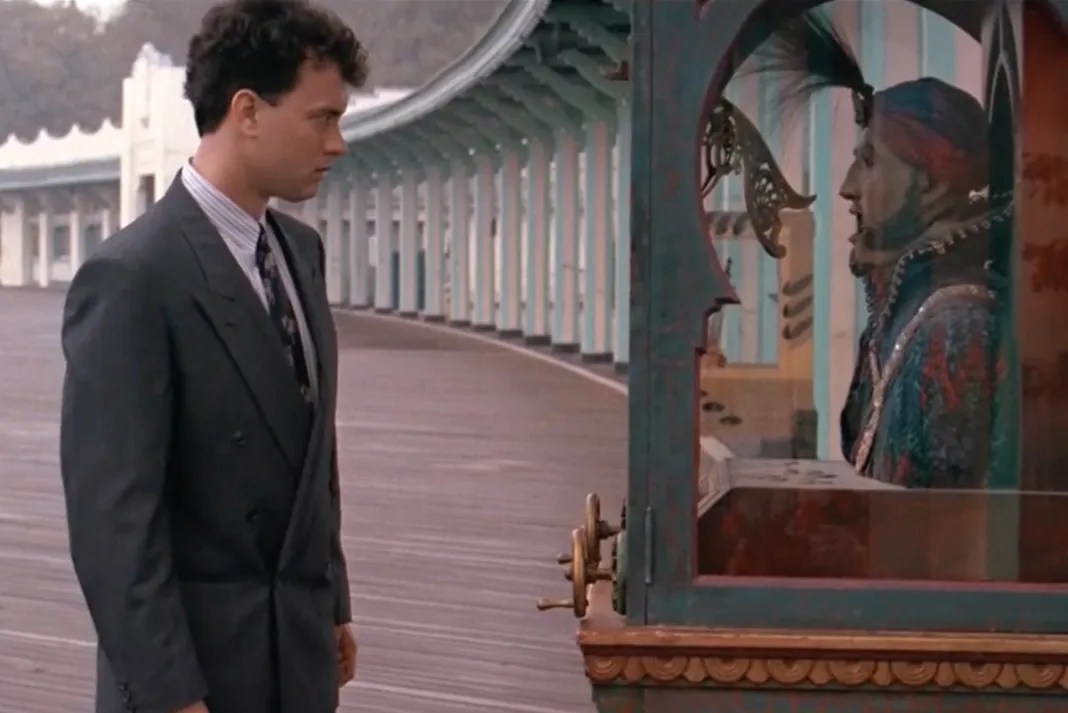
Big (1988, dir by Tom Hanks, DP: Barry Sonnenfeld)

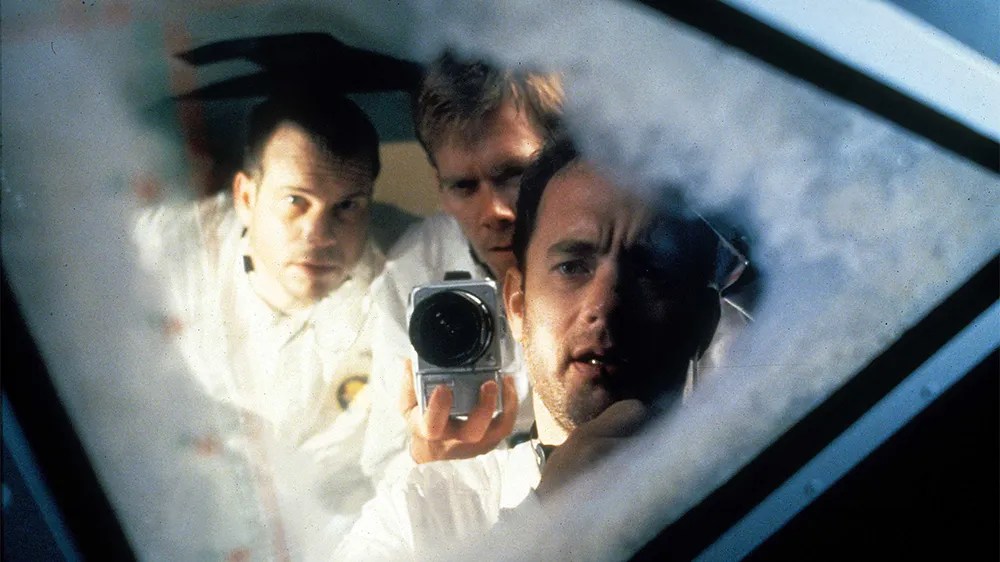
Apollo 13 (1995, dir by Ron Howard, DP: Dean Cundey)

Cast Away (2000, dir by Robert Zemeckis, DP: Don Burgess)

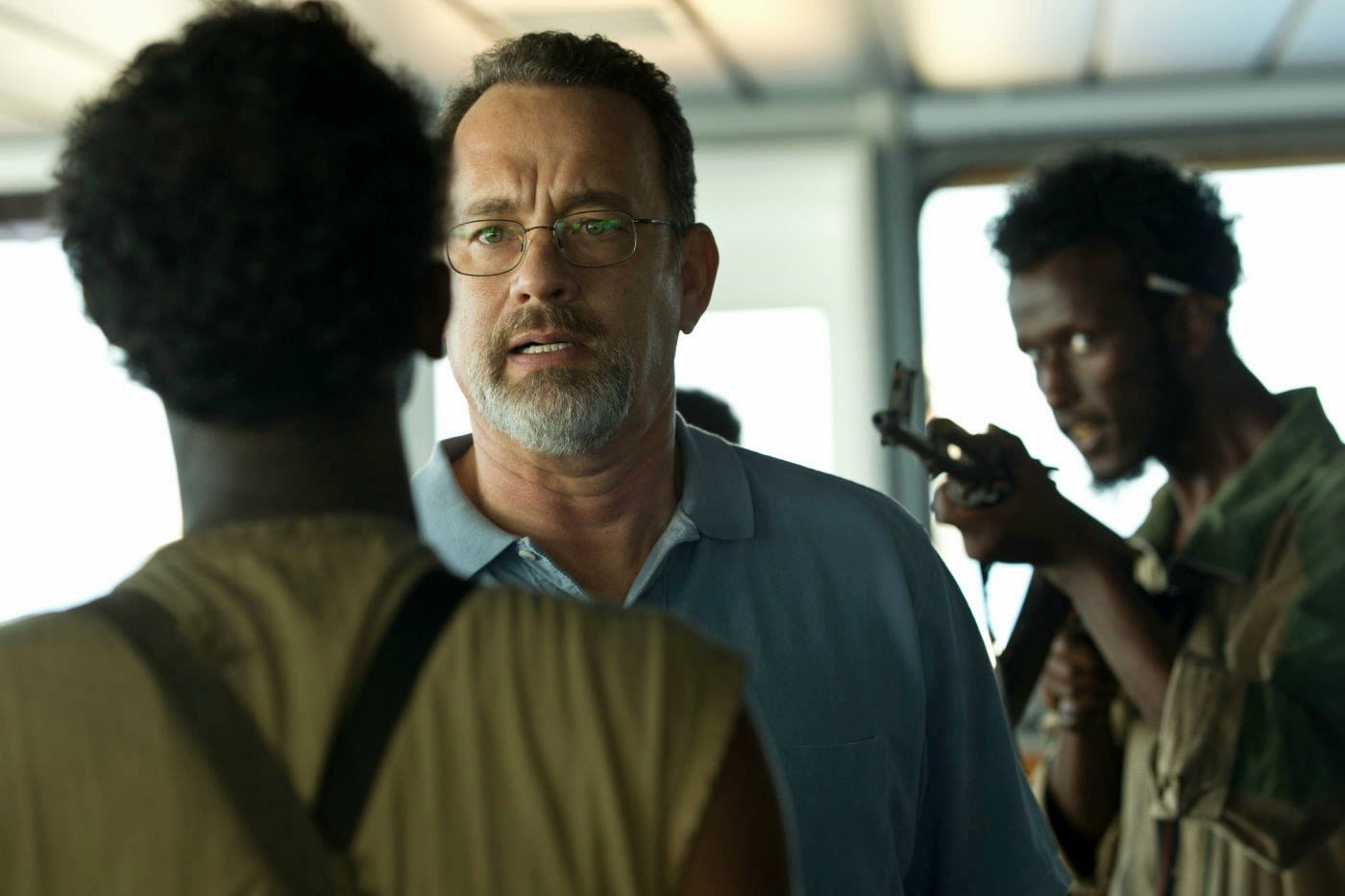
Captain Phillips (2013, dir by Paul Greengrass, DP: Barry Ackroyd)


Scenes I Love: The Opening of Shaft


Today would have been the birthday of Richard Roundtree so, of course, today’s scene that I love could only be the classic opening of 1971’s Shaft.

By doing something as simple as walking down a street in New York, Roundtree showed us exactly who Shaft was and why Shaft did what he did.  This is one of those scenes that’s been parodied so many times that it’s actually surprising to rewatch and see how just defiant and sexy Richard Roundtree’s confident strut actually was.

On another note, I enjoy seeing all of the names of the movies that were playing on 42nd Street when this scene was filmed.

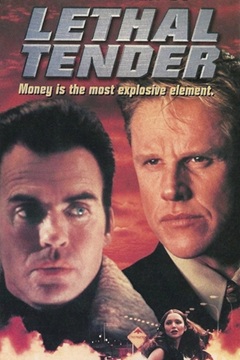
Lethal Tender (1997, directed by John Bradshaw)


Montessi (Kim Coates) and his men have taken over a water filtration plant, are holding hostages, and keep threatening to poison the water supply.  Rogue cop David Chase (Jeff Fahey) and Melissa Wilkins (Carrie-Anne Moss) sneak around the plant and try to stop the terrorists.  David Chase is set up to be a John McClane type but instead, he only kills one terrorists and then lets everyone else do most of the work.  Of course, the whole water filtration hostage situation is just a distraction so Mr. Turner (Gary Busey) can steal a bunch of bonds.  Busey sits behind a computer for most of the movie, lending his name but not much else.

A good cast is wasted in what is definitely one of the worst of the many Die Hard rip-offs to come out in the 90s.  There’s not enough action, with Jeff Fahey as a passive hero and even the great Kim Coates reduced to standing around and doing a lot of yelling for most of his time on screen.  Gary Busey is the big star here but it’s obvious that he was only on the set for a few hours and his plan for stealing the bonds never makes sense.  Whenever anyone questions his plans, he says that it involves computers.  In the 90s, I guess that was enough.

Watching this last night, I realized that I had seen it on Cinemax back in the day.  It didn’t make much sense back then either.

Brad’s Scene of the Day – Kim Darby “bargains” with Strother Martin in TRUE GRIT (1969)!


In honor of Kim Darby’s 78th birthday, I’m sharing one of the highlights of her film career. In this scene, young Mattie Ross (Darby) shows Colonel G. Stonehill (Strother Martin) that her bargaining skills are way beyond her years! I especially love TRUE GRIT because the story opens in my home state in Fort Smith, Arkansas, before heading west in search of Tom Chaney! As a matter of fact, the author of the TRUE GRIT novel, Charles Portis, is one of the greatest authors from the state of Arkansas.

Enjoy one of many great scenes from the classic western, TRUE GRIT!

4 Shots From 4 Films: Special Wally Pfister Edition


4 Or More Shots From 4 Or More Films is just what it says it is, 4 shots from 4 of our favorite films. As opposed to the reviews and recaps that we usually post, 4 Shots From 4 Films lets the visuals do the talking!

Today, the Shattered Lens wishes a happy birthday to cinematographer Wally Pfister!  It’s time for….

4 Shots From 4 Wally Pfister Films

Memento (2000, dir by Christopher Nolan, DP: Walyl Pfister)

Insomnia (2002, dir by Christopher Nolan, DP: Wally Pfister)

The Prestige (2006, dir by Christopher Nolan, DP: Wally Pfister)

Inception (2010, dir by Christopher Nolan, DP: Wally Pfister)

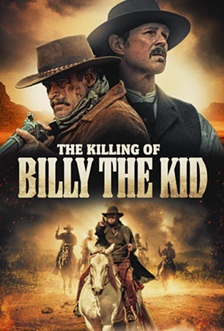
The Killing of Billy The Kid (2023, directed by Brett Bentman)


In the year 1881, a recently arrested prisoner named Thomas Riley (Andrea Zirio) attempts to gain his freedom by offering to inform Sheriff Pat Garrett (Thom Hallum) about the location of a man calling himself Henry McCarty.  At first Garrett asks why he should care about a man named McCarty but, when Riley reveals that McCarty is actually the infamous Billy the Kid, Garrett becomes much more interested.

The Killing of Billy The Kid is a straight-forward account of the events leading up to the death of Billy the Kid (played here by Paul Addison).  While there are flashbacks to the pasts of both Billy and Garrett, the majority of the film is Garrett heading out to the location where Billy is hiding.  With a few notable exceptions, it sticks to the general accepted facts about the death of Billy the Kid.  Paul Addison plays Billy as being a cocky punk and probably comes closer to capturing Billy’s actual personality than a lot of other actors have.

The budget was obviously low (the imdb says it was made for only $30,000) but the film still looks good and it’s version of the old west feels duty and isolated enough to be passable.  I have seen the film listed as having a 90-minute runtime on some sites.  Every streaming version that I’ve found clocks in at 77 minutes and, when I watched the film, it didn’t seem like there were any parts of the story missing.  Addison and Hallum are convincing in their roles, looking authentic whether riding a horse or shooting a gun.  For western fans, there’s much to appreciate about The Killing of Billy The Kid.