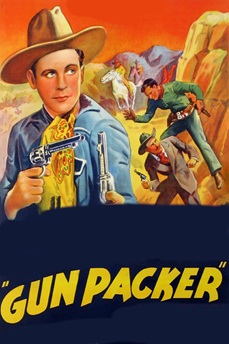
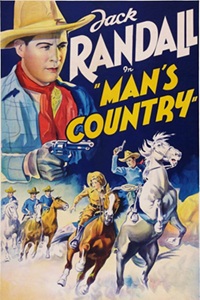
Someone is holding up stages and making off with a fortune of gold bullion. The government decides to send in a gun packer. Jack Denton (Jack Randall), the son of a legendary lawman, is sent to investigate, along with his sidekick Pinkie (Ray Turner) and Rusty the Wonder Horse. Jack goes undercover, telling an elderly ex-con (Barlowe Borland) that he’s a former partner of his, which leads Jack to the leader of the robbers, Chance Moore (Charles King).
There are a lot of familiar faces in this western. Not only does Charles King play yet another villain but Glenn Strange shows up in his customary role as the town sheriff. Lloyd Ingraham, Forrest Taylor, Victor Adamson, George Hazel, Dave O’Brien, and Tex Palmer all have roles. It’s interesting that the same actors showed up in these movies and almost always seemed to be playing the same roles. The only thing that changed was the hero. In this case, it’s Jack Randall, who may not have been a great actor but who was a believable western hero. His sidekick here is Ray Turner, a black actor who began his career during the silent era and who had a long career in the westerns. While Turner plays a subordinate character, the role still avoids a lot (though not all) of the demeaning racial stereotypes that were very common in most films from the 1930s. Jack treats Pinky with respect and they’re clearly friends outside of work. That may not sound like a lot but it was a big deal for a 1938 Poverty Row western.
The real hero here is Rusty the Wonder Horse. Rusty’s best scene? Jack, needing to climb a mountain, calls for Rusty to drop his lariat. Jack grabs the rope and Rusty pulls him up. Rusty truly earns the right to be called a wonder horse.
4 Or More Shots From 4 Or More Films is just what it says it is, 4 shots from 4 of our favorite films. As opposed to the reviews and recaps that we usually post, 4 Shots From 4 Films lets the visuals do the talking!
Today, we celebrate the birthday of Mexican director and actor Alfonso Arau! It’s time for….
4 Shots From 4 Alfonso Arau Films
Calzonin Inspector (1973, dir by Alfonso Arau, DP: Jorge Stahl Jr.)
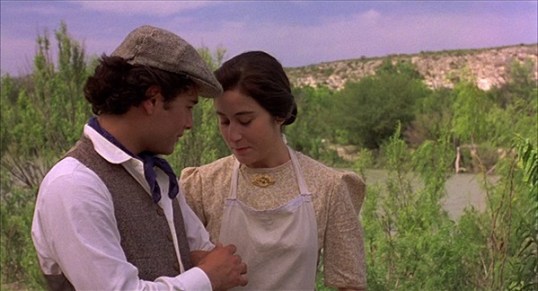
Like Water For Chocolate (1992, dir by Alfonso Arau, DP: Emmanuel Lubezki)
A Walk In The Clouds (1995, dir by Alfonso Arau. DP: Emmanuel Lubezki)
The Trick In The Sheet (2010, dir by Alfonso Arau, DP: Vittorio Storaro)
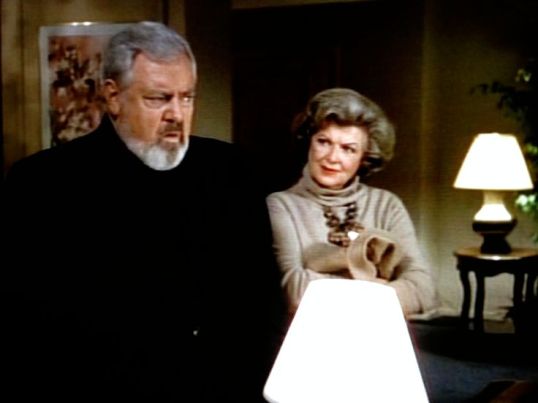
Perry Mason (Raymond Burr) has spent a semester teaching moot court at a law school. When one of his students, Frank Wellman Jr. (John Allen Nelson), is murdered, the accused is another student named Ken Malansky (William R. Moses). Despite being a close friend of the victim’s father (Brian Keith), Perry thinks that Ken is innocent and agrees to defend him. Ken’s ex-girlfriend, Amy Hastings (Alexandra Paul), pays Ken’s bail and helps him and Perry investigate the crime, even though Ken spends the whole movie talking about how “crazy” she is.
No William Katt. No David Ogden Stiers. Barbara Hale’s barely in it. The Case of the Lethal Lesson was the start of a new era in the Mason movies and I didn’t like it. Ken and Amy are Perry’s new assistants but I didn’t like either one of them. Amy was stalkerish but Ken still cried too much about her being the one who paid his bail. Did Ken just want to stay in jail? Ken just wasn’t very likable and it bothered me that the movie never explained why Paul wasn’t available to help. Both Paul and William Katt deserved better. Meanwhile, the new prosecutor (Marlene Warfield) didn’t have the same friendly rivalry that her predecessor did. The mystery element was okay until some cartoonish gangsters showed up. I didn’t buy any of it.
Give it up for my sister, though. A few minutes into the movie, Lisa said, “I bet that’s the murderer,” and she was right! If Perry Mason had her helping him instead of Ken and Amy, he could have solved this case a lot quicker.
When his innocent son, Ted (David Sharpe), is accused of committing a murder, Lex Crane (Walter Long) turns him over to Texas Ranger Jack Haile (Jack Randall) because he knows that Jack will make sure that Ted gets a fair trial. Lex says that he and his men are accused of every crime that happens in the area, even though they’re always innocent. Jack understand and respects Lex as a man and a father. But when someone shoots and kills Ted, Lex and his men set out for revenge. The twist? Lex has a twin brother named Buck (also played by Walter Long) and the two brothers hate each other.
Most poverty row westerns blend into each other but Man’s Country stands out as an intelligent and well-acted western. Even though the twin twist is undoubtedly an overdone one, Man’s Country does a good job with it and Walter Long gives such a good performance that both Lex and Buck emerge as individual, identifiable characters. Jack Randall may not have been the greatest of the old western actors but he’s believable as the tough but fair Texas Ranger. There’s enough western action for fans of the genre but, for once, the plot is interesting enough that it might hold the attention of other watchers as well.
Of course, this is a Poverty Row western so Charles King does appear as one of the bad guys. He gets into a fist fight, like he almost always did. I wonder how many onscreen punches Charles King actually threw over the course of his career in the westerns. It had to have been a lot.
The Greater Western New York Film Critics Association has announced its picks for the best of 2025. And here they are:
BEST PICTURE
The Ballad of Wallis Island
Bugonia
Frankenstein
If I Had Legs I’d Kick You
It Was Just an Accident
Marty Supreme
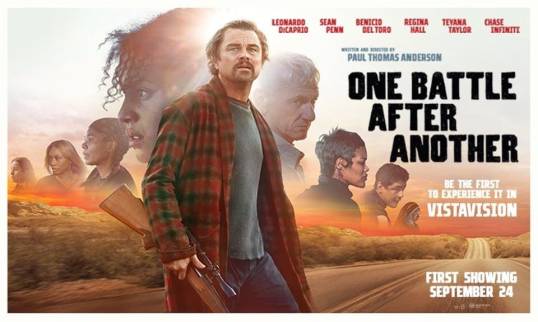
No Other Choice One Battle After Another
Sinners
Train Dreams
BEST FOREIGN FILM
It Was Just an Accident (Iran/France)
Misericordia (France)
No Other Choice (South Korea)
The Secret Agent (Brazil) Sentimental Value (Norway)
BEST ANIMATED FILM
Arco
Boys Go to Jupiter KPop Demon Hunters
Little Amélie or the Character of Rain
Zootopia 2
BEST DOCUMENTARY
Afternoons of Solitude
Cover-Up
The Encampments The Perfect Neighbor
The Tale of Silyan
BEST DIRECTOR Paul Thomas Anderson – One Battle After Another
Mary Bronstein – If I Had Legs I’d Kick You
Ryan Coogler – Sinners
Guillermo del Toro – Frankenstein
Josh Safdie – Marty Supreme
LEAD ACTOR Timothée Chalamet – Marty Supreme
Leonardo DiCaprio – One Battle After Another
Ethan Hawke – Blue Moon
Michael B. Jordan – Sinners
Jesse Plemons – Bugonia
LEAD ACTRESS
Jessie Buckley – Hamnet Rose Byrne – If I Had Legs I’d Kick You
Jennifer Lawrence – Die My Love
Renate Reinsve – Sentimental Value
Emma Stone – Bugonia
SUPPORTING ACTOR Benicio del Toro – One Battle After Another
Jacob Elordi – Frankenstein
Delroy Lindo – Sinners
Sean Penn – One Battle After Another
Stellan Skarsgård – Sentimental Value
SUPPORTING ACTRESS
Odessa A’zion – Marty Supreme
Ariana Grande – Wicked: For Good
Amy Madigan – Weapons Wunmi Mosaku – Sinners
Teyana Taylor – One Battle After Another
ORIGINAL SCREENPLAY
If I Had Legs I’d Kick You (Mary Bronstein)
It Was Just an Accident (Jafar Panahi)
Marty Supreme (Josh Safdie & Ronald Bronstein)
Sentimental Value (Eskil Vogt & Joachim Trier) Sinners (Ryan Coogler)
ADAPTED SCREENPLAY
Bugonia (Will Tracy)
Frankenstein (Guillermo del Toro)
Hamnet (Chloé Zhao & Maggie O’Farrell)
No Other Choice (Park Chan-wook, Lee Kyoung-mi, Jahye Lee & Don McKellar) One Battle After Another (Paul Thomas Anderson)
BEST ENSEMBLE It Was Just an Accident
Marty Supreme One Battle After Another
Sentimental Value
Sinners
BEST CINEMATOGRAPHY
Frankenstein (Dan Laustsen)
Marty Supreme (Darius Khondji)
One Battle After Another (Michael Bauman)
Sinners (Autumn Durald Arkapaw) Train Dreams (Adolpho Veloso)
BEST EDITING
It Was Just an Accident (Amir Etminan)
Marty Supreme (Ronald Bronstein & Josh Safdie) One Battle After Another (Andy Jurgensen)
Sinners (Michael P. Shawver)
Weapons (Joe Murphy)
BEST ORIGINAL SCORE
Frankenstein (Alexandre Desplat)
Marty Supreme (Daniel Lopatin)
One Battle After Another (Jonny Greenwood) Sinners (Ludwig Göransson)
Train Dreams (Bryce Dessner)
BREAKTHROUGH PERFORMANCE
Odessa A’zion – Marty Supreme
Miles Caton – Sinners Chase Infiniti – One Battle After Another
Inga Ibsdotter Lilleaas – Sentimental Value
Eva Victor – Sorry, Baby
BREAKTHROUGH DIRECTOR
Clint Bentley – Train Dreams Mary Bronstein – If I Had Legs I’d Kick You
Harris Dickinson – Urchin
Carson Lund – Eephus
Eva Victor – Sorry, Baby
4 Or More Shots From 4 Or More Films is just what it says it is, 4 shots from 4 of our favorite films. As opposed to the reviews and recaps that we usually post, 4 Shots From 4 Films lets the visuals do the talking!
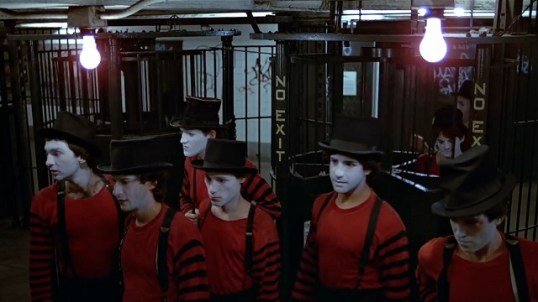
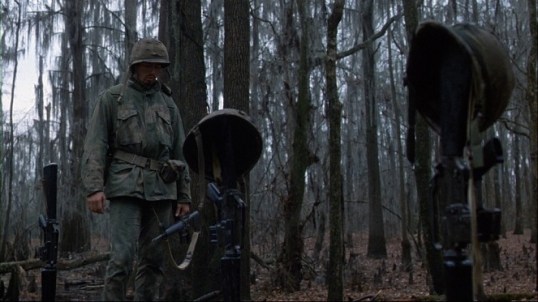
Today, we here at the Shattered Lens wish a happy 84th birthday to the great director Walter Hill.
Walter Hill is one of those legendary figures who has a devoted cult of fans but it still seems like he’s never quite gotten all of the opportunities and the acclaim that he deserved. Perhaps because so many of his films are considered to be genre pieces, they were often not appreciated until a few years after they were first released. But for film lovers and film students, Walter Hill is one of the most important directors of the past 50 years.
Today, we celebrate with….
4 Shots From 4 Walter Hill Films
The Warriors (1979, dir by Walter Hill, DP: Andrew Laszlo)
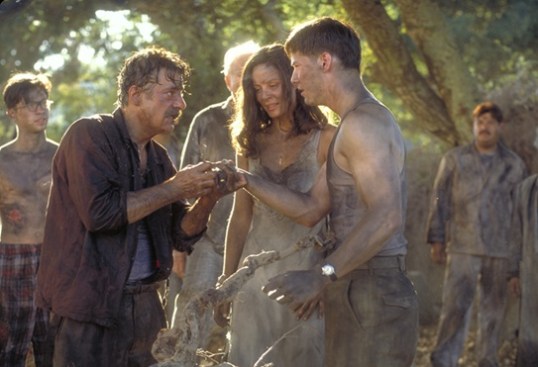
Southern Comfort (1981, dir by Walter Hill, DP: Andrew Laszlo)
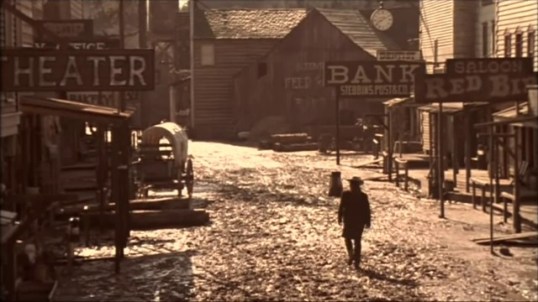
Wild Bill (1995, dir by Walter Hill, DP: Lloyd Ahern II)
Dead For A Dollar (2022, dir by Walter Hill, DP: Lloyd Ahern II)
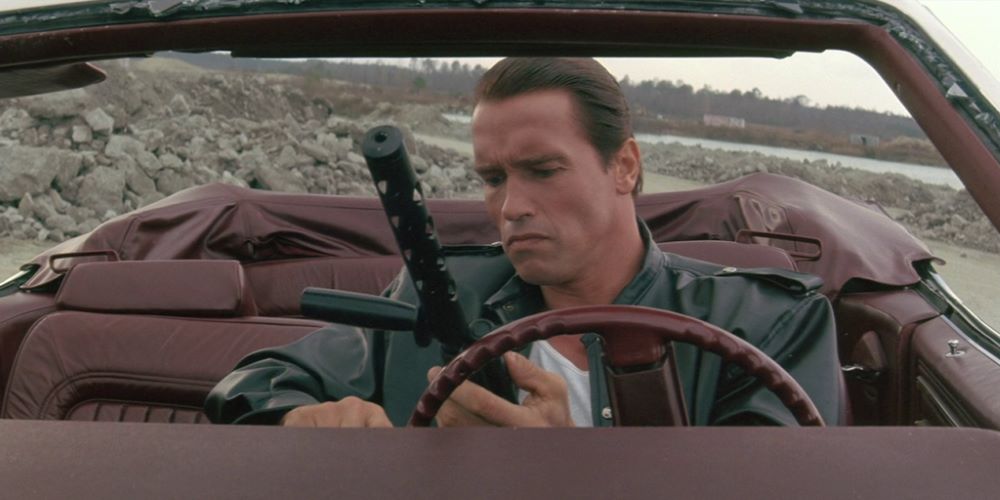
The gravel shootout in Raw Deal is pure, unfiltered 80s excess — the kind of scene that makes you grin even as you shake your head at the absurdity of it all. Arnold Schwarzenegger rolls up in a leather jacket over a white t-shirt, hair slicked back, with that dead-serious look that says he’s about to turn a quarry into a warzone. Then the Rolling Stones’ “(I Can’t Get No) Satisfaction” starts blaring — a choice so wildly on-the-nose that it wraps around to genius. Bullets fly, gravel explodes, and every bad guy who dares show his face gets launched off a cliff or riddled with rounds like it’s just another Tuesday.
It’s one of those moments where action filmmaking and rock-and-roll attitude collide in glorious overkill. Everything about it—the slow-motion carnage, the editing rhythm synced to Mick Jagger’s drawl, even the dust clouds swirling around Arnie—feels like a music video someone made after chugging pure testosterone. It’s ridiculous, it’s brilliant, and it’s exactly the sort of scene that makes Raw Deal such a lovable slice of 80s mayhem and why I just love this scene.
Happy 52nd Birthday to Bollywood actor Hrithik Roshan!
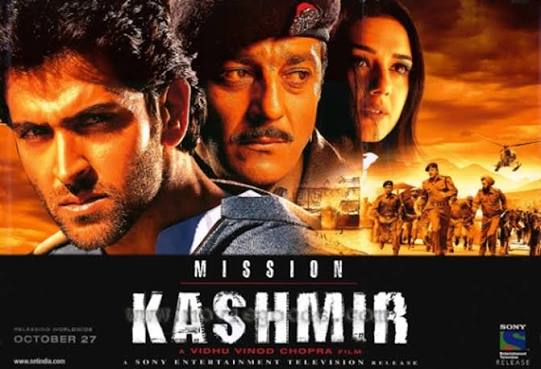
Around the turn of the century, I first became aware of the films being made in Bollywood, India’s Hindi-language film industry. It was then I noticed that the film MISSION KASHMIR was for sale at the Best Buy in Little Rock, AR. I figured that this must be a pretty good film to find itself manufactured, packaged, and being sold all the way over here in Central Arkansas. That was also around the time that I first signed up for Netflix. Not yet a streaming giant, Netflix was just a service for renting movies through the mail. I immediately put MISSION KASHMIR in my queue so I could check it out. This was only my third Bollywood experience, behind the very good films DIL SE (1998) and ASOKA (2001). I remember being fired up about the chance to see some new actors and discover a Hindi action film. Although not completely satisfying, I did find MISSION KASHMIR to be an enjoyable experience.
The plot finds Inspector Khan (Sanjay Dutt) living the good life. He has a beautiful wife (Sonali Kulkarni), a good son, lives in a beautiful house, and gets paid to periodically kick the posteriors of some bad Indians. Unfortunately, his success in his professional life has had some bad side effects. One particularly bad guy has put out the word that any doctor who treats Inspector Khan, or his family, will be killed, and as one scene proves, this guy is a man of his word. Next thing you know, Khan’s son falls and hits his head. Tragically, the boy dies because all of the doctors refuse to help him until it is already too late.
Seeking revenge, his face covered by a black ski mask, Khan tracks down the men responsible and viciously kills them all, including the innocent father, mother, and daughter of a family being held captive by the bad guys. The only survivor is the young son of the slaughtered family, Altaaf, who has terrifying dreams of the black-masked killer of his family. Inspector Khan, who feels extreme guilt over what he has done, allows his wife to talk him into bringing the boy to their house rather than allowing him to spend his childhood in an orphanage.
Life is just starting to get good again when Altaaf figures out that the killer of his family was actually his new father, Khan. After first pausing to try to kill Khan unsuccessfully, Altaaf takes off, not to be heard from again for 10 years. When Altaaf finally shows back up, he has turned into heartthrob Hrithik Roshan, is under the control of a psycho terrorist (played by Jackie Shroff) who has a plan to bomb the heck out of Kashmir, and has a new laundry list of goals in life:
Use childhood sweetheart for terror purposes even though I still love her – check!
Use kung fu training to good action effect – check!
DESTROY INSPECTOR KHAN AT ALL COSTS!!! – ??????
I’ll let you discover the results of goal number four.
Before I go into my thoughts on MISSION KASHMIR, I want to note that while the film is set against the backdrop of the Kashmir conflict, it mostly uses that setting for its story of personal melodrama and high-octane action. I am no expert on the region’s complex politics, so this review focuses only on what I think of the movie itself, with no added political commentary.
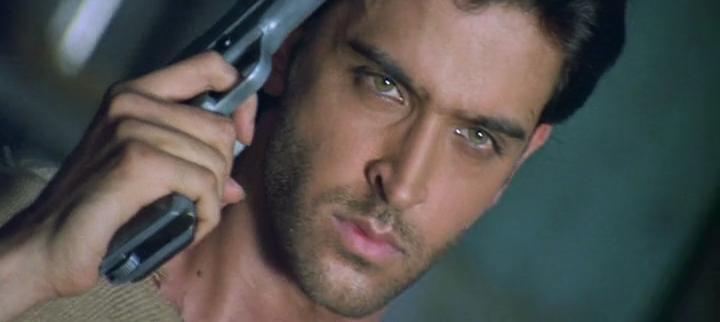
As a movie, MISSION KASHMIR has a lot of good things going for it. First and foremost, I am a fan of action films, and I was looking for some good action scenes. This film did not disappoint in that department. From the MATRIX-like introduction to Altaaf’s adult persona to the final attempts to thwart the master terrorist’s plot, the action is presented in a highly stylized manner. Wirework kung fu, slow-motion carnage, and a hero wielding a massive missile launcher aimed at bad guys make for a pleasant viewing experience in my book.
Secondly, the film features some good performances. Sanjay Dutt’s portrayal of Inspector Khan is commanding, and I found myself really pulling for his character. It is hard not to be sympathetic to a guy who endures as much as he does here. This was the first time I had seen Hrithik Roshan in a film. With his matinee idol good looks, Roshan was emerging as a major star of Hindi cinema, even challenging Shah Rukh Khan, the reigning megastar of Bollywood. Roshan gives a solid performance as the grown-up Altaaf and is especially strong in the action scenes. The other major performance comes from Preity Zinta, who plays the girl Altaaf loved as a child and still loves as a man. I had seen her before in DIL SE and really like the naturalistic, best-friend, girl-next-door vibe she brings to her roles, albeit a very beautiful girl next door. It is easy to see why Altaaf has always loved her. Finally, as with the other Bollywood films I have seen, this movie is just beautiful to look at. I think the greatest cinematography of landscapes in the world is being done in India.
I do have a couple of complaints with MISSION KASHMIR. First, clocking in at over two and a half hours, the movie is too long. The story could have been made into a very exciting ninety-minute film. As it is, the movie seems to drag in places, with the insertion of songs and sequences that do not add much to the proceedings. There were times I found myself thinking, “OK, I get it. He really loves her. Now let’s move on with it,” or “Not another song…” Secondly, I felt that some of the songs were simply not appropriate for what was happening on the screen. For example, there is one peppy little dance number that leads directly into a horrific tragedy. Granted, the scene is effective for the surprise element, but when the film should have been building action and suspense, it instead throws in this routine, which took me out of the movie for a bit. These are the only real complaints I had.
Overall, I did enjoy MISSION KASHMIR. The movie is filled with strong action sequences, along with good performances from a talented cast. Although it overstays its welcome in certain areas, I still recommend this film and give it a 7 out of 10.
As some of our regular readers undoubtedly know, I am involved in a few weekly live tweets on twitter. I host #FridayNightFlix every Friday, I co-host #ScarySocial on Saturday, and I am one of the five hosts of #MondayActionMovie! Every week, we get together. We watch a movie. We tweet our way through it.
Tonight, for #ScarySocial, I will be hosting 1959’s The Giant Gila Monster!
If you want to join us on Saturday night, just hop onto twitter, start the film at 9 pm et, and use the #ScarySocial hashtag! The film is available on Prime and Tubi! I’ll be there co-hosting and I imagine some other members of the TSL Crew will be there as well. It’s a friendly group and welcoming of newcomers so don’t be shy!
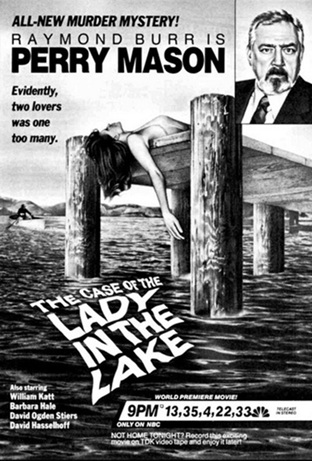
Fifteen years ago, the sister of Sara Wingate (Doran Clark) was murdered at a lake near the family home. Traumatized, Sara had a nervous breakdown. It was only when she married Billy Travis (David Hasselhoff), a former tennis player, that Sara started to get over her fear of the lake. When Sara disappears while walking along the lake, Billy is arrested and charged with murdering her. Because Perry’s is an old friend of Sara’s uncle (John Ireland), he takes the case. If you’re going to get arrested for murder, you better hope one of your relatives knows Perry Mason.
This movie wasn’t bad. It had a twist at the end, which I saw coming but which was still unique for the Perry Mason movies. The actual guilty party is pretty obvious but the mystery wasn’t as important as usual in this one. The supporting cast was pretty good, though David Hasselhoff seemed to be too calm for someone accused of murder. As Perry, Raymond Burr uses his cane again and leans against something whenever he has to stand up. Della jokes that Perry won’t be skiing anymore. Most of the action falls to Paul Drake, Jr. (William Katt), who gets beaten up even more than usual but who also gets to be the big hero in the end.
This was the last Perry Mason film for both William Katt and David Ogder Stiers, who played the district attorney. I’m going to miss both of them. William Katt’s hair was huge in this one and I was really looking forward to seeing how much bigger it could get.
 Someone is holding up stages and making off with a fortune of gold bullion. The government decides to send in a gun packer. Jack Denton (Jack Randall), the son of a legendary lawman, is sent to investigate, along with his sidekick Pinkie (Ray Turner) and Rusty the Wonder Horse. Jack goes undercover, telling an elderly ex-con (Barlowe Borland) that he’s a former partner of his, which leads Jack to the leader of the robbers, Chance Moore (Charles King).


 Through the Shattered Lens