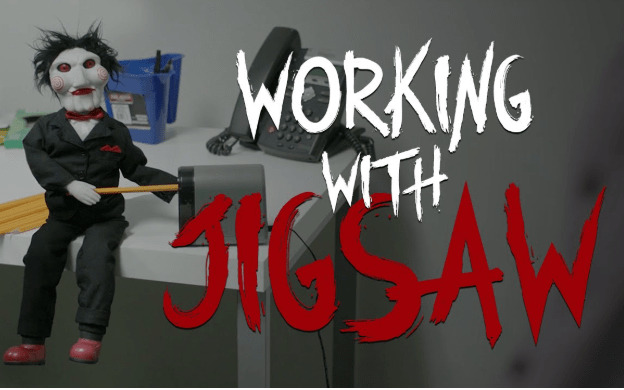
This is an example of a perfect short film! Sometimes life is just awful and you find that Hell has sub-basements. I am currently in the next to last sub-basement; yes, it really is that bad. At times like that, Richard Morgan, the author of Altered Carbon wrote “You take what’s offered….sometimes you just need to get to the next screen.” Working with Jigsaw was one of those moments for me. It was funny enough to make my brain take a brief break and allow me to laugh. Trust me, if a film is funny enough to make me laugh at this time in my life, you might literally pee your pants or poo or pee/poo them. What I am trying say is that you should wear your peeing yourself pants while watching this and then shower- Don’t be gross!
Thanks Al
The plot is right in the title and you get what you were promised. You know you have something special when the writer and director know that 3 minutes and 43 seconds is actually longer that you think. Why is that important? It is critical to have the time awareness because it frees the short film director to use silence to set up a reaction. In this film, the silences set up the punchlines, but it a straight horror short it allows for suspense, payoff, and even to have a moment to care about the characters. Most of the shorts I watch are either pitches in disguise or worse they don’t use their time wisely to make you care that the characters are in peril.
Working with Jigsaw pulls together the concept of a malevolent force being awful at work. Jigsaw is constantly interfering with people’s work to make them play his non-lethal but horribly annoying games. The HR scene at the end is film gold!
I really can’t say enough nice things about this short. Both writers got jobs working for Jimmy Kimmel after this short, which fills with rare joy! I hope they continue to make short films and feature length comedies- they are truly gifted artists!
With apologies to Brad Crain, I’ve never been a basketball fan.
I’m not really a team sports fan in general but basketball truly gets on my nerves. My main issue, of course, is that all the squeaky shoes make it difficult for me to watch a game. The constant squeaking is headache-inducing. My other problem with basketball is that people who like basketball tend to really, really, really like it, to the extent that they can’t handle the fact that some of us don’t really care. Finally, I get tired of being expected to pay attention to whatever it is the coaches say after the game. How many times have I come online to see breathless stories about a basketball coach giving his thoughts on current events? Like seriously, who cares? Why would I care what a coach thinks about tariffs? Why are we even asking basketball coaches for their opinions? Aren’t basketball coaches just supposed to yell at people until they get kicked out of the game? I’ve seen Hoosiers, which I will acknowledge is a very good movie despite my feelings about the game. Gene Hackman was constantly getting kicked off the court and everyone loved him for it. Temper tantrums, that’s what we need from basketball coaches. We don’t need to know your thoughts on the cost of bread.
What’s the point of all this? Before I talk about 2022’s Nothing Is Impossible, I thought you deserved to know my own bias against the game. Nothing is Impossible is a movie that loves basketball.
Nothing is impossible? Try telling that to former basketball-star-turned-high-school-janitor Scott Beck (David A.R. White). Scott, we’re told, could have been a star in the NBA but it didn’t pan out. Instead, Scott works as a janitor and volunteers as an assistant high school coach. While NBA players and their coaches are answering questions about who they voted for in the last election, Scott is looking after his alcoholic father and regretting the fact that he left Ryan Aikins (Nadja Bjorlin) at the altar.
Ryan is now the owner of a basketball team and, when the team announces that it will be holding live tryouts for anyone who wants to try to make the team, Scott finds himself tempted to try to achieve his dream of playing in the NBA. Can Scott do it? Can he still compete at a competitive level? Actually, could he ever compete at a competitive level? Listen, I know this is a PureFlix film and David A.R. White can probably appear in any one of their films that he wants to because he’s one of the founders of the company but White is never particularly convincing as someone who could make a professional basketball team. He’s not particularly tall. He doesn’t come across as being particularly athletic. He’s middle-aged. Nothing is impossible the title tells us but the idea of an unathletic, middle-aged, 5’10 white guy dunking on a bunch of NBA superstars truly tests that claim.
The important thing, of course, is that Scott and Ryan discover that they’re still in love and White and Bjorlin manage to generate enough romantic chemistry to make a believable couple. The other important thing is that Steven Bauer shows up as a heartless executive. It’s always nice to see Bauer destroying dreams. Otherwise, the film did not change my opinion about basketball.
Seriously, those shoes are just too damn squeaky….
“You’re a monster!” a terrified woman shouts at the hulking, murderous figure who haunts the local abandoned cannery.
“I yam what I yam,” the Sailor Man (Jason Robert Stephens) replies before presumably killing her in some grotesque way.
The Sailor Man haunts the cannery. Some believe him to be a ghost be actually, he’s just a former sailor who has been mutated after eating too much contaminated spinach. Now, he is freakishly strong and can literally rip people into pieces with his hands. Running into the Sailor Man means that you will soon be seeing disconnected limbs, compound fractures, and split open heads. The Sailor Man’s motives aren’t always easy to figure out but, if you smell the burning of his pipe, you should probably run. With those gigantic arms and his permanent sour expression, the Sailor Man can pretty much do whatever he feels like doing. Shooting him or stabbing him won’t stop him. He’s hooked on the spinach.
Popeye The Slayer Man is one of three Popeye-themed slasher movies to be released in the wake of Popeye moving into the public domain. In this one, Dexter (Sean Michael Conway), a film student, decides that he wants to make a documentary about the Sailor Man legend so he and his friends break into the cannery. Almost everyone is killed in a bloody way and it’s hard not to notice that no one seems to be that upset about it. Dexter comes across the dead body of someone who was previously described as being his best friend since the Second Grade and he barely seems to care. Instead, he just lifts up his camera and films. I’m tempted to think that this was meant to be a satire on the callousness of aspiring documentarians but I might be giving the film too much credit. Who knows?
Obviously, you can’t take a film like this too seriously. In almost every room in the cannery, there’s at least a handful of empty spinach tins. To be honest, I actually think the film didn’t go far enough. Sure, Popeye’s killing people and there’s a character named Olivia (Elena Juliano) but where’s Bluto? Popeye is presented as a largely silent killer which, again, seems like a missed opportunity. Popeye is also presented as being rather random in his kills. He allows one person to survive for reasons that are incredibly unclear, beyond the fact that I guess the filmmakers felt that the character in question was too sympathetic to suffer the same bloody death as nearly everyone else in the film.
Other than the killer being Popeye, this is pretty much a standard low-budget slasher. I will admit that I kind of appreciated that is was pretty straight-forward about its intentions. Unlike a lot of recent slasher films, it never came across as if it was apologizing for being what it was and there’s definitely something to be said for that. The film embraces the philosophy of “I yam what I yam.” The Sailor Man would be proud.
In 1988’s The Undertaker, a small college town is rocked by a serious of viscous, sexually-charged murders. While the professors and the students deal with their own dramas on campus, the bodies are piling up at the local funeral home. Who could the murderer be?
Well, Joe Spinell’s in the film. That really should be the only clue you need.
Spinell plays Roscoe, the town undertaker who has issues with his mother, cries at random, talks to dead bodies, watches movies featuring sacrifices, and occasionally performs what appears to be some sort of a ritual with his victims. This film was Spinell’s final film and he gives a performance that alternates between being perfunctory and being fully committed. On the one hand, there are plenty of scenes where Spinell appears to be making up his lines as he goes along, In the scenes in which he appears in his office, it’s appears that Spinell is literally reading his lines off of the papers on top of his desk. Then there are other scenes where Spinell suddenly seems to wake up and he flashes the unhinged intensity that made him such a fascinating character actor. In the 70s and 80s, there were many actors who frequently played dangerous people. Spinell was the only one who really came across like he might have actually killed someone on the way to the set. Spinell was in poor health for most of his life and he also struggled with drug addiction. In The Undertaker, he doesn’t always look particularly healthy. Even by Joe Spinell standards, he sweats a lot. And yet, in those scenes were actually commits himself to the character, we see the genius that made him so unforgettable.
As for the film itself, it’s basically Maniacbut without the New York grit that made that film memorable. Instead, it takes place in a small town and Spinell, with his rough accent and his button man mustache, seems so out-of-place that the film at times starts to feel like an accidental satire. Roscoe is obviously guilty from the first moment that we see him and yet no one else can seem to figure that out. Only his nephew suspect Roscoe but that problem is quickly taken care of. Whenever anyone dies, their body is brought to Rosco’s funeral home. Roscoe puts on his black suit, plasters down his hair, and tries to look somber. Roscoe spends a good deal of the film talking to himself. When a victim runs away from Roscoe, Spinell looks at a nearby dead body and shrugs as if saying, “What can you do, huh?”
If you’re into gore, this film has a lot of it and, for the most part, it’s pretty effective. In the 80s, even the cheapest of productions still found money to splurge on blood and flayed skin effects. If you’re looking for suspense or a coherent story, this film doesn’t really have that to offer. It does, however, offer up Joe Spinell in his final performance, sometimes bored and yet sometimes brilliant.
1979’s Apocalypse Now reimagines the Vietnam War as pop art.
Jim Morrison sings The End in the background as slow-motion helicopters pass in front of a lush jungle. The jungle erupts into flame while in a dingy hotel room, Captain Benjamin Willard (Martin Sheen) gets drunks, practices his karate moves, and smashes a mirror before collapsing to the floor in tears. The next morning, the hung-over and bandaged Willard ends up at a U.S. military base where he has a nice lunch with Lt. General Corman (G.D. Spradlin) and Col. Lucas (Harrison Ford) and a nearly silent man wearing an undone tie. Willard is asked if it’s true that he assassinated an enemy colonel. Willard replies that he did not and that the operation was classified, proving that he can both lie and follow military protocol. Willard is told that a Col. Walter Kurtz (Marlon Brando) has gone rogue and his mission is to go into Cambodia and terminate his command with “extreme” prejudice. It’s a famous scene that features G.D. Spradlin delivering a brilliant monologue about good and evil and yet it’s often missed that Willard is getting his orders from Roger Corman and George Lucas.
(Roger Corman was the mentor of director Francis Ford Coppola while the pre-Star Wars George Lucas was Coppola’s business partner. Indeed, Apocalypse Now was originally somewhat improbably planned to be a George Lucas film.)
Up the river, Willard heads on a patrol boat that is populated with characters who could have come out of an old World War II service drama. Chief (Albert Hall) is tough and no-nonsense. Lance (Sam Bottoms) is the goofy comic relief who likes to surf. Clean (Laurence Fishburne) is the kid who is obviously doomed from the minute we first see him. Chef (Fredric Forrest) is the overage, tightly-wound soldier who just wants to find mangoes in the jungle and who worries that, if he dies in a bad place, his soul won’t be able to find Heaven. The Rolling Stones are heard on the boat’s radio. Soldiers on the other patrol boats moon the boat and toss incendiary devices on the roof. It’s like a frat prank war in the middle of a war.
Colonel Bill Kilgore (Robert Duvall) is a badass calvary officer whose helicopter raids are legendary amongst the enemy and a dedicated surfer who tries to turn every night into the equivalent of an AIP Beach Party film. He’s a brilliant warrior who speaks with Malibu accent (“Charlie don’t surf!”) and who doesn’t flinch when a bomb goes off near him. “I love the smell a napalm in the morning,” he says and, for a few moments, you really wish the film would just abandon Willard so we could spend more time with Kilgore. “Some day this war is going to end,” he says with a reassuring nod, showing a non-neurotic attitude that is the opposite of Kurtz’s. Willard says that he could tell Kilgore was going to get through the war without even a scratch and it’s true. Kilgore doesn’t try to rationalize or understand things. He just accepts the reality and adjusts. He’s a true surfer.
The film grows progressively more surreal the closer the boat heads up the river and gets closer to Cambodia. A USO show turns violent as soldiers go crazy at the sight of the Playboy Bunnies, dressed in denim outfits and cowboy hats and twirling cap guns like the love interest in a John Wayne western. A visit to a bridge that is built every day and blown up every night is a neon-lit, beautiful nightmare. Who’s the commanding officer? No one knows and no one cares.
The closer Willard gets to Kurtz, the stranger the world gets. Fog covers the jungles. A tiger leaps out of nowhere. Dennis Hopper shows up as a photojournalist who rambles as if Billy from Easy Rider headed over to Vietnam instead of going to Mardi Gras. Scott Glenn stands silently in front of a temple, surrounded by dead bodies that feel as if they could have been brought over from an Italian cannibal film. Kurtz, when he shows up, is an overweight, bald behemoth who talks in riddles and who hardly seem to be the fearsome warrior that he’s been described as being. “The horror, the horror,” he says at one point in one of the few moments that links Apocalypse Now to its inspiration, Joseph Conrad’s Heart of Darkness.
Directed by near-communist Francis Ford Coppola and written by the unapologetically right-wing John Milius, Apocalypse Now is actually less about the reality of Vietnam and more about how the images of the war shaped pop culture the world over. It’s a reminder that Vietnam was known for being the first television war and that counterculture was not just made up of dropouts but also of writers, actors, and directors. Kurtz may say that Willard’s been sent by grocery store clerks but actually, he’s been sent by the B-movie producers who first employed and mentored the directors and the actors who would eventually become the mainstays of the New Hollywood. The film subverts many classic war film cliches but, at the same time, it stays true to others. Clean dying while listening to a tape recording of his mother telling him not to get shot and to come home safe is the type of manipulative, heart-tugging moment that could have appeared in any number of World War II-era films. And while Coppola has always said the film was meant to be anti-war, Col. Kilgore remains the most compelling character. Most viewers would probably happily ride along with Kilgore while he flies over Vietnam and plays Wagner. The striking images of Vietnam — the jungle, the explosions, the helicopters flying through the air — stay in the mind far more than the piles of dead bodies that appear in the background.
It’s a big, messy, and ultimately overwhelming film and, while watching it, it’s hard not to get the feeling that Coppola wasn’t totally sure what he was really trying to say. It’s a glorious mess, full of stunning visuals, haunting music, and perhaps the best performance of Robert Duvall’s legendary career. The film is too touched with genius to not be watchable but how one reacts overall to the film will probably depend on which version you see.
The original version, which was released in 1979 and was nominated for Best Picture, is relentless with its emphasis on getting up the river and finding Kurtz. Willard obsesses on Kurtz and really doesn’t have much to do with the other people on the boat. It gives the story some much-needed narrative momentum but it also makes Kurtz into such a legendary badass that it’s hard not to be disappointed when Willard actually meets him. You’re left to wonder how, if Kurtz has been living in the jungle and fighting a brutal and never-ending guerilla war against the communists, he’s managed to gain so much weight. Brando, who reportedly showed up on set unprepared and spent days improvising dialogue, gives a bizarre performance and it’s hard to view the Kurtz we meet as being the Kurtz we’ve heard about. As strong as the film is, it’s hard not to be let down by who Kurtz ultimately turns out to be.
In 2001 and 2019, Coppola released two more versions of the film, Redux and The Final Cut. These versions re-inserted a good deal of footage that was edited out of the original cut. Most of that footage deals with Willard dealing with the crew on the boat and it’s easy to see why it was cut. The scenes of Willard bonding with the crew feel out of character for both Willard and the rest of the crew. A scene where Willard arranges for Clean, Lance, and Chef to spend time with the Playboy bunnies seems to go on forever and features some truly unfortunate acting. Worst of all, Redux totally ruins Kilgore’s “I love the smell of napalm in the morning” monologue by having Willard suddenly steal his surf board. Again, it’s out of character for Willard and it actually feels a bit disrespectful to Duvall’s performance to suddenly turn Kilgore into a buffoon.
But then there are moments that do work. I actually like the lengthy French Plantation scene. By the time Willard, Lance, and Chef stumble into the plantation, the journey upriver has gotten so surreal that it makes a strange sort of sense that they would run into a large French family arguing politics while a clown tries to keep everyone distracted. The new versions of the film are undeniably disjointed but they also shift the focus off of finding Kurtz and place it more on Willard discovering how weird things are getting in Vietnam. As such, it’s less of a disappointment when Kurtz actually shows up. Much as with the French Plantation scene, the journey has become so weird that Kurtz being overweight and pretentious feels somehow appropriate.
What all the versions of the film have in common is that they’re all essentially a neon-lit dream of pop cultural horror. Is Apocalypse Now a horror film? Critic Kim Newman argued that it owed a lot to the genre. Certainly, that’s the case when Willard reaches the temple and finds himself surrounded by corpses and and detached heads. Even before that, though, there are elements of horror. The enemy is always unseen in the jungle and, when they attack, they do so quickly and without mercy. In a scene that could almost have come from a Herzog film, the boat is attacked with toy arrows until suddenly, out of nowhere, someone throws a very real spear. Until he’s revealed, Kurtz is a ghostly figure and Willard is the witch hunter, sent to root him out of his lair and set his followers on fire. If the post-60s American horror genre was shaped by the images coming out of Vietnam then Apocalypse Now definitely deserves to be considered, at the very least, horror-adjacent.
Apocalypse Now was controversial when it was released. (It’s troubled production had been the talk of Hollywood for years before Coppola finally finished his film.) It was nominated for Best Picture but lost to the far more conventional Kramer vs Kramer. Robert Duvall was the film’s sole acting nominee but he lost the award to Melvyn Douglas’s turn in Being There. Douglas was very good in Being There and I imagine giving him the Oscar was also seen as a way of honoring his entire career. That said, Duvall’s performance was amazing. In his relatively brief screen time, Duvall somehow managed to take over and ground one of the most unruly films ever made. The Oscar definitely should have gone to him.
As for the film itself, all three versions, flaws and all, are classics. It’s a film that proves that genius can be found in even the messiest of productions.
Dr. Kobras (Donald Pleasence) has got an evil scheme. He’s going to use an ancient gold mask to take over people’s mind and eventually take over the world. Only the Pumaman, a man who has inherited God-like powers, can defeat Dr. Kobras and keep the mask from falling into the wrong hands. Unfortunately, Prof. Tony Farms (Walter George Alton) doesn’t understand that he’s the Pumaman. Vadinho (Miguel Angel Fuentes), an indigenous shaman, travels to London to convince him.
Perhaps the worst super hero movie ever made, Pumaman was an attempt to cash in on the popularity of the Superman movies. Pumaman didn’t start out in a comic book. He was created directly for the screen and his first movie was obviously meant to be the start of many adventures. It didn’t work out that way. Pumaman has plenty of fantastic powers but he’s not sure how to use them and he spends a lot of the movie complaining. He might as well just be called Whinyman. From the minute that he meets Tony, Vadinho has an expression on his face that reads as, “I’ve made a terrible mistake.” Beyond Pumaman just being plain unlikable, the movie also features some of the worst special effects that I’ve ever seen. The success of a film like that depends on whether or not you believe that a man can fly. Pumaman flies but he looks really stupid doing it. That was the failure of Pumaman.
How bad is Pumaman? Even Donald Pleasence looks embarrassed. Pleasence always made a good villain. He set the standard for Bond villains in You Only Live Twice. Pleasence also had the right sensibility for a good super hero film. If he had been born a decade or two later, he would have been equally well-cast as either Professor X or Magneto in the first X-Men film. In Pumaman, he rolls his eyes while delivering his lines. Not even he can believe this movie.
Pumaman saved the day and then disappeared. Earth already had enough heroes.
The 1994 made-for-TV movie Deadly Vows opens with a football game.
It’s just a friendly football game in the park. The majority of the players appear to be frat boys. They’re muscular and athletic and they play hard but they’re not professional athletes. However, there is one player that sticks out. Tom Weston (Gerald McRaney) is taking the game very seriously and he is determined to win. He continually begs his team’s quarterback to throw him the ball. When he’s tackled, he staggers back up and run back to the huddle, even though he’s limping and out-of-breath. Again, Tom is taking the game very seriously. Tom is also nearly twenty years older than the other players.
Tom is desperate to prove that he can still keep up with the young guys around him, even though it’s obvious that he can’t. Tom also drives a truck for a living and spends his time on his CB radio, bragging about how good he is at his job and trying to pick fights with anyone who he feels doesn’t treat him with enough respect. Incidentally, Tom is not driving a big truck. He’s driving a small truck. It’s actually more of a van than a truck…..
In other words, Tom is having a midlife crisis.
I think everyone either knows or has, at least, come across someone like Tom Weston. He’s the balding, forty-something guy who brags about how he’s in the best shape of his life and who shamelessly flirts with every young woman that he sees, despite the fact that he’s married to a woman his own age, Nancy (Peggy Lipton). Nancy, for her part, tries to be understanding. Like a lot of insecure men, Tom is a very active gaslighter. Indeed, when Nancy first meets Bobbi (Josie Bisset), she believes Tom when he says that Bobbi is just a friend. Of course, the truth of the matter is that Tom is having an affair and he even married Bobbi a few weeks earlier. Tom’s not just a guy having a mid-life crisis. He’s also a bigamist. And eventually, he’s a murderer.
DeadlyVows is based on the true story of Robert Harnois, a man who is currently in prison for murdering one wife and trying to kill the other. When this film was made, Harnois had not yet been convicted of the murder which is why the character’s name was changed to Tom Weston. The film itself is slightly ambiguous as to the circumstances that led to the murder. While we see Tom reading about it in prison and smirking, we don’t actually see him taking the contract out on the victim’s life. But, in a safely made-for-TV style, it’s pretty clearly implied that Tom hired someone to carry out the murder. (And, in real life, that’s exactly what happened.)
DeadlyVows is, in many ways, a typical made-for-TV true crime film. What sets it apart from other entries in the genre is Gerald McRaney’s chilling performance as Tom Weston. McRaney plays Weston as the type of sociopath who thinks that he can charm his way out of any situation. Instead, most people can see right through him and his manipulative bluster. Indeed, the film portrays Tom as being a very stupid and pathetic man. Unfortunately, one doesn’t have to be smart to hurt other people. Peggy Lipton and especially Josie Bisset both give good performance as well but this film is ultimately dominated by McRaney’s performance as a murderous loser who simply cannot accept that he’s not 22 anymore.
Technically, I didn’t watch this last night. I watched it earlier this morning on Prime. But seriously, morning? Night? When you sleep as little as I do, it really doesn’t make a difference.
Why Was I Watching It?
As most of our longtime readers know, I love Lifetime movies. I used to review hundreds of Lifetime movies a year. Unfortunately, over the past few years have been busy one and I haven’t been able to keep up with the latest Lifetime films like I used to. That’s something that I want to change so I’ve decided to start getting caught up with this year’s films. It’s time to once again embrace the melodrama!
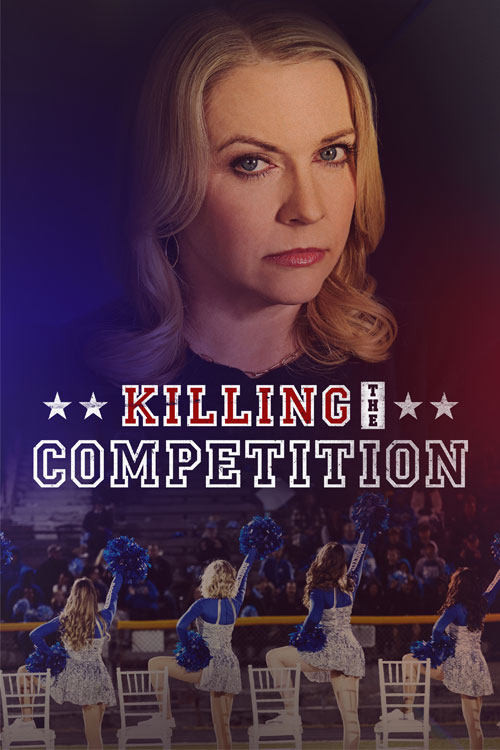
After getting two hours of sleep, I woke up this morning feeling under the weather. I told my sister to go to mass and say a prayer for my continued life. And then, once I had the house to myself, I watched Killing The Competition. Why did I pick that particular Lifetime film? Three words: Melissa. Joan. Hart. SABRINA! Hart has appeared in her share of Lifetime films over the past few years and she always throws herself into each one. When I read that this film featured Hart as an obsessive cheer mom, I knew there was no way I couldn’t watch.
What Was It About?
In high school, Elizabeth (Melissa Joan Hart) was a cheerleader and a member of the chess team. (“See, I was smart!” she says while looking through an old yearbook.) She claims that she was head dancer, even though the cheerleading team has never had a head dancer. Now that she’s married and bored with her suburban existence, Elizabeth pushes her teenage daughter, Grace (Lily Brooks O’Bryant), to try out for the squad. When Grace isn’t selected, Elizabeth lodges a formal complaint and the mayor of the town announces that not only will Grace be a cheerleader but so will every other girl who was rejected that year. Grace is excited but Elizabeth is worried that this will now cause people to view Grace as being a loser who was forced onto the team.
At first, I assumed that Elizabeth would be one of those cheer moms who hired a hitman to take out one of her daughter’s cheer rivals. Instead, Elizabeth turns out to be so pathologically jealous that she gets upset when her daughter makes the team. Elizabeth convinces herself that Grace’s boyfriend is cheating with another cheerleader (Valerie Loo) and that Grace is about get dumped. When Grace doesn’t get dumped or humiliated, Elizabeth goes off the deep end.
What Worked?
Again, three words: Melissa. Joan. Hart. Whether she’s sneaking into cheerleader try-outs or spying on her daughter while wearing sunglasses and a wig, Hart is a total joy to watch as Elizabeth goes mad with envy. Elizabeth tries to run her daughter’s boyfriend over with her car. Elizabeth steals her daughter’s phone and sends texts. (She takes a picture of a wedding dress and sends Grace’s boyfriend a text that reads: “Thinking of the future.”) Elizabeth insists that everyone try on her former cheerleading uniform. Elizabeth talks about how no one will ever forget who you were when you were in high school. Elizabeth points a gun at people and then tries to convince them that it’s no big deal. Elizabeth does a lot of things and Melissa Joan Hart does a great job portraying each and every one of them.
What Did Not Work?
At times, this film was almost too self-aware. That may seem like a strange thing to say about a Lifetime film but I always like the Lifetime films that are subtly self-aware as opposed to the ones that attempt to scream from the rooftops, “We’re laughing with you!” The best Lifetime films often feel like a private joke between the network and its fans, one that only devoted watchers will be able to fully understand and appreciate.
“Oh my God! Just like me!” Moments
Watching this film, I realized how lucky my sister Erin and I were. Our mom was supportive but she wasn’t crazy. She went to every game when Erin was a cheerleader. No matter where we were living, she always found me a dance teacher and she always told me how proud she was of me and she always made me feel like I was the greatest dancer in the world. She was supportive and, though we didn’t appreciate it at the time, she sacrificed a lot to make sure we could do what we wanted to do. But, at the same time, she never tried to kill anyone. We never had to deal with the awkward moment of the police showing up at the house with an arrest warrant. That was a good thing.
I’ll admit it right now. I’ve never really been a dog person.
That’s the way it’s been my entire life. According to my sisters, I was bitten by a dog when I was two years old. Needless to say, I don’t remember that happening but that still might explain why, when I was growing up, I was scared to death of dogs. Seriously, if I was outside and I heard a dog barking or if I saw a dog running around loose (or even on a leash), I would immediately start shaking. It didn’t help that, for some reason, I always seemed to run into the big dogs that wanted to jump and slobber all over me. (“Don’t be scared,” one dog owner shouted at me, “that’ll just make him more wild,” as if it was somehow my responsibility to keep his dog under control.)
Then there was that time when was I was ten and I was visiting Lake Texoma with my family. There was another family there and they had a big black dog with them. When I first saw him, the dog was very friendly. He ran up to me and, tentatively and with my sisters standing beside me for moral support, I even patted his head,. He seemed so nice! Finally, I had met a dog that didn’t scare me. My family was really happy. We went down to the lake and everyone told me how proud they were that I had managed to face a dog without running away. As we came back from the lake, I saw the dog laying down next to his family’s van. I smiled at the sight of him. He raised his head, looked at me, and started to growl. He wasn’t growling at my sisters or my parents. He was growling at me. Terrified, I went over to my family’s car and I ducked down behind it. I could hear my Dad telling the dog to stop and then I heard the loudest barking and saw the dog running towards me. I jumped in the car and locked the doors. The dog’s owners eventually grabbed their dog and took him back to their van. They said that I probably looked like someone who had been mean to it a few weeks earlier. One thing that they did not really do was apologize. Instead, they just made me feel like it was somehow my fault. They didn’t seem sympathetic when my Mom explained that I was terrified of dogs. When they realized my Dad was on the verge of punching someone, they retreated to their van and quickly left. At that time, I decided that 1) I would never trust another dog and that 2) dog owners are the most selfish people on the planet. I know that sounds harsh but seriously, I was traumatized!
As I grew up, I mellowed a bit. I met nice dog owners who actually made the effort to control their pets. I even met some friendly dogs and slowly realized that not all of them were going to try to kill me. I became less scared of dogs but they still definitely make me nervous. I still cringe when listening to the barking and I still reflexively step back whenever I see a big dog anywhere near me. Now that I know more about dogs, I have to admit that I feel a little bit guilty about not liking them more. Knowing that dogs actually blame themselves for me not liking them is kind of heart-breaking and I have been making more of an effort to be, if nothing else, at least polite to the canines who lives in the neighborhood. That said, I’m a cat person and I’ll always be cat person. Cats don’t care if you like them or not nor do they blame themselves if you’re in a bad mood, which is lot less of an emotional responsibility to deal with.
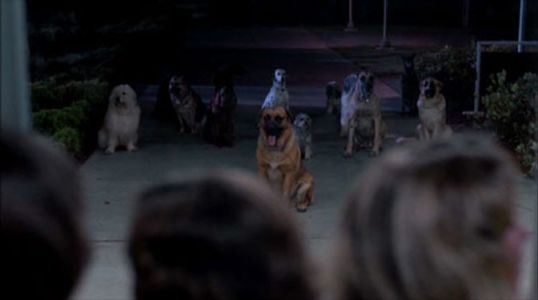
1977’s Dogs is a film that seems like it was especially made to give people like me nightmares. It’s a pretty simple movie. At a college in Southern California, the students and the faculty find themselves under siege from a bunch of dogs that have been driven mad by pheromones being sprayed into the atmosphere by a nearby, top secret government experiment. Two professors (David McCallum and George Wyner) attempt to convince everyone to evacuate the college and the town but, in typical Jaws fashion, no one wants to admit the truth about what’s happening. By the end, nearly everyone is dead (and the final scene of all the dead bodies spread across campus is genuinely haunting) and the cats are starting to hiss at humans.
Dogs is a low-budget drive-in flick but it’s still a frightening film, largely because the dogs are relentless and the victims may be largely stupid but they’re all stupid in realistic ways. A group of college students is told to wait inside until George Wyner comes back for them but Wyner takes so long in returning that the terrified students decide to make a run for it themselves. It doesn’t end well but it’s the sort of thing that I can actually imagine happening. No one likes being told to wait and, with no idea of what’s actually going on, making a run for it might actually seem like as good an idea as any. Even when the movie recreates the Psycho shower scene (with dogs instead of Norman Bates), it’s far more effective than it perhaps has any right to be.
Would this film be as effective from the point of view of someone who doesn’t have a history of being scared of dogs? It’s a legitimate question. Dogs aren’t like sharks. Most people like dogs. But when they’re barking and growling and determined to bite your throat, they can be pretty scary! I’ll just say that Dogs is a film that seemed to be uniquely designed to give me nightmares.
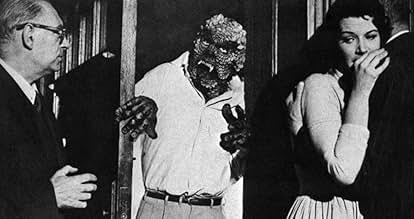
Those words are spoken in the 1958 film, The Hideous Sun Demon. Sultry pianist Trudy (Nan Peterson) may just be talking about her own nocturnal lifestyle and her job as the entertainment at a bar but those words also have a double meaning to scientist Gil McKenna (Robert Clarke). Whenever the sun comes up, Gil is transformed into the Hideous Sun Demon!
In theory, of course, this is an interesting take on the werewolf legend or even a traditional vampire tale. Typically, monsters aren’t supposed to come out until the sun goes down and they can move under the cover of darkness. The werewolf is transformed by the moonlight. The vampire is destroyed by the sun. (Or, at least, he used to be. Largely due to authorial laziness, many modern vampire tales have abandoned the whole idea of not being able to go out during the day.) Gil, however, reverses the trend. By night, he’s a handsome and brooding scientist. By day, he’s not just the sun demon. He’s the …. HIDEOUS SUN DEMON!
(Seriously, that can’t be good for his self-esteem.)
Like all great monsters, Gil doesn’t want to be the sun demon. He tries to stay in his house until night falls so that he won’t be transformed into a monster. But it’s difficult when he finds himself talking to Trudy and getting lost in their conversation. The beach looks so nice at night but it looks even better at dawn!
As for Gil, he’s got a lot of scientists working on a cure for his condition but he knows it’s hopeless and he’s pretty bitter about it. Poor guy. I may not turn into a demon but I do have red hair so I could slightly relate to his feelings. Redheads don’t tan as much as we just burn. I guess that’s one reason why I love this time of year. The skies are full of clouds and one can safely walk around during the daylight hours.
As for The Hideous Sun Demon, it is a ludicrous and fun B-movie, a quick 74-minute beach romp with a convincing performance from Robert Clarke and an effective monster costume. The scientists investigating Gil’s case are all extremely sober while Gil is extremely mopey and Trudy is extremely sultry and George (Peter Similuk), a bar patron who also likes Trudy, is a true middle-aged 50s tough guy. It’s very much a film for the 50s drive-in crowd and all the more entertaining because of it.



 Through the Shattered Lens