Lisa Cleans Out Her DVR: A Blueprint for Murder (dir by Andrew L. Stone)


(I am currently in the process of cleaning out my DVR!  I recorded the 1953 film noir, A Blueprint for Murder, off of FXM on February 21st.)
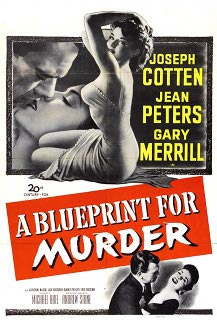
Much like Alfred Hitchcock’s Shadow of a Doubt, A Blueprint for Murder stars Joseph Cotten in a story about a seemingly wonderful person who might actually be a murderer.  Actually, now that I think about it, it seems like Joseph Cotten appeared in quite a few films that centered around that idea.  What distinguished A Blueprint For Murder is that, for once, Joseph Cotten is not the murderer.  Instead, he’s the one who is forced to deal with the overwhelming evidence that someone in his life might be a sociopath.

Cotten plays Cam Cameron, who is shocked when his niece, Polly, suddenly takes ill and dies.  Cam’s immediate response is to comfort his sister-in-law, Lynne (Jean Peters).  And yet, Lynne doesn’t seem to be too upset over Polly’s death.  Could it be because Polly was only her stepdaughter? Or maybe Lynne is no longer surprised by sudden death, seeing as how her husband also died after a sudden and mysterious illness.

Or could it be that Lynne murdered both Polly and her husband?  That’s the theory put forward by Maggie (Catherine McLeod), the wife of Cam’s friend, Fred (Gary Merrill).  Maggie thinks that it sounds like both Polly and her father were poisoned with strychnine!  As the initially skeptical Fred points out, when Lynne’s husband died, he put all of his money in a trust for his children.  If his children die, Lynne stands to inherit the fortune.  Polly’s already dead.  The only remaining obstacle would be Cam’s nephew, Doug.

Much like Don’t Bother To Knock, A Blueprint for Murder barely clocks in at a little over 70 minutes.  It’s a briskly told melodrama and, seen today, it’s easier to imagine it as an episode of a television series than as an actual movie.  As I watched it, I kept thinking that it felt like an old episode of CSI Miami, with Joseph Cotten in the role that would have been played by David Caruso.  (“Two deaths in one family?  It sounds like something’s in the water and it’s not fluoride.”  YEEEEEEEEEEAHHHHHH!  DON’T GET FOOLED AGAIN!!  NO NO!)  For that matter, it was also easy for me to imagine A Blueprint For Murder being remade for Lifetime, with Josie Davis in the Joseph Cotten role and maybe AnnaLynne McCord replacing Jean Peters.

A Blueprint For Murder is actually pretty predictable up until the final 15 minutes.  It’s during the final 15 minutes that Cam, Lynne, and Doug all end up on a cruise ship together and, in an effort to prove his suspicions, Cam does something that has so much potential for backfiring that it kind of makes you reconsider everything that you previously assumed about him.  To be honest, it doesn’t make much sense.  It’s hard to believe, despite what Cam insists, that what he did was his only possible option.  Then again, it is the 1950s.  In an era before DNA testing, maybe the only way to solve a crime was by doing something crazy.

That said, I enjoyed A Blueprint for Murder.  It’s a real time capsule film and you know how much I love those.  I may never be able to find a time machine but I can always experience the past by watching something like A Blueprint for Murder.  Joseph Cotten is, as always, a sturdy lead.  In real life, Jean Peters’s acting career was somewhat derailed when she married legendary weird guy Howard Hughes.  In this film, she gives a great performance as the potentially murderous sister-in-law.

If you’re a fan of 50s noir or either of the two leads, keep an eye out for A Blueprint For Murder.

Lisa Cleans Out Her DVR: 20,000 Years in Sing Sing (dir by Michael Curtiz)


(I am currently in the process of cleaning out my DVR.  I recorded the 1932 film, 20,000 Years In Sing Sing, off of TCM on January 31st.)

I was somewhat surprised to discover that I had this 1930s prison film on my DVR.  I’m not sure what led to me deciding to record it though, if I had to guess, I’d say that it was probably the title.  I probably assumed it was about a prisoner who served a 20,000 year sentence.  I mean, that sounds interesting, right?

It turns out I was wrong though.  The film starts with a shot of a line of prisoners walking into a prison, with their sentence superimposed over their heads.  One guy is in for 7 years.  Someone else has a 50 year sentence.  Another person has a 33 year sentence.  I’m guessing that if you added all of the sentence up, you would end up with 20,000 years.

That’s a lot of angry men, all trapped in one location.  Fortunately, Sing Sing Prison has a compassionate warden.  Paul Long (Arthur Byron) is a good man, a criminal justice reformer who believe that prison should be about more than punishment.  He is tough but fair and he runs his prison on the honor system.  Break the rules and you’ll be tossed into solitary.  Respect the rules and the Warden might even let you leave the prison for a day or two.  The press and the bureaucrats may think that Warden Long is naive but prison guards love him.  “We’re behind you,” the head guard says when it appears that Long might be about to lose his job.  And the prisoners respect him, even if few of them are willing to admit it.

Tommy Connors (Spencer Tracy) is the newest prisoner.  He’s been sentenced to 5 to 30 years for robbery and assault with a deadly weapon.  Tommy’s a tough guy, the type who speaks in the rat-a-tat manner that will be familiar to anyone who has ever watched a 30s gangster film.  He’s a tough guy so he ends every sentence with “see?,” as in, “No prison is going to break me, see?” Tommy’s the type of guy who brags that, even if they send him to solitary, he can do his time standing on his head.  When he gets called into the Warden’s office, he tosses a lit cigarette on the floor.  Can the Warden reform even as rough a customer as Tommy Connors!?

It doesn’t help, of course, that Tommy has a friend named Joe Finn (Louis Calhern) and, even though Joe is on the outside, he’s constantly encouraging Tommy to break the rules.  Joe has an ulterior motive for wanting to keep Tommy in prison for as long as possible.  That motive is his desire for Fay (Bette Davis), Tommy’s loyal girlfriend.  When Fay is injured in an accident, the Warden agrees to let Tommy visit her on the condition that Tommy return in 24 hours.  However, when Tommy’s visit leads to murder, the Warden is blamed.  It gets even worse when the Warden announces that he is sure that, despite the charges against him, Tommy will honor his word and return to the prison.

Will Tommy do the right thing?  Or will he flee and destroy the Warden’s career?

20,000 Years in Sing Sing was produced by Warner Bros and it features the studio’s typical pre-code combination of a B-movie action and progressive politics.  Seen today, it’s a watchable but minor film, one that often seems dated in its view of criminal behavior.  (Even I, a huge believer in the need for criminal justice reform, thought the warden was being incredibly naive when he put the convicts on the honor system.)  That said, it’s always interesting to see Bette Davis in the days before she became the Bette Davis and was just another ingenue trying to make an impression while surviving the studio system.  As well, since Spencer Tracy eventually became best known for portraying wise, plainspoken men, it’s interesting to see him playing the cocky and disrespectful Tommy.

Still, I think there is a place for a movie about someone spending 20,000 Years in Sing Sing.

(I imagine that, after the first 10,000 years, it gets easier.)


Lisa Cleans Out Her DVR: Don’t Bother To Knock (dir by Roy Ward Baker)


(I am currently attempting to clean out my DVR.  I recorded the 1952 film Don’t Bother To Knock off of FXM on April 3rd.)

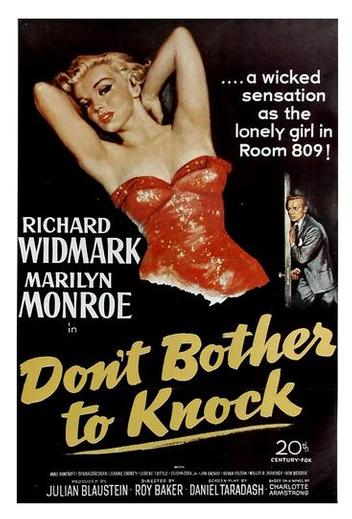
Welcome to the McKinley Hotel in New York City!  The McKinley is a nice place, though it’s no Grand Budapest Hotel.  Presumably, the McKinley was named after the late President William McKinley.  While I’m sure that McKinley would have appreciated the gesture, I don’t know how he would feel about all the melodrama that’s occurring behind closed doors.

For instance, there’s Lyn Lesley (Anne Bancroft, making her screen debut).  Lyn sings in the hotel bar and, though she might seem to be cynical and tough, she actually has a big heart.  In fact, she cares so much about humanity that she broke up with her longtime boyfriend, Jed Towers (Richard Widmark), because he doesn’t seem to have a heart at all.  Of course, she broke up with Jed by sending him a letter.  When Jed checks into the hotel and tracks her down in the bar, he has questions about their breakup and he wants answers that won’t require any reading.  She tells him that he’s not capable of caring about anyone so why should she waste her time on him?  Then she sings a love song because that’s her job.

As for Jed, he’s kind of a jerk in the way that most men tend to be in movies from the 1950s.  He’s an airline pilot who served overseas during World War II and spent a year living in England.  He’s tough and he’s cynical and now, he’s single.  He’s also got a room in a hotel for the night.

And then there’s Peter and Ruth Jones (Jim Backus and Lurene Tuttle), who have a function to attend in the hotel ballroom but who don’t have anyone to look after their ten year-old daughter, Bunny (Donna Corcoran).  Fortunately, the hotel’s elevator operator, Eddie (Elisha Cook, Jr.), has a niece named Nell (Marilyn Monroe).  Nell is quiet and shy and needs the money.  She’ll be more than willing to babysit!

Of course, the only problem with Nell is that she’s a little unstable.  This becomes obvious when she’s left alone with Bunny and promptly says that, if Bunny isn’t careful, something bad might happen to one of her toys.  Inside the apartment, Nell is impressed by all the pretty things owned by Ruth.  She tries on her jewelry.  She sprays her perfume in the air.  She puts on Nell’s negligee and looks at herself in the mirror.  Eddie is not amused when he discovers what Nell’s been doing.  If she wants all of this stuff, he tells her, she needs to marry someone rich.  That’s not bad advice but the only problem is that Nell is currently single.  She’s been single ever since her boyfriend died in a plane crash.  In fact, Nell was so upset by his death that she even tried to commit suicide afterward.

From his room, Jed has a direct view of Nell trying on Ruth’s clothes.  When he and Nell spot each other, Nell invites him over.  She tells Jed that she’s a guest at the hotel and that Bunny is her daughter.  Jed can immediately tell that there’s something strange about Nell.  Nell, meanwhile, thinks that Jed is her dead boyfriend.  Meanwhile, Bunny is helpless in her room…

Clocking in at a brisk 72 minutes, Don’t Bother To Knock feels less like a movie and more like a one-act play or maybe even an adaptation of an old television production.  (After watching the movie, I was shocked to discover that it was based on neither.)  Seen today, it’s mostly memorable for featuring Marilyn Monroe’s first true starring role.  After appearing in small roles in several films (including All About Eve), Don’t Bother To Knock was not only Marilyn’s shot at stardom but also her first dramatic performance.  Reportedly basing her performance on her troubled mother, Marilyn is sympathetic and almost painfully vulnerable.  Her scenes with Elisha Cook, Jr. are especially charged, full of a subtext that will probably be easier for modern audiences to spot than it was for audiences in 1952.  Marilyn gave an incredibly poignant performance and she is the main reason to watch Don’t Bother To Knock.

Lisa Cleans Out Her DVR: A Deadly Affair (dir by David Bush)


(Once again, I am trying to clean out my DVR.  I recorded A Deadly Affair off of the Lifetime Movie Network on March 5th.)

At first glance, Charlie (Alan Powell) and Mary (Austin Highsmith) might look like the perfect couple.  They’re attractive.  They’re apparently in love.  They’ve got a nice house.  Charlie has a manly job as a house renovator and he even has a badass lion tattoo on his chest.

Even better, they’re best friends with another perfect couple!  Susan (Valerie Azlynn) and Trevor (Luke Edwards) are also attractive and apparently in love and they’ve got a nice house of their own!  Susan’s a lawyer and Trevor has got a sexy tattoo too!  Two perfect couples living so close to each other?  What could possibly go wrong?

Well, Mary thinks that Charlie might be cheating on her.  And Trevor says that Susan isn’t really responsive to his needs.  One night, Mary and Trevor have a bit too much to drink.  They end up sharing a kiss.  Mary freaks out and says that she can’t cheat on Charlie, especially not with the husband of her best friend.  Essentially, Mary says, “There’s no way this is going to happen.”  Trevor, being a guy, interprets that to mean, “It’ll happen later.”

Later, Mary gets a call from her husband.  He sounds like he’s in some sort of trouble.  When he doesn’t subsequently return home, Mary goes out to the house that was renovating.  Walking through the dark house, she stumbles across the dead body of her husband.  Someone’s murdered Charlie!

Well, of course, the entire town suspects that Mary killed Charlie.  Even her sister-in-law, the possibly unstable Crystal (Lorna Street Dopson), is convinced that she saw (and heard) Mary with Trevor.  It doesn’t matter how much Mary protests her innocence.  The detective (J. Terry Garces) in charge of the case thinks that she did it.  The entire town thinks that she did it.  Soon, Mary is running the risk of losing her teaching job.  The parents don’t want a murderer teaching their kids…

In fact, it appears that only one person is willing to stand up for Mary and that’s Susan!  Susan is not only Mary’s lawyer but she’s her best friend as well.  But how is Susan going to react if she finds out that Mary kissed her husband…

Towards the end of A Deadly Affair, there’s a scene where the murderer says, “Thank you for begging.  I appreciate that.”  I love that line and it pretty much sums up the reason why I enjoyed this movie.  A Deadly Affair is an enjoyably twisty and over the top murder mystery, the type of movie where characters interrupt meetings by storming into the room, shouting, “You bitch!” and then slapping someone hard.  It’s a lot of fun.

And, I don’t want to give away any spoilers but I will say that the person playing the murderer did a really good job when it came time for the big reveal.  It takes a definite skill to make the confessional monologue compelling but this person did it.

A Deadly Affair was a lot of fun.  If you enjoy over the top melodrama (and who doesn’t?), you’ll enjoy this one.

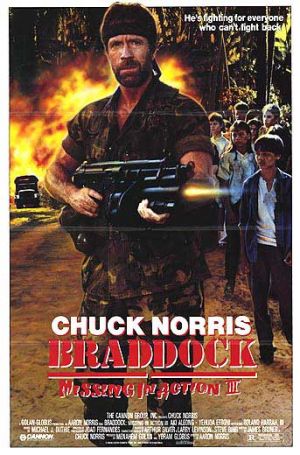
A Movie A Day #137: Braddock: Missing in Action III (1988, directed by Aaron Norris)


Chuck Fucking Norris, dude.  Chuck Norris is so cool that continuity bends to his will and thanks him for the opportunity.
Need proof?

Just watch Braddock: Missing in Action III.

The third Missing in Action film starts in 1975, with the fall of Saigon.  The communists are taking over.  The Americans are fleeing Vietnam.  Colonel James Braddock (Chuck FUCKING Norris) is determined to bring his Vietnamese wife to America with him but, when she loses her papers and is not allowed to make her way to the American embassy, Braddock believes that she had been killed. (Keep an eye out for Keith David as the Embassy guard.  Only Chuck Norris could overshadow Keith David in a movie.)  Heartbroken, Braddock returns to the United States.

Every fan of the Missing in Action franchise knows better.  We all know that Chuck was in a POW camp when Saigon fell.  In Missing in Action 2, he and his fellow prisoners did not even know if the war had ended.  Also, Chuck mentioned having a wife waiting for him back in the United States.  What gives?

I can think of only two possible explanations.

Either Chuck Norris and Cannon Films did not care about continuity

or

Chuck Norris is so cool that, in order to prevent his collected coolness from knocking the Earth off of its axis, the U.S. Army split Chuck’s coolness in half by creating a clone.  One clone spent ten years in a POW camp.  The other clone escaped during the Fall of Saigon but had to leave behind his wife.

Thirteen years later and back in the U.S., Chuck is contacted by Reverend Polanski (Yehuda Efroni), who tells him that his wife is still alive in Vietnam and that he has a 12 year-old son.  Chuck’s boss at the CIA tells him that, under no circumstances, is Chuck to go to Vietnam.

Anyone who thinks they can tell Chuck Norris what do is a fool.

Chuck goes to Vietnam and is reunited with his wife and son.  Unfortunately, when Chuck tries to get his new family out of the country, they are captured by sadistic General Quoc (Aki Aleong).  Again, Braddock must escape from a Vietnamese prison camp.

Braddock: Missing in Action III was co-written by Chuck Norris and it was directed by his brother, Aaron.  It’s a Norris production all the way, which means a lot of heroic shots of Chuck and a lot of bad guys wondering why Chuck is so much better than them.

Braddock was released four years after the first Missing in Action but, more importantly, it was released two years after Oliver Stone’s Platoon changed the way that movies dealt with the war in Vietnam.  By the time that Braddock came out, films in which lone American refought and single-handedly won the war were no longer in fashion.  Braddock was a flop at the box office and it ended the franchise.  However, continuity errors aside, Braddock is actually the best of the Missing in Action films.  It features Chuck’s best performance in the series and Chuck searching for his wife and child gives Braddock more emotional weight than the first two Missing in Action films. Maybe Chuck should have co-written and selected the director for all of the films he made for Cannon.

Chuck Norris, dude.

Chuck Fucking Norris.

A Movie A Day #136: Missing in Action 2: The Beginning (1985, directed by Lance Hool)


Goddamn, dude.  Chuck Fucking Norris.  Even when the movie is terrible, Chuck is cool.
That is especially relevant when it comes to a movie like Missing In Action 2: The Beginning.  Produced by Cannon Films and shot back-to-back with the first Missing in Action, The Beginning was supposed to come out first.  However, Menahem Golan and Yoram Globus took a look at the two movies and realized that The Beginning would work better as the 2nd film in the series.  They were right though some post-production tinkering did lead to some serious errors in continuity.

(Not that anyone watching a Golan/Globus production would be worrying about continuity.)

Did you ever wonder how James Braddock (Chuck Norris) became a POW in the first place?  No?  Missing In Action 2 is going to show you how it happened anyway.  It turns out that he and his men were captured, in 1972, by the Viet Cong when their helicopter crashed into a lake.  At the start of the movie, Chuck only has a mustache.  If Chuck had been fully bearded, there is no way the VC could have captured him.  After Chuck and his men have spent ten years in a jungle prison, where they are forced to pick poppies for a French heroin drug lord, Chuck has grown a full beard and is finally strong enough to escape from the prison, rescue his men, and defeat the sadistic camp commandant (Soon-Tek Oh) in hand-to-hand combat.  None of it is surprising but there’s enough weird stuff, like the prostitutes that the French drug dealer flies into the camp and the Australian journalist who shows up out of nowhere and is executed ten minutes later, to keep it interesting.  Chuck is as stiff as always but he’s good in the action scenes and gets to show off some sweet karate moves towards the end of the movie.  Supposedly, Chuck viewed the Missing in Action films as a tribute to his brother, Wieland, who was killed in Vietnam.

The continuity error has to do with the amount of time that Braddock and his men spend in the camp.  After Chuck is captured in 1972, the film inserts some footage of Ronald Reagan giving a speech about the men who never returned from Vietnam.  A narrator says that the Americans are still wondering what happened to the thousands of soldiers who were reported as being MIA in Vietnam.  The implication is that Chuck and company spent ten years in the POW Camp, which means that they escaped in 1982.  Since it is said, in Missing in Action, that it has been ten years since Chuck escaped, that means that Missing in Action actually took place in 1992.  But if Chuck and the boys escaped and returned to America in 1982 then why, in 1992, was everyone so convinced that all the POWs were released immediately after the Vietnam War?

Fortunately, Chuck Norris is so cool that it doesn’t matter what year it is.

Chuck Norris, man.

Chuck Fucking Norris.

Let’s Go to the Drive-In with Charles Bronson in BREAKOUT (Columbia 1975)


gary loggins's avatarcracked rear viewer

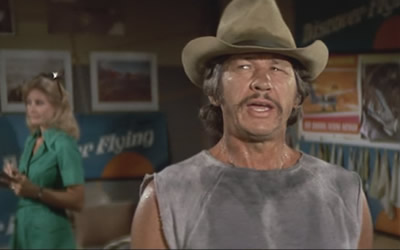
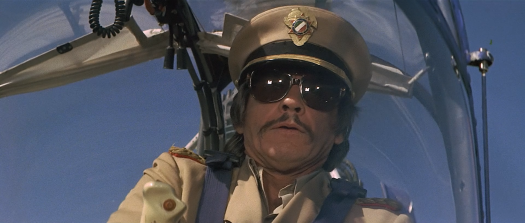
Charles Bronson  finally achieved superstar status in the 1970’s after years of toiling in supporting parts thanks to drive-in fare like THE MECHANIC, MR. MAJESTYK, and the DEATH WISH films. 1975’s BREAKOUT had a bigger budget, a better than average cast, and major studio support, but at it’s heart it’s still a drive-in movie, albeit a cut above the usual action flick.

Bronson casts aside his normal stoic, stone-faced screen persona as Nick Colton, a somewhat shady pilot/mercenary who’ll do anything for a buck. Charlie’s quite a charmer here, displaying a sense a humor and talking a lot more than usual. He’s in rare form, getting to display his acting chops, honed through over two decades in the business, and is obviously having a good time in the role.

Nick is hired by Ann Wagner to rescue  her husband Jay, framed by his own grandfather and sentenced to a ruthless Mexican pennitentary…

View original post 399 more words

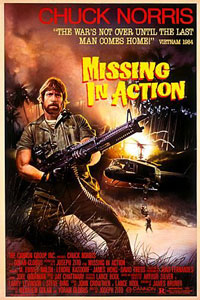
A Movie A Day #135: Missing in Action (1984, directed by Joseph Zito)


Chuck Fucking Norris, man.  Is there anything this man can not do?

In Missing in Action, he plays Colonel James Braddock, an army intelligence officer.  For a career military man, his long hair and his beard are definitely against regulations but who is going to tell Chuck Norris to get a haircut?  Ten years ago, Braddock escaped from a POW camp in North Vietnam.  Haunted by nightmares and still convinced that there are American POWs in Vietnam, Braddock is inspired by an episode of Spider-Man and his Amazing Friends (I am not joking!) to accompany a U.S. Senator on a fact-finding trip to Ho Chi Minh City.  It’s there that Braddock uncovers evidence that American soldiers are being held prisoner by the evil General Trau (James Hong).  With the government refusing to help him, Braddock is forced to go to Thailand, where he hooks up with an old friend, a former soldier turned black marketeer named Tuck (M.  Emmett Walsh).  Braddock and Tuck head into the jungle, to both rescue the POWs and to remind the world that, no matter what a bunch of pointy-headed lefties might say, Americans never lose a war!

A blatant rip-off of the Rambo films, Missing in Action was one of Cannon Films’ most financially successful movies.  Seen today, Missing in Action is borderline xenophobic and it takes forever for the action to really get started.  I was surprised by the number of scenes that were devoted to Braddock looking for evidence that the POWs were still in Vietnam, as if there was ever any real suspense about what Braddock would find.  (No POWs = no movie.)

On the positive side, once it finally starts, the action is exciting.  Joseph Zito was a veteran genre director and he know how to handle a battle scene.  Unfortunately, in this one, Chuck does most of his fighting with a machine gun instead of his hands.  This is also one of the first movies where Chuck Norris has the full beard going.  The beard serves to distract from what a stiff actor Chuck Norris usually was and it does its job in Missing in Action.  When it comes to picking a Chuck Norris film to watch, it’s a good idea to see how much facial hair will be featured.  If Chuck has a beard, definitely watch.  If Chuck only has a mustache, proceed with caution but, if there’s nothing else to watch, give the movie a chance.  If Chuck is clean-shaven and Bruce Lee is nowhere to be seen, throw the movie back and never speak of it again.

Missing in Action was shot back-to-back with what eventually became known as Missing in Action 2: The Beginning.  Originally, The Beginning was meant to be released first and Missing in Action was intended to be a sequel.  However, once the execs at Cannon saw the footage, they deemed The Beginning to be unreleasable and instead sent Missing in Action out to theaters.  (A movie so bad that even Cannon was hesitant to release it?  It boggles the mind.)  Missing in Action was such a box office success and The Beginning was subsequently released as a prequel.  However, when it comes to Norris/Cannon films, Invasion USA is the one to watch.  That one has a bearded Chuck and Richard Lynch!

A Movie A Day #134: America Ninja 3: Blood Hunt (1989, directed by Cedric Sundstrom)


Is an American Ninja film still an American Ninja film if it doesn’t feature the American Ninja?

That is the question posed by American Ninja 3: Blood Hunt.  Michael Dudikoff, who played Joe Armstrong in the first two films, is nowhere to be found.  Instead, he has been replaced by Doug Bradley.  Fortunately, the movie does not try to pass Bradley off as being Joe Armstrong.  Instead, he is a new character, CIA agent Sean Davidson.  Sean’s father was a martial arts champion who was killed by gangster while Sean watched.  Sean later went to Japan where he was trained in the ways of the ninja.  Sean is an American ninja, even if he’s not the American Ninja.

He also happens to be best friends with Jackson (Steve James), who previously appeared in the first two films and who never comments on the coincidence of having two best friends who both happen to be American ninjas.  Jackson, along with sidekick Dexter (Evan J. Klisser) and lady ninja Chan Lee (Michele B. Chan), team up with Sean after Sean’s sensei is kidnapped by a terrorist known as The Cobra (Marjoe Gortner).  The Cobra, who has a team of his own ninjas, has developed a poison that he wants to test on Sean.

The plot makes as much sense as the previous two American Ninja films and, somehow, everyone forgets about finding the sensei before the movie ends.  As an actor, Doug Bradley is no Michael Dudikoff (which is saying something) but he’s good in the fight scenes and that is the only thing that really matters.  The whole film is nearly worth it just to see former child evangelist Marjoe Gortner in the role of The Cobra.  Dudikoff is missed but at least his absence meant that Steve James got to do more in American Ninja 3 than he did in the first two films.  Sadly, just three years after this film’s release, James died as the result of pancreatic cancer.  He was 41 years old.

Screwball Comedian: Joe E. Brown in ALIBI IKE (Warner Brothers 1935)


gary loggins's avatarcracked rear viewer

We’re about a quarter of the way through the baseball season, so let’s take a trip to the ballpark with Joe E. Brown in ALIBI IKE, a 1935 comedy based on a story by Ring Lardner, one of the best baseball writers of the early 20th Century. Brown, known for his wide mouth and comical yell, is an admittedly acquired taste; his “gosh, golly” country bumpkin persona is not exactly what modern audiences go for these days.  But back in the 30’s he was one of Hollywood’s top box-office draws, specializing in sports themed comedies  revolving around wrestling (SIT TIGHT), track and field (LOCAL BOY MAKES GOOD), swimming (YOU SAID A MOUTHFUL), polo (POLO JOE), football ($1,000 A TOUCHDOWN), and racing (boats in TOP SPEED, airplanes in GOING WILD, bicycles in SIX DAY BIKE RACE).

ALIBI IKE is the final chapter in Brown’s “baseball trilogy”. The first, 1932’s FIREMAN, SAVE MY CHILD, found him…

View original post 493 more words