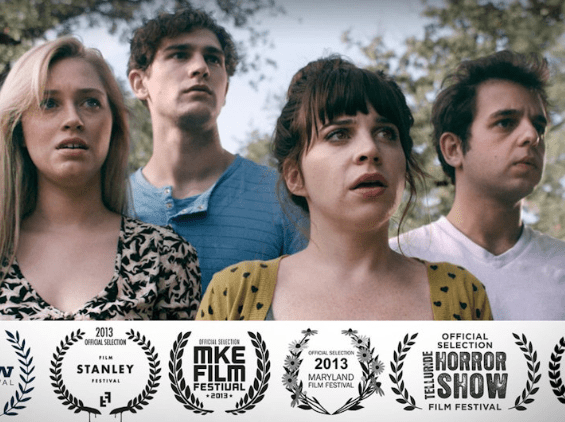
Hell No: The Sensible Horror Film, Short Film Review by Case Wright


This is fun!!! Technically, this short film does not have an actual story, BUT it is still a well done and fun short film. But Case, you’re so hard on everyone and this year you’re being so lenient! Fair critique, but I argue that this is within the parody genre and is exempt from my usual rules. Attack of the Killer Tomatoes was one of the first films to do a feature length send up of many different movies and this short is in that vibe.

They go through the tropes: they stop at an abandoned cabin and say – F THAT!, a cop who WAITS for backup, and a boy who finds the Hellraiser puzzle and just plays with his iPhone instead and then does something hilarious to the box. If you want a quick laugh when you’re in line or anything other time you have about 3 minutes to kill, it is great choice. Life can be challenging and good laugh is better than a good cry.

October Positivity: Marriage Retreat (dir by David Christiaan)


In 2011’s Marriage Retreat, Jeff Fahey and Victoria Jackson play marriage counselors.

Seriously, that’s bring to mind some wonderful images, doesn’t it?  I would pay money for a film where Jeff Fahey plays a Dr. Phil-type psychiatrist who has his own television show where he yells at his guests and tell them that they’re not worth his time.  Fahey would totally knock that role out of the park.  As for Victoria Jackson, her eccentric screen persona would seem to make her the perfect companion for Fahey.  Fahey is known for intensity.  Jackson is known for being in her own private world.  They’re a good combination!

And Fahey and Jackson are the best things about Marriage Retreat.  Admittedly, Victoria Jackson doesn’t really get to do too much but she has a few good scenes with Fahey.  Fahey, for his part, dominates the entire film.  Marriage Retreat may be a lightweight and ultimately rather light-headed comedy but Fahey doesn’t give a lightweight performance.  Fahey delivers all of his lines with that hard-driving intensity of his and, when someone complains about being married, Fahey’s glare tells you all you need to know.  If the film’s message was that being a bad husband results in dealing with the wrath of Fahey, many husbands would immediately shape up.

Unfortunately, the rest of the film doesn’t really live up to the performances of either Fahey and Jackson.  The majority of the film deals with three boring couples who all go on a marriage retreat.  They stay at what appears to be a summer camp and they discuss why their marriages are falling apart.

For instance, Mark (David A.R. White) says that he’s not ready to be a father and he’s come up with all sorts of financial excuses to justify not starting a family.  Do you think Jeff Fahey’s going to let him get away with that?  No way!  Plus, Mark’s wife (Andrea Logan White) is already pregnant so Mark better stop whining and step up.

Bobby Castle (Tommy Blaze) was a successful businessman but then he blew all of his money in some unwise investments.  Now, Bobby is addicted to gambling online and his wife (Caroline Choi) is thinking of leaving him.  Bobby is such a degenerate gambler (to quote Joe Pesci in Casino) that he even finds a way to get online at the camp so that he can continue to play poker on the Internet.  The man needs help!

And finally, James Harlow (Matthew Florida) needs to grow up, especially since he’s about to become a father…. wait, a minute, I thought that was Mark’s problem.  Well, no matter.  Grow up, James!

The men are all immature and Jeff Fahey calls them out on it while Victoria Jackson tells the wives that they need to remember that God made them second and their job is to support their husbands …. wait, what?  Oh, wait — this is another faith-based movie about marriage.  The recurring theme in these films is that, no matter how much the husband screws up, it’s still ultimately the fault of the wife for not being understanding and supportive.  Yeah, okay, then.  There’s a difference between being supportive and being a doormat.

Anyway, the problem with this film is that I didn’t really care about the married couples.  But I did enjoy watching Jeff Fahey do his thing.

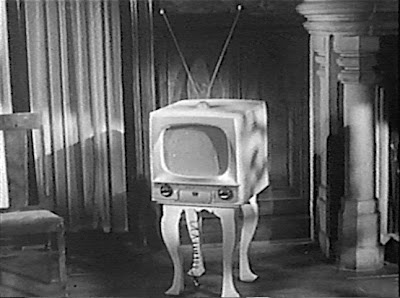
Horror On Television: Final Curtain (dir by Edward D. Wood, Jr.)


1957’s Final Curtain is a short, 22-minute film in which a mysterious man (Duke Moore) wanders around a creepy and seemingly abandoned theater.  While Dudley Manlove (who played Eros the Alien in Plan Nine From Outer Space) provides narration, the man sees many strange things in the theater.  What is real and what is merely a hallucination?  Watch to find out!

Final Curtain was envisioned, by director Edward D. Wood, as being the pilot for a horror anthology series.  Though none of the networks were interested in buying Wood’s proposed series, Wood considered Final Curtain to be his finest film and it certainly is a bit more atmospheric than the typical Wood film.  The role of the mysterious man was written for Bela Lugosi but, after Lugosi passed away, Duke Moore was cast in the role instead.

From 1957, here is Final Curtain.

The TSL Horror Grindhouse: The Sadist (dir by James Landis)


1963’s The Sadist opens with three teachers driving to a baseball game.

Ed (Richard Alden), Doris (Helen Hovey), and Carl (Don Russell) are planning on just having a nice night out but their plans change when they have car trouble out in the middle of nowhere.  They pull into a gas station/junkyard that happens to be sitting off the side of the road.  The teachers look for the owner of the gas station or at least someone who works there.  Instead, what they find is Charlie Tibbs (Arch Hall, Jr,) and bis girlfriend, Judy Bradshaw (Marilyn Manning).

Charlie is carrying a gun and he demands that the teachers repair their car and then give it to him so that he and Judy can continue their journey across the country.  Charlie has been switching cars frequently, largely because the cops are looking for him.  That’s because Charlie has been killing people all up and down the highway.  The intellectual teachers find themselves being held hostage by Charlie and Judy, two teenagers who may not be as smart as them but who have the killer instinct that the teachers lack.

It’s interesting to watch The Sadist after watching Eegah!  Arch Hall, Jr. and Marilyn Manning played boyfriend and girlfriend in that one as well but neither Hall nor Manning were particularly credible in their roles.  Hall seems uncomfortable with the whole teen idol angle of his role while Manning seemed a bit too mature for the role of a teenager.  In The Sadist, however, they’re both not only believable but they’re terrifying as well.

Charlie and Judy are almost feral in their ferocity, with both taking a disturbing glee in taunting the teachers.  Charlie kills without blinking and Judy enjoys every minute of it.  It’s easy to imagine Charlie and Judy at a drive-in showing of Eegah!, laughing at the sight of the caveman getting gunned down by the police and never considering that violence in real life is different from killing in the movies.  The teachers discover that it’s impossible to negotiate with Charlie and that Charlie’s promise not to try to kill them if they fix the car is ultimately an empty one.  And yet the teachers, dedicated to education and trying to reach even the most difficult of students, struggle to fight back.  They’re held back by their conscience, something that Charlie does not possess.  It’s intelligence vs instinct and this film suggests that often, intelligence does not win.

It’s a pretty intense and dark film, one that makes great use of that junkyard setting and which is notable for being the first film to feature the cinematography of Vilmos Zsigmond.  For those who appreciate B-movies, it’s memorable for showing that, when he wasn’t being pushed to be a squeaky-clean hero who sang sappy ballads in films directed by his father, Arch Hall, Jr. actually was capable of giving a very good performance.

The Sadist was based on the true-life crimes of Charlie Starkweather and Caryl Ann Fugate.  Interestingly enough, their crimes also inspired Terence Malick’s  Badlands.

The Saga of the Viking Women and Their Voyage to the Waters of the Great Sea Serpent (1958, directed by Roger Corman)


The Saga of the Viking Women and Their Voyage to the Waters of the Great Sea Serpent.  That’s the title of this one and it’s far too long for a 67-minute drive-in feature.  Maybe Roger Corman thought he could fool people into thinking the movie was better than it was by giving it a pompous sounding title.

A group of Viking men leave on a voyage and never come back.  After waiting nearly a year, the remaining Viking women vote to set sail and look for them.  Leading them is Desir (Abby Dalton) and she even welcomes the bad-tempted Enger (Susan Cabot) onto their boat.  The last remaining male Viking, Ottar (Jonathan Haze), also joins the quest.

The Viking women (and Ottar) have barely set sail when a “giant” sea serpent rises out of the water and strands them on an island.  The Viking women discover that their men are being held prisoner on the island.  Even if they can rescue their men from King Stark (Richard Devon), the sea serpent still waits for them to try to return.

The Saga of the Viking Women and yadda yadda yadda is a remarkably cheap-looking epic.  A major film about the Vikings was scheduled to be released by United Artists and Corman, determined to get his movie into theaters first, shot the film in ten days and for $65,000.  Irving Block and Jack Rabin, two special effects experts, promised Corman an amazing sea serpent and instead delivered what appeared to be a water-proof puppet.  The Sea Serpent only appears in two scenes and Corman doesn’t allow us a very good view of it.  It looks like something you could have picked up at Toys ‘R Us back in the day.

There’s nothing convincing about the movie, from the costumes to the combat to the serpent.  This was one of Roger Corman’s early misfires though, released on a double bill with the Astounding She-Monster, it still made money.  People love Vikings.


October True Crime: Manson: Summer of Blood (dir by Brad Osborne)


Charles Manson was a bore.

That was one of the first thoughts I had while watching 2024’s Manson: Summer of Blood.  The film opens with Charles Manson (Wes Gillum) sitting in a prison cell, with his long scraggly hair and his gray beard.  (Actor Wes Gillum doesn’t really look like Manson but he does possess a certain resemblance to Josh Brolin.)  Manson is being interviewed about his crimes by an almost unnaturally calm man named Jacob Cohen (Joseph Boehm).

Manson goes through the usual facts of his early life.  He talks about not knowing who his father was.  He talks about spending the majority of his life in prison.  Even before he became famous as the leader of the Family, Manson was a career criminal.  Manson talks about trying to pursue a musical career in Los Angeles.  He kisses Dennis Wilson’s feet.  He gets angry when he feels that record producer Terry Melcher (Chad Bozarth) cheated him out of a record deal.  He talks about picking up hitchhikers and making them a part of the Family.  And, as he speaks, he uses all of the familiar phrases.  He talks about how the members of the Family are “your children.”  Blah blah blah blah.

For all the attention that Charles Manson was given over the course of his life, he was essentially a third-rate intellect who picked up a few key phrases in the 50s and 60s and repeated them ad nauseum.  Manson’s words and justifications meant nothing but, because he said them so often and they were slightly more poetic than the usual career criminal blathering, there were people got into their heads that Manson was some sort of rebel philosopher.  The truth of the matter was that the only people dumber than Manson were the ones who decided to live with him at Spahn Ranch.

Unfortunately, dumb people can still hurt people.  That was certainly the case with Charles Manson.  The film depicts the murders of Gary Hinman, Sharon Tate, Jay Sebring, Abigail Folger, Voytek Frykowski, and, to a lesser extent, Leno and Rosemary LaBianca.  It’s difficult to watch and that’s the way it should be.  I remember, when Once Upon A Time In Hollywood came out, there were a lot of people who objected to Rick Dalton setting “Sadie” on fire in his pool.  If those people knew even the slightest details of what Sadie — real name: Susan Atkins — actually did and said to Sharon Tate and her unborn child, they would understand why she got exactly what she deserved in Tarantino’s reimagining of that terrible night.

As for Manson: Summer of Blood, my initial reaction while I was watching it was that it was another movie that exploited a real life tragedy.  I found myself wondering why we should care what Charles Manson had to say about himself and his crimes.  But that was before the final ten minutes of the film.  The final ten minutes of the film features a wonderful twist, one that truly gave that old bore Manson the ending that he deserved.  I’m still not sure that we needed another film about Charles Manson and his crimes but I do know it would be nice if most serial killer films ended the same way was Manson: Summer of Blood.

Horror Film Review: Eegah! (dir by Arch Hall, Sr.)


First released in 1962, Eegah! has a reputation for being one of the worst films ever made.

Usually, whenever I come across a film with that type of reputation, my natural instinct is to be a contrarian and to argue that the film is not so much bad as its just misunderstood.  I can’t really do that with Eegah!  Eegah! is a legitimately bad movie, though I don’t know if I’d call it one of the worst.  It’s a low budget vanity project and, quite frankly, I think snarkiness is better directed at big budget vanity projects.  Eegah! is bad but it’s also bad enough to be entertaining in a train wreck sort of way and there’s something to be said for that.

While driving at night, 30 year-old teenager Roxy Miller (Marilyn Miller) runs over Eegah (Richard Kiel), a giant caveman who has somehow gone unnoticed up until that moment.  Eegah runs off into the desert.  Roxy tells her boyfriend, Tom (Arch Hall, Jr.) and Tom’s father, Robert (Arch Hall, Sr., who also directed) about her encounter.  While Tom plays his guitar and sings a sappy ballad, Robert goes into the desert in search of Eegah.  When Robert doesn’t return, Tom and Roxy grab a dune buddy and head into the desert.

Roxy finds Eegah and Robert first.  Eegah grabs Roxy and takes her to a nearby cave, where Robert is waiting for them.  Eegah can’t speak and does most of his communication by swinging around a club and being a bit too handsy.  (There’s one painting on the wall of his cave but it’s not very good.)  Eegah, despite his fearsome appearance, seems to actually be pretty amiable.  But then he falls in love with Roxy and becomes rather possessive.  When Roxy gives Robert a shave, the bearded Eegah demands a shave as well.  He’s fairly handsome without the beard but still, it’s hard not to get grossed out by the way he tries to lick up the thick shaving cream that’s covering his face.

Eventually, Tom rescues Roxy and Robert and not a minute too soon!  There’s a party in town and Tom and his band are scheduled to play!  Eegah, upset that Roxy has left him, picks up his club, puts on his best animal skin, and heads into town on a rampage!

Eegah (and, yes, I’m dropping the exclamation point) was produced and directed by Arch Hall, Sr.  (He receives a story credit as well.)  It was actually one of many movies that Hall Sr. made, all in an effort to make his son into a film star.  In Eegah, Arch Hall, Jr. performs two songs and dances with Roxy.  The film positions him as a teen idol but Hall, Jr. doesn’t seem to be particularly comfortable with the role.  Of course, it doesn’t help that he’s working with an absolutely terrible script.

I do, however, appreciate the performance of Richard Kiel as Eegah.  Kiel does the best that anyone could with the role, playing him as being  giant who simply doesn’t understand that you can’t walk around with the a club in public without someone calling the police.  Poor Eegah!  He doesn’t even know what the police are.

Eegah! (yeah, I’ll return it’s exclamation point for the next-to-last paragraph) is a film that is so ineptly done and poorly written that it becomes rather fascinating to watch.  It’s boring only if you’re the type who can’t appreciate terrible dialogue, terrible camera placement, and the type of acting that can only be found in a film that was directed, produced, and essentially written by one guy trying to make his reluctant son into a star.

Arch Hall, Jr. was far less interested in being a star and instead became a pilot and pursued his love of flying.  As for Richard Kiel, he went on to play Jaws, one the greatest of the James Bond henchmen.

Horror On The Lens: Plan 9 From Outer Space (dir by Edward D. Wood, Jr.)


Today, we pay respect to Edward D. Wood, Jr. on the date of his birth.  He was born 101 years ago today.

Some films need no introduction and that’s certainly the case with Wood’s 1957 masterpiece, Plan 9 From Outer Space.

Plan 9 is a film like no other, a film that mixes UFOs with zombies and which ends with a rather sincere plea for world peace.  When Eros the Alien explains that the Solarnite bomb could destroy the entire universe, the film’s hero, airline pilot Jeff, doesn’t point out that Eros’s logic doesn’t make sense.  Instead, he just says that he’s glad that America is the one that has the bomb.  “You’re stupid!  Stupid minds!” Eros shouts before Jeff flattens him with one punch.  Go Jeff!  Don’t take any backtalk from that judgmental alien!

From Criswell’s introduction to Tor Johnson’s rise from the dead to Lyle Talbot casually standing with his hands in his pockets while a UFO explodes above him, Plan 9 is a true classic of some sort.

Can you prove it didn’t happen?

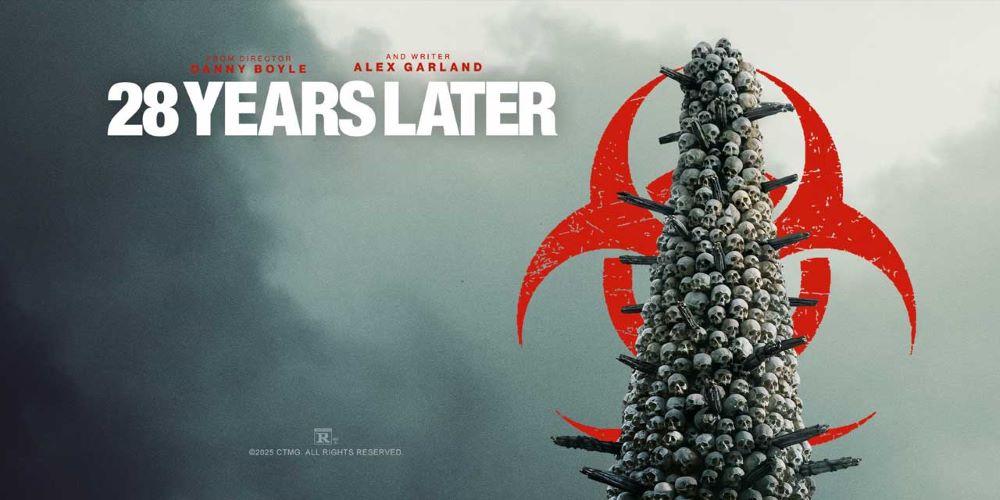
Horror Review: 28 Years Later (dir. by Danny Boyle)


Danny Boyle waited nearly two decades to return to the world he helped redefine with his groundbreaking 2002 film 28 Days Later, which reshaped the zombie subgenre by replacing the traditional, slow-moving undead with fast, feral infected that embody contagion, panic, and societal collapse. While purists continue to debate whether the creatures are technically zombies or infected, Boyle’s vision fundamentally changed how audiences engage with themes of epidemic, survival, and the breakdown of order on screen. The 2007 follow-up, 28 Weeks Later, directed by Juan Carlos Fresnadillo, expanded the Rage virus mythology and landscape but lacked the original’s haunting intimacy and innovation, leaving the franchise in a state of uncertainty until Boyle and writer Alex Garland reunited for 28 Years Later, a film that feels less like a conventional sequel and more like an elegy for a deeply changed world.

The film opens with a short, brutal prologue: young Jimmy Crystal’s family is consumed by the Rage virus while watching Teletubbies, and the boy flees to find safety only to discover his minister father welcoming the infected as a sign of apocalyptic judgment. This early scene deftly establishes the film’s unease, blending visceral horror with spiritual inquiry and foreshadowing a narrative caught between faith, grief, and chaos. Boyle reasserts his command of visceral set pieces while signaling that this film is more concerned with memory and ritual than with relentless terror.

Decades later, the British Isles have been sealed off; NATO forces enforce a quarantine and blockade, isolating the mainland as a toxic exclusion zone. On the tidal island of Lindisfarne, a small community clings to a fragile existence, protected by a causeway that floods at high tide—a detail that metaphorically underscores themes of isolation and dangerous connection. It is here that the emotional core emerges in Jamie and his son Spike, played by Aaron Taylor-Johnson and the remarkable newcomer Alfie Williams. Their spare, heartfelt relationship grounds what otherwise wanders into meditative and often surreal territory.

Alfie Williams emerges as one of the year’s most impressive new talents. His portrayal of Spike avoids the usual survivor archetype; instead, he presents a boy deeply shaped by inherited trauma and cautious curiosity. Boyle’s camera lingers on Williams’ face, capturing silent shifts of fear, wonder, and resilience, making his quiet moments as powerful as the film’s larger set pieces. Williams shines particularly in a sequence where Spike and his mother, portrayed with subtle grace by Jodie Comer, navigate a moss-covered village reclaimed by nature; Williams embodies awe and terror with a single glance. His encounters with the evolved infected—some sedentary and tree-like, others organized into predator packs—are charged with terrifying authenticity and emotional depth. Early reviews label Williams a breakout star, praising his ability to hold the screen alongside veteran actors.

Visually, Boyle and cinematographer Anthony Dod Mantle experiment with a striking mix of techniques, blending the use of iPhone 15 Pro Max cameras and drones with traditional film methods to create a language that oscillates between intimate human moments and sweeping, documentary-style landscapes. The Britain depicted is no longer a lifeless wasteland but an ecologically regrown terrain—lush, eerie, and indifferent. This verdant backdrop reflects the Rage virus’s own evolution. The infected have adapted in ways both terrifying and fascinating: some feed off the earth and fungus, becoming near-plantlike and sedentary, while others form packs ruled by alpha mutants, suggesting emergent social structures even after humanity’s collapse. This biological and ecological evolution amplifies the film’s central theme: survival transcending humanity.

Anchoring the film’s philosophical inquiry is Ralph Fiennes’s performance as Dr. Ian Kelson, a former general practitioner who has exiled himself to live among the infected. Fiennes crafts Kelson with haunting solemnity and layered ambiguity—part caregiver, part fanatic, part recluse—who has created the eponymous “Bone Temple,” a shrine assembled from bones and memories to honor the dead and the changed world they inhabit. The role requires quiet intensity, and Fiennes delivers; his interactions with Spike are charged with both menace and melancholy. Kelson’s reverence for the infected and his willingness to coexist with them challenge traditional survivalist narratives, injecting the film with a solemn meditation on loss, acceptance, and the possibility of new forms of life.

28 Years Later opts for a deliberately slower, more contemplative pace than its predecessors. Boyle and Garland invest their energy in exploring grief, adaptation, and collective memory. The infected become symbolic forces of transformation rather than mere antagonists, while survivors seek meaning through ritual and remembrance as a bulwark against despair. This approach has divided fans: some lament the absence of the unrelenting terror and pace that characterized the earlier films, while others welcome the franchise’s intellectual maturity and thematic depth.

Certain scenes—such as the stranded NATO patrol subplot and glimpses of emerging cult-like human factions—hint at a larger, more complex world but never overshadow the film’s intimate father‑son narrative. Jodie Comer complements Williams with a nuanced portrayal of Spike’s mother, and Taylor‑Johnson brings grounded emotional weight to Jamie, embodying a parent wrestling with how to protect the next generation in a broken world and dealing with his own inner demons.

The interplay between Williams and Fiennes forms the film’s core dynamic, uniting youthful vulnerability with somber reflection. Kelson’s philosophical acceptance of the apocalypse contrasts with Spike’s struggle for identity and belonging, producing compelling, often unsettling exchanges that elevate the narrative’s moral complexity.

Toward the film’s conclusion, a jarring tonal shift occurs with the sudden arrival of a grown-up Jimmy Crystal, whose unsettling presence and cult leadership drastically change the mood. The moment is so discordant that viewers are left questioning whether it is literal or a fevered hallucination—an ambiguity that effectively sets the stage for the sequel.

The upcoming follow-up, 28 Years Later: The Bone Temple, is set for release in January 2026 and will be directed by Nia DaCosta, with Alex Garland returning as screenwriter. This sequel is expected to explore the role of Kelson’s Bone Temple more deeply and develop the cult gathering led by Jack O’Connell’s Jimmy Crystal, expanding on the fractured post-apocalyptic world and the characters introduced in the current film.

Ultimately, 28 Years Later is a film about evolution—of species, storytelling, and filmmaking itself. It balances raw dread with haunting visuals and somber themes, anchored by Alfie Williams’s quietly compelling Spike and Ralph Fiennes’s enigmatic Dr. Ian Kelson. Boyle has not merely revived the franchise; he has transformed it into an unsettling, elegiac meditation on rage, loss, and the fragile hope that survives beyond apocalypse.

20 Horror Movies For The Weekend (10/10/25)


It’s time for another round of movie recommendations for the Halloween season!

Universal Horror On Prime

It’s the Halloween season and I am happy to say that Prime has a few classic, old school horror films.  I know that they probably take some getting used to for modern audiences but I personally love the old horror movie.

Dracula (1931), for instance, has a reputation for being rather stagey and that reputation is actually justified.  It was based less on Bram Stoker’s classic novel and more on the subsequent stage play.  That said, years of bad imitations have not diminished the strength of Bela Lugosi’s performance as Dracula.  Though this film is, understandably, dominated by Lugosi, I’ve always appreciated the performances of Dwight Frye and Edward Van Sloan as well.  Dracula is on Prime.

Frankenstein (1932) also features Edward Van Sloan and Dwight Frye, along with Mae Clarke as Elizabeth, Colin Clive as Henry Frankenstein, and Boris Karloff as the Monster.  Nowhere near as campy as its reputation would seem to suggest, Frankenstein is actually a thoughtful and rather sad horror film.  Karloff’s performance as the Monster has never been equaled and the scene where he unknowingly tosses the little girl in the lake to see if she will float is a classic moment of Universal horror.  Frankenstein is on Prime.

Needless to say, any viewing of Frankenstein should be immediately be followed by the second part of the story, Bride of Frankenstein (1935).  Bride of Frankenstein opens with Elsa Lanchester (as Mary Shelley) revealing that there is more to her story than revealed in the first film.  Lanchester returns towards the end of the film, playing the title character.  Her reaction to being brought to life is heart-breaking.  Boris Karloff is even better in this film than he was in the first one.  Of the old Universal horror films, this is the best.  It can be viewed on Prime.

The Invisible Man (1933) is often overlooked when it comes to discussing the classic Universal horror films but I’ve always enjoyed.  The special effects are effective to this day and Claude Rains gives an excellent performance as the title character.  The Invisible Man can be viewed on Prime.

Finally, I have to mention one of my personal favorites.  Creature From The Black Lagoon (1953) may have come out 20 years after the first wave of Universal horror films but it’s still an undeniable classic.  The scenes of the Creature and Julia Adams swimming underwater are like a surreal and beautiful ballet.  The Creature itself remains one of the best of Universal’s monsters.  It can be viewed on Prime.  (We’ll be watching it tomorrow for #ScarySocial!)

British Horror Online

In the 1950s, Britain’s Hammer Studios made their own version of the classic horror tales.  Hammer’s films were in color and featured a combination of blood and cleavage that made them very popular with audiences in both the U.K. and the U.S.  Even more importantly, they featured actors like Peter Cushing and Christopher Lee.

Curse of Frankenstein (1957) featured Peter Cushing as the Baron and Christopher Lee as the monster.  If the first Frankenstein presented the scientist as being misguided but ultimately well-intentioned, the Hammer version presents Baron von Frankenstein as being a man who is all-too eager to play God, mostly for the sake of his own ego.  Lee is an effective Monster but the true monster here is Cushing’s mad scientist.  Curse of Frankenstein can be viewed on Tubi.

Horror of Dracula (1958) was the first of many Hammer films to feature Christopher Lee as Dracula and Peter Cushing as Van Helsing.  (Somewhat sweetly, the two actors were best friends off-screen.)  Lee eventually grew bored with the Hammer Dracula films but, in the first one, he gives an intense and almost feral performance as the blood-thirsty vampire.  I’ve always preferred Cushing’s kindly Van Helsing to his cruel Frankenstein.  Horror of Dracula can be viewed on Tubi.

Hammer was not the only British studio creating memorable horror films.  Amicus Productions was responsible for some classic films of their own.  One of my favorites is Scream and Scream Again (1970), which manages to be a horror film, a science fiction film, and a conspiracy thriller all in one.  Christopher Lee and Peter Cushing appear in small roles while Vincent Price plays the scientist at the heart of the thriller.  The late Michael Gothard plays a killer who, when handcuffed to a car, simply rips off his hand in order to make his escape.  Scream and Scream Again can be viewed on Tubi.

In Death Line (1972), Donald Pleasence gives one of his best performances as an alcoholic cop who is investigating a series of disappearances in London’s underground.  Hugh Armstrong plays the rather pathetic cannibal who is only capable of saying, “Mind the gap….” Christopher Lee has a cameo.  Death Line can be viewed on Prime.

Finally, I have to recommend something from the underrated director Pete Walker.  The Flesh and Blood Show (1972) is a fun and macabre little horror story about actors rehearsing a play in an isolated theater.  Needless to say, they aren’t alone.  It can be viewed on Tubi.

Italian Horror Online

With this upcoming Monday being Columbus Day, here are some Italian horror recommendations.

Of course, any discussion Italian horror has to start with Mario Bava.  Black Sabbath (1963) is one of Bava’s best films, an anthology film that features three classic tales.  Boris Karloff appears in the second story, playing a patriarch who has been transformed into a vampire.  All three of the stories are wonderfully scary and entertaining and they all reveal Bava as a true master of horror.  Black Sabbath can be viewed on Tubi.

Baron Blood (1972) deals with a mansion, a curse, and an ancient evil.  The great Joseph Cotten stars.  Remember that story about the hole in Russia from which you could supposedly hear the screams of the people in Hell?  The “screams’ were even recorded.  It was later determined that the screams in question had been lifted from this very film.  Baron Blood can be viewed on Tubi.

Mario Bava’s Lisa and the Devil (1973) is a surreal mix of giallo mystery and demonic horror.  Elke Sommer plays Lisa (hey!) who finds herself stranded in a mansion and experiencing what may or may not be a dream.  Telly Savalas plays the mysterious Leandro, who may or may not be the other title character.  The film can be viewed on Tubi.

Bava’s final film as a director was 1977’s Shock, a brilliant and frightening ghost story starring Daria Nicolodi and John Steiner.  Nicolodi gives an intense and riveting performance as a mental fragile woman who may or may not be haunted by her ex-lover’s ghost.  The hallway scene is horrifying.  It can be viewed on Tubi.

Mario Bava’s son, Lamberto Bava, has gone on to have a directorial career of his own.  He is perhaps best-known for directing the Dario Argento-produced Demons (1985), in which the audience of horror movie is transformed into a collection of blood-thirsty demons.  It’s a wonderfully over-the-top horror film and it can be viewed on Tubi.

Lamberto Bava also directed A Blade In The Dark (1983), an excellent giallo about a film composer who is on a deadline but still finds time to get caught up in the brutal murders that all seem to be occurring around his duplex.  This was one of the first giallo films that I ever saw and I was pretty much hooked from the beginning.  The murder scene that takes place over the sink still freaks me out.  It can be viewed on Tubi.

Finally, I have to recommend a few films from Lucio Fulci, the genius who was responsible for some of the most visually stunning (albeit narratively incoherent) Italian horror films of all time.

First off, any discussion of Fulci’s horror work has to start with Zombi 2 (1979).  Though the film was sold as being a “sequel” to Dawn of the Dead, Zombi 2 is actually a separate story and a horror classic in its own right.  As opposed to the gray-skinned members of the undead that populated Romero’s films, Fulci’s zombies truly do look as if they’ve spent the last decade buried underground and they attack with a disturbing relentlessness.  One zombie battles a shark underwater.  A conquistador zombie digs its way out of the ground, in a scene that is actually shown from the zombie’s point of view!  The final scene is a classic and was apparently shot without bothering to get any permits ahead of time.  Zombi 2 is on Tubi.

Finally, any discussion of Fulci has to include his masterwork, The Beyond trilogy.  These three films, which are loosely-connected, are about as surreal and dream-like as they come, as narrative coherence is sacrificed for nightmarish visuals that truly do stick with the viewer.

In the first part of the trilogy, City of the Living Dead (1980), Christopher George and Catriona MacColl visit a small New England town where a priest’s suicide has opened a portal to Hell.  The great Giovanni Lombardo Radice makes his film debut as Bob the Pervert, who has a bad experience with a drill to the head but who still returns to get a measure of revenge.  City of the Living Dead can be viewed on Pluto TV.

The second part of the trilogy, The Beyond (1981), takes place in New Orleans.  Catriona MacColl plays a different character here, a woman trying to reopen a hotel where, decades ago, a painter was lynched.  The charming David Warbeck plays a doctor who has to deal with the dead coming back to life.  Cinzia Monreale plays the beautiful, blind, and enigmatic Emily.  The Beyond is about as close as the Italian horror industry ever got to capturing the feel of classic H.P. Lovecraft story.  The ending will stick with you.  It can be viewed on Tubi.

Finally, The House By The Cemetery (1981) features Catriona MacColl as yet another new character.  This time, she and her husband and their son move into a house in New England, little realizing that the house’s previous inhabitant, Dr. Fruedstein, is still in the basement.  This bloody film was apparently Fulci’s biggest hit in the States.  Dr. Fruedstein is a terrifying creation and the film ends on a note of haunting ambiguity.  This film can be viewed on Tubi.

That’s all I have room for in this entry but I imagine I’ll be writing about a lot more about Italian horror as the month progresses!

Click here for last week’s recommendations.