Film Review: The Dallas Connection (dir by Christian Drew Sidaris)


My first thought when I came across 1994’s The Dallas Connection:

Oh my God, it’s a movie about my hometown!

And, just judging from the film’s poster, it appears that Dallas is blowing up!  Look at all of those flames behind Reunion Tower!

(Whenever a film is set in Dallas, you know you’re going to see Reunion Tower in the background.  Depending on when the film was made, you’ll probably also see Bank of America Plaza.  That’s the green building.)

Of course, film posters are often inaccurate and it’s not really a spoiler for me to tell you that, at no point, does Reunion Tower blow up in this movie.  Don’t get me wrong.  A lot of stuff does blow up in The Dallas Connection.  It’s a Sidaris film, produced by Andy Sidaris and directed by his son, Christian Drew Sidaris.  The Sidaris name is pretty much synonymous with stuff blowing up.

That said, a good deal of The Dallas Connection does take place in Dallas and, unlike a lot of other films, it was actually filmed in Dallas.  This wasn’t a case of something like Dallas Buyers Club or Killer Joe, where New Orleans was used as a Dallas stand-in.  Nor was it like that terrible “Babylon” episode of The X-Files, where a bunch of Canadians in denim were awkwardly cast as Texans.  It’s always fun to see building that you recognize when you watch a movie.

That said, The Dallas Connection opens in Paris.  We know it’s supposed to be Paris because of all the French stock footage.  Inside a Parisian mansion (which looks suspiciously like a house one would expect to find in the suburbs of Dallas), an assassin named Black Widow (Julie Strain) is murdering a scientist.  Black Widow’s trademark is that she has rough sex with her targets before murdering them.

Meanwhile, Black Widow’s associates — Cobra (Julie K. Smith) and Scorpion (Wendy Hamilton) — are killing scientists in South Africa and Hong Kong.  The South African scenes feature a lot of grainy stock footage that was probably lifted from a nature documentary.  Meanwhile, in Hong Kong, death comes via an exploding golf ball.

Why are all the scientists being killed?  Well, it turns out that they’re all due to attend a scientific conference in Dallas.  (Woo hoo!  Way to go, Dallas!)  Apparently, they’ve developed some sort of missile defense system or something.  The last remaining scientist, Morales (Rodrigo Obregon), needs to be protected from Black Widow and her assassins so it’s time to call in Chris Cannon (Bruce Penhall) and his team of incompetent government agents.

In typical Sidaris fashion, the plot is pretty much impossible to follow.  That’s not because the story is especially complex or clever.  This isn’t one of those films where you need to rewatch it to pick up on all the details or the clues or anything like that.  Instead, The Dallas Connection’s incoherence feels as if it’s a result of everyone just making it all up as they went along.  It’s a Sidaris film so you know that, inevitably, everyone’s going to end up in the bayous, blowing stuff up.

And yes, yet another remote control boat shows up and explodes.  Of all of the Sidaris trademarks, the exploding remote controlled boats is perhaps the strangest.  At the same time, it’s also the most amusing.  Seriously, whenever anyone is standing near any body of water, you just know a tiny speedboat’s going to come along and blow him up.

In the end, The Dallas Connection is a typically incoherent Sidaris film but at least it features a lot of scenes shot in my hometown.

Rockin’ in the Film World #15: THE BEATLES: EIGHT DAYS A WEEK – THE TOURING YEARS (Apple Corps/Imagine Entertainment 2016)


gary loggins's avatarcracked rear viewer

Beatle fans will have a blast watching THE BEATLES: EIGHT DAYS A WEEK – THE TOURING YEARS, director Ron Howard’s 2016 rock doc covering the Fab Four’s career from their earliest club days through the height of Beatlemania, until they stopped touring for good in 1966. The film features rare and classic footage of The Beatles live in concert around the globe, juxtaposing their rise with news events of the day and interviews with all four members.

Howard conducted brand-new interviews with Paul McCartney and Ringo Starr, and included archival interviews with the late John Lennon and George Harrison. Through these and behind the scenes clips and press conferences, we get a sense of what it was like to be at the center of all the Beatlemania  madness. Ringo says it best: “We just wanted to play… playing was the only thing” far as these talented musicians were concerned, but…

View original post 518 more words

Embracing the Melodrama Part III #3: More (dir by Barbet Schroeder)


More is such a film of the 60s that you can almost get a contact high from watching it.

It’s not just that the film was released in 1969.  After all, there were a lot of films released in 1969 that don’t, in any way, feel like they belong in the 60s.  (Just consider two of 1969’s Best Picture nominees, Anne of the Thousand Days and Hello, Dolly.)  However, More is a film that seems to include every single thing that we think of when we think about the late 60s.

Drugs?  Check.

Hitchhiking?  Check.

Petty crime?  Check.

Ennui?  Check.

Weirdly out-of-place political bullshit?  Check.

A fatalistic ending that suggests that nothing really matters?  Check and double check.

More tells the story of a young German named Stefan (Klaus Grunberg).  Stefan has just wrapped up his mathematics studies and now, he’s intent on exploring Europe and experiencing life!  The first time we see Stefan, he’s hitchhiking and not having much luck.  No one really wants to pick up Stefan and I really can’t blame them.  Stefan is an incredibly boring character and Grunberg gives a remarkably dull performance in the lead role.  Unfortunately, Stefan also narrates his story.  I usually don’t like narrators in general but they especially get on my nerves whenever they appear in a movie that was made between 1966 and 1970.

Anyway, Stefan finally finds himself in Paris.  He befriends Charlie (Michel Chanderil), who is a petty thief and who takes the naive Stefan under his wing.  The movie picks up a bit whenever Charlie is on screen, largely because Chanderil has more screen presence than Grunberg.  As I watched Charlie teach Stefan how to steal, I found myself wishing that the whole film could have been about Charlie.

But no.  We’re stuck with boring old Stefan.  Stefan eventually meets an American girl named Estelle (Mismy Farmer).  Now, if Stefan was a fan of Godard, he would undoubtedly have seen Breathless and he would know better than to run off with an American girl.  But, because Stefan is a dullard, he instead decides that he loves Estelle.  When Estelle heads off for Ibiza, Stefan follows.

In Ibiza, Estelle is living with an enigmatic German named Dr. Wolf (Heinz Engelmann).  Dr. Wolf is a former (and, it’s implied, current) Nazi.  Stefan wins her away from Dr. Wolf.  Stefan thinks that he’s rescuing her but Estelle really doesn’t seem to care one way or the other.  Estelle introduces Stefan to the world of drugs and Stefan is soon hooked on heroin.

And it just goes on from there.

More probably could have probably been a really good film if Stefan wasn’t such a dull protagonist or if Grunberg had been in the least bit compelling in the lead role.  From the minute I first saw him hitchhiking, my reaction was, “I do not care about this person” and that was pretty much the way I felt throughout the entire film.

The film does have its good points.  The cinematographer was Nestor Almendros so Ibiza looks amazing and Pink Floyd provides an appropriately moody score.  Mimsy Farmer, an American actress who later appeared in some of the best gialli to come out of Italy, is perfectly cast as the self-centered and casually destructive Estelle.  But all the good points can’t make up for the film’s slow pace and Grunberg’s charisma-free performance.

More is probably best viewed as a cultural artifact.  I’m a history nerd and I’m always fascinated by films like More that, regardless of their overall quality, are such obvious works of their time.  More may reek of stale weed but watching it is definitely a chance to experience the 60s.

Film Review: Enemy Gold (dir by Christian Drew Sidaris)


The 1993 film, Enemy Gold, actually gets off to a promising start, with a series of scenes that take place during the Civil War.  Men in gray uniforms wander through the woods, looking for a place to hide their gold.

Now, you’ll notice that I said that it was a promising start.  I didn’t necessarily say it was a good start.  To be honest, when I first saw the soldiers, I thought they were supposed to be Civil War reenactors.  The haircuts, the facial hair, even the relatively cleanliness of the uniforms; nothing that we see really suggests that we’ve been transported back to the 1860s.

That said, I’m a history nerd and I’ve always been fascinated with the Civil War.  Even if it’s a totally unconvincing recreation, I’m always interested in seeing a movie about the period.  I was even more interested when I discovered that the film’s Confederates were supposed to be members of Quantrill’s Raiders.  William Quantrill was one of the more infamous sociopaths to come out of the Civil War and many of the famous outlaws of the Old West served with Quantrill.  There’s always been rumors that, before he was killed by Union forces, Quantrill hid his gold in Texas.  That rumors rests at the heart of Enemy Gold.

Of course, it takes a while to get around the gold.  After the Civil War-set prologue, Enemy Gold jumps to the 1990s.  A group of secret agents are preparing to attack a bunch of drug smugglers.  One of the agents is played by an actor named Bruce Penhall, who previously played special agent Bruce Christian in the last few Andy Sidaris films.  Despite the fact that Enemy Gold was directed by Sidaris’s son, Christian Drew Sidaris, it’s quickly established that Bruce Penhall is not playing Bruce Christian in this film.  Instead, he’s playing Chris Cannon, a character who is exactly the same as Bruce Christian except that Cannon’s jokes are even worse than Christian’s.  His two colleagues are named Mark Austin (Mark Barriere) and Suzi Midnite (Suzi Simpson).

(I was once tempted to change my name to Lisa Marie Midnite.  I might still do it if I ever have to flee the country.)

Anyway, Chris, Mark, and Suzi manage to take down the drug smugglers.  Great job, right?  Wrong.  It turns out that their boss, Dickson (Alan Abew), doesn’t appreciate them or their extreme methods.  Dickson tells them that they’re suspended!

The three agents aren’t that upset about being suspended, though.  It just means more time to hang out and maybe even go into the woods and search for Quantrill’s gold!

However, it turns out that they’re not the only ones who want the gold.  An evil drug dealer, Santiago (Rodrigo Obregon), wants the gold and he’s hired a deadly assassin named Jewel Panther (Julie Strain) to help him get it.  In case you were wondering why Dickson is such a jerk, it probably has something to do with the fact that he’s secretly working for Santiago!

Soon, everyone is in the woods, getting naked, and blowing stuff up.  It’s a typical Sidaris film, right down to the reoccurring cast members and the terrible jokes.  Actually, I take that back.  The jokes in Enemy Gold are even worse than the typical Sidaris jokes.

A typical exchange from Enemy Gold:

“What’s up?”

“I am.”

I probably would have enjoyed Enemy Gold is the action had remained in the 19th century.  The Civil War scenes may not have been convincing but at least they were dealing with an interesting period of time.  Instead, the action jumped to the early 90s and the film got bogged down with drug smugglers and stuff like that.

Along with just being a generally dumb movie, Enemy Gold lacks the self-awareness that made films like Hard Ticket To Hawaii and Malibu Express somewhat enjoyable.  The two best things about the film are Rodrigo Obregon and Julie Strain, who go totally overboard as the villains and provide the type of performances that a film like this needs.  (At times, Obregon reminded me of Tommy Wiseau.)  By contrast, our three heroes are remarkably dull.

If you’re a fan of stuff blowing up and Civil War trivia, Enemy Gold might occasionally hold your interest. Roberto Obregon,  Otherwise, this is a film that you won’t regret missing.


Embracing The Melodrama Part III #2: Common Law Wife (dir by Eric Sayers and Larry Buchanan)


Welcome to Serenity, Texas!

Serenity is the setting for the 1963 film, Common Law Wife.  It’s a small country town, one with a modest downtown and a quaintly innocent feel to it.  As soon as the movie started, I recognized Serenity and that’s not just because I’m a Texan.  No, I recognized it because Common Law Wife was filmed in Forney, Texas.  Forney is known as being the “antique capital of Texas” and apparently, it hasn’t changed much over the past 55 years.  I always like seeing old films that were made locally, even if they’re held in as little regard as Common Law Wife.

Just as small Texas towns rarely ever changed, the same can be said for the way that exploitation and grindhouse films were advertised.  Just look at the poster at the top of this review.  Judging from the poster, you would think that this film is not only dealing with the most important issue ever but that it’s also a realistic look at what it means to be a common law wife.

“You don’t have to say ‘I DO’ to be married!” the poster shouts, “Do you know the law in your state?  Are you a common law wife?  If you’re not old enough for marriage, you should not see this movie.”

On top of that, we’ve got the scales of justice and a key for a room at the State Line Motel.  Nothing good ever happens at a State Line Motel!

Of course, the film itself has very little to do with anything to be found on the poster.  Don’t get me wrong.  There is a common law marriage in the film.  Rich, old Shugfoot Rainey (George Edgley) has lived with Linda (Anabelle Weenick) for so long that they are now legally considered to be married.  Linda and Shug have the type of relationship where Shug keeps himself entertained by throwing darts at Linda’s head.  However, Shug now wants Linda to move out of his house.  His niece, a stripper named Baby Doll (Lacey Kelly) is moving from New Orleans to Serenity and she’s going to need a place to live.  Shug wants Baby Doll.  Baby Doll wants Shug’s money.  Unfortunately, for her, Linda also wants Shug’s money.

While Shug tries to get Linda to move out, Baby Doll gets to know all of the other men in Serenity.  Fortunately, there aren’t many of them.  There’s the sheriff and then there’s a moonshiner.  It turns out that Shug loves his moonshine so what better way to get rid of him than to serve him some poisoned moonshine?  Shug is just dumb enough to fall for Baby Doll’s act but not Linda.  It all leads to an appropriately fatalistic ending.

As in the case of many grindhouse film, the story behind Common Law Wife is more interesting than the story that appears on screen.  In 1960, the notorious Texas-based director Larry Buchanan started to work on a film called Swamp Rose.  For whatever reason, Swamp Rose was abandoned but, three years later, a director named Eric Sayers shot some additional footage and mashed it to together with Buchanan’s footage.  The end result was Common Law Wife.  The majority of the footage is taken from Swamp Rose but all of the dialogue was overdubbed to change Swamp Rose‘s plot.  Whereas the Sayers footage is bleak and harshly lit, the Swamp Rose footage is notably grainy.  Obviously, it makes for a disjointed viewing viewing experience, though it’s really not as disjointed as any other movie that Buchanan was involved with over the course of his long career.

Common Law Wife is currently available of YouTube.  Even by the standards of Larry Buchanan, it’s definitely a lesser film but if you’re a fan of grindhouse and exploitation films — especially ones that have a hillbilly feel to them — you might get a laugh or two from it.

Tomorrow, we continue to embrace the melodrama with the 1968 drug epic, More!

Film Review: Fit To Kill (dir by Andy Sidaris)


1993’s Fit To Kill opens with the most incompetent secret agents in the world on a training exercise in the desert.  All of the Andy Sidaris regulars are present.  There’s Donna (Dona Speir).  There’s Nicole (Roberta Vasquez).  Bruce (Bruce Penhall) and Shane (Michael Shane) are still with the organization, despite the fact that, over the course of four films, neither one of them has really added much to the mix.  For some reason, these agents still don’t know better than to hide whenever they see a remote control helicopter.  Seeing as how every Andy Sidaris film features someone being blown up by either a remote control helicopter or remote control boat, you would think that these experienced government agents would no longer be shocked when it happened.

Anyway, we quickly go through all of the usual Sidaris stuff.  There’s a meeting in a hot tub.  The team’s boss, Lucas (Tony Peck), shows up and acts like a prick.  Coded messages are still being sent out via the Hawaiian radio station.  Shane Abilene still can’t shoot a gun to save his life.  Eventually, the film gets around to revealing the latest mission.

Chang (Aki Aleong) is the owner of a valuable Russian diamond.  As he explains in a flashback that’s full of stock footage, the diamond was originally stolen by a Nazi general.  On his deathbed, the general gave the diamond to Chang.  And really, in defense of Sidaris, it must be said that the flashbacks are actually handled fairly well.  Maybe the flashbacks were Sidaris’s attempt to show that he actually could be a good director when he felt like it.  Anyway, Chang is planning on returning the diamond to the Russian ambassador (Rodrigo Oberon) during an official ceremony.  The problem is that the diamond is extremely valuable and, as a result, certain international criminals want to steal it.

Criminals like Martin Kane!

That’s right.  Martin Kane is back and he’s again played by RJ Moore.  Just as in Hard Hunted, RJ Moore is handsome, stylish, and charismatic.  RJ was the son of Roger Moore and, when he shows up wearing a tuxedo, it’s hard not to regret that RJ never got a chance to play James Bond.  Kane is determined to steal the diamond but it turns out that he’s motivated by more than just pure greed.  What’s this!?  A complex character in an Andy Sidaris film?  Believe it or not, it’s true.  And Moore gives a good performance in the film, perhaps the best performance to ever show up in a Sidaris film.

If Moore gives the best performance in the film, he’s closely followed by Julie Strain, who plays Blu Steele.  Blu Steele is the mercenary/assassin who is hired by Kane to steal the diamond.  However, Blu Steele has schemes of her own.  Strain, to her credit, appears to understand the exact type of movie that she’s been cast in and she responds with a totally over-the-top performance.  Both she and Moore are so memorably berserk that Donna, Roberta, Bruce, and Shane are even more forgettable than usual.

Fit To Kill is stupid but entertaining.  The plot makes no sense and the dialogue is full of the usual bad puns and regrettable jokes.  Still, it’s entertainingly stupid, thanks to Moore and Strain.  Plus, there’s a scene in which two hitmen get into a passionate debate about whether Homer Simpson’s a better actor than Fred Flintstone.

Of course, it all ends with a hot tub party.  The Fast and the Furious franchise has Vin Diesel saying grace before everyone eats.  Andy Sidaris films have hot tub parties.

Embracing the Melodrama Part III #1: No Down Payment (dir by Martin Ritt)


Back in 2014 and 2015, I did a series of reviews that I called Embracing the Melodrama, in which I reviewed some of the best (and worst) melodramas ever made.  All together, I reviewed 186 films as a part of Embracing the Melodrama, everything from Sunrise to Reefer Madness to The Towering Inferno to Cocaine: One Man’s Seduction.  I had so much fun doing it that I’ve decided to do it again.

No, don’t worry.  I’m not going to attempt to review 186 films this time.  Instead, for Embracing The Melodrama Part III, I am going to limit myself to reviewing 8 films.  I’ll be posting one Embracing the Melodrama review a day, from now until next Sunday.

Let’s kick things off with 1957’s No Down Payment, a film about life in … THE SUBURBS!

(cue dramatic music)

The suburbs!

Is there any place in America that’s more dramatic?  Is it any wonder that, since the early 50s, films have regularly been using the suburbs as an example of everything that’s apparently wrong with America?  Every year sees at least one major film about how terrible life is in the suburbs.  Last year, for instance, George Clooney directed a film called Suburbicon, which was regularly cited as a possible Oscar contender before it was released and everyone was reminded of the fact that George Clooney is a terrible director.  That said, I can understand why filmmakers continue to be drawn to the suburbs.  Secret affairs.  Dangerous drugs.  Duplicitous children.  Fractured families.  Barbecuing alcoholics.  Undercover occultists.  You can find them all in the suburbs!

No Down Payment opens with David (Jeffrey Hunter) and Jean Martin (Patricia Owens) driving down a California highway and looking at the billboards that dot the landscape.  Every billboard advertises a new community, inviting people to make a new and better life away from the crowded city.  David and Jean smile, amused by how blatant all of the ads are.  That’s when they see the billboard that’s advertising their new home:

Sunrise Hill Estates

A Better Place For Better Living

Soon, David and Jean are moving into their new home and meeting their new neighbors.  It turns out that most of the houses in Sunrise Hill Estates are available for “no down payment” and the majority of the residents are struggling financially.  Though David may look at all of his neighbors and say, “Looks like everybody here is living a wonderful life,” the truth is something far different.

(If David’s line sound a bit too on the nose and obvious, that’s because almost all of the dialogue in No Down Payment was too on the nose and obvious.  As a side note, “on the nose” is an extremely strange expression.)

David’s neighbors include:

Herm Kreitzer (Pat Hingle) and his wife, Betty (Barbara Rush).  Herm owns an appliance store and sits on the town council.  Herm is gruff but likable.  He’s the leader of his neighborhood and he welcomes the Martins with a backyard party.  Herm’s employee, Iko (Aki Aleong), wants to move to Sunrise Hill but no one is willing to give him a reference because he’s not white.

Troy Boone (Cameron Mitchell) and his wife, Leola (Joanne Woodward).  We know that Troy is going to be trouble because he’s played by Cameron Mitchell.  We know that we’re going to like Leola because she’s played by Joanne Woodward.  Troy’s an auto mechanic and a veteran.  He wants to be appointed the chief of police but the town is reluctant to hire him because he doesn’t have a college education.  Leola wants to have a child but Troy says that they can’t even think about that until he has a good job.

And then there’s Jerry Flagg (Tony Randall) and his wife, Isabelle (Sheree North).  Jerry is a used car salesman and he’s also a drunk.  Jerry spends most of the movie hitting on other women and embarrassing Isabelle.  Jerry has no impulse control and, as a result, he’s heavily in debt.  His only hope is that he can convince a family to buy an expensive car that they really don’t need.  When last I checked, that’s what a used car salesman is supposed to do.

The film deals with a lot of issues — prejudice, sexism, economic insecurity — that are still relevant today.  Unfortunately, the film itself is a bit slow and what was shocking in the 50s seems rather jejune today.  Watching the film, you get the feeling that, as with many films of the 50s, all of the interesting stuff is happening off-screen.  That said, the film has an interesting cast.  Jeffrey Hunter and Patricia Owens are a bit dull as the Martins but then you’ve got their neighbors!  Any film that features Cameron Mitchell glowering can’t be all bad but the best performance comes from Tony Randall, who is memorably sleazy and desperate as Jerry Flagg.  For a fun experiment, watch this film right before watching Will Success Spoil Rock Hunter?

Tomorrow, we’ll continue to embrace the melodrama with 1961’s Common Law Wife!

Film Review: Hard Hunted (dir by Andy Sidaris)


Uh-oh!  A master criminal is trying to sell a nuclear device to terrorists and it’s up to the most secret law enforcement agency in the world to stop him!  How secret is this agency?  It’s so secret that it’s based in Dallas but most of its agents live in Hawaii.  It’s so secret that there’s an entire Hawaiian radio station that exists for the sole purpose of broadcasting heavily coded messages.  It’s the type of agency that continues to employ an agent who can’t shoot a gun and where the completion of successful mission is celebrated with a hot tub party.

As you probably guessed, 1992’s Hard Hunted is an Andy Sidaris film.

Hard Hunted picks up where Do Or Die left off.  Master criminal Kane is still at large and planning to do various evil things.  It’s up to Donna (Dona Speir) and Nicole (Roberta Vasquez) to catch him but their search for him mostly seems to mostly amount to spending a lot of time sunbathing in Arizona.  Fortunately, there are two other agents, currently working undercover as members of Kane’s operation.  Considering how dangerous and evil Kane apparently is, you have to wonder why the agency never just takes out Kane.  I guess that wouldn’t be ethical or something.

In Do Or Die, Kane was an elderly Japanese man who made a big deal about fair play and his code of honor.  In Hard Hunted, Kane is suddenly a young and handsome British man.  He’s played by RJ Moore, who was the son of Roger Moore.  Kane is now charming and sexy and that’s good.  If you’re the type who continually threatens to destroy the world, you should definitely be hot because otherwise, people are going to get sick of you.

Anyway, Kane has a nuclear trigger device that he wants to sell to terrorists.  He keeps the device hidden in a jade Buddha.  One of the undercover agents manages to run off with the trigger so Kane sends his number one henchman, Raven (Al Leong), to retrieve it before it gets into the hands of Donna and Nicole.

There are two things to notice about Raven.

First off, as you can tell from the picture above, Raven wears a jacket with a lion’s hand emblem on it.  Kane is apparently big into branding because all of his henchmen wear clothing with the lion’s head emblem.  It would seem to me that, when you’re a global supper villain, it might be a mistake to advertise yourself but Kane apparently feels differently.

The other good thing about Raven is that he’s played by Al Leong.  Leong, who got his start as a stuntman, is a character actor who has been playing evil henchman since the 1980s.  Leong always brings a lot style to these roles and he does so again in Hard Hunted.  In fact, he’s the second best thing about this largely misbegotten movie, right behind his helicopter.

Anyway, as for the film itself, it’s stupid even by the standards of Andy Sidaris.  This time, most of the action takes place in Arizona.  The biggest plot development is that Donna strikes her head on a rock and spend the latter half of the film suffering from amnesia and being held hostage by Pico (Roberto Obregon).  While Donna’s out-of-commission, it’s up to Bruce (Bruce Penhall), Shane (Michael Shane), and Nicole to step up and take care of the situation.  It’s all typical Sidaris mayhem, with stuff blowing up and final justice being meted out with yet another rocket launcher.

It may not make any sense, but at least it has Al Leong and a helicopter!

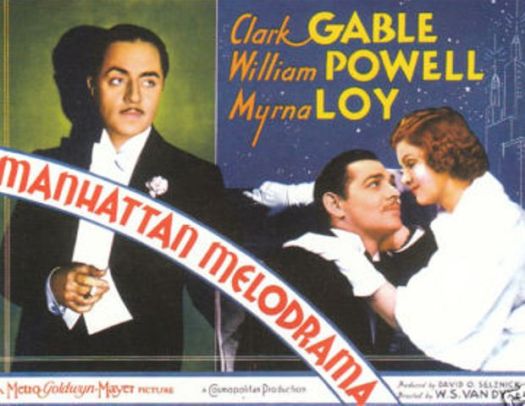
That Old, Familiar Song: MANHATTAN MELODRAMA (MGM 1934)


gary loggins's avatarcracked rear viewer

The plot of MANHATTAN MELODRAMA will certainly be familiar to movie lovers: there’s two kids, one rambunctious, the other studious. Rambunctious grows up to be on the shady side of the law, while Studious represents law’n’order. There’s Girl in the Middle, who loves Rambunctious but always winds up with Studious. Rambunctious perpetuates some evil deed, and Studious must now bring his old pal to justice. Girl in the Middle is torn between the two. In the end, justice prevails, and Rambunctious pays for his crimes, but not before making peace with Studious.

Sound familiar? Sure it does, having been rehashed umpteen times in countless westerns, gangster sagas, wartime dramas, and other genres. But MANHATTAN MELODRAMA was the first, even winning an Oscar for Arthur Caesar’s Best Original Story. Too bad Caesar didn’t copyright the idea; he’d have been a very rich man! The film also has that MGM shine going…

View original post 465 more words

Film Review: Do or Die (dir by Andy Sidaris)


So, imagine this.

You and your BFF are at a luau in Hawaii.  Fires are being spun.  People are dancing.  Drums are being beaten.  It’s almost time to eat the pig and suddenly, you discover that a mysterious old man wants to speak to you.  The man is surrounded by armed guards but you’re used to that.  Both you and your BFF work for the government.  You blow things up and save the world for a living!

Anyway, the old man informs you that he is a master criminal named Kane.  He’s one of those “I’m going to take over the world” types but apparently, you keep thwarting his plans.  He’s a little bit upset about that and why not?  It’s hard enough trying to conquer the world without having somebody continually blowing up all of your friends.  He says that he’s going to have you killed.

Uh-oh!

But fear not!  Kane isn’t going to kill you right there and then.  It turns out that Kane has a code of honor that he lives by.  He may be evil but he believes in fair play.  So, Kane says that he’s going to kill you later.  Apparently, he’s hired six different teams of assassins.  Over the next couple of days, they’re going to try to kill you.  Fortunately, the team’s aren’t going to work together or anything intelligent like that.  That wouldn’t be fair.  Instead, they’re going to come at you one at a time.  Once one teams fails to kill you, they’re out of the hunt.

How would you react?  What would be the first thing that you and your BFF would do?

Would you make sure your guns were loaded, lock the doors, and then wait for the first team to make their move?

Would you try to make the first move, maybe trying to take out Kane right then and there?

Or maybe you would leave the country and try to start a whole new life under a new identity?

I’d probably go with the third option but that’s not what Donna (Dona Speir) and Nicole (Roberta Vasquez) do when Kane (Pat Morita) tells them that they’ve been targeted.  Instead, they get topless and relax in the hut tub while discussing how much it sucks that someone wants to kill them.

Honestly, this shouldn’t come as a surprise.  The 1991 film, Do or Die, was directed by Andy Sidaris.  In a Sidaris film, a topless hot tub party plays much the same role as the family get togethers that often end the Fast and the Furious movies.  Still, it’s hard not to be a little bit disappointed by their sudden passivity.  After all, Donna is the same agent who previously used a rocket launcher to blow up Erik Estrada at the end of Guns.

Speaking of Erik Estrada, he’s back.  However, he’s playing a different character than he played in Guns.  Now, he’s a heroic agent named Rico.  When Donna and Nicole finally get around to letting their boss, Lucas (William Bumiller), know what’s going on, Lucas recruits Rico to help protect them.  Bruce Christian (Bruce Penhall) and Shane Abilene (Michael Shane) are also brought in as well.  Shane still has terrible aim.  I know that’s a running joke in all of the Sidaris films but you really do have to wonder why the government continues to employ someone who sucks at a huge part of his job.

Anyway, Donna and Nicole eventually head for the mainland but that doesn’t do much good because Kane put a tracking device on her watch and Donna apparently lost several IQ points between the end of Guns and the start of this movie.  At first, they go to Vegas but eventually, they end up in Louisiana.  This leads to the usual remote-controlled boats and helicopters, the same ones that appear in nearly every Sidaris film.  Needless to say, a lot of stuff gets blown up.

And it’s all pretty boring, to be honest.  It sounds like it should be fun, what with all the different assassins showing up and Kane getting more and more frustrated as Donna and Nicole continue to survive.  But, unfortunately, none of the assassins are that interesting.  Most of the film takes place in Caddo Parish.  My family lived in Shreveport for a year and a half.  I like Caddo Parish.  But it really can’t compare to Hawaii as far as photogenic locations are concerned.

Do or Die had potential but it got lost in the hot tub.