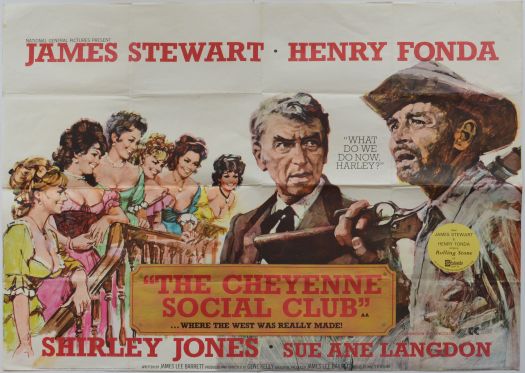
THE CHEYENNE SOCIAL CLUB isn’t a great movie, but it’s not a bad one, either. It couldn’t be; not with all that talent in front of and behind the cameras. You’ve got two legendary leads, James Stewart and Henry Fonda , Oscar winner Shirley Jones, Gene Kelly in the director’s chair, and John Wayne’s favorite cinematographer William Clothier . Still, the film, while amusing, should’ve been so much better.
The story’s fairy simple: two old Texas cowhands, John O’Hanlon (Stewart) and Harley Sullivan (Fonda) are plying their trade when John receives a letter. Seems John’s brother has died and left him an inheritance – The Cheyenne Social Club in Cheyenne, Wyoming. John and his old pal head north, and it turns out The Cheyenne Social Club is a cathouse, run by Madame Jenny (Jones), and she and the girls warmly greet the perplexed duo. Uptight John, who’s always wanted to…
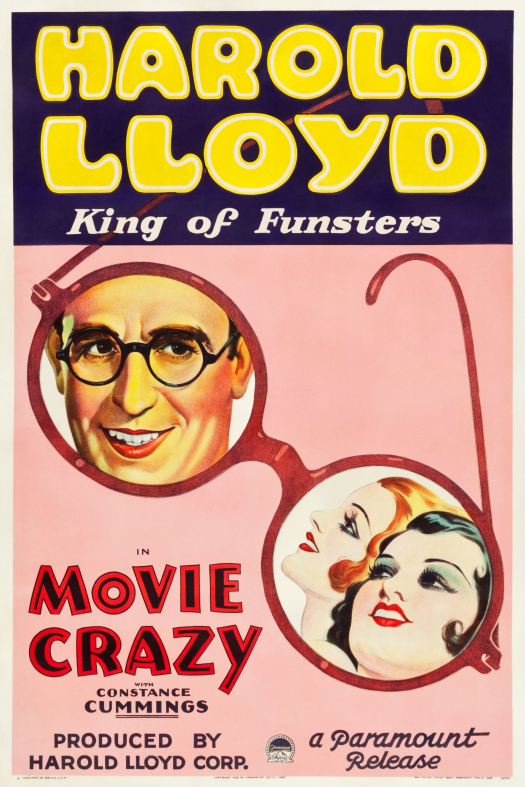
Harold Lloyd made a smooth transition from silent films to talkies beginning with 1929’s WELCOME DANGER. Unlike Charlie Chaplin (who stubbornly clung to making silents until 1940), and Buster Keaton (whose MGM contract took away much of his artistic freedom), Lloyd retained both his comic visual style while integrating verbal gags in the new medium and kept control of the pictures he made. And while his popularity had begun to wane by the 1930’s, Harold Lloyd’s early talkies are definitely worth watching – because they’re flat-out funny! Case in point: 1932’s MOVIE CRAZY.
MOVIE CRAZY is one of those “Hollywood-behind-the-scenes” stories you know I love so much, so it automatically scored cool points with me! Kansas farm boy Harold Hall lives with his parents and daydreams of being a movie star. One day, he sends his picture and a letter to Planet Films exec O’Brien – only the inept Harold…
On Friday night, I watched the latest Lifetime premiere, Long Lost Daughter!
Why Was I Watching It?
First off, let me just say that, considering what the folks on the East Coast have had to deal with over the past two weeks, I feel really guilty about complaining about getting a little bit of rain in Texas. (And it’s not really a complaint because, to be honest, I love stormy weather!)
That said, it rained all day Friday and it’s supposed to continue to rain through the weekend. When I was driving home from work, the rain was so bad that I actually had to limit myself to 30 mph. We’re under flash flood warning right now. What better way to pass the time when you’re trapped inside by a storm than be watching a Lifetime movie?
What Was It About?
Cathy Rhodes (Molly Hagan) is a successful and acclaimed author of children’s books. She’s written hundreds of stories about Mr. Poppins, a rabbit who can’t find his way home. It’s made her a beloved figure in her small town but there are some who find Cathy and her husband (Bates Wilder) to be a little bit strange. They whisper about how, 20 years earlier, Cathy’s 7 year-old daughter, Michelle, vanished.
Meanwhile, two new arrivals have come to town. Jonathan (Richard Brancatisano) is an aspiring science fiction writer. And his wife (Sofia Mattson) is going to help run the education center that Cathy has helped to fund. It turns out that Jonathan’s wife is 27 years old and has no memory of her mother or her childhood. And her name is …. Michelle!
Could Michelle be Cathy’s daughter? That’s certainly what Cathy thinks and she’s willing to do anything to make sure that both her daughter and Mr. Poppins find their way home…
What Worked?
Molly Hagan may not be a household name but I can guarantee you that you would recognize her if you saw her. She’s been in a countless number of films over the years and she is a truly great character actress. She’s played so many different characters and she’s been totally convincing every time. (I think her best-known recent film might be Sully, where she played one of the flight attendants who chanted, “Brace! Brace! Head down! Stay down!”) Anyway, Hagan does a great job as the Cathy Rhodes, making her both frightening and sympathetic.
Also giving a good performance was Bates Wilder, who played Cathy’s somewhat creepy husband. Both he and Hagan keep you guessing.
Speaking of keeping you guessing, this film had an ambiguous ending that I absolutely loved. I won’t spoil it but it was handled very well. It’s the type of ending that I wish Lifetime would try more often. Sometime, it’s not necessary to spell everything out.
What Did Not Work?
Could Michelle and Jonathan have been anymore unlikable? Michelle acted like moving from the city to a small town was the equivalent of moving to a different country. When Cathy mentioned she was making a casserole, Michelle’s smug response of, “Casserole!” was enough to make me decided that I wouldn’t ever want to know someone like Michelle in real life.
As for Jonathan … well, I lost all sympathy for him when he announced that, for him, being a writer was about business and not art. “No one ever reads Proust anymore,” he said, at one point. What a jerk! Michelle, at least, kinda redeemed herself as the film progressed. But Jonathan …. well, once a jerk, always a jerk.
“Oh my God! Just like me!” Moments
Whenever Michelle got annoyed with Jonathan, I was like, “Oh my God! I feel the exact same way!”
Watching Life Itself is like getting a Hallmark card from a serial killer. Even if you appreciate the sentiment, you still don’t feel good about it.
Written and directed by This Is Us creator Dan Fogelman, Life Itself attempts to juggle several different themes, so much so that it can sometimes be difficult to understand just what exactly the film is attempting to say. That said, I think the main lesson of the film is that you should always look both ways before stepping out into the middle of the street. It doesn’t matter if you’ve got a horrific backstory, involving a decapitated father, a pervy uncle, and a gun. It doesn’t matter if you love Pulp Fiction or if you think Bob Dylan’s more recent work is underrated. It doesn’t matter if you’ve got a dog and husband who is so in love with you that he’s practically a stalker. It doesn’t even matter that your pregnant and looking forward to naming your firstborn after your favorite musician. If you don’t look both ways before stepping out into the middle of the street, you’re going to get hit by a big damn bus.
That’s the lesson that Abby (Olivia Wilde) does not learn and, as a result, she not only gets run over by a bus but we, the viewers, are subjected to seeing her repeatedly getting run over by that bus. As temtping as it is to feel bad for Abby, my sympathy was limited by the fact that she and her husband (Oscar Isaac) named their dog Fuckface. I mean, seriously, who does that? Not only is it cruel to the dog but it’s also inconsiderate to the people who have to listen to you shouting, “Fuckface!” whenever the dog gets loose. For whatever reason, the movie doesn’t seem to get how annoying this is. That’s because Life Itself is another one of those movies that mistakes quirkiness for humanity.
The other annoying thing about Abby is that she’s an English major who somehow thinks that the use of the unreliable narrator is an understudied literary phenonema. In fact, she’s writing her thesis on unreliable narrators. Her argument is that life itself is the ultimate unreliable narrator because life is tricky and surprising, which doesn’t make one bit of sense.
Speaking of narrators, Life Itself has three, which is three too many. Two of the narrators are unreliable but I get the feeling that the third one is meant to be taken literally, which is a shame because the film would have made a lot more sense if it had ended with a Life of Pi-style revelation that none of what we just watched actually happened.
Anyway, Abby getting hit by a bus has repercussions that reverberate across the globe and across time. Not only does it lead to her husband writing a bad screenplay but it also leads to him committing suicide in a psychiatrist’s office. Abby’s daughter, Dylan (Olivia Cooke), grows up to be what this film believes to be a punk rocker, which means that she angrily covers Bob Dylan songs and stuffs a peanut butter and jelly sandwich down another girl’s throat. Meanwhile, in Spain….
What? Oh yeah, this film jumps from New York to Spain. In fact, it’s almost like another film suddenly starts after an hour of the first one. You go from Olivia Cooke sobbing on a park bench to Antonio Banderas talking about his childhood. Banderas is playing a landowner named Vincent Saccione. Saccione wants to be best friends with his foreman, Javier (Sergio Peris-Mencheta) but Javier suspects that Saccione just wants to steal away his saintly wife, Isabel (Laia Costa) and maybe Javier’s right!
Javier has a son named Rodrigo (who is played by five different actors over the course of the film before eventually growing up to be Alex Monner). When Saccione gives Rodrigo a globe, Javier decides to one-up him by taking his wife and child on a vacation to New York City. Rodrigo has a great time in New York, or at least he does until he distracts a bus driver, which leads to a bus running down a pregnant woman…
…and the movie’s not over yet! It just keeps on going and believe it or not, there’s stuff that I haven’t even mentioned. Life Itself has a running time of only two hours. (For comparison, it’s shorter than almost every comic book film that’s come out over the past few years.) This is one of the rare cases where the film might have been improved with a longer running time because Fogelman crams so much tragedy and melodrama into that running time that it literally leaves you feeling as if you’re being bludgeoned. This is one of those films that gets in your face and screams, “You will cry! You will cry!” Even if you are inclined to cry at movies (and I certainly am), it’s impossible not to resent just how manipulative the film gets. You get the feeling that if you spend too much time wondering about the plot holes or the on-the-nose dialogue, the third narrator might start yelling at you for not getting with the program.
Life Itself is full of twists that are designed to leave you considering how everything in life is connected but, for something like this to work, the twists have to be surprising. They have to catch you off-guard. They have to make you want to see the movie again so that you can look for clues. The twists in Life Itself are not surprising. Anyone who has ever seen a movie before will be able to guess what’s going to happen. For that matter, anyone who has ever sat through an episode of This is Us should be able to figure it all out. Life Itself is not as a clever as it thinks it is.
Also, for a film like this work, you have to actually care about the characters. You have to be invested in who they are. But nobody in the film ever seems to be real and neither do any of their stories. (To the film’s credit, it actually does point out that one narrator is idealizing the past but that’s an intriguing idea that’s abandoned.) Everyone is just a collection of quirks. We know what type of music they like but we never understand why. Background info, like Abby being molested by her uncle or Isabel being the fourth prettiest of six sisters, is randomly dropped and then quickly forgotten about. Almost ever woman has a tragic backstory and, for the most part, a tragic destiny. (Except, of course, for Rodrigo’s first American girlfriend, who is dismissed as being “loud.”) Every man is soulful and passionate. But who are they? The film’s narrators say a lot but they never get around to answering that question. This is a film that insists it has something to say about life itself but it never quite comes alive.
Some critics are saying that Life Itself is the worst film of 2018. Maybe. I don’t know for sure. The Happytime Murders left me feeling so icky that I haven’t even been able to bring myself to review it yet. Life Itself, on the other hand, is such a huge misfire that I couldn’t wait to tell everyone about it. There’s something to be said for that.
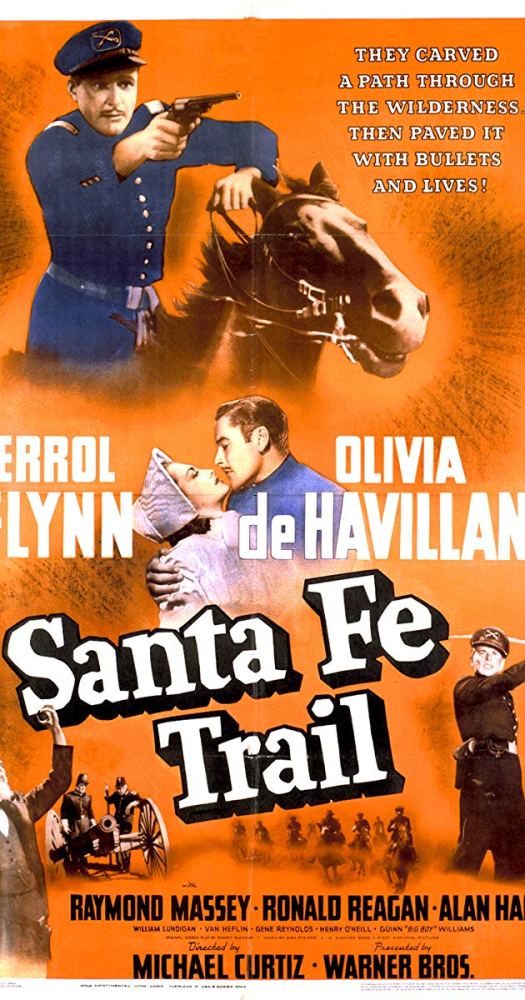
A movie lover could get pretty spoiled living on a steady diet of Errol Flynn/Warner Brothers epics from the 30’s and 40’s. You’ve got Flynn, the personification of the classic “movie star”, performing heroic feats and romancing his leading lady (usually Olivia de Havilland ). A historical setting serving as the backdrop to move the story along, expertly directed by Michael Curtiz or Raoul Walsh, a cast full of Hollywood’s greatest character actors, a majestic music score (mainly Max Steiner , but there were others equally as talented), action, drama, humor, conflict… what more could a film fan ask for?
SANTA FE TRAIL has all this and more, an energetic pre-Civil War tale guaranteed to hold your interest for its 110 minutes no matter which side of the Mason-Dixon Line you live on. It’s characters are drawn from history, but historic accuracy be damned… these films were all about…
I recorded the 2009 film, In The Blink of an Eye, off of one of the local channels on September 9th.
Remember how Bill Murray had to relive the same day over and over again in Groundhog Day?
Well, consider this to be Rapture Day!
David A.R. White, who has been involved in several faith-based, apocalyptic-minded productions, plays David, an agnostic cop who saves the life of pop star Lindsey O’Connor (Jessica Hope), who is obviously meant to be a Britney Spears/Miley Cyrus type of figure. She really needs someone to step in and help her get some control over her life but, before that can happen, she has to go on vacation in Mexico with her manager. Since David saved her life and all, he and his wife (Andrea Logan White) and his ultra-religious partner (Lonnie Colon) are invited to accompany her.
Of course, David has an ulterior motive for accepting that invitation. David’s captain (Eric Roberts!) thinks that Lindsey’s manager might have connections to the shadowy world of international organized crime! So, David is not only going to Mexico to relax. He’s also going down there to investigate!
But, of course, then the Rapture happens so none of that really matters. David’s wife vanishes. David’s partner vanishes. You know who doesn’t vanish? That’s right — David!
At first, David is confused as to what happened. In fact, he’s so confused that he ends up getting killed by Lindsey’s manager! But fear not! No sooner has David died than he’s waking up and reliving the day. Once again, his wife and his partner vanish. Once again, David gets killed. Once again, David awakens and has to relive the whole day all over again…
So, here’s my issue with In the Blink Of An Eye. Now, admittedly, I don’t share the film’s Evangelical background but, since the film takes a premillennialist approach to its story, doesn’t that mean that everyone in the movie should only get one chance to be raptured? I mean, isn’t the idea that the “living elect” ascend to the Heaven and everyone who didn’t get selected basically has to live through the tribulation, regardless of whether they later come to have faith or not?
But instead, in this film, David gets not just one chance but six different chances to get raptured! That doesn’t seem quite fair, especially since no one else in the film appears to get that chance. Eric Roberts certainly doesn’t get that chance. Instead, he just get an email telling him not accept the sign of the beast. That really doesn’t seem quite fair.
But hey, at least Eric Roberts is in the movie! Seriously, you never know where Eric Roberts is going to pop up. He doesn’t really get to do much in this movie. His role is mostly a cameo but he’s Eric Roberts so who cares?
In the Blink of an Eye attempts to wed religious debate with a crime thriller plot. Due to some awkward dialogue, stiff performances, and a particularly bizarre obsession with denouncing popular music, (the cops make some comments about dealing with “the people who listen to rap music” that will literally have you cringing), the film doesn’t come any where close to working. That said, I have to admit that, as someone who is always interested in films made outside of the normal studio system, that I do often find these low-budget, faith-based films to be interesting, just for the chance to see what people can do when they have no money but a lot of enthusiasm.
Last night, after I watched Cutthroat Island, I continued to prepare for Talk Like A Pirate Day by watching The Island, a pirate movie from 1980.
Michael Caine has appeared in some truly bizarre films over the course of his long career but The Island may be the strangest. (According to the imdb, it’s also one of the few films that he refuses to discuss in interviews, which is kind of amazing when you consider some of the films that Caine will discuss.) In The Island, Caine is plays Blair Maynard, a cynical New York journalist who happens to have a cockney accent. Looking to do a story about the Bermuda Triangle, Maynard heads down to Florida. He takes along his 12 year-old son, Justin (Jeffrey Frank), because what father wouldn’t unnecessarily put his only child’s life in danger? Of course, Justin isn’t happy when he finds out that his father lied about visiting Disney World but all is forgiven after Maynard buys him a gun. Justin does love to shoot guns, which will become a plot point soon enough.
Anyway, Maynard and Justin soon discover that the reason people are disappearing in the Bermuda Triangle is because they’re being kidnapped by … wait for it … PIRATES!
David Warner and the Pirates
That’s right, real-life pirates! Apparently, centuries ago, a group of French pirates set up a colony on an uncharted island in the Caribbean. Now, under the leadership of the savage Nau (played by the very British and not very savage David Warner), these pirates spend their time attacking boats, murdering people, and speaking in an odd combination of English, French, and Portuguese. However, centuries of in-breeding have weakened the bloodline. So, while Nau brainwashes Justin and turns him into a little buccaneer, Maynard is given to Beth (Angela Punch McGregor) and told to “thrust thrust.”
Yes, that’s right. This is a film in which a middle-aged Michael Caine — complete with his trademark glasses and his “what the bloody Hell?” attitude — is turned into a sex slave. (Again, this is one of the few films that Caine apparently refuses to discuss.) The scene in which Beth strips the chained Maynard naked and then starts to rub Vaseline on him would be strange regardless of who played the main role but when it’s Michael Caine, it goes beyond the merely strange to becoming almost a work of outsider art.
Anyway, the movie only gets stranger from there as Justin grows to love the pirate life style and, eventually, both he and his father even get to take part in a raid on a schooner. It’s during this raid that, from out of nowhere, a guy in extremely tight shorts pops up and starts doing all sorts of elaborate kung fu moves. (He also makes all of the expected kung fu sounds while David Warner has a good laugh.) It’s also during this raid that the pirates come across several packets of white powder.
“It’s a drug called cocaine,” Maynard says.
“What does it cure?” Beth asks.
“Insecurity,” Maynard answers.
It all leads to not only an impromptu wedding ceremony but also to the sight of Michael Caine screaming his head off while firing a machine gun. I think we’re supposed to feel that the ordeal has driven Maynard somewhat mad but it’s hard to tell. Caine has always been open about the fact that, for many years, he basically just accepted any role that was offered to him and The Island would appear to be a perfect example. Maynard may have been trying to rescue his son but Caine’s main concern was obviously getting his paycheck and moving on to the next role.
Michael Caine in The Island
The Island is one of those movies that’s so odd that it really doesn’t matter whether it’s any good or not. Between the strange plot and Michael Caine’s almost comically detached performance, this one of those films that, once you start watching, you really can’t look away from it. In the end, The Island is so weird and misjudged that it becomes brilliant despite itself.
Today is Talk Like A Pirate Day which, let’s just be honest, is an extremely stupid holiday that mainly exists to remind us that “doubloon” is a deeply silly word.
Doubloons were a currency that were popular in Europe and South America back in the 18th century and pirates were always looking for doubloons. If you listen to enough pirate talk, you’ll quickly discover that there’s a lot different ways to say the word doubloon. Some people put the emphasis on the fist syllable while others emphasize the second. Some people say Due-bloon while others say Duh-bloon. Either way, it’s impossible to listen to pirates talk about doubloons without thinking that they sound very, very silly. The secret behind the success of The Pirates of the Caribbean franchise is an understanding that it’s impossible to take pirates seriously.
Unfortunately, I chose not to watch The Pirates of the Caribbean for Talk Like A Pirate Day. Instead, I watched 1995’s Cutthroat Island.
Cutthroat Island is a story of pirates, a lost treasure, and one big sea battle that literally seems to go on and on. There is occasional talk of doubloons, though not enough for my liking. Instead, most of the film deals with the efforts of Morgan (Geena Davis) to find a hidden treasure before her uncle, Dawg (Frank Langella), discovers it. Morgan has one-third of a map. It was originally tattooed on her father’s head. After he died, she scalped him and took over his boat. She also purchased a swashbuckling slave named Shaw (Matthew Modine) because Shaw is capable of reading Latin, the language in which the map is written. Needless to say, Shaw and Mogan fall in love while Dawg teams up with corrupt colonial officials to not only track down the treasure but to also capture his niece.
The film starts out as a romance with a dash of comedy before eventually transforming into a standard action movie. That means that boats get blown up and there’s a lot of scenes of people fencing. There’s also a lot of slow motion footage of bodies plunging into the ocean. The climatic battle goes on forever and it actually features Morgan hissing, “Bad dawg!” at her uncle.
(Amazingly, “Bad Dawg” isn’t the worst of the dialogue to be heard in Cutthroat Island. Morgan has a habit of saying stuff like, “I will maroon you on a rock the size of this table, instead of splattering your brains across my bulkhead” and “Since you lie so easily and since you are so shallow, I shall lie you in a shallow grave.”)
Throughout the film, there are hints of what Cutthroat Island could have been, if it hadn’t been such a by-the-numbers action flick. The fact that it was Morgan who was continually rescuing Shaw was a nice change-of-pace from the usual damsel-in-distress clichés that one finds in most pirate movies. When Morgan effortlessly breaks the neck of a soldier and sets free her crew, it’s a great moment, comparable to Angelina Jolie taking out Liev Schreiber in Salt or Milla Jovovich kicking zombie ass in a Resident Evil film. Unfortunately, director Renny Harlin (who was married to star Geena Davis, at the time) is usually too concerned with getting to the next action set piece to truly take advantage of the film’s subversive potential.
Frank Langella is smart enough to bellow his way through his villainous role while Matthew Modine appears to be so amused by the film’s terrible dialogue that it’s impossible not to like him. Geena Davis is convincing when she’s breaking necks and swinging swords but she delivers her dialogue like someone who has already figured out that the movie was a bad idea and resigned herself to the fact that her film career will never recover. She doesn’t appear to be having any fun, which kind of defeats the purpose of being a pirate.
Cutthroat Island was a huge and notorious box office flop and it’s still considered to be one of the biggest financial disasters in film history. Apparently, Hollywood was so traumatized that it would be another 8 years before there was another major pirate production. That production, of course, was Pirates of the Caribbean, a film that captured the fun that was so lacking in Cutthroat Island.
I haven’t posted anything on The Ritz Brothers since January of 2016 , so when TCM aired a trio of their films this weekend, I chose to review what I consider their best solo effort, 1937’s LIFE BEGINS IN COLLEGE. This was their first name-above-the-title movie, and features Harry, Jimmy, and Al at their zaniest, with the added bonus of comedienne Joan Davis as a kooky coed with her sights on Native American football hero Nat Pendleton.
Collegiate musical comedies were a popular sub-genre in the 30’s: COLLEGE HUMOR, PIGSKIN PARADE, COLLEGE SWING, COLLEGE HOLIDAY, et al, so it seemed the perfect milieu for the Ritzes to showcase their peculiar brand of nuttiness. The story is typical campus corniness, as George “Little Black Cloud” Black arrives at Lombardy College (crashing his motorcycle for an entrance) wanting to join the football team, and immediately developing a rivalry with football team captain…
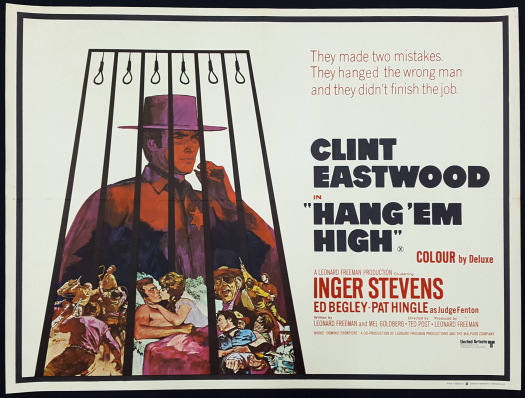
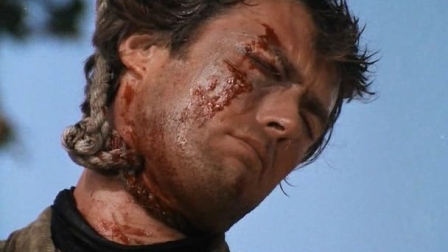
Clint Eastwood returned to America after his amazing success in Sergio Leone’s Man With No Name Trilogy as a star to be reckoned with, forming his own production company (Malpaso) and filming HANG ‘EM HIGH, a Spaghetti-flavored Western in theme and construction. Clint was taking no chances here, surrounding himself with an all-star cast of character actors and a director he trusted, and the result was box office gold, cementing his status as a top star.
Clint plays ex-lawman Jed Cooper, who we meet driving a herd of cattle he just purchased (reminding us of his days on TV’s RAWHIDE). A posse of nine men ride up on him and accuse him of rustling and murder, appointing themselves judge, jury, and executioner, and hang him. He’s left for dead, until Marshal Dave Bliss comes along and cuts him down, taking Jed prisoner and transporting him to nearby Ft. Grant. Evidence…






 Through the Shattered Lens