The TSL’s Horror Grindhouse: Flesh For Frankenstein (dir by Paul Morrissey)


Here are just a few things to be experienced in 1973’s Flesh For Frankenstein:

A fanatical Baron von Frankenstein (Udo Kier) needs a brain for his latest creation so his assistant, Otto (Arno Jurging) goes out with a giant pair of hedge clippers, snips off a divinity student’s head, and then runs off with it.

An incredibly sexy farmhand named Nicholas (Joe Dallesandro) speaks with a thick and very modern New York accent, despite living in Germany in the 19th century.  Meanwhile, everyone around him speaks with an extra-thick German accent.

The Baron announces to Otto, “To know life, you must fuck death in the gall bladder!”

Nicholas has an affair the Baroness von Frankenstein (Monique van Voreen), who in one scene loudly sucks on Nicolas’s armpit.

The Baron gets rather obviously turned on while removing organs from a body.

The Baron’s children decapitate their dolls and take a perverse pleasure in being cruel.  Some of this could possibly be because the Baron and the Baroness are also brother and sister.

The Baron rants and raves about how, by bringing the dead back to life, he will be able to create the perfect Serbian race, one that will only take orders from him and which will …. well, do something.  The Baron has a lot of plans but he’s not always clear on just what exactly the point of it all is.

Speaking of points, one character eventually gets a spear driven through his back an out of his chest.  Despite the fact that his heart is literally hanging off the tip of the spear, he still manages to get out a very long and very emotional monologue before dying.

Now, of course, you have to remember about that scene with the heart is that Flesh for Frankenstein was originally shot in 3D, which means that audiences in 1973 would have literally had that heart dangling over their heads while waiting for that endless monologue to stop.  How the audience would react to that would have a lot to do with whether or not they were in on the joke.

And make no mistake, Flesh For Frankenstein is not a film that’s meant to be taken too seriously.  It’s a satire of …. well, just about everything.  Baron Frankenstein, with his sexual hang-ups and his obsession with creating a perfect male and a perfect female so that they can have perfect Serbian children, is the ultimate parody of the mad scientists who usually populate these films and Udo Keir gives a truly mad performance in the role.  One need only compare Keir’s Frankenstein to the coldly cruel version that Peter Cushing played in Hammer’s “serious” Frankenstein films to see just how much Keir embraced the concept of pure batshit insanity.  Whereas Keir joyfully overacts every moment that he’s on-screen, Joe Dallesandro pokes fun at the traditional image of the strong, silent hero by barely reacting to anything at all.  The film’s nonstop flow of blood parodies the excesses of the horror genre while Nicholas’s affair with the Baroness satirizes not only Marxism but also an infinite number of European art films.  Flesh for Frankenstein is a film that is so deliberately excessive that it often feels as if it’s daring you to stop watching.  Of course, you don’t stop watching because you know the movie will probably start making fun of you as soon as you turn your back on it.

Flesh For Frankenstein is also known as Andy Warhol’s Frankenstein.  Warhol actually had little do with the movie, beyond lending his name.  The film was directed by Paul Morrissey, who served as Warhol’s “house director” during the Factory years.  The best Factory films were defined by the combination of Warhol’s detachment with Morrissey’s political and religious conservatism.  With Flesh For Frankenstein, Morrissey not only satirizes what he viewed as being the excesses of European and horor cinema but he also satirizes the fact that there’s an audience for his satire.  Flesh For Frankenstein is definitely not a film for everyone but, in this case, that can be considered a compliment.  It’s an audacious and wonderfully over-the-top movie, one that would be followed by Blood for Dracula.

One final note: Because the film was made in Italy, Antonio Margheriti was credited as being a co-director on the film with Morrissey.  While Margheriti did do some second unit work, it is generally agreed that he was not, in any way, a co-director.  Apparently, Margheriti was credited as being a co-director so that the film could receive financial aid from the Italian government.  This scheme later led to both Margheriti and producer Carlo Ponti being charged with criminal fraud.

Italian Horror Showcase: Il mostro di Frankenstein (dir by Eugenio Testa)


Sadly, there are some films that I will probably never get to see and this is one of them.

There’s a lot of reasons that films become lost.  Some films have been purposefully destroyed.  Some have been merely forgotten.  Unfortunately, it took several decades for people to understand that films could also be art.  Back during the silent era, I imagine people would have laughed at the idea that someone in 2018 would have any interest in watching a film that was made in 1920.

1920 was the year that a German-Italian production company produced Il mostro di Frankenstein.  It was one of the first film adaptations of Mary Shelley’s classic monster.  (It wasn’t the first, of course.  Thomas Edison produced his version of Frankenstein in 1910 and there may have even been earlier versions.)  It was a silent film.  It reportedly starred the hulking Umberto Guarracino as Frankenstein’s Monster while the Baron was played by a former circus performer name Luciano Albertini.  (Albertini also produced the film.)  The completed film reportedly ran afoul Italy’s then-stringent censorship laws and so much footage was cut that the final version only ran 39 minutes.

Il mostro di Frankenstein is considered to be a lost film, one that is now remembered for being one of the few Italian horror films released before the 1950s.  (As a genre, horror was frowned upon by both the Vatican and Mussolini, which meant the while the genre thrived across the world, Italian horror spent several decades moribund.)  In fact, I’ve read that Il mostro di Frankenstein was the last horror film to be produced in Italy until Riccardo Freda’s I Vampiri was released in 1957.  I can’t say for sure whether that’s true or not but it makes for a good story.

Sadly, I’ll probably never see Il mostro di Frankenstein.  But, hey — if anyone in your family ever worked in the Italian film industry, why don’t you go up to your attic and take a look?  If it’s in your basement, get it out.  And if you find it in a storage locker, don’t throw it away because you’ve got a piece of history that many of us would like to see.

Until that happens, we only have this one screenshot to let us know that there was once a silent Italian film about Frankenstein and his monster.

Horror Film Review: Mary Shelley’s Frankenstein (dir by Kenneth Branagh)


Oh my God, this is an exhausting movie.

Directed by and starring Kenneth Branagh, the 1994 film Mary Shelley’s Frankenstein sticks pretty closely to the plot (if not the tone) of Mary Shelley’s original novel.  What that means is that this movie includes a lot of the good stuff that often seems to get left out of other Frankenstein adaptations.  For instance, we learn more about the life of Victor Frankenstein (Kenneth Branagh) before he created his monster.  We find out about his family and his troubled romance with Elizabeth (Helena Bonham-Carter).  Victor’s good friend Henry Clerval (Tom Hulce) is included and so is Professor Waldman (John Cleese) and Captain Robert Walton (Aidan Quinn).

It also means that we get to watch as the Monster (Robert De Niro) flees into the wilderness and later befriends a kindly blind man (Richard Briers).  The Monster, as always, is happy until mankind interferes and treats him unfairly.  The Monster learns to speak and, after it learns to read, it discovers who created it and it sets out for revenge.  We watch as everyone that Victor Frankenstein cares about dies, all as a result of his desire to play God.

And yet, while you have to respect the fact that Branagh tried to stay (more or less) true to the plot of the original novel, Mary Shelley’s Frankenstein is a bit of a chore to sit through.  A huge part of the problem is that Kenneth Branagh cast himself to play Victor Frankenstein.  In the book, Victor is a rather sickly character and his desire to create life is probably as much inspired by his own poor health and the death of the people close to him.  In the film, Branagh plays Victor as being almost a Byronic figure, with the camera emphasizing his flowing hair and his muscular physique.  Even when Victor does push himself to the point of death in his research, you never really believe it because Branagh the director isn’t willing to let Branagh the actor look weak or malnourished.  However, turning Victor into an alpha male also turns him into a jerk.  Unlike say Colin Clive or Peter Cushing in The Curse of Dracula, you never find yourself sympathizing with Kenneth Branagh’s Victor.

And then you have Robert De Niro as the Monster.  Now, really, I imagine that — in 1994 — the idea of De Niro playing the Monster seemed like an obvious one.  I mean, the Monster is a great role and De Niro’s one of the greatest actors who ever lived so if anyone could find a new and interesting way to play Frankenstein’s Creation, it would have to be De Niro, right?

But no.  First off, De Niro may be a great actor but it’s hard to accept the idea that a monster created in Germany would speak with a New York accent.  Even under tons of makeup, De Niro does an okay job of projecting the Monster’s rage but, unlike Karloff or Christopher Lee, De Niro never seems to really connect with the character.  You never forget that you’re watching a heavily made-up Robert De Niro.  De Niro often seems to be rather detached from what’s happening on screen.

Branagh’s directs in a manner that can only be called operatic, which turns out to be a mistake.  The story is already dramatic enough without Branagh spinning the camera around every few moments.  There’s not a subtle moment to be found in the film but unfortunately, Frankenstein is a story that needs just a little bit of subtlety.  It all gets to be a bit overwhelming and, by the time the Monster is literally ripping a heart out of a body, you’re just like, “Enough already!”

It’s just a really tiring movie.

I Watched Eight Men Out


This year, watching the World Series has felt strange to me.

I love baseball so, of course, I’m going to watch.  But with neither the Rangers nor the Astros playing this year, I don’t really have anything invested in who wins.  The last time the Red Sox were in the series, I wanted them to win because the city was still recovering from the Boston Marathon bombing but this year, the Red Sox are the team that defeated Houston for the American League Championship.  I guess I want the Dodgers to win but it feels weird to cheer for a National League team.  The Red Sox are currently up 2 to 0.  That doesn’t mean that the Dodgers are out of it but they’ve got some ground to make up.  Luckily, they’ll be playing at home tonight.

Since there wasn’t a game last night, I watched Eight Men Out, a 1988 movie about the 1919 World Series.  I love this movie.

In the 1919 World Series, the Cincinnati Reds faced off against the Chicago White Sox.  The 1919 White Sox team was considered to be one of the best in the history of baseball and they entered the series of heavy favorites.  When they lost 5 games to 3 (the 1919 World Series was a best of nine series), a lot of gamblers lost a ton of money but there were a few that made a fortune.  Even before the series was over, there were rumors that several members of the White Sox were paid off to intentionally lose the game.  The scandal grew so large that the franchise owners agreed to appoint a judge named Kennesaw Mountain Landis as the first commissioner of baseball.  Eight White Sox players were accused of taking money to throw the game.  Even though they were acquitted of all the criminal charges, Landis still banned all eight of them from ever again playing major league baseball.  Among the players who were banned, 6 were definitely in on the fix.  However, both Buck Weaver and Shoeless Joe Jackson would go to their graves insisting that they hadn’t thrown a single game.

Eight Men Out tells the story of that World Series and how the White Sox came to be known as the Black Sox.  The film begins with various gamblers all approaching different players and offering them money to throw the World Series.  Fed up with being taken for granted and mistreated by management, some of the players agree immediately while others, like pitcher Eddie Cicotte, are more reluctant.  When the owners of the White Sox cheats Cicotte out of a bonus, Cicotte finally decides to accept the gamblers’s offer.

The best part of Eight Men Out are the scenes that contrast how the White Sox play when they’re throwing a game to how they play when they’re trying to win.  Even though they’re getting paid to lose, the players are depressed and angry after a loss.  When they play to win, they’re happy because they’re doing what they’re good at and they’re amazing to watch.  Those scenes are what baseball are all about.

Eight Men Out is a movie that loves baseball almost as much as I do and I recommend it to anyone else who loves the game.  It’s got a big cast and they’re all very good, even Charlie Sheen who plays one of the players.  My favorite performances were John Mahoney’s as the disappointed White Sox manager and John Cusack’s as Buck Weaver, who does nothing wrong but suffers the worst of any of the accused players.

If you’re just not feeling the World Series this year, check out Eight Men Out.

The Real 1919 Chicago White Sox

Death From Above: Beaks: The Movie (1987, directed by Rene Cardona, Jr.)


The birds are pissed off.  A hang glider gets pecked to death while flying through the sky.   A chicken farmer is devoured. A professional hunter loses an eye to a bird and then has to use the remaining one to watch as the birds savagely attack his granddaughter’s birthday party.  A family on vacation is forced to run for cover as their attacked by pigeons and doves.  From South America to Spain to Puerto Rico, the birds are organizing and they are attacking.  Can journalist Vanessa (Michelle Johnson) and her cameraman Peter (Christopher Atkins) figure out why the birds are attacking or are they destined to become the latest victims of the avian terror?

This may sound like the Hitchcock film but Beaks was directed by Mexico’s Rene Cardona, Jr. and that makes all the difference.  Following in the footsteps of his father, Cardona was the king of Mexican B-movies.  There was no idea strange enough or plot stupid enough that Rene Cardona, Jr. couldn’t take it and turn it into a really bad movie.  Even by his standards, Beaks is bad as pigeons and doves are tossed at screaming actors.  Why are the birds attacking?  Caronda shows us a polluted lake as if to say, “Any questions?”  In the end, the birds attack until they suddenly don’t anymore but don’t get too cocky because there are other animals out there that are looking mighty disgruntled.

For some reason, in the late 80s and early 90s, Christopher Atkins had a very busy career in bad movies.  Seeing the Atkins name in the cast was usually a good sign that it was time to change the channel.  In Beaks, he gets the best line when he says, “These birds know what they’re doing!”  The film’s second best line goes to another actor, Gabriele Tinti, who says, “Fucking bird, flapping everywhere.”

If Hitchcock made The Birds with less skill but more gore and gratuitous nudity, the end result would still be better than Beaks.

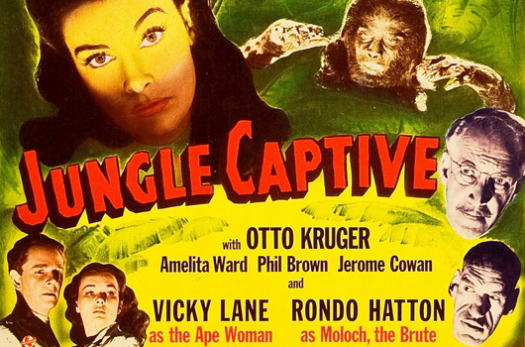
Halloween Havoc!: JUNGLE CAPTIVE (Universal 1945)


gary loggins's avatarcracked rear viewer

The third and final entry in Universal’s Paula Dupree/The Ape Woman series, JUNGLE CAPTIVE was released in 1945. I’m happy to report it’s a slight upgrade on JUNGLE WOMAN – by no means a classic horror movie, but certainly more enjoyable than that wretched sequel to CAPTIVE WILD WOMAN . The budget is lower-than-low, but the performances and script are far better, and it makes a good finale to the Ape Woman saga.

Hulking brute man Moloch, henchman of biochemist Mr. Stendahl (who’s not a doctor, by the way), strangles a morgue attendant and steals the body of the Ape Woman from it’s slab (where we left it in the last film). Inspector Harrigan is called in on the case, and a lab smock found near the abandoned crashed-and-burned meat wagon leads him to Stendahl’s lab, where he encounters pretty assistant Ann and her fiancé Don working (actually, they’re necking…

View original post 299 more words

Horror On The Lens: I Was A Teenage Werewolf (dir by Gene Fowler, Jr.)


1957’s I Was A Teenage Werewolf combines two genres that were very popular in the late 50s.

On the one hand, it’s a film about a teenage rebel.  Tony Rivers (Michael Landon) is a teenager that means well but he keeps losing his temper.  If he can’t learn to control his anger, he could very well be looking at a life behind bars.

On the other hand, it’s also a horror film.  When Tony visits a hypnotist (Whit Bissell), the end result is Tony turning into a werewolf and going on a rampage, all while still wearing his letterman jacket.

All in all, this is a pretty fun little movie.  You can check out my review of it by clicking here.

And you can watch the movie below!


Italian Horror Showcase: Beyond Darkness (dir by Claudio Fragasso)


In 1981, The Evil Dead was released in Italy as La Casa.

In 1987, Evil Dead II was released in Italy as La Casa 2.

In 1988, La Casa 3 was released in Italy and retitled Ghosthouse for distribution in America and the UK.

That same year, La Casa 4 was also released in Italy and it was called Witchery in America.

And then, finally, 1990 saw the release of La Casa 5.

Directed by Claudio Fragasso (who, outside of Italy, is probably best known for directing Troll 2), La Casa 5 was also known as Beyond Darkness* and it was the third “unofficial” Italian sequel to Evil Dead.  Like both Ghosthouse and Witchery, it actually has nothing to do with any of the Evil Dead films.  Instead, it plays out more like a weird mix of Poltergeist and The Exorcist.

Let’s say that you’re an aging clergyman and you’re living in a house that appears to be haunted by the ghosts of several dead witches.  Despite your own faith, you haven’t been able to exorcise their evil spirits.  What should you do!?  When Rev. Jonathan (Steven Brown) finds himself in that situation, his solution is to sell the house to one of his former students, Rev. Peter (Gene LeBrock).  Jonathan figures that Peter’s faith is so strong that he’ll be able to exorcise the house in no time!  Of course, Jonathan doesn’t actually bother to tell Peter that the house is possessed by evil.  Instead, Jonathan just lets Peter and his family discover that on their own.

And discover that they do, as the house quickly reveals itself to be haunted.  Meat cleavers fly across rooms.  Radios make strange noises.  Dishes are shattered.  A strange group of black-shrouded women are spotted hanging around upstairs.  It might have something to do with the big black swan statute that’s sitting in the kid’s room.  Or maybe it has something to do with the strange light that’s streaming out of one of the closets.  Eventually, Peter’s son gets sucked into the netherworld and, when he returns, he’s not only possessed but he keeps trying to kidnap Peter’s daughter as well!

Despite being told to avoid him, Rev. Peter is eventually forced to turn to another of Rev. Jonathan’s students, Father George (David Brandon).  Ever since he was forced to spend time with a serial killer who ate children, George has been struggling with his faith.  Will George be strong enough to help Peter exorcise the demon that has possessed his son?

(Incidentally, Peter’s son is played by Micheal Stephenson, who also starred in Troll 2 and who more recently directed the documentary about that film, Best Worst Movie.)

Watch and find out what happens!  Or don’t.  Actually,if you’ve seen The Amityville Horror, The Exorcist, or Poltergeist, you’ll be able to guess everything that happens in this film.  Even the final twist has been borrowed from countless other horror films.  The presence of Claudio Fragasso in the director’s chair might tempt some to watch this in the expectation that it’ll be another “WTF!?” romp like Troll 2 but Beyond Darkness is actually pretty dull.

Beyond Darkness was the last Italian entry in the La Casa franchise but it was not the last La Casa film.  When the American horror film House II was released in Italy, it was retitled La Casa 6.  This was followed by La Casa 7, which was actually an American slasher film called The Horror Show.

And with that, the La Casa series finally ended.

* While we’re on the topic of titles, Beyond Darkness should not be confused with 1979’s brilliant Buio Omega, which was released in English-speaking territories as Beyond The Darkness and which was directed, under the pseudonym Joe D’Amato, by Aristide Massaccesi.

Italian Horror Showcase: Witchery (dir by Fabrizio Laurenti)


Like many Italian horror films, Witchery is a film that is known by many names.

When it was originally released in Italy, it was called La Casa 4 and it was sold as being a sequel to Sam Raimi’s Evil Dead films.  (In Italy, Evil Dead was called La Casa.)  In countries where Umberto Lenzi’s Ghosthouse was a hit, this film was entitled Ghosthouse 2.  (Adding to the confusion, Ghosthouse was called La Casa 3 in Italy, even though it had nothing to do with the Evil Dead films.)  In countries where neither Ghosthouse nor La Casa were hits, this film was sometimes called Witchcraft and sometimes called Witchery.  For the purposes of this review, I’m going with Witchery, just because Witchcraft is kind of a bland title.

Anyway, the main lesson to be learned from Witchery is that David Hasselhoff will never be anyone other than David Hasselhoff.  In this film, he plays a character named Gary but, from the minute you see him and he starts talking, it’s impossible to think of him as being anyone other than David Hasselhoff.  You spend the film thinking, “Uh-oh, David Hasselhoff’s getting sexually frustrated.  Uh-oh, that witch is coming for David Hasselhoff.  Did they just throw David Hasselhoff through a window?”

David Hasselhoff and his friend Leslie (Leslie Cumming) are in Massachusetts, staying at an abandoned hotel.  It’s rumored that, living nearby, there’s a reculsive actress, known as the Woman in Black (Hildegard Knef), who decades ago made some sort of deal with the devil or a witch or something like that and the hotel is now some sort of portal to Hell.  Leslie is determined to discover whether the rumors are true but all David Hasselhoff cares about is the fact that Leslie is still a virgin.  “It’s not normal,” he tells her, with a look in his eye that suggests that he’s willing to help her out.  Somehow, Leslie manages to resist Hasselhoff.

Before Hasselhoff can continue to make his case, both he and Leslie have to hide in the hotel because a group of people show up.  It turns out that the Brooks family is interested in buying the hotel so that they can renovate it and hopefully make some money!  Now, they’ve arrived and they’re looking to inspect the property.  There’s Jane (Linda Blair), who is pregnant.  There’s Jane’s obnoxious stepmother, Rose (Annie Ross), who won’t stop complaining.  There’s two real estate agents, Linda (Catherine Hickland) and Jerry (Rick Farnsworth).  And then there’s a little kid who has a Sesame Street cassette player with him.  Have you ever wanted to hear a demonic chant come out of a bulky box decorated with Big Bird and Oscar the Grouch?  Well, this is the film for you!

Anyway, the Brooks family ends up getting stranded at the hotel for a night, which gives the Woman In Black several chances to pop up and send people to Hell.  It turns out that the hotel is crawling with all sorts of demonic creatures and not even David Hasselhoff can scare them off.  One person gets their lips sewn together and is hung in a fireplace.  Someone else gets crucified upside down.  Someone else gets impaled on a marlin.  Because she’s played by Linda Blair, Jane gets possessed….

It’s a real mess of a film and not one that ever makes much sense.  You keep wondering just what exactly the Woman In Black is hoping to accomplish but then you realize that the film itself has no idea so you stop worrying about it.  Witchery may not be a good film but it’s such a strange film that it’s a little bit hard to resist.  I mean, how many other films combine demonic chants with Big Bird?  How many other films feature David Hasselhoff playing himself and getting into a fight with Linda Blair?  Watching the film, you get the feeling that everyone involved just kinda made it up as they went along.

I’m not exactly recommending Witchery but it is one of those films that’s weird enough to justify viewing it at least once.

All That Vampire Jive: Old Dracula (1975, directed by Clive Donner)


Count Dracula (David Niven) is old and lost in the swinging seventies.  He has been reduced to opening up his castle to tourists and Playboy Bunny photoshoots. When his manservant drains the blood from the bunnies, Dracula discovers that one of them has the same blood type as his comatose wife, Vampira.  Dracua decides to use the blood to finally revive his wife but, when he does so, Vampira turns into a black woman played by Theresa Graves.  (Graves is best remembered for playing the title character on Get Christie Love.)  Vampira keeps calling Dracula a “jive turkey” while Dracula heads to London to try to collect more blood cells.

The idea of David Niven playing a comedic Dracula seems like a no-brainer but Old Dracula is one of those films that is so dated and unintentionally racist that you worry you’re going to go to Hell just for watching it.  It seems like the film was trying to satirize race relations in the same way that Godfrey Cambridge and Melvin Van Peebles did in Watermelon Man but most of the jokes fall flat.  The film also tries to mine humor out of Dracula, with his old world manners, trying to survive in the modern world but, again, there’s not much here beyond the idea of Dracula being old.  The concept is far funnier than the execution.  While Theresa Graves is a lively presence, David Niven often seems to be tired and weary.  I can only guess he really needed the money because Niven’s heart does not seem to be in the film and even his famous natural wit is muted in most of his scenes.  Niven does get a few decent one-liners but otherwise, Old Dracula is a painful relic.

Old Dracula is often mistakenly referred to as being a rip-off of Young FrankensteinOld Dracula was actually made a year before Young Frankenstein but it sat on the shelf for two years before American International Pictures finally decided to release it.  The title of the film was originally Vampira but AIP changed it to capitalize on the success of Mel Brooks’s far more successful film.