30 Days of Noir #15: The Man With My Face (dir by Edward Montagne)


The 1951 film, The Man With My Face, tells the story of Chick Graham (Barry Nelson).

Chick’s a nice guy.  He might be a little bit bland but, at the same time, he’s also never been in any real trouble.  He’s the type of person who you would trust to look after your money but, at the same time, you would probably also forget to wish him a happy birthday on Facebook.  He’s just one of those decent but forgettable human beings.

After serving his country in World War II, Chick moved to Puerto Rico and opened up a business with his best friend from the army, Buster Cox (John Harvey).  Not only that but he also married Buster’s sister, Cora (Lynn Ainley).  Of course, when he fell in love with Cora, he also abandoned his then-girlfriend, Mary (Carole Mathews).  Mary’s still a little bit upset about that but you know who is really bitter about it?  Mary’s brother, Walt (Jack Warden).  Walt says that Chick’s no good and there’s no way that he would ever help Chick out if Chick ever got in any trouble.

But no matter!  Chick’s got a nice house.  He’s got a loving wife.  He’s got a loyal best friend.  And he’s got a dog!  It’s a perfect life!

Or is it?

One day, Chick is shocked when his wife doesn’t pick him up after dropping him off in the city.  When she calls his house and asks her what’s going on, she replies that she doesn’t have the slightest idea who he is.  When Chick finally makes it home, both Cora and Buster continue to insist that they don’t know who he is.  His own dog doesn’t even seem to know him!

However, what’s really strange is that, in Chick’s house, there’s a man who looks exactly like him.  Cora, Buster, and the man all claim that he’s the real Chick Graham and that the original Chick is just a double. Fleeing his house, Chick soon discovers that his picture is on the front page of every newspaper!

Except, of course, it’s not his picture.  Instead, it’s a picture of Bert Rand!  Bert is a notorious criminal who recently robbed a bank in Miami.  It’s rumored that he’s fled to Puerto Rico!  It doesn’t take long for Chick to figure out that Bert has stolen his identity and moved into his house.  But how can Chick prove it?  (Remember this film was made in 1951, back when most people didn’t even know what DNA was.)  Making things even worse for Chick is that he now has a crazed dog handler (Jim Boles) and a doberman chasing him all over San Juan….

As far as stolen identity films are concerned, The Man With My Face isn’t bad, though it is kind of predictable.  It’s not a spoiler to say that people are conspiring against Chick but, as you watch the film, you have to wonder why these criminals would pursue such a needlessly complicated scheme.  You have to admire their dedication but, at the same time, it’s seems like they could have gotten the same results with a much simpler plan.  On the plus side, Barry Nelson (who you might recognize as Mr. Ullman from Kubrick’s The Shining) is a sympathetic hero and character actor Jack Warden has a nice supporting role as Mary’s world weary brother.  Though Puerto Rico may seem like a strange place to set a film noir, the film’s final chase scene makes good and atmospheric use of the Fort San Cristobal.  All in all, The Man With My Face is an entertaining little time waster.

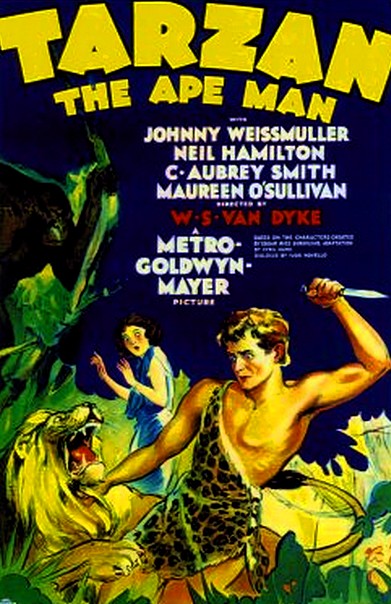
Going Ape!: TARZAN, THE APE MAN (MGM 1932)


gary loggins's avatarcracked rear viewer


Edgar Rice Burroughs’ Lord of the Jungle first hit the screen way back in 1918 with Elmo Lincoln as Tarzan. Many actors since then have donned the loin cloth, but for me the definitive movie Tarzan remains Johnny Weissmuller , who swung from his first Hollywood vine in MGM’s TARZAN, THE APE MAN, and played  the part for 16 years in 12 films.

Elderly John Parker and his young partner Harry Holt are in deepest Africa searching for the legendary “elephant’s graveyard”, which contains a fortune in ivory, but is considered sacred ground by the native tribes. Parker’s daughter Jane shows up, a spirited girl who’s no ball of fluff, but can hold her own. When Jane insists on accompanying the men on their journey, Parker scoffs, but Harry signs off because of course he’s immediately smitten with her.The jungle trek is fraught with perils, like a dangerous river crossing…

View original post 622 more words

30 Days of Noir #14: Shoot to Kill (dir by William Berke)


The 1947 film, Shoot to Kill (also known as Police Reporter), opens with both a bang and a crash.

The police are chasing a car down one dark and lonely road.  When that car crashes, the police are shocked to discover who was inside of it.  Two men and one woman, all well-dressed.  The men are both dead but the woman is merely unconscious.  The police identify one of the men as being the notorious gangster, Dixie Logan (Robert Kent).  It makes sense that Logan would be fleeing the police but what about his two passengers, newly elected District Attorney Lawrence Dale (Edmund MacDonald) and Dale’s wife, Marian (Luana Walters)?

The police may not be able to get any answers but fortunately, there’s a reporter around!  Mitch Mitchell (Russell Wade) is a crime reporter and, seeing as how he knew both Lawrence and Marian, he seems like the perfect person to get some answers.  (In fact, it was Mitch who first suggested that Lawrence should hire Marian as his administrative assistant, therefore setting in motion the whirlwind romance that would end with them married.)  Mitch goes to see Marian in her hospital room and he asks her what happened.

It’s flashback time!  Yes, this is one of those films where almost the entire film is a flashback.  That, in itself, is not surprising.  Some of the best film noirs of all time were just extended flashbacks.  (D.O.A, Double Indemnity, and Sunset Boulevard, to name just a few examples.)  What sets Shoot to Kill apart is the fact that, occasionally, we even get characters having a second flashback while already in someone else’s flashback.  We’re through the the film noir looking glass here, people.

Lawrence Dale, we’re told, was elected district attorney because he managed to secure the conviction of notorious gangster Dixie Logan, despite Logan’s insistence that he was no longer involved in the rackets.  However, what we soon discover is that not only was Logan actually innocent but Dale specifically prosecuted him as a favor to some of Dale’s rival gangsters.  That’s right, Lawrence Dale was on the take!  It also turns out that Marian has some secrets of her own.  When she first showed up at Dale’s office, she was doing more than just looking for a job.  As for her marriage to Dale …. well, I really can’t tell you what the twist is here because it would spoil the entire film.

Shoot To Kill may clock in at just 64 minutes but it manages to pack a lot of twists and turns into just an hour.  In fact, I’d argue that it probably tries to do a little bit too much.  At times, the film is a bit difficult to follow and a few inconsistent performances don’t help matters.  For instance, Russell Wade is likable as the crime reporter but he still doesn’t exactly have a dynamic screen presence.  Much better cast are Luana Walters and Edmund MacDonald, who both do a good job as, respectively, a femme fatale and a sap.  At the very least, history nerds like me will be amused by the fact that Edmund MacDonald was obviously made up to resemble Thomas E. Dewey, the former Manhattan District Attorney who twice lost the U.S. presidency.

The best thing about Shoot To Kill is the look of the movie.  Filmed in grainy black-and-white and full of dark shadows, crooked camera angles, and men in fedoras lighting cigarettes in alleys, Shoot to Kill looks the way that a film noir is supposed to look.

Regardless of whether it was the filmmaker’s original intention, Shoot To Kill plays out like a low-budget, black-and-white fever dream.  It’s definitely a flawed film but, for lovers of film noir, still worth a look.

30 Days of Noir #13: Undertow (dir by William Castle)


In the 1949 film, Undertow, Scott Brady plays Tony Reagan.  Tony used to be a member of the Chicago mob but that’s all in the past now.  He served his country in World War II and now, as he tells his old racket friend, Danny (John Russell), all Tony wants to do is settle down and run a hunting lodge in Reno.

However, before Tony can forever abandon Chicago for Nevada, he has to make peace with his future in-laws.  He’s engaged to marry Sally Lee (Dorothy Hart).  In fact, he’s so in love with her that not even meeting a single teacher named Ann McKnight (Peggy Dow) can distract Tony from his plans.  The only problem is that Sally is the niece of a Chicago gangster named Big Jim Lee and, in the past, Big Jim and Tony haven’t always been the best of friends.  In fact, the Chicago police are constantly harassing Tony because they’re convinced that he wants to start a gang war with Big Jim.  Instead, Tony just wants to make peace with Big Jim before the wedding.

Tony goes to visit Big Jim and …. well, you can guess what’s going to happen, can’t you?  If you’ve seen enough film noirs, you know that no one is every totally out of the rackets.  No one believes an ex-mobster when they say that they’re no longer interested in making trouble.  Even worse, any murder committed with automatically be blamed on anyone who says that they’re no longer a member of the rackets.  That’s what happens to Tony.  Not only does he discover that Big Jim has been shot dead but everyone thinks that he’s the one who did it.  Fleeing through the shadowy streets of Chicago, Tony finds himself not only being pursued by the police but also by the murderers.  Everyone wants to either capture or kill Tony.

In fact, the only person who seems to be on Tony’s side is Ann McKnight.  Ann lets Tony hide out at her apartment while he tries to figure out what’s going on.  Of course, Ann does have a nosy landlady who has no hesitation about letting herself into the apartment whenever she feels like it….

The plot of Undertow isn’t going to win any points for originality.  It’s not going to take you long to figure out who is setting Tony up, if just because there really aren’t enough characters in the film for there to be much suspense about who is betraying who.  But no matter!  The film is still an atmospherically shot and briskly-paced thriller.  Undertow was directed by William Castle, who is probably best known for directing campy B-movies like The Tingler and Strait-Jacket.  There’s nothing campy about Castle’s direction of Undertow.  The majority of the film was shot on location and Castle makes great use of Chicago.  When Tony tries to lose the cops that are tailing him, it helps that he’s not running across a soundstage but instead down real city streets, ones that feels alive with tension and danger.  There’s also a great chase that takes place in a long and dark corridor in an underground garage.

Scott Brady (who was the brother of tough-guy actor Lawrence Tierney) gives a sympathetic performance as Tony and he and Peggy Dow have a really likable chemistry in their scenes together.  Dorothy Hart is also well-cast as the film’s femme fatale, while Bruce Bennett has a few good scenes as a detective who is an old friend of Tony’s.  Fans of “classic” matinée idols will want to keep an eye out for Rock Hudson, making a brief appearance in his second film and credited as “Roc” Hudson.

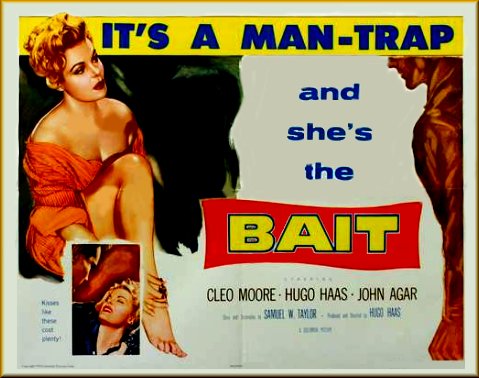
Give The Devil His Due: Hugo Haas’s BAIT (Columbia 1954)


gary loggins's avatarcracked rear viewer

Every Tuesday during the month of “Noirvember”, I’ll be spotlighting some dark genre gems. Enjoy wandering down the crooked path of film noir!

Welcome to the world of Hugo Haas, King of Low-Budget 50’s Film Noir. I’d heard about producer/director/writer/actor Haas’s films for years through Leonard Maltin’s annual Movie Guide, usually accompanied by a *1/2 to ** (or less!) rating. Of course, being a connoisseur of bad cinema, I was interested, but it wasn’t until recently I viewed my first Hugo Haas epic, 1954’s BAIT, starring Hugo’s screen muse Cleo Moore, who was featured in seven of the  maestro’s movies.

BAIT starts with a unique introduction (and some nice camerawork from DP Eddie Fitzgerald), as an elegantly dressed Sir Cedric Hardwicke plays The Devil Himself delivering a monologue expounding on his evil machinations. Then we get into the story itself (written by Samuel W. Taylor, with “additional dialog”…

View original post 527 more words

30 Days of Noir #12: The Hitch-Hiker (dir by Ida Lupino)


The intense 1953 film noir, The Hitch-Hiker, begins with news of a murderer at large.

His name is Emmett Myers (William Talman).  He’s the rough-looking man who you might occasionally see standing by the side of the road, asking for a ride with his thumb outstretched.  For me, it only takes one look at Myers’s unfriendly face and his shifty eyes to know that I would never slow down to give him a ride.  However, The Hitch-Hiker takes place in a more innocent era, at a time when everyone wanted to be of help.  Anyone who gives Emmett a ride ends up dead.  He steals their cars and then drives across country, abandoning the car only when he learns that his previous murder has been discovered.  Emmett has hitchhiked from Illinois to Southern California and he’s left a trail of dead bodies behind him.

Roy Collins (Edmond O’Brien) and Gilbert Bowen (Frank Lovejoy) don’t know who Emmett is.  They’ve missed all of the reports about Emmett’s killing spree.  They haven’t read the newspapers, all of which feature a picture of Emmett on the front page and a warning to never pick him up.  Roy and Gilbert have been too busy getting ready for a long-planned fishing trip in Baja California.  When they see Emmett hitchhiking in Mexico, they pull over and offer him a ride.

Unlike other movie hitchhikers, Emmett doesn’t waste any time before revealing who he is.  As soon as he gets in the car, he pulls a gun and tells the two men that they’re going to drive him deeper into Baja California.  He’s got a boat to catch and he says that all the two men have to do is follow orders.  Of course, both Roy and Gilbert know better.  They know that Emmett’s planning on killing them as soon as they arrive at their destination.  In fact, if Emmett learns that the police are looking for the two men, he’ll kill them sooner.  Roy and Gilbert not only have to keep Emmett from flying off the handle but they also have to keep him from discovering that both of them have been reported as being missing.

As the three men drive across California, Emmett continues to taunt his prisoners.  Repeatedly, he points out that the only reason they’re in this situation is because of their loyalty to each other.  As Emmett explains it, if the two men tried to run in opposite directions, Emmett would probably only be able to kill one of them.  If the two men both attacked him, Emmett would again probably only have time to kill one before the survivor subdued him.  Will Roy and Gilbert remains loyal to each other or will they finally embrace Emmett’s philosophy of every man for himself?

Oh, how you’ll hate Emmett Myers!  As played by William Talman, Emmett is not just a criminal but a bully as well.  The enjoyment that he gets out of taunting Roy and Gilbert will make your skin crawl.  Emmett is hardly the type of witty or charming master criminal who often shows up in movies today.  Instead, The Hitch-Hiker emphasizes that Emmett’s an idiot but, because he has the gun, he has the power.  Edmond O’Brien and Frank Lovejoy are also well-cast as the two friends who are forced to choose between survival and loyalty.

The Hitch-Hiker was one of the few films to be directed by a woman in the 1950s.  (It’s generally considered to be the only film noir to have been directed by a woman.)  Ida Lupino was not only an actress but also the only female director in the old Hollywood system and she made several hard-hitting films, the majority of which dealt with the type of issues that mainstream Hollywood was still too scared to handle.  With The Hitch-Hiker, Lupino emphasizes not only Emmett’s cruelty but also the bonds of friendship between Emmett’s two hostages.  Visually, she makes the wide open desert appears as menacing and as dangerous as any shadowy city street.  If urban noirs often suggested that threats could be hiding anywhere, The Hitch-Hiker takes the opposite approach.  The threat is in the back seat of the car and there’s literally no place to hide.

The Hitch-Hiker is an intense film that holds up well today.  Watch it below and never again make the mistake of helping out a stranger.

Special Veterans Day Edition: John Wayne in SANDS OF IWO JIMA (Republic 1949)


gary loggins's avatarcracked rear viewer

Critics of John Wayne gave him a lot of flak for not serving his country during World War II, especially in the turbulent 1960’s, labeling him a phony patriot and celluloid warrior. The truth is Wayne DID try to get into the war, but was stymied in his attempts on two fronts: Republic Studios boss Herbert Yates, who filed for deferments so he wouldn’t lose his cash cow, and Wayne’s first wife Josie, who failed to forward letters from OSS Chief Wild Bill Donovan’s office. Be that as it may, The Duke was no phony, and did what he could on the home front for the war effort.

SANDS OF IWO JIMA was made four years after the war as a tribute to the brave souls of the United States Marine Corps who fought against the Japanese in the South Pacific. Wayne plays the tough top kick Sgt. John Stryker…

View original post 748 more words

30 Days of Noir #11: Wicked Woman (dir by Russell Rouse)


The 1953 film noir, Wicked Woman, opens with a bus coming to a stop in a small town in the middle of nowhere.

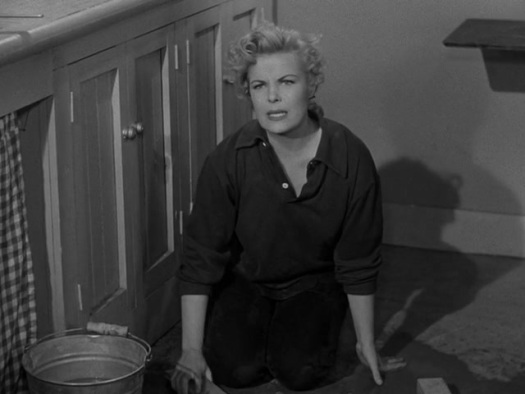
Getting off the bus is Billie Nash (Beverly Michaels).  From the minute she starts walking through the town, it’s obvious that Billie may not have a home and she may not have a lot of money but what she does have is total and complete confidence in herself.  Nobody tells Billie Nash what to do!  When she movies into a boarding house (the rent is $6 a week!), she’s leered at by her new neighbor, the diminutive Charlie Borg (Percy Helton, a character actor who will be familiar to anyone who has ever spent a week bingeing on TCM.)

It turns out to be a rather low-rent boarding house.  The landlady may be found of shouting, “I run a respectable place!” but nothing about this location seems to support that claim.  Billie has one room to herself.  The bathroom is down the hall.  A pay phone sits in the hallway.  Billie actually has to spend money to make a phone call.  Fortunately, Charlie Borg is always around and willing to loan her money.  In fact, when Billie says that she needs twenty dollars to buy a new outfit, Charlie hands it over and asks Billie to thank him by going out to dinner with him sometime.  Even though she has no intention of ever spending any lengthy amount of time with Charlie, Billie says sure.  Money is money.  You do what you have to do.

(Myself, I’d just like to live in a time when it only cost $20 to buy a new outfit.)

Once Billie finally manages to get Charlie to stop bugging her, she goes down to the local bar and applies for a job.  It’s not much of a bar but, again, money is money.  The bar is owned by Dora Bannister (Evelyn Scott), an alcoholic who asks Billie if she’s sure that she can the bar’s “rough crowd.”  Billie assures her that there’s no one so rough that she can’t handle and, as played by Beverly Michaels, you never doubt that she’s telling the truth.

Soon, Billie is flirting with the bar’s handsome bartender, Matt (Richard Egan).  Matt is ambitious and hard-working and, after just a few nights, he’s absolutely crazy about Billie.  The only problem is that Matt is not only married but he’s married to Dora!  That doesn’t matter to Billie.  In fact, she’s even come up with a scheme to steal not only Matt but also the bar from Dora.

Unfortunately, for Billie, the walls at the boarding house are extremely thin and Charlie overhears her and Matt scheming.  It turns out that Charlie’s not quite as clueless as he seems and soon, he’s blackmailing Billie.  He really wants that date….

Wicked Woman is a wonderfully sordid, low-budget film noir, one that features just a little bit of everything.  Adultery, blackmail, sex, addiction …. it’s all here and it’s impossible not to be entertained by the film’s over-the-top melodrama.  While both Richard Egan and Percy Helton are memorable as the two men in her life, the film is pretty much stolen by Beverly Michaels.  Whether coolly glaring at Charlie or giving a little smile after having done something particularly manipulative, there’s rarely a time that Billie isn’t in complete control of her destiny.  Beverly Michaels is a force of nature in this film and she turns “wicked” into a compliment.

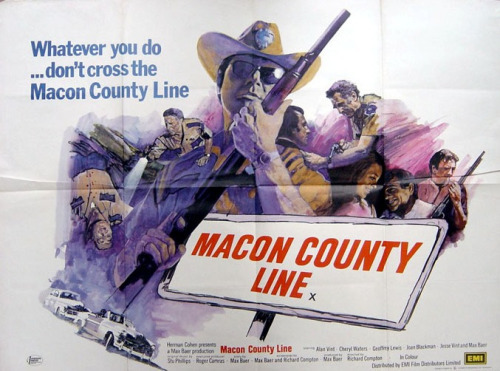
Drive-In Saturday Night 3: MACON COUNTY LINE (AIP 1974)/RETURN TO MACON COUNTY (AIP 1975)


gary loggins's avatarcracked rear viewer


Yee-haw! Southern Fried Exploitation was box office gold during the 1970’s, a  genre that usually had one or more of the following elements: race cars, moonshine, redneck sheriffs, scantily clad country girls, shotguns, and/or Burt Reynolds .  One of the foremost practitioners of this art was Max Baer, namesake son of the heavyweight boxer and erstwhile Jethro Bodine of TV’s THE BEVERLY HILLBILLIES, who scored a surprise hit when he produced, wrote, and costarred in 1974’s MACON COUNTY LINE.

The story’s set in the 50’s, complete with some vintage tunes on the soundtrack (The Chords’ “Sh-Boom”, Laverne Baker’s “Jim Dandy”, Big Joe Turner’s “Corrine, Corrina”). “The story is true”, reads a pre-credits scrawl, “only the names have been changed” (Actually, the story was concocted by Baer and director Richard Compton, but what the hey…). Brothers Chris and Wayne Dixon (played by brothers Alan and Jesse Vint ) are a pair…

View original post 781 more words

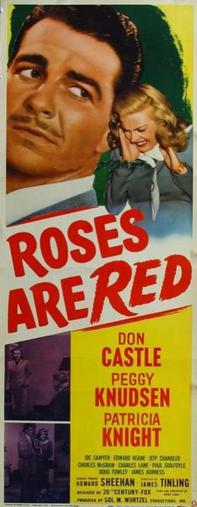
30 Days of Noir #10: Roses are Red (dir by James Tinling)


As the 1947 film, Roses Are Red, begins, Robert A. Thorne (Don Castle) has just been elected to the office of district attorney.

Now, being the horror fan that I am, the thing that I immediately noticed was that the new district attorney had the exact same name as the character played by Gregory Peck in The Omen.  However, Roses Are Red has nothing to do with the son of Satan or the end of the world.  Instead, it’s just a briskly paced tale of swapped identity.

Robert A. Thorne is not just a brilliant lawyer.  He’s also an example of that rare breed, an honest politician.  He ran on a platform of reform and that’s what he’s intending to pursue now that he’s been elected.  As he tells his girlfriend, journalist Martha McCormick (Peggy Knudsen), cleaning up this country isn’t going to be easy but he’s determined to do it.  And the first step is going to be taking down the local mob boss, Jim Locke (Edward Keane).

The wheelchair-bound Jim Locke is a man who prefers to stay in the safety of his penthouse, where he can feed his fish and give orders to his subordinates, all of whom have names like Duke (Charles McGraw), Knuckle (Jeff Chandler), Buster (Paul Guilfoyle), and Ace (Douglas Fowley).  However, his man on the police force, Lt. Rocky Wall (Joe Sawyer), has warned him that this new district attorney might not respond to usual combination of bribes and intimidation.  That’s not good news because there are men who might be willing to testify against Locke in return for a shorter prison sentence.

However, things start to look up when none other than Robert A. Thorne shows up at Locke’s penthouse and says that the honesty bit was all a sham and that he wants to be on Locke’s payroll.  However, Locke soon figures out that he’s not talking to Thorne.  Instead, he’s talking to Don Carney (also played by Don Castle), a career criminal who has recently been released from prison and who just happens to look exactly like Robert Thorne!

Locke and Don come up with a plan that seems foolproof.  What if Knuckle kidnaps Thorne and holds him hostage for a few days?  During that time, Don can study Thorne and learn how to perfectly imitate all of his movements and expressions.  Once the two men are absolutely indistinguishable, Knuckle will murder Thorne and then Don will take his place.

Knuckle manages to kidnap Thorne with absolutely no trouble.  The police, under the prodding of Lt. Wall, announce that Thorne has obviously run off to avoid dealing with the local gangsters.  Don starts the process of studying Thorne but it turns out that the district attorney has a few tricks of his own….

With a running time of only 67 minutes, Roses are Red doesn’t waste any time jumping into its somewhat implausible plot.  Fortunately, the film is so short and quickly paced that most viewers won’t really have time to worry about whether or not the film’s plot actually makes any sense.  This is an entertaining, low-budget film noir, featuring a host of memorable performances and all of the hard-boiled dialogue that you could hope for.  Don Castle does a good job playing both the sleazy Don Carney and the upright Robert A. Thorne.  History nerds like me will immediately notice that, with his mustache and his slicked back hair, Castle bears a distinct resemblance to former Manhattan D.A. and two-time presidential candidate, Thomas E. Dewey.

All in all, Roses are Red is an enjoyable film for fans of old school gangster noir.  Check it out below: