Cinemax Memories: Raw Nerve (1991, directed by David A. Prior)


Raw Nerve opens with a serial killer haunting Mobile, Alabama, using a pump action shotgun to shoot women in the face while they’re wearing red high heels.  Race car driver Jimmy Clayton (Ted Prior, brother of this film’s director) has been having visions of the murders so he goes to the police and offers to help them out.  Unfortunately for Jimmy, neither Detective Ellis (Jan-Michael Vincent!) nor Captain Gavin (Glenn Ford!!) believe in psychic phenomena so they toss Jimmy’s ass in jail.  While Ellis’s ex-wife, Gloria (Sandahl Bergman!!!), tries to prove that Jimmy’s innocent, Jimmy’s mechanic (Randall “Tex” Cobb!!!!), takes an unhealthy interest in Jimmy’s teenage sister, Gina (TRACI LORDS!!!!!).

As you can tell from reading the paragraph above, the main thing that this film has going for it is a cast full of recognizable B-actors.  Though none of them are really at their best, Raw Nerve is still your only chance to see Glenn Ford, Jan-Michael Vincent, and Sandahl Bergman all sharing scenes together.  Unfortunately, despite all of the famous names in the cast, Ted Prior got the most screen time and he really didn’t have the screen presence to pull off either the role or the film’s loony final twist.

The best thing about Raw Nerve is that it features both Randall “Tex” Cobb and Traci Lords.  Lords was a legitimately good actress, even if her past as a pornographic actress made it impossible for her to get the type of roles that she really deserved.  Lords doesn’t get to do much in Raw Nerve but she does her best to make Gina into a real character instead of just a generic victim.  Meanwhile, Randall “Tex” Cobb is a marvel as a biker who is never seen without a beer in his hand.  When Cobb eventually leaves the movie, you miss him.

Raw Nerve was one of the many low-budget thrillers that came out in the 90s.  Like many of these films, Raw Nerve was directed by David A. Prior and released by Action International Pictures, which shared both an acronym and a sensibility with American International Pictures.  Though films like Raw Nerve may not have been great art, they were entertaining if you came across one of them on Cinemax.  Where else were you going to see Tex Cobb and Jan-Michael Vincent battle it out at two in the morning?

Halloween Havoc!: ISLAND OF LOST SOULS (Paramount 1932)


gary loggins's avatarcracked rear viewer

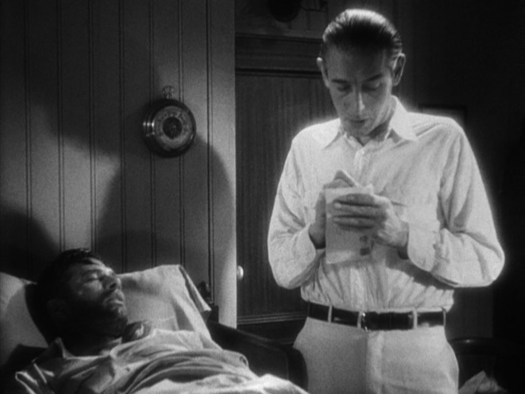
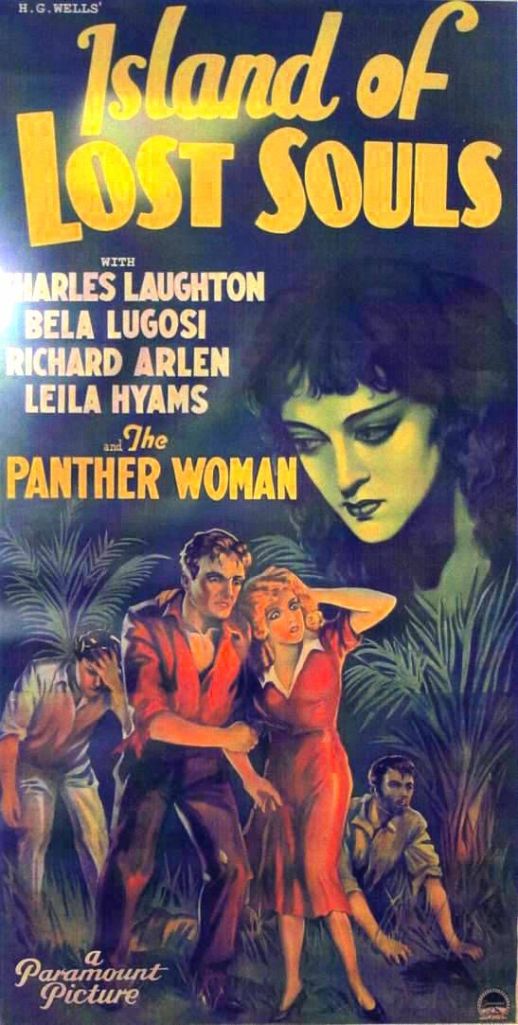
Universal Pictures kicked off the horror trend of the early 30’s with DRACULA and FRANKENSTEIN , and soon every studio in Hollywood, both major and minor, jumped on the terror train. Paramount was the first to hop on board with an adaptation of Stevenson’s DR. JEKYLL & MR. HYDE , earning Fredric March an Oscar for his dual role. Soon there was DR. X (Warners), THE MOST DANGEROUS GAME (RKO), FREAKS and THE MASK OF FU MANCHU (both MGM), and THE MONSTER WALKS and WHITE ZOMBIE from the indies. Paramount released ISLAND OF LOST SOULS at the end of 1932, a film so shocking and perverse it was banned in Britain for over a quarter century, and still manages to frighten even the most jaded of horror fans today.

Based on the novel The Island of Dr. Moreau by H.G. Wells, the film begins with shipwrecked Edward Parker being rescued…

View original post 818 more words

International Horror Film Review: Hour of the Wolf (dir by Ingmar Bergman)


An Ingmar Bergman horror film?

Indeed.  Despite the fact that Bergman’s bleak imagery and existential themes undoubtedly influenced any number of horror filmmakers (Wes Craven’s Last House On The Left was essentially a remake of Bergman’s The Virgin Spring), the 1968 film, Hour Of The Wolf was Ingmar Bergman’s only official horror film.

Of course, it’s also an Ingmar Bergman film, which means that it’s also a meditation on relationships, regret, the difficult of ever knowing what’s truly going on inside someone else’s head, and the artificiality of the artistic process.  It tells the story of a painter named Johan Borg (Max Von Sydow) and his pregnant wife, Alma (Liv Ullman) and their life on an isolated island.  Alma is worried about Johan’s feelings towards his former muse and ex-lover, Veronica Vogler.  Johan is haunted by nightmarish visions of menacing figures and the feelings that demons are pursuing him.

The film opens with a title card, informing us that the story that we’re about to see is true and that it’s an attempt to reconstruct the final days of Johan’s life before his mysterious disappearance.  Of course, as anyone who has seen enough found footage films can tell you, the title card is a lie and there never was a painter named Johan Borg, or at least not one who mysteriously vanished while living in an isolated house on an island.  Instead of being meant to convince us that we’re about to see a true story, the title card instead establishes that what we’re about to see can be considered to almost be a dark fairy tale.  The title card is the film’s way of saying, “Once Upon A Time…..”  It’s also a reminder that most fairy tales are considerably more grim than what those of us raised on Disney might expect.

(No coincidentally, the title Hour of the Wolf came from Swedish folk lore.  The Hour of the Wolf is the time between 3 and 5 in the morning, during which it is said that most births and deaths occur.)

While the opening credits flash by on a dark screen, we hear the sounds of men working and anyone who has any experience in theater will immediately realize that we’re listening to a set being built.  As the opening credits come to an end, we hear Bergman shouting out, “Action!”  Our next shot is Alma standing outside of the house that she shared with Johan.  Alma looks straight at the camera as she tells us that she still doesn’t know what happened to Johan.  She tells the unseen Bergman that she’s revealed to him everything that she knows.

It’s an interesting opening, one that reminds the audience that what they’re seeing is merely a recreation of what might have happened on Johan and Alma.  When Alma speaks to Bergman, there’s an interesting subtext to her words and her tone and one gets the feeling that Alma and the director are meant to have a history of their own.  It’s almost as if the film is saying that the story’s meaning can only be found in what we can’t see, in what’s going on behind the camera.  That seems especially true when you consider that, when Hour of the Wolf was filmed, Liv Ullman, who played the pregnant Alma, actually was pregnant with Bergman’s child and that Bergman himself later said that Johan Borg’s nightmares were recreations of Bergman’s own nightmares.  It’s perhaps a little too easy to imagine that the demons that inspire Johan’s art are the same demons that inspired Bergman’s films and that this film is both an apology to Ullman for his own neurotic tendencies and a tribute to her willingness to put up with him.

Hour of the Wolf is a bleakly effective film, one that works as both a dissection of an unstable relationship and a portrait of a man who may be losing his mind.  Von Sydow plays the haunted Johan as a charismatic but introverted artist, a troubled individual who can only truly express what’s happening in his mind through his art.  Indeed, Johan’s tragedy seems to be that the joy he gets from creating can only come from the pain that he suffers from imagining and dreaming.  Ullman is heart-breaking as she tries to keep her husband from succumbing to his own darkness while, at the same time, trying not to get sucked into the darkness herself.  About halfway through the film, Johan confesses to committing a shocking crime and, like Alma, you don’t know whether to believe him or to believe that he’s reached the point where he can’t tell the difference between reality and his nightmares.  Ullman plays the scene with the perfect combination of fear and sadness, sympathy and revulsion.  As for Von Sydow, he brings to life both the natural arrogance of an artist and the terror of someone who suspects that he has no control over his own existence.

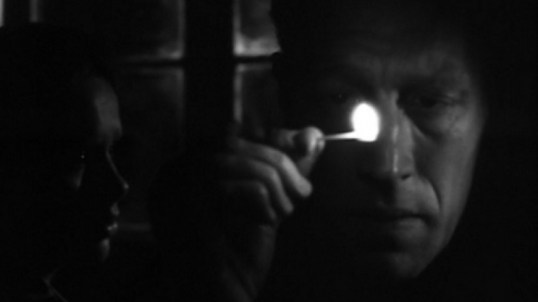
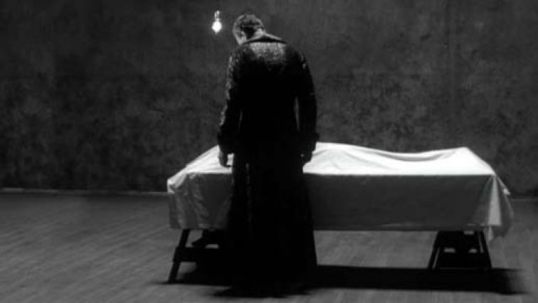
Visually, this film is bleak by even the standards of Bergman.  The black-and-white cinematography plays up not just the shadows of the night but also the brutal desolation of Johan and Alma’s life on the island.  It reminds us that Johan is an artist living in a world without color.  Bergman views Johan and Alma through a detached lens, recording the collapse of their lives but, at the same time, keeping his distance as if to protect the audience from getting trapped inside of Johan’s madness.

Hour of the Wolf may have been Ingmar Bergman’s only official horror film but it’s definitely an effective thriller, one that manages to explore both Bergman’s signature themes while also keeping the audience off-balance and wondering what might be lurking in the darkness.  It may not be one of Bergman’s “best-known” films but it’s definitely one for which to keep an eye out.

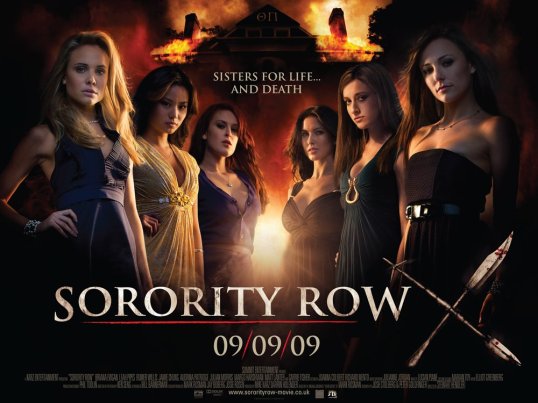
Sorority Row, Review By Case Wright


Sorority-Row.jpg

Horror can make a political statement, it can make you reflect on your status in society, or it can just entertain.  The first two types are good, but it’s also nice to just have fun! “Sorority Row” written by Josh Stolberg & Peter Goldfinger and directed by Stewart Hendler is a 1990s throwback.  It had a real “I Know What You Did Last Summer” feel to it.  Honestly, the reviews are not fair to this film.  A lot of people want horror to be all things, but it’s supposed to be fun too.  So, just relax and have a good time.  Also, it doubled its money, which is what a movie is supposed to do- especially horror. It’s one of the few genres left that can produced by mere mortals.

What I liked mostly about the film was the writing.  It had a lot of great humor without it being campy. I’ve gotten to know Josh Stolberg on twitter the script has quite a bit of his personality: clever and quick-witted.  I especially enjoyed Jessica (Leah Pipes).  As a man who went a Greek dominated college, she was very realistic.  Her character and one-liners gave the story a mix of comic relief and reality.  I practiced Criminal Law for waaaaay too long and I can tell you that even honest people can turn to something wicked if they feel threatened.  People will invariably choose themselves over a possible life ending punishment.

The plot is similar to the original House on Sorority Row: a prank run a muck.  The girls belong to Theta Pi and they to love to party, prank, and get murdered.  Garrett a brother of the Sister “Chuggs” cheated on Megan another Theta Pi, which is not okay! So, the sisters have her fake an overdose so that Garrett believes he killed Megan.  The sisters: Jessica, Ellie, Cassidy, Claire, Megan, and Chugs are all in on the prank are a little too convincing because they make Garrett believe that they need to hide Megan’s body in a mine shaft or their lives will be ruined.  The sisters say they have to get rid of the air in Megan’s lungs or she’ll float back up. So, Garrett takes the initiative as a true go-getter and uses a tire iron to stab Megan to death.  Jessica decides very quickly that they need to hide Megan’s body for real.  When Cassidy refuses to participate, they wrap the corpse in Cassidy’s coat and throw it down the mine shaft.  Jessica really thinks fast on her feet.

I don’t know about you, but I think Jessica would be good marriage material. Hear me out: she’s determined, quick-thinking, has a college degree, and is ruthless to protect her goals.  Also, Cassidy tried to be all above it, but as Jessica said- “you could’ve called the police, but you didn’t!”  Agreed.  You don’t get to benefit from something wicked and then look down on everyone else.  Jessica made her choice and stuck to it.  She made a good point as to protecting everyone’s future and ran with it.  Cassidy kept Hamletting over her bad choices.  Do it or Don’t.  Jessica, don’t listen to the haters.

All seems fine a year later.  They’ve all moved on except for Garrett who has become a wreck over his humiliation and accidental murdering.   Then, they all receive a threatening group text on their very old timey looking phones- 2009 was just ten years ago and these phones look like museum pieces.  Sorority-Row-Megan-s-HERO-Cell-Phone-1.jpg

This technology allowed for some extra suspense because reception and tech wasn’t that great then; therefore, the characters can be cutoff from help.  I really think horror shouldn’t be set any time after 2009 because it’s just too easy to get help now.  This lack of tech added a nice layer of suspense.  The text sender stalks and murders them one by one.

The kills were pretty clever: an electrocution, death by chardonnay, tire iron throwing, and a good ol’ fashioned stabbing or three.  It also had a fun twist at the end like the 1990s horror films of my youth.   I recommend this film.  Read my past reviews- I don’t just recommend anything.  I’m an iconoclast and can tell you that this was a lot of fun. Happy Horrorthon!

sorority-row2.png

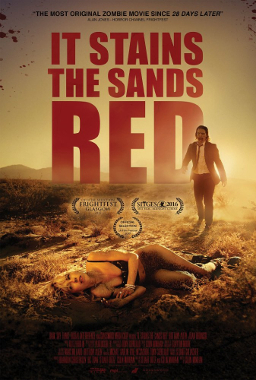
Horror Film Review: It Stains The Sands Red (dir by Colin Minihan)


So, imagine this scenario.

The world’s ending, again.  The city that you once called home — in this case, Las Vegas — is on fire.  Hordes of zombies are attacking the living and it seems like even the people who have, up until now, survived the undead have still allowed their worst instincts to take over.  The military is opening fire on anyone that they come across and scavengers, both living and not, are all over the place.

Your boyfriend, Nick, has a way to escape.  His lowlife buddies have a plane ready to go.  They’re just waiting for him to show up, mostly because he’s bringing the drugs.  His friends, of course, could hardly care less about you but, as long as you show up with Nick, you know that you’ll be able to escape with them.  Unfortunately, Nick is now dead.  His throat was ripped open by a zombie.

So, now, you’re walking across the Nevada desert and you’re just trying to make it to the airfield without getting killed.  It’s over a 100 degrees out.  You’re not sure where you’re going.  You’re not dressed for a desert journey.  You’re haunted by memories of your son.  Though you’re smarter than people give you credit for being, you have no desert survival skills.  Meanwhile, the same zombie that killed Nick is staggering along behind you, hoping to get a chance to do the same to you.

And, just in case this week wasn’t bad enough, you’re also on your period and you have exactly one tampon.

That’s the situation in which Molly (played by Brittany Allen) finds herself in the 2017 zombie film, It Stains The Sands Red.  As Molly makes her way through the desert, she finds herself becoming cautiously attached to the zombie pursuing her, a zombie that she nicknames Smalls (and who is played by Juan Reidinger).  It makes sense, really.  For most (though not all) of the movie, Smalls is the only other creature around.  Who else is Molly going to talk to?  It also helps that, being a walking corpse, Smalls can’t interrupt her while she’s speaking or dismiss her concerns out-of-hand.  When you compare him to the living people that Molly meets, a group that includes two redneck rapists and a few trigger-happy soldiers, it’s easy to view Smalls as being harmless.

Or, at least, it’s easy to view him that way until he gets too close and tries to bite off your finger.

I had mixed feelings about It Stains The Sands Red.  It’s an extremely uneven film, one that is sometimes quite clever and even empowering and sometimes rather forgettable.  Molly’s monologues bring a welcome feminist sensibility to the zombie genre and there’s a clever scene in which she uses a bloody tampon to distract her zombie stalker.  And yet, it’s indicative of both the film’s strengths and its weaknesses that the scene with the tampon is played as much for shock value than as an example of Molly’s resourcefulness.  The film is full of scenes in which we see that Molly has somehow managed to slow down or subdue Smalls but we’re always left wondering how she managed to get close enough to him without getting attacked.  Smalls’s effectiveness as a zombie seems to change from scene-to-scene, depending on the needs of the narrative.

And yet, there’s one thing that I greatly appreciated about It Stains The Sands Red and that was the character of Molly.  As soon as you see her snorting cocaine while wearing her leopard-print leggings, her pleather halter top, and her fake fur, you know that Molly is the type of character who usually dies within the first 15 minutes of a film like this.  Instead, Molly not only survives the first 15 minutes but she goes on to repeatedly show that she’s far more determined and intelligent than anyone in the viewing audience originally gave her credit for being.  She emerges as a compelling and determined survivor, one who refuses to surrender to either the desert or its predators.  Molly is the type of strong female character that horror fans like me have always wanted to see in a film like this.  She elevates It Stains The Sands Red above its flaws and makes the film worth watching.  In the role of Molly, Brittany Allen brings life to this film about the dead.


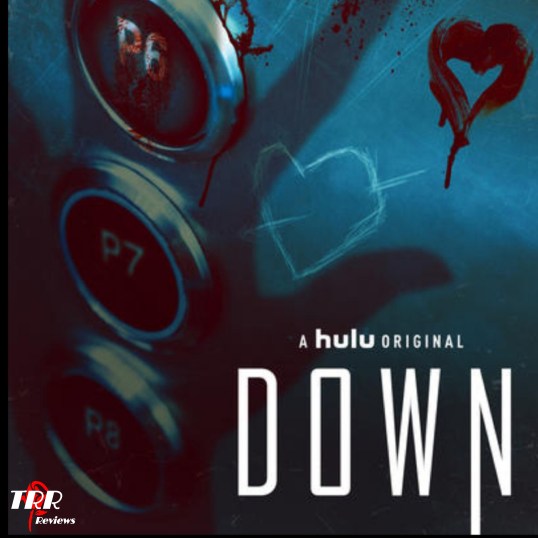
Into the Dark, “Down”, Dir. Daniel Stamm, Review By Case Wright


Down

Happy Horrorthon!!!!

Should some people embrace their creative mediocrity? YES! Yes, they should.  I don’t mean that what they write or direct is bad. It’s simply unoriginal, predictable, with characters who make obviously bad decisions REPEATEDLY, and still are amazingly fun! I never thought I’d get into Lifetime movies until Lisa got me into them. I discovered how fun Hallmark movies are these past few years.  Law & Order embraced its predictability so much that their main sponsor Listerine would break the show down in the Commercials: Body discovery, Wisecrack, Investigation and Arrest, Prosecution, and Verdict. Law & Order lasted 19 years.  Case, what’s your point?  My point is that mediocrity can be fun…a LOT of fun.

Hulu’s “Into the Dark” series is the fun trash that is great to watch and nothing more (accept for the episodes that are hamfisted, political, and preachy) ; it’s like the Jack in the Box Munchie Meals…yeah, they’ll give you a bit of diarrhea, but come on, sometimes you just gotta have a Sriracha Curly Fry Burger.  That’s just science!

“Down” is awesomely bad.  The actors mug, the character decisions are stupid, and it’s great for the elliptical or exercise bike and probably safer to watch as you’re burning those last Lbs.  The plot is simple and doesn’t try to go into a supernatural direction. It’s fun because it never tries.  Jennifer Robbins ( Natalie Martinez) is trapped in an elevator on a holiday weekend with Guy (Matt Luria), BUT is Guy hiding something sinister? Yes…yes, he is and you can tell because he mugs A LOT!

If Lifetime went down the horror route, this would be the premiere.  Guy is in fact Jennifer’s stalker and manipulates her into having sex like the Lifetime movies with the Single Moms and the Predator Next Door.  Lifetime movies are better than “Down” because with Lifetime movies once the heroine realizes she has to fight; it’s to the death.  Here, when Jennifer realizes Guy is a Psycho Killer she doesn’t Run….Run…Away.  In fact, he tries to kill her a lot and then she gets the upper hand, but does she finish him off? Nooooope.  She fails to deliver the Coup de Gras not once, not twice…no, we’re talking six times here when she could’ve finished the movie and literally had a smoke after the 45 minute mark, but 45 minutes of filler was fine for my physical therapy time.

I know that this reads harsh, but these movies have their place; they’re fun.  If the pacing and plot points matched with a Lifetime MOW, it would’ve been that much better, but you can’t have everything, nor should you! Will I review a bunch more of these Into the Dark quasi-episodes? YES, Yes I will!

Happy Horrorthon!

Horror on the Lens: Raiders of the Living Dead (dir by Samuel M. Sherman and Brett Piper)


Hi there and welcome to October!  This is our favorite time of the year here at the Shattered Lens because October is horror month.  For the past three years, we have celebrated every October by reviewing and showing some of our favorite horror movies, shows, books, and music.  That’s a tradition that I’m looking forward to helping to continue this year.

Let’s start things off with the 1986 epic, Raiders of the Living Dead!

I reviewed this film last year but to recap, it’s the story of a creepy boy, a laser gun, a reporter, and a bunch of zombies.  There’s a mad scientist involved, too.  There always is.  The movie opens with a truck being hijacked and then the action shifts to a power plant and, honestly, I have no idea what any of it means.  Technically, Raiders of the Living Dead is not exactly a good film but it is a film unlike any other that you’ve seen.  If nothing else, it’s a film that you watch and you can’t help but admire the fact that it somehow got made and went on to find a small but kind of appreciative cult audience.  It’s just a very strange film and a good one to start October with, no?

Plus, it has got the greatest zombie-centric theme song ever!  The opening credits alone are worth the price of admission (which, incidentally, is free because those of us at the Shattered Lens love you!)

So, here is Raiders of the Living Dead. 

Enjoy!

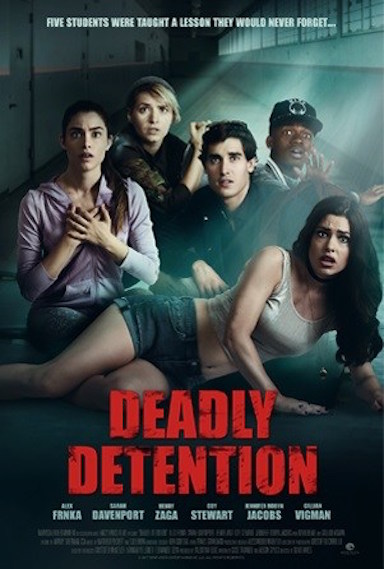
The Things You Find On Netflix: Deadly Detention (dir by Blair Hayes)


If you’re in high school and you have to do Saturday detention in an abandoned, but perhaps haunted, prison, there’s a good chance that you’re gong to die.

That’s the main lesson that can picked up from the 2017 film Deadly Detention, which I watched via Netflix a few nights ago.  Old prison.  Sex.  Detention.  It all leads to death.  Of course, you really shouldn’t need a movie to teach you that lesson.  I mean, it’s just common sense.  STAY OUT OF THE OLD PRISONS, PEOPLE!  Especially if it’s got a death row because you just know there’s going to be a lot of pissed off ghosts floating around there….

The good thing about Deadly Detention is that it realizes that abandoned prison=death should be common sense as well.  It’s an extremely self-aware movie, fully indulging in all of the slasher movie cliches while, at the same time, poking cheerful fun at them.  Deadly Detention may start out as a horror film but, after about 15 minutes or so, it turns into a full-blown comedy and it’s actually pretty fun to watch.

Why are our students attending detention?  Well, it turns out that the majority of them have been framed, which explains why even the popular school athlete is being punished.  Why are they attending detention in a prison?  Well, it seems that a pack of rabid possums were somehow released into the school.  Now, of course, being the former country girl that I am, I immediately knew something strange was happening because possums are actually immune to rabies.  So, seriously, if you see a possum in your back yard, don’t panic!  They’re harmless.

Among those spending their Saturday in detention:

Officer Pete (Kevin Blake), the quiet hall cop,

Miss Presley (Gillian Vigman), the principal who brings her very big and very pointed principal-of-the-year trophy with her,

Lexie (Alex Frnka), the rebellious school tramp who turns out to be a lot more smarter than anyone gave her credit for,

Jessica (Sarah Davenport), the school athlete who has always been driven to be the best,

Barrett (Henry Zaga), the hilariously vain and shallow rich kid whose main hope is that, if he dies, he’ll still look good,

Kevin (Coy Stewart), the gay religious kid who turns out to actually have a lot more depth than anyone originally suspected,

and Taylor (Jennifer Robyn Jacobs), the cheerfully strange girl who knows all the stories about all the ghosts.

Now, you may be thinking that this cast of characters sounds familiar and it’s true that they’re all deliberately meant to invoke various slasher movie tropes.  At the same time, I suspect that they’re also meant to remind us of the members of The Breakfast Club as well.  However, each character is so well-cast and each actor seems to be having so much fun that they all soon develop their own individual identities.  In fact, this cast is so fun to watch that it’s kind of sad once the blood starts to spill.

But spill, it does.  Soon, the detainees find themselves having to figure out how to escape the prison while an unseen stalker taunts them over the intercom.  What sets this film apart from many other Netflix slasher films is that the students all seem to know that they’re in a horror film and they tend to comment on the action accordingly.  When it comes to a horror-comedy, a film always has to decide if it’s going to be more of a horror or a comedy and, early on, Deadly Detention embraces the comedy label and it turns out that the film made the right choice.  Thanks to a likable cast and some clever dialogue, Deadly Detention is an entertaining 90 minutes.

As I said, the entire cast is good but Alex Frnka, Coy Stewart, and Jennifer Robyn Jacobs especially deserve a lot of credit for taking characters who could have been cliches and instead turning them into fairly compelling human beings.  Alex Frnka not only gets all the best lines but she makes them even better with a delivery that’s perfectly perched between sincerity and snarkiness.  The same can be said of the film as a whole.

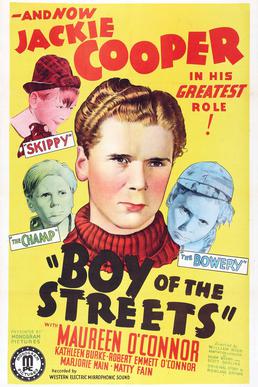
Cleaning Out The DVR: Boy of the Streets (dir by William Nigh)


Welcome to New York City, circa 1937!

It’s a place where the extremely wealthy carefully avoid the districts dominated by the extremely poor, like the Bowery.  In the Bowery, families live in tenements and worried mothers can only cry as they watch their sons join street gangs and their daughters settle for a life of abuse and loss.  Sure, there’s a few do-gooders.  Occasionally, there’s a cop who is convinced that no boy is a lost cause.  Sometimes, you’ll run into a doctor who is determined to provide adequate medical care to the inhabitants of the Bowery.  In fact, you might even see a rich person who is determined to spread about some charity.  But, for the most pat, life in the Bowery is just one hopeless day after another.

14 year-old Chuck Brennan (Jackie Cooper) lives in the Bowery.  He’s got a gang of boys who will do anything that he tells them to do and, despite the fact that Chuck is obviously smarter than almost everyone else around him, he has no interest in being a role model or decent citizen or anything else of that matter.  Chuck lives in a shabby apartment with his mother (Marjorie Main) and his father (Guy Usher).  Chuck looks up to his father who apparently knows important people and is often out of town on “business.”  However, when Chuck discovers that his father is actually a low-level hood who works for the local political machine, Chuck is not only disillusioned but also inspired to go find some gangsters to team up with himself.

The system says that Chuck is a hopeless case but not everyone agree.  Officer Rourke (Robert Emmett O’Connor) thinks that there’s hope for Chuck, he just needs something or someone to straighten him out.  (Like maybe a stint in the Navy….)  And then there’s Nora (Maureen O’Connor), the sweet Irish girl who lives in Chuck’s building and who is often heard singing to her deathly ill mother.

In the end, it’s all up to Chuck.  Will he pursue a life of crime or the life of an honest man?  Will he be a man like his father or will he end the cycle of crime and desperation?

Boy of the Streets is a low-budget, black-and-white film from 1937.  It was produced by Monogram Pictures and, much like Dead End (which came out the same year and featured a superficially similar storyline), it’s a film that mixes social commentary with a bit of gangster action.  The film’s low-budget doesn’t do it any favors and there’s nothing particularly surprising to be found in the film’s plot but child actor Jackie Cooper is convincingly cocky as the swaggering Chuck and Marjorie Main does a good job as his anguished mother.  (Interestingly, Main also played Humphrey Bogart’s mother in Dead End.)

Boy of the Streets is a good example of a film that I never would have seen if not for TCM.  (I recorded it off of TCM way back in June.)  That’s one reason why I’ll always be thankful for TCM.  At a time when so many people seem to be determined to destroy history, TCM is celebrating it.

A Blast From The Past: The Good Loser (dir by Herk Harvey)


Director Herk Harvey

What’s more important?  Being a good winner or a good loser?

Does being a good winner make it more difficult to be a good loser?

Should an individual loss matter if it contributes to a team victory?

When your child loses, is it a good idea to relentlessly taunt them about it?

These questions and more are explored in the 1953 short film, The Good Loser.  This is one of those films that they used to show in schools in order to teach students how to …. well I’m not sure what anyone learns in The Good Loser.  It tells the story of Ray, who is the best public speaker in all of Kansas or, at least, he is until he makes the mistake of agreeing to mentor Marilyn.  After Marilyn beats him at the speech and debate tournament, Ray throws a little hissy fit.  It doesn’t help that everyone — from his classmates to his own father — is making fun of him for losing to his protegee.

“What do you think?” the narrator asks and I’ll tell you.  I’ve never been a good loser so I totally think that Ray has every right to drop out of school and spend the rest of his life wandering around the country, drifting from job-to-job and refusing to trust anyone.  “Second place just means you’re the best loser.”  A teacher said that to me once and the end result was …. well, actually, I think I was kinda like, “Really?  The best?”  Anyway….

Now, if you’re wondering why I’m sharing this video in October, it’s because this film was directed by Herk Harvey.  Harvey made a career out of directing short educational films but, to horror audiences, he’s best known for directing a classic horror film called Carnival of SoulsCarnival of Souls is a film that I’ll be sharing on later in the month.  On the surface, The Good Loser may not appear to have much in common with Carnival of Souls.  However, I think you can compare Ray’s insensitive classmates to the insensitive ghosts who haunted Candace Hilligoss in Carnival.  If nothing, they’re all similarly relentless.  They’re also all jerks, if you ask me.

What do you think?