Returning to their hometown in Missouri in the days following the end of the Civil War, former Confederate guerrillas Jesse James (Colin Farrell) and Cole Younger (Scott Caan) are disgusted to discover that the railroad companies are trying to take over everyone’s land. After Cole’s cousin and Jesse’s mother are killed by railway thugs, Jesse and Cole take revenge by forming the James/Younger Gang and robbing banks. Soon, the members of the James/Younger Gang become folk heroes and the railroad company resorts to bringing in Alan Pinkerton (Timothy Dalton) to track the outlaws down. However, even as they try to remain out of the clutches of Pinkerton’s men, there is growing dissension in the ranks of the James/Younger Gang. Cole feels like Jesse doesn’t respect his opinions while Jesse is falling in love with Zee (Ali Larter) and it’s hard to court a girl when you’re constantly having to hide out from Alan Pinkertson. Meanwhile, the other members of the gang wonder why their wanted posters never look as good as Jesse’s and Cole’s.
There have been many movies made about the James/Younger Gang and this is certainly one of them. What sets this telling apart from other versions of this familiar tale is that American Outlaws is the feel-good version of the story. Bob and Charley Ford are nowhere to be seen in American Outlaws and Jesse James doesn’t get shot in the back while straightening a picture. This approach misses the point of what makes the legend of Jesse James so memorable in the first place. Jesse James was the greatest outlaw in the west but he was ultimately taken down by a coward who shot him in the back. Take out that part of the story and the story loses all of its power. Jesse James just becomes another outlaw.
In real life, the James/Younger Gang were reportedly a rough group of outlaws who didn’t hesitate when it came to killing. In American Outlaws, they come across more like a boy band with a side hustle robbing banks. Jesse is the soulful leader, Cole is the rebel, and the other members of the gang are the interchangeable backup vocalists. There’s been many good and even great films made about the James/Younger Game. American Outlaws is not one of them. For a good movie about the life and times of Jesse James and his associates, I would suggest checking out Walter Hill’s The Long Riders or Andrew Dominik’s The Assassination of Jesse James by the Coward Robert Ford.
The 1934 best picture nominee, The Barretts of Wimpole Street, takes place largely in one room.
That room is a bedroom located in a mansion that sits on Wimpole Street in London. The room is occupied by Elizabeth (Norma Shearer), a sickly woman who has spent years in bed and who is barely able to walk. She is the eldest of 11 siblings and all of them live in the house together, under the watchful eye of their tyrannical father, Edward (Charles Laughton). Edward has forbidden any of his children from ever leaving home. None of them are to get married. In fact, none of them are to have even a relationship. Even when he hears that a trip to Italy could actually improve Elizabeth’s health, he sternly forbids her from leaving. Edward is obsessed with sin. As he explains it, he was once a sinner himself. In fact, he was such a sinner that he sometimes lost control of himself. Now that he’s a father and a widower, Edward deals with his less savory impulses through constant prayer and he’s determined to never allow his children to fall into sin as well.
Despite her father’s attempts to keep her isolated from the outisde world, Elizabeth has managed to find an escape. She’s a poet and her words have won her admirers from around world. One of those admirers is another poet, a young man named Robert (Fredric March), who frequently writes her letters about his love of her work. One day, in the middle of a snowfall, Robert shows up at the house on Wimpole Street and requests to see Elizabeth. Robert tells her that her poetry has not only inspired him but it has also caused him to fall in love with her. When Elizabeth explains that she is dying and cannot leave the bedroom, Robert says that she’s going to live forever. After Robert leaves, Elizabeth manages to stand and, for the first time in years, walks over to the window to watch as he departs.
Sounds like a perfect love story, right? Well, there’s a problem. Edward has absolutely no intention of allowing Elizabeth to leave the house, regardless of how much her health improves after her initial meeting with Robert. He is determined to keep her in that bedroom and, this being a pre-code film, it becomes obvious that there’s more to Edward’s behavior than just being an overprotective father. Though the dialogue may be euphemistic, Edward’s incestuous desires are plain to see. It’s there every time that he leers as his daughters while also saying that he’ll be sure to pray for their souls. It’s there in the film’s final moments, when Edward makes a request that’s so dark and cruel that it will take even a modern audience by surprise. Charles Laughton played a lot of villains over the course of his long career but Edward is perhaps the most monstrous.
As a film, The Barretts of Wimpole Street is undeniably stagy and it’s a bit overlong as well. Charles Laughton so dominates the film with menace that he threatens to overshadow not just March and Shearer but also Maureen O’Sullivan, who plays one of Elizabeth’s sisters. But no matter! I absolutely love The Barretts of Wimpole Street. The house is gorgeous, the plot is wonderfully melodramatic, and Shearer and March both have a wonderful chemistry. You can debate whether or not March and Shearer are credible as poets but, ultimately, what matters more is that they are totally believable as soul mates. From the minute they first meet, you simply buy them as a couple that is meant to be. Robert’s earnestness is perfectly matched with Elizabeth’s growing strength and it’s impossible not to cheer at least a little when Elizabeth first manages to walk down a staircase without collapsing.
Of course, as any student of literature should be aware, Robert is Robert Browning and Elizabeth is Elizabeth Barrett. In real life, Robert Browning did arrange a meeting with Elizabeth after having read her poetry and, as well, it’s been said that Elizabeth’s father did not approve of her relationship with Robert. It’s also apparently true that Edward actually did disinherit any of his children who married. As for the other details of Edward’s depiction in The Barretts of Wimpole Street, it’s unknown how close to the truth Laughton’s performance may have been.
The Barretts of Wimpole Street is a wonderful historical romance. It was Oscar-nominated for best picture, though it lost to a far different romance, It Happened One Night.
Having quit her corporate job, Elizabeth (Traci Lords) has taken a position as an intern at We@r Magazine. (Yes, that’s how it’s spelled.) She’s not making much money and she and her husband, Eric (Jack Kerrigan), are really struggling to pay the bills. However, Elizabeth is getting to work for her college mentor, Griffin (Jeff Fahey), and she’s pursuing her dream. Unlike Eric, who surrendered his fantasies of being a professional photographer, Elizabeth is determined to make it as a writer.
The only problem is that she can’t seem to get anything published. Griffin tells her that she’s too repressed and that she doesn’t put enough of herself into her stories. He orders her to “confront your demons and nail your endings.” Elizabeth gets a chance to do just that when she meets Ann (Maria Diaz). Ann says that, like Elizabeth, she spent her youth at a Catholic boarding school and she married the first man that she ever had sex with. However, Ann is now in an open marriage and she says that it’s the greatest thing that ever happened to her. Intrigued, Elizabeth decides to write a story about Ann. But, when Ann disappears, Elizabeth fears that she may have been murdered and she decides to track down Ann’s latest lover, Bob (Brian Bloom), herself.
Extramarital is the type of thriller that used to air on Cinemax, late at night, in the 90s. In fact, it’s such a 90s film that the entire plot hinges on deciphering a garbled message that was left on a broken answering machine. Like most of the Cinemax thrillers of the era, the plot borrows a lot from Basic Instinct and no one ever does anything intelligent. (To cite just one example, after Elizabeth discovers the someone is planning to kill her, she calls everyone but the police.) The film deserves some credit for actually having the guts to cast Traci Lords as someone who is sexually repressed. Griffin calls her the “Virgin Adulteress,” which probably would have been a better title than Extramarital.
Because of her background in the adult film industry and the fact that even her non-porn roles usually required her to show a lot of skin, Traci Lords never got much respect as an actress but, as she shows here and in her other 90s direct-to-video films, she had more talent than she was given credit for. Lords seems to really invest herself in the role of Elizabeth and her performance is often the only thing that holds this film together. Her best moment is when she discovers that she’s been betrayed and she trashes a room while screaming, “Fucking liar!” Traci could destroy a room with the best of them.
The film’s ending doesn’t make much sense and you’ll figure out who the main villain is just by process of elimination. That’s one problem with low-budget whodunits. There usually aren’t enough people in the cast to really keep you guessing. But Traci Lords is both sexy and sympathetic as Elizabeth and Jeff Fahey gives another memorably weird performance. As far as late night Cinemax features from the 1990s are concerned, Extramarital delivers exactly what it promises.
The world is at war and a child is having the adventure of a lifetime.
That’s the idea behind the 1987 best picture nominee, Hope and Glory. Taking place at the start of World War II, Hope and Glory shows us the Blitz through the eyes of ten year-old Billy Rowan (Sebastian Rice-Edwards). The world around Billy is on that is full of destruction, death, and often surreal imagery. It’s a world where school children wear gas masks and the nights are full of explosions and shaking walls. In the morning, everyone steps outside to see whose house has been destroyed.
Billy’s father, Clive (David Hayman), joins the army, leaving his wife Grace (Sarah Miles) to look after the Billy, Susie (Gerladine Muir), and their rebellious older sister, Dawn (Sammi Davis). While Dawn falls in love with a Canadian soldier (Jean-Marc Barr) and Grace is tempted to have an affair with her husband’s best friend, Mac (Derrick O’Connor), Billy spends his days exploring the ruins of London and collecting scrap metal. He and his friends loot bombed-out houses for all that they can find. When they hear that Pauline’s (Sara Langton) mother was killed in the bombing, they blithely ask her if it’s true. And while Billy eventually comes to better appreciate the reality of what’s happening around him, the rest of his friends remain cheerfully unconcerned. “Thank you, Adolf!” one yells to the sky after learning that their school has been bombed.
Hope and Glory is a comedy but it has a very serious core. Even while we’re watching Billy having his adventures, we’re very aware of what’s happening in the background. For that matter, so is Billy, even if he doesn’t always immediately understand what he’s seeing or hearing. Billy may be confused as to why Grace and Dawn have such a strained relationship but, for the observant viewer, the clues are there in every tense line of dialogue, awkward silence, and sidelong glance. One of the film’s best scenes features Billy pretending to be asleep while listening to Grace and Mac talking about their past together. As they speak, it becomes obvious that Grace may have married Clive but she’s always loved Mac. Marrying Clive allowed her to have a family and a home, both of which now seem as if they could all just instantly disappear depending on where the bombs randomly land. It’s a sweet but rather sad scene, one that’s perfectly played by both Sarah Miles and Derrick O’Connor.
I cried a lot while watching Hope and Glory. I cried when Clive told his family that he was leaving. I cried when Billy was forced to confront the reality of war. I even teared up when Billy, while cheerfully exploring the ruins of a house, caught sight of the house’s former inhabitant watching him with a shell-shocked expression on her face. But it’s also a very funny film. About halfway through, Billy’s grandfather (Ian Bannen) shows up and he’s a wonderfully cantankerous and proudly contrary character. It was also hard not to like little Roger (Nicky Taylor), the pint-sized leader of the gang who swaggers like a mini-James Cagney and delivers his lines with a rat-a-tat combination of innocence and jerkiness.
Not surprisingly, Hope and Glory was autobiographical. Director John Boorman based this film on his childhood and Hope and Glory is sweetly touching in the way that only a story that comes from the heart can be. This deeply moving and very funny film was nominated for best picture but it lost to The Last Emperor.
Tonight, I watched the 2nd Lifetime film of 2020, Her Deadly Reflections (a.k.a. Shattered Memories)!
Why Was I Watching It?
Well, the main reason I was watching it was because it was on the Lifetime Movie Network and, by this point, everyone should know that there’s no way I can resist a new Lifetime film.
I also really liked the title. According to imdb, this film is also known as Shattered Memories but I prefer Her Deadly Reflections. I mean, “Deadly” is one of those word that, when it appears in a title, you simply can’t resist. Especially when that title happens to belong to a Lifetime film!
What Was It About?
It’s a Lifetime amnesia film!
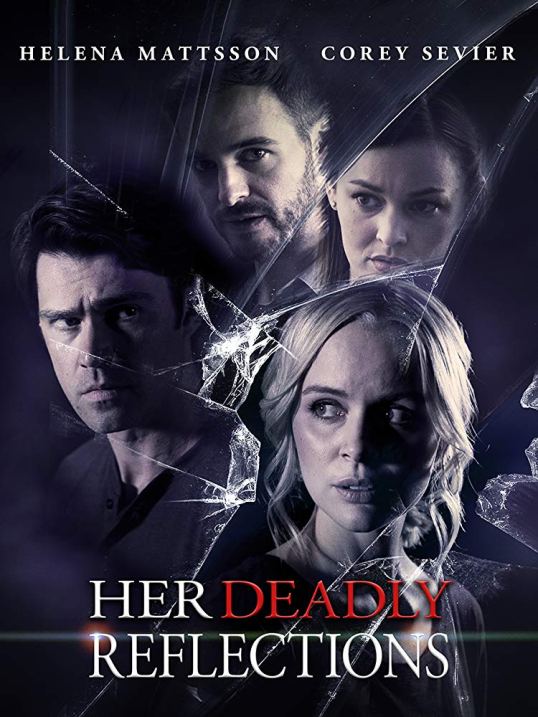
Kelly Moore (Helena Mattsson) is an artist who has just woken up in the hospital. Apparently, she’s been in a terrible car accident. In fact, she’s lucky to have survived! Unfortunately, she’s also woken up with partial amnesia. She remembers her childhood. She remembers growing up. She remembers waking up in the hospital. But almost everything in-between is a blank. She no longer knows her husband, Dan (Corey Sevier). She barely knows her best friend, Allison (Melanie Stone) or Allison’s husband, Logan (Jake Stormeon).
What she does know is that she keeps having vague flashes of memory that suggest that there’s more to her injuries than just being in an accident. She sees herself falling out of a window and running from an unseen assailant. Who tried to kill her and why? That’s what Kelly has to try to figure out, while also putting together the clues to discover just what her life was like before the accident.
What Worked?
I always enjoy a good Lifetime amnesia film and Her Deadly Reflections contained all of the elements that you could hope for this unique cinematic genre, everything from hazy flashbacks to sudden realizations that neither Kelly’s marriage nor her friendships were quite as strong as she’s originally led to believe when she first wakes up. It’s an interesting dynamic. Because Kelly can’t remember anything that happened before her accident, everyone tries to pretend as if things were perfect before Kelly lost her memory. I imagine that’s what people would do in real life, as well.
Helena Mattsson did a good job in the lead role, capturing Kelly’s confusion as she struggled to figure out who she used to be. Melanie Stone was also well-cast as Kelly’s best friend.
What Did Not Work?
The film needed a few more suspects to really keep us guessing as to who attacked Kelly.. Once we eliminated all of the obvious the suspects, there was only one person left so the revelation of that person’s identity was not quite as shocking as it could have been.
“Oh my God! Just like me!” Moments
I’m happy to say that I’ve never had amnesia, though I did once total my car. (In fact, it flipped over and the fact that I wasn’t killed or even seriously injured was something of a miracle.) I could relate to Kelly and Allison’s friendship. I’ve had friends like Allison. I think we all have.
Lessons Learned
Memories are important so don’t ever let go of them.
In this HBO movie, Alan Alda plays the biggest asshole in the world.
Alda is cast as Dan Cutler, an ad exec who books a corporate retreat to Canada’s White Mile. He tells the nine men who accompany him, some of whom are clients and some of whom work for him, that it’s going to be a weekend of fishing and male bonding. What he doesn’t reveal is that the trip is also going to require whitewater rafting. Despite the fact that the majority of the men are out-of-shape and hardly any of them have any rafting experience, Dan insists that they all take part. When their guide says that they’re going to need to take two boats, Dan refuses. He wants everyone in one boat, the better so they can all work together to prove their manhood by conquering the river.
The trip starts out well but, when the raft hits a rock and turns over, five of the men end up dead. Despite injuring his leg, Dan survives and, when he returns to work, he’s hailed as a hero. However, one of the widows of the men who didn’t survive is now suing the company. While Dan tries to cover his own ass, one of the survivors — Jack Robbins (Peter Gallagher) — is faced with a dilemma of his own. As one of the few people who knows that Dan demanded that the guide only use one boat, will Jack testify to the truth at the trial or will he follow Dan’s orders and keep quiet about what really happened?
Based on a true story, White Mile features some brief but exciting (and harrowing) rafting scenes but the film is less about what happened in the wilderness and instead about what’s happening behind the closed doors of corporate America. White Mile does a good job of taking Alda’s sensitive male persona and pushing it through the looking glass. As played by Alda, Dan is the type of tyrannical boss who we’ve all had to deal with. His friendly smile barely disguises a bullying streak. Even after the accident leaves five of his colleagues dead, Dan is still convinced that the trip was a good idea and that everyone was having the best day of their lives until they hit that rock. When the river guide initially finds Dan stranded on a rock, Dan makes a show of telling the guide to come back for him later and to find the others. When Dan later comes across one of the dead men, he says, “He must have had a bad heart,” as he grasps at any way to avoid taking responsibility. Though White Mile is dominated by Alda’s villainy, it also features good performances from Gallagher, Robert Loggia, Bruce Altman, and Jack Gilipin. When Gilpin demands to know if anyone at the ad agency has shown any true remorse for what happened, he is speaking for the entire audience.
White Mile was an early HBO film and, because it was released before HBO became known for its original programming, it’s often unfairly overlooked. When it was released on DVD, it was advertised as being an action-adventure film, which it definitely is not. Instead, it’s a look at the type of head games that far too often act as a substitute for responsible and ethical management in corporate America. It’s a good movie and you’ll never look at Alan Alda the same way again.
The 2017 best picture nominee, Darkest Hour, opens with Europe at war.
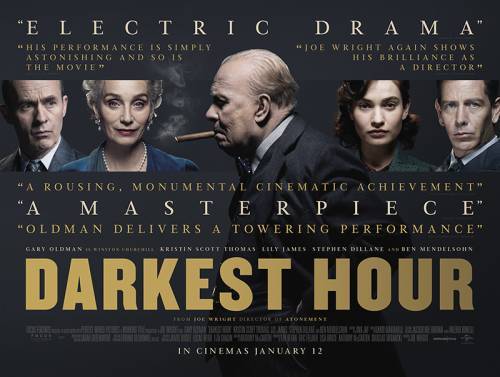
While the United States remains officially neutral, the Nazi war machine marches across Europe. After years of appeasement, the United Kingdom has finally declared war on Germany but the feeling in Parliament is that Prime Minister Neville Chamberlain (Ronald Pickup) is not strong enough to take on Hitler. When the Opposition demands that Chamberlain resign, Chamberlain does so with the hope that he’ll be replaced by Lord Halifax (Stephen Dillane). Like Chamberlain, Halifax continues to hold out hope for some sort of negotiated peace with the Germans. However, Halifax declines, saying that it’s not yet his time. Instead, Chamberlain’s successor is Winston Churchill (Gary Oldman), the only Conservative that the Opposition is willing to accept as Prime Minister.
(This is a bit of invention on the part of the filmmakers. In reality, the Opposition did demand Chamberlain’s resignation but they did not stipulate that he could only be replaced by Churchill.)
No one is particularly enthusiastic about the idea of Winston Churchill becoming prime minister. Chamberlain and Halifax both view him as being a war monger who is so determined to prove himself as a military strategist that he’ll sacrifice thousands of British lives just for his own glory. The King (Ben Mendelsohn) worries that Churchill is an unreliable radical and he still resents Churchill for defending the marriage of Edward VIII and Wallis Simpson. Churchill is regularly described as being a buffoon and an eccentric. He’s quick-tempered and obsessive about things that many people would consider to be of no importance. When we first see Churchill, he’s making his new assistant (played by Lily James) cry because he’s discovered that she single-spaced a memo as opposed to double-spacing it. The only people who seem to like Winston are the member of his family and even his loyal wife (Kristin Scott Thomas) is frequently frustrated with him.
Churchill’s enemies are not impressed by his first actions as prime minister. They listen in disgust as he lies about the prospects of victory in France. They are shocked by his refusal to even consider a negotiated peace. They are horrified by his ruthless pragmatism as he willing sacrifice a thousand British soldiers in order to save several thousand more at Dunkirk. An aristocrat who has been rejected by his peers, Churchill is betrayed by those serving in his government but beloved by the people who ride the Underground and who are being asked to potentially sacrifice everything to defeat Hitler’s war machine.
As directed by Joe Wright, Darkest Hour plays out like a dream, with 1940s Britain recreated in hues of black and gray. The film’s visual palette is so dark that, at times, Gary Oldman’s Winston Churchill appears to literally emerge out of the shadows, an almost mythical figure who symbolizes a society in transition. In many ways, Churchill is an old-fashioned Edwardian who nostalgically remembers the glory days of the British Empire. At the same time, Churchill is enough of a realist to see that the world is changing and, regardless of who wins the war, that it will never be the same. Churchill is enough of an aristocrat to be unaware of what a backwards V-sign means but also enough of a commoner to laugh uproariously upon learning its meaning.
Churchill spends a good deal of the film bellowing and, at times, it’s easy to see why many initially dismissed him as being a buffoon. Indeed, in Darkest Hour, Churchill frequently is a buffoon. But he’s also a pragmatic leader who truly loves his country and its people. Oldman has a lot of scenes where he’s loud but he also has other scenes in which he reveals Churchill to be a thoughtful man who loves his country and who is determined to win a war that many believe to be unwinnable. When he’s reduced to calling the United States and has to pathetically beg President Roosevelt to honor a treaty, you feel for Churchill and you share his frustration as he tries to get the flaky FDR to understand the reality of what’s happening in Europe. When Churchill explains why he’s willing to sacrifice a thousand in order to save 41,000 more, Oldman delivers his lines with a steely certainty. As played by Oldman, Churchill knows what has to be done, even if no one else has any faith in him.
It’s a good film, even if it ultimately feels more like a showcase for one actor than a cohesive narrative. The rest of the cast does a good job, especially Ronald Pickup as the haunted and dying Neville Chamberlain. But ultimately, Darkest Hour is Gary Oldman’s show. That’s appropriate. Much as how Churchill dominated British politics, Gary Oldman has dominated British acting. Not surprisingly, Gary Oldman won his first Oscar for playing Winston Churchill in Darkest Hour. The film was also nominated for best picture but it lost to Shape of Water.
Tonight, I watched the first Lifetime movie of 2020 — Escaping My Stalker!
Why Was I Watching It?
Because it was the first Lifetime film of 2020, of course!
Seriously, though, 2019 was not an easy year for me as a reviewer. I got busy. My time management skills mysteriously fell apart. As a result, I missed a few Lifetime films and I also didn’t always have time to review quite a few of the ones that I did see. One of my resolutions for 2020 is to not let that happen again.
I mean, don’t get me wrong. If I’m not going to be at home when the movie airs, I’m going to set the DVR. But, this year, I’m not going to let movies pile up on my DVR before I watch them and, even more importantly, I’m not going to get behind on my reviews. That’s my 2020 resolution and if I break it, I’m blaming everyone who follows me on social media.
Those are the stakes, my friends.
(For the record, I will be watching and hopefully reviewing the remaining Lifetime films on my DVR this weekend.)
What Was It About?
Up until a year ago, 17 year-old Taylor (Ezmie Garcia) was homeless. Fortunately, she was eventually taken in and adopted by Larry (Linden Ashby) and his wife, Sandy (Alexandra Paul). Now, Taylor has a job at the local skatepark and her life appears to be heading in the right direction. However, Taylor also has a stalker! When that stalker breaks into Taylor’s home and shoots Larry in the leg, Taylor realizes that her new life isn’t as secure as she thought it was.
It’s no spoiler to tell you that Taylor’s stalker is Miles (Andrew James Allen). Miles lives with his grandmother (Mariette Hartley) and it quickly turns out that grandma is actually encouraging Miles! Miles and grandma have got their own reasons for wanting to destroy Taylor’s new family, reasons that only become clear as the film progresses.
What Worked
It all worked!
Seriously, Escaping My Stalker was a perfect way to start the new year. The story was interesting. The film was well-directed by Linden Ashby. Ezmie Garcia did a great job playing a character who was a bit tougher than the average Lifetime teenager. Meanwhile, Mariette Hartley appeared to be having a lot of diabolical fun in the role of the Grandma from Hell. Even though Miles was not necessarily a sympathetic character, it only took one look at Grandma to understand why Miles turned out the way that he did.
Also, Escaping My Stalker featured a Clu Gulager shout-out! When Taylor first meets Clu Dunsten (Pedro Correa), she asks him if he’s named after the great character actor Clu Gulager. They even spend a few minutes talking about Return of the Living Dead! If that isn’t the best way to start off 2020, I don’t know what is.
Finally, this was not just a Lifetime melodrama. It was also a film about the homeless situation, which is getting worse day-by-day (and not just on the West Coast, either). This was a Lifetime film with a conscience.
What Didn’t Work
As I said, it all worked. This was exactly the type of film that one hopes to see while watching the Lifetime Movie Network.
“OH MY GOD! JUST LIKE ME!” Moments
To be honest, I could only hope to be as tough and resourceful as Taylor.
Lessons Learned
There are still people out there who appreciate a good Living Dead film.
Cocaine is flooding the United States and only one man is to blame! Ramon Cota (Billy Drago) is so evil that, after killing a group of DEA agents, he appears on closed-circuit television just so he can taunt their superior, John Page (Richard Jaeckel). When Ramon drives through his home country of San Carlos, he kills the peasants, rapes their women, and murders their babies, just because he can. He’s one bad dude.
Ramon is untouchable as long as he stays in San Carlos but occasionally he does have to leave the country so he can conduct business. A frequent flyer, Ramon always buys every seat in first class so that he and his bodyguards can have privacy. However, what Ramon didn’t count on, was Delta Force’s Col. Scott McCoy (Chuck Norris!). McCoy and his partner, Maj. Chavez (Paul Perri), aren’t intimidated by that curtain separating first class from the rest of the plane. As soon as Ramon’s flight enters American air space, they burst out of coach, knock out Ramon’s bodyguards, and then toss Ramon out of the plane. Being an experienced skydiver (not to mention that he’s also Chuck Norris), Col. McCoy is able to catch up to Ramon and grab him before he plummets all the way to the Earth.
Unfortunately, arresting Ramon in America means that you run the risk of a liberal, Carter-appointed judge setting a low-enough bail that Ramon can go free. Having taken advantage of America’s own legal system, Ramon murders Chavez and returns to San Carlos, leaving Col. McCoy and the rest of the Delta Force to seek vengeance for their fallen comrade.
Only Chuck Norris returns for this sequel to the greatest movie ever made. Unfortunately, Lee Marvin died shortly after the release of the first Delta Force. Even though John P. Ryan (as General Taylor) and Richard Jaeckel both seem to be attempting to channel Marvin’s grim, no-nonsense spirit in their performances, it’s just not the same. What made the first Delta Force so memorable was the mix of Marvin’s cool authority and Chuck Norris’s general badassery. Norris is as tough as always but the film still has a Lee Marvin-size hole in the middle of it and, without Marvin glaring at the bad guys and barking at the Washington pencil pushers who think they know how to keep America safe, Delta Force 2 could just as easily be a sequel to one of Norris’s Missing In Action films. This is a Chuck In The Jungle movie, with drug dealers replacing the usual Vietnamese POW camp commandants.
If you can see past the absence of Lee Marvin, Delta Force 2 is an okay Chuck Norris action movie. It’s typical of the movies that he made for Cannon but the fight scenes are well-directed by Chuck’s brother and Billy Drago is a loathsome drug lord who gets what he deserves. Chuck gets a few good one-liners and you’ve got to love the film’s final shot. Delta Force 2 never comes close to matching the original but at least it’s got Chuck Norris doing what he does best.
Well, here we are! It’s January 1st. In just a few days, the Oscar nominations will be announced and then, on February 9th, the winners will be revealed! From now until the day of the ceremony, I will be taking a look at some of the films that were nominated for and won Oscars in the past. As of this writing, 556 films have been nominated for best picture. I hope that, some day, I will be able to say that I have seen and reviewed every single one of them.
Let’s start things off with the 1978 Best Picture nominee, Coming Home!
Coming Home takes place in California in 1968. While hippies stand on street corners and flash peace signs, teenagers are being drafted and career military men are leaving for Vietnam and people continue to tell themselves that America is doing the right thing in Indochina, even though no one’s really sure just what exactly it is that’s going on over there. At the local VA hospital, the wounded and the bitter try to recover from their wartime experiences while struggling with an often heartless bureaucracy and feelings of having been abandoned by their country.
When Marine Corps. Capt. Bob Hyde (Bruce Dern) is deployed to Vietnam, he leaves behind his wife, Sally (Jane Fonda). Told that she can no longer live on the base while her husband is overseas, Sally gets an apartment, a new car, and eventually a new hairdo. She also gets a new friend, Vi Munson (Penelope Milford). Vi smokes weed and is critical of the war in Vietnam. It doesn’t take long for Sally to start to enjoy the idea of being free and not having to cater to Bob’s every whim. Sally even ends up volunteering at the local VA hospital.
That’s where she meets Luke (Jon Voight, looking youngish and incredibly sexy), a bitter but sensitive vet who, having gone to Vietnam and returned to the U.S. as a paraplegic, is now outspoken in his opposition to the war. Luke is also friends with Billy (Robert Carradine), who is Vi’s shell-shocked brother. When Luke and Sally first meet, they collide in a hallway and Sally gets a bag full of urine spilled on her. It’s only later that Luke and Sally realize that they knew each other in high school and soon, they’re having an affair. Luke, who is as gentle a lover as Bob is brutish, brings Sally to her first orgasm in a sensitively-directed scene that should be studied by any and all aspiring filmmakers.
Unfortunately, the problem with having an affair while your husband is away is that, eventually, your husband’s going to come back. Bob returns from Vietnam and he’s no longer the confident and gung ho officer that he was at the start of the film. He now walks with a pronounced limp and, like Luke, he’s angry. However, whereas Luke has channeled his anger in to activism, Bob tries to keep his emotions bottled up. (He does take the time to give the finger to a few protesters and, considering how obnoxious most of the protesters in this film are, you can’t help but feel that Bob may have had a point.) When Bob discovers that Luke and Sally have been having an affair, he snaps….
Meanwhile, Billy is having a hard time readjusting to life, Vi is getting picked up by sleazy men in bars, and there’s a ventriloquist who shows up a few times. There’s a lot going on in Coming Home and, at times, it feels like the film’s trying to cram in too much. The film often seems a bit disjointed, with semi-documentary footage of Voight hanging out with real paraplegic vets awkwardly mixed in with didactic scenes of Sally turning against the war.
That the love story between Sally and Luke is so effective has far more to do with the performances of Jane Fonda and especially Jon Voight, than it does with anything in the film’s script. Indeed, the script itself doesn’t seem to be too concerned with who Luke and Sally were before they collided in that hallway and it also doesn’t seem to be all that interested in who they’ll be after the end credits role. As written, they’re just plot devices, specifically created and manipulated to express the film’s antiwar message. But then you see Jon Voight’s haunted eyes while he’s listening to a group of vets discuss their experience or you hear the pain in his voice while he talks to a bunch of high school students and it’s those little moments and details that tell you who Luke is. By that same token, Jane Fonda does a good job of showing each stage in Sally’s liberation, even if you can’t help but feel that the main reason Sally becomes an anti-war feminist is because she’s played by Jane Fonda.
Of course, in the end, the entire film is stolen by Bruce Dern. You actually end up feeling very sorry for Bob Hyde (and, to the film’s credit, you’re meant to). It would have been very easy to just portray Bob as being a close-minded pig but the film respects his pain just as much as it respects Luke’s anti-war activism and Sally’s need to be free. In the end, you actually feel worse for Bob than you do for either Luke or Sally. Bob is as much a victim of the war as anyone else in the film.
Coming Home was one of the first films about Vietnam to ever be nominated for best picture. Jane Fonda and Jon Voight both won Oscars but the film itself lost to a far different look at the war in Vietnam, The Deer Hunter.
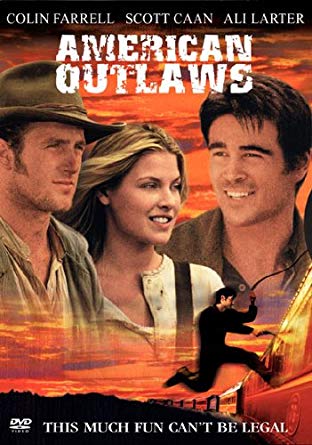 Returning to their hometown in Missouri in the days following the end of the Civil War, former Confederate guerrillas Jesse James (Colin Farrell) and Cole Younger (Scott Caan) are disgusted to discover that the railroad companies are trying to take over everyone’s land. After Cole’s cousin and Jesse’s mother are killed by railway thugs, Jesse and Cole take revenge by forming the James/Younger Gang and robbing banks. Soon, the members of the James/Younger Gang become folk heroes and the railroad company resorts to bringing in Alan Pinkerton (Timothy Dalton) to track the outlaws down. However, even as they try to remain out of the clutches of Pinkerton’s men, there is growing dissension in the ranks of the James/Younger Gang. Cole feels like Jesse doesn’t respect his opinions while Jesse is falling in love with Zee (Ali Larter) and it’s hard to court a girl when you’re constantly having to hide out from Alan Pinkertson. Meanwhile, the other members of the gang wonder why their wanted posters never look as good as Jesse’s and Cole’s.






 Through the Shattered Lens