18 Days of Paranoia #7: Cuban Rebel Girls (dir by Barry Mahon)


In the 1959 film, Cuban Rebel Girls, Errol Flynn (playing himself) flies down to Cuba.  The time is shortly before the Cuban Revolution.  (From a cinematic point of view, Flynn is in Havana at the same time as Hyman Roth and Michael and Fredo Corleone in The Godfather, Part II.)  Flynn has been hired by the Hearst newspaper syndicate to go down to Cuba and do a report on Fidel Castro.  Flynn narrates the film and tells us that he was very sympathetic to Castro and his cause….

OH MY GOD, ERROL FLYNN WAS A COMMUNIST!

Well, maybe not.  If you actually go back and read contemporary reports about the Cuban Revolution, you’ll see that a lot of Americans had a romanticized view of Fidel Castro and his revolutionaries.  Everyone seemed to agree that the president of Cuba, Batista, was a dictator and he needed to be forced out of power.  Castro, himself, didn’t fully and openly declare himself to be a hardline communist until after he had already taken over Cuba.  In Cuban Rebel Girls, someone mentions that Fidel was “always looking out for the little guy” and that’s the attitude that this film takes.  At the time the film was made, it can legitimately be said that Flynn had no way of knowing that Fidel Castro would eventually reveal himself to be despotic dictator.  (For more infuriating, to me, are the people who have continued to defend the Castros up until this day.)

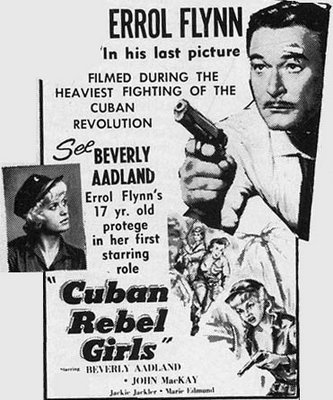
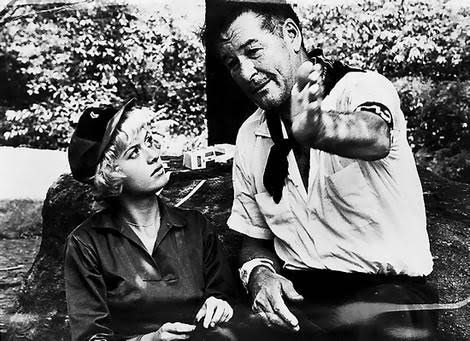
Fidel Castro, himself, doesn’t actually appear until the very end of Cuban Rebel Girls and, even then, it’s just newsreel footage of him riding a tank through Havana.  (Che Guevara does not show up at all.  He may have been busy shopping for berets, I don’t know.)  That said, the film was actually shot in Cuba and it does feature footage of Errol Flynn meeting actual Cuban rebels.  This was also Errol Flynn’s last film and, for the most part, he looks terrible.  Though the film’s poster may feature a suave-looking Errol Flynn holding a gun, the film actually features a noticeably overweight and often out-of-breath Errol Flynn who really doesn’t do much other than sit around and listen to other people talk.

(That said, Flynn’s voice over narration does have the occasional moment of charm.  When he meets one of the rebel girls of the title and he kisses her hand, he jokes that he was relieved to see that he hadn’t totally lost “the Flynn touch.”  Flynn delivers the line with just enough self-depreciation that it’s charming rather than creepy.)

The majority of the film doesn’t actually involve Flynn.  Instead, it involves two girls from New York — Beverly (Beverly Aadland) and Jacqueline Dominguez (Jackie Jackler) — who want to help out the revolution.  Jacqueline is from Cuba, went to high school with Fidel, and her brother is currently a part of the revolution.  Beverly, meanwhile, is convinced that she’ll find the man that she loves in jungles of Cuba.  Beverly explains that she doesn’t know much about Castro or Batista.  That’s for others to worry about!  Jacqueline assures her that, even in high school, “the big jerk” was always looking out for people.

Anyway, Beverly and Jacqueline raise some money from their friends and then decide to smuggle it into Cuba so that the guerrillas can use it to buy weapons.  What follows is a lot of intrigue and sneaking around as Beverly and Jackie try to avoid Batista’s secret police and help out the guerrillas.  And, of course, when I say “a lot,” what I actually mean is “next to none.”  For two people who don’t really come across as being particularly smart, Jacqueline and Beverly certainly don’t have much trouble sneaking around Cuba.

(That said, there are enough references to Batista’s secret police to justify reviewing the film as a part of the 18 Days of Paranoia.  Take my word for it.  Or watch the movie on YouTube, where it’s available under the name Assault of the Rebel Girls.)

Anyway, this is a weird movie, along with also being a really cheap movie.  Beverly Aadland was apparently Errol Flynn’s protegee.  She also wasn’t a very good actress.  (Jackie Jackler does a little bit better in the acting department, though not by much.)  That said, as a film partially shot in Cuba during the days leading up to the revolution, this is an interesting historical document.  And, for some people, just the fact that it’s a pro-Castro film from Errol Flynn (!) will be enough to justify sitting through it.

(Seriously, a celebrity defending a communist?  That’s like a major news outlet or a bunch of basketball players going out of their way to defend the Chinese government.  It just doesn’t make sense….)
Other Entries In The 18 Days Of Paranoia:
  1. The Flight That Disappeared
  2. The Humanity Bureau
  3. The Private Files of J. Edgar Hoover
  4. The Falcon and the Snowman
  5. New World Order
  6. Scandal Sheet

What Lisa Watched Last Night #209: Revenge For Daddy (dir by Tom Shell)


Last night, I watched the latest Lifetime premiere, Revenge for Daddy!

Why Was I Watching It?

Well, first off, you may not have heard but the entire world is kind of shut down right now so basically, watching TV is about as wild as my Thursday night is going to get….

Then again, I would have watched it even if we weren’t on lockdown.  It’s a new Lifetime movie and you know that I love those!  I especially love Lifetime movies that have words like “Fatal,” “Wrong,” or “Revenge” in the title.  Those are usually the best.

What Was It About?

It’s been a tough year for Lisa (Sarah Butler).  Her father died under mysterious circumstances.  Her boyfriend, Bobby (Charlie Gorilla), got drunk and slept with one her co-workers, Bethany (Eva Hamilton), leaving Lisa suddenly single.  Her mother (Joely Fisher) keeps pressuring her to start dating again.  Finally, just to keep her mom happy, Lisa photoshops herself into a picture with a handsome man on a dating site.  All she wants to do is send it to her mom so her mom will get off her back.  Instead, it leads to the man in the picture, Michael (Clayton James), tracking her down.  Soon, Lisa and Michael are dating for real!

But can Michael be trusted?  It turns out that Michael has a somewhat shady past which includes at least one mysterious death.  Michael says he’s innocent but when one of Lisa’s co-workers shows up dead (and, even worse, when it appears that someone is trying to frame Lisa for the murder), Lisa starts to have her doubts….

What Worked?

This one was fun.  I mean, let’s be honest.  When it comes to most Lifetime melodramas, you’re not exactly looking for a realistic examination of all the world’s troubles.  You’re looking for twists and turns and melodrama, preferably taking place in a nice house where everyone is either handsome or pretty and everyone wears nice clothes.  Revenge For Daddy delivered all of that with the style.

The cast was uniformly good and the film actually did a pretty good job of keeping you guessing as to whether or not Michael was who he said he was.  The film even managed to work in a few moments of intentional humor in the middle of all the drama and the mystery.  All in all, this was one an enjoyable and entertaining Lifetime film.

I really liked the office where Lisa and her friends worked.  It was nicely designed and, even more importantly, it didn’t seem like anyone really had to do much work.  It seems like it would be a fun place from which to collect a paycheck.

What Didn’t Work?

It all worked!  To repeat, this was an enjoyable and entertaining Lifetime film.

“Oh my God!  Just like me!” Moments

The main character was named Lisa!  You don’t get much more like me than that.

Lessons Learned

There were definitely lessons learned but I can’t really share them without spoiling the film’s ending.  So, you’ll have to watch and learn for yourself!

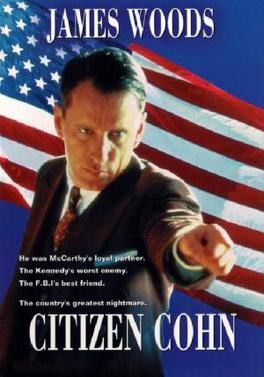
Citizen Cohn (1992, directed by Frank Pierson)


The year is 1986 and the powerful attorney Roy Cohn (James Woods) is dying.  The official story is that Cohn has liver cancer but the truth is that he’s dying of AIDS.  As he lies in his hospital bed, he thinks about his past and the events the led to him becoming one of the most feared and powerful men in America.  He is haunted by the ghosts of his many enemies, people like communist spy Ethel Rosenberg (Karen Ludwig) and his former colleague, Bobby Kennedy (David Marshall Grant).

Not surprisingly, a good deal of Cohn’s memories center around his association with Sen. Joseph McCarthy (Joe Don Baker), a charismatic alcoholic who, in the 50s, charged that he had a list with the names of communist spies deep within the government.  Cohn and Kennedy served as the counsels on McCarthy’s committees.  Cohn is with McCarthy from the beginning and he’s with him until the end of the senator’s career.  In fact, it’s Cohn’s own shadowy relationship with an army private that ultimately leads to McCarthy’s downfall.

Except for one aspect of the film, Citizen Cohn is one of the best films to ever be produced by HBO.  The film covers a lot of history in a little less than 2 hours and it does so in a way that is always interesting and easy to follow.  By including incidents from every phase of Cohn’s life, as opposed to just focusing on his time as McCarthy’, the film also shows how someone like Roy Cohn can become a behind-the-scenes power player despite the majority of the country having no idea who he is.  James Woods gives one of his best performances as the hyperactive and unapologetically corrupt Cohn while Joe Don Baker is perfect as the self-pitying Joseph McCarthy.

The problem with the film, and your mileage may vary on how big an issue this is, is that it almost presents Cohn’s final days — dying of AIDS in a lonely New York hospital room — as being some sort of deserved fate for everything that he did wrong in life.  For me, even in the case of someone like Roy Cohn, that’s a step too far and it comes very close to presenting AIDS as some sort of divine punishment (which, itself, comes dangerously close to mirroring the homophobic statements that were made — and still are being made — by anti-gay activists).  That may not have been the film’s intention but, with the flashback structure and all of his dead enemies materializing to taunt Cohn as he lies dying, it’s still a very valid interpretation.

Some of that is perhaps unavoidable.  Cohn, in both real life and the film, died largely unrepentant for anything he did during his life.  As the central character of a biopic, Cohn never has the type of big moment that you would hope for, where he would realize that it was wrong for him to destroy so many lives and show at least a hint of contrition for his past behaviors.  That Roy Cohn is even a compelling character is a testament to the talent of James Woods because it’s certainly not due to any sort of hidden goodness lurking underneath the surface of Cohn’s snarling personality.  The lack of apologies and regrets that made Cohn a powerhouse in real life also makes him an ultimately unsatisfying subject for a movie.

18 Days of Paranoia #6: Scandal Sheet (dir by David Lowell Rich)


“So be it,” journalist Helen Grant dramatically announces as she lifts up her camera and starts snapping pictures of a body in a casket, “I’m …. a ….. WHORE!”

That is just one of the many wonderfully, over-the-top moments that can be found in the 1985 film, Scandal Sheet.  Directed by David Lowell Rich, Scandal Sheet stars Burt Lancaster as Harold Fallen.  If this movie were being made today, Fallen would be in charge of a TMZ-style website.  Since this movie was made in the 80s, Fallen is the publisher and editor of a sleazy tabloid magazine.  He specializes in stories about aliens and ghosts.  When someone brings him in a story about the ghost of Grace Kelly haunting the beaches of Malibu, he announces, “Front page!”  When someone else tells him about a woman who wants to marry a man from outer space but who can’t find anyone to perform the ceremony, Fallen arranges to get the woman a lawyer.

When Fallen isn’t tracking down ghosts and arranging for interplanetary marriages, he’s trying to destroy celebrities.  When the film begins, he’s obsessed with taking down Ben Rowan (Robert Urich).  We’re told that Ben Rowan is one of the world’s top movie star.  (It’s important that we’re told this because there’s nothing about Urich’s bland performance that would lead us to suspect that to be the case.)  Ben’s career is in trouble because he’s got a drinking problem.  He just got out of rehab but no insurance company is willing to insure him.  His wife, Meg North (Lauren Hutton), is demanding that Ben be cast in her latest movie.  Everyone in Hollywood is like, “No way.”

It has the potential to be a big story and Fallen wants to be the first to break it.  But to do so, he’s going to need an inside source.  That’s where Helen Grant (Pamela Reed) comes in.  Helen was Meg’s college roommate and she’s still friends with both her and Ben.  Fallen decides to hire Helen to work for his magazine.  The only problem is that Helen is a serious journalist.  She writes stories about homeless children.  She has no desire to work for a tabloid.

“I’ll pay you more than you’re making right now,” Fallen tells her.

Helen’s not interested.

“I’ll pay you $80,000 a year.”

Helen’s interested.

Against her better judgment, Helen accepts Fallen’s offer.  At first, things seem okay.  She’s a bit annoyed with having to work with a sleazy photographer named Simon (Peter Jurasik, giving a wonderfully reptilian performance) but she’s got a nice house and her son is going to a good school and she gets to use the company credit card and she even gets a housekeeper out of the deal!

Then Fallen tells her that her next assignment is to write about Meg and Ben.  Helen refuses but she soon discovers that Howard Fallen is not an easy person to refuse.  Not when he’s got people watching your every move, along with paying your housekeeper to spy on you.  When her former boss (Max Wright) angrily tells her that no reputable magazine will ever work with her again, Helen is left with only two options: Become a whore or starve.

Scandal Sheet is a lot of fun.  Just the fact that the main bad guy is named Howard Fallen should tell you almost everything you need to know about this movie.  He’s Fallen — as in a fallen angel.  At the end of the movie, he even wears all black with a white tie, which we all know is the typical modern-day costume of demons pretending to be human.  (At one point, Fallen even says that he’s going to make someone an offer that they can’t refuse, giving us all a chance to see what The Godfather would have been like if Burt Lancaster had played Don Vito.)  Lancaster gives a charismatic performance and he’s so effortlessly manipulative that it’s hard not to enjoy watching him, even if he is destroying innocent people.  The rest of the cast is okay.  As I said earlier, Robert Urich was a bit too bland to be a convincing film star but Pamela Reed does a good job of capturing Helen’s struggle to decide whether to side with good or evil and Lauren Hutton tears into the scenery with just the type of ferocity that a film like this requires.  Late in the film, when she spits in Helen’s face, it’s the most dramatic spitting that you’ll probably ever see.

Scandal Sheet is an enjoyably over-the-top, anti-press melodrama.  Watch it with someone who you would be willing to sell out for $80,000 a year.

Other Entries In The 18 Days Of Paranoia:
  1. The Flight That Disappeared
  2. The Humanity Bureau
  3. The Private Files of J. Edgar Hoover
  4. The Falcon and the Snowman
  5. New World Order

Fever (1991, directed by Larry Elikann)


Ray (Armand Assante) is a formerly viscous ex-con who has just gotten out of prison and is now determined to go straight and live on the right side of the law.  After spending nearly a decade behind bars, all he wants to do is to reunite with his girlfriend, Lacy (Marcia Gay Harden), and make her his wife.  However, there’s a problem.  While Ray was locked up, Lacy moved on.  She’s now engaged to Elliott (Sam Neill), a liberal attorney who, unlike Ray, is a pacifist.  Even though Lacy is still attracted to Ray, she does not want to get back together with him.

Unfortunately, there’s a second problem.  Ray may have gone straight but his former criminal associates don’t believe him.  They want Ray to help them pull off a major crime and when Ray says that is no longer his thing, they react by kidnapping Lacy.  If Ray ever wants to see Lacy again, he’s now got to return to his life of crime.

There’s also a third problem.  Ray may be an experienced criminal but Elliott insists on tagging along with him while he’s following the kidnappers’s orders.  So now, Ray not only has to commit several crimes but he has to do it with an inexperienced partner who doesn’t even believe in firing guns!

Fever is one of those HBO films that used to show up all the time on cable in the 90s.  I watched it a few times back in the day, just because I was a teenage boy and the movie featured a good deal of nudity.  Even at that time, though, I thought it was a slow and frequently boring movie.  Rewatching it for this review, I was shocked to discover that it was even slower than I remembered.  It seems like it takes forever for Ray and Elliott to finally team up and for the movie to get going.  Though the plot description may make it sound like a buddy comedy, it’s actually a very tough and grim picture.  Armand Assante and Sam Neill are not actors known for their light touch and they both give very serious and gritty performances.  Unfortunately, the film’s pace never really matched the intensity of its stars and the film’s storyline isn’t strong enough to hold up under scrutiny.  Once you start to wonder if Ray would really let Elliott tag along with him, the movie itself falls apart.

Armand Assante is a good actor who rarely seems to appear in good films.  Fever is a good example of that.  Assante gives an excellent and complex performance (and both Sam Neill and Marcia Gay Harden are pretty good too) but Fever itself never really clicks.

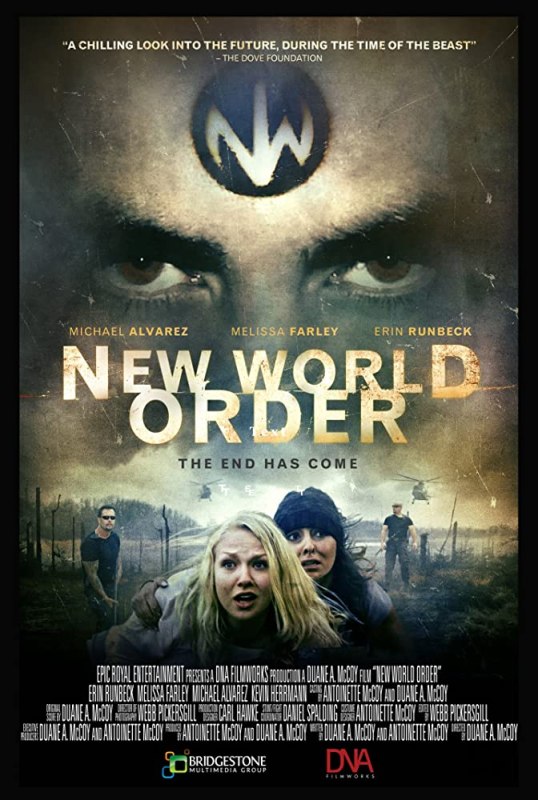
18 Days of Paranoia #5: New World Order: The End Has Come (dir by Duane McCoy)


Welcome, everyone, to the end of the world (again).  Today, the world ends in the 2013 film, New World Order: The End Has Come!

Demi (Melissa Farley) sits in a park, reading the Bible.  She’s reading the Book of Revelation or, as she calls it, “the scary one.”  As she gets in her car, she calls her friend, Christen (Erin Runbeck) and assures her not to worry.  “I don’t think we’re there yet.”  Then she puts the car in reverse and promptly runs over Jason (Daniel Spaulding).

Fear not!  Jason’s not injured and his career as an exotic dancer (I’m not kidding, it’s a plot point) is not damaged in the least.  In fact, Jason is so enchanted by Demi and her lack of driving skills that soon, they’re a couple!  And, fortunately, Jason has a single friend named Cedric (Will Roberts) so that means that Cirsten doesn’t have to be a third wheel whenever everyone goes out for the night.

Cristen and Demi may be good friends but we quickly discover that there are differences between the two of them.  Cristen doesn’t drink.  Demi gladly accepts a beer when Jason offers it.  Cristen likes to stay home and look after her younger brother.  Demi is all, “So, we’re going to that party, right?”  One thing that both of them do have in common is that, on Sunday morning, they giggle in church and check their messages instead of listening to the preacher.  I’m sure that won’t come back to haunt them….

Flash-forward by a few years or so and — oh no!  The world has totally changed!  Iran briefly conquered Europe and there was a huge war but, fortunately, a man named Aldo DeLuca, not only brokered peace but also come back to life after being shot in the head.  Some people think that Aldo didn’t really come back to life but instead, that his body was possessed by Satan.  Those people are threats to the New World Order and you can tell who they are because they’re the only people who refuse to get NWO tattooed on either their forehead or their hand….

“Wait a minute!” Demi says, as she thinks about everything that’s happened over the past year, “I’ve read this somewhere!”

That’s right, Demi.  You should have paid more attention to the Book of Revelations.  But you didn’t and now, everyone’s getting the mark except for you, Cristen, and a few others.  And, in order to eliminate people who refuse to get themark, the black-clad soldiers of the New World Order are now gunning people down in the streets while the brainwashed, soulless masses cheer.

The majority of this film is told in flashback, while Demi and Cristen are sitting in a prison area.  They’ve been given one final chance to either get the mark and live or to refuse and die.  Can you guess who sacrifices their soul and who willingly gives up their life?  In order to maitainn some suspense, I will not tell you who.  These are the things that I do for you.

Watching New World Order while on lockdown because of the Coronavirus was an interesting experience.  On the one hand, the film’s low budget is obvious in every frame and the acting is particularly amateurish.  (Just check out the scene where the Supreme Chancellor is greeted by a jubilant crowd of about 20 extras.) On the other hand, any movie about a totalitarian state using a crisis to come to power and destroy individual liberty is going to feel oddly compelling if you watch it while the country is literally shut down by government order.  I actually found myself falling under the film’s spell.  Normally, I’d make fun of the cartoonish NWO tattoos but instead, I found myself thinking, “What if they do decide to mark those of us who have been tested negative for Coronavirus in a different way from those who are sick?  And what if they do say that only people with the mark can enter a grocery store or see a movie?  And what if the mark eventually becomes a way of determining not who is healthy but instead of identifying people who never question the government?  What do we do then?”  I felt kind of silly after I wondered all that but …. well, not really.  I imagine that, right now, a lot of people are probably having reactions to films like this that they wouldn’t normally have.

Anyway, as a Christian scare film, New World Order will probably be best appreciated by scared Christians.  As a portrait of a society where people have sacrificed their freedom for a false sense of security, it feels like it could be dangerously prophetic.

Other Entries In The 18 Days Of Paranoia:

  1. The Flight That Disappeared
  2. The Humanity Bureau
  3. The Private Files of J. Edgar Hoover
  4. The Falcon and the Snowman

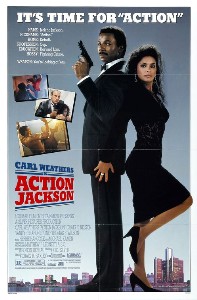
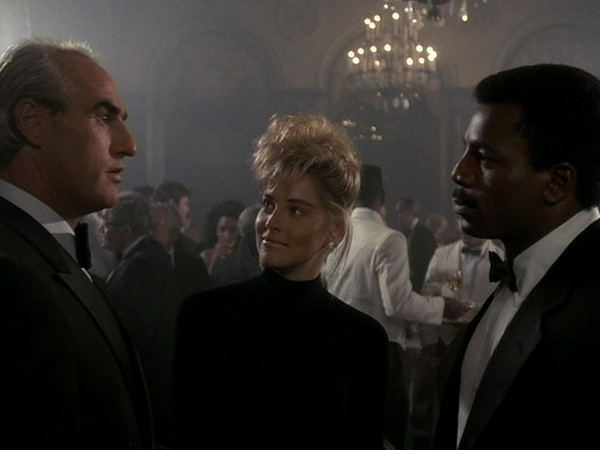
Action Jackson (1988, directed by Craig R. Baxley)


Jericho Jackson (Carl Weathers) is the tough Detroit cop who everyone calls “Action” because I guess Jericho was just too normal a name.  He’s a legend in the department and on the streets of the Motor City.  “Some people say his mother was molested by Bigfoot,” one patrolman says but the truth is simpler.  Jackson was a high school football star before he went to Harvard Law and got his degree.  He could have been an attorney but he decided to become a cop instead.

Unfortunately, Action Jackson is currently Desk Duty Jackson.  When he arrested Sean Dellaplane, the pervert son of auto manufacturer Peter Dellaplane (Craig T. Nelson), Jackson “nearly ripped off the boy’s arm.”  (“He had a spare!” Jackson snarls.)  Everyone says that, since his son’s arrest and his marriage to the beautiful Patrice (Sharon Stone), Peter Dellaplane has turned over a new leaf and is now an honest businessman.  Action Jackson doesn’t buy it.  In fact, he suspects that Dellaplane is responsible for the brutal murder of a union rep.

Though he may be married, Dellaplane still has a mistress.  Sydney Ash (Vanity) is a heroin-addicted singer.  After Dellaplane watches her sing a song, Sydney tells him, “I was expecting a standing ovation.”  “You’re getting one,” Dellaplane replies.  Jackson knows the best way to get to Dellaplane is to get his hands on Sydney.  He better hurry because Action Jackson has been framed for a murder that he didn’t commit and now he’s got every cop and criminal in Detroit after him.

A lot of people will tell you that Action Jackson is a bad movie but I like it.  It’s a tribute to the classic blaxploitation films of the 70s and though the violence may be excessive, it’s all played tongue-in-cheek.  Carl Weathers first suggested the movie to Joel Silver while the two of them were filming Predator and, from the start, Action Jackson is proud to be a B-movie.  There’s no subtext or deeper meaning involved, beyond Action Jackson cleaning up the streets.  Taking it seriously would be a crime.  This is probably the only film where you will ever be able to see Apollo Creed and the dad from Poltergeist face off in hand-to-hand combat.  Of course, whenever Craig T. Nelson throws a punch or a kick, the scene cuts away to disguise the fact that a stuntman is doing most of the work but even that becomes fun to watch for.  Some B-movie have a visible boom mic.  Action Jackson has a stuntman disguised to look like Craig T. Nelson from behind.

If I do have a complaint, it’s that the script is heavy on the one-liners, which makes sense as this film was made shortly after Schwarzenegger revolutionized action film dialogue with “I’ll be back.”  Unfortunately, Weathers wasn’t as good at handling one-liners as Arnie and Bruce Willis were.  As anyone who has seen the first four Rockys can tell you, Carl Weathers was an actor who could create art from a monologue of non-stop trash talk.  As I watched the film, I kept wishing that Action Jackson would do some Apollo Creed-level trash-talking whenever he was fighting the bad guys.  Maybe if he had, there would have been an Action Jackson 2.

18 Days of Paranoia #4: The Falcon and the Snowman (dir by John Schlesinger)


The 1985 film, The Falcon and the Snowman, tells the story of two friends.  They’re both wealthy.  They’re both a little bit lost, with one of them dropping out the seminary and the other becoming a drug dealer who is successful enough to have a lot of money but inept enough to still be treated like a joke by all of other dealers.

Chris Boyce (Timothy Hutton) is the son of a former FBI agent (Pat Hingle).  He has a tense relationship with his father.  It’s obvious that the two have never really been sure how to talk to each other.  While his father is sure of both himself and his country, Chris is far more sensitive and quick to question.  While his father plays golf and attends outdoor barbecues, Chris becomes an expert in the sport of falconry and spends a lot of time obsessing about the state of the the world.  While his father defends Richard Nixon during the Watergate investigation, Chris sees it as evidence that America is a sick and corrupt country.  Because his father doesn’t want Chris sitting around the house all day, he pulls some strings to get Chris a job working at the “Black Vault,” where Chris will basically have the ability to learn about all sorts of classified stuff.

Daulton Lee (Sean Penn) was Chris’s best friend in school.  Daulton’s entire life revolves around cocaine.  He both sells and uses it.  He’s managed to make a lot of money but his addiction has also left him an erratic mess.  Daulton’s father wants to kick him out of the house.  Daulton’s mother continually babies him.  Chris and Daulton may seem like an odd pair of friends but they’re both wealthy, directionless, and have a difficult time relating to their fathers.  It somehow seems inevitable that these two would end up as partners.

Chris Boyce and Daulton Lee, together …. THEY SOLVE CRIMES!

No, actually, they don’t.  Instead, they end up betraying their country.  (Boooo!  Hiss!  This guy’s a commie, traitor to our nation!)  After Chris discovers that the CIA has been interfering in the elections of America’s allies (in this case, Australia), he decides to give information to the Russians.  Since Daulton already has experience smuggling drugs over the southern border, Boyce asks Lee to contact the KGB the next time that he’s in Mexico.  Despite being a neurotic and paranoid mess, Lee manages to do just that.

Of course, as Chris soon comes to discover, betraying your country while working with a greedy drug addict is not as easy as it seems.  While Chris wants to eventually get out of the treason game, marry his girlfriend (Lori Singer), and finish up college, Daulton wants to be James Bond.  The Russians, meanwhile, soon grow tired of having to deal with Lee and start pressuring Chris to deal with them directly….

And it all goes even further downhill from there.

Based on a true story, The Falcon and the Snowman tells the story of how two seemingly very different young men managed to basically ruin their lives.  Boyce’s naive idealism and Lee’s drug-fueled greed briefly makes them a powerful duo but they both quickly discover that betraying your country isn’t as a simple as they assumed.  For one thing, once you’ve done it once, it’s impossible to go back to your normal life.  As played by Hutton and Penn, Chris and Daulton are two very interesting characters.  Boyce is full of righteous indignation and sees himself as being a hero but the film hints that he’s mostly just pissed off at his Dad for never understanding him or caring that much about falconry.  Daulton, meanwhile, is a lunatic but he seems to be aware that he’s a lunatic and that makes his oddly likable.  At times, it seems like even he can’t believe that Chris was stupid enough to depend on him.  The film provides a convincing portrait of two men who, because of several impulsive decisions, find themselves in over their heads with no possibility of escape.

The Falcon and the Snowman is an entertaining and occasionally thought-provoking time capsule of a different age.  If the film took place in 2020, Daulton would be hanging out with the Kardashians and Chris would probably be too busy working for the Warren campaign to spy for America’s enemies.  If only the two of them had been born a few decades later, all of this could have been of avoided.

Previous Entries In The 18 Days of Paranoia:

  1. The Flight That Disappeared
  2. The Humanity Bureau
  3. The Privates Files Of J. Edgar Hoover

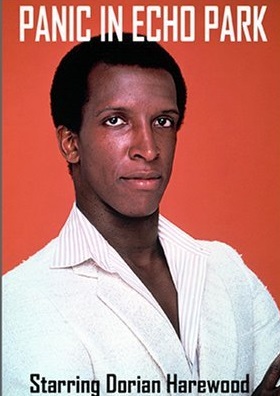
Panic in Echo Park (1977, directed by John Llewellyn Moxey)


Dr. Michael Stoner (Dorian Harewood) is a young, black doctor who works in a hospital located in a poverty-stricken Los Angeles neighborhood that has a high crime rate.  Stoner’s got the education and the talent to be working in an upscale hospital and making a lot of money but it’s more important to Stoner that he give something back to the community.  Stoner is a doctor who cares and he has no hesitation letting everyone know it.  When he meets a wealthy plastic surgeon at a party, he tells him that he should come down to Stoner’s hospital and try his hand at fixing up bullet holes.  The plastic surgeon doesn’t react well to the suggestion.

Stoner is convinced that there’s an epidemic breaking out in the Echo Park neighborhood but he can’t get anyone to listen to him.  No one cares about what happens in Echo Park.  When Stoner deduces that the illness is being caused by dirty tap water, he still can’t get anyone to listen to him.  He yells at people at parties and everyone ignores him.  He goes to the press and the media refuses to cover the story.  The corporate weasels who are responsible for poisoning the water don’t care about anything other than money.  Stoner talks about his problems to a young man who is in a coma and he gets no response.

Finally, Stoner is forced to enlist the help of a group of local teenagers who are making a documentary about life in their neighborhood.  Dr. Stoner may not always be polite but he gets results.

Directed by John Llewellyn Moxey, Panic In Echo Park is a made-for-TV movie and much like Where Have All The People Gone? (which was also directed by Moxey), it seems like it was probably envisioned as being a pilot for a weekly series.  Watching the film, it’s easy to imagine Dr. Stoner getting mad on a weekly basis.  Like most made-for-TV movies, it’s predictable and the characters are all either too obviously good or too obviously evil.  However, Dorian Harewood (who is probably best known for getting shot over and over again in Full Metal Jacket) gives a good performance as Dr. Stoner.  He doesn’t get to do much other than yell at people but Harewood does it well.  Today, a story involving people getting sick from dirty tap water does not seem far fetched (do they have clean water in Flint, yet?) and the scenes where Dr. Stoner orders people to be put into “quarantine” feel disturbingly like the evening news.

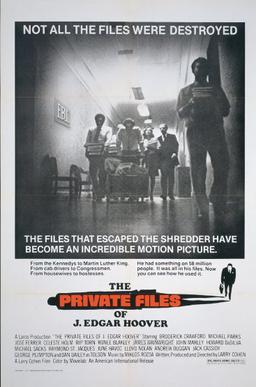
18 Days of Paranoia #3: The Private Files of J. Edgar Hoover (dir by Larry Cohen)


The 1977 film, The Private Files of J. Edgar Hoover, opens in 1972.

J. Edgar Hoover, the much-feared and long-serving director of the FBI, has just been found dead at his home and it seems like the entire city of Washington, D.C. is scrambling.  Not only are people jockeying for Hoover’s job but they’re also wondering what might be found in his secret files.  As quickly becomes apparent, Hoover had a file on everyone.  While Presidents lauded him and the press portrayed him as hero, Hoover spent nearly 50 years building up a surveillance state.  Hoover said it was to fight criminals and subversives but mostly, it was just to hold onto his own power.  Even President Nixon is heard, in the Oval Office, ordering his men to get those files.

Hoover may have known everyone’s secrets but, the film suggests, very few people knew his.  The film is narrated by a former FBI agent named Dwight Webb (Rip Torn).  Dwight talks about how he was kicked out of the FBI because it was discovered that he not only smoked but that he was having an adulterous affair with a secretary.  “You know how Hoover was about that sex stuff,” he says, his tone suggesting that there’s more to the story than just Hoover being a bit of a puritan.

We flash back to the 1920s.  We see a young Hoover (James Wainwright) as a part of the infamous Palmer Raids, an early effort by the Justice Department to track down and deport communist subversives.  Though Hoover disagrees with the legality of the Palmer Raids, he still plays his part and that loyalty is enough to eventually get him appointed, at the age of 29, to be the head of the agency that would eventually become the FBI.  Hoover may start out as a relatively idealistic man but it doesn’t take long for the fame and the power to go to his head.

Hoover (now played by Broderick Crawford) serves a number of Presidents, each one worse the one who proceeded him.  Franklin Delano Roosevelt (Howard Da Silva) is an avuncular despot while the Kennedy brothers (William Jordan as John and Michael Parks as Bobby) are two rich brats who think that they can control Hoover but who soon discover that Hoover is far more clever than they realize.  Hoover finds himself a man out-of-place in the 60s and the 70s,  Suddenly, he’s no longer everyone’s hero and people are starting to view the FBI as being not a force for law enforcement but instead an instrument of oppression.

Through it all, Hoover remains an enigma.  He demands a lot of from his agents but he resents them if they’re too successful.  Melvin Purvis (Michael Sacks) might find fame for leading the manhunt that took down Dillinger but he’s driven to suicide by Hoover’s cruel treatment.  Unlike Clint Eastwood’s film about Hoover, The Private Files of J. Edgar Hoover suggests that Hoover was not gay but that instead, that he was so repressed that he was essentially asexual.  When one woman throws herself at him, he accuses her of being a subversive and demands to know how anyone could find him attractive.  He’s closest to his mother and when she dies, he shuts off his emotions.  His own power, for better and worse, becomes the one thing that he loves.  He’s married to the FBI and he often behaves like an abusive spouse.

The Private Files of J. Edgar Hoover is an interesting film.  It’s an attempt to do a huge American epic on a less than epic budget.  At the start of the film, the low budget is undeniably distracting.  The 1920s are essentially represented by a back lot and two old cars.  The scenes of the FBI dealing with gangsters like Dillinger and Creepy Karpis feel awkward and slapdash.  But, as the film’s timeline gets closer to what was then the modern era, the film’s story tightens up and so does Larry Cohen’s direction.  (One get the feeling that Cohen was, perhaps understandably, more interested in the Hoover of the 60s and the 70s than the Hoover of the 20s and 30s.  There’s a sharpness to the second half of the movie that is just missing from the first half.)  Broderick Crawford gives a chilling performance as a man who is determined to hold onto his power, just for the sake of having it.  The scenes were Hoover and Bobby Kennedy snap at each other have a charge that’s missing from the first half of the film.  Michael Parks does a great job portraying RFK as basically being a spoiled jerk while Crawford seems to relish the chance to play up the resentful, bitter old man aspects of Hoover’s personality.  The film ultimately suggests that whether the audience previously admired RFK or whether they previously admired Hoover, they were all essentially duped.

Though the film never quite overcomes the limits of its low budget, it works well as a secret history of the United States.  In 1977, it undoubtedly took guts to make a film that portrayed Roosevelt and Kennedy as being as bad as Nixon and Johnson.  (It would probably even take guts today.  One need only rewatch something like The Butler or Hyde Park on Hudson to see the ludicrous lengths Hollywood will go to idealize presidents like Kennedy and dictators like FDR.)  While this film certainly doesn’t defend J. Edgar Hoover’s excesses, it often suggests that the president he served under were just as bad, if not even worse.  In the end, it becomes a portrait of not only how power corrupts but also why things don’t change, regardless of who is nominally in charge.  In the end the film’s villain is not J. Edgar Hoover.  Instead, the film’s villain is the system that created and then enabled him.  The man may be dead but the system remains.

Previous entries in the 18 Days of Paranoia:

  1. The Flight That Disappeared
  2. The Humanity Bureau