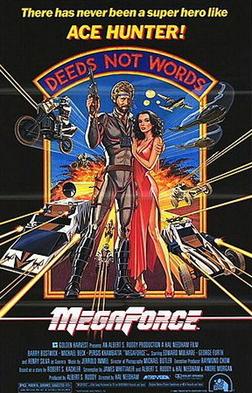
Megaforce (1982, directed by Hal Needham)


Megaforce is the code name for America’s daring, highly-trained, Special Mission force. Its purpose: To defend human freedom against Cobra, a ruthless terrorist organization determined to rule the world.

Oh wait, that’s G.I, Joe!

Megaforce is another daring, highly-trained, Special Mission force.  Led by Ace Hunter (Barry Bostwick), Megaforce is a group of international soldiers who have the latest technology at their disposal, like dune buggies and lasers and all of the cars the were left over from Cannonball Run.  They also have flying motorcycles that can shoot missiles and we can all agree that’s pretty damn cool.  When Megaforce is recruited to protect the Republic of Sardun from being conquered by the nation of Gamibia, it brings Ace and his men into conflict with Duke Gurerra (Henry Silva), who used to be a friend of Ace’s until he became a mercenary who would work for the highest bidder.  Duke’s latest employer?  GAMIBIA!

Megaforce is a strange movie.  Director Hal Needham later said that, when the film went into production, he felt he had his finger on the pulse of the country and apparently he thought America was ready for a movie about a group of men who wear skin-tight uniforms and who communicate almost exclusively by giving each other a thumbs up.  What led to Needham choosing to cast Barry Bostwick in the lead role?  Bostwick is very enthusiastic as Ace but he’s not a believable military leader.  We expect discipline and stoicism from our military leaders but Bostwick always seems to be a little too excited about everything.  “Remember,” he says, “the good guys always win!  Even in the 80s!”  Then he kisses his thumb, which is his way of letting the newest member of Megaforce, Zara (Persis Khambatta), know that she is loved.  I don’t know of many military leaders who were known for kissing their thumbs.  Patton probably could have gotten away with it.  Eisenhower, however, never would have been elected President if he had been half as enthusiastic as Ace Hunter.

There’s not really any plot to Megaforce.  Zara tries out for the group but she’s a woman so she has to prove herself.  Ace and his second-in-command, Dallas (Michael Beck), lead the troops in Gamimbia.  The soldiers shoot lasers and rockets from their glowing cars and their flying motorcycles but Megaforce is one of those strange action movies where no one is actually injured as a result of all the violence.  Megaforce was made for the kids.  It was made for an audience that cares more about flying motorcycles than plot or good acting or the non-existent romantic sparks between Barry Bostwick and Persis Khambatta.  In 1982, there probably wasn’t a parent alive who didn’t dread the prospect of their child demanding to watch Megaforce for the hundredth time.

Megaforce has a reputation for being one of the worst movies ever made but it’s not that bad.  How many other films feature something like this:

It’s impossible not to appreciate the brave efforts of the actors as they feign excitement over something that was definitely not actually happening in front of them.  Michael Beck and Barry Bostwick will make you believe that a green screen can be used to make a motorcycle look like it can fly.  Megaforce’s slogan may be Deed Not Words but who needs either when you’ve got a hundred dollars to spend on your special effect budget?

I will be the first to admit that Megaforce is no Delta Force but it’s dumb and sometimes it features Barry Bostwick on a flying motorcycle and it’s got Henry Silva in it, laughing like a maniac.  And finally, it leaves us all with a valuable lesson.  The good guys always win!  Even in the … 20s.
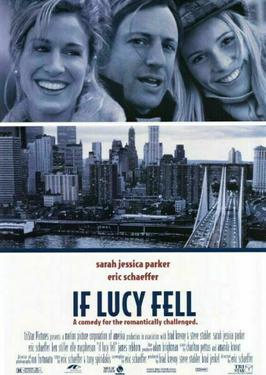
If Lucy Fell (1996, directed by Eric Schaeffer)


Lucy (Sarah Jessica Parker) and Joe (Eric Schaeffer) are two platonic best friends and roommates.  They have a pact.  If they don’t find true love by the time Lucy turns 30, they’ll hold hands while jumping off of the Brooklyn Bridge.  Now, Lucy’s 30th birthday is rapidly approaching and Lucy still hasn’t found the right man!  Meanwhile, Joe is obsessed with Jane (Elle MacPherson) but he hasn’t had sex in five years!  It looks like Lucy and Joe are going to have to commit suicide.  They made a pact, after all and single New Yorkers don’t break pacts.  Fortunately, things start to look up when Joe finally talks to Jane and Lucy meets a weirdo artist named Bwick (Ben Stiller).  Or could Lucy and Joe are actually meant to be together?

If Lucy Fell was briefly a big deal in 1996 because it featured both supermodel Elle MacPherson and Ben Stiller.  (It’s easy to forget how popular Ben Stiller was in the mid-90s.)  Once the film came out, people discovered that it was actually about the bland characters played by Sarah Jessica Parker and Eric Schaeffer and the film bombed at the box office.  Though it may be forgotten today, If Lucy Fell is still the epitome of the type of independent romantic comedy that a lot of directors made in the 90s.  Take a plot line that probably wouldn’t have made it beyond the table read if it was an episode of Friends (it’s interesting to note that both MacPherson and Stiller later made guest appearances on that sitcom), toss in some “alternative” music, and beg someone with a well-known name to take a supporting role.  The film is also interesting as an example of how a generally unappealing actor can play the lead in a romantic comedy and get to make out with both Elle MacPherson and Sarah Jessica Parker.  Just write and direct the film and then cast yourself in the lead role.  Congratulations to Eric Schaeffer for figuring it all out.

I’ve been feeling nostalgic for the 90s.  I guess everyone eventually feels nostalgic for the decade in which they grew up.  But nostalgia can be a harsh taskmaster and it’s important to remember that not all 90s independent films were Pulp Fiction and Fargo.  Quite a few of them were If Lucy Fell.  Ben Stiller has some funny moments, though they’re so cartoonish that they seem like they belong in a different film.  Elle MacPherson is beautiful, even if her character never makes sense.  Sarah Jessica Parker seems like she deserves better than everything the film offered to her.  Eric Schaeffer is dull but at least he got along with the director.  12 year-old Scarlett Johansson has a small role.  If Lucy Fell was a film that could only have been made in 1996 and it was forgotten by 1997.

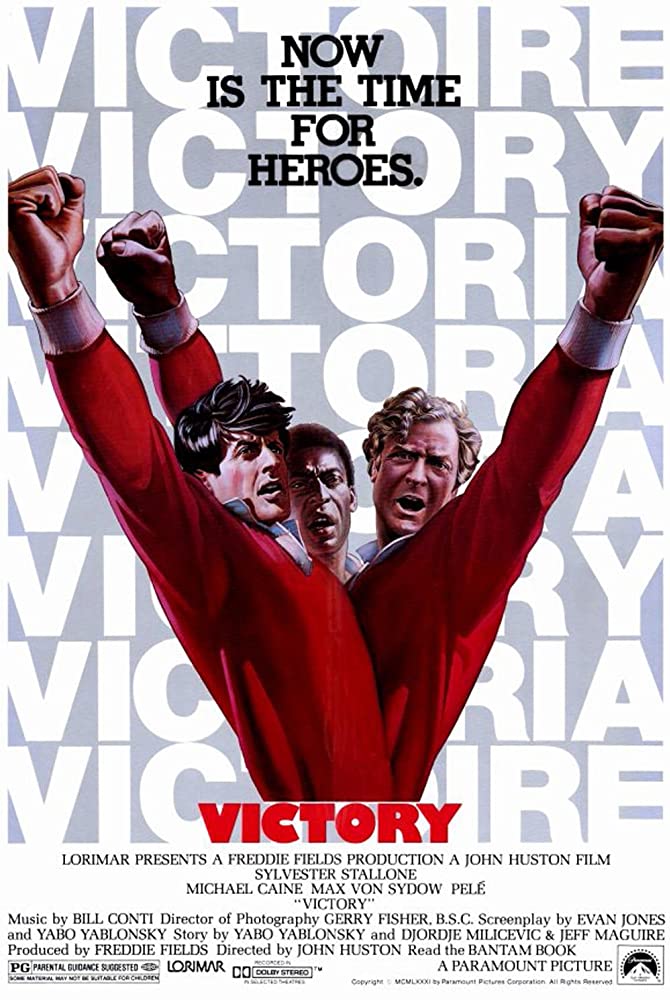
Escape to Victory (1981, directed by John Huston)


In 1942, during the height of World War II, Nazi Major Karl von Steiner (Max von Sydow) is surprised to discover that professional English footballer John Colby (Michael Caine) is a prisoner of war in France and that he has formed his own soccer league with his fellow POWs.  Seeing a chance for a propaganda coup, von Steiner arranges for a team led by Colby to be travel to occupied Pairs where they will play a match against the German national team.

Colby agrees, on the condition that it be a real game and that the teams not just be made up of officers.  At the insistence of his senior officers, Colby also allows an American prisoner named Robert Hatch (Sylvester Stallone) to serve as the team’s trainer.  Hatch is plotting to use the match as a cover for his own escape.  When it appears that there’s a chance for the entire team to escape during the match, Colby and his team are forced to choose between defeating the German team or making a run for freedom.

I think that, for most people, that wouldn’t be too difficult of a decision to make.  If I have to choose between escaping a POW camp or winning a match, I’m going to go down the tunnel and do what I have to do to make it across the English channel.  In the movie, though, it’s a matter of pride and I think Michael Caine is probably the only actor who could make such a conflict feel credible.  Though Stallone got both top billing and a romantic subplot with a member of the Resistance, it’s Michael Caine’s movie all the way through.  From the minute he demands to know “what the bloody hell” is going on, Michael Caine owns Escape to Victory.

Escape to Victory is an old-fashioned war film.  Think of it as being The Great Escape with tons of soccer kicked in.  Fans of the game will probably enjoy seeing legendary players like Pele and Bobby Moore cast as the POWs who make up Colby’s team.  The movie has some slow spots but it’s ultimately a rousing adventure, featuring good performances from Caine, von Sydow, and Sylvester Stallone.  It’s interesting to see Stallone cast as someone who isn’t automatically the best player on the field.

The film is based on a true story, one that sadly did not share this film’s happy ending.  In 1942, a group of Ukrainian POWs played an exhibition match against their German captors.  When the POWs won the match, the Germans responded by executing the majority of the players.  The true story of the Death Match (as it was later called) was told in 1962, in a Hungarian film called Two Half Times In Hell.

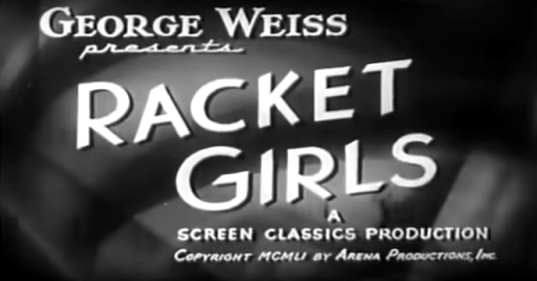
An Offer You Should Refuse #12: Racket Girls (dir by Robert C. Dertano)


The other night, I watched the 1951 film Racket Girls with a select group of friends.  We get together every Saturday night and watch a movie.  Usually, the movie’s pretty bad.  (For instance, we watched Disco Beaver From Outer Space one night.)  Still, I think Racket Girls might be the worst film we’ve seen to date.

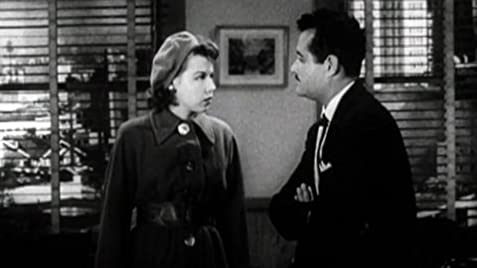
Racket Girls tells the story about how the mob infiltrated the sport of professional wrestling.  Umberto Scali (Timothy Farrell) and his little friend Joe (Don Ferrara) make their living managing female wrestlers but it turns out that the wrestling hall is really a front for all of Umberto’s illegal activities.  We’re told that there’s a lot of illegal activities going on but we don’t really see many of them.  Anyway, Umberto borrows too much money from Mr. Big and then he gets the police mad at him and it looks like it all might lead to a bad end for Umberto and his little friend Joe.

Or maybe not.  Who knows?  This movie is only a 67 minutes long but it’s next to impossible to actually follow the plot.  To be honest, I found the complete lack of background music to be more interesting than the plot itself.  It gave the film a strangely existential feel.  There’s no music.  There’s no entertainment.  There’s just a lot of wrestling and bullets.

In fact, I’d say that the film is 75% wrestling, which …. well, I guess whether or not that works depends on whether or not you’re a fan of grainy professional wrestling footage.  I’m not a huge fan, though I’ve seen some good wrestling movies that were smart enough to explore the real people behind the outsized personas.  In Racket Girls, no one really has a personality and no one has a persona either.  There’s a lot of overhead shots of a wrestling ring and we hear what sounds like a crowd cheering even though we never actually see them.  It’s actually a bit of an odd effect.  It makes the wrestling scenes seem positively surreal.  I kept waiting for that strange radiator woman from Eraserhead to step out in the ring and start singing, In Heaven, Everything Is Fine….

Anyway, the film does make a legitimate point about mob’s influence in professional sports.  Umberto, it should be noted, doesn’t appear to be a very smart gangster.  That’s his downfall.  Still, if you enjoy watching movie featuring tough guys in black suits threatening each other …. well, this film probably still isn’t for you.  I mean, a few of the actors playing the gangsters have got the look down but no one’s particularly convincing.  It’s like a community theater production of The Sopranos or something.  It’s like they remade Scarface with Justin Bieber.

As I watched this film, I found myself wondering whether or not Ed Wood was involved because the film just feels like an Ed Wood production.  Also, it should be noted that Racket Girls was produced by George Weiss, who produced several of Wood’s films and that star Timothy Farrell appeared in at least 3 Wood-directed films.  Ed Wood’s name doesn’t appear anywhere in the credit but I swear, this film has his finger prints all over it.

I’m probably making Racket Girls sound more amusing than it actually is.  This is an incredibly boring movie.  My friends nearly abandoned me about ten minutes into the movie and that hardly ever happens.  I had to beg them to stay and watch the rest of the film.  (I told them that there was a cartoon coming up that featured the first appearance of Bobba Fett.  That was the same line I used to keep them from abandoning me two years ago when we were watching The Star Wars Holiday Special.)  This is an offer that you can refuse.  In fact, you should refuse it.

Previous Offers You Can’t (or Can) Refuse:

  1. The Public Enemy
  2. Scarface
  3. The Purple Gang
  4. The Gang That Could’t Shoot Straight
  5. The Happening
  6. King of the Roaring Twenties: The Story of Arnold Rothstein 
  7. The Roaring Twenties
  8. Force of Evil
  9. Rob the Mob
  10. Gambling House
  11. Race Street

Striking Distance (1993, directed by Rowdy Herrington)


Thomas Hardy (Bruce Willis) comes from a huge family of Pittsburgh cops.  He used to be a homicide detective but then his father (John Mahoney) was murdered by a serial killer and his cousin (Robert Pastorelli) jumped off a bridge after Hardy turned him in for being crooked.  When Hardy insisted that the serial killer who murdered his father and countless others in Pittsburgh had to be a cop, he was kicked out of homicide and reassigned to the river patrol.

Two years later, Hardy drinks too much and spends his time floating up and down the river.  He’s got a new, younger partner named Emily (Sarah Jessica Parker) but not even Emily can snap him out of his funk.  It’s not until the serial killer starts to strike again — this time specifically targeting people from Hardy’s life — that Hardy starts to care about police work again.

Striking Distance is a good example of a thoroughly mediocre film that bombed at the box office but was given a new lease on life by HBO.  During the 90s, it sometimes seemed as if there wasn’t a day that went by that HBO didn’t air Striking Distance at least once.  I guess it makes sense.  Bruce Willis was a big name and Sarah Jessica Parker did eventually end up starring on one of HBO’s signature hits.  Still, it seems like they could have found a better Bruce Willis film to air.  When critics in the 90s complained that Bruce Willis was an ego-driven star who wasn’t willing to break out of his comfort zone, they weren’t talking about Willis’s appearances in films like Pulp Fiction or 12 Monkeys or even Die Hard.  They were talking about movies like Striking Distance, where Willis smirks his way through the film and spends more time making the camera gets his good side than actually developing a character.

The most interesting thing about Striking Distance is that it manages to be too simple and too complicated at the same time.  There’s no mystery to the identity of the serial killer or why Hardy is being targeted.  There’s also no depth to Hardy and Emily’s relationship.  As soon as they meet, everyone knows where their relationship is going to head.  At the same time, the movie is full of red herrings and unnecessary characters.  Hardy comes from a family of policemen and it seems like we meet every single one of them.  Tom Atkins, Dennis Farina, and Tom Sizemore all show up as different relatives.  They don’t add much to the movie but they’re there.  Andre Braugher, Timothy Busfield, and Brion James also all show up in minor roles, to no great effect beyond providing the film with an “It’s that guy!” moment.

To the film’s credit, it has a few good chase scenes, though the novelty of everyone being in a boat wears off pretty quickly.  Striking Distance is a mess but everyone who had HBO in the 90s sat through it at least once.


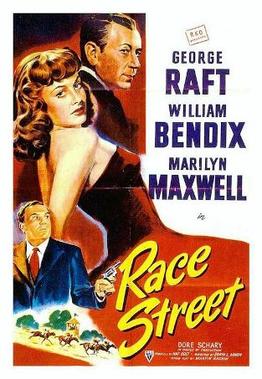
An Offer You Can’t Refuse: Race Street (dir by Edwin L. Marin)


The 1948 film noir, Race Street, tells the story of what happens when the mob comes to San Francisco.

Led by the ruthless Phil Dickson (Frank Faylen, who you might recognize as Ernie the Cab Driver from It’s a Wonderful Life), the mob is looking to move in on San Francisco’s bookmaking rackets.  Dickson wants all of the bookies to pay him for protection.  Of course, he knows that he’s going to have a hard time convincing some of them to go along with his plans so he comes up with the brilliant idea of making an example of one bookie.  He sends two of his men to talk to a small-time bookie named Hal Towers (Harry Morgan).  They tell Hal that he can either pay Phil or he can suffer the consequences.  Hal says that he’ll suffer the consequences so they promptly through him down a flight of stairs, killing him.

When Hal’s best friend, nightclub owner Dan Gannin (George Raft), discovers what has happened, he swears that he’s going to get revenge.  Even after Dickson’s men abduct Dan and give him a brutal beating, Dan remains committed to getting justice for Hal.  Lt. Barney Runson (William Bendix), who has been Dan’s best friend since childhood, tries to convince Dan to let the police handle it.  He even tries to get Dan’s sister, Elaine (Gale Robbins) and Dan’s mysterious girlfriend, Robbie (Marilyn Maxwell), to convince him to back off but Dan won’t hear of it.  Of course, because this is a film noir, Robbie has secret of her own….

Race Street is a low-budget noir that only has a running time of 79 minutes but still somehow finds time to sneak in a few musical performances from Gale Robbins.  When the film first started, I have to admit that I wasn’t expecting much.  George Raft seemed bored with his role and William Bendix’s opening narration didn’t fill me with much confidence.  However, it didn’t take long for the film to win me over.  Harry Morgan, for instance, brought a lot of wounded dignity to his relatively small role and his monologue before his murder is surprisingly moving.  Frank Faylen was cast against type as the evil mobster but it worked.  Seeing the normally amiable Faylen threatening to kill people was a good reminder that not all monsters look like monsters.  Some of them look like the friendly Bedford Falls cab driver.  As befits a film noir, the film is full of ominous shadows and sudden bursts of violence.  The scenes where Hal is murdered and Dan is beaten both stand out as being perhaps a bit more brutal than one might expect a film from 1948 to be.

Race Street is a minor noir but aficionados of the genre should enjoy it.  This is a short and no-nonsense film that gets the job done.  It’s an offer you should not refuse.

Previous Offers You Can’t (or Can) Refuse:

  1. The Public Enemy
  2. Scarface
  3. The Purple Gang
  4. The Gang That Could’t Shoot Straight
  5. The Happening
  6. King of the Roaring Twenties: The Story of Arnold Rothstein 
  7. The Roaring Twenties
  8. Force of Evil
  9. Rob the Mob
  10. Gambling House

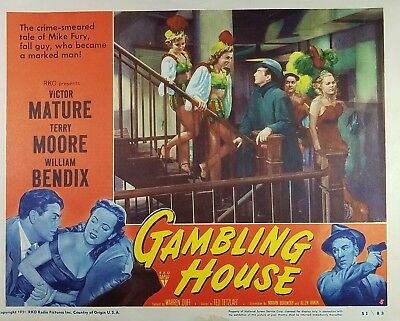
An Offer You Can Refuse #10: Gambling House (dir by Ted Tetzlaff)


The 1950 film noir, Gambling House, begins with the aftermath of a murder.

A man’s been gunned down in an illegal gambling house.  The murderer is gangster named Joe Farrow (William Bendix) but Farrow has no intention of going to prison.  Fortunately, another gambler was wounded during the shoot out.  Marc Fury (Victor Mature) will survive his injury but he might not survive being a witness.  However, Farrow sends his gunmen to make Fury an offer.  If Fury agrees to take the rap for the shooting, he’ll not only live but Farrow will pay him a good deal of money.  Fury agrees because …. well, what else is he going to do?

Fury is arrested for the murder.  He pleads self-defense and he’s acquitted at the trial.  So far, so good, right?  However, there’s always a complication.  First off, there’s the fact that Farrow wasn’t exactly being honest when he promised to pay Fury.  Farrow has no intention of giving Fury any money.  In fact, now that Fury has been acquitted and the case is officially closed, it might be more convenient just to have Fury killed.

The other problem is that Fury’s trial brings him to the attention of the Immigration and Naturalization Service.  The INS takes a look at Fury’s record and they discover that he’s not Marc Fury at all!  (I know, it’s a shock.  Who would think that a name like Marc Fury would be fake?)  It turns out that his original name was Marc Furiotta and he was born in Italy.  His family came to the U.S. when Marc was a child.  Marc always assumed that he was a citizen but it turns out that his parents were never naturalized and therefore, Marc is in the country illegally!  INS wants to deport him.  Marc wants to stay in the United States.

Fortunately, Marc will have a chance to try to convince a judge to let him stay in the United States, despite his lengthy criminal record.  Until his hearing (or until he makes bail), he’ll be detained at Ellis Island.  Marc soon finds himself stuck on Ellis Island, presumably right underneath the base of the Statue of Liberty.  (I know the Statue of Liberty isn’t actually on Ellis Island but the imagery just got stuck in my head while I was writing this review and I’ll be damned if I’m going to take it out.)  He’s surrounded by earnest immigrants who can’t wait to become American citizens and that awakens his own patriotic feelings.  He also meets a social worker named Lynn (Terry Moore) and he falls in love with her.  When he appears before the judge, he explains that he can’t put into words why he wants to stay in America.  He just know that he does.   Awwww, what a wonderful story …. oh wait.  He’s still got Joe Farrow trying to kill him, doesn’t he?

Gambling House is an odd film.  Actually, it’s something like three different films at once.  On the one hand, it’s a low-budget film noir, with menacing tough guys and a morally ambiguous hero and an outwardly respectable villain who is actually a member of the mob.  On the other hand, it’s an earnest legal drama about an immigrant who comes to love his adoptive country.  And then, on the other hand (that’s right, this movie has three hands), it’s a romcom where cynical Marc ends up falling for idealistic Lynn.

That’s a lot for one, low-budget 90-minute film to carry on its shoulder and sadly, Gambling House struggles to balance all of its different elements.  It gets off to a good start, with Victor Mature delivering all of his lines with a scornful disdainful for anyone who looks at him.  And the scenes with William Bendix as the mob boss are effective.  But none of those scenes seem to belong in the same movie with Marc waiting on Ellis Island and Lynn explaining why she wants to help people become citizens.  In the end, this is a film about many things but none of those things are really explored in that much depth.

Though this is a adequately directed and acted film and this is one scene, in which Marc looks at the New York skyline from the holding cell in Ellis Island, that achieves a certain visual poetry, this is still an offer that you can refuse.

Previous Offers You Can’t (or Can) Refuse:

  1. The Public Enemy
  2. Scarface
  3. The Purple Gang
  4. The Gang That Could’t Shoot Straight
  5. The Happening
  6. King of the Roaring Twenties: The Story of Arnold Rothstein 
  7. The Roaring Twenties
  8. Force of Evil
  9. Rob the Mob

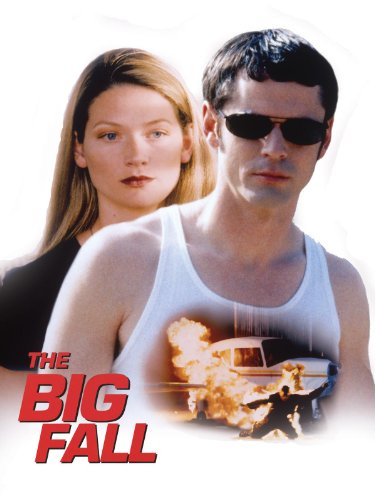
Cinemax Friday: The Big Fall (1997, directed by C. Thomas Howell)


Directed by C. Thomas Howell!?

You read that right!  After spending years as a straight-to-video mainstay, C. Thomas Howell finally stepped up from just starring in these films to directing one.  Of course, Howell still stars in The Big Fall as well as directing it.  What better way to make sure that your star takes your direction than by casting yourself in the lead role?  It makes sense.  The end result is a lot better than anyone would probably expect it to be.

Howell plays Blaise Rybeck, a self-described “private dick,” who works in modern Los Angeles with his protege (Sam Seder) and his secretary (Kathy Griffin, whose role is thankfully small).  Rybeck talks and dresses like a hard-boiled, 1940s P.I., right down to wearing a trench coat and a fedora while delivering his lines in a Bogart-style rasp.  The decor of his office is straight from the 40s as well.  Despite this, the movie takes place in modern times, with people using cell phones and bungee jumping off of bridges.  That no one comments on how out-of-time Rybeck seems to be indicates that Howell knew exactly what he was doing with his directorial debut.  The Big Fall is a tone perfect send-up of the neo-noirs that Howell spent most of the 90s appearing in.  His direction shows far more wit than you might expect from the star of Soul Man.

Rybeck is hired by sultry Emma Roussell (Sophie Ward) to find her brother.  It turns out that her brother has gotten involved with a bunch of extreme sports-obsessed bungee jumpers.  (This film attempts to do for bungee jumping what Point Break did for surfing and it actually succeed because the bungee jumping scenes are pretty damn cool.)  It all has to do with a criminal named Axe Roosevelt, played by the great Jeff Kober.  Of course, it also turns out that there’s more to Emma than meets the eye because this is a noir and there always is.

As a director, Howell does a good job of spoofing the material while still playing it straight enough that the movie doesn’t just become one big inside joke.  Jeff Kober and Titus Welliver are great as the bad guys, Sophie Ward is sexy as the femme fatale, and C. Thomas Howell keeps things moving both in front of and behind the camera.  This is an unexpected straight-to-video gem.

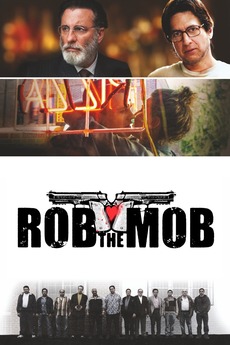
An Offer You Can’t Refuse #9: Rob the Mob (dir by Raymond De Felitta)


The 2014 film, Rob the Mob, tells the true story of a young couple in love who became minor celebrities when they robbed the mob.  Of course, they also ended up with a huge target on their back, which tends to happen when you repeatedly humiliate a bunch of angry men who have weapons at their disposal.

The year is 1992 and Tommy Uva (Michael Pitt) and his wife, Rosemarie (Nina Arianda) are professional criminals who, after getting busted for trying to rob a florist on Valentine’s Day, end up working at a debt collection agency.  Their boss (played by Griffin Dunne) spent time in prison for insider trading and he believes in giving convicts a second chance.  The problem is that Tommy doesn’t really want a second chance.  He’s actually pretty happy being a criminal.

Tommy has some issues with the Mafia, largely due to the fact that his father borrowed money from the mob to open up a shop and spent the rest of his short life being beaten and humiliated by loan sharks.  Tommy believes that the pressure is what led his father to an early grave.  Tommy’s mother (Cathy Moriarty), on the other hand, claims that it was the stress caused by Tommy being a criminal.  Regardless, seeing his father repeatedly mistreated has definitely left Tommy with some anger issues.

Even though Tommy claims that he hates the Mafia, he still seems to be rather obsessed with them.  At times, it’s hard to tell if Tommy is angry with the Mafia or if he’s just jealous about the fact that he’ll never be as rich or as powerful as the local neighborhood mobster.  Tommy starts to skip work so that he can observe the trial of John Gotti.  It’s while doing this that Tommy hears that guns are not allowed in Mafia social clubs.

Soon, Tommy is robbing those same clubs, taking all of the money that he can and humiliating the mobsters at the same time.  (He forces one group of paunchy gangsters to march outside in their underwear.)  With Rosemarie serving as his getaway driver, Tommy soon becomes something of a legend.  The mobsters even nickname the pair “Bonnie and Clyde.”  Because the Mafia doesn’t want to attract any unnecessary attention during the Gotti trial, Tommy and Rosemarie are able to get away with their activities for a while.  But then they make the mistake of stealing a list that could bring down the entire New York Mafia….

Rob the Mob is a bit of an uneven film.  The film starts with Tommy and Rosemarie getting high and then attempting to rob a florist and, in that scene, they both seemed like such idiots that I really wasn’t sure that I wanted to spend 104 minutes of my life watching a film about them.  Even after Tommy got out of a prison and got a legitimate job, he still seemed like such an unsympathetic loser that I found myself wondering why I should care.

However, once Tommy and Rosemarie start actually robbing the mob, the film picks up.  We meet Big Al, the temporary head of the New York mafia, and he’s played by Andy Garcia, who gives an intelligent and understated performance.  Big Al may be a mobster but he’s not an unsympathetic character.  The film presents him as being someone who has been unexpectedly thrust into a position of power and who is doing his best to keep everything from falling apart.  Then, as the robberies continue, Ray Romano shows up as Jerry Cardozo, a reporter who makes “Bonnie and Clyde” famous but who realizes too late that he’s also put their lives in even greater danger than they were before.  Over the past few years, Romano has gone from being a former sitcom star to being a surprisingly effective character actor and his performance here gives Rob the Mob its conscience.

Perhaps even more importantly, during the second half of the film, the chemistry of Michael Pitt and Nina Arianda finally won me over and I actually started to care about what would happen to Tommy and Rosemarie.  Tommy and Rosemarie find a reason for living in their criminal activities.  They go from being losers to being minor New York celebrities, even if they can’t reveal their actual identities.  They may be idiots but their love is real and there’s something very touching about how much they actually do care about each other.  It’s hard not to be happy for them, even if it’s obvious from the start that their story is not going to have a happy ending.

Rob the Mob is uneven but, in the end, it’s more than worth watching.  This is an offer you should not refuse.

Previous Offers You Can’t (or Can) Refuse:

  1. The Public Enemy
  2. Scarface
  3. The Purple Gang
  4. The Gang That Could’t Shoot Straight
  5. The Happening
  6. King of the Roaring Twenties: The Story of Arnold Rothstein 
  7. The Roaring Twenties
  8. Force of Evil

An Offer You Can’t Refuse #8: Force of Evil (dir by Abraham Polonsky)


The 1948 film noir, Force of Evil, plays out like a fever dream of dark and disturbing things.

The film begins on the third of July with attorney Joe Morse (John Garfield) telling us that, by the end of the 4th of July, he will have made his first million dollars, something that he describes as being “an important moment in every man’s life.”  Joe has an appreciation of money that one can only get from growing up poor.  By his own admission, Joe spent most of his youth on the streets, committing petty crimes.  It was his older brother, Leo (Thomas Gomez), who held things together back home and who kept Joe from getting into any truly serious trouble.  Now, years later, Joe is an attorney and Leo is a small-time player in New York’s numbers racket.

(The numbers racket, as the film explains, is an illegal lottery in which people — mostly in working class neighborhoods — bet on which three numbers will be drawn at the end of the day.  In this film, those three numbers are the last three digits of “the handle”, the amount race track bettors placed on race day at a major racetrack, published in the major newspapers in New York.)

Joe now works for Ben Tucker (Roy Roberts).  Tucker may look like a respectable businessman and he may operate out of an office building but he’s actually a gangster.  He got his start as a bootlegger and then, after prohibition ended, he moved into the number game.  He and Joe have come up with a scheme to consolidate and take over the entire New York numbers racket.  They’re going to fix the handle so that, on July 4th, everyone who picks “776” as their three numbers will win.  (As Joe explains, a mix of patriotism and superstition leads to thousands of people picking 776 on every Independence Day.)  When the small time operators don’t have the money to pay off the winners, Tucker will loan them the money to stay afloat.  However, by accepting the loan, the operators will now be in debt to Tucker and Tucker will basically control their operations.  Anyone who doesn’t want to work for Tucker will either be out of work or dead.  It’s all strictly business.

The only problem is that Joe knows that the plan will basically bankrupt Leo.  When Joe goes to Leo and tries to warn him, Leo refuses to listen to him.  Leo may be a criminal but he’s an honest criminal and he has no interest in getting involved with someone like Ben Tucker.  Leo watches out for the people working underneath him and treat them fairly, a concept that men like Ben Tucker will never understand.  In fact, the only thing that Leo asks from Joe is that Joe make sure that Leo’s longtime secretary, Doris Lowry (Beatrice Pearson), is taken care of.

Needless to say, things get even more complicated from there….

Force of Evil presents us with a world where everyone — with exception of maybe Doris — is corrupt and where everything — from blackmail to murder — is strictly business.  Greed is the motivator for every action and the more money that comes in, the easier it is to justify every ruthless act.  Joe makes his fortune over the course of one of America’s most sacred holidays but it comes at the expense of his brother.  His brother tries to do the right thing as far as his employee are concerned, just to discover that the Walter Tuckers of the world don’t care what happens to the people who work for them as long as the money keeps coming in.  It’s a dark and cynical movie, a gangster movie were the cops are just as dangerous as the people they’re arresting and where concepts like love and loyalty mean nothing when there’s money to be made.

As directed by Abraham Polonsky, Force of Evil plays out like a filmed nightmare.  Every interior seems to be full of ominous shadows and the exterior scenes always seem to find characters like Leo Morse and his timid accountant (Howland Chamberlain) dwarfed by the city around them.  Gangsters like Ben Tucker and his associates emerge from the darkness, with the film’s final shoot-out taking place in complete darkness and featuring characters shooting at shadows despite not knowing who that shadow might belong to.  It’s a dark and claustrophobic world that Polonsky presents, one that always seems to be closing in on the Morse brothers and the people unlucky enough to be around them.  (The real world would later close in on Polonsky, an unapologetic Marxist whose ideology is obvious in the film’s portrait of crime just being another form of big business.  Polonsky was among those blacklisted in the 50s.  Force of Evil was the first of only three movies that he would ever direct.)

John Garfield plays Joe Morse with a barely contained anger.  Even after he’s made his first million, he’s still angry at the world.  Getting rich is his revenge on a society that predicted that someone like him would never amount to anything.  Roy Roberts is perfectly sleazy as the outwardly respectable Walter Tucker and Marie Windsor has a few wonderful scenes as his vampish wife.  Perhaps the film’s best performance comes from Howland Chamberlain, playing an accountant who soon finds himself in over his head as Tucker makes his move on Leo’s operation.

Tough, violent, and visually unforgettable, Force of Evil is an excellent gangster film and a classic noir.  It’s definitely an offer that you can’t refuse.

John Garfield in Force of Evil

Previous Offers You Can’t (or Can) Refuse:

  1. The Public Enemy
  2. Scarface
  3. The Purple Gang
  4. The Gang That Could’t Shoot Straight
  5. The Happening
  6. King of the Roaring Twenties: The Story of Arnold Rothstein 
  7. The Roaring Twenties