A group of old friend who call themselves the Uptowners’ Club (yes, really) want to go on a picnic on top of a remote mountain. The only problem is that they have to ride a cable car up to the mountain and there are reports of potentially bad weather. It’s not safe to ride in a cable car during a thunderstorm. Drunken ne’er-do-well Alan (Bert Convy) doesn’t care and, since his family owns both the mountain and the tramway, his demands that he and his friends be allowed to ride the cable car are met. One lightning strike later and the members of the Uptowners’ Club are stranded in a cable car that is perilously suspended, by only a frayed wire, over treacherous mountain valley.
With no place to go, there’s not much left for the members of the Uptowners’ Club to do but bicker amongst themselves and have lengthy flashbacks that reveal every detail of their own sordid history. Paul (Sam Groom) is angry with Alan because Alan is now engaged to his ex-wife (Donna Mills). Sue Grainger (Patty Duke) is angry with everyone else because they don’t want to admit how their old friend Bobby Graham (Doug Llewellyn) actually died. The other members of the Uptowners’ Club are angry because there’s not much for them to do other than watch Duke and Convy chew on the scenery. Because of the supposedly fierce winds, someone is going to have to climb out on top of the cable car and repair it themselves. Will it be Paul or will it be cowardly drunk Alan? On top of everything else, Paul is set to enter the witness protection program and has got hitmen who want to kill him.
This made-for-TV disaster movie was produced by Irwin Allen. Are you surprised? It’s also three hours long and amazingly, Leslie Nielsen is not in it. It’s hard to understand how anyone could have produced a cable car disaster film and not given a role to Leslie Nielsen. Cameron Mitchell’s in the film but he’s not actually in the cable car so it’s a missed opportunity. Any film that features Patty Duke detailing how her friends got so drunk that they ended up killing the future host of The People’s Court is going to at least have some curiosity value but, for the most part, Hanging By A Thread gets bogged down by its own excessive runtime and lack of convincing effects. Hanging By A Thread came out at the tail end of the 70s disaster boom and it shows why the boom didn’t continue into the 80s.
It seems like whenever there’s any sort of disaster, people are advised to seek shelter. Often, if the disaster is national news, people are told to take shelter in their basement, as if everyone in the world has a basement. This is a bit of a pet peeve of mine because I live in North Texas, where the land is completely flat and no one has a basement, a cellar, or any other sort of underground shelter. (We also don’t have mud rooms and, in fact, I’m not even sure what a mud room is.)
That said, there’s a part of me that’s glad that it would be impossible for me to take shelter because, from what I’ve seen in the movies, it appears that spending months in a shelter can actually be worse than dying in a disaster.
Take the 2011 film, The Divide, for instance.
The Divide opens with several people watching while a mushroom cloud blooms over New York City. Eight of those people all end up taking shelter in the same basement. While that means that they don’t get incinerated by the nuclear blast, it also means that they now have to figure out how to live together. That’s not going to be easy because it doesn’t take long to realize that none of these people should be anywhere near each other.
For instance, there’s Mickey (Michael Biehn). Mickey’s the one who built the shelter. He says that he specifically built it so that, in case of a nuclear war or a terrorist attack, he could safely sit underground and laugh at everyone dying above him. That’s not a nice sentiment but Mickey is played by Michael Biehn so he’s still one of the more likable characters in the film.
There’s Josh (Milo Ventimiglia) and his brother Adrien (Ashton Holmes) and their friend Bobby (Michael Eklund), three idiots who are clearly destined to end up going crazy before the ordeal is over.
There’s Eva (Lauren German) and her boyfriend, Sam (Ivan Gonzalez), who are both obviously destined to be the voices of reason to which no one is going to listen.
And then there’s Marilyn (Rosanna Arquette) and her daughter (Abby Thickson), who are there because it’s not a shelter-movie without a child being put in jeopardy.
Lastly, there’s Devlin (Courtney B. Vance), who is there to be the older authority figure who ultimately fails to exercise much authority.
After an effectively chilling scene where the basement is briefly invaded by some mysterious men in Hazmat suits, The Divide settles down to be a fairly predictable and, to be honest, rather unpleasant examination of a group people going crazy from the stress of being trapped together. It may seem odd to complain that a film about the aftermath of a nuclear apocalypse was unpleasant and I guess it is. But The Divide runs a little over two hours and it’s so relentlessly bleak and everyone is ultimately so nasty that it becomes a bit of a chore to sit through. By the time the torture scenes begin, The Divide has slipped into Hostel territory and it’s hard not to feel that the film is being grotesque simply for the sake of being grotesque.
That said, the film does have its strength. The shelter is an effectively claustrophobic location and Michael Biehn does what he can with the role of Mickey. When some of the characters end up getting radiation sickness, it creates some effectively scary visuals. I mean, if you ever thought it would be cool to poison yourself with radiation, this film will change your mind. That’s a good thing, I suppose.
The Divide is a very long movie about some very unpleasant people in an even more unpleasant situation. It’s well-made but not particularly entertaining to watch. In the end, it’s easy to feel that everyone would have been better off just staying above ground and getting it over with.
That’s always a good question. The usual answer is that your either in Purgatory or you’re having a dream or someone is trying to drive you crazy by making you think that you died and then came back to life.
I don’t know if any of that is true about the upcoming film, Death of Me, but I do like the trailer.
And here it is:
Death of Me is scheduled to be released on October 2nd.
The trailer for Scare Me features a man and woman staying in a cabin in the woods and attempting to scare one another. Seriously, that’s the whole trailer. I assume that there’s more to the movie but who knows. Maybe that’s the whole movie, too.
Personally, I can relate. Jeff and I played the same game the last time we were up at Mt. Nebo. I have to admit that I get scared a bit more easily than the people in this trailer. In fact, when I was six, I was scared to death that this barn near our house was haunted and I used to imagine seeing all sorts of things in the shadows of that barn. And then, when I was 11, I was outside in the front yard and it suddenly occurred to me that there could be a lion or a tiger inside my house. So, I literally sat out on the front porch until my mom came home and opened the door and showed me that there weren’t any wild animals in the living room. So yeah, definitely, I can relate….
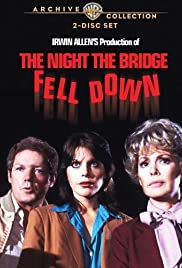
When civil engineer Carl Miller (James MacArthur) discovers that the Madison Bridge is on the verge of collapsing, he goes to his superior (Philip Baker Hall!) and explains that the bridge has to be closed down or people could die. Since there wouldn’t be a movie if anyone listened to Carl’s concerns, he’s ignored.
No sooner has Carl been told that he doesn’t know what he’s talking about than the bridge suddenly starts to collapse. With both ends of the bridge collapsing into the river below, a diverse group of people find themselves stranded in the middle. The group is made up of the usual group of disaster movie characters and, of course, one of them is played by Leslie Nielsen. This time, Nielsen is a crooked businessman with a mistress (played by Barbara Rush) and a baby to worry about. Eve Plumb (who was a member of the original Brady Bunch) is a nun. Richard Gilliland is a wounded cop. Gregory Sierra is a landscaper. Perhaps most improbably, clean-cut Desi Arnaz Jr. is a bank robber who keeps losing his temper and pointing a gun at everyone. Carl has to figure out how to get everyone off of the bridge before the entire things collapses. This leads to many shots of chunks of concrete falling off what’s left of the bridge, as if we need to be reminded that it’s dangerous to be on a bridge that’s in the process of very slowly collapsing.
After finding success making movies about fires, overturned ocean liners, volcanoes, cave-ins, and killer bees, I guess it only makes sense that Irwin Allen would finally get around the producing a movie about a collapsing bridge. The Night The Bridge Fell Down was filmed in 1980 but it wasn’t aired until 1983. When it did air, it played opposite the series finale of M*A*S*H, which remains one of the highest rated single episodes of television ever aired. It’s obvious that no one had much faith in a three hour film about a collapsing bridge and it only aired because NBC needed something — anything — to air at a time when they knew no one would be watching.
Because of the lengthy amount of time between the film’s production and it’s airing, The Night The Bridge Fell Down is the type of serious and plodding disaster film that was popular in the 70s but, by the time 1983 rolled around, had been rendered obsolete by the satiric bards of Airplane!Airplane‘s Leslie Nielsen even appears here, giving the type of serious performance that he specialized in before people discovered that he was actually a very funny man. Nielsen doesn’t give a bad performance but everything he says is thoroughly undercut by how difficult it is to take Leslie Nielsen seriously. No matter what Nielsen says, it always seems like he’s on the verge of adding, “And don’t call me Shirley.”
The main problem with The Night The Bridge Fell Down is that it’s a three-hour movie and that’s a long time to spend with a group of thinly characterized people on a bridge. I guess the film does feature an important message about maintaining roads and bridges. Watch it next Infrastructure Week.
What do you get when you mix sanctimonious liberalism with the type of production values that one would normally associate with an evangelical-produced film about the rapture?
The 2018 film, Sunset, opens with a birthday party and it’s all downhill from there. Elderly Henry (Liam Mitchell) may have just wanted to celebrate the fact that his wife Patricia (Barbara Bleier) had managed to survive another year despite being in poor health and almost constant pain but he made the mistake of inviting Julian (Austin Pendleton, who always seems to get cast in roles like this) to the party and all Julian wants to do is talk politics.
Julian is concerned that the United States has been carpet-bombing the Middle East. Henry thinks that the Middle East is getting what they deserve because a group of terrorists set off a nuclear bomb in Los Angeles and apparently destroyed the West Coast. Julian isn’t so sure that the destruction of Los Angeles justified the destruction of the rest of the world. (Take that, City of Angels.) Fortunately, before things can get too intense, Chris (David Johnson) says, “Let’s get this party started!” and all of the political talk is abandoned.
However, the next morning, everyone wakes up to discover that missiles will soon be hitting the East Coast! (This movie made me happy to live in the middle of the country.) Everyone is making plans to evacuate the coasts and move to the red states, where they’ll presumably demand a state income tax and a Wawa on every street corner. (To quote the Texas waitress in Hell or High Water, “Some asshole from New York ordered a trout. We ain’t got no goddamned trout.”) However, Patricia refuses to leave her house because she’s old and in constant pain and she wants to end her life on her own terms. Of course, since Patricia refuses to leave, that means that Henry is now obligated to stay there with her and die as well, despite the fact that he has a sister in Missouri who would probably take him in. Way to go, Patricia.
While Patricia is getting ready to kill her husband, the other people who were at her party are making plans as well. Chris uploads a YouTube video where he talks about how scared he is about the end of the world. Ayden (Juri Henley-Cohn) and Breyanna (Suzette Gunn) do a Google search on the effects of nuclear war and they decide that they don’t want any part of that. (I wouldn’t want any part of it either. Nuclear war sounds gross.) Smarmy little Julian pops up occasionally and basically spouts the type of boomer political blather that makes Stephen King’s twitter feed so tedious. Every few minutes, someone turns on a radio or television and we hear a reporter talking about how the world is about to end. This is a low-budget film so we don’t actually see any of those reporters, we just hear their voices.
Usually, this is where I would point out that the film at least has good intentions regardless of its aesthetic shortcomings but …. eh. Good intentions can only go so far and the aesthetic short comings here are dramatic. This is one of those films where people are dealing with a huge, emotional event but everyone seems to spend their time speaking as if they were a Wikipedia article come to life. Add to that the fact that Patricia’s desire to die in her house seems more selfish than noble and you’ve got a film that really doesn’t work.
That said, I did like the final five minutes of the film and not just because they indicated that the film was almost over. Those final five minutes do give the film a much-needed sense of grace. One gets the feeling that the entire film was made so that the director could have those final five minutes and, regardless of how bad the rest of the movie may be, the ending does have an isolated impact. If you just saw those five minutes (and not the 80 minutes that came before them), you would be sincerely moved.
Anyway, as far as films about the end of the world go, Sunset didn’t end it quickly enough for me.
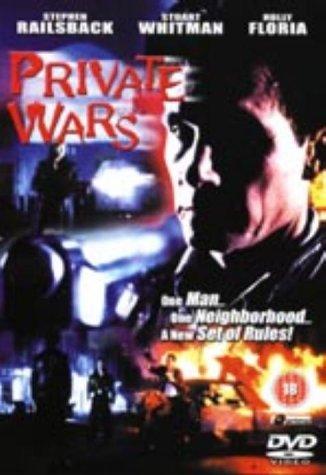
The 1993 action film, Private Wars, tells the story of a neighborhood, a big evil businessman, and one drunk private investigator who likes to shoot things.
The big evil businessman is Alexander Winters (played by Stuart Whitman). Winters is so evil that he probably spends at least three hours every night practicing his smirk. He’s the type who will plot someone’s death and then laugh about it just to make sure that it’s understood that he’s totally evil. Winters wants to build a new business complex but there’s a neighborhood sitting on the land that he wants to use and no one’s willing to move.
However, Winters has a plan to bring about change. If the people in the neighborhood won’t move voluntarily, he’ll just make them flee for their lives. Winters pays off some local gangs to create trouble in the neighborhood. Soon, stores are exploding and windows are getting broken and obscene graffiti is showing up on walls. Everyone in the neighborhood keeps going to the community center and debating what to do. You have to wonder why the gangs are wasting their time vandalizing storefronts when they could have just blown up the community center and taken out every who was in their way.
Eventually, the community decides to hire someone to teach them how to defend themselves. After auditioning a series of ninjas and other wannabe soldiers of fortune, the community hires Jack Manning (Steve Railsback). Why do they hire Jack Manning? Well, he’s a friend of one of the community leaders. He’s also an alcoholic who shoots his car whenever the engine starts giving him trouble. How exactly anyone could look at Jack — who is not only almost always drunk but also a bit on the short and scrawny side — and think that he could protect the neighborhood is an interesting question that the film doesn’t really explore.
Anyway, the community is soon fighting back, which turns out to be a lot easier than anyone imagined. Eventually, Jack ends up in jail as a result of Winters’s corruption but fortunately, it’s while in jail that Jack meets a few guys who all have mullets and who all come back to the neighborhood to help Jack out when a bunch of ninjas try to take over the streets. Winters may have ninjas but Jack has a bunch of petty criminals who look they’re all heading to a hockey game in Toronto. It’s a fair fight.
To be honest, the main thing that I will always remember about Private Wars was just how unnecessary Jack eventually turned out to be. For all the money that he was apparently being paid, he really doesn’t do much. I guess he does teach people in the neighborhood the techniques of self-defense but the film is so haphazardly edited that it’s hard to be sure of that. It’s entirely possible that everyone already knew how to fight but they were just hoping Jack would do it for them. Watching the film, it’s easy to get the feeling that the folks in the community center took one look at Jack and said, “Well, shit …. I guess we gotta do this ourselves.” Even the final confrontation between Jack and Winters is resolved by a third character. Imagine Roadhouse if Patrick Swayze spent the whole movie sitting at the bar and you have an idea what Private Wars is like.
Private Wars is really silly but, possibly for that very reason, it’s also occasionally fun in its own stupid way. If nothing else, Stuart Whitman and Steve Railsback appeared to be enjoying themselves. The movie’s on YouTube. I watched it last Monday as a part of the #MondayActionMovie live tweet and I enjoyed myself.
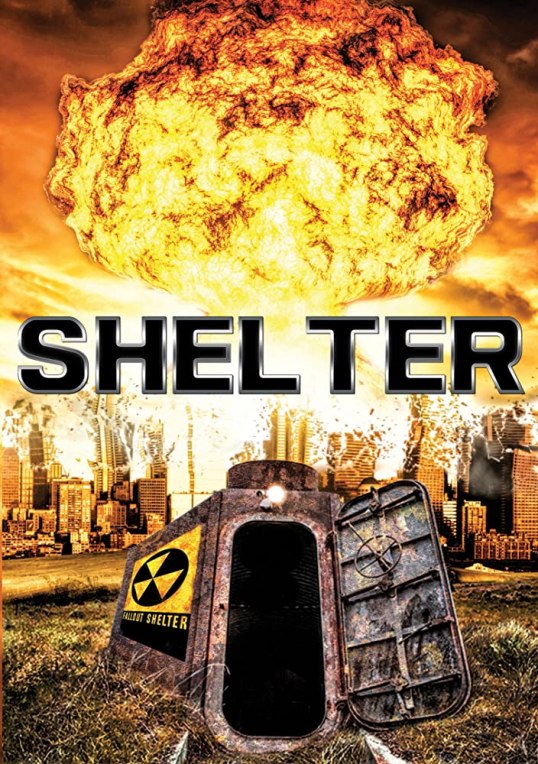
The 2012 film, Shelter, opens in an ominous and sterile-looking room. There are bunk beds. There are shelves that appear to be full of supplies. There’s a table where people could possibly sit down and talk or play cards. There’s a shower stall, with a shower curtain providing a little bit of privacy.
There are also several people in the room. One woman is asking what they’re going to do. In the shower, another woman is crying. We can tell by looking at the inhabitants of the room that they’ve been in the room for a while and that they’re all losing whatever grip they once had on sanity.
And really, even though we don’t know what’s going on, we can all relate. We can probably relate better in 2020 than audiences could in 2012. Most of us have, in one way or another, been sheltered in place since at least March and — surprise! — it turns out that all of those “We’re all in this together” commercials didn’t make anyone feel any better about the idea of not even being able to go outside without having to first put on a mask. It’s not just the feeling of claustrophobia or humanity’s natural inclination to resent being ordered around. It’s also that it’s hard to be happy when you don’t have the freedom to live your own life. When someone is continually told that what they want isn’t important and that their fate is in the hands of some unseen regulator, who can blame them for going a little crazy? That certainly would appear to be the situation in which the characters in Shelter have found themselves.
The film flashes back to the day that five strangers first found themselves locked away in the shelter. They entered the room because an alarm went off. None of them knew what the room was but, shortly after entering, they heard an explosion and felt the ground shake. On a monitor, they saw a bright flash of light apparently vaporize the city above them. They also found a note that explained that the room was designed to provide safety from a nuclear attack. According to the note, they had enough food to last for several years. Of course, the note also stated that the shelter was built and stocked with two inhabitants in mind, as opposed to five.
We follow the five survivors as they get to know each other and as they adjust to life in the shelter. It doesn’t take long for them to settle into their new routine. There’s really nothing else for them to do but accept the situation. The room is locked and the doors are not going to open until a computerized system determines that it’s safe for the inhabitants to leave. They’re stuck together so they might as well play cards and just wait it out.
Of course, things don’t work that smoothly. The hours turn into days and the days turn into months and soon, petty annoyances become major disagreements. Some of the survivors seem to be content with the idea of staying in the shelter forever while others think about escape. Some start to wonder if there’s even actually been a war….
Shelter is a good thriller about human nature and just how much isolation and claustrophobia someone can take before they snap. The characters are all well-defined and well-acted and the film made good use of its low-budget, with that sterile bunker ultimately becoming as much of a character as the people trapped inside of it. The film ends with a twist that, while not completely unexpected, was still satisfying nonetheless.
Shelter‘s on Prime so watch it the next time you’re feeling trapped.
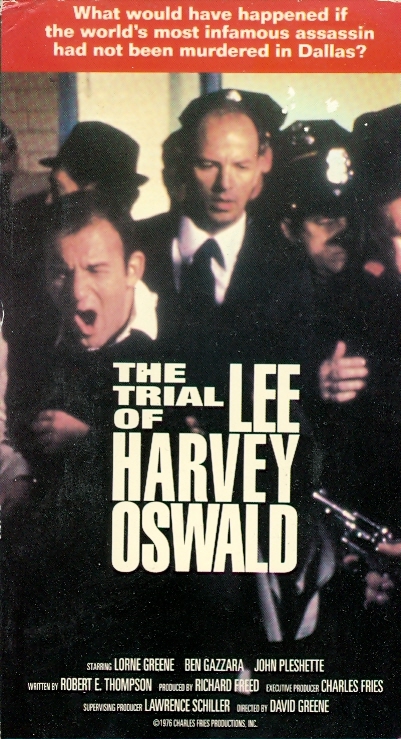
What if, instead of being shot by Jack Ruby, Lee Harvey Oswald had survived and been put on trial for the murder of President John F. Kennedy?
That’s the question asked by this television film. John Pleshette plays Lee Harvey Oswald while Lorne Greene plays his attorney, Matt Weldon and Ben Gazzara plays the prosecutor, Kip Roberts. The film imagines that the trial would have been moved to a small Texas town because Oswald presumably wouldn’t have been able to get a fair trial in Dallas. While Roberts is forced to deal with his own doubts as to whether or not Oswald actually killed the President, Weldon is frustrated by Oswald’s paranoid and self-destructive behavior. Oswald insists that he’s a patsy and that he was framed by “them” but he refuses to tell Weldon who they are.
With a running time of four hours, The Trial of Lee Harvey Oswald is a courtroom drama that tries to be fair to both sides and which ends with a frustrating cop-out. While Weldon presents all of the evidence that real-life conspiracy theorists frequently cite in their attempts to prove Oswald’s innocence, Roberts makes the case that was presented in the Warren Commission. Unfortunately, the film ends up trying too hard to avoid coming down on one side or the other and just proves that it’s impossible to be even-handed when it comes to conspiracy theories around the Kennedy assassination. It’s either buy into the idea that it was all a huge conspiracy involving mobsters and intelligence agents or accept that it was just Oswald doing the shooting as a lone assassin. Trying to come down in the middle, as this film does, just doesn’t work.
John Pleshette does a good job as Oswald and bears a passing resemblance to him. Because the movie refuses to take a firm stand on whether or not Oswald’s guilty, the character is written as being a cipher who claims to be innocent but who, at the same time, also refuses to take part in his defense. Pleshette plays up Oswald’s creepy arrogance, suggesting that Oswald was capable of trying to kill someone even if he didn’t actually assassinate JFK. Both Greene and Gazzara are convincing as the two opposing attorneys, even if neither one of them really does much more than offer up a surface characterization.
The majority of the movie takes place in the courtroom, with a few flashbacks to Oswald’s past included to keep things from getting too stagnant. When the film was made, people were still learning about the conspiracy theories surrounding the Kennedy assassination and The Trial of Lee Harvey Oswald might have had something new to tell them. Seen today, the majority of the film’s evidence seems like old news. The Trial of Lee Harvey Oswald never escapes the shadow of later films, like Oliver Stone’s JFK.
It’s hard not to regret that The Trial of Lee Harvey Oswald wasn’t willing to come definitively down on one side or the other. Instead, it ends by telling us that we’re the jury and that the only verdict that matters is that one that we come up with. They could have just told us that at the start of the movie and saved us all four hours.
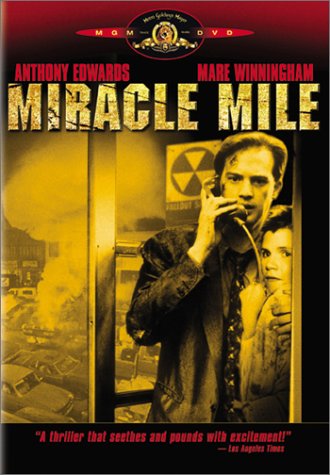
Last night, as I was watching the 1988 film, Miracle Mile, I found myself thinking about the fact that this film literally could not be made today.
No, it’s not because the film itself is about the treat of nuclear war. Though nuclear war may no longer be as much of a cultural obsession as it apparently was back in the 80s, the fact of the matter is that the U.S., Russia, the UK, France, and China all still have nuclear weapons. Pakistan, India, and North Korea all claim to have nuclear weapons. It’s believed that Israel also has a few. Iran is apparently working on developing an arsenal. It’s estimated that there are currently 13,865 nuclear weapons in existence, 90% of which are divided between the U.S. and Russia. That’s not even counting the threat of a terrorist group setting off a nuclear device. In short, the threat of nuclear war is still very much a real one.
Instead, what truly makes Miracle Mile stand out as a film of its time, is the fact that almost the entire plot revolves around the character of Harry (played by Anthony Edwards) answering a Los Angeles pay phone at four in the morning.
Why is Harry answering a pay phone at 4 in the morning? It’s because, earlier, he met Julie (Mare Winningham) at the La Brea Tar Pits and they fell instantly in love. After spending most of the afternoon together, they made a date to meet at the local diner where Julie worked as a waitress. Julie’s shift ended at midnight. Harry went home to get a quick nap before picking her up. Unfortunately, a power failure — one that was largely caused by Harry carelessly tossing away a cigarette — resulted in Harry’s alarm not going off. At midnight, while Julie was standing outside the diner, Harry was asleep.
Harry doesn’t wake up until well-past 3 a.m. After hastily getting dressed, Harry drives down to the diner. When he arrives, he bumps into a tree and three rats fall off the branches and land on his car, which is a bit of an ominous omen. (After watching the movie, I did a Google search and discovered that it’s actually not uncommon for rats to hang out in palm trees after dark. I had no idea. I’m glad I don’t live near any palm trees.)
By the time Harry arrives, Julie’s already gone. From the payphone outside the diner, Harry calls Julie and leaves an apologetic message on her answering machine. (Julie sleeps through it.) Within minutes of Harry hanging up, the pay phone rings again. Harry answers it, expecting to speak to Julie. Instead, he finds himself talking to a panicked soldier who was trying to call his father but who dialed the wrong area code. The soldier says that a war is about to break out and that everyone is going to die. Suddenly, Harry hears what sounds like a gunshot. Another voice gets on the phone and tells Harry to go back to sleep and forget about the call.
Of course, the reason why this story couldn’t take place in 2020 is pretty obvious to see. No one uses pay phones anymore. If the movie were made today. Harry would have just Julie on his own phone and then waited for her to call him back. The soldier would never have misdialed his father’s area code. Harry never would have gotten the message that the world was about to end and most of the subsequent events in Miracle Mile never would have happened. Harry would have just sat in the diner and had a cup of coffee and waited for Julie to call until the inevitable happened. In 2020, that would have been the movie.
So, let’s be happy that this film was made in 1988. during the time when pay phones were everywhere, because Miracle Mile is an excellent film. Miracle Mile starts out as a romantic comedy, with Anthony Edwards and Mare Winningham making for an incredibly adorable couple. Then, after Harry answers that pay phone, the movie grows increasingly grim as Harry desperately tries to make his way to Julie and arrange for the two of them to board a plane that a mysterious woman (Denise Crosby) has charted for Antarctica. The problem, of course, is that in order to reach Julie, Harry is going to need the help of the type of people who are typically up and wandering around at 4 in the morning in Los Angeles. Several people die as Harry tries to make it to Julie and, smartly, the film doesn’t just shrug off their deaths. For the majority of the film, Harry isn’t even sure if there’s actually going to be an attack and it’s possible that he’s not only panicking over nothing but that he’s causing others to panic as well. People are dying because of that phone call and Harry doesn’t even know whether it was real or not. Even when full scale rioting breaks out, Harry doesn’t know if it’s because the world’s ending or because of a bad joke that he took seriously. Transitioning from romantic comedy to dark comedy, Miracle Mile eventually becomes a nightmare as it becomes obvious that, even if Harry does reach Julie, escaping the city is not going to be easy. The sun is rising and the truth is about that phone call is about to revealed….
Miracle Mile is a film that will get your heart racing. On the one hand, Anthony Edwards and Mare Winningham have such a wonderful chemistry and they’re both just so damn likable that you want them to find each other and stay together. Even if it means running the risk of being incinerated in a nuclear explosion, you want Harry and Julie to be with each other. At the same time, you watch the movie with the knowledge that, even if they do manage to reunite, it might not matter because the world’s going to end. Remarkably, almost everyone who Harry talks to about the phone call believes him when he says that a war is about break out. Almost all of them have a plan to escape and, as a viewer, you get so wrapped up in the film that it’s only later that you realize that none of their plans made any sense. Hiding out in Antarctica? How exactly is that going to work? Antarctica’s not exactly a place to which you impulsively move. If there is truly no way to escape the inevitable, perhaps we should just be happy that Julie and Harry found love, even if it was right before the apocalypse.
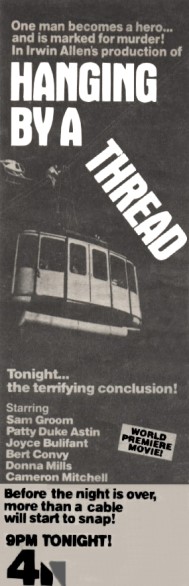 A group of old friend who call themselves the Uptowners’ Club (yes, really) want to go on a picnic on top of a remote mountain. The only problem is that they have to ride a cable car up to the mountain and there are reports of potentially bad weather. It’s not safe to ride in a cable car during a thunderstorm. Drunken ne’er-do-well Alan (Bert Convy) doesn’t care and, since his family owns both the mountain and the tramway, his demands that he and his friends be allowed to ride the cable car are met. One lightning strike later and the members of the Uptowners’ Club are stranded in a cable car that is perilously suspended, by only a frayed wire, over treacherous mountain valley.


 Through the Shattered Lens