Beverly Wood (Ivy Smith) is a professional social media influencer whose ego is almost as big as her following. She’s referred to as being “#BigBitch” for a reason. Her manager, Bradley (Eli Cirino), is always looking for new ways to promote Beverly and now products for her to endorse. However, Bradley is also a no-good cheater who is seeing Beverly’s assistant, Fuschia (Christine Nguyen), on the side. When eating a new, scientifically-modified brand of hot dog causes Beverly to grew to 50 feet tall, she sets out for revenge, just like in Attack of the 50 Foot Woman. This time, though, the romantic rival also grows to 50 feet tall and the movie ends with a Godzilla vs. King Kong-style battle over a bunch of miniature buildings.
This is the latest remake of Attack of the 50 Foot Woman, without any of that film’s subversive subtext and, unfortunately, without any actresses as memorable as Allison Hayes and Yvette Vickers. It’s a Jim Wynorski joint so you know what you’re going to get, which is lots of nudity, stiff acting, cheap special effects, and a nonstop stream of dad jokes that are more likely to make you groan than laugh. (If you think hashtag is the funniest words this side of Poughkeepsie, you might chuckle once or twice.) Ivy Smith even makes out with the film’s token sexy scientist (played by Lisa London) for no reason other than the fact that Wynorski knows his audience. There’s nothing challenging or surprising about Attack of the 50 Foot Camgirl. It’s a very unambitious film. At the same time, Wynorski’s style is so self-aware and good-natured that the movie is still more likable than most of the other direct-to-video schlock that ends up streaming for free online. It may be a dumb movie but it is smart enough not to take itself seriously. The film both begins and ends with two giant women have a kaiju-style battle and destroying several miniature buildings. That tells you all you need to know about both the film and whether or not you’ll enjoy it.
The 1980 Canadian film, Death Ship, opens with a black freighter ominously sailing across the ocean in the middle of the night. The freighter appears to be deserted but, when a cruise ship appears over the horizon, we suddenly hear disembodied German voices announcing that the enemy is in sight and it’s time to take battle stations. The freighter changes direction and starts to rapidly move straight towards the cruise ship.
On the cruise ship, a really bad comedian named Jackie (played by Saul Rubinek) is telling a series of unfunny jokes. Fortunately, before he can further offend anyone else’s comedic sensibilities. the freighter crashes into the cruise ship and sinks it. The next morning, we see a small group of survivors floating on a piece of debris. There’s the firm and harsh Captain Ashland (George Kennedy), who was on the verge of being forced into retirement before his boat sank. There’s Mrs. Morgan (Kate Reid), the odd religious passenger. There’s Trevor Marshall (Richard Crenna), his wife Margaret (Sally Ann Howes), and their two annoying kids. There’s a guy named Nick (Nick Mancuso) and a woman named Lori (Victoria Burgoyne), who are in love but obviously doomed. And then there’s Jackie. That’s right, Jackie survived! And he’s still telling bad jokes!
Suddenly, the survivors spot the freighter in the distance. Not realizing that it’s the same freighter that previously rammed them, they board the boat and discover that it appears to be totally abandoned. Jackie stands on the deck, encourages everyone to be positive, and makes more jokes. Suddenly, a cable wraps around his ankles, one of the ship’s cranes suddenly moves, and Jackie is tossed back into the ocean. The comedy Gods have spoken.
Anyway, once Jackie is no longer around to make them laugh, the cruise ship survivors set about going crazy. It’s not that difficult to do because it turns out that not only is the freighter full of ghosts but the ship’s engine is fueled by pure hate. That means that one passengers takes a shower just to have the water turn to blood. Another makes the mistake of watching an old movie and eating a cursed piece of hard candy. Yet another ends up getting tossed into the gears of the ship and loses an arm.
Meanwhile, Captain Ashland stumbles around the ship and hears voices telling him that the ship is now his. After Ashland discovers and then puts on an old officer’s uniform, he declares that he’s in charge of the freighter and then he proceeds to try to kill everyone else on the ship. Captain Ashland is possessed and there’s not even anyone on the boat who can make a joke about it.
Death Ship is a dumb but crudely effective movie. This is one of those films where everyone could have saved themselves a lot of trouble by sticking together as a group instead of splitting up to search the freighter but it’s not like you’re watching a movie called Death Ship because you’re looking for a coherent narrative or anything. The main reason you’re watching is so you can see George Kennedy get possessed and go crazy. Fortunately, George Kennedy was just the type of character actor who you could depend upon to act the hell out of getting possessed. There’s not a hint of subtlety to be found in Kennedy’s performance and, if nothing else, that certainly makes him entertaining to watch. Kennedy attacks this role with the ferocity of a cheetah pouncing on a gazelle in a nature documentary. He basically grabs hold of the film and snarls at the rest of the cast, “This is my movie! If you steal a scene from me in your dreams, you better wake up and apologize!” It’s fun to watch.
The same can be said about Death Ship, which is a totally over-the-top movie but which, thanks to Kennedy’s performance and a few atmospheric shots of the freighter, is also far more entertaining than it has any right to be.
This 1979 film tells the story of George and Kathy Lutz (James Brolin and Margot Kidder), a young married couple who move into a big house in Amityville, New York. George and Kathy are having financial trouble so it’s good thing that they were able to find such a nice house at such a low price. Of course, it’s possible that the house was cheap because it was built on a native burial ground. Plus, the previous owners were murdered by their son, who later claimed that he was possessed by evil spirits. The house has a less than savory history but then again, what house doesn’t?
Anyway, strange things start to happen as soon as the Lutzes move in. Noxious black liquid floods the plumbing. Crosses are turned upside down. Their priest (Rod Steiger) gets violently ill when he attempts to bless the house. George starts to act weird, getting angry at strange moments and walking around with an ax. Kathy’s daughter from a previous marriage says that she’s made a new imaginary friend named Jodie and, apparently, Jodie doesn’t like George or her babysitter. Flies swarm through the house and weird noises are heard in the middle of the night. Kathy has nightmares. George screams, “I’m coming apart!” Even the family dog seems to be worried about the house, especially after a secret room is discovered in the basement.
Could the house be possessed!? Is a terrible, other worldly evil trying to destroy the George and Kathy? Will the Lutzes be able to escape and hopefully make a lot of money by selling their story? Watch the film and find out. And, if for some reason, you can’t watch this film, you can watch one of the dozen or sequels or maybe even the remake…
The original Amityville Horror was based on a book that claimed to tell the true story of the Lutzes. For the record, it is generally agreed that Ronald DeFeo murdered his family in Amityville, New York and that George and Kathy Lutz later moved into the DeFeo house. It’s also known that the Lutzes left the house after 30 days. The Lutzes claimed that the house was possessed. Others said that the Lutzes left because they couldn’t afford the house payments. Regardless of why the Lutzes actually left, the book that claimed to tell their story was a best seller.
As for the film adaptation, The Amityville Horror is frequently described as being a classic of horror cinema. However, I have to admit that, whenever I’ve tried to watch it, I’ve always ended up giggling after the first ten minutes or so. Some of that is because the film is such a blatant rip-off of The Exorcist, right down to including a bratty child with a invisible friend and a troubled priest who struggles with his faith. Just as The Exorcist featured Linda Blair throwing up on Max von Sydow and Jason Miller, The Amityville Horror seems to take a good deal of unsavory delight in tormenting Rod Steiger. From the minute he first shows up, the house really has it out for him. He gets swarmed by flies. He gets physically ill. His car stops working on him. It’s like, seriously, just leave Rod Steiger alone!
(Interestingly, Don Stroud plays Steiger’s protegee and their relationship is largely reminiscent of the relationship between Father Merrin and Father Karras in The Exorcist. Later, a police detective shows up and acts exactly like Lee J. Cobb’s Detective Kinderman. Val Avery, who plays the detective, even bears a resemblance to Lee J. Cobb. Considering just how successful The Exorcist was, it’s not surprising that the Amityville Horror would be influenced by it but, again, it’s still hard not to be a little bit amazed at just how blatant a rip-off Amityville really is.)
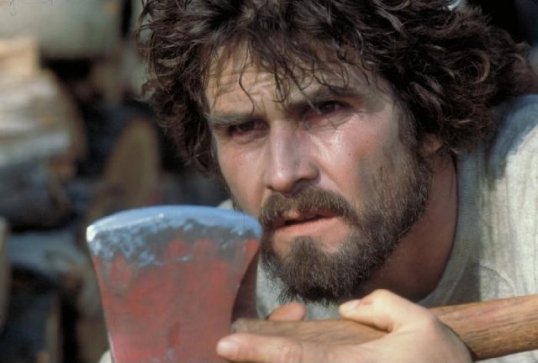
When the film isn’t tormenting Steiger, it’s concentrating on George going crazy. Unfortunately, as played by James Brolin, George seems to be in a permanently cranky mood even before he and Kathy move into their new home. Once the Lutzes movie into the house you find yourself wondering if George is possessed or if he’s just a jerk? Sometimes, it’s hard to tell. One thing is for sure: shortly after moving into the house, George becomes absolutely obsessed with chopping firewood and polishing his ax. I know the sight of Brolin with that axe is supposed to be ominous and scary but I have to admit that I started to laugh every time he started chopping away. Far more convincing was Margot Kidder in the role of Kathy but the film really didn’t give her much to do other than scream and worry about why her husband was always in such a sour mod.
Anyway, the most interesting thing about The Amityville Horror is that this rather slow and derivative film was such a box office success that it’s been followed by 20 sequels and one remake! Someday, when I’m feeling really, really brave, I’ll get around to reviewing all of the Amityville films. Until then, I leave you with George Lutz and his beloved ax.
For today’s horror on the lens, we have 1973’s The Night Strangler.
This is the sequel to The Night Stalker and it features journalist Carl Kolchak (Darren McGavin) in Seattle. (After all the stuff that happened during the previous movie, Kolchak was kicked out of Las Vegas.) When Kolchak investigates yet another series of murders, he discovers that paranormal murders don’t just occur in Las Vegas and aren’t just committed by vampires.
I actually prefer this movie to The Night Stalker. The Night Strangler features a truly creepy villain, as well as a trip down to an “underground city.” It’s full of ominous atmosphere and, as always, Darren McGavin is a lot of fun to watch in the role in Kolchak.
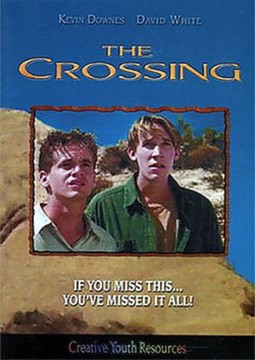
The 1994 film, The Crossing, tells the story of two teenage friends. Jason (Kevin Downes) and Matt (David A.R. White) used to be cheerful juvenile delinquents. But now, Matt is dying of what appears to be leukemia and Jason …. well, Jason’s in denial. Jason does not want to admit that his best friend is going to die. But then his best friend does die and Jason really doesn’t have any choice to admit it. But then, at Matt’s funeral, Matt suddenly shows up and starts talking to Jason.
That’s right …. MATT’S BACK!
Unfortunately, Matt’s only back for a little bit and only Jason can see him. Having died, Matt has not only witnessed Heaven but also discovered that it’s really difficult to get in. He takes Matt to a heavenly court where they watch as another one of their friends is condemned to Hell by a sympathetic but firm-handed judge. Matt also visits the big computer room where all of the records are kept. He’s given a big dot-matrix printout that lists all of his sins. There’s a lot of them!
However, Jason tells Matt that there’s still hope for him and then invites him to come check out Heaven. They just have to walk over a wooden cross that is used as bridge between Purgatory and Heaven. Underneath the bridge is Hell and no one wants to go down there. However, no sooner have Matt and Jason crossed over than Jason notices that his mother is following them! And she can’t see the bridge! Uh-oh!
The Crossing is an early example of the Christian scare film, where the main message is that, if you displease God, you’ll go to Hell and suffer for all eternity. Obviously, that’s a very cinematic message and these films always seem to spend a good deal of time in trying to find new ways to visualize Hell. That said, I’ve always felt like that message was a bit counter-productive. Instead of emphasizing what Jesus preached and what the Church is supposed to stand for (even if it rarely lives up to its own standards), these films instead seem to say, “Convert or we’ll punish you forever.” People will do a lot of things under the threat of eternal pain and damnation but I’m a bit skeptical as to how sincere any of those actions will be. Indeed, many evangelical films seem to take a bit too much pleasure in imagining people being condemned to Hell. There’s definitely an element of, “You think you’re so smart but we’ll get the last laugh!” to these films. That’s not exactly the best attitude.
That said, The Crossing is slicky produced and it gets a lot of mileage out of its low budget. The scene in the computer room actually had a few intentional laughs as Matt marveled at how business-like and matter-of-fact all the record keepers were. They were just doing their jobs with an attitude that said, “We’ve seen things you can’t even imagine.” Who wouldn’t want that job? Still, one has to wonder why Matt got to go see all of this and change his life but his friend who was condemned to Hell didn’t. That doesn’t seem quite fair.
Sitting out of the middle of nowhere, there’s a house. And in this house, there lives an old man and an old woman. They appear to be very friendly, the type who will happily open up their home to anyone needing a place to stay and have a cup of coffee. They make dolls for a living. They make the type of dolls that smirk at you whenever you trip and that glare at you whenever you say that you don’t care about toys. They’re living dolls and they’re actually kind of vicious. Don’t get on their bad side.
That is exactly the mistake that a few people make when they arrive at the house on one stormy night. Two punk rock girls with exaggerated British accents make the mistake of trying to find something to steal. Uh-oh, here come the dolls! A self-centered man and his wife make the mistake of not caring about their daughter. The dolls aren’t going to stand for that! Seriously, the dolls may be cute but if they don’t like you, you are doomed!
The dolls, however, do like the daughter. And they appear to be willing to tolerate Ralph, the goofy traveling salesman who made the mistake of picking up the two punk rock girls while they were hitchhiking. Will the dolls continue to like the daughter and Ralph or will they eventually turn on everyone in the house? They may be small but again, you seriously do not want to get these dolls mad.
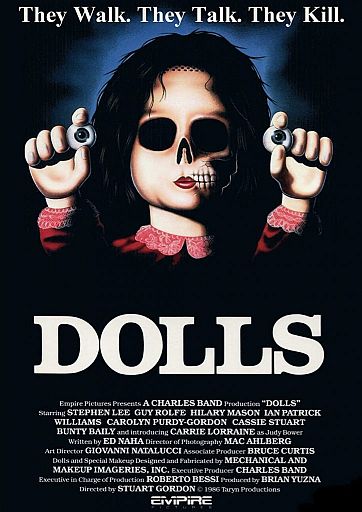
First released in 1986, Dolls is a seriously strange movie from director Stuart Gordon and producer Charles Band. There’s a lot of good things to be said for Dolls. The house is atmospheric. The dolls are truly creepy. The acting really isn’t that bad, though I do think most viewers won’t necessarily miss the two punks girls. The movie does take the characters and the dolls in some unexpected directions. But the movie’s tone is all over the place. It starts out as a broad comedy before then turning into a surprisingly violent and bloody horror film and then it turns into this strangely macabre family drama. The movie can’t seem to decide whether it wants you touch your heart or scar your soul. Imagine Home Alone if the movie kept all the heart-warming stuff but then had the kid brutally kill the burglars and laugh while stuffing their corpses in a furnace and you have some idea of what the tone of Dolls is like.
It’s an odd film but it’s hard not to like. Stuart Gordon’s direction is energetic and, since the movie only has a running time of 77 minutes, the whole thing feels like an extra weird episode of Tales From The Crypt or The Twilight Zone. Even the film’s mix of humor and disturbing violence feels strangely appropriate, as if the film itself is an adaptation of a particularly grisly fairy tale.
Watch Dolls and you’ll never look at a toy the same way again!
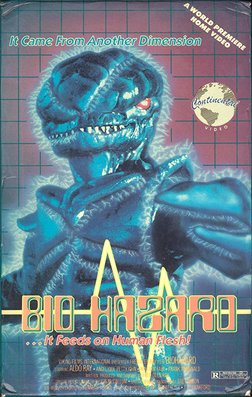
At a government research lab in the middle of the desert, Lisa (Angelique Pettyjohn) is a psychic who has the ability to go into different dimensions and bring things back with her. While demonstrating her abilities for Gen. Randolph (Aldo Ray), she accidentally brings back a container that is carrying a small, humanoid/lizard hybrid. (Inside the costume was director Fred Olen Ray’s six year-old son, Christopher.) The monster goes on a rampage, killing hoboes and other random people who live in a nearby town. Lisa and Carter (William Fair) try to track down the creature before it can cause too much damage and kill too many people. Meanwhile, the town drunk wants to sell the monster’s story to the newspapers.
Biohazard is a typical early Ray film. Hire some veterans, like Aldo Ray and Carroll Borland. (Fred Olen Ray, if nothing else, was good about finding work for Hollywood veterans who, otherwise, would have spent their final years in obscurity.) Unleash someone in a monster costume. Toss in some gratuitous nudity. Spill some fake blood. Pad it out so that the film reaches feature-length. Biohazard goes the Hal Needham route when it comes to padding out the film and gives us several minutes of blown takes and other mistakes. The takes start out amusing but, eventually, there’s only so many times you can watch actors blow lines that weren’t that good to begin with. It’s still not as bad as having to watch Burt Reynolds slap Dom DeLuise a hundred times during the closing credits of Cannonball Run. At least most of the actors actually look like they enjoyed being on the set of Biohazard.
With Fred Olen Ray, you know what you’re going to get and Biohazard delivers all of Ray’s trademark moments, including ineptly lit day-for-night scenes, overacted comedy relief, and one or two scenes that work despite themselves. As bad as the end result was, the film does have a DIY aesthetic that will appeal to anyone who has ever thought about getting a couple of friends together and just making a movie. Supposedly, it took Ray two years to complete Biohazard. Today, an aspiring filmmaker could just film it on his phone over two weekends and then upload it to YouTube and get a few thousand likes. In some ways, independent filmmakers like Fred Olen Ray were ahead of their time.
I mean, let’s just be honest about that. No one wants to get older. No one wakes up in the morning and thinks to themselves, “Yay! I’m one day closer to death!” People do not celebrate the appearance of a wrinkle or a laugh line. No one is happy when their vision gets blurrier or when they start to ache more and more frequently. No one wants to get old! That’s a simple truth and it’s the truth that is at the heart of the 1958 film, The Wasp Woman.
Directed by B-movie maestro Roger Corman, The Wasp Woman tells the story of Janice Starlin (Susan Cabot). Janice owns a cosmetic company. She’s made a fortune helping people defy their age. Unfortunately, the company’s sales are down because Janice herself cannot defy the passage of time. She’s looking older and apparently, people across the world are saying, “Why would I buy makeup for a mortal? I only buy my makeup from ageless mythological goddesses, who never age.”
So, Janice does what anyone would do. She tries to find a way to stop herself from getting old. When she discovers that a scientist is experimenting with using the enzymes from the royal jelly of a queen wasp to reverse the aging process, she agrees to fund his work. However, she has one condition. She has to be the test subject …. which, now that I think about it, makes absolutely no sense. Surely Janice could hire someone else to be the test subject before undergoing a highly experimental and unproven scientific process herself. I mean, Janice is extremely wealthy! Or maybe Janice could just hire a model to be the new face of her company. Or she could retire and take her millions to Europe and spend the rest of her life living in luxury. My point is that it seems like Janice is acting a bit impulsively here.
Anyway, Dr. Eric Zinthrop (Michael Mark) reluctantly agrees to Janice’s demands. He really needs the money, I guess. And if Janice dies, it’ll just means that he’ll probably go to prison for life. He certainly won’t ever be allowed to experiment with any more wasps. Is anyone in this movie capable of thinking ahead?
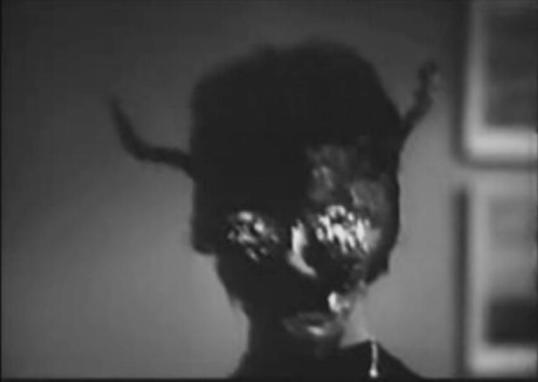
At first, the experiments seem to work. After one weekend, Janice looks 20 years younger! However, there is an unfortunate side effect. Janice occasionally transforms into a wasp/human hybrid! Uh-oh! That’s not good….
Clocking in at barely 70 minutes, The Wasp Woman is an entertainingly daft movie. As I’ve already pointed out, this is one of those movies where so much drama could be avoided if people would just consider the possible consequences of their actions. That said, the pace is fast and Susan Cabot is enjoyably bitchy in the role of Janice. The Wasp Woman costume manages to be both ludicrous and effective at the same time. Laugh? Scream? Why not do both!?
In the end, this is a silly but entertaining movie. If nothing else, it proves that sometimes it’s best just to accept that no one stays young forever.
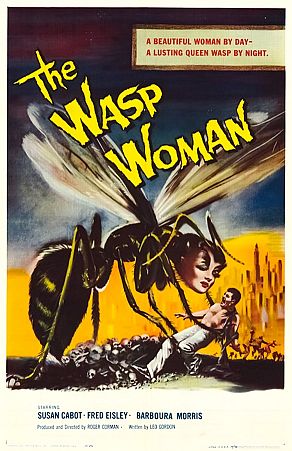
One final note: This film has a great poster, even if it is totally misleading.
For today’s horror on the lens, we have a real treat! (We’ll get to the tricks later…)
Long before he achieved holiday immortality by playing the father in A Christmas Story, Darren McGavin played journalist Carl Kolchak in the 1972 made-for-TV movie, The Night Stalker. Kolchak is investigating a series of murders in Las Vegas, all of which involve victims being drained of their blood. Kolchak thinks that the murderer might be a vampire. Everyone else thinks that he’s crazy.
When this movie first aired, it was the highest rated made-for-TV movie of all time. Eventually, it led to a weekly TV series in which Kolchak investigated various paranormal happenings. Though the TV series did not last long, it’s still regularly cited as one of the most influential shows ever made.
Anyway, The Night Stalker is an effective little vampire movie and Darren McGavin gives a great performance as Carl Kolchak.
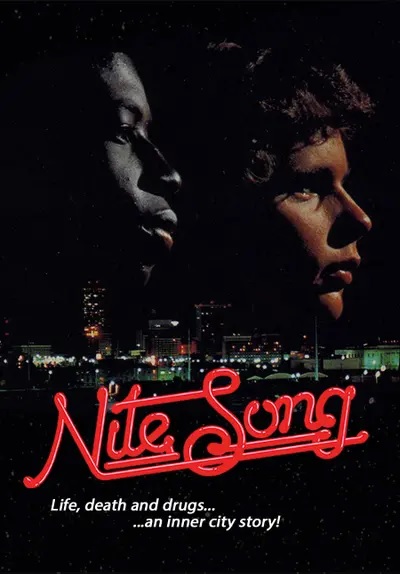
The 1978 film, Nite Song, takes place on the mean streets of Des Moines, Iowa. Pete (Bobby Hoffman) and his best friend, Joe (Tom Hoffman), are neighbors in the local tenement. They also both play on the high school basketball team. In fact, the only reason that this movie is over an hour long is because there’s about five minutes of slow motion basketball footage.
Life’s not easy in Des Moines. The local drug lord wants Pete to work for him. Joe’s sister is addicted to heroin and his father is out of work. Joe has recently become a Christian, which Pete finds to be kind of strange. Even stranger is that Joe often sits outside on the balcony of the tenement and sings a song called I Will Serve Thee. Later in the film, another character will spontaneously start singing I Will Serve Thee while staring up at the night sky. I guess that’s the “nite” song of the title but what’s interesting is that the film itself isn’t a musical.
Anyway, the local drug lord wants Joe to help him rob the local pharmacy. Joe refuses so the dealer refuses to give Joe’s sister any more heroin. Joe and Pete decide to start following the drug dealer around town, in order to gather enough evidence to find a way to stop him. Unfortunately, that plan doesn’t really work out that well. Joe ends up with a knife in his back and Pete is left to struggle with whether he should go to the police or just sit out on the balcony and pray about it. It turns out that all of the other kids at the high school are also Christians, specifically because of Joe. They decide to clean up the streets themselves! Fortunately, that won’t be hard because there’s only three criminals in Des Moines and they all hang out together….
It’s actually probably a little bit too easy to be snarky about a film like Nite Song, if just because it’s a low-budget, amateur film about life and death in Iowa. But actually, the film deserves a bit more credit than I’m giving it. Taken on its own terms, it’s actually an achingly sincere and earnest film and, as opposed to a lot of other faith-based films, it never makes the mistake of getting preachy or being overly judgmental. (The film’s sympathetic portrayal of Joe’s drug-addicted sister actually deserve a good deal of praise.) Even though the actors are all obviously amateurs and the singing gets a bit weird, everyone brings a certain authenticity to their roles. This is a film about Iowa that was actually populated with people who were from Iowa and yes, that does make a difference.
Plus, there’s something charmingly naïve about the idea of the high school basketball team taking out the local drug dealers. All those weapons and tough talk prove useless against a 15 year-old with a dream and jump shot. Nite Song‘s a well-intentioned film. Des Moines has nothing to be ashamed of.
 Beverly Wood (Ivy Smith) is a professional social media influencer whose ego is almost as big as her following. She’s referred to as being “#BigBitch” for a reason. Her manager, Bradley (Eli Cirino), is always looking for new ways to promote Beverly and now products for her to endorse. However, Bradley is also a no-good cheater who is seeing Beverly’s assistant, Fuschia (Christine Nguyen), on the side. When eating a new, scientifically-modified brand of hot dog causes Beverly to grew to 50 feet tall, she sets out for revenge, just like in Attack of the 50 Foot Woman. This time, though, the romantic rival also grows to 50 feet tall and the movie ends with a Godzilla vs. King Kong-style battle over a bunch of miniature buildings.
 Through the Shattered Lens