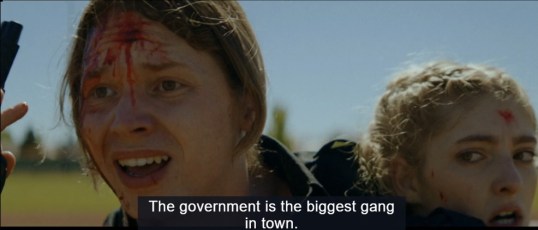
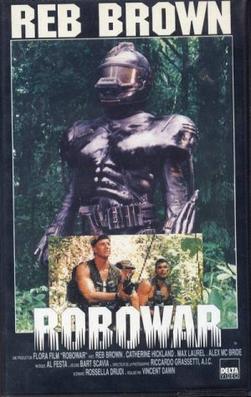
The TSL Grindhouse: Robowar (dir by Bruno Mattei)


After some men go missing in the jungles of an isolated island, a group of mercenaries is assigned to search the jungle, battle the guerillas who control the island, and rescue the missing.  Accompanying the mercenaries is a shifty CIA agent who seems to know more than he’s letting on.  What the mercenaries soon discover is that the guerillas aren’t the only threat that they have to worry about.  There’s a shadowy figure stalking them.  Equipped with state-of-the-art weaponry and encased in impenetrable armor, this figure is following them like some sort of preda–

Wait.  Does this sound familiar?

The 1988 film, Robowar, is an unapologetic rip-off of the Predator.  Directed by Bruno Mattei and written by Troll 2 director Claudio Fragasso (who also plays this film’s version of the Predator), Robowar is such a rip-off of the Predator that it even ends with an end credits sequence in which we see clips of each actor stalking through the jungle.  Reb Brown plays Murphy Black, the head of the mercenaries, and he spends a lot of his time shrilly shouting at them to “Move!  Move!  Move!”  Catherine Hickland plays the head of a local orphanage.  She introduces herself as “Virginia” and is called “Virginia” throughout the film but the end credits insist that her character was actually named “Virgin.”  The other mercenaries are played by a combination of American and Italian stuntmen and some of them vaguely resemble their better-known counterparts from Predator.  Max Laurel, who plays the group’s fearless tracker, looks like he could have been distantly related to Sonny Landham.  Massimo Vanni and Romano Puppo play two mercenaries who have a relationship that’s similar to the friendship between Jesse Ventura and Bill Duke.  Of course, in anyone really makes an impression, it’s Mel Davidson as the group’s government handler and who spends the whole movie smiling while delivering lines about how the entire group is doomed, himself included.  It’s such an odd performance that it becomes rather fascinating.

What type of film is Robowar?  It hits all of the same plot points as Predator but it does it with a much lower budget.  Indeed, the film’s opening sequence appears to be made up of footage lifted from Mattei’s earlier film, Strike Commando.  Whenever we see the action through the killer robot’s eyes, Mattei gives the action an extreme orange tint that makes it impossible to actually tell what’s going on.  Reb Brown spends a lot of time yelling but the same thing could be said for the entire cast.  This is one of those films where no one fires a machine gun without screaming while doing so.  And yet, because it’s a Mattei film, it’s always watchable.  Bruno Mattei (who born 92 years ago today in Rome) may have specialized in ripping-off other, most successful films but he was so shameless and unapologetic about it that it’s impossible to judge him too harshly.  As always, Mattei keeps the action moving quickly and doesn’t worry to much about things like continuity.  Mattei’s films were rarely good but they were almost always fun when taken on their own silly terms.

At times, Robowar almost feels like a parody of an American action film, with Fragasso’s script featuring dialogue that is so extremely aggressive and testosterone-fueled that even Shane Black probably would have told him to tone it down a notch.  Much as with Troll 2, the film provides an interesting view into how Fragasso imagined Americans to be.  Early on, we are informed that the mercenary group is known as BAM, which stands for “Big Ass Motherfuckers.”  Later, one of the members of BAM insults two others by saying, “I bet they have the AIDS.”  It’s as if someone programmed a computer to write an action movie and, as such, Robowar might turn out to be a surprisingly prophetic film.

Despite featuring a few Americans in the cast, Robowar was not available in the U.S. until it was released on Blu-ray by Severin Films in 2019.  Though Bruno Mattei passed away in 2007, his work continues to be discovered by new audiences.
Film Review: Children of Divorce (dir by Frank Lloyd and Josef von Sternberg)


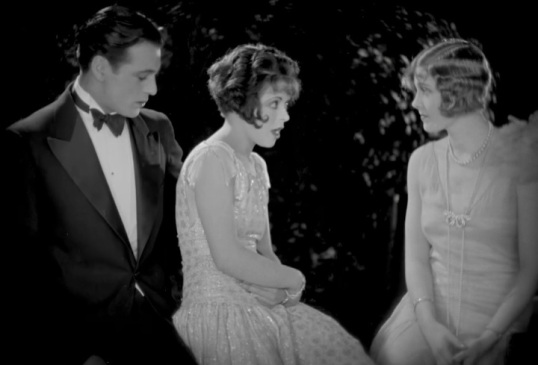
The 1927 silent melodrama, Children of Divorce, opens at a private Catholic boarding school in Paris.  It’s a place for rich and idle parents to dump off their children while they enjoy the City of Lights.  Jean Waddington is dropped off at the school and struggles to make friends until she meets the vivacious Kitty Flanders.  Jean and Kitty bond because they are both children of divorced parents.  (Kitty says that she has only one mother but that’s she’s had four different fathers.)  Jean meets Ted Larrabee, who is Kitty’s neighbor back in New York and who has also been dumped off at the school by his divorced parents.

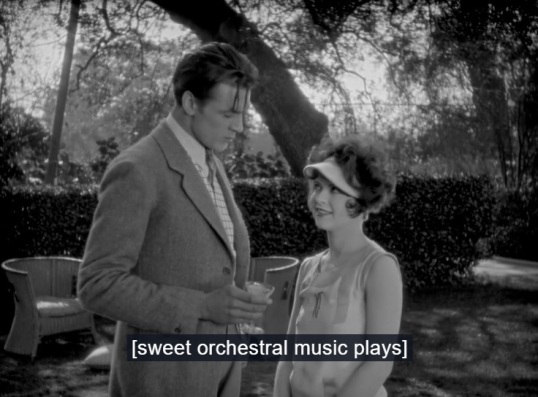
Flash forward a few years and Kitty (Clara Bow), Jean (Esther Ralston), and Ted (Gary Cooper) are all young adults.  Kitty is in love with Prince Vico (Einar Hansen) but the Prince’s father refuses to allow Vico to consider marrying her because Kitty’s mother (played by future gossip columnist and Queen of Hollywood, Hedda Hopper) is not rich.  Believing that the only way that she’ll ever be happy is if she marries a rich man, Kitty set her eyes on Ted.  Ted, however, wants to marry Jean but Jean says that she’ll only consider marrying Ted if he gets a real job and proves that he can do something more than just live off of his father’s money.

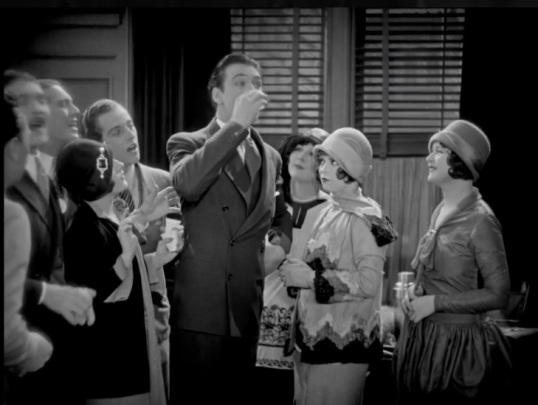
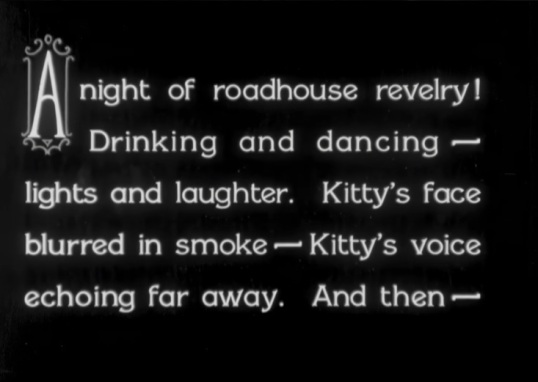
Ted starts his own architectural firm and proves that he’s capable of hard work.  However, when Kitty convinces Ted to celebrate his success by going out drinking with her….

Ted wakes up with a hangover.  He soon discovers that he’s also woken up with a wife!  While he was drunk, he married Kitty!  Ted is stunned.  Jean is heart-broken.  She begs Kitty to grant Ted a divorce so that she can marry him but Kitty reveals that she has no intention of ever getting divorced.  As she explains it, Kitty has been raised to marry a rich man, Ted is rich, and now, she’s married to him.  Why would Kitty want to give that up?  When Ted says that he’ll file for the divorce, Jean tells him that she can’t marry a man who would leave his wife and then she leaves for Europe….

Of course, that’s not the end of the story.  This wouldn’t be a silent melodrama if it ended that simply.  Instead, years later, Kitty does come to see the error of her actions and she also discovers that her true love remains Prince Vico.  But, by that point, it’s too late and, of course, Jean still refuses to marry a divorced man.  Kitty seeks redemption in the most extreme was possible….

Clocking in at a brisk 70 minutes, Children of Divorce is a wonderful showcase for Clara Bow, who was born 118 years ago on this date.  Gary Cooper is properly handsome and sincere as Ted and Esther Ralston is lovely if a bit boring as Jean but the film ultimately belongs to Clara Bow, who brings so much vitality and energy to her role that it doesn’t matter that Kitty tricks Ted into marrying her and destroys all of Jean’s romantic dreams.  Most viewers will instantly sympathize with Kitty and, to be honest, it’s kind of hard not to be on her side.  Kitty has fun.  Kitty refuses to let society stand in her way.  While Jean makes a list of demands about what she needs Ted to do before she can even consider marrying him, Kitty encourages Ted to loosen up and enjoy his success.  Kitty is the one who I think most viewers, at the very least, would want to be friends with.  While Jean tries to run away from her problems, Kitty is determined to live her best life.  Indeed, Kitty’s ultimate redemption is all the more effective because, once again, Kitty is the one who is making things happen while Ted and Jean just passively accept the conventions of society.

Clara Bow was one of the greatest of the silent film stars and Children of Divorce shows why.  As opposed to many of the other actresses of the day, Clara Bow was convincingly cast as women who were willing to do whatever needed to be done to find happiness.  Sadly, Clara Bow’s later years were not happy ones.  She deserved better than the world gave her.  Watching her in films like this one and It feel like looking out a window into the past, a time when it seemed like anything was possible.

Barbie (dir. by Greta Gerwig)


I may be the wrong person to be writing about Barbie. As a guy, I can’t really empathize with all of the elements of womanhood. I’ll never experience childbirth, nor fully understand all of the issues women have to deal with (though watching the women in my family proved insightful over the years). The closest I’ll know is either through writing or having a girl character in Grand Theft Auto Online and having to deal with players shooting my character to hell for not getting into their ride when I clearly have one of my own.

Still, I can appreciate both the fun and the serious notes that Barbie offered.

I spent last Christmas with a friend’s family, watching as they passed gifts between each other. During the gift giving, my friend passed along a small wrapped box to his wife. She smiled up at him from the sofa, but looked at the box with a hint of confusion. Tearing into it, she gasped and then broke into tears, which silenced the room.

The unwrapped present was a Barbie Doll, complete in a luxurious dress. I think it might have been the Oscar De La Renta one.

She explained that when she was little, living in Colombia, she had always wanted a Barbie. Sure, there were dolls to be had, but nothing like a Barbie. I listened to this and smiled, associating it as the female equivalent of asking your parents for a Transformer but only ever receiving GoBots instead. I could relate.

It also reminded me of my little sister, who had the Dream House, the Car, and a box full of clothes. She’d humor me with my Transformers, I’d humor her with Barbie life, either borrowing a Ken or her Kimber from her Jem line. We’d hop in the convertible and drive.

I can imagine James Earl Jones’ character in Field of Dreams noting that Barbie “has marked the time” throughout history.

So, when it was announced that there was an actual Barbie movie being made, I knew I’d check it out, especially with all of the Oppenheimer madness on the same weekend. I decided to watch Oppenheimer first (a 5pm showing), and then Barbie (at 9:30pm) this past Thursday. This proved to be a good idea. Barbie‘s lighthearted approach was a stark contrast to Oppenheimer’s tone.

I enjoyed Barbie, which opens with a homage to 2001: A Space Odyssey and a narration by Dame Helen Mirren. It’s the tale of a Barbie – Stereotypical Barbie, if you need particulars (Margot Robbie, Babylon) who lives her life in Barbieland with all of the Barbies and the Kens. One Ken (Ryan Gosling, The Gray Man) has his heart set on Barbie. Life is nice in Barbieland, sunning by the beach during the day and partying at night. However, once our Barbie begins to have thoughts about death and her existence, the magic around her begins to be disrupted. With the help of a Crazy Barbie (Kate McKinnon, DC’s League of SuperPets), our Barbie finds herself on a quest towards the Real World to find her companion – similar to Toy Story‘s toys and their owners – and fix what’s gone wrong. Adding to the mayhem is Mattel, whose CEO (Will Farrell) discovers the breach between Barbie Land and the Real World and sends his own agents after Ken and Barbie.

Can Barbie make things right? Will Ken just tag along for the ride?

Written by Greta Gerwig & her husband, Noah Baumbach, Barbie‘s plot is pretty straightforward. Barbie is lighthearted throughout and the audience (which was pretty packed) seemed to enjoy it. My showing lost a mother and two kids in the front row around the time the story reached the Real World, however. Or perhaps they moved back to a higher row. The story gets itself involved with the complex role of women in society, which is both welcome and expected. While it’s not as heavy handed as The Handmaiden’s Tale in what it’s trying to say, I thought the story worked well and was extremely accessible, for the most part. Like many movies these days, Barbie has something to say about the times we live in. I’m not entirely sure how everyone else will handle it. I’m curious to know more about Gerwig’s other works. Although the film is shy of the 2 hour mark, it moves quite quickly.

Barbie is on par with Christopher Nolan’s Oppenheimer for the casting. There’s such a great line up here. Simu Liu (Shang-Chi and the Legend of the Ten Rings), Kingsley Ben-Adir (Marvel’s Secret Invasion), and John Cena (Fast X) as some of the Ken’s in town. From Netflix’s Sex Education, you have Ncuti Gatwa, Emma Mackey and Connor Swindels They’re paired off with Alexandra Shipp (Love, Simon), Nicola Coughlin (Netflix’s Bridgerton), Rhea Perlman (Matilda) and singer Dua Lipa. Longtime Barbie fans will also recognize Midge (Emerald Fennell, director of Promising Young Woman) and Allen (Michael Cera) in the mix. Barbie feels like a labor of love, with both the acting and the set design. Gosling and Robbie as the leads are fantastic. I can’t imagine a better person than Robbie for Barbie and Gosling gets a bit more with the songs he gets to sing. All in all, it’s a great party, and they’re both at their comedic best here.

The standouts, though happen to be both America Ferrera (How to Train Your Dragon) and Ariana Greenblatt (65). If Robbie and Gosling are the perfect Ken and Barbie, than I would argue that Ariana and America had the perfect characters for helping the audience understand some of the parts we (guys, in particular) don’t get. The audience loved their interactions, and there was at least one part that garnered some applause and cheers from the crowd.

From a production design standpoint, everything is there in Barbie Land. The Barbie Dream house, the car, the pool. Whoever worked on these designs obviously played with the toys growing up and made a near flawless recreation. It felt like Bumblebee, with Transformers that were more like their animated counterparts than jagged pieces of shrapnel.

While there isn’t anything particularly special in the sound department (that’s more Oppenheimer‘s territory), music plays a big part in the Barbie experience. Whether it’s Gosling singing his heart out while pining for Barbie, or a lovely piece by Billie Eilish, it’s all fun and caring.

Overall, Barbie really surprised me. It manages to take something extremely simple – a doll loved by many – and surprisingly turn it into a thought provoking piece that may have you thinking differently about your mothers & grandmothers (or any of the women around you). At least, after you’ve stopped chuckling and or nodding with the music.

Retro Television Reviews: Murder In New Hampshire: The Pamela Smart Story (dir by Joyce Chopra)


Welcome to Retro Television Reviews, a feature where we review some of our favorite and least favorite shows of the past!  On Sundays, I will be reviewing the made-for-television movies that used to be a primetime mainstay.  Today’s film is 1991’s Murder In New Hampshire: The Pamela Smart Story!  It  can be viewed on YouTube!

When Pamela Wojas (Helen Hunt) first became engaged to Gregg Smart (Hank Stratton), she thought that they would never get older or settle down to a conventional life.  She thought that Gregg would always have long hair and that they would spend the rest of their lives following Van Halen around the country.  But then Gregg got a job with a New Hampshire insurance company and he cut his hair.  And then Pam failed in her attempts to get hired by the local news station and instead, she ended up accepting a job as the part-time media director at a local high school.

Pam spearheaded the school’s anti-drug campaign and ended up working closely with two students in particular, Billy Flynn (Chad Allen) and Cecelia Pierce (Riff Reagan).  Billy and Pam bonded over their shared love of Van Halen and soon, they were having an affair.  Was Pam just trying to relive her youth or was she already setting up Billy to murder her husband?

Based on the true story that also inspired Gus Van Sant’s To Die For, Murder In New Hampshire jumps back and forth through time.  The film opens with Gregg being shot and killed by Billy and one of his friends.  It then cuts to a courtroom, where a prosecutor (Howard Hesseman) tells the jury that Gregg was murdered on the orders of his own wife.  A very conservatively and modestly-dressed Pam sits in the courtroom and provides quite a contrast to the far more wild and hedonistic Pam who we see in the film’s frequent flashbacks.  While Gregg settles comfortably into life as a suburban insurance agent, Pam continually tries to hold onto her past.  While Gregg wins awards for selling the most insurance, Pam tells Billy that Gregg beats her and that he’s dangerous.

It’s difficult to watch Murder In New Hampshire without comparing it To Die For.  They both tell the same story and they even use the same flashback structure.  But if To Die For presented Nicole Kidman as being a soulless killer who was driven by her obsession with being a star, Murder In New Hampshire suggests that Pam’s main motivation was that she just couldn’t handle the idea of settling down and living a conventional, suburban life.  As well, To Die For presented Joaquin Phoenix’s gunman as being someone who was essentially incapable of thinking for himself.  In Murder In New Hampshire, Billy is far more active character.  Though he is undoubtedly manipulated by Pam, Billy is still portrayed as someone who made his own decision to get involved in Pam’s schemes.  If To Die For is a stylized satire of the true crime genre, Murder In New Hampshire is the epitome of what was being satirized.

That said, Murder In New Hampshire is a good example of the true crime genre, largely due to Helen Hunt’s wonderful performance as Pam Smart.  Hunt plays Pam as someone who has never grown up and who is so scared of being required to that she’ll even resort to murder to pull it off.  While Murder In New Hampshire never quite escapes the shadow of To Die For, it’s still an effective film when taken on its own terms.

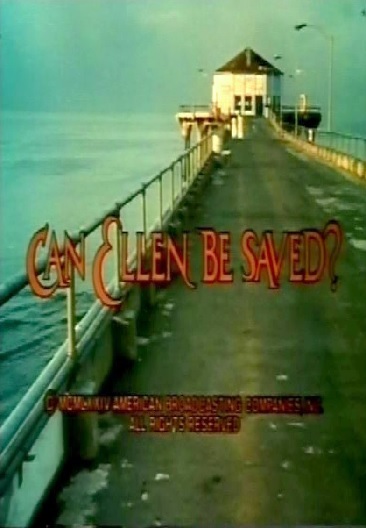
Retro Television Reviews: Can Ellen Be Saved (dir by Harvey Hart)


Welcome to Retro Television Reviews, a feature where we review some of our favorite and least favorite shows of the past!  On Sundays, I will be reviewing the made-for-television movies that used to be a primetime mainstay.  Today’s film is 1974’s Can Ellen Be Saved!  It  can be viewed on YouTube!

Ellen Lindsey (Katharine Cannon) is an intelligent but depressed teenager who feels that she just doesn’t belong anywhere in the world.  She’s not interested in the money and class-obsessed lifestyle of her parents, Arnold (Leslie Nielsen, back in his serious actor days) and Bea (Louise Fletcher).  At the same time, she’s also not interested in the silly lives of her friends, who spend all of their time chasing boys and talking about celebrities.  Ellen is looking for something deeper and she thinks that she may have found it when she attends a religious retreat led by a charismatic man named Joseph (Michaele Parks).

Everyone at the retreat is very friendly and very dedicated and very concerned with finding more to life than just surface pleasures.  They spend hours listening to sermons.  They spend even longer singing hymns.  The leaders of the retreat emphasize that anyone can leave whenever they want but, if they do, they’ll still be making the biggest mistake of their life.  Ellen is happy because she’s finally found a group of friends who seem to feel the same way that she does about society and materialism.  Joseph is happy because he’s brainwashed another member of his cult who he can now send out to panhandle for him and the compound.

Arnold and Bea are not happy when Ellen runs away to join Joseph’s commune.  When Arnold visits the commune, he discovers a secretive world where outsiders are not welcome.  He also discover that Ellen no longer seems to be capable of thinking for herself.  With the police unwilling to help, Arnold and Bea turn to an enigmatic deprogrammer named James Hallbeck (John Saxon).  Hallbeck specializes in grabbing kids that have joined cults and bringing them back to their parents.  Of course, it’s hard not to notice that neither Joseph nor Arnold seems to be giving much thought to what Ellen actually wants from her life.

Can Ellen Be Saved? is a well-made TV movie that has a lot in common with later films like Split Image and Ticket To Heaven.  As in both those movies, the first half of the film details how cults initially brainwash their members while the second half deals with the sometimes harsh process of reversing that brainwashing.  And, just as in those two later films, Can Ellen Be Saved? features parents who mistakenly assume that their child can be returned to them exactly as she was before.  Though all three of the films feature cults that are definitely sinister, they also feature main characters who were lost before they joined the cult and all three of them end on an ambiguous note, leaving us to wonder if the characters have regained their free will or if they’ve just traded one brainwashing for another.

Along with being a well-written and well-acted film, Can Ellen Be Saved features one of those once-in-a-lifetime casts.  Popping up in small roles are familiar faces like William Katt, Rutanya Alda, and Kathleen Quinlan.  Michael Parks and John Saxon are both convincing as two morally ambiguous characters whose own motives are left enigmatic.  Katherine Cannon is sympathetic as Ellen, whose need to be a part of something leaves her vulnerable to manipulation.  Finally, it must be said that Leslie Nielsen — despite his reputation for having been a dull dramatic actor — is actually very effective as Ellen’s confused but well-meaning father.  Usually, when I watch Neilsen in a dramatic film, I find myself expecting him to wink at the camera or deliver a silly line in a deliberately flat and unemotional tone.  But, in this film, I actually forgot I was watching Leslie Nielsen.  Instead, he just become a suburban dad, trying to understand why his daughter was so dissatisfied with the life that he had worked so hard to give her.

I wasn’t expecting much from Can Ellen Be Saved? but it turned out to be surprisingly effective.

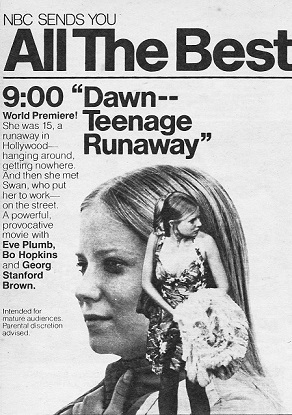
Retro Television Reviews: Dawn: Portrait of a Teenage Runaway (dir by Randal Kleiser)


Welcome to Retro Television Reviews, a feature where we review some of our favorite and least favorite shows of the past!  On Sundays, I will be reviewing the made-for-television movies that used to be a primetime mainstay.  Today’s film is 1976’s Dawn: Portrait of a Teenage Runaway!  It  can be viewed on YouTube!

Dawn Wetherby (Eve Plumb) is fifteen years old.  She’s naive.  She’s innocent.  She’s …. well, let’s just be honest and admit that she’s not particularly bright.  Sick of being embarrassed by her alcoholic mom (Lynn Carlin), Dawn decides to hop on a bus and travel to Hollywood.  Maybe she can make a new life for herself in California.

Of course, it doesn’t take long for Dawn to discover that Los Angeles is not a city where dreams magically come true.  It’s a tough and harsh town and it’s not like Dawn has any money or any particular skills.  When she tries to get a job, she’s told that she’s too young.  When she tries to rent a room, she’s told that ten dollars is not enough to cover two weeks rent.  When she gives a dollar to a boy who says that he needs it, he responds by mugging her for the rest of her cash.  A prostitute named Frankie Lee (Marguerite DeLain) takes some sympathy on Dawn and tells her to call if she ever wants to make some money.

Eventually, a nasty cough leads to Dawn going to the free clinic.  That’s where she meets Alexander (Leigh McCloskey).  Alexander is a teen runaway, just like Dawn.  However, Alexander also can somehow afford an apartment and food to eat.  Alexander invites Dawn to live with him and Dawn, realizing she has no where else to go, agrees.  Alexander offers to look after her but, after Dawn discovers that Alexander makes his money by working as a male prostitute, Dawn decides that she needs a job of her own.

It’s time to call Frankie Lee!  And it’s time for Frankie Lee to introduce Dawn to Swan (Bo Hopkins), a pimp who lives in a nice house and who offers to put Dawn to work….

Dawn: Portrait of a Teenage Runaway is an earnest film that was obviously made with the best of intentions and which actually did have something say, in its melodramatic way, about the dangers of running away from home and trying to make it on your own when you’re not even old enough to drive.  That said, I imagine that most people who go through the effort to track down this film will do so because it stars The Brady Bunch‘s Eve Plumb as an underage runway who ends up walking the streets and taking men back to her motel room.  The movie might as well be called Jan Brady Goes Bad, because Eve Plumb does essentially give the same performance that she gave when she was playing the whiniest member of the Brady Bunch.  There’s nothing tough or streetwise about her, which works for the first half of the film but not during the second half.  Once Dawn has been on the streets for a bit, you would expect her to toughen up a bit but she still comes across like she’s mad at Greg and Bobby for tying up the phone.  Dawn goes through a lot and becomes a bit jaded as a result but, every time she speaks, you expect her to exclaim, “Why does Marcia get to runaway from home but I don’t?  It’s not fair!”  Far more impressive are the performances of Bo Hopkins and, in the role of Dawn’s probation officer, George Stanford Brown.  William Schallert also has a good bit as Dawn’s first client, who ends up feeling so sorry for Dawn that he just give her twenty dollars and then tells her to go back home.

Dawn: Portrait of a Teenage Runway is one of those film that was obviously designed to make parents worry about their kids.  It seems to be asking, “Do you know where your children are tonight?”  In 1976, I imagine they were busy watching Jan Brady try to make it on the mean streets of Hollywood.

I Watched High & Outside: A Baseball Noir (2017, dir. by Evald Johnson)


Last night, my sister and I wanted to watch a movie.  Since she knows that I love baseball, she pulled up every movie on Tubi that had the word “baseball” in the title.  We nearly went with a sweet movie about a first baseman who promises his son that he will hit a home run every time he steps up to the plate.  I thought that sounded unrealistic so Lisa suggested we instead try High & Outside: A Baseball Noir.

High & Outside is not a terrible movie.  It is just relentlessly depressing and unpleasant.  Phil Harding (Phil Donlon) is a 35 year-old minor league player who still thinks he has a chance to make it to the major leagues.  His team manager (Ernie Hudson) fires him at the start of the movie.  Phil goes home and spends a day trying desperately to save his career and make some money, whether by selling drug or by becoming a coach.  Meanwhile, his poor father, Len (Geoffrey Lewis), is a former baseball great who has suffered from two strokes and who is making money signing baseball cards.  Facing the threat of being sent to a nursing home, he gives his championship rings to his nurse (David Proval) and sends him to the pawnshop to see what he can get for them.

That’s what the entire movie is like, just one scene after another of two helpless men watching as their lives fall apart.  Len was one of the greats but he spent so much time playing baseball that he neglected his wife and marriage.  Phil did the same thing but he was never great so no one will ever ask him to sign a baseball card.  I have no doubt that it’s an accurate portrayal of what happens to many athletes after their playing days are over but it is not pleasant to watch and it’s so dark and depressing that it gets boring and it feels pointless.  Phil was such a jerk that I didn’t care what happened to him.  The only really likable character was the nurse.

We should have picked the home run movie.

Film Review: Detective Knight: Independence (dir by Edward Drake)


The Detective Knight trilogy comes to a close with Detective Knight: Independence.

If you haven’t been keeping up with the wonderfully pulpy adventures of Detective James Knight, here’s a quick refresher of what happened last year.  First off, in Detective Knight: Rogue, Detective Knight (Bruce Willis) sought vengeance after his partner, Fitz (Lochlyn Munro), was seriously wounded during a robbery.  Fitz recovered but not before Knight has dispensed some vigilante justice of his own.  The surviving bad guys went to prison but sadly, so did Detective Knight.

Fortunately, Detective Knight was released from prison in Detective Knight: Redemption.  He was released because a cult of people who dressed up like Santa Claus and who chanted, “Ho!  Ho!  Ho!” while committing their crimes were terrifying the city.  With the help of Detective Knight, the police were able to stop the Santa Cult.

In Detective Knight: Independence, Knight is once again on the police force.  He and Fitz are still quick to shoot first and ask questions later.  That said, Knight is trying to make amends with his estranged wife and spend more time with his daughter.  That’s not going to be easy, though, because there’s a new threat in town …. just in time for the 4th of July!

Dezi (Jack Kilmer) is an EMT who has always dreamt of being a cop.  Unfortunately, he’s never been able to qualify for the force.  Even when he shows up at a cop bar and just tries to have a beer in peace, the bartender approaches him with a baseball bat and two detective toss him out of the place.  When Dezi is subsequently fired for refusing to give aid to a wounded man (the man in question was a bank robber and Detective Fitz actually told Dezi to go help a bleeding civilian in the bank and leave the robber to die), Dezi snaps.  First, Dezi steals a uniform, a badge, and a gun.  After dispensing some vigilante justice on some muggers, Dezi decides that he would like to rob a bank.  Yes, you read that correctly.  In just a matter of hours, Dezi goes from pretending to be a cop to pretending to be a criminal.  As the film progresses, it starts to become pretty clear why the police force didn’t want to hire this guy in the first place.

Unfortunately, for Dezi, his fellow EMT and occasional lover, Ally (Willow Shields), had a connection to Detective Knight and soon, Knight is on Dezi’s trail.  It all leads to a 4th of July confrontation on a baseball field.

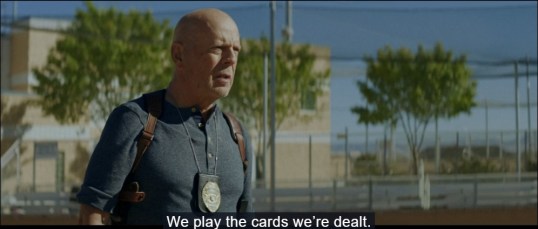
Even though Bruce Willis is playing the title character, he’s not present for much of Detective Knight: Independence.  As with the other two Detective Knight films, it’s obvious that Willis was only on set for a day or two.  While Willis is still a physically imposing actor, there’s none of the wise guy swagger that made Willis a star.  Instead, Detective Knight is a fairly grim character.  As always, it’s a bit difficult to watch Willis in films like this, especially with the knowledge of his recent health struggles.  That said, the Detective Knight films are definitely the best of Willis’s final films and, despite the limitations imposed by his health, Willis comes across well in them.  Considering that this is Willi’s final film, certain lines hit in a way that they otherwise might not.

As with the previous Detective Knight films, the majority of the screen time is given over to the man that the Detective is pursuing.  Jack Kilmer gives a strong performance as the unbalanced Dezi.  When he first appears, he’s almost a sympathetic character.  The cops were being bullies when they kicked him out of their bar.  His boss was being unreasonable when she announced that, rather than suspend him, she was just going to fire him because she didn’t like his attitude.  When Dezi first puts on his stolen badge and uniform, it’s hard not to sympathize with his happiness because he finally has what he wants.  But almost immediately, the power goes to his head and he loses control.  He becomes a frightening character but still, it’s hard not to feel sorry for him as he yells, “I’m not the bad guy!”  Of course, Dezi is the bad guy and the tragedy of his character is that he’ll never be able to understand why that is.

He’s right, you know.

For those of us who remember him in films like Die Hard, Pulp Fiction, and The Sixth Sense, late-era Bruce Willis films can be difficult to watch and I understand and respect why some people simply can’t bring themselves do it.  And, obviously, several of Willis’s later films do leave one feeling as if the actor has been exploited by filmmakers who cared less about his legacy and more about making money off of his name.  That said, the Detective Knight films do not feel exploitive, certainly not in the way that many of his 2022 films did.  Instead, the trilogy serves as a tribute to Willis and his status as one of the world’s most popular movie stars.  As pulpy as it may be, Detective Knight: Independence allows Bruce to go out on a good note.

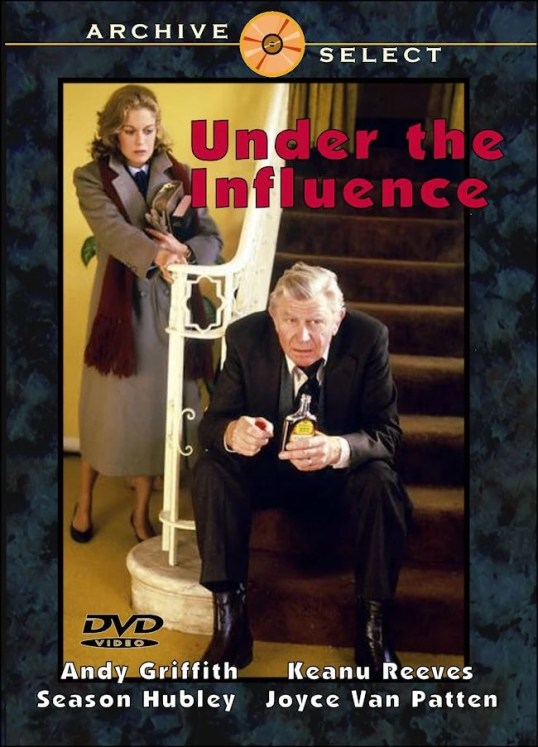
Retro Television Reviews: Under the Influence (Dir by Thomas Carter)


Welcome to Retro Television Reviews, a feature where we review some of our favorite and least favorite shows of the past!  On Sundays, I will be reviewing the made-for-television movies that used to be a primetime mainstay.  Today’s film is 1986’s Under the Influence!  It  can be viewed on YouTube!

Noah Talbot (Andy Griffith) is an upstanding member of the community.  He owns a hardware store.  He has a large family.  He’s known as a gruff but folky storyteller.  He’s a deacon in his church and helps to collect the offering every Sunday.

He’s also a drunk and a bit of a bully.  His family walks on eggshells around him, fearful of setting him off on one of his benders.  He occasionally spends the night in jail, arrested for trying to drive drunk.  Even when he gets bailed out, his first instinct is to go back to the bar.  The folks at the bar love him, don’t you know.  The people at the bar are always happy to see him and never bother him about whether he’s had too much.  The people at the bar never let him down the way that he feels his family has left him down.

The members of his family each cope in their own individual way.  Noah’s wife (Joyce Van Patten) is in denial and spends a lot of her time popping pills.  His oldest daughter, Ann (Season Hubley), is driven to succeed at work and spends all of her time both hating her father and desperately hoping for his approval.  (When she tells him that she got a raise at work, he berates her for only getting a 6% increase in her salary.  “That’s just a cost of living increase!” he snaps at her.)  His eldest son, Stephen (Paul Provenza), fled to Los Angeles and is trying to make a career as stand-up comedian.  (“You’re no David Letterman,” Noah tells him.)  His youngest daughter, Terri (Dana Anderson), secretly replaces Noah’s liquor with water and food-coloring.  And his youngest son, Eddie (Keanu Reeves), is becoming an alcoholic himself.

Having read all that, you may be wondering just how exactly Keanu Reeves could be the son of Andy Griffith and it’s a fair question.  This was one Keanu Reeves’s first acting roles and he does a pretty good job in the role of Eddie.  That said, he looks so totally different from both Andy Griffith and Joyce Van Patten and the actors playing his siblings that I was half-expecting someone to mention that Eddie had been adopted.  Then again, Paul Provenza doesn’t really bear much of a resemblance to the actors playing his parents either.  Dana Anderson and Season Hubley do, at least, look like sisters.

Lack of family-resemblance aside, all of the actors in Under the Influence do a good job of inhabiting their characters.  For those who are used to seeing Andy Griffith playing friendly Southerners in reruns of The Andy Griffith Show and Matlock, it’s shocking and a little disturbing to see him playing an abusive, alcoholic jerk in Under the Influence.  Noah is someone who would not only destroy his own family to get a drink but who would then blame them for it happening in the first place.  Noah may be under the influence of alcohol but the entire family is suffering because they’re under the influence of Noah.  By the time Noah is spitting up blood and demanding that his youngest son sneak liquor into his hospital room, the viewer knows there is no hope for Noah but hopefully, his family will escape.

It doesn’t make for a particularly happy movie but, speaking as someone who grew up in an alcoholic household, I can attest that it does make for an honest portrayal of what addiction does not just to the addict but also to the people around the addict.  I cringed in sympathy through nearly the entire film, especially as I watched three of the four children react in the same ways that I did.  (Unlike Eddie, I never became much of a drinker and instead developed an aversion to alcohol in general.)  It’s a film that feels real and one’s heart aches for the entire family.  If it could happen to Andy Griffith, it could happen to anyone.

Film Review: Purple Rain (dir by Albert Magnoli)


“Prince could actually act.”

That was my main reaction to watching the 1984 film, Purple Rain, a few nights ago.  Over the years, there have been a lot of music stars who have attempted to make the transition to acting.  Some have been more successful than others.  While some have stuck to playing versions of themselves, others have attempted to become actual character actors and the end results have often been mixed.  Being a strong stage performer does not neccesarily mean that person is automatically going to be a convincing film actor and the history of the movies is full of famous singers whose personality seemed to evaporate as soon as they had to act for the cameras and try to sound convincing while reciting dialogue.  Taylor Swift has built up a strong and incredibly loyal fanbase but you wouldn’t necessarily believe that she was one of the world’s biggest stars if you only knew her from her wan and bland performances in Cats and Amsterdam.  Indeed, while watching her in Amsterdam, it’s kind of hard not to be thankful when that car drives up and brings her performance to an end.

Prince, on the other hand, could truly act.

In Purple Rain, he plays The Kid.  The Kid is an enigmatic musician living in Minneapolis, Minnesota.  He’s the front man of a band called The Revolution and he sings songs that are, at times, almost disturbingly personal.  The Kid rides a purple motorcycle and he’s one of those musicians who is driven to record almost every sound that he hears.  (At one point, The Kid listens to a recording of an unidentified woman sobbing.  Who exactly the woman was or why she was crying are questions that are never answered, though I think it’s possible it was supposed to be the Kid’s mother.)  He performs to escape from the scars of his upbringing.  His father (Clarence Williams III), a failed musician, regularly beats his mother (Olga Karlatos, who memorably lost an eye in Lucio Fulci’s Zombi 2).  No one can deny The Kid’s talent but he’s also known for being a bit of a control freak and the other members of the Revolution sometimes feel that he’s not willing to give them the credit and opportunities that they deserve and….

Okay, obviously there are some similarities between The Kid and the man playing him.  Purple Rain was Prince’s first film and his first acting role and it makes sense that he would want to play a character in a situation that he was familiar with.  But that still doesn’t change the fact that Prince gives an excellent and charismatic performance in the lead role.  Unlike so many other singers-turned-actors, he doesn’t lose his spark when he has to remember his lines.  His presence doesn’t evaporate when the camera is turned on him.  Instead, if anything, Price feels even more natural off-stage than on.  Whether the Kid is being playful or serious, driven or defeated, Prince is never less than convincing.  Yes, the audience never forgets that they’re watching Prince.  But, at the same time, the Kid comes to life as an individual character with his own life and problems and personality separate of the actor who is playing him.

As for the film’s plot, it’s a fairly simple one.  The Revolution is one of three bands that hold down the house band slot at the First Avenue nightclub.  The Kid’s rival, Morris Day (played by Morris Day), plots to replace the Revolution by putting together an all-girl group called Apollonia Six.  Apollonia Six is led by Apollonia (Apollonia Kotero), who is the Kid’s girlfriend.  As Morris explains it, the Kid is too wrapped up in himself to help out Apollonia or the Revolution’s Wendy and Lisa.

And Morris Day has a point.  As soon as Apollonia tells the Kid that she’s going to be working with Morris, the Kid responds by striking her.  It’s a shocking scene but, as the film shows, it’s all the Kid learned at the hands of his father.  It’s only after a personal tragedy that the Kid starts to realize that he does not have to be just like his father.  That said, let us hope that the Kid invested in some therapy and some anger management courses after the end credits rolled.

As a character, the Kid would be unbearable if not for the strength and charm of Prince’s performance.  Prince is amazing when he performs on stage and the film’s soundtrack still holds up but what makes the film work are the moments when Prince shows us the Kid’s vulnerable side.  Self-loathing is not an easy feeling to play and it’s an even more difficult feeling to make sympathetic but Prince does both.  The Kid knows that he’s self-destructive and immature but he’s also sincere in his desire to be better than his past. The film leaves you to wonder if he’ll succeed.

Personally, I really hope he did.