Grant Morrison Channels His Inner Philip K. Dick In “Annihilator”


4226786-a1

You’re never gonna believe me when I say this given how mercilessly I’ve been shilling for the guy’s recent work, but — I’m honestly not the world’s biggest Grant Morrison fan. As is the case with out esteemed fellow TTSL scribe Arleigh, his work has always been very much a “hit-or-miss” affair with me, and while I loved The InvsiblesThe Filth, and his now-legendary runs on Animal Man and Doom Patrol, a lot of his more-celebrated efforts — such as his runs on JLANew X-Men, and even Batman — were decidedly “meh” affairs in my book, that certainly never veered into actively bad territory but were, nevertheless, largely unmemorable. They had their moments, of that there’s no doubt,  but I felt that they were too few and far between to really stand out all that much.

And we won’t even mention his flat-out offensive analysis of the super-hero phenomenon in general,  Supergods, which dubiously posited that Jerry Siegel and Joe Shuster were not, in fact, the creators of Superman, but merely the human vessels through which this timeless ideal that was floating around in the ether decided to express itself. Guess DC doesn’t owe either of them a dime, then, do they, Grant?

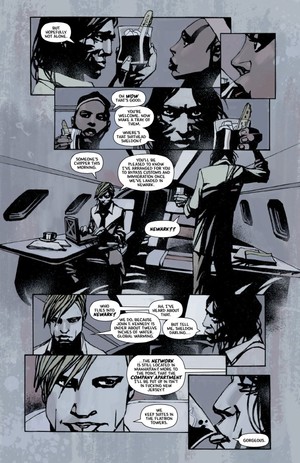
Still, I gotta call it like I see it, and despite the fact that I don’t have much reason to “root” for Morrison personally, it can’t be denied that he’s in the midst of arguably his strongest period as a creator right now, and I don’t say that simply because of the runaway artistic and commercial success that is The Multiversity (although that’s a big part of it, to be sure) — I also say it because, flying far underneath the the cover of hype generated by that blockbuster project (hype which I’m guilty of contributing to in my own small way with my glowing reviews for its last couple of issues),  there’s a little six-part series he’s doing with artist extraordinaire Frazer Irving for Legendary Comics called Annihilator that’s flat-out blowing the minds of the (apparently) few of us who are reading it.

4146792-img_0522

I’ve gotta be honest here — I have no idea why this book isn’t generating a more significant level of “buzz” than it’s managed to so far : maybe it’s because for all their Hollywood dollars and clout Legendary doesn’t seem to be putting much promotional muscle behind their comics line; maybe it’s because the subject matter of the series is too outre for all but the most hardened sci-fi fans to wrap their heads around; maybe it’s because neither of the main characters in the story are in any way “likable”; maybe it’s because The Multiversity is sucking all the oxygen out of the room when it comes to current Morrison work and there’s just not much energy left to heap praise on this title; or maybe it’s some combination of all those elements.

Whatever the case may be, though, it’s kind of a bummer, because four parts in it’s apparent that this is one of the most complex, challenging, interesting, and fun projects to come down the pipeline this year and would definitely be a shoo-in to be near the top of any “Top 10 Comics Of 2014” list I would cobble together if such rankings interested me in any way — which they don’t.

4226574-a+3

Think about it for a second : here we’ve got a veteran writer (ranked as the number two comics author of all time in the CBR poll that was just released earlier today — oh yeah, what was it I just said about not caring about “best of” lists again?) operating at the top of his game paired up with an up-and-coming “hot property” artist who’s doing career-defining work with this series and yet the whole thing seems to be going more or less unnoticed and is selling only a fraction of the number of copies each month of middling super-hero fare like, I dunno, Batwoman or Cyclops — both of which were recently cancelled by DC and Marvel, respectively, due to low sales. Something just ain’t right with this picture.

Well, never let it be said that I’m unwilling to get up on my soapbox and cheerlead for a comic that not enough people are paying attention to, because I’m here to tell you that if you like superbly-illustrated, high-concept, Philip K. Dick-style fuck-with-your-head science fiction, then you absolutely have to get caught up on Annihilator right now.

Here’s a brief rundown of the particulars just to whet your appetite : Ray Spass (pronounced “space”) is an asshole. A Hollwood screenwriter whose career trajectory is headed straight down, he hopes to get back on the “A List” with his new project, which is a script (called , you guessed it, “Annihilator”) about another asshole, a formerly-high-flying intergalatic criminal named Max Nomax who is imprisoned in orbit around the black hole ( named — wait for it — “The Annihilator”)  at the center of the Milky Way and is using his time there to try to bring the love of his life back from the dead.

You have to hand it to Max — he doesn’t think small. The problem is, he doesn’t know how his story ends, and in order to find out, he has to become real, and pay a visit to his writer.

The first three issues really cause the reader to question how much of this is really happening and how much is the result of fevered hallucinations brought on by an inoperable brain tumor that’s afflicting Ray, and while the fourth chapter goes some way toward resolving that question, it raises plenty of new ones at the same time, chief among them — okay, if this is real, and Max needs Ray to keep working on his script in order to lay out the course of his life for him, then how is it happening — and why?

4279184-a+4

Intrigued yet? I can assure you that my brief synopsis only skims the surface of all that’s happening here, and that this is a book that certainly rewards multiple re-reads as it goes about laying its foundation of carefully-constructed twists and turns. It’s hard to say at this just-beyond-mid-way point how many seemingly disparate elements will be woven into the final pattern that Morrison is knitting here and how many will turn out to be throwaway “red herrings,” but my money is on “everything here matters in some way, shape, or form, and not even the smallest detail will go to waste once it’s all said and done,” as each successive installment to date has proven to be a further measured layer of intricacies built upon what’s gone before. A picture that began as convoluted is coming into view more clearly as events progress, even if it’s still largely obscured and even if, as just mentioned, every answer has a tendency to elicit about a dozen new questions.

And yet for all that story awesome-ness, I’m still not prepared  to say whether or not the (admittedly superb) writing is the real “star” of the show here, though, so polished and expressive is Irving’s art. I’d kill for an original page or two — any original page or two — from this series, as they’re all flat-out breathtaking and of “suitable for framing” quality. If you’re a big time “art geek” like I am, prepare to spend a lot of time “ooh”ing and “aah” ing to the — no exaggeration — unfolding series of wonders on display here. Irving has gone from being a “guy to watch” to a “guy to follow” to a “guy others will no doubt try to imitate” over the short space of four months (oh yeah, did I mention that each issue so far has even managed to come out on time?),  and you might as well get used to his name, because you’re bound to be hearing it a lot in the years to come.

I think I’ve pretty well exhausted my supply of compliments and superlatives at this point, so — yeah. Annihilator. Get it. Now.

Oh, and tell your friends, too — it”s not too late to build some genuine momentum for this book as it steamrolls headlong toward what’s sure to be a memorable conclusion.

“The Multiversity : Thunderworld Adventures” #1 — Grant Morrison’s Love Letter To C.C. Beck


4285249-01

If there’s one criticism that’s been leveled at Grant Morrison — and British comics writers in general — over the years, it’s that their work, while admittedly literate and intelligent, is often too “dark” or “cynical.” I guess sometimes it does apply — I mean, The Invisibles and The Filth , to name just a couple of standout Morrison projects, weren’t exactly light-hearted, happy-go-lucky affairs, were they?

And yet — even those two comics, bleak and nihilistic as they could often be, ultimately had optimistic endings, didn’t they? And books like Animal Man and All-Star Superman were flat-out celebrations of the type of comic book storytelling that the “British invasion” of the 1980s supposedly put an end to (as a side note, Alan Moore gets called out onto the carpet for the “darkness” of his work a lot, as well,  yet the same guy who gave us From Hell also gave us the most majestic tribute to the Superman of old ever conceived with his downright mythic run on Supreme and years earlier gave us arguably the single-greatest Superman story of all, “Whatever Happened To The Man Of Tomorrow? ” — hell, even Watchmen had a more optimistic conclusion than most folks give it credit for). All in all, then, when it comes to Morrison’s career arc, it’s probably more fair to say that even when things do get “dark” and/or “dystopian” (anybody reading Annihilator right now? You really should be), it’s usually only a matter of time until we get to the light.

That’s why I was a bit confused over some of the hand-wringing that was going on prior to his much-anticipated Captain Marvel (or Shazam!, if you must) story for The Multiversity. People were openly questioning whether or not his “style” would be the right fit for the character. Whether or not he could “do it justice.” Whether or not he could “bring back that 1950s-style magic and innocence.”

Well, The Multiversity : Thunderworld Adventures #1 came out last Wednesday, and it’s fair to say that all those concerns have been silenced in the days since, because this is probably the most heartfelt, endearing, spot-on adventure for The Big Red Cheese since C.C. Beck chronicled his exploits for Fawcett publications.  No hyperbole, no bullshit — everything you were hoping this issue would be, it is.

blogger-image-1390298821

Off we go, then, to Earth-5, which is apparently where Captain Marvel (and I bet we don’t see him referred to by that name anytime again too soon)  as he ought to be — instead of the angst-ridden, more “realistic” version of him we’ve been subjected to in the “New 52” universe — still exists, along with the rest of the Marvel family, and still does battle with the likes of Black Adam, Mr. Mind, The Monster Society Of Evil, and the villain of this story, Dr. Sivana, who has created a doppleganger “Sivana Family” and added an eighth day to the week, thanks to time and power siphoned away from other realities in the Multiverse.

That “cynicism” people were fretting about? It’s nowhere to be found here, as this is pure Beck-style storytelling all the way : imaginative, character-driven, idealistic, and action-packed. Heck, Morrison even gets the little touches right, such as when he gives us the first appearance in forever and a day of the non-super-powered Uncle Marvel, and continues the tradition of him pretending to have powers and everybody else knowing he doesn’t but humoring him anyway. There’s not a note missed, not a beat skipped. This is a majestic old-school comic book adventure that doesn’t even feel so much like an homage as it does a direct continuation of a story abandoned over 50 years ago (you know, when DC sued Fawcett right out of business for their flagship character’s “similarity” to Superman — then bought up his rights for a pittance).

It may flirt with overkill sometimes, I suppose, but even after two readings I remain more than happy to put that tiny concern aside, simply because there’s nothing in the least bit “post-ironic” — much less ironic — about what Morrison is doing here. Every page, every panel, every word bubble — it’s all coming from the heart, without any sort of “knowing wink at the audience” to be had. Much as I liked All-Star Superman, it still had elements of a 12-part funeral dirge to it, a “last story of this type that’s ever going to be told” vibe. There’s none of that on display here, even if we probably won’t see a comic quite like this one — at least from DC — again in our lifetimes.

BhmVPtcCMAAzdn-

It also represents a 180-degree turn from the more nihilistic — but every bit as well-executed — tone taken with this series’ last “one-shot” issue, the magnificently rich and complex Pax Americana, yet while  the two stories couldn’t be further apart in terms of style, this one is just  as compelling  that modern masterwork despite being infinitely “simpler” and more straightforward. The two issues coming out back-to-back as they have certainly highlights the diversity of Morrison’s writing ability, of course, but also the diversity inherent in The Multiversity project itself — a series where, truly, any story can be told in any given month. We hear that said — usually in hype generated by the publishers — about lots of comics, I suppose, but in this case, it’s proving to be absolutely true, and while Thunderworld Adventures does, in fact, make a few more concessions to the overall narrative connecting all of these disparate books than Pax Americana did, rest assured that it can still be read as a “stand-alone” story just fine.

About the only concession made here to the kind of “mind-fuckery” our guy Grant likes to engage in is a trippy double-page splash (one that’s so awesome to behold that I can’t bring myself to “spoil” it by including a preview image here, sorry) that doesn’t make much rational “sense” but certainly fits in with the overall tone of the proceedings very nicely indeed. Apart from that, though, all else in the world of Billy Batson and his magically-powered alter ego is more or less exactly as you remembered — maybe even better,

Speaking of the art — Cameron Stewart, who provides both pencils and inks for this issue, is a guy I’ve never considered to be anything other than a competent journeyman artist, providing good, but hardly memorable, work for a number of titles over the years, including several projects with Morrison like Seaguy and Batman And Robin (he’s currently the regular penciler on DC’s recently-revamped Batgirl monthly series), but damn if this isn’t the comic he was born to draw. Just look at that panel reproduced above showing a car smashing into Captain Marvel for a prime example of the dynamic and impactful sensibility he brings to the table here. I get the feeling that he spent several months working on this book, and if he didn’t — well, shit, then I guess I’m even more impressed, because none of the trademarks of a “rush job” are apparent here in any way. This is bold, breathtaking stuff that has me reconsidering his entire body of work in a whole new light. You might even say that he’s unleashed his inner super-hero here.

And the colors — man oh man, the colors! It’s hard to believe this is the same Nathan Fairbairn who gave us the more muted tones of Pax Americana as everything here is bright, vibrant, eye-catching, and just plain sunny. Earth-5 literally looks like a place where it never rains. Just have a look at the triumphant panel the story ends on here and you’ll see exactly what I mean —

tumblr_inline_ngqsxpiyfM1qaj97u

That, right there, is why most of us who fell in love with the comics medium as kids did so, isn’t it? Even if these characters were a bit “before our time” for most of us, it was the spirit of idealistic adventure that drew us in and that we all wish we’d see more of these days. In my headline for this review I called Thunderworld Adventures Morrison’s “love letter to C.C. Beck” (it’s worth noting that Alan Moore has pointed to Beck as being his primary storytelling influence on Supreme, as well), and while that’s undoubtedly true, there’s actually more to it than that — it’s a love letter to youth, optimism, idealism, and a kind of non-ironic goodness that’s in far too short a supply both in modern comics and , crucially, modern life. It’s a celebration of all that we can be, and sometimes are — when we’re willing to be the heroes of our own adventures.

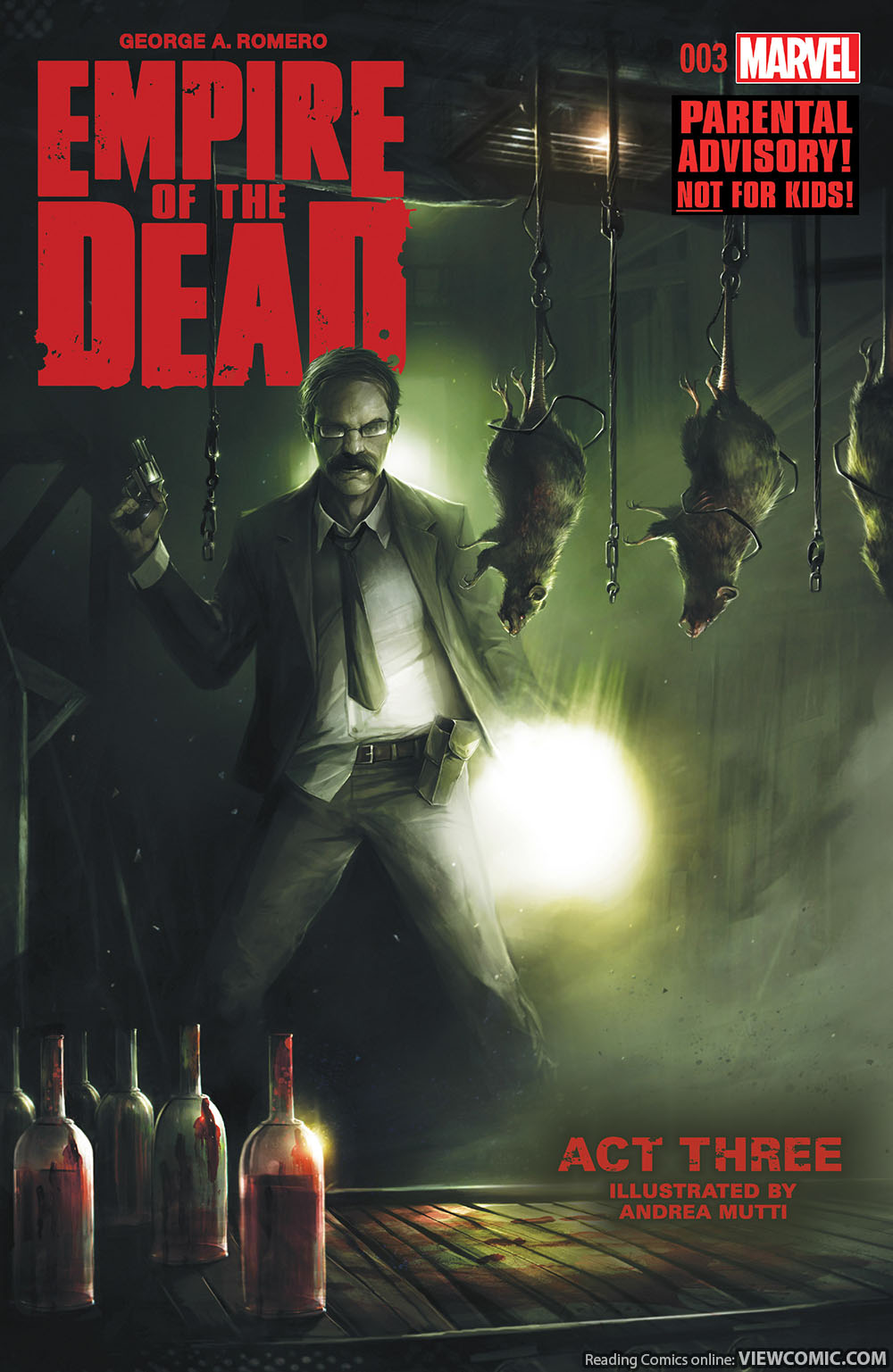
George Romero Finally Picks Out His Hero In “Empire Of The Dead : Act Two” #4


4265326-04

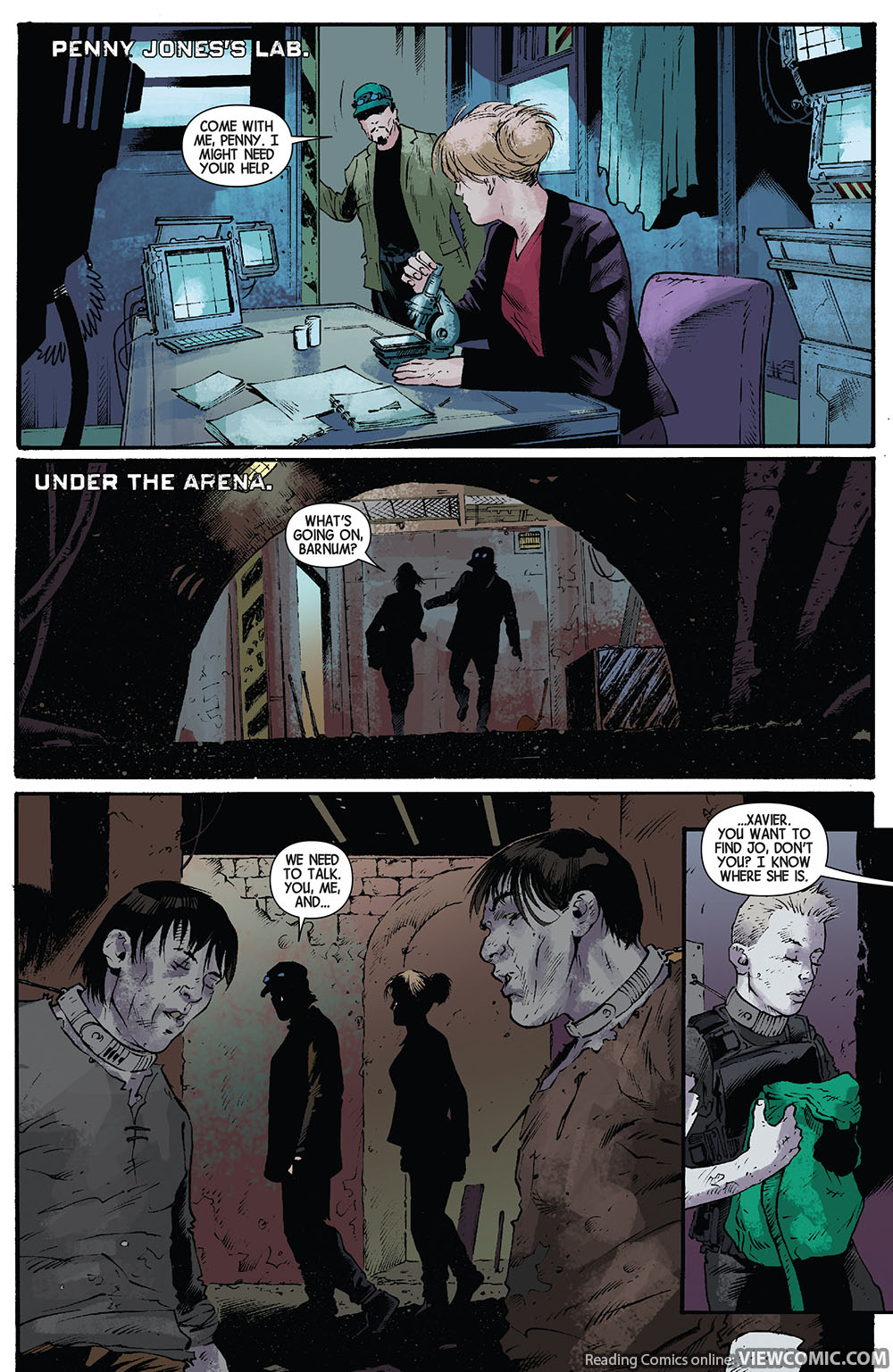
Is it just me, or has the second act of George Romero’s Empire Of The Dead positively flown right by? I mean, here we are with only one issue left to go, and it feels like it was just the other day that the series started up again after the conclusion of the hiatus that followed its first arc. I have no doubt the book lost a fair amount of readers during the break — in fact, like most comics it probably lost a good half of its initial readership right after the first issue — but for those of us who’ve stuck with this thing, the payoff in the form of a big “fireworks” finale does seem to be approaching, albeit slowly. Remember, if all goes according to plan we’ve still got two more five-part acts to go following next month’s wrap-up of the current one, but there seems to be a steady flow to the story that’s been established here in the second chapter that wasn’t there in the first, with its sometimes-fitful starts and stops.

All that being said, though, it’s not like that better overall narrative hasn’t come at a price. George Romero’s Empire Of The Dead Act Two has been plagued with some seriously forced and unnatural dialogue at times — a flaw more apparent than ever in this fourth issue since Romero seems to have fallen back on dropping a whole lot of “—“s into his sentences in order to impart them with some cheap n’ easy pseudo-gravitas, and hey, I’m not ashamed to admit that I still miss Alex Maleev’s art, despite the continued improvement of Dalibor Talajic as he’s grown more comfortable and confident with horror-themed material (the addition of Rick Magyar on inks beginning with issue 3 also helped, as he’s given the imagery a darker, more subdued tone, a trend that I’m pleased to say continues this month).

The biggest qualm that many of us readers have, though, is that eight issues into this sprawling zombie saga, we still don’t know — or didn’t know, at any rate, since that seems about to change — who the hero of the story is supposed to be. There are various points of identification that the average reader can clearly see with a number of the characters, sure, but no clear-cut “good guy,” a la Ben in Night Of The Living Dead, has stepped forward.

And that’s where the often-neglected “zombie wrangler” Paul Barnum enters the picture here. There have been a number of issues where he’s been given precious little — if anything — to do, but now that the “love triangle” between himself, Dr. Penny Jones, and Mayor Chandrake seems to be evaporating — with no one in a position to “get the girl” (and that’s all that I’ll be saying about that due to the internet’s penchant for breeding self-appointed “spoiler police” around every digital corner) — our guy Paul seems to be out to bring the whole vampire cabal running post-zombie-apocalypse New York down. Mess with the girl he’s sweet on, and you’ve messed with him, I guess.

The only other significant story developments in this issue focus on the machinations to replace Chandrake with Chilly Dobbs now that nephew Billy is out of the way and the oncoming aerial-and-land assault being planned for the city by the militaristic forces using Dixie Peach and her southern hell-raisers as their ostensible (and quickly disposable, should the need arise) front. A common theme in both of these plot threads — which do, in fact, intersect in the pages of the comic itself and not just thematically — is that the devil we don’t know is often worse than the one we do, and that “leaders” of various movements — whether in the halls of government or out on the streets — are perfectly interchangeable pawns in the hands of the power brokers who really pull the strings, so that seems to be where Romero is aiming his always-present social commentary in his latest zombie epic.

All in all, then, shaky dialogue and an uncharacteristically impressionistic (and not, I might add, succesfully impressionistic) cover from the otherwise-reliable-to-this-point Alexander Lozano aside, issue four of Empire Of The Dead Act Two is an intriguing piece that Romero has moved into position on his grand chessboard. The focus of the story is tightening, events are coalescing with a kind of subtle yet undeniable force, and I think we’re headed for a bang-up conclusion to the second arc in 30 days or so.

“Crossed + One Hundred” #1 : Zombie Apocalypse, Alan Moore-Style


4253003-01

Who are we kidding? Of course I was gonna pick this book up — despite having no previous experience with, or knowledge of, the Crossed  “universe” — because, hey, it’s a new six-part Alan Moore series, and while there are very few creators who can “sell me” on a new title based on their involvement alone, Moore is (and frankly always will be) one of them. Still, for those (like myself) who need a brief history of the basic premise here before diving in, here goes —

4253978-01-oldcountrycgc

Crossed is veteran comics writer Garth Ennis’ take on the zombie apocalypse. No one knows what caused it. The zombies are called “the crossed.” To date there have been several mini series set in this world, each featuring a different cast of characters. They’ve all been published by Avatar Press. That’s it.

4253982-01-futuretense

A threadbare setup? Sure. But that has its advantages — namely, other creators can jump in and provide their own unique take on the proceedings, and to date, many have (most notably David Lapham and Simon Spurrier). Now it’s Moore’s turn, and what’s not to be over-the-moon thrilled about? Rich, detailed, amazingly-well-realized speculative worlds have always been his stock in trade, going all the way back to Halo Jones, and with Crossed + One Hundred he’s taking us, as the title would imply, a century into the future after the dead got up and started walking around. The cast of characters is entirely new for this series, and if you’ve never read any Crossed comics before this,  you’ll do just fine.  So get it! Now, let me tell you why —

4253984-01-crossedculture

In truth, the aforementioned Halo Jones is a pretty apt comparison for what’s apparently going on here as a whole, since our protagonist, one Future Taylor, is a young lady trying to make her way in a world that both she, and we, don’t fully understand — and, as with Halo, Moore has created an entirely unique, dense-but-eminently-decipherable dialect for his characters to speak in. It may take one read-through or so to fully get your head around the various terms used, all of which have evolved from where our language is at right now, but that’s part of the fun here. For those who struggled with the first chapter of Moore’s prose novel, Voice Of The Fire, rest assured, this is nothing like that, and really, you’re not going to have too much difficulty figuring out what folks are saying.

4253980-01-boxsetleather

Okay, so, with all of that out of the way, then — how’s the story? And the art?

I’m pleased to report both are astonishingly good. Moore has given us a rag-tag group of survivors, living in a converted steam train, that are immediately fascinating and complex. Ms. Taylor, our entry point into this great unknown, is the band’s “archivist,” a sort of scavenger of lost knowledge and information, and most of the action in this initial chapter takes place in an abandoned library that our intrepid nomads come upon. Through Future’s (an interesting thing to note here is how all the youthful characters have optimistic names) journal entries and her interactions with others we come to see her, in no time flat, as a strong-willed, inquisitive, multi-faceted woman who hopefully has what it takes to survive, and possibly even thrive, in this hostile world. There’s a lot of talk about “strong female characters” in various media this days, and within the space of about six pages Future Taylor puts the likes of Katniss Everdeen (or however you spell that) to shame by being a living, breathing, realistic person who just happens to have been born in a  time, and under a set of circumstances, that have caused human civilization to go down, to put it in the mildest possible terms, an unexpected path.

4253981-01-newworldbagged

As for  for the other inhabitants of this perhaps-dystopian-and-perhaps-not makeshift “society” — knowledge and learning are at a premium here, since everyone knows so little of how they came to be in the world got to be in its current state and there’s no centralized education system (or, for that matter, centralized anything) left. I get the feeling that Moore intends to use this situation as a spring-board for exploring some of his well-known anarchist ideals, but we’ll see — I hate to predict any sort of plot trajectory with any degree of certainty when it comes to The Bearded One because his capacity to completely surprise us is so firmly established.

One thing he also firmly establishes here, though, is an overwhelming sense of dread. I mean, dread so thick you can cut it with a knife. Future and her cohorts only have the briefest of encounters with The Crossed in this first issue, and survive these skirmishes with relative ease, but there’s nothing but unease hanging over them from page one to page 24. It definitely takes skill to wring that much tension out of nearly-thin air, and if there’s one thing Crossed + One Hundred excels at right out of the gate it’s in imbuing its readers with a sense of confidence that they’re in mightily capable creative hands. Moore knows exactly where he’s going with this story, it’s just us readers — and his characters — who are in the dark. That makes for some page-turning excitement no matter how much — or even how little — is going on.

4253985-01-amhistory

The art for this series is being handled by Gabriel Andrade, who has worked on a handful of other projects for Avatar in recent years, and  he does a really fine job here. His people look like — well, people — his monsters look suitably monstrous, and while there’s nothing particularly “flashy” about his style, his eye for detail is very welcome here as it takes more than words alone to bring a fully-fleshed-out alternate reality to life. Plus, he provided all eight of this first issue’s variant covers, so that speaks well of his ability to do a quality job even with the heaviest of workloads — I’m therefore reasonably optimistic that all six issues of this series will be coming out on time, and will manage to do so without looking half-assed or rushed.

4253979-01-designsketch

Are you excited yet, friends? I sure hope so — and I know I am. The zombie apocalypse is certainly thoroughly -charted territory by now as far as genre premises go, but if anyone can breathe some new life into it and challenge, if not entirely overturn, our preconceived notions about what such a scenario would necessarily entail, it’s Moore and Andrade. These guys are bringing their “A game” and are flat-out eager to show us something new and entirely unexpected. This promises to be not just the Crossed story to beat all Crossed stories, but a seminal tale in the history of “zombie fiction” as a whole. The next four weeks can’t pass quickly enough, I’m completely hooked and counting down the days to the second issue.


“Shaft” #1 Brings Blaxploitation Bad-Ass To The Printed Page


4252960-01a

Right off the bat, I should probably apologize for the misleading headline here — Dynamite Entertainment’s Shaft #1 (the first of a six-part series) isn’t “bringing blaxploitation bad-ass to the printed page” so much as it’s bringing it back to the printed page, given that “the black private dick that’s a sex machine to all the chicks” actually started out life not on the silver screen, but in a series of pulp novels by the legendary Ernest Tidyman. And it’s probably down to the fact that Tidyman’s widow owns the copyright to the character of John Shaft that we even have this new spin-off comic at all, seeing as how negotiating a licensing rights deal with her is probably a lot easier than dealing with, say, MGM. Even so — am I the only one who’s surprised that this comic even exists?

I mean, when I think of licensed properties making the leap to the four-color world, I think Star WarsStar TrekBattlestar Galactica. Heck, this week Boom! Studios even released the first issue of a new Escape From New York ongoing monthly, and that didn’t exactly come out of left field in my estimation, but this? A comic based on a cult blaxploitation hero who “peaked” about 40 years ago in terms of his popularity? I gotta say, I didn’t see that one coming at all.

4253652-01b

Still, I’m glad it’s here, and in the hands of writer David F.Walker and artist Bilquis Evely, Tidyman can rest easy in his grave — they seem to know what they’re doing every bit as much as Gordon Parks and Richard Roundtree did when they translated the urban adventures of “the cat who won’t cop out when there’s danger all about” onto celluloid. Is this a good comic? Damn right.

Walker (who’s also penning a six-part Shaft prose story available by scanning QR codes included in the printed versions of each of the comics) has opted to go the “prequel” route here, taking us back to 1968 when a newly-returned-from -Vietnam John Shaft is trying to make a go of it an as Brooklyn-based amateur boxer. We learn a lot about our main character’s backstory here — certainly more than we ever did in the film — and I have to say that all the revelations we’re served ring very true indeed to the Shaft we’ve always known, while somehow being at least modestly surprising at the same time. The fact that Walker is able to convey all this info with a sparse and breezy prose style is an added plus, and while the main through-line of the plot is a pretty simple one — Shaft is ordered to throw a fight, what’s he gonna do about it? — that doesn’t mean the impact of our guy John’s decision, predictable as it may be, has any less of an impact on readers. He’s headed for big trouble, and I’m looking forward to it already.  This first issue is pure table-setting, to be sure, but where’s the harm in that? Set the table nicely enough and I’ll want to stick around for the meal.

4253651-01c

The art from Evely, whose prior work I confess to being unfamiliar with, can also be fairly categorized as “not flashy, but certainly effective.” It’s pretty simple and straightforward, but displays a kind of professionalism and eye for craft that were more common in the comics of 1971 — the year that Shaft hit theaters — than they are today. It suits the subject and time period quite well and invests the  reader in the proceedings rather than alienating you with so much of the unskilled “flashier” art we find in, say, the average DC “New 52” comic. The panels in this book  look good without sacrificing realism and plausibility along the way, and  are more concerned with drawing you in than bowling you over. All in all, a job very well done.

4253650-01d

As with pretty much all Dynamite first issues, Shaft #1 has hit the stands with about a bajillion different variant covers. I’ve included my four favorites with this review (by Denys Cowan and Bill Sienkiewicz, Francesco Francavilla, Michael Avon Oeming, and Ulises Farinas, respectively), and while they all portray a more Richard Roundtree-looking Shaft than Evely does in his interior pages (well, except for the one by Farinas, since that’s not Shaft at all, but the bad guy of the story), you really can’t argue with the awesome-ness of any of them. I opted for the Francavilla cover since I always opt for Francavilla covers, but I was sorely tempted by the main Cowan/Sienkiewicz one, as well. Any way you go, though, you can’t lose — either with what’s on the outside of the book or what’s in it. This is the John Shaft we’ve always known, but shown in a whole new light that I think almost all fans will appreciate.


“The Multiversity : Pax Americana” #1 Is The Comic Of The Year — No Question


MULTIVERSITY-Cv4-05

Understand — it’s not like me to make grandiose pronouncements like “such-and-such is the movie of the year,” “such-and-such is the comic of the year,” etc. It’s pretty damn hard to pinpoint something as being the best offering in any given medium when one person, obviously, can’t see or read everything that’s out there — and it’s probably doubly stupid to engage in such hyperbole before the year is even over.

And yet — that’s exactly what I’m doing right here, and with full confidence. That’s because the latest issue of Grant Morrison’s The Multiversity has no chance of being topped, barring a miracle of some sort. It’s just. That. Fucking. Good.

1-1

For those not familiar with the basic premise of what’s going on with The Multiversity, it’s an eight-issue mini-series from DC written by Morrison and illustrated by a bevy of the industry’s top talents — in this case,  his frequent collaborator Frank Quitely, who absolutely outdoes himself here. Yeah, okay, all his stuff’s awesome to behold, but his work  on Pax Americana leaves even his much-celebrated turns on Flex MentalloBatman And Robin, and All-Star Superman so far behind in the dust it’s not even funny. Just look at that spectacular page reproduced above and you’ll know that not only is Quitely rendering images here with amazing detail and care, he’s also pushing the boundaries of the comics page in terms of how narrative structure flows visually. I haven’t seen an artist on a “Big Two” project tell a story this hermetically sealed, with its own unique and perfectly logical, yet also expressive and evocative,  language since Dave Gibbons created the singular look and feel of the Watchmen “universe” nearly 30 years ago.

And hey, it’s no coincidence that we bring up Watchmen here since Pax Americana has been referred to, more than once, as “Morrison’s Watchmen,” and for good reason.  Each self-contained issue of The Multiveristy takes place on one of DC’s “parallel Earths,” with a slowly-unfolding, meta-fictional, ” comic within a comic” premise (nothing new for our guy Grant there, he’s been busting the fourth wall ever since his days on Animal Man) binding them all together in ways not fully understood yet given that we’re only halfway through the series, and this time out we’re on Earth-4, the Earth populated by the Charlton comics “Action Heroes” that DC acquired in the early ’80s and that Alan Moore famously first intended to utilize as his principal characters in he and Gibbons’ seminal work.  Morrison famously hates Watchmen, and takes every available opportunity to say so, and so the “intrigue factor” here is pretty high in terms of comics fans wanting to see how he’d handle essentially the same characters.

MCPAX-SMP-2

I say “essentially the same” because, of course, Moore and Gibbons weren’t allowed to use the Charlton characters in the end, and so quick stand-ins were devised — The Question became Rorschach, Blue Beetle became Nite Owl, Nightshade became Silk Spectre, Peter Cannon, Thunderbolt became Ozymandias, Peacemaker became The Comedian, and Captain Atom became Dr. Manhattan. DC had “other plans” (most of which amounted to a hill of beans) for the “real” characters at the time, but in the “New 52” universe they’ve all been shelved indefinitely and so Morrison is free to use the original versions here — with the exception of Peter Cannon, whose copyright has reverted back to his creator, Pete Morisi.

The Watchmen similarities don’t end with the principal characters the story is based around, though — Pax Americana also employs a tight, dense story structure that plays around freely with timelines and often employs mirror images of the same scene told from multiple perspectives, such as in the astonishing two-page spread above. Rest assured, it all makes perfect sense, but odds are you won’t catch it all on the first reading unless you’re, I dunno, Stephen Hawking or something.

1447_multiversity_pax_americana_1_splash

And that’s part of the joy of a book like this, isn’t it? Make no mistake — if you’re not willing to invest a few hours, at least, of your time (not to mention $4.99 of your hard-earned money) into what Morrison and Quitely (along with colorist supreme Nathan Fairbairn, who imbues the world of Earth-4 with a distinctive palette all its own) have created here, you’re short-changing yourself, because this is a story that reveals more and more about itself with each successive re-read. As you continue to peruse its contents you’ll be able to glean which instances are integral to a full understanding of the complex proceedings and which are just clever structural gimmicks employed by the author to impress you, but it wouldn’t be a good mystery story — and Pax Americana is, in fact, a great mystery story, centered around the most consequential murder any society can endure, that of its leader — without a few red herrings being thrown into the mix. Heck, Morrison even takes a fun, albeit admittedly cheap, shot at his arch-enemy, Mark Millar, by deftly deconstructing the most pivotal sequence of Wanted and essentially copying it note-for-note while turning it on its ear at the same time, and has a bit of fun at the expense of the scene with Sally and Laurie Jupiet/Juspeczyk in Watchmen #2, as well. Gratuitous? Sure, but it works.

The other ballsy move Morrison makes here is in asking the same fundamental question with his story that Moore and Gibbons did with Watchmen in terms of when is it right to sacrifice the few for the (supposed) good of the many, who “gets” to make that call, and how do they arrive at their decision? Granted, it’s a weighty theme that can’t be grappled with as comprehensively in one 40-page comic as it can in 12 separate 30-page comics, but I give him credit for essentially finding a way to tell multiple (hmmmm — a multiversity?) of stories here at once, given that there’s more going on in this one issue than most comics with a standard “A to Z” linear narrative manage to pack into a year’s worth of their pages, and by utilizing the same characters (again, essentially) that Watchmen used to deal with the same (again, essentially) themes and concepts, Morrison and Quitely aren’t so much aping Moore and Gibbons as they are answering them.

None of which is to say that Pax Americana is going to make people forget about Watchmen any time soon. Or even that it’s “as good” as Watchmen. Again, it’s much shorter, for one thing — but it’s certainly as intricate, arguably even moreso, certainly as demanding, and in the end, certainly as revelatory, at least for those with the patience to give it the detailed attention it both deserves and rewards (as an added plus, you needn’t even be invested in the other Multiversity comics to get on board with this one, it reads just fine on its own).

The comic of the year? Yeah, I can say that pretty easily — even though there’s a bunch of other stuff I haven’t read, and the year’s not over yet.

Palace Intrigue Is The Order Of The Day In “Empire Of The Dead : Act Two” #3


4212100-03

Remember that famous scene in The Godfather where Michael Corleone is having his henchmen settle all The Family’s old scores while he attends his infant son’s baptism? George Romero clearly does, because Empire Of The Dead Act Two #3 (or George Romero’s Empire Of The Dead Act Two #3 to be technically correct about things) is all about Mayor Chandrake — who’s front and center in Alexander Lozano’s stunning cover, as shown above — eliminating all threats to his leadership of both New York City and the secret vampire cabal for whose benefit the entire town is run. He’s ruthless, determined and, unlike Michael Corleone, not afraid to get his own hands dirty in the process.

The bloodbath is precipitated, as you might guess, by a visit from the cops — not Chandrake’s own loyal “security” personnel, but actual, rank-and-file NYPD detectives. Apparently, he doesn’t own them all yet, and one newcomer to the story, a certain Buckie Perez, seems to be the post-zombie apocalypse’s answer to Jim Gordon in that he can’t be bought, bullied, or otherwise strong-armed into toeing the mayor’s line. Between a true “good cop” snooping around, the seeming political ascendancy of his nephew, Billy, and the pesky presence of an “unauthorized” victim of vampirism still resting semi-comfortably in the hospital, then,  there are a lot of loose ends to tie up.

The problem is — one of the above-mentioned targets survives their attempted assassination, and there’s still that missing dirigible from a New Jersey warehouse to be accounted for.

Outside Chandrake’s desperate and homicidal machinations, though — which do lead to some interesting, if overly-expository in terms of how they’re handled, revelations (for instance, there are actually a lot fewer vampires than we’d previously been steered into assuming) — some other notable plot developments  do take place here, particularly in The Arena, where the void left by the loss of super-fighter Zanzibar ends up being filled by  — zombies who have actually learned to team up and work together? Trainer/wrangler Paul Barnum sees this, reluctantly, as a positive — but only for the time being, since he knows what it means if the same behavior patterns begin to emerge on the streets.

As for the cliffhanger, it’s a doozy — mistakenly believing that all his problems are solved, Chandrake pays a visit to his latest muse, Dr. Penny Jones, in her newly-equipped-to-the-hilt lab, and let’s just say that she might finally be getting close enough to the fire to be irrevocably burned.

All in all, then, a reasonably solid issue story-wise with one addition to the creative team worth mentioning in the form of the arrival of inker Rick Magyar, who seems to stay fairly true to Dalibor Talajic’s pencil line in that not a whole lot of stylistic difference can be discerned between this and the previous two installments, which Talajic inked himself, apart from an overall “darker” look owing to Magyar leaning a bit more heavily on his brush, so to speak, which suits both the material itself, as well as the mood it creates, quite nicely. A solid effort from all concerned, then,  that has me very much looking forward to next month.

“The Kitchen” #1 : If You Can’t Stand The Heat — Well, You Know


4212079-01

So it appears that one of the sites I’ve done a fair amount of writing for, geekyuniverse.com, has shuttered its digital doors.Furthermore, it looks as if they sold their domain name off to something called “Swagger Magazine,” whatever that is, and did all of  this without informing any of us contributors that it was happening. Am I pissed? I guess I wasn’t at first, but now I sort of am, simply because all that content I posted on there, much of which was pretty good (even if I do only say so myself), is now lost forever, and because, going by sheer numbers alone, my stuff was far and away the most popular material on the site. Seriously, most of the posts on there were lucky to generate a half-dozen “likes” and one or two faceboook and twitter “shares,” while my articles routinely got a couple hundred of each. Does that mean I think my stuff was “better” than the work of the site’s other contributors? I dunno. I guess that’s all a matter of taste. I’d invite you to compare all of our work and decide for yourself, but — it’s all gone. And somebody made a little bit of money — probably not much, but something — selling off a site that was built by the work of folks who submitted work to it for free. Pretty goddamn sleazy, really.

Anyway, I’ve tried to get an explanation as to why it all went away without explanation, but the (now former) owners of the site haven’t responded to either my tweets or my emails, so I guess all I can do it call ’em out on their bullshit here and let them know that I’m not impressed. Don’t spend that two or three hundred bucks you made in one place.

Still, what the hell does any of this have to do with Through The Shattered Lens? Well, it means — for better or worse — that I’ll have a little bit more time to contribute to this site for the next couple of months, until my super-big-project-that-I-can’t-talk-about-yet eats up all my time for a little while, and that I’ll have more time for this site again once said super-big-project-that-I-can’t-talk-about-yet is finished. It also means that my quick-fire comic book reviews — as opposed to the lengthy, detailed, serialized pieces I do for the more “academic” comic website sequart.org — are in need of a new home with the demise of GU, so you’re getting ’em here.

I figure, hey, why not? Nobody else here “talks comics” very regularly, and I know a certain number of readers (and writers) here are fans of the medium, so, for the time being at an rate, I’ll “park” my comic book review work here unless and until Arleigh or Lisa Marie or somebody tells me to take it somewhere else. Which they won’t because they’re good people who like to indulge me — right?

4212404-01-variant

With all that preamble shit out of the way, then, let’s talk about The Kitchen #1, shall we? It’s a new eight-part creator-owned mini-series from DC’s venerable “mature readers” imprint, Vertigo, and it stands out for not only being a book centered on non-spandex-clad female characters, but for boasting a nearly-all-female creative team — except for, ya know, the writer.

Described in Vertigo’s press materials as a “talented newcomer,” author/co-creator Ollie Masters provides the only whiff of testosterone here, with the project’s artist/co-creator being the talented Ming Doyle, fresh off her run on the critically-lauded Image series Mara (which was written by apparent serial-sexual-harasser Brian Wood), the colorist being the highly-sought-after Jordie Bellaire, and covers coming our way courtesy of current “hot property” artist Becky Cloonan (except for the variant for this first issue, pictured above, which is from Doyle’s own mind and hand).

With a crew like that in place, then, you can be sure that the finished product is gonna look good — and it does. Doyle evokes the 1970s Hell’s Kitchen settings perfectly, and her characters look like real human beings of the sort you’d see at the time. Everything from the home furnishings to the cars to the street scenes to the facial expressions are all wonderfully authentic and yet also smoothly expressionistic, with everyone looking like a real, actual individual rather than a curvy superheroine who just happens to be wearing street clothes. The seventies were a wonderfully “run down” time in New York — long before Times Square and other “red light districts” got gobbled up by Disney — and the titular Kitchen was especially run down, even by then-contemporary standards. You feel every bit of that oozing, semi-intoxicating unwholesome-ness in Doyle’s art and Bellaire”s suitably drab, realistic colors.

So, then, what of the story? I’m unfamiliar with Masters’ other work — assuming he has any to his credit — but he acquits himself very nicely here. The premise goes that local loan shark/”protection” racket strongman Jimmy Brennan, a semi-connected guy in the Irish mob, has been sent away, along with two of his crew, for beating the shit out of some snitch right in plain sight of the cops, and in his absence, his brother, Jack, is letting things slide to the point that Jimmy’s wife, Kath, and her friends, Angie and Raven (who are married to the two other guys that got shipped upstate along with their boss), are finding the weekly takes from local businesses that the rely on to maintain their “lifestyles” are getting lighter and lighter all the time. Not content to let this state of affairs continue, and unable to rely om Jack to straighten it out, they decide to take matters into their own hands. Problem is, their primary target, a pizza shop owner, turns out to be a lot more than just another dime-a-dozen welcher, and “sending a message” by going after him on their first night out may prove to be a fatal mistake —

First issues can be a little bit of a tricky business because you’ve gotta introduce most, if not all, of your principal cast, give them each a semi-distinct personality, and establish the basic “through-line” of your plot, all while leaving things on nice little cliffhanger that will have your readers coming back for more. Masters manages to do all that and furthermore, he does so without ever making it feel like he’s going into overly-heavy “info-dump” mode. All in all, it’s a job very well done.

Combine great art and color (and covers) with a reasonably good, involving story, stick it between two covers, and keep the price — thankfully! — at $2.99, and you have to say that The Kitchen is definitely following a recipe for success.

Stand Back For A George Romero Info-Dump In “Empire Of The Dead : Act Two” #2


4143654-02

If you’ll recall, the second issue is when the wheels fell off a bit in act one of George Romero’s Empire Of The Dead Marvel Comics series, and it really took about another whole issue after that for the story to find its footing again.  I’m pleased to say the pattern doesn’t repeat itself here in the second story arc, but truth be told this book does have some rather hefty problems, and we’ll get to those in just a minute.

First, though, I gotta say my hat is off to Alexander Lozano for that kick-ass cover shown above. Sure, the painting of a zombie wearing what appears to be a pretty expensive watch and hurling a molotov cocktail — with the fire not doing jack shit to him, by the look of it — has nothing to do with the interior contents whatsoever, but it sure is cool-looking. Maybe my favorite cover yet, which is just as well since it’s the only one, with this issue being the first in the series to go out without any variants.I was kinda hoping that Francesco Francavilla, who did the variant last month, would stick around for a bit, but I’m not surprised that Marvel has finally scaled back to just one cover for this title, since — let’s face it — sales aren’t all that great, and it would be pretty unusual for them to keep doing two covers month in and month out on any book, much less one like this where most folks seem to be waiting for the trades rather than picking it up in singles, anyway.

What can I say, though? I’m fully aware that it’s not the economical way to go, but when I know there’s a Romero fix to be had, I need it quick, and by and large this series has been one that reads pretty well in individual installments, so I’ll keep going like I have been with it — even though, as I said before, this particular issue does have some problems.

So, hey,  let’s talk about those, shall we? It’s been hinted for some time that the vampires in the “Romeroverse” operate by a different set of rules (yes, folks, we’ve got “Romero Rules” for vampires) than we’re accustomed to, and with the main focus of the story this time around being on the patient being treated by Dr. Penny Jones who’s been bitten and, in equal portion, a young prostitute named Sarah who’s undergoing “the change” voluntarily, those rules are finally spelled out explicitly. It’s interesting reading and all, don’t get me wrong, but it’s more than a bit clunky, and doesn’t exactly flow with the rest of the proceedings. It’s more like an almost-overly-expository side-step than anything else, and there probably could — and should — have been a way to get all this information across by dint of actions taking place within the main body of the plot itself. This is stuff we need to know, without question, but we don’t need it to be spoon-fed to us this clumsily.

And speaking of clumsy — the aforementioned Dr. Jones and “zombie wrangler” Paul Barnum appear to finally be making some romantic headway this time out, but their not-quite-love scene is almost painfully awkward and clunky to read. Sorry, George, but people just don’t talk that way.

Those quibbles aside, though, there is definitely plenty to like in George Romero’s Empire Of The Dead : Act Two  #2, including the further rapid “humanization” of SWAT-officer-turned-zombie Xavier, a more complete layout of the plan to sell out Billy Chandrake and still bring down his uncle’s reign as mayor at the same time (and yeah, this part admittedly gets pretty heavily expository as well, but at least it reads better), and the emergence of a new champion in the “slaughterbowl” ring at the expense of a character who’s been with us since the beginning. All in all, then, some fairly interesting and significant plot developments do take place here, but be prepared for some complete breaks in the action that send us down info-dump avenue along the way.

On the art front, Dalibor Talajic seems to be growing into the job and I like his work here a lot better than I did last month, but damn — I still miss Alex Maleev. Talajic’s style is just fine for the conversational, “wordy” scenes, but when it comes to the bloodier zombie carnage we all love, he’s still got a ways to go to even come close to the heights his distinguished predecessor achieved. Here’s hoping he gets there at some point.

As for the ending this time around, well — that confused me, I admit. Last issue got us all good and primed for the aerial blimp assault on New York from the forces formerly aligned with southern rebel-rouser Dixie Peach, and this time they go into action — but apparently they’ve decided to stage a trial raid on Secaucus, New Jersey first. Don’t ask me what that’s all about. Hopefully next issue will reveal the method behind this particular bout of madness, because right now it just plain doesn’t make any sense. This is a series that has rewarded its reader’s patience on a few occasions before, though, so I’m optimistic that trend will continue.

George Romero Picks Up Where He Left Off With “Empire Of The Dead : Act Two” #1 — But What About Everyone Else?


4087873-01

I’ll admit that it brands as being in a tiny minority, but George A. Romero’s Empire Of The Dead  is my favorite ongoing zombie story right now. I’ve long since given up hope for The Walking Dead as both a TV series — blasphemy to some around these parts, I know — and a monthly comic,  with Kirkman and his cohorts long having since lost the plot, in my view, in both of that franchise’s iterations, but good ol’ George, after stumbling out of the gate a bit in Act One of this, his latest (and first printed-page) undead epic, really seems to be in the midst of getting a damn solid little tale going here, and I couldn’t be happier about it. Well, actually, I suppose I could 

For one thing, the second five-issue arc of what’s slated to be a 25-parter (bearing the official copyright title this time of George Romero’s Empire Of The Dead Act Two #1) starts off with some notable changes on the creative front. Gone is artist extraordinaire Alex Maleev, who towards the end of the first series was blowing some deadlines (not that his art wasn’t worth the wait, it most certainly was), and in is Dalibor Talajic, fresh from drawing two rather unremarkable Dexter min-series for Marvel (not that it was his fault — his illustrations were fine, but Jeff Lindsay really mailed it in on the script front, particularly in the atrocious second series,  Dexter Down Under, which is a bit of a shock given that he, ya know, created the character and everything), and who, like his predecessor, is tackling both the penciling and inking duties on the book. Talajic’s art is fine as far as these things go — and his style seems to have taken a healthy leap forward from that aforementioned Dexter work — but the change is still a jarring one, and overall the look of the series has changed from grim and gritty “naturalistic” horror to more standard-issue Marvel Comics “house style” renderings, so that’s kind of a drag. I knew the switch was coming, and it’s a little less violent than I’d feared, but — I dunno. No offense to Talajic, but I think that if bringing on a new artist was inevitable, a guy like Declan Shalvey, for instance, would have been a better fit.

Maleev’s off the cover assignment, too, but if the work of new cover artist Alexander Lozano is any indication, we’re in good hands on that front. Yeah, admittedly, the scene depicted on the cover shown above doesn’t actually happen in the book, but so what? It’s still got a classic “old-school horror comic” vibe to it and wouldn’t feel at all out of place adorning the front of an old Warren mag like Creepy  or Eerie. I liked it a lot, and I think most other readers will, as well.

There’s also been a change of artists for the variant covers, but again, this is no problem in my estimation. Yes, Arthur Suydam’s “NYC” cover series was a blast, but when you’ve got Francesco Francavilla stepping up to the plate in his absence, well — who’s complaining? This guy has been one of my favorite cover artists for years now (have you seen the incredible work he’s been doing on Dynamite’s new Twilight Zone comic?), and my only gripe about his alternate cover for this issue (as shown below) is that my LCS didn’t get a single copy of it, otherwise you can bet that I would’ve snapped it up pronto.

4088277-01-variant

On the story front, I’m pleased to report that Romero is continuing the steady roll he’s been on since the fourth issue of Act One which is when, for my money, things really started kicking into another gear. As with most first issues (although whether or not this can actually be considered a “first” issue is debatable, I suppose), we’re in “pure set-up” mode here, but the payoffs to the various storylines that are running look like they’re going to be big, provided the father of the entire modern zombie revival doesn’t drop the ball. Semi-intelligent “walker” (whoops, wrong comic) Xavier seems to be making a quantum leap forward in becoming “civilized” under the tutelage of Dr. Penny Jones, and has formed a real emotional bond with her wayward young friend (whose name, in case you’d forgotten — as I admit I had — is Jo), and shares a secret with her that most likely will shake the entire series to its core. Dr. Jones, for her part, seems to be torn between responding to the romantic advances of the vampiric Mayor Chandrake and his head “zombie wrangler,” Paul Barnum, but rest assured there’s more to that situation than meets the eye — Barnum hints that he’s keeping a pretty big secret himself, and the Mayor, while not one to lose any sort of contest (and he drops some ominous threats to that very effect), may be forced to devote more of his attentions elsewhere, as the campaign to unseat him currently being waged by his nephew, Billy, seems to be gaining some traction. But is Billy really driving this train — or is he being set up for a spectacular “crash and burn” come-uppance?

And speaking of being set up — what of southern rebel-rouser Dixie Peach and her newly militarized entourage? A major development occurs in this issue that may end up marking her as  expendable to her own cause. I admit that the timelines attached to some of these various plot-threads do seem a bit garbled, and probably could’ve benefited from an eidotr who was paying somewhat closer attention ( the Xavier subplot seems to have advanced by several days, if not weeks, as has the mayoral race, while the subplot involving Dixie Peach and her no-longer-quite-allies seems to be picking up more or less right where it was left hanging in Act One), but if that all sounds intriguing to you — and trust me when I say it is — then put your reservations about the change behind this book’s drawing board aside, and queue up for the rest of Act Two, because it appears it could be quite a memorable ride.