The Covers of Adventures Into The Unknown


First published in 1948 by the American Comics Group, Adventures Into The Unknown was the first regularly published horror comic book and it’s success led several other comic book companies, most notably EC Comics, to start publishing horror comics of their own.  Because Adventures Into The Unknown‘s content was never as explicit as some of the comics that it inspired, Adventures became one of the few horror comics to survive the anti-comic book moral panic that erupted in 1954.  Unlike Tales From The Crypt and The Vault of Horror, Adventures Into The Unknown continued to be published after the creation of the Comic Book Code.  In total, it enjoyed a 20-year run of 174 issues.

Below are some of the many covers of Adventures Into The Unknown.  As you can tell, the covers went from emphasizing horror to emphasizing science fiction and adventure after the creation of the Comic Book Code.

Enter The Vault of Horror


by Johnny Craig

Along with The Haunt of Fear and Tales From The Crypt, The Vault of Horror was a horror anthology comic book that was published, from 1950 to 1955, by EC Comics.  Hosted by The Vault-Keeper, The Vault of Horror featured adaptations of classic horror stories along with totally original tales of terror and fright.  The Vault of Horror was so popular among young readers that eventually a psychiatrist named Fredric Wertham claimed that it, along with other comics, was responsible for juvenile delinquency and every other social ill facing 1950s America.  Congress investigated and, because of all the bad publicity, EC canceled all of their horror titles.

However, the jokes on Wertham and Congress because The Vault of Horror is now eagerly sought after by collectors and is viewed as a high point in comic book history.  Below are a few covers from The Vault of Horror, all done by artist Johnny Craig.

Are you read to enter the Vault?


Great Moments In Comic Book History: “Even in Death…”


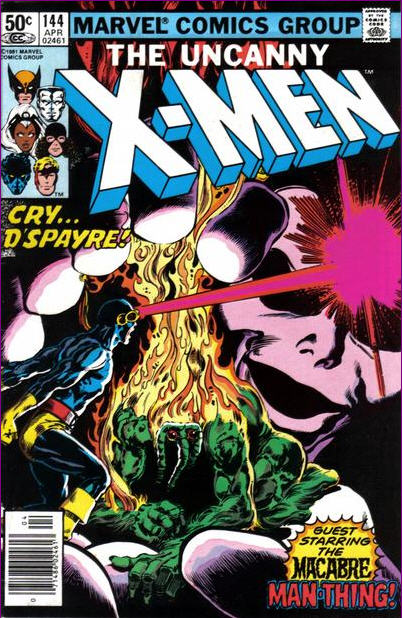
The Uncanny X-Men #144 finds Scott Summers (better known as Cyclops, the occasional leader of the X-Men) working on a fishing boat in the Florida Everglades.  Scott’s new boss, Lee Forrester, is obviously interested in him but Scott is still mourning Jean Grey.  It’s been months since Jean, consumed by the Dark Phoenix, chose to protect the universe by destroying herself.  Scott has taken a leave of absence from the X-Men to grieve and, as they used to say back in the day, find himself.

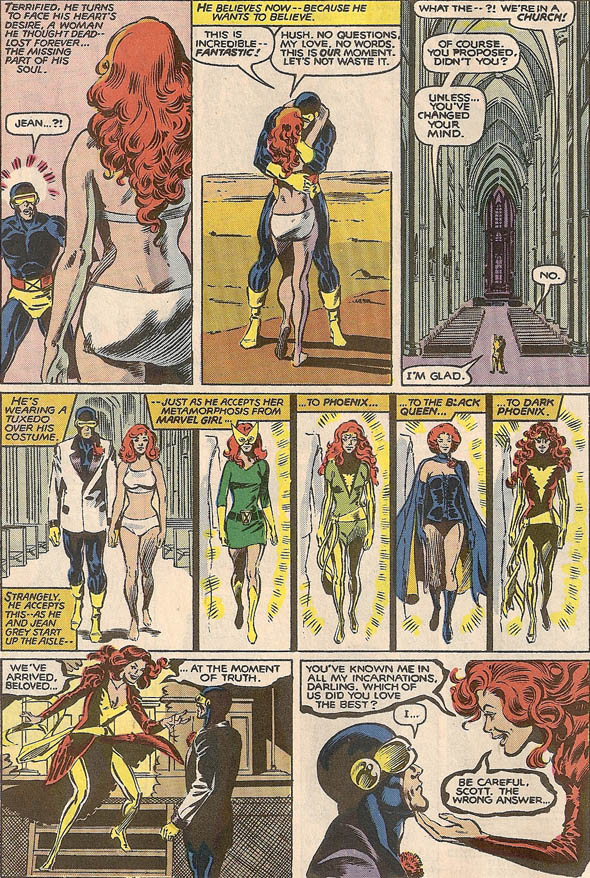
When the fear-inducing demon D’Spayre shows up, it not only drives Lee’s father to suicide but it also forces Scott to deal with his deepest fears.  Scott hallucinates the plane crash that led to him and his brother being separated from their parents.  He visualizes the X-Men dead, having been killed by Sentinels.  And finally, in the issue’s most famous scene, he finds himself walking down a church aisle with Jean.

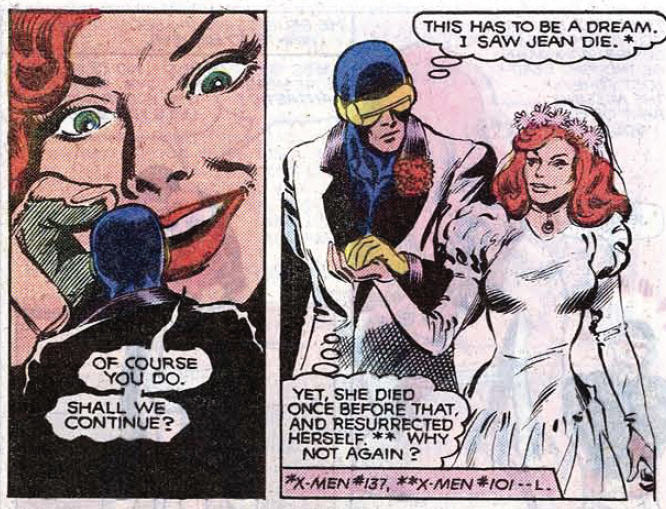
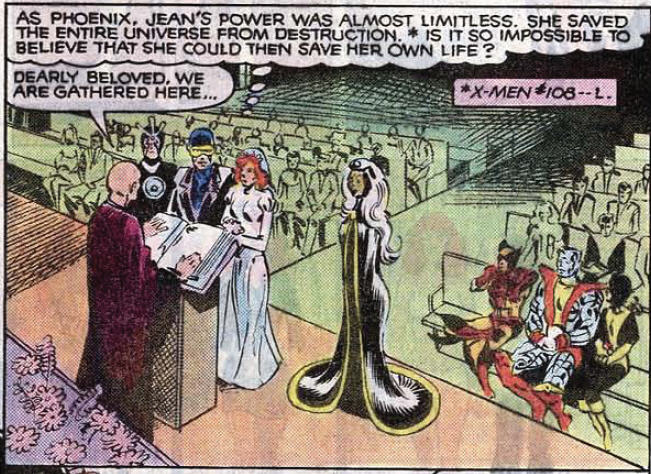
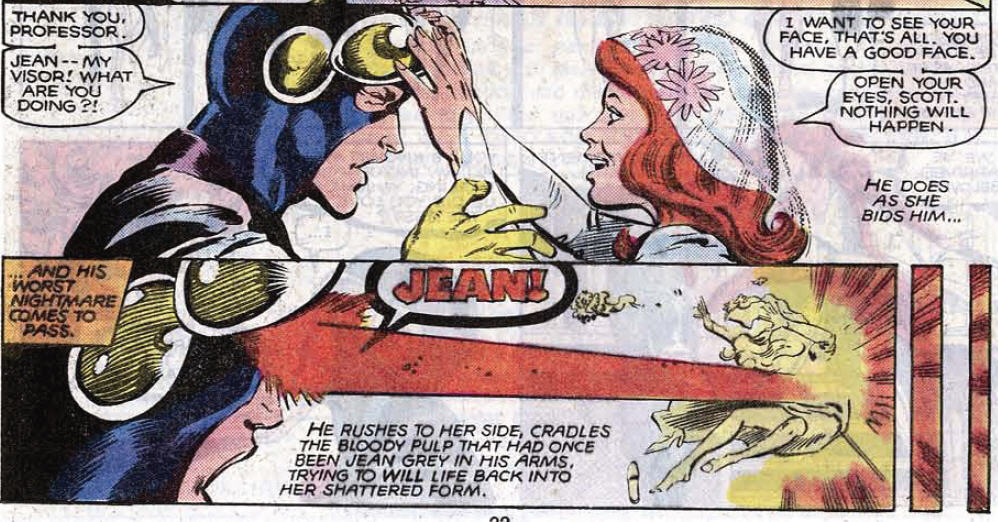
As they walk down the aisle, Jean’s costume changes to reflect all of the different roles that she played as member of the X-Men.  She goes from being in her underwear to being in her green Ms. Marvel costume to being the Phoenix to being the Hellfire Club’s Black Queen to finally being the Dark Phoenix.  When they reach the minister, Jean is dressed as a bride.  When the minister tells Scott that he may kiss the bride, Jean suddenly reaches up and lifts Scott’s visor.  A blast a red energy brings the wedding to an abrupt end.

Eventually, Scott teams up with the Man-Thing (who is Marvel’s version of Swamp Thing) and is able to easily defeat D’Spayre.  Since all you have to do to make D’Spayre go away is refuse to believe what he’s showing you, he is not one of Marvel’s most intimidating villains.  Still, Scott’s church hallucination provides not only a perfect coda for the Dark Phoenix saga but it also shows a comic book character dealing with depression.  That’s an emotion that, until Chris Claremont started writing the X-Men, super heroes rarely had to deal with for more than an issue or two.  Even Spider-Man, with all of his problems and guilt, always kept his sense of humor.  This issue of the X-Men finds Scott deeply mired in his grief.  Even after Scott defeats D’Spayre, the sadness remains but he swears to himself that will not surrender to it.

Of course, the impact of this issue is lessened by the fact that Marvel would later reveal that the Dark Phoenix who sacrificed herself was just an energy force that took on Jean’s memories and personality while the real Jean remained in suspended animation at the bottom of Jamaica Bay.  X-Men #144 is still a good issue and a good example of Chris Claremont’s ability to bring out the humanity in even those with super powers.

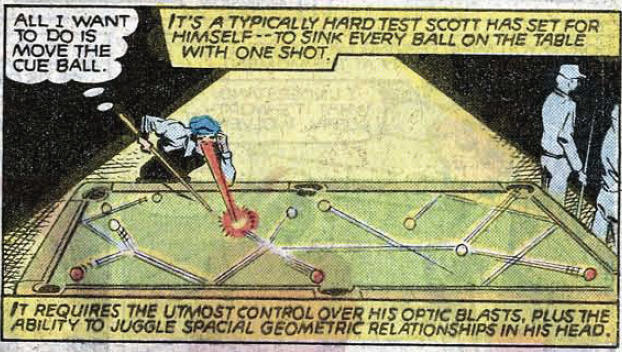
Plus, we learn how Cyclops plays pool

The Uncanny X-Men #144 (April, 1981)

“Even in Death”

  • Writer: Chris Claremont
  • Guest Penciler: Brent Anderson
  • Inker: Josef Rubenstein
  • Letterer: Tom Orzechowski
  • Colorist: Glynis Wein
  • Editor: Louise Jones
  • Editor-in-Chief: Jim Shooter

Previous Great Moments In Comic Book History:

  1. Winchester Before Winchester: Swamp Thing Vol. 2 #45 “Ghost Dance” 
  2. The Avengers Appear on David Letterman
  3. Crisis on Campus

The Ghastly Covers of The Haunt Of Fear


The Haunt of Fear was a bi-monthly horror anthology comic that was published by EC Comics, from 1950 to 1954.  Like its sister publication, Tales From The Crypt, The Haunt of Fear featured stories and artwork that were considered to be so controversial and so dangerous that Congress took it upon itself to investigate.  Despite the fact that The Haunt of Fear was one of their most popular titles, EC Comics canceled the series as a result of the bad publicity.

Despite only lasting 28 issues, The Haunt of Fear remains a favorite of collectors and has been cited as an influence by a countless number of horror writers and filmmakers.  Below are a few of the covers of the The Haunt of Fear, all of which were done by the artist Graham Ingels (who simply signed his work as “Ghastly.”)  Remember that these covers were responsible for juvenile delinquency in the 50s so look at them at your own risk.

Here are the ghastly covers of The Haunt of Fear:

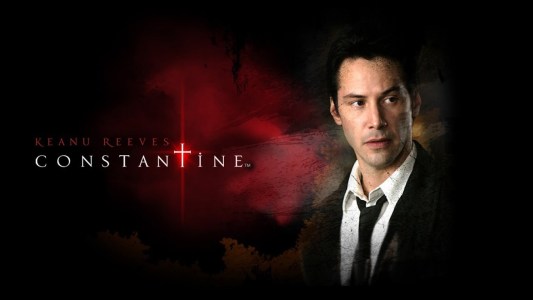
Constantine, Review by Case Wright


CONS.jpg

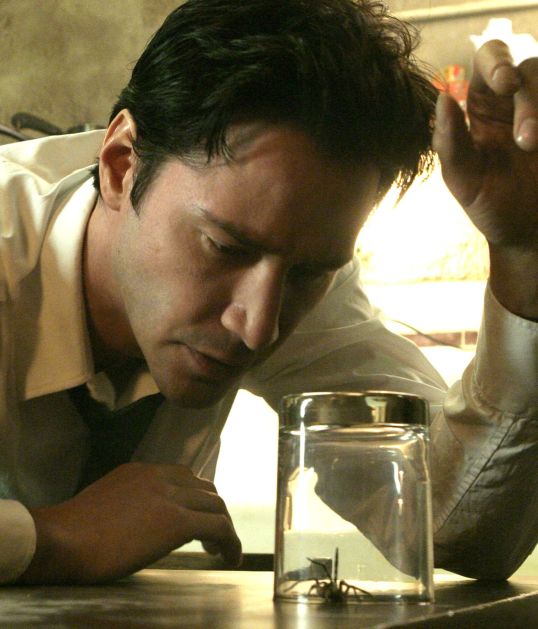
Can one act stain your soul for all eternity? It turns out that if you attempt suicide, you’re going to Hell.  Anywho, Constantine was a comic by Alan Moore (Watchmen) long before Keanu Reeves played the demon fighter.  Full disclosure, I have purchased, but not read the comic. It’s long and I’m not sure if I can get through it for this horrorthon, but I WILL TRY!

Constantine was born with a “gift” that he could see demons among us.  This drives him out of his mind; so, he commits suicide and is sent promptly to Hell. He’s tormented for what seems like an eternity, but in our time was just two minutes. He returns to Earth because paramedics revive him.  Because he attempted to kill himself, he’s condemned to Hell when he dies.  How do I know this?The “Half-Angel” Gabriel tells it to us in really clunky exposition.  It turns out that Heaven and Hell are basically in a Cold War and can’t directly fight on Earth.

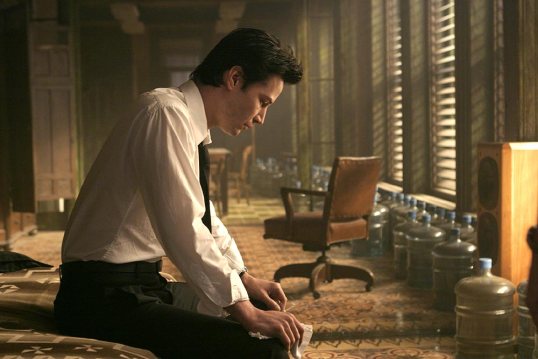
Constantine REALLY doesn’t want to go back to Hell.  His solution is to fight demons for a living to get into heaven. He does an exorcism here and there and fights evil, but this isn’t his ticket back to heaven- as I was told by MORE exposition.  Constantine is kind of a depressive and a little whiny at times.  I guess that’s why I kept getting annoyed by him.  Yeah, Yeah, your life sucks, but there’s no reason to do this all the time:

CON2.jpg

There’s a lot of these “I’m so broody Boohoo” moments in this film.

Like this one: broody 3.jpg

This one was a long trip to bummer time with a soupçon of anger:

broody 2.jpg

Between the complaining, Constantine uncovers a plot that Lucifer’s son Mammon is trying to break into earth and cause a lot of trouble.  Trouble….Trouble….that starts with M …. and ends with N, which stands for Mammon!

Constantine was entertaining, but it seems kinda all over the place at times.  The parts that had him hot on the trail of Mammon and his evil plans were fun, but all the side plots and side characters were a mixture of goofy and dull.  Overall, it was a good burgers and fries flick.  Not to say that the comics or the cartoon (yep, there’s a cartoon, I know because of Google) aren’t awesome, but if they are the same quality as the movie, they are beach reads or I’m stuck on public transportation reading.  There might be sequel.  Will I watch it? Yes, because despite my snark, I’m basically 14.


The Corrupting Covers of Tales From The Crypt


Published by EC Comics, Tales From The Crypt is one of the most fondly-remembered horror comics books of the 1950s.  The series actually began under the title International Comics and went through several other title changes before becoming Tales From The Crypt.  A horror anthology series that was hosted by The Crypt Keeper, The Vault Keeper, and the Old Witch, Tales From The Crypt ran from 1950 to 1955 and was so popular with young readers that a psychologist named Fredric Wertham claimed that reading the comic book could lead to juvenile delinquency and other deviant behavior.  The resulting moral panic led to a Congressional investigation and the adaptation of the Comic Book Code.  It also led to the cancellation of all of EC’s horror titles, including Tales From The Crypt.

In the decades since, issues of Tales From The Crypt have been highly sought after by collectors and the comic book even inspired a television show on HBO.  Below is a selection of the covers of Tales From The Crypt, the series that corrupted America’s youth.

It’s always interesting to see what used to be controversial.

Joker, Book Review, By Case Wright


IMG_1908

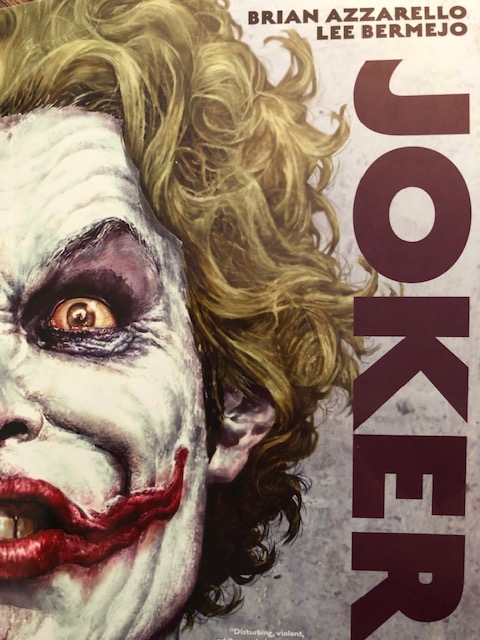
Happy Horrorthon! 2008 – Barack Obama was becoming a household name, I still had some hair, and Heath Ledger’s Joker brought the absolute evil of clowns to the silver screen.  I understand that some of you might think that the comic Joker is not a horror comic, but guys it’s got a clown right there on the cover; they are ALL trying to kill you. IT COUNTS!

Brian Azzarello and Lee Bermejo sought to bring Ledger’s Joker into a comic form and dig a little deeper into the psychology of Joker and why someone would follow him.  The story is narrated by Jonny Frost – a small time gangster- who wanted to be big.  Jonny figures that he himself is not larger than life, but by being near bright evil, he too could shine like the moon does with the earth.  He picks the Joker.

Christopher Nolan described the Joker as an absolute. He is an id of Corruption and destruction.  In this story, the Joker has gotten out of Arkham….again.  SIDE NOTE: what’s with Gotham?! They must have the single party liberal governing that we have in Seattle because you’d think they’d have a Three Strikes Rule or the Death Penalty by now.  I mean, why let the Joker continue to keep breathing? I get how Batman has this weird code- he wears rubber, cape, lives in a cave, and is all kinds of weirdo, but why do the rest of Gotham’s citizens have it? Do they not vote? Do they have only one ballot choice? So, the Joker meets Jonny Frost the second that he leaves Arkham and Jonny works as a toady and hanger on for the majority of the book.

Jonny narrates the Joker’s return to power as he reaps through the underworld, but he burns most of his possessions down and kills all of his own henchmen and even shoots Jonny at the end.  Really, the story depicted the Joker as a force of Anti-Creation.  While it was a deeper dive into this Super Villain, it left me wanting because it was told through the lens of this mediocrity Jonny Frost.  It says Joker right there on the cover so you’d think it would be all about the Clown Prince of Crime, but instead it was this tangential view of him.  I would’ve been more captivated by a story just about the Joker without a go-between.

The story was strong and depicting LOTS AND LOTS of gore.  In fact, the Joker kills more people than the Spanish Flu.  He’s Lucifer and Death combined to cause havoc.  In the end, we get the obvious conclusion that he’s just this disease of evil and that Batman is really just a treatment, but not a cure.  It seems that Gotham’s real disease is a soft on crime public policy.

Horror Review: Glyceride by Junji Ito


Junji Ito Glyceride

While Junji Ito’s work has been done both in long-series format and novella-style stand-alone, most of his work has been through short story collections which has been collected in tanboko collections. It’s with some of his short stories that themes really shine through despite their short length. He’s able to disturb unnerve, disgust and horrify a reader with a quick read than most horror writers and filmmakers have tried using much longer formats.

One such short tale is “Glyceride.”

“Glyceride” is chapter 5 of his collection of one-shot stories in the collection Yami no Koe (Voices in the Dark). It tells the tale of a girl named Yui whose family owns a barbecue restaurant (city or town never mentioned other than it has a clear view of Mt. Fuji) in town. The place is always dark, dirty and there’s a heavy atmosphere of grease permeating everything in the place.

It’s this sense of grease both literal and figuratively which creates that sense of otherworldly horror and uneasiness. Ito’s artwork makes one feel the very grease the tale’s protagonist speaks about to such a level that, at least for me, one would need to take a thorough shower once done.

While the story is quite brief it leaves a definite imprint on the reader. Below is the anime adaptation of the short story.

Titans S2Ep1, “Trigon”, Review by Case Wright (Dir. Carol Banker)


titans-1

Welcome back! This has been a hard year for me in terms of reviewing season two and three shows-

Sabrina 2- garbage

Stranger Things 3- Just so very sad.

And then there was Titans.  I was prepared for a sophomore slump like I had seen all year with my favorite shows and ….. it NEVER happened.  Season 2 Episode 1 was like a new pilot of my most beloved show.  It had family murder, a quasi Lucifer, and an introduction of Death Stroke, Bruce Wayne, a new Titans Headquarters, and a cure for male pattern baldness!

The episode picked up where it left off with Dick turned into an evil minion and the rest of the gang trying to help.  Hawk and Dove go to Jason Todd and they all descend upon the EVIL Farmhouse …. and are invited in or are they?  Trigon (Seamus Dever) is up to his old tricks of temptation, manipulation, and pagination – he’s really into orderly manuscripts; it can’t be all about world destruction.

The Titans fall one by one.  Jason Todd is manipulated to kill his “older brother” Dick, Starfire is tricked into killing Rachel, Hank gets Dawn hooked on smack… yes smack…horse…the dragon…the boy…the beast…H…or dope.  You even see the needle enter her arm and shoot it up.  I’m not sure whether this show or Breaking Bad is darker?  Maybe I need to watch something lighter like Disneyland being hit by a meteor or all the unicorns dying to Adiago For Strings.  But, man oh man it is enthralling!!!  I know that DCU is yet another subscription service, BUT it is worth every single penny to me! *Views expressed do not represent this blog, but are always correct. *

Once everyone is turned and Gar is nearly beaten to death by the now Evil Titans, Raven’s heart breaks allowing Trigon to fulfill his prophecy and start some earth destroying.  He reaches into his daughter’s chest, crushes her beating heart, turns it into a ruby, and puts the stone on her forehead….and I thought my childhood Thanksgivings were awkward…HIYOOO! Then, Trigon goes full-on Lucifer, which almost made this a Horrorthon post.

Gar wakes and breaks Raven free of the curse and she kills/banishes her father. EPIC… JUST EPIC! Anywho, once the dust settles, we get introduced to our new villain Death Stroke (who apparently hates Jason Todd; I don’t know why because he really grows on you) and Bruce Wayne.  This was a really good portrayal of an older aging Bruce- from father to Dick’s peer.  The episode ends with the Titans in San Francisco in their familiar HQ to the fans of the animated series.

This show succeeded in so many ways.  It’s deliciously 99% Cacao Dark.  It has great action, great dialogue, heart wrenching failure and redemption.  The performances, as always, were superb across the board.  I will say that Jason Todd (Curran Walters) should get a spinoff of the Red Hood.  He would be an amazing Anti-Hero and a clever take on a Batman like hero without ANY rules.  Ahem Greg….Ahem!  See you in a week!

Artist Profile: L.B. Cole (1918 — 1995)


L.B. Cole, who was born Leonard Cohen in the Bronx, New York, ended his formal education when he was 13 years old.  That was when he dropped out of school and went to work in his uncle’s cigar factory.  It was while working in the factory that Cole first noticed all of the work that went into designing the labels and the packages of his grandfather’s cigars.  This was the start of an interest in illustration that would lead to L.B. Cole becoming one of the busiest and most prolific artists of both the pulps and the Golden Age of Comics.

Cole left his grandfather’s factory in 1936 and, at the age of 16, joined the art staff of the company the designed the factory’s cigar box labels.  Cole spent three years working as an apprentice and learning the ins and outs of graphic design.  By the time that Cole turned 21, he had already begun his career as a commercial artist.

Cole apparently did his first paperback covers in 1942, for Phoenix Press.  He would go on to work in both the paperback and the comic book industry, dabbling in every genre and making a name for himself with his bold and colorful work. Cole even briefly made the transition from artist to publisher when, in 1949, he founded Star Publications.  L.B. Cole was also one of the few commercial artists of the era to sign his name to almost all of his covers.

Cole worked regularly through the mid-60s.  After his retirement, he was rediscovered by collectors and continued to contribute occasional illustrations to fan publications.  After his death in 1995, Cole was posthumously inducted into the Will Eisner Hall of Fame.

Here’s some of his work: