Review: Eastern Promises (dir. by David Cronenberg)


You can’t always be in control.” — Nikolai Luzhin

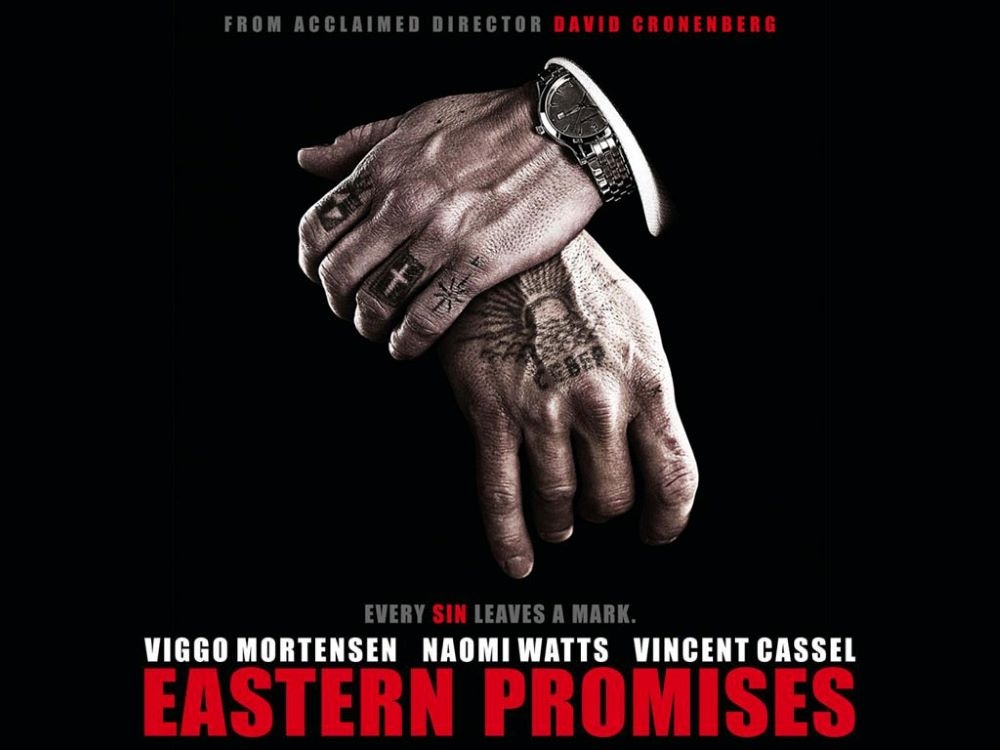
In 2005 Canadian filmmaker David Cronenberg brought to the silver screen a film that was both a taut, smart crime-thriller and also a well-done film treatise on the nature of violence and how it changes not just witness’ perception of an individual but about themselves as well. The film also introduced what might be the newest creative pairing that could be on par as other pairings like Scorsese-DeNiro and Burton-Depp. The pairing I speak of is that of Cronenberg and his growing repertoire with actor Viggo Mortensen. They scored a critical hit with A History of Violence and in 2007 they collaborate in another crime-drama that more than lives up to their initial collaboration. Eastern Promises is a taut and meticulous drama which brings new eyes and a different approach to the mob film genre made famous by Coppola and Scorsese.

The film begins innocently enough with a very pregnant teenage Russian girl named Tatiana entering a neighborhood store. While Cronenberg chose to open up A History of Violence nary any musical cues and backgrounds to create a sense of naturalism and plant a seed of unease in the audience of what’s to come, he does the opposite with Eastern Promises by allowing long-time collaborator Howard Shore to score this opening scene with a haunting violin solo. Even right from the start Cronenberg’s propensity to use a sudden image of violence to shock the audience works well to set the tone for the film. It is not the usual filmgoing experience to see a young girl, looking lost and afraid of her surroundings, suddenly and bloodily starts to give birth in the middle of a store. It is from the diary entries of this young girl where we get glimpses of the true meaning of the film’s title and sets up the clues and tidbits that Cronenberg gradually fills in as the film progresses and the main characters investigate the girl’s death and the full contents of her diary.

We’re quickly introduced to Anna Khitrova (played with touching compassion and a certain naivete by Naomi Watts), midwife at the London hospital where Tatiana dies from bloodloss due to childbirth. Having had experienced her own personal tragedy regarding a past pregnancy Anna takes it upon herself to find the next of kin or, at the very least, close friends who might know Tatiana and thus claim the child and care for her. It was finding Tatiana’s diary and the business card tucked within amongst the young girl’s meager possessions which gives Anna a starting point for her investigation and search.

It is during this search into Tatiana’s life that Anna encounters Nikolai Luzhin (Viggo Mortensen at his most chameleonic), the personal driver of one Semyon (as played by Armin Mueller-Stahl). Semyon charms Anna with his old world grandfatherly persona yet both the audience and Anna feels something off, even sinister beneath the charm and twinkling eyes. Semyon is not just the owner of the Trans-Siberian, a Russian restaurant, but a boss in the vory v zakone also known as the Russian Mafia. It is through Nikolai that we see the underbelly of Tatiana’s life before her death.

It is during the second half of the film that the film takes a clear turn into Cronenberg territory. With all the players in play Eastern Promises starts to peel the layers on all the characters. Just like in A History of Violence every character in this unofficial follow-up to that film go on through the film living dual-lives. Even Anna’s seeming naivete, in regards to the danger she faces in Semyon and his unstable son Kirill, shows a modicum of world-weariness born out of personal tragedy and those she sees on a daily basis when working as a midwife in the hospital.

Cronenberg doesn’t just try to tell a crime drama about the mob and the subculture they live and die in but he adds his own personal stylistic and metaphorical touches on the mob film conventions. While in the past he has taken on the immutability of the body and the physical nature of man in his later years he has moved on to the amorphous nature of man’s very nature as both a civilized and reasoned animal to the primal being which lurks within each. Eastern Promises delves into this metaphysical topic by showing the natures of both Nikolai and Semyon. Both of whom, at first glance, inhabiting a particular stereotype but soon showing the opposite as the audience gets to know them. Even the twists in the story in the middle section and close to the end doesn’t seem like cheap plot tricks but a logical and almost mathematical conclusion to the very themes Cronenberg has been exploring right from the beginning.

The performances by the cast was top-notch from top to bottom. David Cronenberg’s always has had a reputation for being an actor’s director. His willingness to allow his actors to not just play the part but find ways to become their characters makes his films some of the more well-acted one’s of the last quarter-century. From Watts’ own touching performance as the moral center of the film in Anna to Cassel’s unstable and coward of a bully in Kirill the work put on by the actors adds a level of gravitas to a story that has it’s roots in pulp crime stories and not the high-brow tales prestige films like Eastern Promises has been compared to. But the two stand-out work comes from Viggo Mortensen as the enigmatic Nikolai and Armin Mueller-Stahl as Russian mob boss Semyon. Where Watt’s performance was subtle and Cassel’s literally scene-chewing both Mortensen and Mueller-Stahl bring forth nuanced performances full of life and complexities that makes both characters stand out above a cast already doing great work.

Mortensen’s work as Nikolai actually surpasses his previous Cronenberg-directed role in Tom Stalls of A History of Violence. Viggo has always been quite the Method actor and really loses himself in every role he takes on, but it took him being paired up with Cronenberg for critics and cineastes to finally realize how great an actor he really has become in the last decade. His Nikolai oozes a charisma from the moment he enters the film. He makes Nikolai not just a thug with a brain and a semblance of compassion beneath the rough surface. Mortensen literally becomes Nikolai right down to the very tattoos which tells his character’s criminal past in ink. One could not help but be mesmerized by Mortensen’s work in this film that it was easy to forget that he was playing a part and not actually living that life. To say that Mortensen may have found his creative soulmate in Cronenberg would be quite the understatement and with more projects in the future linking the two together it wouldn’t be a surprise if the two in conjuction finally get the critical awards that has eluded both.

While A History of Violence showed that Cronenberg could work beyond the genre and esoteric genres of his part works, it is with Eastern Promises that we see him move towards a more mainstream type of work. Yet despite a work more accessible than before he still was able to add his own style of storytelling and explore themes usually not seen in crime dramas and mob films. It is this ability to marry the violent pulp with the intellectual high-brow which makes Eastern Promises a delight for both the general filmgoer and the arthouse cineaste. Time will only tell if the successful streak by the duo of Cronenberg-Mortensen continues as the two continue to work together in the years to come.
Song of the Day: Harvest of Sorrow (by Blind Guardian)


Who would’ve thought that a German power metal band will end up penning and composing one of the best ballad’s dedicated to a story from J.R.R. Tolkien’s classic novel, Silmarillion. Power metal bands has always been quite adept at using fantasy-related subject matter as inspiration for songs and entire albums. The band Blind Guardian have pretty much made a career out of using J.R.R. Tolkien’s stories and tales as inspiration. They’ve even dedicated an entire full-length album to Middle-Earth: Nightfall in Middle-Earth.

One of the bonus tracks from Nightfall on Middle-Earth is our “Song of the Day.” It is a song based on Tolkien’s tragic tale of  Túrin Turambar as he mourns the loss of his sister Nienor. One would expect Harvest of Sorrow to be full of metal riffs and overdubbed vocals common in metal power ballads, but this is not the case in this Blind Guardian ballad. The band has instead gone renaissance folk-rock in their composition. I will say that their stylistic choice fits the song well. The song has been so popular that there are nine versions of the song. There are the seven recording variants in addition to two live versions. There are two English versions, two versions in Spanish, one in French and another in Italian with another a mix of all versions minus the English acoustic.

So, those who think that metal is all about sturm und drang with screaming and guttural noises will be in for a surprise to know that they can also be quite subtle in the music they make. Harvest of Sorrow is a fine example and quite easy to sing-along to. Just pull up a chair at the table, grab a stein of ale or a horn full of mead and sing-along using the lyrics provided.

Harvest of sorrow

She is gone leaves are falling down
The tear maiden will not return
The seal of oblivion is broken
And a pure love’s been turned into sin

At the dawn of our living time
Hope may cover all cries
Truth lurks hidden in the shadows
Dreams might be filled with lies
Soon there will be night
Pain remains inside

Suddenly (oh) it seemed so clear
All the blindness was taken away
She closed her eyes and she called out my name
She was never ever never ever seen again

Harvest of sorrow, your seed is grown
In a frozen world full of cries
When the ray of light shrinks
Shall cold winter nights begin

She is gone and I fall from grace
No healing charm covers my wounds
Fooled’s the dawn and so I am
Fooled by life and a bitter doom
To bring you the end of the day

At the dawn of our living time
Hope it soon will pass by
Facing a darkness
I stand (alone)

Harvest of sorrow, your seed is grown
In a frozen world full of cries
When the ray of light shrinks
Shall cold winter nights begin

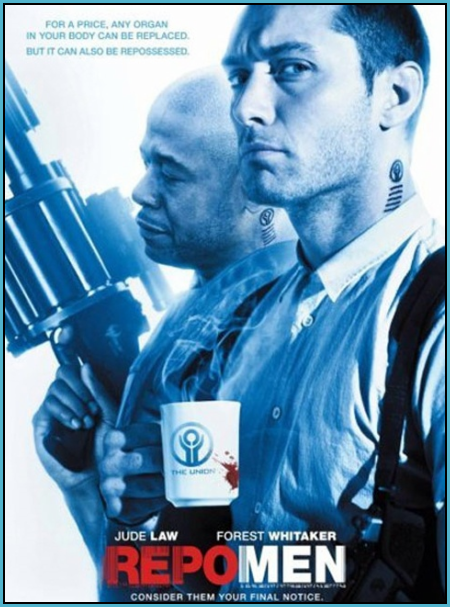
Review: Repo Men (dir. by Miguel Sapochnik)


In the beginning of 2010 a scifi-horror film arrived in the theaters to much internet hype. This film showed a future world where a massive societal change and the resulting health crisis following it was described in detail. It was a film which cleverly built a world so different from out very own yet still very similar in its foundation. This film was Daybreakers and for all the wonderful world-building it did to establish a foundation for the story being told the film couldn’t find it’s way to having the film’s plot match what the filmmakers’ established in the beginning. I say this because it is now late March 2010 and another film has done another wonderful job of establishing a future world so very different and yet so very similar in many ways. Where the Spierig Brothers failed in more ways than one to have the rest of Daybreakers live up to the world established in the beginning and a premise that was quite new, Miguel Sapochnik did a much better job — albeit still flawed — in allowing the plot for Repo Men live up to the world established in the opening minutes of the film.

In the near future of Repo Men medical science and technology has advance far enough that most organs and parts of the human body can be artificially replaced when they failed. While this detail of the film sounds like the makings of a future utopia it’s actually much closer to our own reality in that these organs, despite being mass-produced, are still only affordable to the rich. Artificial organs (artiforgs in this film’s vocabulary) sold to the rich like luxury items. Those not-so-rich, but desperate to try and find a way to change a fatal health situation, also offered these artiforgs on a monthly payment plan suitable to their current expense situation. It’s mostly these payment plan artiforg owners who experience the skill sets of the so-called “repo men.” These are individuals employed by the artiforg company called The Union who sell the products. When someone misses too many payments on their artiforgs and goes delinquent on their payment plan then the repo men will be knocking on their door to take back the synthetic organ. It’s similar to banks repossessing cars and homes when payments are not made.

The film’s told in the point of view of one of these repo men. Jude Law’s character Remy is one of The Union’s top repo men who we see enjoys his work despite the ultimate consequence of what he does to the people whose artiforgs he takes back. His partner is Jake (played with childish glee by Forest Whitaker). The two have been friends since grade school and both share a similar sense of sociopathy when it comes to violence. To say that they’re like brothers minus the shared genetics won’t be too far off. The first third of Repo Men shows the audience these two organ repossessors in their element as they hunt down those delinquent in their plan and those who have turned to the black market for their artiforgs. The film’s touches upon the current public hysteria of the two sides in the health care debate. While the film touches upon this current debate it does so without being too broad or preachy. It’s done subtly and without having it distract the audience from the film’s story.

The film does sing and move at an entertaining pace during the first third, but inevitably it does reach a point where the conflict of the story shows itself to add a dramatic ingredient to the film. It’s during what was to be Remy’s final repo mission before he heads over to a less paying, but safer job as sales in The Union that he goes from the repossesser to potential possessee. The switch in roles soon has Remy unable to do what he’s been so good at as cutting into someone delinquent on their artiforg when he himself now has one keeping him alive. It’s a common storytelling telling idea of the insider getting a taste of their own medicine and seeing how the other side lives. Avatar used it late last year and Daybreakers did it clumsily earlier this year.

This second third of the film has some character development flaws which could be attributed to some of the script’s weakness. While Remy’s sudden inability to do his job as a repo man after his own artiforg surgery makes sense the one-note characterization of his wife (played by the Black Book‘s Carice von Houten) who leaves him during this crisis of faith adds an unnecessary factor to his problems. In actuality the roles of the wife and Remy’s son could’ve easily been left off the film and just had the story be about Remy and his long-time friend and fellow repo man Jake. This would’ve been enough conflict and drama to power the rest of the film. This is where less would’ve definitely more and keep the story lean, mean and definitely more efficient. But even with this misstep in the film’s script it doesn’t sink the film. This could be attributed to some strong performances from Jude Law who manages to credibly transition from what amounts to be a paid serial killer to one having his eyes opened to the devastation he has wrought on individuals and families. Even the scene-chewing done by Whitaker as Jake doesn’t diminish Law’s performance and instead just shows that despite some of the horrible things Remy’s done he’s actually the sanest person in the film w/ everyone else close around him playing certain caricatures whose roles are to push him one way or another to picking a side on the issue of artiforgs and their repo issues.

It is in the beginning of the third act which may make or break the film for those who have stayed with it through the first acts. A particular even happens which transitions act to three which ramps up the action to it’s bloodiest and, at times, quite Cronenbergian level. It is this third act which pays homage to several great action-thrillers of the past decade. One scene in particular tries to emulate the classic hallway fight scene from Oldboy. This time around more weapons are used from knives, guns and all the way to a medical hacksaw. This scene leads up to another which pays homage to another Jude Law film of the past with a Cronenberg pedigree. While bloodier than similar scenes in eXistenZ there’s no denying that Sapochnik sure loves his Cronenberg. The climactic finish to the film before a sort of epilogue of a twist just builds and builds throughout the third act. For some the epilogue’s reveal may and will ruin the rest of the film as it seems like a cop-out of a plot twist, but I thought it was actually well done and gives a new meaning to the conventional Hollywood happy ending to an action-thriller.

As a first-time feature-film director Miguel Sapochnik has a deft and keen eye for visuals. The artistic design of the near-future world of Repo Men shows influences from the consumeristic dystopian future of Blade Runner up to the grounded in futurist science of Spielberg’s Minority Report. He’s quite adept at blocking and handling the many action setpieces which helped keep the film from being bogged down by flaws in the script and some uninspired characters. Sapochnik does need to get a better feel for how his cast interacts with each other. As stated earlier with the exception of Law’s Remy character and Liev Schrieber’s delicious turn as a gleefully amoral example of corporate evil at its best, the rest of the cast seem uninspired from von Houten’s role as Remy’s wife right up to Alice Braga’s performance as Beth, the artiforg addicted singer Remy hooks up with halfway through the film.

Repo Men could’ve easily gone highbrow in addition to keeping to it’s genre trappings the way the Spierig Brothers tried to do with Daybreakers. Fortunately, Sapochnik w/ writers Eric Garcia and Garrett Lerner kept things focused on Remy’s journey from hunter to prey to “savior” without trying to overly explain his motivations. While they weren’t subtle in all things they tried to tell with the story they gamely tried to stick to the rule of showing and not telling everything. For his directing debut Sapochnik does a good job despite he flaws and shows promise.

In the end, Repo Men is a very good scifi action-thriller which delivers on its title. Despite missteps in the writing and some uninspired characters the film still turned out to be quite entertaining. It was a fast-paced film with several bloody, gore-filled action setpieces timed to pick up the film when dialogue and exposition starts to drag it down. Miguel Sapochnik’s debut feature-film could easily have turned off the rails and went in so many different directions but he kept things on the straight and narrow. While for some the ending will infuriate and negate what fun they were having through most of the film it also would be seen by others as an inspired take on the Hollywood happy ending. Repo Men won’t be mistaken as the next Brazil and Sapochnik won’t be mistaken as the next Cronenberg or Park Chan-wook, but both filmmaker and film is better than it should be and wholly entertaining from start to finish.

Hottie of the Day: Sugimoto Yumi


A new hottie picks up the mantle of Hottie of the Day and this particular one is the ridicilously cutie-hot Sugimoto Yumi.

Born in Osaka, Japan in April 1, 1989, the girl-next-door hotness that is Ms. Sugimoto started her career as a model. She started her modeling career when she was in elementary school. She was picked in a Grand-Prix audition for Ribbon, a manga magazine which is about 4 girls, their friendship, love lives, and various adventures. Ms. Sugimoto went from there to posing for gravure and other idol-related photoshoots where her innocent look made her popular. She has ventured into being an actress in addition to being a model. Sugimoto Yumi could be seen in Japanese tv shows such as Boys Este (tv drama) and the Power Rangers-like tokusatsu series, Engine Sentai Go-onger. In the latter she would play the equivalent of the Silver Ranger.

Ms. Sugimoto continues to model both for gravure and regular modeling photobooks. She has segued into film as part of the film-adaptations of her tokusatsu series Engine Sentai Go-onger. While her fans in Japan have never made mention of it those fans she has in the US has likened her as the Japanese Mary Elizabeth Winstead due to her close resemblance to the actress. In the end, she more than earns her hottie label due to her girl-next-door looks and innocent persona.

Will the Human Torch become Captain America?


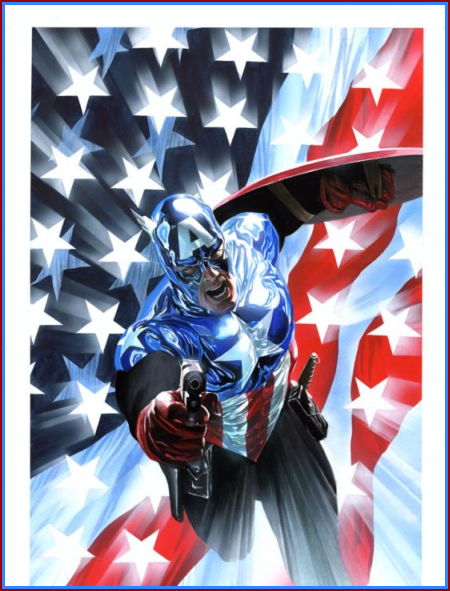
The news which hit the blogosphere and geekdom like a thrown vibranium shield has Chris Evans (formerly known as Johnny Storm (Human Torch) of the last two Fantastic Four films) being offered the role of Steve Rogers aka Captain America.

The titular role for Marvel Picture’s The First Avenger: Captain America has been talked off non-stop for the last month or so with many names from John Krasinski to Mike Vogel being mentioned as possible choices to play Steve Rogers. Even Ryan Phillipe got his name in the ring just in the last week or so. Now, it looks like Marvel and Joe Johnstone (picked to direct the film) have decided upon Chris Evans as their Captain America.

News broke with The Hollywood Reporter one of the first to break the story late Friday afternoon on March 19, 2010. While neither Marvel or Chris Evans’ CAA reps have confirmed anything about the purported offer sources who have been following the process have said that Chris Evans is indeed the choice and offered the role. The question now is whether Evans will done the red, white and blue and The Shield.

Chris Evans is not new to the superhero film genre as mentioned earlier being the one to bring the definitive Human Torch of the Fantastic Four on the silver screen. While my geek pick was Ryan McPartlin from Chuck or Jensen Ackles from Supernatural I am not against Evans being chosen to take the role (if he deigns to accept the offer). He’s got cred with the geekdom of comicdom and he has the look.

Here’s to hoping he does accept just so the production can start principal photography. If he does the unthinkable and declines one of the top roles of the 2011-2012 blockbuster season then hopefully Ackles still has an outside chance.

Source: THR

Review: Zombie (dir. by Lucio Fulci)


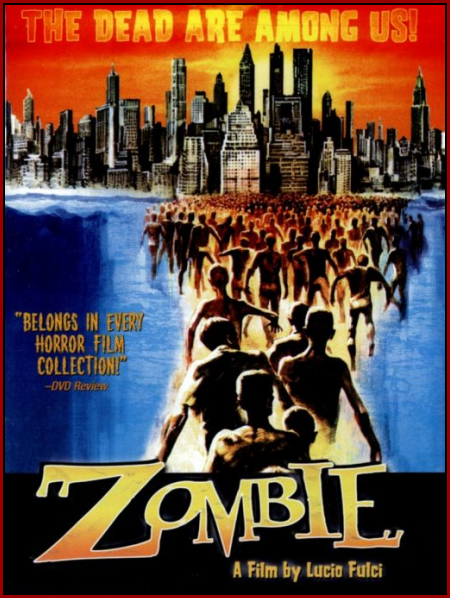
1979 saw the release of a film titled Zombi 2. It was suppose to be an unofficial sequel to Romero’s own Dawn of the Dead which was released in Italy under the title of Zombi. many thought this pseudo-sequel was a way to cash-in on the success of Romero’s film in Italy. This wasn’t true for the fact that it’s director and producers had already been working on their own zombie film as Romero started on Dawn of the Dead. It was by coincidence that both were released within the same year and in order to try and tie the two films together their titles reflected it.

Lucio Fulci’s Zombi 2 (or just plain Zombie in the US) has no connection whatsoever with Romero’s own Dawn of the Dead except for the zombies and the rules governing their destruction. This is not to say that Fulci’s Zombi 2 wasn’t good. In fact, I would say that Zombi 2 was, and still a great horror movie that’s been unfairly compared with Romero’s ultimate zombie classic. The two films tell different type of stories even when sharing similar plot devices and rules. Where Romero used the backdrop of the zombie epidemic as a damning visual commentary on the growing consumerism culture in the United States, Fulci’s film eschews any such social observations and goes for pure horror instead.

Zombi 2 helped begin the Italian cinema’s love of zombie movies and Fulci’s film still stands as the best of the lot. Starring Tisa Farrow as Ann, the daughter of a missing doctor working in the Carribean, and Ian McCulloch as reporter Peter West who helps Ann try to solve the mystery of her father’s disappearance in one of the Carribean Islands. The only clue they have being the mysterious reappearance of a boat belong to Ann’s father. A drifting yacht which, when inspected by NY Harbor Patrol, a disfigured, obese man violently attacks one of the patrolmen before falling overboard into the city harbor. From that moment on, Ann and Peter head off to her father’s last location on the Carribean island of Matool. Once on Matool, Ann and Peter discover that one of her father’s colleagues, a Dr. Manard, has been trying to solve the mysterious disease, or curse as the native islanders call it, which her father became afflicted with. A disease which seem to kill those it infects and then return them to life to attack the living.

These two are soon joined by a vacationing couple who seem to have arrived on Matool at the worst time. Ann and Peter soon enlist the aid of Brian and Susan, but before they could solve the island’s deadly mystery the island’s dead, both past and recent, rise up from their resting place and doom the remaining inhabitants. One sequence involving these zombies has gone down in horror history as one of the most cringe-inducing scenes on film. It involves the torturously slow sequence where a woman’s head is dragged forward toward a door splinter aimed directly at the woman’s eye. This gore-sequence in addition to the scenes of the zombies attacking and feeding on the visiting Westerners and the remaining living islanders were very well done and all due to make-up FX master Giannetto de Rossi. There’s even a spectacular sequence where a zombie tries to attack and feed on a live shark. Even to this day I still marvel at whichever stuntman volunteered for that action shot.

Zombi 2 has been called a dumbed down attempt to capitalize on Dawn of the Dead. I wholeheartedly disagree with this obeservation. Zombi 2 was never meant to be socially relevant, but one whose only goal was the scare, disgust and disturb its audience with scenes of extreme violence and gore. In this respect Fulci succeeded with the final cut of Zombi 2. The acting itself was very well done considering that half the cast spoke in English as their natural language while the other half were saying their lines in Italian. The dubbing of the Italian-spoken lines were done particularly well. A rarity when it comes to dubbed films.

The final few minutes of Zombi 2 where the Matool survivors make it back to New York through its harbor makes for a great ending. With a city radio station recounting the growing zombie crisis which seemed to have begun while Ann and Peter were on Matool, the final shot of zombies walking on the pedestrian level of the Brooklyn Bridge with cars below them seeming to be rushing out of the city to escape the crisis still makes for a haunting scene. Lucio Fulci’s Zombi 2 might not have been the iconic, cultural and societal masterpiece that was Romero’s Dawn of the Dead, but it more than holds its own when seen as a pure horror film.

Trailer: Pride and Prejudice and Zombies Prequel


I rather enjoyed the literary classic and genre mash-up that was Seth Grahame-Smith’s Pride and Prejudice and Zombies. That mash-up soon spawned other copycats and imitators from Sense and Sensibilities and Sea Monsters right up to Adventures of Huckleberry Finn and Zombie Jim. There’s actually even more classics which have been mashed-up with genre staples such as zombies, vampires, werewolves and even steampunk. Writer Seth Grahame-Smith even follow’s up his best-selling Austen collab with a historical what-if to be titled, Abraham Lincoln: Vampire Hunter.

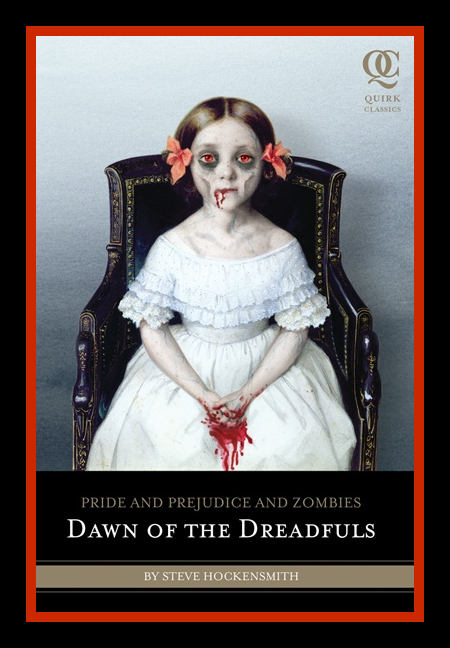
With Grahame-Smith busy with that book Quirk Books turned to Steve Hockensmith to write the prequel to Pride and Prejudice and Zombies. This prequel will keep the original’s title with the additional title tag of Dawn of the Dreadfuls. This prequel will explain how the Bennett girls from the original novel were such good zombie-hunters and killers. This prequel will be a major detailing of the backstory of the existence of zombies in Austen’s literary world.

There’s already a film adaptation of Pride and Prejudice and Zombies in the works with Natalie Portman headlining the cast. This trailer for the prequel novel just gives a gory and quite awesome glimpse at just how awesome (did I say awesome twice because it definitely is) the film adaptation would look.

Some have been saying that all these literary classics being mashed up with zombies is getting old. I say those people do not know what fun is when it kicks them in the groin. I, for one, think zombies added to anything makes them better in the long run.

Michael Caine is Harry Brown (trailer)


This is another film from 2009 that has still to get a release in the United States. A thriller from filmmaker Daniel Barber and starring two-time Academy winner Michael Caine, Harry Brown looks like another in the line of revenge films which all share some similarities with the Charles Bronson 70’s classic Death Wish. The film also stars Emily Mortimer, Liam Cunningham and Iain Glen.

The premise of the film does seem to owe much to Bronson’s Death Wish series with some of the rioting of hoodlums and gang members in the trailer reminiscent of the cult-classic Death Wish 3 where Bronson’s Korean War veteran literally goes to war with the neighborhood gang on the streets. I like Michael Caine as an actor and he always seems to inhabit a role no matter how much, at first glance, it seems like its not a good fit. Caine’s early works has had him play characters with a darkness in them and I think this film will help remind younger viewers to the fact that he was not always Alfred the Butler.

The film makes it’s U.S. debut on April 30, 2010.

Hottie of the Day: Seto Saki


The Hottie of the Day returns with a new addition to the growing harem. Today’s hottie is the lovely Ms. Seto Saki.

Born in 1982 on June 21, Ms. Seto is not your typical Japanese gravure idol in that she doesn’t see herself as one. She’s actually one of Japan’s up and coming young actresses. Despite earning her initial fame for winning the 2003 Miss Shuukan Shounen Magazine gravure idol contest, she truly earned her lasting fame as part of the cast of the popular Japanese tv comedy show Haruka 17. Ms. Seto’s popularity and fresh-faced beauty made her perfect for the ever-growing modeling scene in Japan. She’s modeled for product ads and fashion lines. In 2002 she tried her hand in the music business as part of the Japanese pop-trio band “Strawberry”.

She’s lasted in the modelling and entertainment industry more than most people in her business. She currently has several modeling photobooks already in-print. Her acting career has spanned beyond Haruka 17 and into others series such as Hana Yori Danga 2 (Boys Over Flowers 2), Memories of Matsuko and Shimokita GLORY DAYS. While she hasn’t transitioned yet into the film industry it probably won’t be too long before she does and her fame grows even more. Until then her fans will continue to follow her through her tv shows and many modeling photobooks.

Review: A History of Violence (dir. by David Cronenberg)


“In this family, we do not solve our problems by hitting people.” — Tom Stall

David Cronenberg’s A History of Violence opens like a familiar American story but soon transforms into something far darker and more complex—a meditation on how violence reshapes identity and reality itself. The film begins in small-town Indiana where Tom Stall, a mild-mannered diner owner, becomes an overnight hero after killing two violent spree killers who attempt to rob his restaurant. These killers—Billy and Leland—serve as the initial violent intrusion that shatters Tom’s peaceful world and propels the narrative forward. Their actions attract the attention of Carl Fogarty, an East Coast mobster whose relentless pursuit gradually forces Tom and his family to confront a buried, violent history. This confrontation unravels the fragile facade of domesticity and sets the stage for the film’s profound exploration of identity, perception, and the primal tensions beneath civilization.

Cronenberg’s direction is a study in restraint and precision. Far from glamorizing violence, the film presents it as brutally efficient and intimately physical. Cronenberg himself described the action sequences as neither choreographed nor aestheticized but raw, unembellished, and quick—realistic portrayals of violence drawn from street-fighting techniques rather than cinematic spectacle. This choice heightens the emotional impact, making every outbreak of violence feel sudden, close, and devastatingly human. The opening extended shot of the spree killers, for example, follows them in a languid, almost eerie calm before revealing their cold-blooded brutality, establishing an unsettling tone early on. Cronenberg’s camera work—often tight and intimate—immerses viewers in moments where violence erupts not as a fantasy but as a harsh reality, forcing the audience to reckon with its consequences rather than its thrill.

Viggo Mortensen anchors the film with a layered performance that seamlessly navigates the duality of Tom Stall—a man striving for peaceful normalcy—and the darker instincts touched by his mysterious past. Mortensen’s portrayal moves fluidly between the affable family man and the capable, restrained force beneath, embodying the film’s exploration of how violence shapes identity and perception. His physicality and subtle shifts in tone reveal a man perpetually caught between two worlds, never fully belonging to either. Maria Bello as Edie complements Mortensen beautifully, delivering a performance rich in emotional complexity. Her character oscillates between nurturer and survivor, revealing a raw, sometimes unsettling vulnerability beneath her composed exterior. Bello’s nuanced acting gives weight to the evolving dynamics of fear, desire, and trust within their marriage, especially evident in scenes that contrast tender intimacy with underlying tension.

The supporting cast enriches the film’s moral landscape. Ed Harris brings a quiet menace to Carl Fogarty, embodying violence as a cold, business-like inevitability rather than a source of pleasure or spectacle. William Hurt’s portrayal of Richie Cusack is especially memorable—his eight-to-ten-minute screen time is electrifying, providing a darkly charismatic figure who embodies familial loyalty intertwined with brutal pragmatism. Hurt’s performance deftly balances charm and cruelty, offering one of the film’s starkest reminders of violence’s cyclical nature within families. These actors contribute to the film’s thematic depth, portraying violence as a heritage passed down and a force that both defines and corrodes.

Cronenberg’s screenplay, coupled with Howard Shore’s minimalist score, emphasizes mood and psychological tension over action set pieces. The film refuses to indulge in excessive gore or prolonged combat; instead, it presents violence as a disruptive force that shatters normalcy and forces internal reckonings. A notable subplot involving Tom’s teenage son and a school bully underscores the generational transmission of violence and fear, reinforcing the idea that violence’s impact extends beyond immediate events to shape social and familial identities.

One of the film’s most powerful effects is the way it forces viewers to reconsider notions of safety, civility, and identity. Tom’s line, “In this family, we do not solve our problems by hitting people,” starkly contrasts with his son’s chilling rejoinder, “No, in this family, we shoot them.” This exchange encapsulates the film’s core tension—the desire to reject violence while simultaneously being shaped by its inescapable presence. Moments of quiet domesticity are undercut throughout by an ever-present undercurrent of menace, illustrating Cronenberg’s thesis that violence is not merely an event but a contagion of perception and reality.

Ultimately, A History of Violence is a film of dualities—between past and present, civility and savagery, love and fear. Cronenberg’s direction delicately balances these tensions, crafting a film that is at once a taut thriller and a profound psychological study. The performances, especially those of Mortensen and Bello, give the film its emotional resonance, while the supporting cast strengthens its examination of violence’s personal and social ramifications. By the film’s haunting conclusion, viewers are left with a haunting question: can anyone truly escape the shadows cast by violence, or are we forever altered by its imprint?