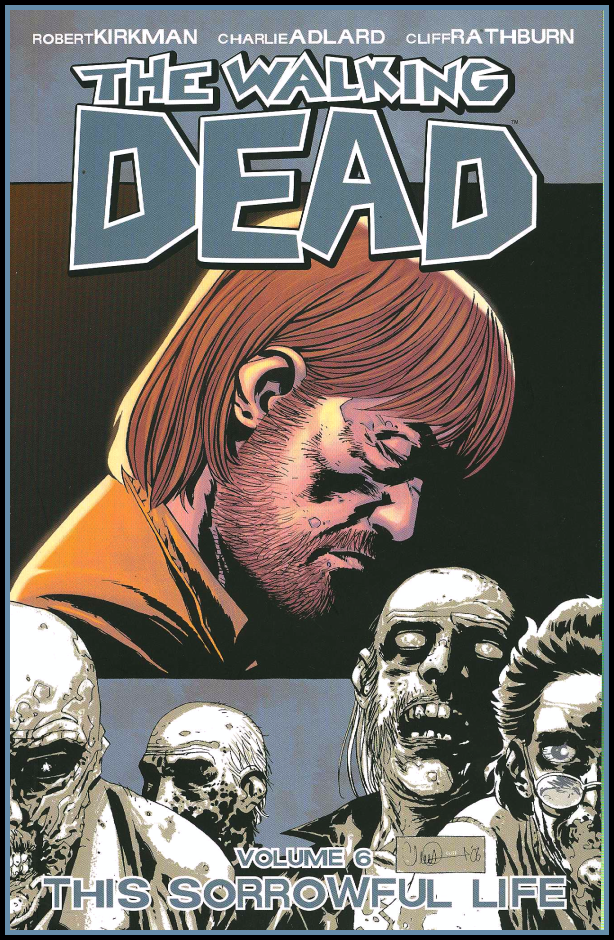
The Walking Dead follows-up the 5th volume with This Sorrowful Life and Kirkman sure does hit it right on the nail with the title. The book tells the second half of the story arc begun in the previous volume. To recap in the previous volume Rick and his group make way to investigate a crashed helicopter only to run into another group of survivors who have holed up in the partially walled off and fortified town of Woodbury. Whatever joy they find in knowing there are other survivors other than themselves was short-lived as they finally meet the person who runs and rules Woodbury.
This Sorrowful Life takes the story up with Rick, Michonne and Glenn in even a worse situation than being stuck outside with the zombies. The book introduces the people of Woodbury as not just survivors but also the polar opposite of those surviving in the prison. While the book makes a point to not paint the whole Woodbury population as losing their humanity it also points out that they’ve sacrificed their humanity to those promising them safety. They’ve pretty much given up their rights to the one who calls himself the Governor who rules Woodbury through intimidation and so-called bloodsports involving gladiator-like fighters and corralled zombies. We see who the difference between Rick and the Governor’s way of keeping their people safe also show the kind of people the are. Where Rick tries to keep his people safe and together without losing their humanity the Governor goes the opposite way and grabs a hold of power even at the cost of everyone.
Kirkman does a great job of showing the two groups and how its probably inevitable that the two will have a confrontation either in Woodbury or back in the prison. While not everyone in Woodbury were out for themselves, a few manage to sympathize with Rick and his group, the rest of the town could easily be considered as the biggest threat hanging over the prison survivors. Again Kirkman shows that sometimes its not the zombies themselves who’re the biggest threat to humanity’s survival. It’s people and their flaws to always get into conflict with each other instead of pulling together for the greater good and survival of everyone.
The book ends with Rick having to make another decision where he has to sacrifice some of his own ideals in order to keep his family and friends safe. Will this sacrifice end up costing him down the line will be up to Kirkman to tell us. I hope he continues to expand on this Woodbury angle but at the same time not go overboard on the extreme end of the emotional spectrum. It’s great that he’s limited the amount of soap opera-style stortelling which dominated volume 4, but going for just action and action and action without plot would be just as bad. So far, volume 6 and it’s predecessor in volume 5 tells me he’s got a great hold on the story.
If someone just five years ago told me that Ben Affleck would turn out to be a director whose work has been some of the better crime drama/thrillers of the past decade then I would declare shenanigans on that individual. Ben Affleck might have won an Oscar for helping write the screenplay for Good Will Hunting, but his career since could be labeled as being one of a joke (Gigli) interspersed with huge paycheck projects (Armageddon) that showed his range as an actor.
This is not to say that Affleck has no talent in front of the camera. I just believe that early in his career after winning his Oscar he got fooled into thinking that everything else since would be Easy Street paved in gold (financially and critically). To say that it hasn’t turned out to be that way (though he did make a ton of money) would be an understatement. But one thing happened while Affleck’s acting career was heading nowhere but down. He got behind the camera as a director and his very first time directing a feature-length film he would make one of 2007’s best films. I speak of his film adaptation of the Dennis Lehane crime drama, Gone Baby Gone. He didn’t just direct the life out of that film, but he also the screenplay with the help of Aaron Stockard.
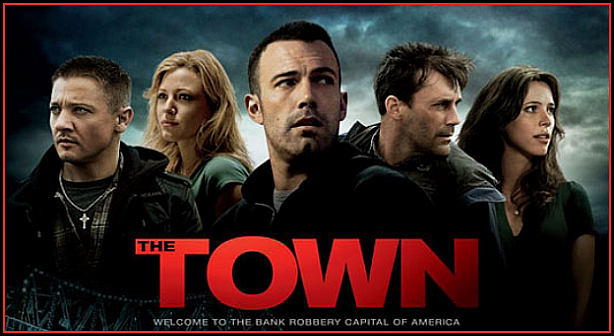
The two of the them would collaborate once again on Affleck’s latest Boston-based crime drama, The Town. He wrote the screenplay and directed the film and pulled in some wonderful performances from an ensemble cast which included Jeremy Renner, Jon Hamm, Rebecca Hall, Blake Lively, Titus Welliver and Pete Postlethwaite. Fellow site writer Lisa Marie already reviewed the film in detail and her review pretty much put down into words exactly what I thought of the film. I will say that I would swerve slightly away from what she considered some of the flaws in the film.
The Town was adapted from Chuck Hogan’s novel, Prince of Thieves. I would consider the screenplay and dialogue as a major strength of the film. While at times it did seemed to follow the step-by-step and by-the-numbers heist thriller story the screenplay itself didn’t ring false. I liken this film to another heist film which shared some themes and similarities. Michael Mann’s Heat also dealt with the cops-and-robbers foundation. Where Mann’s film had a much larger and epic scope to its storytelling it still boiled down to two groups of determined men playing a dangerous game of cat-and-mouse. The women in both film were written just enough that they had distinct personalities, but in the end they were motivations for the men in the film.
Affleck shows that he doesn’t just know how to direct, but continues is reputation as being one very good screenwriter. One just has to be reminded that he is now 3-for-3 when it comes to screenplays he has written which have turned out to be great ones. While he doesn’t have the same flair for words as Tarantino or Mamet when it comes to the screenplay. What he does well was to create an efficient script which flowed from scene to scene. Tarantino’s screenplays are great, but at times he does allow himself to overindulge his inner-film geek and create dialogue that might be Sorkin-like in execution. What I mean is that as great as the dialogue sound there’s no way people really spoke like this to each other. Affleck’s screenplay for The Town felt very natural and even with Jon Hamm’s less than great performance the film had a natural and genuine sound to it’s dialogue.
That’s one flaw pointed out by Lisa Marie that I would disagree with her on. The other two I can see her point, but it bothered me none. Though if I ever took on a life of crime I would hope I find someone just like Rebecca Hall’s Claire. Now there’s a woman who stands by her man no matter what.
I think in the long run this film might just be seen as one of the best of 2010 and some critics have already dubbed it so. While it’s prospects come awards season time is still up in the air I wouldn’t be surprised if it ends up nabbing one of the ten Best Picture nominations when the Oscar nominations get announced. It would be well-deserved and would just prove that Affleck’s career in the film industry might just be hitting its stride. Who would’ve thought it would be as a writer-director and not as an actor.
The song of the day is tied in with my Twitter Follow Friday. I’m going way back old school. For most of my friends and family this is not too way back, but for the other half I know anything that didn’t come out during the last 10-15 years is way, way back. With that out of the way I present to your viewing and listening pleasure “Whip Appeal” by Babyface.
This particular slow jam from Babyface’s 1989 LP album Tender Lover was a particular favorite of RnB fans from 1989 and beyond. I know that it was a major hit from 1990-91 during the prom season. Even after 1991 after I had graduated it stayed quite popular with everyone especially couples. I mean this song has romance written all over it. I wouldn’t be surprised if the sudden baby boom of 1990 and a few years was due to just this particular one song.
Whip Appeal
Somebody told me
There’d be trouble at home
‘Cause we never talk a lot
When we spend time alone
So how are we supposed to know
Know when something is wrong
Well, we’ve got a right to communicate
It keeps a happy home
And no one does it like me
And no one but you
Has that kind of whip appeal on me
Keep on whippin’ on me
Work it on me
Whip all your sweet sad lovin’ on me
Keep on whippin’ on me
Work it on me
Whip all your sweet sad lovin’ on me
When we go to work
How the day seems so long
The only thing I think about
Can’t wait ’til we get home
‘Cause we got a way of talking
And it’s better than words
It’s the strangest kind of relationship
Oh, but with us it always works
And no one does it like me
And no one but you
Has that kind of whip appeal on me
Whatever you want
It’s alright with me
‘Cause you’ve got that whip appeal
So work it on me
It’s better than love
Sweet as can be
You’ve got that whip appeal
So whip it on me
Keep on whippin’ on me
Work it on me
Whip all your sweet sad lovin’ on me
Keep on whippin’ on me
Work it on me
Whip all your sweet sad lovin’ on me
And no one does it like me
And no one but you
Has that kind of whip appeal on me
[HOOK 4 times]
Keep on whippin’ on me
Work it on me
Whip all your sweet sad lovin’ on me
Keep on whippin’ on me
Work it on me
Whip all your sweet sad lovin’ on me
The definition of the Japanese word ronin describes it as a samurai who has lost his master from the ruin of or the fall of his master. John Frankenheimer (with some final draft help with the script from David Mamet) takes this notion of a masterless samurai and brings to it a post-Cold War setting and sensibility that more than pay homage to the great stories and film of the ronin. One particular story about ronin that Frankenheimer references in detail is the classic story of the 47 Ronin. Ronin shows that in the latter-stages of his career, Frankenheimer was still the master of the political/spy-thriller genre. He infuses the film with a real hard-edge and was able to mix together both intelligence and energy in both the quieter and action-packed sequences in the film.
The film begins quietly with the introduction of the characters involved. We meet each individual in this quiet 10-minute scene that shows Frankenheimer’s skill as a director would always be heads and shoulders above those of the bombastic and ADD-addled filmmakers of the MTV generation (Michael Bay being the poster boy). Robert De Niro plays the role of one of the two American mercenaries (or contractors) who instantly becomes the focal point for everyone in the scene. His casual, but attentive reconnoitering of the Paris bar where the first meet occurs helps build tension without being being heavy-handed in its execution. It’s with the introduction of Jean Reno as the Frenchman in the group that we get the buddy-film dynamic as De Niro and Reno quickly create a believable camaraderie born of the times for such men during and after the Cold War.
The rest of the cast was rounded out by an excellent and high-energy turn from Sean Bean as an English contractor who might not be all that he claims and brags to be. The other American in the group was played by Skipp Sudduth who in his own understated way more than kept up with the high-caliber of actors around him. Finishing off and adding the darker and seedier aspects of the cast were Stellan Skarsgard as a former Eastern Bloc (maybe ex-KGB) operative and Jonathan Pryce as an IRA commander whose agendas for bringing this team of masterless ex-spies and operatives together might not be all as he claims. The only break in all the testosterone in the film was ably played by the beautiful, yet tough Natasha McElhone. Like Sudduth, McElhone more than keeps up and matches acting skills with the likes of De Niro, Reno and Skarsgard.
The film moves from the meeting of the group to the actual operation which brought all these disparate characters together. Taking a page from Hitchcock, Frankenheimer and Mamet introduces what would become the film’s MacGuffin. A “MacGuffin” being a plot device which helps motivates each character of its importance and yet we’re left to believe that the item is important without ever finding out why. The MacGuffin in Ronin ends up being a silver case which the IRA terrorists, the Russian Mob and seemingly every intelligence agency in Europe wants to get their hands on.
It’s up to De Niro and his group to steal the case from another party and this was where Frankenheimer’s skill in seemlessly blending spy-thriller and action film shows. From the set-up of the team and their plans, to a near double-cross during an arms deal to the actual operation to take the case, Ronin begins to move at a clipped and tension-filled pace. There’s no overly extraneous dialogue. Mamet’s script fleshes out the story and adds a sense and feel of intelligent professionalism to the characters.
The action sequences mostly involved car chases through the narrow streets of Nice, France to the metropolitan thoroughfares and tunnels of Paris. Frankenheimer shines in creating and directing these sequences. Sequences which he’d decided against the use of CGI. Using what he’d learned and perfected from his own past as a former amateur race car driver and from his own classic film Grand Prix, Frankenheimer used real life cars and drove them through real (albeit choreographed) traffic to give the sequences that sense of reality and speed that one couldn’t get with CGI. The car chase scene within the Paris thoroughfare tunnel against traffic has to go down as one of the best car chase put on film. With just abit of help from second unit directors Luc Etienne and Michel Cheyko, Frankenheimer pretty much did most of the filming of the car chases.
The story itself, after all the characterizations and high-energy, tense action sequences, was really bare bones and in itself its own MacGuffin. The story just becomes a prop device to help show the mercenaries’ special sense of honor in regards to working with people who might’ve been enemies in the past. The murky world they now live in after the collapse of the black and white sensibility that was the Cold War has become nothing but shades of gray. One little bit of trivia that I found interesting was the fact that Ronin included quite a bit of actors who portrayed past James Bond villains: Sean Bean (Janus), Jonathan Pryce (Carver) and Michael Lonsdale (Drax).
In the end, Ronin became the last great film from a great director. I don’t count Reindeer Games as anything but Frankenheimer picking up a check and the studio dabbling overmuch in the final look and feel of that film. Frankenheimer’s Ronin is a blend of smart dialogue, hard-edged characters, and tense-filled action that he manages to blend together to make a fine and intelligent film. The story’s myseries concerning the MacGuffin might not have been answered in the end, but the journey the audience takes with DeNiro, Reno and McElhone’s character in getting there more than made up for any flaws in the plot.
We’re now heading towards the end of this first season of Madhouse’s anime adaptation of the zombie manga Highschool of the Dead. It is still up in the air whether this 13-episode initially produced will be the first season or just the first half of what will end up being the only season. If the latter is the case then the series just took a relaxing calm before the storm of what will be episode 11 thru to 13.
Episode 10 brings everyone in the group back together as Takashi Komuro and Busujima Saeko finally makes it back to the relative safety of the Takagi fortress-compound in the previous episode. This episode was actually pretty devoid of much of the fanservice which were prevalent in the last 5 previous episodes. The only nod to it’s ecchi side of the series was in the beginning where one might think Rei and Komuro might just end up going all the way (something that suspiciously might have already happened between Komuro and Saeko in the last episode), but alas it was not meant to be. It was just a medical intervention to help Rei heal up from being sorely bruised from the action of episode 8.
While within the Takagi compound we get to know more about the life of Saya and her relationship with her parents. To say that she has lived quite the privileged life would be an understatement. But while in other media the privileged children of rich and powerful parents end up being useless beyond being spoiled and entitled, Saya seems to have grown past being just a spoiled brat and into a child who has tried to live up to the perfection that are her parents. I mean her father is the lord of the manor in more ways than one as the Takagi-clan looks to have been the same clan in centuries past which ruled over the city during the Feudal-era of Japan. Takagi Souichiro and his wife Yuriko are quite formidable parents and we see where Saya gets both her beauty and coldly, logical brain.
This episode to me also shows us just how far Hirano Kohta has come from the geeky and shy introduction from the first couple episodes. We’ve seen him become quite the badass to help bookend Saeko in terms of pure zombie killing power. He’s been the most useful of the group not just in how expertly he handles the guns the group comes across, but in teaching others how to operate them. This new zombie apocalypse world has made Kohta useful in his eyes. So, when the demand by the “adults” at the Takagi compound for him to hand over the weapons he and his group brought with them his reaction was both understandable and quite saddening.
To survive the last couple days as a highschool student while adults around them died and became “Them” it’s jarring to Kohta and the rest of the group to suddenly be treated as children once more. While his tear-filled reaction to not wanting to go back to being a helpless otaku seemed overly dramatic it’s easy to sympathize with him. Thus, it was great to see not just for the group to have his back and support his decision to hold on to the weapons, but to see Saya do the same. The fact that she uses Kohta’s help in securing her safety a way to show her contempt for her parents for not trying to find a way to save her shows the rift between daughter and parents.
While this respite from the doom and gloom action of the previous 3-4 episodes was quite good, this partcular calm before the storm looks to be ending quite quickly as the sneak preview for the next episode show the return of Shido-san and his bus of cult followers. Plus, just when I thought Madhouse was going to cut the bus orgy scene from the manga it looks like they just kept it for the end of episode 10. Now all is right with the world.
The first four volumes of Robert Kirkman’s have led Rick Grimes and his group from the encampment right outside of Atlanta to an abandoned prison which have now become their new sanctuary from the dangers of the outside world. We’ve seen the group lose people to the dangers of the zombies which have now claimed the world. They’ve also gained some new people which in turn has also caused some major conflicts to the group dynamics.
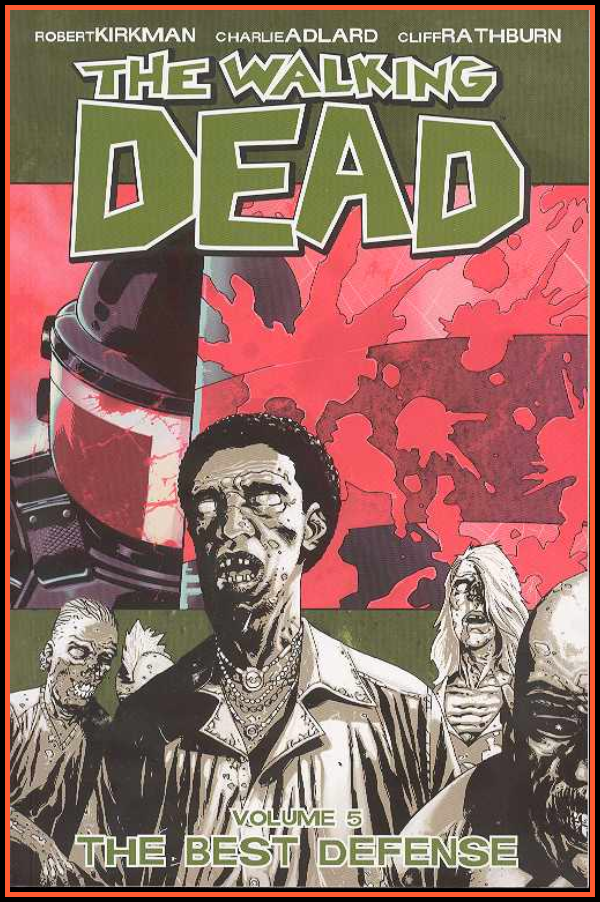
The series’ 5th collected volume (titled The Best Defense) takes place sometimes after the dramatic revelation by Rick Grimes to the group which ends the 4th volume. The Best Defense begins a new story-arc which would last right up to the very last pages of the 8th volume of the series. This was the volume which helped bring back some of the series’ fans who had begun to leave due to the overly dramatic and soap opera-ish narrative of the last volume. While the conflict which began between major characters in the last volume still remain a new surprising discovery of other possible survivors and another fortified compound brings the group back together for a common purpose. While this return towards cooperation was welcome development I did like the fact that Kirkman still kept the conflicts hanging in the air like a sword about to drop at the first wrong step.
Some fans and critics have spoken about how Kirkman’s writing style is actually very bad when compared to other top writers in the comic book industry. Yes, he’s not in the same league as a Warren Ellis, Grant Morrison, Garth Ennis and Alan Moore, but in the type of story he’s trying to tell his style seems to work. He does have a way to put up a lot of exposition with every page in the series. For some this was a sign of a lazy and weak writer who doesn’t allow the images to help tell the story. While at times I will agree as the series can get heavy with dialogue in the end it doesn’t bother me as much. Zombie films, even the best ones, rely and lean heavily on exposition. It’s actually such a surprise for a horror subgenre to have so much dialogue and people actually expect it. The same could be said for this series. The heavy exposition is not a bother for most and actually welcomed by its readers.
With this volume introducing a new outside force as the big baddie for the next major story-arc, Kirkman has easily shown he understands the zombie genre and how the zombies themselves don’t even count as the main danger for humans trying to survive this new apocalyptic world. This is especially true with the new character of The Governor who, in just a handful of issues in this volume, has cemented himself as one of the best villains to appear in any entertainment media in the past 10 years. Here’s to hoping that Frank Darabont in his tv adaptation of this series for AMC doesn’t mess around too much with this character. The Governor definitely makes one wonder if humanity actually deserves to continue as a species and not just march towards extinction.
The latest pick for the Daily Grindhouse should delight fellow site contributor Lisa Marie. I say this because I know of no one else who loves all things Jean Rollin as much as she does. I also picked this particular grindhouse flick because it has the lovely Brigitte Lahaie in it. Those who know need no explanation as to why that coulnts a lot in my pick and for those not in the know will just have to figure it out themselves.
I picked Jean Rollin’s Le Raisins de la Mort (also known as The Grapes of Death) because the title just spoke to me. A zombie (or at least zombie-like) flick with the word “raisins” in the title. What’s not to love and, not to continue repeating myself, it has the lovely Brigitte Lahaie in it even if for just a supporting role. A role that definitely shows her best front, sides and back (I’m a guy so sue me).
If there was ever a reason Jean Rollin has my undying props it’s for always finding a reason to cast Brigitte Lahaie in his films. Now, if Steven Soderbergh can just follow his lead and just keep casting Sasha Grey in all his future films then he’ll have my undying support as well.
This particular grindhouse pick definitely doesn’t make for a good way to promote France’s great wine traditions and their fabulous vintages. What it does promote is France’s own particular take on the zombie genre of the 70’s. Where zombie flicks were always seen as American and Italian provinces of the horror scene other countries had their hand in pushing the genre, but France (with some help from Rollin himself) added their own spin on it by shamelessly (one I applaud and am thankful for) keeping the lovely female performers in them in differing modes of undress.
For that I just have to say one thing: Vive la France!
I missed out on the initial release for 100 Bullets, but I’ve since rectified that problem.
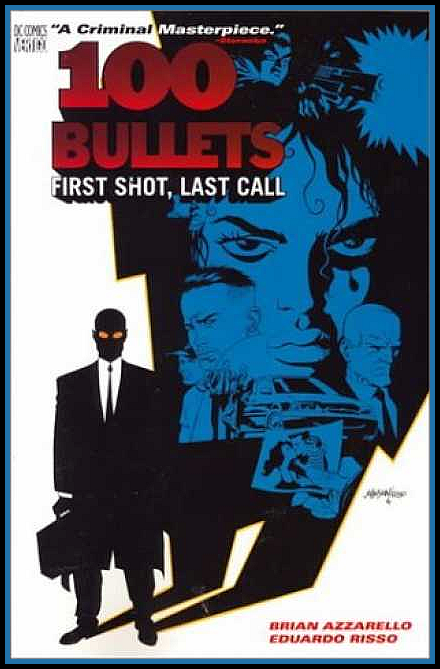
Brian Azzarrello’s 100 Bullets continues the long line of excellent mature comic titles from DC Comic’s Vertigo line. Azzarrello’s hardboiled, crime-thriller noir series brings to mind classic detective-noir works by Hammett, Spillane and Chandler. It’s a more complex continuation of the hyper-noir series Frank Miller began with his Sin City series. I’ve heard people say that this series was better than Sin City and to some respect it was. The stories in each issue contained in this first volume (issues 1 through 5) were abit more complex in nature and execution than Miller’s more simple noir tales. The five stories in this collected volume also laid the basic groundwork for what’ll turn out to be one long-running series lasting exactly 100-issues. Where Sin City‘s simplicity in its storytelling and artwork lay its strength, it’s in the complexities in the tales and the detailed, but economical artwork that 100 Bullets shined through.
In First Shot, Last Call we’re introduced to the gamemaster of the tale: Agent Graves. Looking like an ever-present government agent who has seen all that life has thrown at him and ready for more, Agent Graves picks a recently paroled Latino lass by the name of Dizzy Cordova with a proposition. He offers Dizzy an attache case with a gun and 100 bullets that’re untraceable and definite proof that certain individuals caused her heartache and grief that has ruined her life. He only offers her the attache case, its content and the proof within. The choice is Dizzy’s to make on what she should do with what’s offered her. This set-up and premise is the beauty of 100 Bullets. The story’s basically a morality tale of choices offered to the characters. Will they use the offer to exact vengeance and get away with it scott-free, or will they refuse the offer and live on with their life. The choice of revenge really doesn’t bring back lost time and loved ones and only feeds the need for retribution. Agent Graves doesn’t really force Dizzy’s hand, but a supporting character knowledgable of the offer does — for his own agenda not yet known — prods, pushes and guides her to picking the more primal choice. Dizzy’s choice in the end was both understandable and in the end inevitable.
The second story arc deals with Lee Dolan who also has had his life turned upside-down by people unknown to him. His life and family taken away by the stink of a child pornography accusation in the past. Agent Graves makes him the same offer of the attache case and its untraceable 100 bullets. Dolan’s reaction to this offer is different from that of Dizzy’s, but in the end his ultimate choice doesn’t give him the same resolution and new life path that Dizzy made. It’s a tribute to Azzarrello’s great writing that the decision both Dizzy Cordova and Lee Dolan made were understandable when taken into context of their personalities and yearning to fix the problem that led them to their current state in their lives.
To complement Azzarrello’s words perfectly were Eduardo Risso’s artwork. It would be a misnomer to say that Risso’s art style was minimalist like those of Frank Miller’s woodcut-engraving style for Sin City or Mike Mignola’s chiasroscuro-style for his Hellboy series. There’s a sense of the cinematic in Risso’s work. The scenes were always drawn with a mind for action even when it’s just people standing around. Risso has quite the filmmaker’s eye in how he’s drawn 100 Bullets which just adds to its noirish feel. The characters and environment were drawn not to scale and real-world proportion, but just enough not to look cartoonish. I would agree that there’s an abundance for cleavage on the women drawn, but Risso doesn’t do it gratuitously. Instead he uses this detail to showcase the sexuality of the strong female characters. It paints the female characters like Dizzy Cordova and Megan Dietrich with a sense of both strength and sensuality without pandering to the teenage boy demographic. Plus, he gives these ladies their own personality and character with how he draws them. Dizzy truly has the Latina sensual curves while Megan has the icy-cold Aryan beauty that serves her well.
100 Bullets: First Shot, Last Call was a great discovery and a wonderful beginning to a very mature, intelligent and hardhitting comic series. Congratulations must got to its creator Brian Azzarrello for writing such great characters and memorable stories. I can’t forget the work of his artist and partner-in-crime, Eduardo Risso. Risso’s artwork has stamped themselves in my mind as the only way to see 100 Bullets in. Both Azzarrello and Risso complement each other well and their continued collaboration right up to the end of the series helped make this series one of the best of the past decade.
I finally came across an AMV which does a great job at melding song and images from the romantic-comedy anime series, Toradora!. This series is just getting it’s North American release and I saw the first episode (subtitled of course….don’t believe in dubbing) while over at this summer’s Anime Expo 2010 in LA. To say that the series put it’s romantic-comedy hooks into me would be an understatement. It helped that one of the characters sounded just like one of my favorite anime characters ever. I speak of the very awesome Manabi from the slice-of-life series from a few years back, Gakuen Utopia Manabi Straight!which also happens to be my favorite series ever. EVER.
For the past year or so one particular song has been used over and over again by AMV creators that it’s gotten to the point I’ve tired of hearing it. I’m talking of the song Fireflies by the group Owl City. So, it was a surprise that when I came across this Toradora!-based AMV using this Owl City song and I wasn’t bored by it. The song definitely fit well with the images the AMV’s creator (SweetMina93 on YouTube).
The AMV definitely has spoilers but it matters not as I’ve seen the whole series already, but even those who haven’t should still watch it even if they already know what happens. The joy sometimes is not the surprise of how things turn out but the journey the characters take to get to their destination. So, while I make this post I’ve been watching this AMV over and over for the past couple hours and I can’t stop.
I see that as a sign of a well-done and catchy AMV. Now, I must go back to watching the AMV for another hour or more.
yandere: A Japanese anime/manga character archetype, a character that is loving, sweet & gentle that can suddenly switch to brutal psychotic or deranged behavior
Why the quick brief lesson in Japanese anime/manga terms?
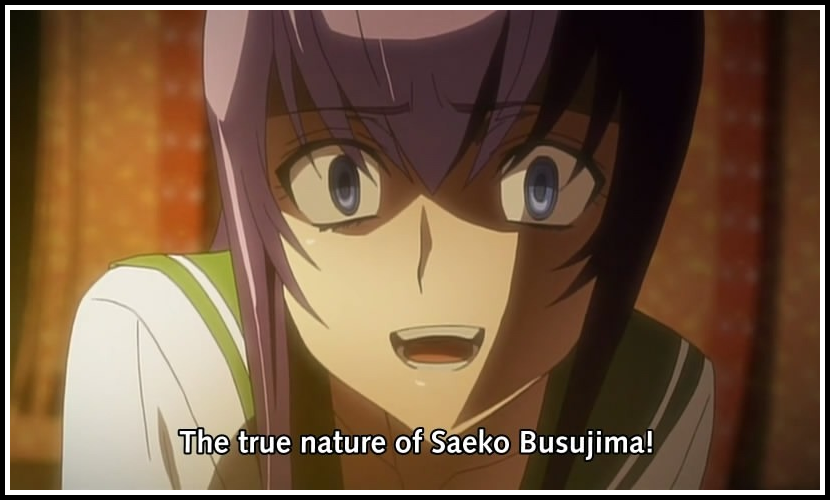
This brief lesson is due to the nature of episode 9 for Madhouse’s anime tv series adaptation of the horror manga title, Highschool of the Dead. This latest episode finally unleashed the dark secret one of the coolest characters in the series has been keeping to herself. For those who have been reading the manga on a regular basis already know of this secret, but for those whose experience of this title is only the anime this episode will open up Busujima Saeko.
The bokken wielding senior-class in the group has been one of the most level-headed in the group surviving since episode 1. Saeko never seems to panic and has shown to be expertly skilled in dispatching the unending stream of zombies with her wooden sword. Outside of the gun otaku himself, Kohta Hirano, she seems to be the one character in the group who has adapted well to the sudden and apocalyptic change in the world around them.
This episode puts her and Takashi Komuro (who is starting to gather quite the harem of hotties) on the run to find a way to the safety of Takagi Saya’s parents’ fortress compound. During their time running from the zombies to find a safe passage Saeko and Komuro get into all sorts of troubles with Saeko getting wet in more ways than one during their run. It’s during this time away from the rest of the group that we learn of Saeko’s penchant for just a bit of sadism.
A past encounter in her early highschool years convinced Saeko that she enjoys inflicting pain on those weaker than herself. This revelation becomes a huge 180 degrees from her earlier behavior. Out of the outside facade of being the cool-headed, elder student who never panics lies the heart of a sadistic yandere who has enjoyed killing “Them” with impunity. The changes in the world has allowed Saeko to indulge in her sadistic tendencies and maybe she’s in the right as it has helped her and her group survive the apocalypse, so far. Even Komuro has accepted this side of Saeko and sees it as a necessary evil in the days ahead.
The episode also hints at what could become a major love triangle (or is it quadrangle) as the relationship between Saeko and Komuro may have turned a particular intimate turn (before the scene faded to black). This episode has deftly laid the groundwork in what could become this series’ version of School Days and Higurashi no Naku Kuru ni. This new development in the series should quiet some of the nitpickers and naysayers (who still continue to watch despite their constant bitching about the series’ heavy fanservice) who wish for more character development and storytelling minus the constant oppai and pantsu shots.
One thing for sure, the anime has begun to take some liberties with details from the manga. This episode has changed the order of certain events and even changed the circumstances of how certain things occur. With four more episodes left in the season the question now is whether the series first season will end caught up to the manga (currently on chapter 26 or 27) or will it end on a cliffhanger that combines chapters 14-16 of the manga. Here’s to hoping that it’s the latter that way we get a follow-up season.





 Through the Shattered Lens