Funny Money (2006, directed by Leslie Greif)


Henry Perkins (Chevy Chase), the most boring man alive, has a job making wax fruit while his wife (Penelope Ann Miller) wants to make a living through drawing naked men.  (I guess that’s fair considering how many men make their living by drawing naked women.)  On Henry’s birthday, Henry spots a briefcase just like his and decides to swap them.  At home, Henry discovers that his new briefcase contains five million dollars!

Henry wants to move to Europe immediately.  But every time he and his wife try to leave their home, something occurs.  A menacing cop (Armanda Assante) shows up.  Henry’s friends drop by to celebrate his birthday.  The Romanian mob makes an appearance, looking for their money.  All Henry and his wife want to do is steal the money but instead, they spend a night dealing with false identities, physical comedy, and slapstick humor.

Funny Money was based on a stage play and it seems like the sort of thing that would have been hilarious if viewed live, with everyone running on and off the stage and some genuine suspense about who was going to show up next.  It does not translate well to film.  This would have been a good vehicle for Chase in the 80s or even the 90s but, by the time the movie was made, Chase seemed old and tired.  Penelope Ann Miller is never convincing as Chase’s wife.  (Someone should have tried to reunite Chase with Beverly D’Angelo or even Goldie Hawn for this movie.)  The main problem is that the supporting characters are never as funny or as quick-on-their-feet as the film needs them to be.  Armand Assante doesn’t seem to know he’s in a comedy.  Even a reliable actor like Christopher McDonald is let down by the film’s script and direction.  That’s too bad because the material had potential.  While it’s not a disaster like Cops and Robbersons, Funny Money is still never funny enough.

The Godson (1998, directed by Bob Hoge)


After the violent death of his son Sonny Calzone, the Oddfather (Dom DeLuise) announces that his other son, Guppy Calzone (Kevin McDonald, of the Kids In The Hall), will be taking over the family business.  Guppy is sent to Mafia University, where he learns how to garrote a traitor and dismember a body.  Guppy falls in love with Don Na (Fabiana Udenio), the daughter of the Rodfather (Rodney Dangerfield), the leader of a rival family.

The Godson tries to do to gangster movies what Airplane! did to disaster movies.  Dom DeLuise does a good Brando impersonation and there’s a funny moment where Guppy stops the action and tries to convince people in the audience to buy a Guppy action figure.  Otherwise, this is a poorly-done parody film.  Good comedy is all about timing and The Godson flunks that test.  Jokes are either too long or too short but hardly any of them stick.  The idea of Mafia University is funnier than the, if you’ll excuse the phrase, execution.  Even worse, the movie doesn’t make much use of Rodney Dangerfield.  When one of the funniest men who ever lived appears in your movie, it’s cinematic malpractice not to give him a chance to shine.

If the film has a highlight, it’s Lou Ferrigno as a member of the Oddfather’s crew.  Otherwise, this is a missed opportunity.

America is Sinking (2023, directed by Mario N. Bonassin)


“This place is about to get real wet!” Captain Pierce (Paul Logan) declares and he’s not kidding.

Remember how you always told yourself that you would do more to protect the environment and reduce your carbon footprint?  Well, you didn’t and now the glaciers are melting at a record pace and the extra water is loosening up all of the Earth’s plates.  We’re talking earthquakes and tsunamis!  Dog and cats living together!  Biblical proportions!  Florida and Washington are already underwater!  What can save the world?  Massive sinkholes!  But can the military and the scientists sink enough in two days to drain all the excess water?  And will the main scientist’s wife and daughter ever get their car to work before the floods come in?

America Is Sinking deserves an award for its title but the rest of the movie is all wet.  It’s low budget so there’s some cheap CGI and some stock footage but not enough to make us believe that America is actually sinking.  Watch it to discover whatever happened to Michael Pare.  (He ended up playing generals in movies like this.)  Former Secretary of Labor Robert Reich plays a Navy SEA.  I guess they’ll let anyone join now.


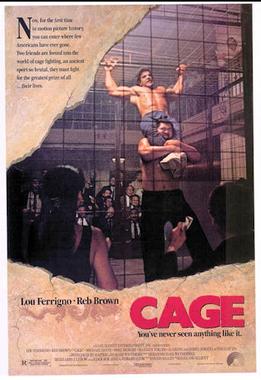
Cage (1989, directed by Lang Elliott)


As with so many stories, it all starts with Vietnam.

In 1969, soldier Billy Thomas (Lou Ferrigno) heroically saves the life of his captain, Scott Monroe (Reb Brown).  Unfortunately, while their helicopter is taking off, Billy takes a bullet to the head.  While he survives the wound, he is left with the mind of a child.  Scott dedicates his life to taking care of Billy and, after the war, they open a bar together.  However, mobster Tony Baccola (Michael Dante) feels that Billy would be the perfect contestant for a series of fight-to-death cage matches that have been set up by Chinese gangster Tin Lum Yin (James Shigeta).  In desperate need of money, Tony kidnaps Billy and forces him to fight, telling him that it’s what Scott needs him to do.  Billy doesn’t want to fight and, when he first enters the cage, he says, “Hi, how are you?” and tries to shake his opponent’s hand.  But when his opponents try to hit Billy, he has no choice but to defend himself.  It’s up to Scott to rescue his friend.

The plot of this movie is pretty dumb but I’m not embarrassed to say that the film itself won me over.  The fights were decent but the main reason why the movie works is because of Lou Ferrigno and Reb Brown, who made their friendship and their bond feel very real.  Ferrigno was especially good in this film.  How can you not root for a guy who just wants to be everyone’s friend and who, even after his twelfth cage match, still gets upset over having to hit people?

A pure B-movie all the way, Cage also features familiar faces like Branscombe Richmond, Al Leong, and Danny Trejo.  Most of the critics may not have liked it but Ferrigno has described Cage as being his his favorite film performance and I agree.

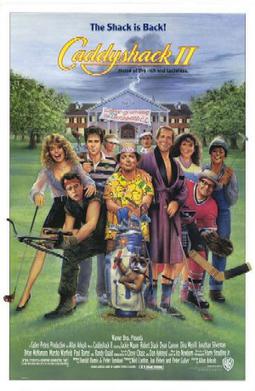
Caddyshack II (1988, directed by Allan Arkush)


Welcome back to Bushwood Country Club!  The Gopher is still stealing balls and burrowing through the course.  Ty Webb (Chevy Chase) is still the majority shareholder of the club, even though he now only plays golf inside of his mansion.  And that’s it!

Only the Gopher and Chevy Chase returned for Caddyshack II.  Ted Knight died before the movie went into production.  Bill Murray didn’t want to recreate his role from the first movie.  Rodney Dangerfield was involved in developing the movie but then dropped out after two million had already been spent in pre-production.  Chevy Chase was paid seven figures to return and he later called it one of the biggest mistakes of his career.  Only the Gopher didn’t complain.

With hardly anyone from the first film willing to come back for a second round, Caddyshack II features comedian Jackie Mason as Jack Hartounian, a real estate developer whose daughter, Kate (Jessica Lundy), wants to be a part of the WASPy Bushwood social set.  When Chandler Young (Robert Stack) keeps the plain-spoken Jack from being given a membership, Jack teams up with his old friend Ty and buys Bushwood.  He turns Bushwood into an amusement park called Jackie’s Wacky Golf.  Kate tells Jack that he’s ruined everything and turned Bushwood into Coney Island.  Chandler hires survivalist Tom Everett (Dan Aykroyd) to kill Jack and then agrees to play Jack in a round of golf.  The winner wins Bushwood.

A bust with both audiences and critics, Caddyshack II is one of the worst sequels ever made.  Why would you do a sequel to Caddyshack that features almost nothing that made the first film so entertaining?  Jackie Mason was a great comedian and writer but he wasn’t much of an actor and he makes a poor replacement for Rodney Dangerfield.  The film really loses me when Chandler Young literally pays money to have Jackie murdered.  It’s just a step too far.  Not even Ted Knight tried to kill Rodney Dangerfield and Dangerfield was a lot more obnoxious than Jackie Mason ever was.  Not even the dancing Gopher can generate much laughs and Kate’s right.  Jackie’s Wacky Golf really is a terrible place.

There are some interesting actors and actresses in the supporting cast.  The lovely Dyan Cannon plays Jack’s love interest and is one of the few good things about the movie, despite having no chemistry with Mason.  Randy Quaid gives a manic performance as Jack’s lawyer, a role that was originally meant for Sam Kinison.  Jonathan Silverman is the good caddy who falls for Jack’s daughter while Chynna Phillips is Chandler’s snobby daughter who befriends Kate and tells her she should change her last name to Hart.  Dan Aykroyd delivers all of his lines in a high-pitched voice that isn’t funny but which becomes very annoying.

The slobs win again.  The snobs are defeated and the Gopher dances with noticeably less enthusiasm.  There has never been a Caddyshack 3.

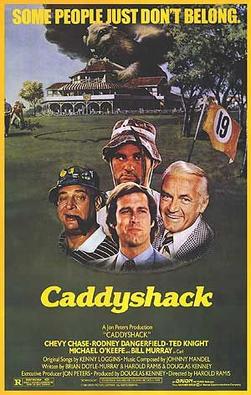
Caddyshack (1980, directed by Harold Ramis)


Whenever I think about Caddyshack, which is one of the funniest moves ever made, I think first of the Gopher, burrowing across the course and dancing to the music.

I then think about Bill Murray, playing the demented groundskeeper and growing his own special grass that you can both play golf on and smoke afterwards.

I remember Rodney Dangerfield dancing on the green while Ted Knight throws a fit.  This was the first film that I ever saw Rodney Dangerfield in.  “It looks good on you, though,” was one of those simple lines that Rodney could turn into a classic.

I remember Ted Knight, appearing in one of his few film roles, and saying, “Well, we’re waiting!” and drawing out every single word.

I remember the scene in the pool.  You know which one I’m talking about.

I remember Chevy Chase, back when he was still funny.

Then I remember how Rodney Dangerfield’s classic last line, “We’re all going to get laid,” was changed to “We’re all going to take a shower!” for television.  Why the censors thought that sounded less dirty than the original, I’ll never know.

I remember the Bishop getting struck by lightning while playing the best game of his life.

And, of course, I remember Cindy Morgan as Lacy Underall.

I remember so many classic moments and funny lines that I’m always surprised when I rewatch the movie and discover that it’s not really about the Gopher, Bill Murray, Rodney Dangerfield, Chevy Chase, or even Lacy Underall.  Instead, the main character in the movie is Danny Noonan (Michael O’Keefe), a teenage caddy at Bushwood Country Club who wants to win a scholarship so he can go to college and avoid having to work in the lumber yard with his father (Albert Salmi).  Danny has a friendly rivalry with caddy Tony D’Annuzio (Scott Colomby) and is dating Maggie (Sarah Holcomb).  Danny has to decide whether to ally himself with the snobs (led by Ted Knight) or the slobs (led by Rodney Dangerfield).

Caddyshack was originally envisioned as being Danny’s story but, once filming started, Harold Ramis (making his directorial debut) realized that the comedic characters were actually more interesting.  The movie went from being a straight-forward coming-of-age story to an almost plotless collection of gags and jokes, with both Bill Murray and Rodney Dangerfield improvising the majority of their dialogue and the Gopher emerging as the film’s true star.  That was bad news for the younger actors playing the caddies, who all found their roles greatly reduced in the film’s final cut but that was good news for audiences.  Caddyshack may not have much of a narrative structure but it does have some of the funniest people who ever lived at the peak of their powers.

Despite a legendarily troubled production, Caddyshack was a huge success with audiences and eventually, the critics came around as well.  Harold Ramis always said that he had a hard time watching it because all he could see were the mistakes that he made.  All audiences could see, though, was a hilariously funny movie that continues to bring people joy to this day.

Life Stinks (1991, directed by Mel Brooks)


Goddard Bolt (Mel Brooks), the massively wealthy CEO of Bolt Enterprises, wants to buy up a huge area of Los Angeles’s slums and tear them down, transforming the area into a chic neighborhood and moving all of the poor residents and street people out.  Rival businessman Vaughn Craswell (Jeffrey Tambor), who grew up in the slum and dreams of destroying it himself, has the same plan.  He and Bolt make a bet.  If Bolt can survive for 30 days on the streets, Craswell will allow Bolt to have the property.  Bolt agrees and soon, he is penniless and sleeping in alleys.  While Bolt befriends Sailor (Howard Morris) and Fumes (Theodore Wilson) and falls in love with a former dancer named Molly (Lesley Ann Warren), Craswell schemes to take over Bolt’s company and keep Bolt on the streets permanently.

Life Stinks was one of Mel Brooks’s attempts to make a straight comedy that wasn’t a parody and which had a serious message underneath the laughs.  The mix of comedy and drama doesn’t really gel,  because the drama is too dark and the comedy is too cartoonish.  Life Stinks is often guilty of romanticizing living on the streets.  With the exception of two muggers, everyone whom Bolt meets is a saint.  It is still interesting to see Brooks creatively at his most heartfelt and humanistic.

Life Stinks does feature some of Mel Brooks’s best work as an actor and it’s also features an excellent turn from Lesley Anne Warren.  At first, I thought Warren would be miscast as a woman who spent her days in a soup kitchen and her nights sleeping in an alley.  But she actually gives a very sweet and believable performance.

No matter what else, Mel Brooks is a true mensch.


Going Berserk (1983, directed by David Steinberg)


John Bourgignon (John Candy) is a man of many talents.  He’s a limo driver.  He’s a drummer.  He is an occasional actor, having starred in Kung Fu U. for his friend, director Sal DiPasquale (Eugene Levy).  John is also improbably engaged to Nancy Reece (Alley Mills), the daughter of Congressman and presidential candidate Ed Reese (Pat Hingle).  As the wedding approaches, John deals with a number of things.  He chauffeurs around a group of Spanish Beatles impersonators.  He finds himself handcuffed to a fugitive (Ernie Hudson) who dies at an inopportune time.  A cult leader (Richard Libertini) attempts to brainwash John into assassinating Ed, though the process might just turn John into a “schmuck.”

Going Berserk was John Candy’s first lead feature role and it was obviously designed to play to Candy’s popularity as one of the stars of SCTVGoing Berserk doesn’t gave a plot as much as it’s a collection of skits, some of which work better than others but all of which are held together by Candy’s comedic timing and amiable presence.  Going Berserk is disjointed and wildly uneven but it’s also frequently funny and that is a testament to Candy’s talent.  Even an overlong parody of The Blue Lagoon raises a smile because John Candy is just so committed to playing out the joke.

Going Berserk also features several familiar faces, like Richard Libertini, Pat Hingle, Ernie Hudson, Dixie Carter, Kurtwood Smith, Paul Dooley, and two of Candy’s SCTV co-stars, Eugene Levy and Joe Flaherty.  I especially liked Levy’s performance as the sleazy director who blackmails his way into filming the wedding.  Going Berserk was frequently stupid but, more often than not, it made me laugh.

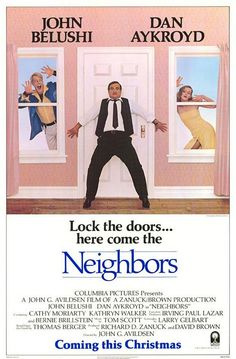
Neighbors (1981, directed by John G. Avildsen)


Uptight suburbanite Earl Keese (John Belushi) is paranoid about his new neighbors, Vic (Dan Aykroyd) and Ramona (Cathy Moriarty).  Ramona continually tries to seduce Earl (and everyone else) while Vic is loud and obnoxious, always telling off-color jokes and insinuating that Earl is less of a man than he is.  Earl thinks that there’s something mentally wrong with Vic but Earl’s wife and daughter (played respectively by Kathryn Walker and Lauren-Marie Taylor) love both Vic and Ramona.  Over the course of one very long night and morning, Earl grows more and more suspicious even as he starts to feel truly alive for the first time in several years.

Based on a novel by Thomas Berger, Neighbors is an unfortunate attempt at dark comedy that also turned out to be the final film appearance of John Belushi.  It’s appropriate that Belushi’s final film featured him with his comedic partner and best friend, Dan Aykroyd, though I think most of their fans would rather remember them for The Blues Brothers than Neighbors.  Originally, Aykroyd was cast as Earl while Belushi was meant to play Vic but the two actors decided to switch roles at the last minute.  It takes a while to get used to seeing Belushi as an uptight character who worries about the neighbor’s dog digging up his flower garden but Belushi actually does give a good performance as Earl, revealing that he had more range as an actor that most suspected.  Aykroyd and Moriarty also give good performances, though Aykroyd’s performance is not as much a departure as Belushi’s.  Earl is an amiable eccentric with several out-there beliefs, which also sounds like a good description of Dan Aykroyd.

Why, despite the talented cast, does Neighbors fail?  Director John G. Avildsen was the wrong choice to direct the film.  From the first shot of Earl and Vic’s two houses sitting on a hill and looking like left-over sets from The Addams Family, Avildsen directs in a cartoonish manner that is not appropriate for a comedy-of-manners.  The book’s humor comes from Earl becoming progressively more and more unstable but, in the movie, Earl seems to be unhinged from the start.  Bill Conti’s musical score drives him every point with a thudding obviousness.  Conti’s style was perfect for the soaring anthems of Rocky but not for a comedy like Neighbors.

Unfortunately, this would be Belushi’s final film.  Neighbors was released in December of 1981.  John Belushi died four months later.

The Art Of War (2000, directed by Christian Duguay)


In The Art of War, Wesley Snipes plays Neil Shaw, an UN operative who is framed for the assassination of a Chinese diplomat and who must uncover the real conspiracy while also proving his innocence.  Proving his innocence means engaging in a lot of conflict while using investigation techniques that were cribbed from the Mission Impossible films.

Featuring a lot of war but not much art, The Art of War has a few good action scenes and an overly convoluted storyline that sometimes makes the film feel like a retread of another film in which Snipes was framed for a crime he did not commit, U.S. Marshals.  It’s hard to take seriously any action hero who works for the United Nations but Wesley Snipes is credible in the action scenes and he could deliver a one-liner with the best of them.  (Of all the bad things you can say about the IRS, the worst is that it put one of our best action stars in prison.  Unforgivable!)  The supporting cast is good, featuring Donald Sutherland, Maury Chaykin, Anne Archer, and Michael Biehn.  The final battle between Snipes and the person who is revealed to be the main villain is exciting but, overall, The Art of War is overlong and overcomplicated.  Neil Shaw is cool but he’s no Blade.