Renegade Girl (1946, directed by William Berke)


Missouri in 1864.  The Civil War is raging and the state is divided between those who support the Union and those secretly support the Confederate guerillas led by Willian Quantrill (Ray Corrigan).  The Union’s Major Baker (Jack Holt) is determined to track down rebel Bob Shelby (Jimmie Martin) and he enlists the Native American Chief Whitecloud (played by Chief Thundercloud) to help find him.  Whitecloud has a personal vendetta against the Shelby family and, when he finds Bob, he executes him in cold blood.  Bob’s sister, Jean Shelby (Ann Savage), is also a Confederate sympathizer and she seeks revenge.  Complicating things is that Jean has fallen in love with Union Captain Fred Raymond (Alan Curtis).

One of the many B-westerns produced by Robert L. Lippert and directed by William Berke, Renegade Girl packs a lot of plot into just 65 minutes.  The action is nonstop and fans of westerns will find all of the horse chases, gunfights, and threats of hanging that they could want.  The main thing that distinguishes Renegade Girl from other B-westerns is the fierce performance of Ann Savage as Jean Shelby, a woman who will not stop until she gets her revenge.  While the film’s portrayal of the Quantrill and Chief Whitecloud definitely goes against modern sensibilities, Ann Savage’s performance feels ahead of her time.  No one is going to stand in Jean Shelby’s way.

Chief Thundercloud’s real name was reportedly Victor Daniels, though his past is shrouded in mystery.  He claimed to be a Cherokee from Arizona, though he was listed as being Mexican on a marriage record that was filed before he started his film career.  As Chief Thundercloud, he was a mainstay in westerns from the 30s to the time of his death in 1955.  He was the first actor to play the Lone Ranger’s Tonto and he also played Geronimo in a 1939 Paramount film of the same name.  His final film role was a posthumous appearance in John Ford’s The Searchers.

Behind the Camera: The Unauthorized Story of ‘Diff’rent Strokes’ (2006, dir by Robert Iscove)


Norman Lear has television superstar Conrad Bain under contract and Fred Silverman wants to build a show around Bain and a talented black child actor named Gary Coleman.  Entitled Diff’rent Strokes and featuring Todd Bridges and Dana Plato as Coleman’s brother and stepsister, the show is a hit.  The three young actors briefly become superstars, much like the amazing Conrad Bain.  And then, when the show is finally canceled after ten years, it all goes downhill as Todd Bridges and Dana Plato run into trouble with drugs and the law and Gary Coleman, once one of the highest paid stars on television, discovers that he’s now flat broke.  All three of them learn how quickly the world can turn on you when you’re no longer considered to be a success.

Behind the Camera: The Unauthorized Story of ‘Diff’rent Strokes’ was another one NBC’s cheap movies about the behind-the-scenes drama of a popular sitcom.  (They also did Three’s Company and Mork & Mindy).  Like all of NBC’s Behind the Camera movies, it makes the mistake of thinking that everyone is as interested in the habits of network executives as the people who work for them are.  (This time, it’s Saul Rubinek who gets to play Fred Silverman.)  The actors who plays Bridges, Coleman, and Plato are convincing enough but the storytelling is shallow, featuring the same information that you would expect to find in an episode of the E! True Hollywood Story.  I was disappointed that we didn’t get any scenes of Alan Thicke recording the theme song.

Todd Bridges and the late Gary Coleman both appear as themselves, talking about their experiences with the show and the difficulties of navigating life after Diff’rent Strokes was canceled.  Bridges is down-to-Earth while Coleman rambles like someone who was still trying to figure out how his life had led up to this moment.  The ending, in which Bridges and Coleman stand at Dana Plato’s grave and Coleman delivers a nearly incoherent monologue, is the one time that the film really captures any feeling of emotional honesty.  It is obvious that both Bridges and Coleman are still haunted by what happened to Plato after the show ended.  Knowing that Coleman himself would die just four years after the airing of this movie makes the scene more poignant when viewed today.


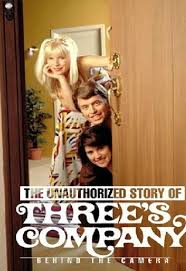
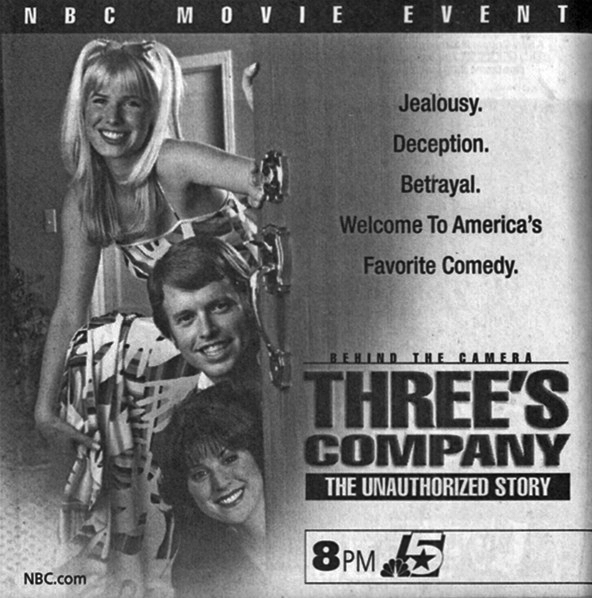
Behind the Camera: The Unauthorized Story of Three’s Company (2003, directed by Jason Ensler)


Do you remember Three’s Company?

The sitcom was a big hit when it aired in the 70s and 80s and it still gets a lot of play in syndication today.  Based on a British sitcom (and you would really be surprised to how closely the first season followed the original series), Three’s Company starred John Ritter as Jack Tripper, an aspiring chef who moved in with two single women, Janet (Joyce DeWitt) and Chrissy (Suzanne Somers).  Because their impotent landlord (Norman Fell) didn’t want people of the opposite sex living with each other unless they were married, Jack pretended to be gay.  Every episode centered around a misunderstanding, though it was Suzanne Somers’s performance as the perpetually bouncy and braless Chrissy Snow that made the show a hit.  The show fell apart when Somers asked for more money, Ritter and DeWitt got angry with her, and the studio bosses lied to everyone.  Today, the show is legendary as an example of how backstage tension can end even a popular series.

Behind The Camera: The Unauthorized Story of Three’s Company attempts to dramatize the success and eventual downfall of Three’s Company.  Joyce DeWitt appears at the beginning and the end to talk about how important she thinks the show was.  In the movie, she is played by Melanie Paxson.  John Ritter is played by a lookalike actor named Bret Anthony while an actress named Jud Taylor plays Somers.  Brian Dennehy plays ABC president Fred Silverman and other executives are played by Daniel Roebuck, Wallace Langham, Gary Hudson, and Christopher Shyer.  The movie recreates all of the drama that went on during Three’s Company without offering much insight or really anything new to the story.  Even though the movie was co-produced and hosted by Joyce DeWitt, Suzanne Somers is really the only sympathetic character in the movie.  DeWitt comes across as being jealous while Anthony plays John Ritter as being a bland nonentity who chooses his own success over being honest with his costars.  The network executives are more interesting, just because watching them provides a glimpse into how real producers and showrunners picture themselves.  They just wanted to make a good show about a sex addict pretending to be gay so he could live with two attractive, single women but the agents and the network presidents just keep getting in the way!  Won’t someone please think of the mid-level network executives?

Bland though this recreation was, it was enough of a rating hits that NBC went on to produce several more Behind The Camera films.  Three’s Company was only the beginning.

A Joseph Cotten Scene That I Love From Citizen Kane


Joseph Cotten passed away 31 years ago today.  Cotten appeared in a lot of good films and worked with many important directors but he will always be remembered for bringing to life Jedidiah Leland, the drama critic in Citizen Kane.  I liked the character so much that I paid tribute to him with my penname, though I substituted an A for the first I.

Cotten played Jedidiah as both a young man and an old man in Citizen Kane.  The first time I saw the movie, I reacted to the young Leland.  With each passing year, I think I understand better what the older Leland was talking about when he said that memory is the greatest curse ever inflicted on the human race.

(Even retired and living in what appears to be a nursing home, Jedidiah Leland still spoke like a drama critic.)


Madhouse (1990, directed by Tom Ropelewski)


Mark (John Larroquette) and Jessa Bannister (Kirstie Alley) have a perfect yuppie lifestyle going until their respective family members show up at their California home and refuse to leave.  First, it’s Mark cousin (John Diehl) and his wife (Jessica Lundy).  Then it’s Jessa’s sister, Claudia (Alison LaPlaca), who has just left her husband and now has to find a new man to support her lifestyle.  Mark and Jessa just want some time alone but instead, they have to deal with a cat who is frequently mistaken for dead, broken marriages, a shipment of cocaine, and a neighbor (Robert Ginty) who builds weird bed frames.  Mark has a big contract to land and Jessa is trying to succeed as a television news reporter but it’s not easy when you’re living in a madhouse.

There are some films that you just like despite yourself and that’s the way I feel about Madhouse.  It’s very much an 80s film, with its emphasis on material goods and achieving the perfect lifestyle.  (The appearance of Dennis Miller as Mark’s co-worker only reminds us of just how much a product of its era that Madhouse is.)  There are a lot of jokes that don’t work and some, like the cat that is continually mistaken for dead, that shouldn’t work but do.  It’s a sitcom transferred to the movies and the humor rarely rises above that level.  It ever stars two of the decade’s biggest sitcom stars, John Larroquette and Kirstie Alley.  Larroquette shows us why he was better suited for television while Alley shows how tragic it was that she didn’t have a bigger film career.  Kirstie Alley gives such a dedicated and fearless performance as someone who has been driven to the end of her rope that it keeps you interested in the film.  Alley, like the great comedic actresses of Hollywood’s golden age, was an actress who could mix physical comedy with barbed one-liners and who was undeniably appealing as she moved from one disaster to the next.  In Madhouse, she was beautiful, frantic, sexy, neurotic, relatable, and funny all at the same time.  By the end of this movie, you really do wish she had gotten more and better opportunities to show off her talents in the years after Cheers went off the air.

Madhouse is nothing special.  It’s a generic comedy about unwanted family guests.  But I’ll always appreciate it for Kirstie Alley.

Funny Money (2006, directed by Leslie Greif)


Henry Perkins (Chevy Chase), the most boring man alive, has a job making wax fruit while his wife (Penelope Ann Miller) wants to make a living through drawing naked men.  (I guess that’s fair considering how many men make their living by drawing naked women.)  On Henry’s birthday, Henry spots a briefcase just like his and decides to swap them.  At home, Henry discovers that his new briefcase contains five million dollars!

Henry wants to move to Europe immediately.  But every time he and his wife try to leave their home, something occurs.  A menacing cop (Armanda Assante) shows up.  Henry’s friends drop by to celebrate his birthday.  The Romanian mob makes an appearance, looking for their money.  All Henry and his wife want to do is steal the money but instead, they spend a night dealing with false identities, physical comedy, and slapstick humor.

Funny Money was based on a stage play and it seems like the sort of thing that would have been hilarious if viewed live, with everyone running on and off the stage and some genuine suspense about who was going to show up next.  It does not translate well to film.  This would have been a good vehicle for Chase in the 80s or even the 90s but, by the time the movie was made, Chase seemed old and tired.  Penelope Ann Miller is never convincing as Chase’s wife.  (Someone should have tried to reunite Chase with Beverly D’Angelo or even Goldie Hawn for this movie.)  The main problem is that the supporting characters are never as funny or as quick-on-their-feet as the film needs them to be.  Armand Assante doesn’t seem to know he’s in a comedy.  Even a reliable actor like Christopher McDonald is let down by the film’s script and direction.  That’s too bad because the material had potential.  While it’s not a disaster like Cops and Robbersons, Funny Money is still never funny enough.

The Godson (1998, directed by Bob Hoge)


After the violent death of his son Sonny Calzone, the Oddfather (Dom DeLuise) announces that his other son, Guppy Calzone (Kevin McDonald, of the Kids In The Hall), will be taking over the family business.  Guppy is sent to Mafia University, where he learns how to garrote a traitor and dismember a body.  Guppy falls in love with Don Na (Fabiana Udenio), the daughter of the Rodfather (Rodney Dangerfield), the leader of a rival family.

The Godson tries to do to gangster movies what Airplane! did to disaster movies.  Dom DeLuise does a good Brando impersonation and there’s a funny moment where Guppy stops the action and tries to convince people in the audience to buy a Guppy action figure.  Otherwise, this is a poorly-done parody film.  Good comedy is all about timing and The Godson flunks that test.  Jokes are either too long or too short but hardly any of them stick.  The idea of Mafia University is funnier than the, if you’ll excuse the phrase, execution.  Even worse, the movie doesn’t make much use of Rodney Dangerfield.  When one of the funniest men who ever lived appears in your movie, it’s cinematic malpractice not to give him a chance to shine.

If the film has a highlight, it’s Lou Ferrigno as a member of the Oddfather’s crew.  Otherwise, this is a missed opportunity.

America is Sinking (2023, directed by Mario N. Bonassin)


“This place is about to get real wet!” Captain Pierce (Paul Logan) declares and he’s not kidding.

Remember how you always told yourself that you would do more to protect the environment and reduce your carbon footprint?  Well, you didn’t and now the glaciers are melting at a record pace and the extra water is loosening up all of the Earth’s plates.  We’re talking earthquakes and tsunamis!  Dog and cats living together!  Biblical proportions!  Florida and Washington are already underwater!  What can save the world?  Massive sinkholes!  But can the military and the scientists sink enough in two days to drain all the excess water?  And will the main scientist’s wife and daughter ever get their car to work before the floods come in?

America Is Sinking deserves an award for its title but the rest of the movie is all wet.  It’s low budget so there’s some cheap CGI and some stock footage but not enough to make us believe that America is actually sinking.  Watch it to discover whatever happened to Michael Pare.  (He ended up playing generals in movies like this.)  Former Secretary of Labor Robert Reich plays a Navy SEA.  I guess they’ll let anyone join now.


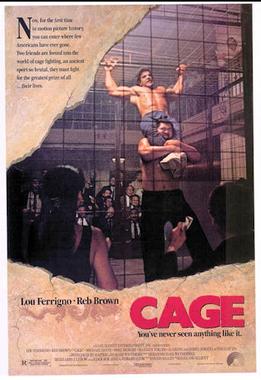
Cage (1989, directed by Lang Elliott)


As with so many stories, it all starts with Vietnam.

In 1969, soldier Billy Thomas (Lou Ferrigno) heroically saves the life of his captain, Scott Monroe (Reb Brown).  Unfortunately, while their helicopter is taking off, Billy takes a bullet to the head.  While he survives the wound, he is left with the mind of a child.  Scott dedicates his life to taking care of Billy and, after the war, they open a bar together.  However, mobster Tony Baccola (Michael Dante) feels that Billy would be the perfect contestant for a series of fight-to-death cage matches that have been set up by Chinese gangster Tin Lum Yin (James Shigeta).  In desperate need of money, Tony kidnaps Billy and forces him to fight, telling him that it’s what Scott needs him to do.  Billy doesn’t want to fight and, when he first enters the cage, he says, “Hi, how are you?” and tries to shake his opponent’s hand.  But when his opponents try to hit Billy, he has no choice but to defend himself.  It’s up to Scott to rescue his friend.

The plot of this movie is pretty dumb but I’m not embarrassed to say that the film itself won me over.  The fights were decent but the main reason why the movie works is because of Lou Ferrigno and Reb Brown, who made their friendship and their bond feel very real.  Ferrigno was especially good in this film.  How can you not root for a guy who just wants to be everyone’s friend and who, even after his twelfth cage match, still gets upset over having to hit people?

A pure B-movie all the way, Cage also features familiar faces like Branscombe Richmond, Al Leong, and Danny Trejo.  Most of the critics may not have liked it but Ferrigno has described Cage as being his his favorite film performance and I agree.

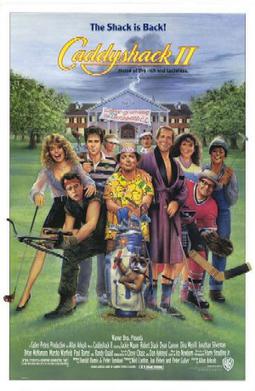
Caddyshack II (1988, directed by Allan Arkush)


Welcome back to Bushwood Country Club!  The Gopher is still stealing balls and burrowing through the course.  Ty Webb (Chevy Chase) is still the majority shareholder of the club, even though he now only plays golf inside of his mansion.  And that’s it!

Only the Gopher and Chevy Chase returned for Caddyshack II.  Ted Knight died before the movie went into production.  Bill Murray didn’t want to recreate his role from the first movie.  Rodney Dangerfield was involved in developing the movie but then dropped out after two million had already been spent in pre-production.  Chevy Chase was paid seven figures to return and he later called it one of the biggest mistakes of his career.  Only the Gopher didn’t complain.

With hardly anyone from the first film willing to come back for a second round, Caddyshack II features comedian Jackie Mason as Jack Hartounian, a real estate developer whose daughter, Kate (Jessica Lundy), wants to be a part of the WASPy Bushwood social set.  When Chandler Young (Robert Stack) keeps the plain-spoken Jack from being given a membership, Jack teams up with his old friend Ty and buys Bushwood.  He turns Bushwood into an amusement park called Jackie’s Wacky Golf.  Kate tells Jack that he’s ruined everything and turned Bushwood into Coney Island.  Chandler hires survivalist Tom Everett (Dan Aykroyd) to kill Jack and then agrees to play Jack in a round of golf.  The winner wins Bushwood.

A bust with both audiences and critics, Caddyshack II is one of the worst sequels ever made.  Why would you do a sequel to Caddyshack that features almost nothing that made the first film so entertaining?  Jackie Mason was a great comedian and writer but he wasn’t much of an actor and he makes a poor replacement for Rodney Dangerfield.  The film really loses me when Chandler Young literally pays money to have Jackie murdered.  It’s just a step too far.  Not even Ted Knight tried to kill Rodney Dangerfield and Dangerfield was a lot more obnoxious than Jackie Mason ever was.  Not even the dancing Gopher can generate much laughs and Kate’s right.  Jackie’s Wacky Golf really is a terrible place.

There are some interesting actors and actresses in the supporting cast.  The lovely Dyan Cannon plays Jack’s love interest and is one of the few good things about the movie, despite having no chemistry with Mason.  Randy Quaid gives a manic performance as Jack’s lawyer, a role that was originally meant for Sam Kinison.  Jonathan Silverman is the good caddy who falls for Jack’s daughter while Chynna Phillips is Chandler’s snobby daughter who befriends Kate and tells her she should change her last name to Hart.  Dan Aykroyd delivers all of his lines in a high-pitched voice that isn’t funny but which becomes very annoying.

The slobs win again.  The snobs are defeated and the Gopher dances with noticeably less enthusiasm.  There has never been a Caddyshack 3.