The Killer Inside Me (1976, directed by Burt Kennedy)


Today is Stacy Keach’s 84th birthday.

Stacy Keach has always been an underappreciated actor.  Despite his obvious talent and his ability to play both heroes and villains, he’s never really gotten the film roles that he’s deserved and he’s mostly made his mark on stage and on television.  There have been a few good films that made use of Keach’s talents.  I’ve always appreciated his performance as Frank James in Walter Hill’s The Long Riders.  He was a morally ambiguous Doc Holliday in Doc.  He played a boxer in John Huston’s Fat City.  Horror fans will always remember him for Road Games. The Ninth Configuration featured a rare starring role for Keach but it was treated poorly by its studio.  He was chilling as a white supremacist in American History X.  For the most part, though, Keach’s film career has been made up of stuff like Class of 1999.  For all of his talent, he seems destined to be remembered mostly for playing Mike Hammer in a television series and a few made-for-TV movies.  It’s too bad because Keach had the talent to bring certain character to life in a way that few other actors can.

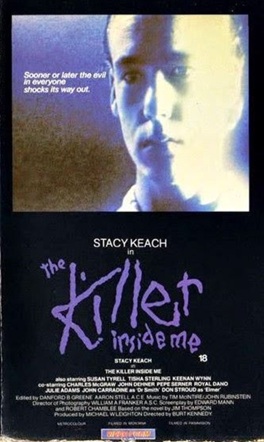
The Killer Inside Me features one of Keach’s best performances.  Based on a pulp novel by Jim Thompson, The Killer Inside Me stars Stacy Keach as Lou Ford.  Lou is a small town deputy.  Everyone thinks that he’s a good, decent man.  He’s dating the local school teacher (Tisha Sterling).  The sheriff (John Dehner) trusts him.  Lou seems to be an expert at settling conflicts between neighbors.  What everyone doesn’t know is that Lou is actually a psycho killer who is having a sado-masochistic affair with a local prostitute (Susan Tyrrell) and who has zero qualms about punching the life out of someone.  When Lou finds out that Tyrrell is also involved with the son of a local businessman, it sets Lou on a crime and killing spree.  Lou thinks he’s a genius but his main strength is that no one can imagine Lou Ford doing the terrible things that he does.

Burt Kennedy was an outstanding director of westerns and straight-forward action movies but he appears to have struggled with The Killer Inside Me’s morally ambiguous tone.  The end result is not a great film but it does feature a great performance from Stacy Keach.  In both his performance and his narration, Keach captures both the arrogance and the detachment from normal society that defines Lou Ford’s character.  He also shows how Ford coolly manipulates the people around him.  Keach is believable and compelling whether he’s playing the fool or if he’s committing cold-blooded murder and he also subtly shows that Lou is not as smart as he thinks he is.  Though Keach dominates the film, The Killer Inside Me also features good performances from a gallery of 70s character actors, including John Carradine, Keenan Wynn, Don Stroud, Charles McGraw, and Royal Dano.

This version of The Killer Inside Me didn’t do much at the box office.  The movie was remade in 2010, with Casey Affleck miscast as Lou Ford.  That version didn’t do much at the box office either.  The secret to recreating the book’s mix of social satire and pulp action has proven elusive to filmmakers but at least we’ve got Stacy Keach’s performance as Lou Ford to appreciate.

Tonight’s #MondayActionMovie Will Be Bulletproof!


Tonight’s #MondayActionMovie will be Bulletproof (1987), a movie that I know nothing about, other than it stars Gary Busey and Henry Silva and it’s about a stolen tank!  The movie starts at 8:00 eastern and the event takes place on Mastodon, the social network that time forgot.

I was hesitant about joining Mastodon because I’m hesitant about every social network.  Back in the day, I deleted MySpace after two weeks.  I have never joined Facebook.  It took Lisa five years to convince me to get on twitter.  I really only joined Mastodon to support Monday Action Movie but I’m glad I did because it is a nice, low-pressure social network.  I haven’t joined Bluesky and I’m not going to.

Back to Bulletproof, it’s on YouTube.  If you’re on Mastodon, join in using the #MondayActionMovie.  I’ll be there.  Lisa should be there.  It’s fun, I promise!

Music Video of the Day: Only by Anthrax (1993, directed by Paul Elledge)


Rocking with Anthrax!

This song is off of Anthrax’s sixth studio album, Sound of White Noise and it was one of their bigger hits from the John Bush era.  No less than James Hetfield referred to this as being a “perfect song.”  The video mixes surreal imagery with clips of the band playing.

If the man with the mirror looks familiar, that’s because he’s played by Frank Silva, who was also Killer Bob on Twin Peaks.  This was Silva’s only role outside of Twin Peaks.

Director Paul Elledge was a photographer who also directed videos  for Ministry.

Enjoy!

Invictus (2009, directed by Clint Eastwood)


Just when I thought I was through with Clint Eastwood, they pull me back in!

Actually, Clint Eastwood may have directed Invictus but that’s not why I’m writing about it today.  I’m writing about it because today is Morgan Freeman’s 88th birthday.  Everyone knows Morgan Freeman, of course,  He’s the man with the amazing voice.  If you ever want to hear someone narrate your life, you want that narrator to Morgan Freeman.  Freeman is also one of our greatest actors and, for my money, Invictus is his best and more important performance.

Morgan Freeman plays the role of Nelson Mandela in Invictus.  Taking place in 1994 and 1995, Invictus centers around the early days of the former political prisoner’s presidency of South Africa and how he used the 1995 Rugy World Cup to bring the tension-filled country together.  While Afrikaner Francois Pinneaur (Matt Damon) unexpectedly leads South Africa to the finals of the World Cup, Mandela tries to guide South Africa into the post-Apartheid era.

Playing a role like Nelson Mandela would have to intimidate even the most confident of actors but Freeman gives a warm, humorous, and believable performance of a man who became a living icon.  Freeman captures both Mandela’s humanity and his canny political instincts and he never allow the performance to become a caricature.  Freeman projects the wisdom that comes from a lifetime of refusing to be broken or defeated, despite the best efforts of both the Apartheid regime and the activists who think that, as president, Mandela is too much of a moderate and too quick to forgive.  Freeman (and Matt Damon) give performances that help the film get over a few spots where it falls into the typical clichés  of the sports genre.  Invictus is a good tribute to both Mandela and the way competition can bring people together.

One final note: Invictus was filmed on location in South Africa.  When Matt Damon’s character is shown the cell were Mandela spent 27 years of his life, Eastwood shows us the actual cell and it’s a reminder of the strength of Mandela that he not only survived but that he went on to lead his country.

Richard Jewell (2019, directed by Clint Eastwood)


In 1996, a security guard named Richard Jewell should have been proclaimed a hero.  He spotted an abandoned backpack in Centennial Park during the Atlanta Summer Olympics.  Thinking that it could be a bomb, Jewell, insisting the proper security protocols be followed even though there was a concert going on, moved as many people as he could away from the backpack before it exploded.  Two people died as a result of the explosion and 111 were injured.  The number would have been much more catastrophic if not for Jewell’s actions.

Jewell saved lives but he soon found himself the number one suspect.  Overweight, a little bit nerdy, Southern accented and possessing a spotty work history, Richard Jewell did not fit the popular conception of a hero.  After the FBI leaked that Jewell was their number one suspect, the press literally reported as if Jewell’s arrest was imminent.  I’m old enough to remember the way that, for a month, the nightly news seemed like the counting the days until Jewell was charged.  Jewell, however, was never arrested and eventually, he sued several media outlets for libel.  After anti-abortion fanatic Eric Rudolph emerged as the number one suspect in the bombing, the three FBI agents who attempted to railroad Jewell were disciplined.  One was suspended for five days without pay, which seems a light punishment for ruining a man’s life.

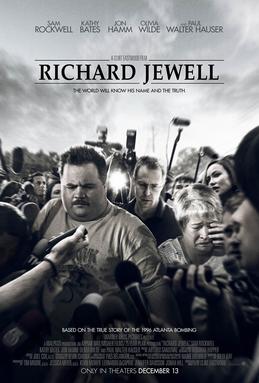
Clint Eastwood’s Richard Jewell was about the persecution of the title character, with Paul Walter Hauser playing Jewell, Kathy Bates playing his mother, Jon Hamm playing the arrogant FBI agent, Olivia Wilde playing the unethical journalist who first reported that Jewell was a suspect, and Sam Rockwell playing Jewell’s attorney.  When Richard Jewell was released in 2019, there was a lot of debate about the way it presented both the media and the FBI.  This was during the first Trump presidency and many critics felt that it was not the right time for a film about an irresponsible reporter and a corrupt FBI agent.  But Eastwood’s film isn’t about the reporter or the FBI.  Instead, like many of his films, it’s about a loner who does the right thing, refuses to compromise, and suffers for it.  If the FBI and the media didn’t want to be presented as being villains in a movie about Richard Jewell, they should have thought twice before announcing to the the world that they thought he was a murderer.

Because of the controversy, Richard Jewell is one of Eastwood’s unfairly overlooked films.  Along with directing in his usual straightforward manner, Eastwood gets a great performance out of Paul Walter Hauser and reminds us that not every hero looks like the Man With No Name.  Even more importantly, Eastwood pays tribute to a man who deserved better than he was given by the world.  Richard Jewell died 12 years before the film that was named after him was released.  A lot of people wanted to sweep what happened to Richard Jewell under the rug.  Eastwood, in one of the best of his later films, refused to let that happen.

Paul Walter Hauser and Clint Eastwood

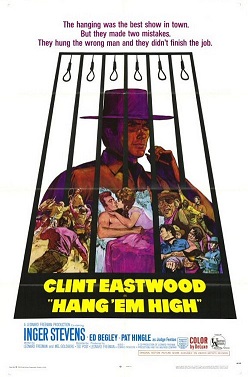
Hang ‘Em High (1968, directed by Ted Post)


1889.  The Oklahoma Territory.  A former lawman-turned-cattleman named Jed Cooper (Clint Eastwood) is falsely accused of working with a cattle thief.  A group of men, led by Captain Wilson (Ed Begley) lynch him and leave Cooper hanging at the end of a rope.  Marshal Dave Bliss (Ben Johnson) saves Cooper, cutting him down and then taking him to the courthouse of Judge Adam Fenton (Pat Hingle).  Fenton, a notorious hanging judge, is the law in the Oklahoma territory.  Fenton makes Cooper a marshal, on the condition that he not seek violent revenge on those who lynched him but that he instead bring them to trial.  Cooper agrees.

An American attempt to capture the style of the Italian spaghetti westerns that made Eastwood an international star, HangEm High gives Eastwood a chance to play a character who is not quite as cynical and certainly not as indestructible as The Man With No Name.  Cooper starts the film nearly getting lynched and later, he’s shot and is slowly nursed back to health by a widow (Inger Stevens).  Cooper is not a mythical figure like The Man With No Name.  He’s an ordinary man who gets a lesson in frontier justice as he discovers that, until Oklahoma becomes a state, Judge Fenton feels that he has no choice but to hang nearly every man convicted of a crime.  (Judge Fenton was based on the real-life hanging judge, Isaac Parker.)  Over the course of this episodic film, Cooper becomes disgusted with frontier justice.

HangEm High is a little on the long side but it’s still a good revisionist western, featuring a fine leading performance from Clint Eastwood and an excellent supporting turn from Pat Hingle.  The film’s episodic structure allows for Eastwood to interact with a motley crew of memorable character actors, including Bruce Dern, Dennis Hopper, L.Q. Jones, Alan Hale (yes, the Skipper), and Bob Steele.  HangEm High has a rough-hewn authenticity to it, with every scene in Fenton’s courtroom featuring the sound of the gallows in the background, a reminder that justice in the west was often not tempered with mercy.

Historically, Hang ‘Em High is important as both the first film to be produced by Eastwood’s production company, Malpaso, and also the first to feature Eastwood acting opposite his soon-to-be frequent co-star, Pat Hingle.  Ted Post would go on to direct Magnum Force.

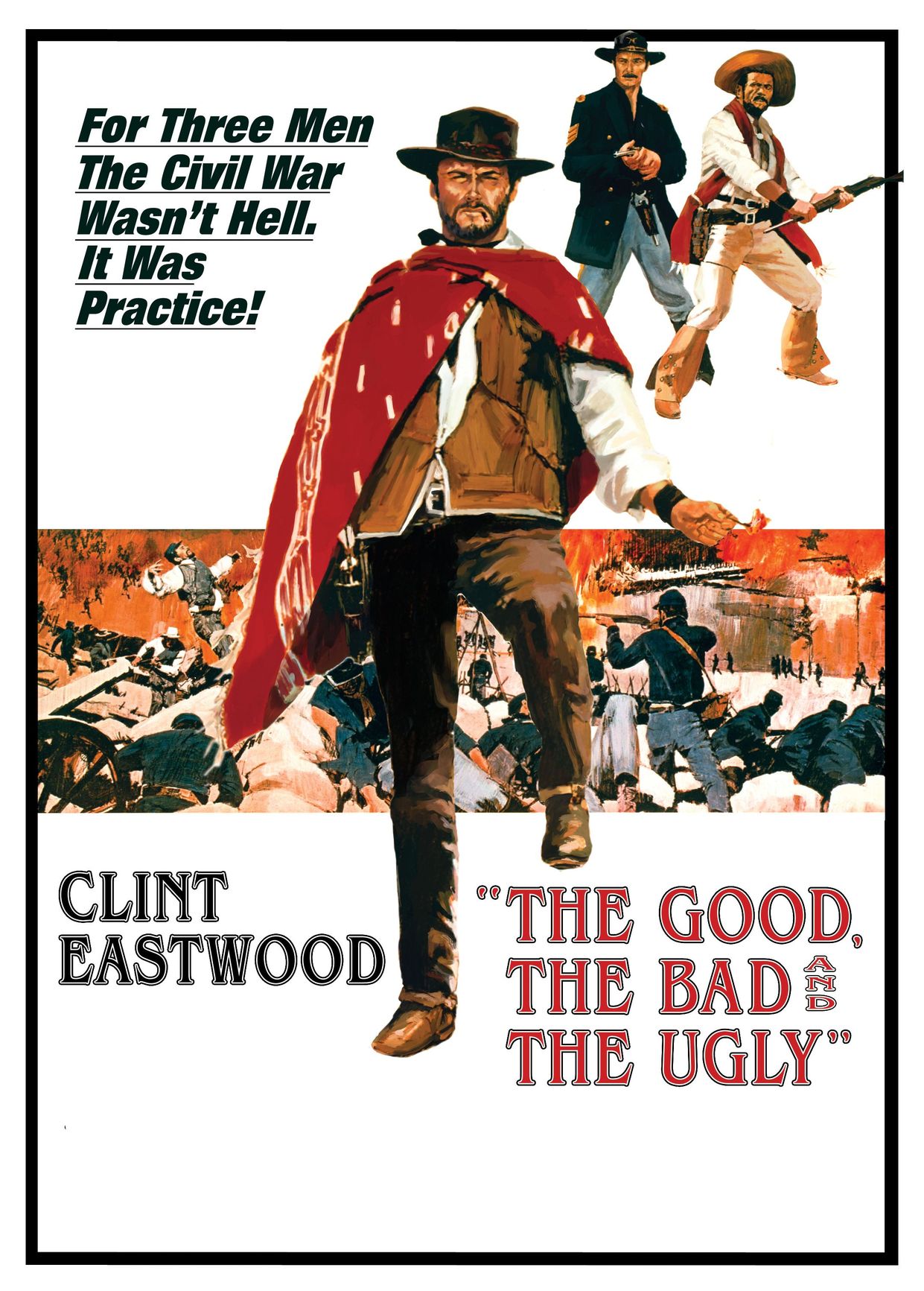
The Adventures of the Man With No Name: A Fistful Of Dollars, For A Few Dollars, The Good, The Bad, and the Ugly


Originally, Sergio Leone envisioned none other than Henry Fond as The Man With No Name.

The year was 1964 and Sergio Leone was searching for the right actor to star in the movie that would become A Fistful Of Dollars.  The film, which reimagined Akira Kurosawas’s Yojimbo as a western, centered around a mysterious, amoral gunslinger whose name was unknown.  Leone needed an American or a British name to star in the film so that it could get distribution outside of Italy.  Leone had grown up watching Henry Fonda movies, all dubbed into Italian.  He later said he wanted to cast Fonda because he always wondered what Fonda’s voice actually sounded like.

After realizing that a major Hollywood star would never agree to star in a low-budget Italian western, Leone then offered the role to Charles Bronson.  Bronson read the script and said it didn’t make sense to him.  Leone went on to offer the role to Henry Silva, Rory Calhoun, Tony Russel, Steve Reeves, Ty Hardin, and James Coburn.  Everyone was either too expensive or just not interested.  Finally, it was actor Richard Harrison who, after tuning down the part himself, suggested that Leone offer the role to Clint Eastwood.  Eastwood, then starring on the American western Rawhide, could play a convincing cowboy.  Leone followed Harrison’s advice and Eastwood, eager to break free of his nice guy typecasting and hoping to restart his film career, accepted.  The rest is history.

Eastwood would only play The Man With No Name in three films but, in doing so, he changed the movies and the popular conception of the action hero forever.

All three of the Man With No Name movies have been reviewed on this site.  But, since today is Clint’s birthday, I thought I’d take a look at how these classic films are holding up, over 60 years since the Man With No Name made his first appearance.

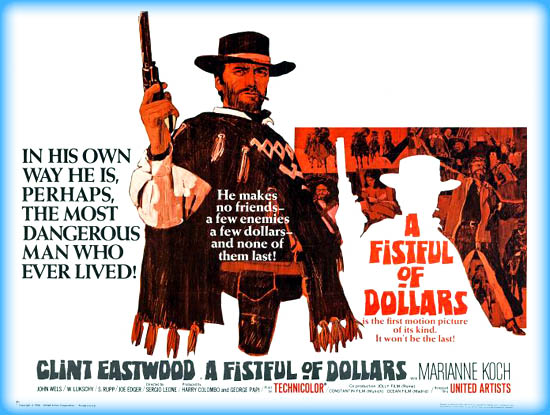
A Fistful Of Dollars (1964)

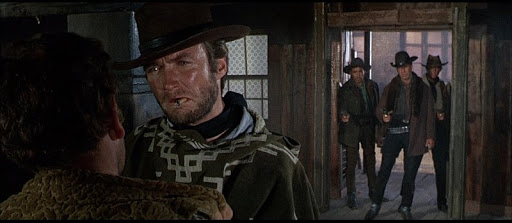
Having now seen both this film and Yojimbo, it’s remarkable how closely A Fistful of Dollars sticks to Kurosawa’s original film.  Interestingly, it’s clear that Eastwood patterned his performance of Toshiro Mifune’s in Yojimbo and yet, at the same time, he still managed to make the role his own.  The Man With No Name rides into a western town, discovers that there are two groups fighting for control of the area, and he coolly plays everyone against each other.  Whether it’s planting the seeds of distrust, exploiting an enemy’s greed, or being the quickest on the draw, the Man With No Name instinctively knows everything that he has to do.  Even when he’s getting beaten up by the bad guys, The Man With No Name always seems to be one step ahead.  Today, a western in which everyone is greedy and looking out for themselves isn’t going to take anyone by surprise.  But if you’ve watched enough westerns from the 40s and 50s, you’ll understand how unique of a viewpoint Leone brought to the genre.  Eastwood’s amoral gunslinger was such a surprise that, when the film aired on television, a scene was shot by the network in which Harry Dean Stanton played a prison warden who released The Man With No Name (seen only from behind) on the condition that he clean up the town.

For A Few Dollars More (1965)

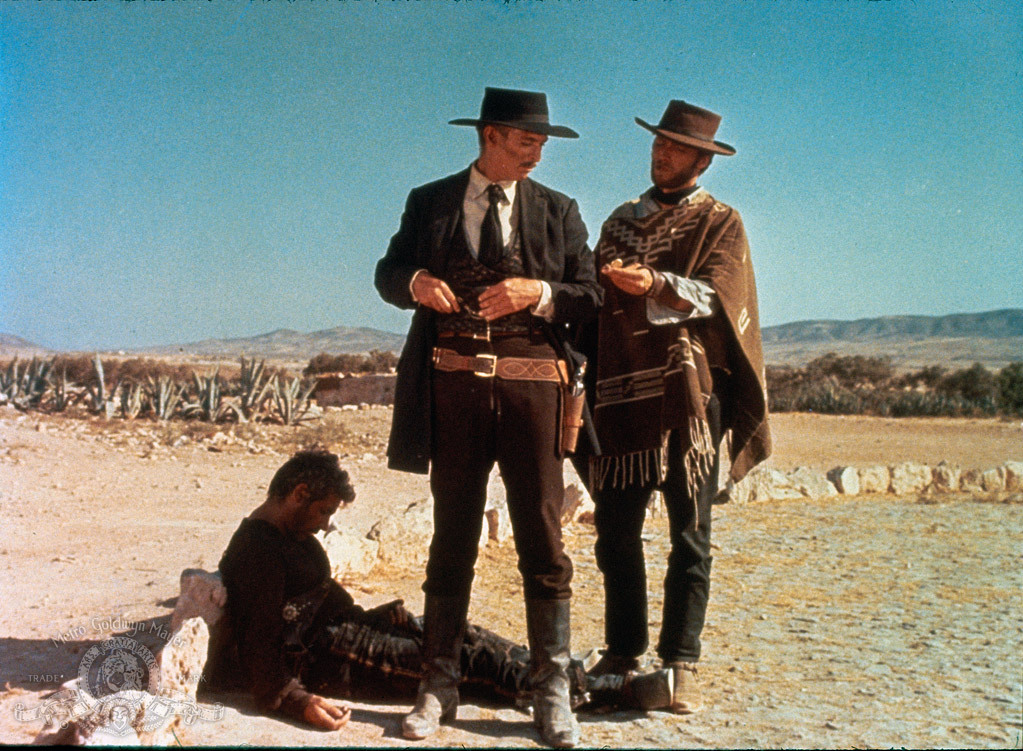
For A Few Dollars More finds The Man With No Name working as a bounty hunter and teaming up with Colonel Mortimer (Lee Van Cleef) to take down El Indio (Gian Maria Volonte) and his gang (including Klaus Kinski as a hunchback.)  This is my least favorite of the trilogy but that doesn’t mean that For A Few Dollars More is a bad film.  Being the least of three masterpieces is nothing to be ashamed of.  Eastwood and Van Cleef were two of the best and it’s interesting to see them working together.  El Indo is a truly loathsome villain and the members of his gang are all memorably horrid.  If it’s my least favorite, it’s just because I prefer the wit of A Fistful of Dollars and the epic storytelling of The Good, The Bad, and The Ugly.  Speaking of which…

The Good, The Bad, and The Ugly (1966)

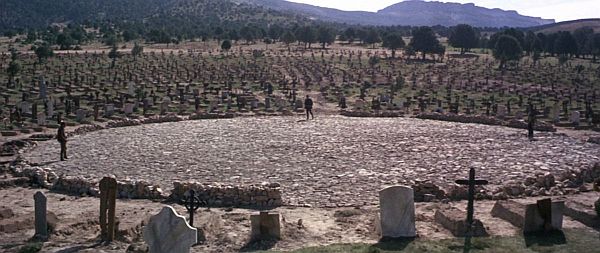
This is it.  The greatest western ever made, an epic film that features Leone’s best direction, Ennio Morricone’s greatest score, and brilliant performances from Eastwood, Van Cleef, and especially Eli Wallach.  It’s hard to know where to start when it comes to praising The Good, The Bad, and The Ugly.  It’s a nearly three-hour film that doesn’t have a single slow spot and it has some of the most iconic gunfights ever filmed.  Leone truly found his aesthetic voice in this film and that it still works, after countless parodies, is evidence of how great it is.  I appreciate that this film added a historical context to the adventures of The Man With No Name.  (Personally, I think this film is meant to be a prequel to A Fistful of Dollars, just because The Man With No Name is considerably kinder in this film than he was in the first two movies.  The Man With No Name that we meet in A Fistful of Dollars would never have gotten Tuco off that tombstone.)  The Good, The Bad, and The Ugly takes place during the Civil War and, along with everything else, it’s an epic war film.  While America fights to determine its future, three men search for gold.  The cemetery scene will never be topped.

American critics did not initially appreciate these films but audiences did.  Clint Eastwood may have been a television actor when he left for Italy but he returned as an international star.  And, to think, it all started with Sergio Leone not being able to afford Henry Fonda.

Music Video of the Day: 5 Minutes Alone by Pantera (1994, directed by Wayne Isham)


In an interview with Rolling Stone, Vinnie Paul explained how this song came about:

“The story behind this song is we were opening for Megadeth, and there was a guy that was flipping us off the whole show and so we stopped the show. And I was like, ‘Listen, in case you haven’t noticed there’s 18,000 people who really dig what we’re doing. You’re the only one doing that stupid shit without even having to egg the crowd on.’ Ten guys just jumped the guy and beat the shit out of him. His dad called the manager after all the lawsuits and this and that, and basically said, ‘Give me five minutes with that Phil Anselmo guy. I want to whup his ass.’ “

The music video, not surprisingly was directed by Wayne Isham.  Isham was one of those directors who worked everybody who was anybody.  Isham especially understood had to capture metal energy in video form.

Enjoy!

Bird (1988, directed by Clint Eastwood)


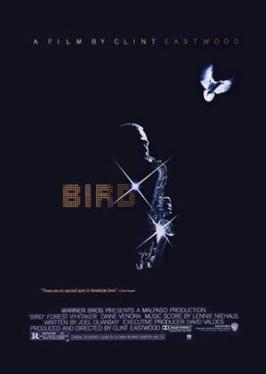
Forest Whitaker stars as the legendary saxophonist Charlie “Bird” Parker.  The film, which is structured around flashbacks and time jumps and features some of the most beautifully-done transitions that I’ve ever seen, follows Parker as he plays his saxophone, challenges the jazz purists who his own individual style, and looks for work in both America and France.  Along the way, we watch as he befriends and learns from Dizzy Gillespie (Samuel Wright), mentors a young trumpet player named Red Rodney (Michael Zelniker), and has a complex relationship with a white jazz lover named Chan Parker (Diane Venora).  Throughout his life, Charlie Parker struggles with his addiction to heroin and alcohol, occasionally getting clean to just then fall back into his habit.  To its credit, the film avoids most of the biopic cliches when it comes to portraying Parker’s addiction.  Parker accepts that he’s an addict, just as he accepts that he has a talent that is destined to revolutionize American music.

Director Clint Eastwood has always been a fan of jazz and he actually saw Charlie Parker perform when he was a young man.  His love of jazz had been present in almost every modern-era film that he has directed, staring with Play Misty For Me’s lengthy trip to the Monterey Jazz Festival.  Bird was a passion project for Eastwood, the first film that Eastwood directed without also appearing in.  (Eastwood doesn’t star in his second directorial effort, Breezy, but he does have a brief and silent cameo as a man standing on pier.)  Eastwood takes a nonlinear approach to telling the story, eschewing the traditional bopic format and instead putting the focus on Parker’s music.  Eastwood was able to get several never bef0re-released recordings of Parker performing and, when Whitaker is blowing into his saxophone in the film, we’re actually hearing Parker.  Eastwood’s direction captures the smoky atmosphere of the jazz clubs where Parker and Gillespie made their name while the nonlinear style reflects the feeling of just letting a song take you to wherever it’s going.  This is a movie about jazz that plays out like a jazz improvisation.

Forest Whitaker gives an amiable and charismatic performance as Charlie Parker, playing him as someone who has found both an escape and peace in his music, even as he physically struggles with the ravages of his drug addiction.  Whitaker won the Best Actor at Cannes for his performance in Bird.  Eastwood received the Golden Globe for Best Director.  Bird feels like it was labor of love for both of them.  Bird may not have set the box office on fire when it was originally released but it remains one of the best jazz films.

Music Video Of The Day: The Trooper by Iron Maiden (1983, directed by Jim Yukich)


Today’s music video of the day is for Iron Maiden’s The Trooper, which was one the band’s few songs to achieve frequent radio airplay in the United States.

The song was inspired by Tennyson’s poem, The Charge of the Light Brigade and the video features scenes taken from the 1936 film of the same name.  The BBC actually banned this video and demanded significant cuts because they felt that the footage from the film was too violent.  Obviously, back in 1983, no one at the BBC had any idea what the future would hold as far as violence in music videos was concerned.

The footage of the band performing was filmed in Brixton Academy and directed by Jim Yukich, who did videos for everyone who was anybody.

Enjoy!