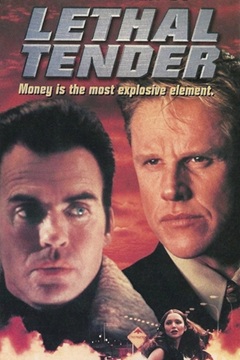
Lethal Tender (1997, directed by John Bradshaw)


Montessi (Kim Coates) and his men have taken over a water filtration plant, are holding hostages, and keep threatening to poison the water supply.  Rogue cop David Chase (Jeff Fahey) and Melissa Wilkins (Carrie-Anne Moss) sneak around the plant and try to stop the terrorists.  David Chase is set up to be a John McClane type but instead, he only kills one terrorists and then lets everyone else do most of the work.  Of course, the whole water filtration hostage situation is just a distraction so Mr. Turner (Gary Busey) can steal a bunch of bonds.  Busey sits behind a computer for most of the movie, lending his name but not much else.

A good cast is wasted in what is definitely one of the worst of the many Die Hard rip-offs to come out in the 90s.  There’s not enough action, with Jeff Fahey as a passive hero and even the great Kim Coates reduced to standing around and doing a lot of yelling for most of his time on screen.  Gary Busey is the big star here but it’s obvious that he was only on the set for a few hours and his plan for stealing the bonds never makes sense.  Whenever anyone questions his plans, he says that it involves computers.  In the 90s, I guess that was enough.

Watching this last night, I realized that I had seen it on Cinemax back in the day.  It didn’t make much sense back then either.

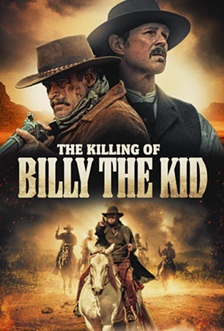
The Killing of Billy The Kid (2023, directed by Brett Bentman)


In the year 1881, a recently arrested prisoner named Thomas Riley (Andrea Zirio) attempts to gain his freedom by offering to inform Sheriff Pat Garrett (Thom Hallum) about the location of a man calling himself Henry McCarty.  At first Garrett asks why he should care about a man named McCarty but, when Riley reveals that McCarty is actually the infamous Billy the Kid, Garrett becomes much more interested.

The Killing of Billy The Kid is a straight-forward account of the events leading up to the death of Billy the Kid (played here by Paul Addison).  While there are flashbacks to the pasts of both Billy and Garrett, the majority of the film is Garrett heading out to the location where Billy is hiding.  With a few notable exceptions, it sticks to the general accepted facts about the death of Billy the Kid.  Paul Addison plays Billy as being a cocky punk and probably comes closer to capturing Billy’s actual personality than a lot of other actors have.

The budget was obviously low (the imdb says it was made for only $30,000) but the film still looks good and it’s version of the old west feels duty and isolated enough to be passable.  I have seen the film listed as having a 90-minute runtime on some sites.  Every streaming version that I’ve found clocks in at 77 minutes and, when I watched the film, it didn’t seem like there were any parts of the story missing.  Addison and Hallum are convincing in their roles, looking authentic whether riding a horse or shooting a gun.  For western fans, there’s much to appreciate about The Killing of Billy The Kid.

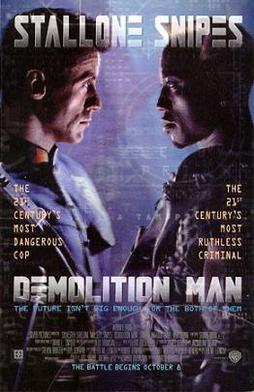
Demolition Man (1993, directed by Marco Brambilla)


File written by Adobe Photoshop¨ 4.0

In the near future, law-breakers and other destructive types are not put in prison but are instead cryogenically frozen and left in suspended animation until they’ve served out their sentences.  The most fearsome criminal in the world, Simon Phoenix (Wesley Snipes) has been frozen but so has his nemesis, Detective John Spartan (Sylvester Stallone).

In the far future, Los Angeles is a part of a megalopolis named San Angeles.  Envisioned and watched over by a seemingly benign dictator named Cocteau (Nigel Hawthorne), San Angeles is a wannabe utopia where cursing leads to an automatic fine and all of the restaurants are Taco Bell.  When he’s thawed out for a parole hearing, the suddenly super-powered Phoenix makes his escape.  The police, no longer knowing how to deal with violence, make the reluctant decision to thaw out John Spartan.  Assigned to work with the enthusiastic Lenina Huxley (Sandra Bullock), Spartan must navigate this strange future to defeat Phoenix.

For some reason, Demolition Man never seems to get the respect that it deserves.  Made at a time when both the Rambo and the Rocky franchises appeared to be over, Demolition Man features one of Stallone’s most appealing performances as he deals with a society where just saying a bad word can cause a scandal.  Just as Spartan proves that his brand of destructive police work still has its place in the future, Stallone proved that he could still carry an action movie in 1993.  There’s a lot of knowing humor to Stallone’s performance.  After a series of failed comedies in the 80s, Demolition Man was the movie that proved that Stallone could be intentionally funny.  Stallone is also surrounded by one of his strongest supporting casts.  Wesley Snipes attacks his villainous role with gusto while Denis Leary breaks out his stand-up routine as Edgar Friendly, the leader of San Angeles’s rebels.  This is also the film that led to Sandra Bullock getting cast in Speed and she’s so incredibly adorable here that even Stallone breaks out into a smile while acting opposite her

(In 1993, you couldn’t turn on television without seeing Sandra Bullock saying, “All restaurants are Taco Bell.”)

Demolition Man is an action film and it lives up to its name, with all the demolition that a viewer could want.  Even more so, It’s also a satire, of both Stallone’s previous films and what was then known as “political correctness.”  Demolition Man’s portrayal of a sterile society where everyone had been programmed to be docile and inoffensive wasn’t that far off from what a lot of politicians were then promoting for America at large.  Luckily, John Spartan was around to put an end to that.  The end result is one of Sylvester Stallone’s most memorable films.
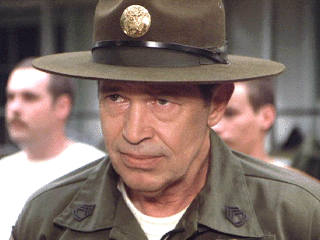
Scene That I Love: Waren Oates Is Sgt. Hulka


I didn’t have time to write a film review today but there’s no way I could late July 5th pass without honoring my favorite actor, Warren Oates.  Oates played a lot of great roles over the course of his career but my favorite was his performance as Sgt. Hulka in 1981’s Stripes.

Here’s Warren Oates, as Sgt. Hulka, asking all the new recruits why they joined the Army.  To those who would say that this isn’t a realistic portrayal of basic training, all I can say is “Lighten up, Francis.”

Video Game Missions I Love: “Fireworks” From The Godfather


I wish I had a 4th of July movie to review today but I don’t.  Instead, I’ll just share my favorite “mission” from the much maligned 2006 Godfather video game.

In this mission, Aldo (who is controlled by the player) takes care of a corrupt cop on the 4th of July.  The Godfather game is hardly perfect but I have always loved that cut-scene of the fireworks going off while Aldo and Rosa look down at the alley.

Happy 4th of July, everyone!

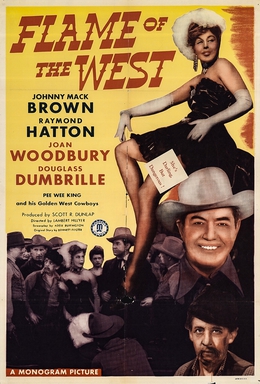
Flame of the West (1945, directed by Lambert Hillyer)


Marshal Tom Nightlander (Douglass Dumbrille) shows up in a lawless frontier town, tasked with bringing peace.  He could sure use the help of Dr. John Poole (Johnny Mack Brown), a former gunslinger who has set his weapons aside and now works as the town doctor.  Dr. Poole has sworn off guns but with corrupt businessman Wilson (Harry Woods) and his gang determined to keep their town lawless, Poole is soon forced to reconsider.

This B-western from Monogram is better than many of the other low-budget, poverty row westerns of the era.  While the plot is another example of a corrupt businessman and his gang making life difficult for peaceful settlers, the characters in Flame of the West are a little more complex than usual.  Brown stands out playing a character who, for once, doesn’t want to fight and believes that it’s better to talk than to shoot.  Of course, this being a B-western, he soon sees the error of his ways.  Dumbrille was usually cast as a villain so this film is a chance to see him in a likable and heroic role and he’s very convincing as a Wyatt Earp-style marshal.

Of course, even a serious B-western is still a B-western so songs and entertainment are provided by the gorgeous Joan Woodbury and Pee Wee King and his Golden West Cowboys.  (Don’t worry, I had never heard of them before, either.)  Joan Woodbury plays a saloon owner who wants to bring a higher class of entertainment to the frontier and she provides the film with enough sex appeal that 1945 audiences probably didn’t mind having to sit through the musical numbers before getting to the inevitable showdown between Johnny Mack Brown and Harry Woods.

Flame of the West is a good B-western that shows what dependable actors like Johnny Mack Brown and Douglass Dumbrille were capable of when given the opportunity.

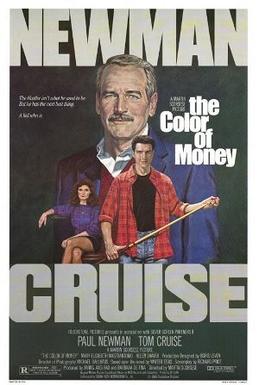
The Color of Money (1986, directed by Martin Scorsese)


ÀW

If you grew up in the 80s or 90s, you probably had at least one friend whose father kept a pool table in the garage.  This movie was probably the reason why.

Fast Eddie Felson (Paul Newman) was once The Hustler, the legendary pool player who recovered from having his fingers broken with a bowling ball and went on to defeat the legendary Minnesota Fats.  That was a long time ago.  Now, Fast Eddie is a slick liquor salesman in Chicago.  Eddie stills hangs out at the pool halls, despite his bad memories of the game.  When he sees a cocky young player named Vincent (Tom Cruise) and his girlfriend Carmen (Mary Elizabeth Mastrantonio), he takes them under his wing and teaches them how to hustle.  It’s not always easy because Vincent doesn’t like to lose, even if it means a chance to score an even bigger victory later on.  Eddie finds himself being drawn back into the game, even as he starts to wonder who is hustling who.

I always forget that The Color of Money is a Martin Scorsese films.  It’s a film that Scorsese made at a time when he had a reputation for only being able to make art films that critics loved but audiences stayed away from.  After the box office failure of The King of Comedy and his abortive first attempt to make The Last Temptation of Christ, Scorsese took The Color of Money to prove that he could work with a studio.  This is a Disney Scorsese film, with his signature camera moves but not much of his religious torment.  Even if it’s not one of his personal films, Scorsese makes pool look exciting, a battle that is as much about psychology as physicality.  Watching The Color of Money, you can smell the chalk on the tip of the pool cue.

Scorsese brings the seedy pool halls to life but it’s Paul Newman’s performance that dominates.  The Color of Money won Newman his first and only Oscar and he deserved it.  Newman had first played Fast Eddie Felson in 1961, in The Hustler.  Returning to the role twenty-five years later allowed Newman to show what would eventually happen to the angry young men that he played in the 60s.  Eddie has grown up and he’s got a comfortable life but he’s not content.  He finally has stability but he misses the game.  He needs the thrill of the hustle.  Newman is at his best in The Color of Money, building on The Hustler but also revealing new sides of Eddie Felson.

Newman is so good that Tom Cruise often gets overlooked but both Cruise and Mastrantonio hold their own against Paul Newman.  Cruise especially does a good job as Vincent, playing him as someone who is too cocky for his own good but also not as dumb as he looks.  Just when you think you’ve got Vincent figured out, Cruise surprises you.  The Color of Money came out the same year as Top Gun and Cruise’s Vincent feels like a commentary on the talented, troubled, but cocky characters that Cruise was playing at that time.  Cruise, Scorsese, and Newman make a good team in this more-than-worthy sequel.

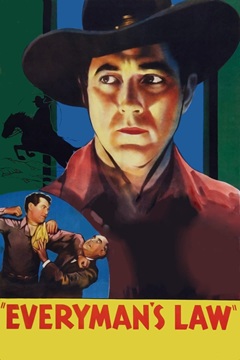
Everyman’s Law (1936, directed by Albert Ray)


Corrupt Sheriff Chris Bradley (Homer Murphy) sends letters to three outlaws, asking them to come to his town and to work for him.  Sheriff Bradley wants to use them to kick some homesteaders off their land.  What Sheriff Bradly didn’t count on was one of the outlaws being an undercover Texas Ranger!  Johnny Mack Brown plays Johnny, a.k.a. The Dog Town Kid.

The Kid takes a liking to homesteader Marian Henley (Beth Marion) and her infant son.  When the Kid and the other two outlaws don’t move out the homesteaders to the sheriff’s liking, Bradley hires fearsome outlaw Lobo Joe (Roger Gray).

This is a pretty typical Poverty Row western.  After you see enough of these, you realize that every plot is going to be about a corrupt sheriff and a businessman teaming up to try to steal the land away from the settlers.  What makes these film work (or not) is the quality of the stars and Johnny Mack Brown was one of the best, someone who seemed authentic when he was riding a horse or shooting a gun but who was also a good enough actor to bring some life to the familiar plots.  As usual, with this film, Johnny Mack Brown is better than his material.

Everyman’s Law is best-known for the scenes of Brown and the other two outlaws having to babysit Marian’s baby.  The “comedic” scene where the baby puts the barrel of Johnny’s six-shooter in his mouth probably had the audience rolling in 1936 but today, it would undoubtedly get the film banned.

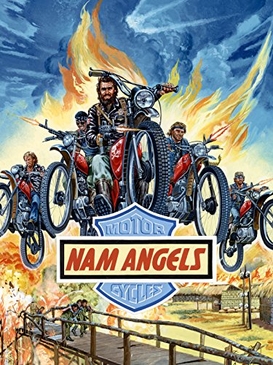
Nam Angels (1989, directed by Cirio H. Santiago)


During the Vietnam War, an American patrol is captured by a German (Vernon Welles) who plans to sell them to the VC.  Only their commanding officer, Lt. Vance Calhoun (Brad Johnson), manages to get away.  When he’s told the the Army can’t spare any men for a POW rescue mission, he instead recruits a group of Hell’s Angels who just happen to be hanging out in Vietnam.  When the Hell’s Angels learn that there’s gold hidden in the caves near the POW camp, they hop on their motorcycles and heard on out.

You might wonder why the Hell’s Angels were in South Vietnam to begin with.  The easy answer is that they were there to raise Hell and spread the legend of their motorcycle club.  The truth is that they were there to win the war for America.  Like many Vietnam films released in the 80s, the main message of Nam Angels is that America could have won if not for the cowardly officers who weren’t willing to rescue our POWs.  America should have listened to Vance Calhoun and the Hell’s Angels.  Meanwhile, the real-life Hell’s Angels sued the filmmakers for trademark infringement.  It doesn’t get more American that!

As for Nam Angels, it has all of the explosions and motorcycles that are promised by the title and, as always, Vernon Wells is a good villain.  Considering the premise, it’s disappointing that Nam Angels proves itself to be a typical straight-to-video war movie but it still features all of the action, torture, and tough talk the fans usually want from these movies.  It ends with a quote from John Milton that doesn’t really have anything to do with the film that we just watched.

This was one of the 104 films that Cirio Santiago directed over his career.  Reportedly, Steven Spielberg was a fan of this one, casting Brad Johnson in Always on the basis of his performance in Nam Angels.  Make good movies because you never know who might be watching.

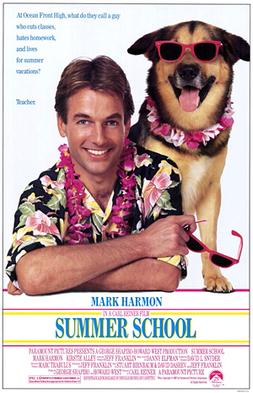
Summer School (1987, directed by Carl Reiner)


Summer School was the movie that made flunking out look like fun.

Freddy Shoop (Mark Harmon) is a relaxed, fun-loving gym teacher who is looking forward to spend his summer in Hawaii until he’s assigned to spend the summer teaching remedial English in summer school.  (His girlfriend goes to Hawaii without him.)  Freddy’s not happy about giving up his summer and he’s prepared to just spend his days taking his students to the beach, the amusement park, and the zoo.  But when he finds out that he’s going to lose his job unless his students pass the big test at the end of the summer, he gets serious and discovers what teaching is supposed to be all about.

When I was growing up, Summer School seemed to be on television all the time.  If it wasn’t on HBO, it was on one of the local stations, usually right before summer began.  The summer school kids seemed to be having too much fun for kids stuck in school.  I don’t think my classmates in Baltimore would have been as happy about losing their summer as the students in this film.  Everyone who has seen this film remembers Dave and Chainsaw (Gary Riley and Dean Cameron) making jokes and showing everyone The Texas Chainsaw Massacre.  They also remember Anna-Maria (Fabiana Udenio), the Italian exchange student who took summer school to work on her English.  They remember Freddy letting one of his students move in with him, which doesn’t seem like a good idea even if she was played by Courtney Thorne-Smith.  Myself, I remember Robin Bishop, the teacher next door, who was played by an extremely sexy Kirstie Alley.  (This was one of the many 80s films in which Kirstie Alley made being uptight seem sexy.)  Of course, Robin was dating the snobbish principal who was trying to get Freddy Shoop fired.

I’m not going to sit here and say that Summer School is a great film.  It’s a dumb comedy with an uplifting message about what a good teacher can accomplish.  However, Summer School is a very likable film, an enjoyable 80s teen romp that suggests summer school was the place to be in the late 80s.  Mark Harmon, Kirstie Alley, and all the students give good performances.  How many future horror nerds were inspired by Dave and Chainsaw?  Legendary nice guy Carl Reiner directed and the movie itself is amiable and amusing enough to be watchable.