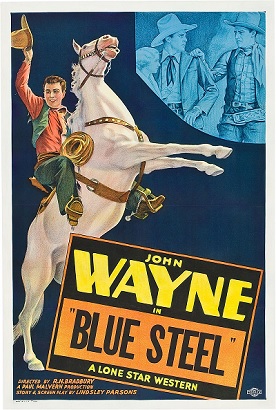
Blue Steel (1934, directed by Robert N. Bradbury)


On a stormy night, frontier Sheriff Jake Withers (George “Gabby” Hayes) and undercover U.S. Marshal Carruthers (John Wayne) both check into the same inn.  They are both searching for the infamous Polka Dot Bandit (Yakima Canutt), who has been burglarizing homes and businesses all over California.  They both figure that, on a rainy night like this, there’s no way that the Bandit is going to be out.  It turns out they are both wrong.  The Bandit breaks into the inn and robs the safe but also leaves behind one of his spurs.  The sheriff comes across Carruthers investigating the safe and mistakenly believes that Carruthers is the bandit.

Later, when Sheriff Winters goes out to Carruthers’s cabin, he’s planning on arresting Carruthers.  Before he can do so, they both hear gun shots.  Outside, another group of bandits is chasing Betty (Eleanor Hunt) and her father.  The Sherriff and Carruthers manage to save Betty but her father is killed.  The grieving Betty is taken in by a local rancher named Malgrove (Edward Peil, Jr.) but it turns out that Malgrove is the head of the Polka Dot Gang and he is planning on killing Betty in order to keep a shipment of supplies from coming to the town!  Carruthers and the sheriff have to work together to thwart Malgrove’s plan and bring the Polka Dot Bandit to justice.

This 54-minute programmer was one of the many B-westerns that John Wayne made for Monogram Pictures in the days before John Ford made him a star by casting him in Stagecoach.  Though Wayne was still learning how to act on camera, the screen presence that would make him a star can be seen in Blue Steel and he and Hayes make a good team.  The story is simple enough but there’s enough horse riding and fistfights to keep most B-western fans entertained.  It’s still hard not to imagine how much different the movie would have been if the sheriff had arrested Carruthers at the scene of the crime instead of letting him ride out to his cabin.  It’s a good thing these old programmers never had to make too much sense.
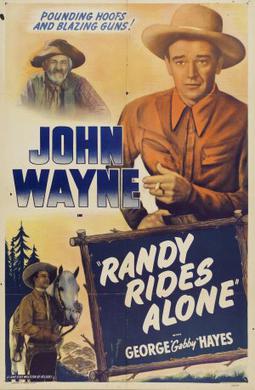
Randy Rides Alone (1934, directed by Harry L. Fraser)


Randy (John Wayne) rides his horse into a frontier town.  He is planning to pay a visit to his old friend, saloon owner Ed Rogers.  But when Randy enters the saloon, he discovers that everyone, including Ed, has been shot dead and a hand-written note has been left by the perpetrator, warning the sheriff not to come after him.

The sheriff and a posse of citizens arrive at the saloon and refuse to believe Randy when he says that he didn’t commit the crime.  Matt the Mute (George Hayes, before he became known as Gabby) hands the sheriff a note in which he suggests arresting Randy and hanging him for the crime.  Matt’s note is written in the same handwriting as the note that was left at the saloon but no one notices because Matt has a reputation for being a fine, upstanding citizen.

With the help of Ed’s niece, Sally (Alberta Vaughn), Randy escapes from the posse and makes his way to a cave, which he discovers is the hideout for a gang of thieves led by Matt the Mute, who isn’t even a mute!  When the gang kidnaps Sally, Randy has to rescue her and clear his name.

A 56-minute programmer, Randy Rides Alone is one of the many B-westerns that John Wayne made before Stagecoach made him a star.  In the 30s, every poverty row studio was churning out short westerns that would play as double features and which would entertain audiences looking for an escape from the present day.  Randy Rides Alone is one of the better examples of the genre, due to John Wayne’s authoritative presence and a better-than-average plot.  The opening, with a smiling John Wayne entering the saloon just to discover that all of his friends have been murdered, establishes the stakes early on and the movie is as much about revenge as it is about Randy clearing his name.  George Hayes, who became best known for playing comedic relief sidekicks, is an effective villain.  The film’s target audience was probably bored with Sally and Randy falling in love but they also probably enjoyed Randy climbing a mountain to rescue her.  The movie ends with Sally announcing that Randy won’t be riding alone much longer.  Randy may have settled down but John Wayne had 150 more films ahead of him.

Intensive Care (2018, directed by Jared Bentley)


Ne’er-do-well Danny (Jai Rodriguez) wants his dying grandmother’s money so he takes the live-in caregiver, Alex (Tara Macken), out on a date while his friends, Seth (Kevin Sizemore) and Rudy (Jose Rosete), break into the house.  When Alex insists on cutting the date short and returning to the house, she is taken hostage by Seth and Rudy.  What they don’t know is that Alex is actually a former member of Special Forces.  Alex is not going to go down without a fight.

This one is pretty predictable.  The three men are so thoroughly outclassed by Alex in every way that there’s never any doubt that she is going to be able to not only stop them but also thoroughly humiliate them in the process.  It never occurs to Alex to call the police or even to put out a call to some of her former colleagues from the Special Forces.  Instead, she spends the whole movie fighting the three men on her own.  She can handle all three of the men but one innocent person dies because Alex never learned how to dial 9-1-1.  The movie ends with a dumb twist that makes Alex’s actions seem even stranger.

Tara Macken is primarily known as a stunt performer and the film is smart enough to focus more on her fighting than on her acting.  Police Academy fans may be interested to know that the grandmother is played by Leslie Easterbrook, who played Sgt. Callahan in almost all of the Police Academy films.  Unfortunately, she spends most of Intensive Care in bed.  Not even Steve Guttenberg and Michael Winslow could save this film.

Cover-Up (1991, directed by Manny Coto)


After an overseas U.S. army base is bombed by terrorists, L.A. Times reporter Mike Anderson (Dolph Lundgren) is sent to Israel to get the story.  Before he became a reporter, Mike was a Marine and he has connections within the U.S. intelligence services.  Mike quickly figures out that CIA honcho Lou Jackson (Lou Gossett, Jr.) is covering something up about the bombing.  The terrorists who bombed the base have also stolen an experimental nerve gas.  Mike is ordered to stay out of the investigation but after Mike’s best friend, Jeff Cooper (John Finn), is blown up by a car bomb, Mike is determined to get justice.  He’s also determined to sleep with his dead best friend’s girlfriend (Lisa Berkley), who is also Mike’s ex.  It turns out that it’s a lot easier to betray a friend’s confidence than to stop terrorists from stealing nerve gas.

When it came to the second-tier action stars of the 90s, Jean-Claude Van Damme was the one who could actually do everything that he did on screen in real life, Steven Seagal was the one who never seemed to get the joke, and Dolph Lundgren was the one who could actually act.  Even in a film that was pure schlock, like Cover-Up, Lundgren usually gave a good performance.  Unfortunately, Lundgren’s performance couldn’t make up for Cover-Up‘s anemic action scenes and incoherent plot.  No one seems to be sure what they’re supposed to be doing in this movie.  Lou Gossett, Jr. survives by playing his role as being pissed off all the time.  Lundgren survives by playing Mike as being even more confused than Gossett.  There’s a weak car chase and a weak shower scene.  Mike really doesn’t waste any time when it comes to hooking up with his best friend’s girl.

Cover-Up was filmed on location in Israel and it does work as a travelogue.  Towards the end of the film, Lundgren runs through a mass of people who are reenacting the Twelve Stations of Christ.  The people were actually in Israel to celebrate Easter and no one informed them that they were about to become a part of a movie.  When Lundgren comes barreling through the crowd, their shock is authentic.  It’s the best part of the movie, even if it did lead to Lundgren being temporarily detained by security.  Fortunately, production was able to clear-up the misunderstanding and Lundgren was freed so that he could go on to star in Universal Soldier and reprise Ivan Drago in Creed II.  I’m glad the Lundgren survived filming but Cover-Up is otherwise forgettable.

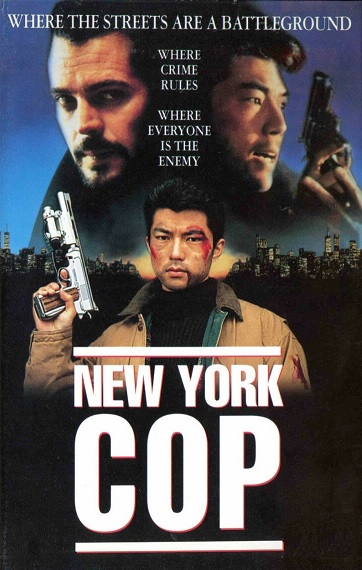
New York Cop (1993, directed by Tôru Murakawa)


Toshi (Tôru Nakamura) is a tough New York cop who is assigned to work undercover in the East Village because, according to his boss, no one will suspect that a Japanese man is actually a cop.  Disguising himself as a homeless gambling addict who has connections with the Tongs, Toshi infiltrates the Brotherhood.  He becomes friends with the gang’s leader, Hawk (Chad McQueen), and he even falls in love with Hawk’s sister, Maria (Mira Sorvino!).  Hawk is buying guns from a mobster named Mr. C (Tony Sirico!!) and Mr. C’s main assassin, Ferrara (Andreas Kastsulas), is driving around New York in a taxi cab and killing undercovers.  Can Toshi take down Mr. C without compromising his relationship with Maria and revealing that he’s actually an undercover cop?  The short answer is no.

New York Cop works best when it focuses on action.  Tôru Nakamura is convincing in the fight scenes but he’s less convincing whenever he has to show emotion or have a conversation with anyone.  The idea that the NYPD would send a Japanese cop undercover to infiltrate a Hispanic gang never makes makes much sense, as Toshi himself points out when the idea is first brought up.  Toshi never makes much of an effort to disguise the fact that he is a cop, which makes Hawk look incredibly stupid for not seeing through him.  The main appeal for most people will probably be the chance to see Tony Sirico and Mira Sorvino in early roles.  Sirico, the former gangster-turned-actor, is convincing as Mr. C and gets all of the film’s best lines.  As for Mira Sorvino, this was only her second or third film role and the script doesn’t give her much to work with.  There are a few scenes where she gets to bring some genuine New York attitude to her character, telling off both her brother and Toshi.  But otherwise, there’s little about her performance that suggests the actress that she would become.  Fortunately, films like Barcelona and Sweet Nothing were right around the corner.

As far as New York cops go, nothing has yet to beat the episode of Barney Miller where Christopher Lloyd vandalizes the station house.

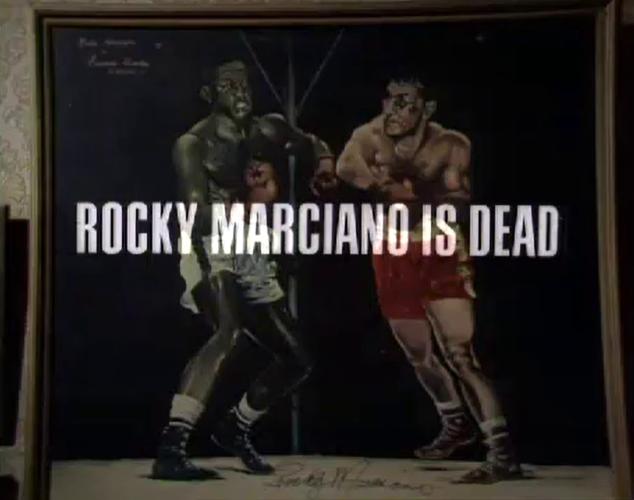
Rocky Marciano Is Dead (1976, directed by Graham Evans)


Harry Marcus (Ron Moody) was once a welterweight boxing champion but that was a long time ago.  Now, Harry is an old man who lives in small London apartment.  His daughter (Yvonne Bonnamy) visits him weekly.  Sometimes, he talks to Sonny (Jeffrey Kissoon), the squatter who is living in the abandoned apartment next to his.  Harry still likes to go back to his old gym and relive the glory days of both boxing and England.  Harry feels that those days are long gone but after he witnesses Sonny fight off a group of muggers, Harry becomes convinced that Sonny could be the next great boxer.

Harry wants to train Sonny but Sonny and his wife (Lesley Dunlop) both think boxing is barbaric.  It’s not until Harry explains that, historically, boxing has been used by the oppressed and marginalized to pull themselves out of poverty that Sonny steps into the ring.  Sonny has the talent but does Harry still have the connections to get Sonny a fight?

Rocky Marciano Is Dead was aired as a part of the BBC’s Play For Today anthology series.  It aired at the same time that Rocky was first setting box office records in the States.  Harry has a lot in common with Mickey Goldmill, the trainer played by Burgess Meredith in the first three Rocky films.  Like Mickey, he’s a former boxer who is trying to make a champ out of someone who is not sure if he has what it takes.  Rocky took place in the slums of Philadelphia while Rocky Marciano Is Dead takes place in a London that is full of abandoned buildings, gangs, and angry graffiti.  This is the London that, one year later, would inspire Johnny Rotten to sing that there was “no future in England’s dreaming.”  Not surprisingly, Rocky Marciano Is Dead is a much darker and cynical look at boxing than Rocky.  Harry is trying to recapture a past that may have never existed.

Along with providing a look at London on the cusp of the Punk Revolution, Rocky Marciano Is Dead is an acting showcase for Ron Moody.  Moody is in almost every scene, as Harry goes from being bitter to hopeful to disillusioned.  Moody makes it clear that Harry sees Sonny as something more than just a good boxer.  To Harry, Sonny is a chance to return to the time when both England and boxing were great.  If he can make Sonny a champ, Harry will be a champ too.  Harry’s mistake is not considering that Sonny might have plans of his own.  Moody was a born performer, as effective on television as in film.  He was also a perennial contender for the role of the Doctor on Doctor Who.  He was even offered the part in 1969 but turned it down, a move that he always said he regretted.  After a long career full of memorable performances in dramas, comedies, and musicals, he died in 2015 at the age of 91.  He gives a good performance in Rocky Marciano Is Dead, making Harry into something more than just an angry old man.

Rocky Marciano Is Dead can be viewed on YouTube.

Congratulations to the Super Bowl Champions, The Kansas City Chiefs!


The Kansas City Chiefs have won the Super Bowl!  After trailing for much of the game, they made a comeback in the Fourth Quarter and defeated the Philadelphia Eagles by three points!  The final score was 38-35!  (My prediction was not too far off.)

Sometimes, the good guys win!  Congratulations, Kansas City, and thank you from a weary nation.

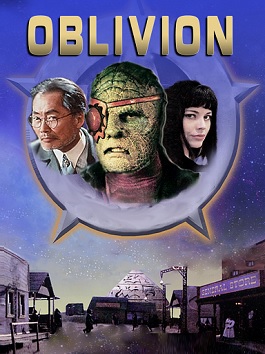
Oblivion (1994, directed by Sam Irvin)


In the far, far future, Earth has set up colonies all across the universe.  One of those colonies is the dusty town of Oblivion, which looks just like an old west town except the deputy is a cyborg and there’s an ATM outside the saloon.  A humanoid lizard named Red Eye (Andrew Divoff, covered in green scales) comes to town and kills the marshal.  Red Eye and his gang take over Oblivion, planning to turn it into their own personal pleasure palace.

The marshal’s son, Zack (Richard Joseph Paul), comes to town for the old man’s funeral.  Everyone thinks that Zack is a coward because he refuses to avenge his father’s death.  Zack, however, is no coward.  He’s just an empath who can’t handle the negative emotion that are generated by violence.  But seeing as how his father is dead, his best friend Buteo (Jimmie F. Skaggs) is being tortured in the town square, and lovely Mattie Chase (Jackie Swanson) wants Red Eye and his gang to get out of town, Zack knows that he’s going to have to do the right thing and conquer his empathy.

Oblivion is a haphazard mix of comedy, science fiction, and the western genre.  Some of the ideas come close to being clever but it never makes sense why an Earth colony in 3031 would resemble a one-horse town from a singing cowboy movie.  (The film probably would have worked better if it had been about Red Eye invading an actual Old West town in the 1800s instead of a colony designed to look like one.)  Andrew Divoff is entertaining as he hams it up as the main desperado but, as far Old West charisma is concerned, Richard Joseph Paul is no John Wayne or Henry Fonda.  Quite a few familiar names were somehow roped into appearing in this low-budget space oater, though most of them only appear for a few minutes and don’t contribute much to the overall story.  George Takei plays the alcoholic town doctor.  Julie Newmar is Miss Kitty, the owner of Oblivion’s “social” club.  In a nod to her most famous role, Newmar hisses at Red Eye and his gang but that’s all she gets to do.  It feels like a waste of a cameo.  Isaac Hayes and Meg Foster also make appearances, though again neither really gets to do anything interesting.

The idea of a space western isn’t a bad one and there actually have been a few good ones.  (Outland, for example.)  But Oblivion can never escape the drag of its low budget and its bland lead.

It’s Over: Tom Brady Retires


Tom Brady has retired.

It’s over.

The last time Tom retired, he changed his mind a month and a half later and returned to lead the Buccaneers to the playoffs.  On Twitter, there’s already a lot of people making jokes about him changing his mind a second time but I think everyone knows that this Brady retirement is for real.  He’s 45 years old now, playing a game that many players are forced to quit when they’re only in their early 30s.  This season, there were times when Brady struggled but he still led the Buccaneers to the post season.  A struggling Brady was still better than many quarterbacks at their prime.

Tom Brady was the greatest of all time.  He’s also someone who played for so long that there’s an entire generation that doesn’t know of a time when Brady wasn’t one of the most dominating quarterbacks in the league.  Brady played 23 seasons.  People who were born during his first season with the Patriots have graduated from college.  Famously, Brady was picked in the 6th round of the 2000 NFL Draft but, in the end, he was the last member of the class standing.  Brady dominated like a few others.  It was exciting and fun to watch him play, except for one he was playing against your team.

There are, of course, other great quarterbacks in the NFL.  Two of them are about to meet in the Super Bowl.  But Tom Brady retiring is definitely the end of an era and a reminder that time catches up with all of us eventually.  Brady has been hired by Fox Sports to provide commentary during the 2023 season.  I could see Tom Brady doing anything he wants during his retirement.

Let’s not get crazy now.

Personally, I think Tom Brady would make a hell of a coach.  But, whatever he does from this point forward, he’ll always be remembered as one of the greatest of all time.