This October, I’m going to be doing something a little bit different with my contribution to 4 Shots From 4 Films. I’m going to be taking a little chronological tour of the history of horror cinema, moving from decade to decade.
1995’s Stolen Innocence opens with 18 year-old Stacy Sapp (Tracey Gold) trying to sneak back into her house after a long night of drinking and partying. Unfortunately for her, Stacey isn’t very good at sneaking around and she’s caught by her mother (Bess Armstrong) and her father (Nick Searcy).
“I’m 18!” Stacy argues.
“You’re going to end up pregnant!” her mother yells.
Stacy says that that her mother is just scared that she’s going to end up a loser “like you!” Well …. yeah, Stacy, that’s kind of the point. If your mother has experience with the life decisions necessary to become a loser, maybe you should listen to her warnings.
Anyway, Stacy runs away with a friend of her’s. After her friend decides to go back home, Stacy hitches a ride with a trucker. When the trucker stops off at a truck stop so he can get his brakes looked at, Stacy meets Richard Brown (Thomas Calabro, wearing a really bad wig). Richard is long-haired and has got a tough guy beard and a cheesy tattoo of a heart on his scrawny forearm. Stacy, of course, is totally smitten and she goes off with Richard and his “friend,” Eddie (Matt Letscher).
It doesn’t take long for us to figure out what Richard is bad news. He carries a gun. He’s financing his trip through stolen checks. He might not even own the truck that he’s driving. He and Eddie have a bizarre relationship in which Richard continually abuses Eddie but Eddie refuses to leave. Richard is obviously a bad guy and we can all see it. When Stacy finally calls her parents from the road, they immediately figure out that Stacy is in trouble. However, it takes Stacy forever to figure it out because Stacy’s kind of an idiot.
I cringed a lot while watching Stolen Innocence, not so much because of the film’s depiction of Richard’s criminal lifestyle but because I used to have a definite weakness for bad boys and I could kind of understand what was going through Stacy’s mind when she first met Richard. That said, I’m pretty sure that I would have figured things out a lot quicker than Stacy did. Stacy quickly goes from being a somewhat sympathetic rebellious teenager to being someone who you really start to get annoyed with. Oh, he’s threatening you with a gun? Okay, that’s when you leave! That’s when you start plotting your escape. You don’t make excuses for him. He’s financing his trip with stolen checks? I’m sorry, is that not a red flag? Add to that, as played by a miscast Thomas Calabro, it’s not like Richard is some boiling cauldron of charisma. From the first minute we see him, with his long hair and his cowboy hat and his tattoo, the guy seems like a joke.
Eventually, Stacy does figure out the truth but, by that point, Richard and her are holed up in a motel room and Richard is exchanging gunfire with the FBI. The film ends with a title card, reminding us that this was a true story. “He’s not a bad person!” Stacy wails to the police. I guess some people really are that stupid.
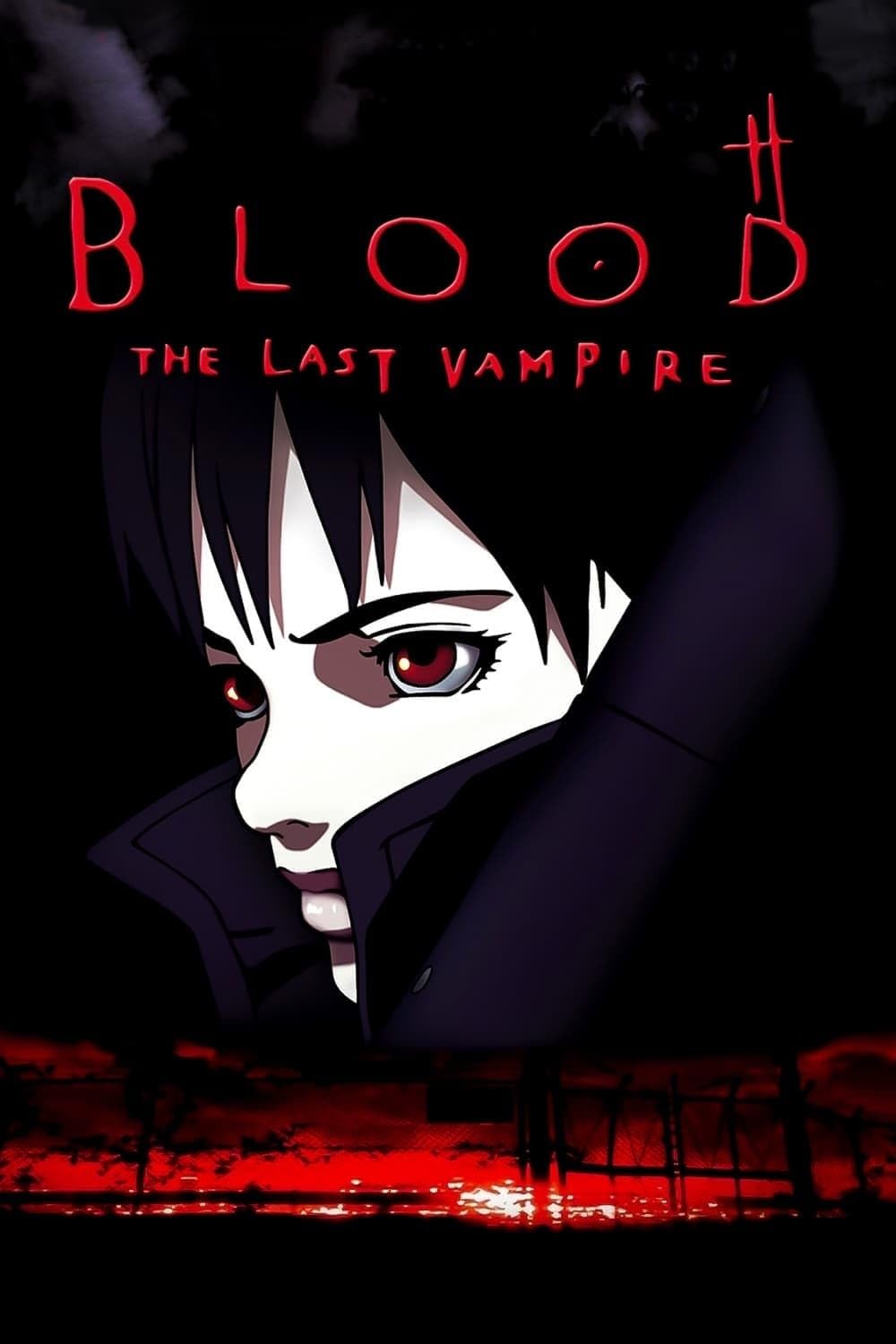
In 2000, Blood: The Last Vampire made quite an impact as a visually stunning and atmospherically intense anime horror film. It expertly combines military tension with supernatural thrills in a compact, sharply executed story. Directed by Hiroyuki Kitakubo and produced by Production I.G, this film helped define the vampire-action subgenre by delivering a haunting tale that’s as much about loneliness and identity as it is about monster hunting.
The story unfolds in 1966 at the Yokota U.S. Air Base in Japan, a setting infused with Cold War anxiety and the looming shadow of the Vietnam War. You follow Saya, a seemingly ordinary schoolgirl with a dark secret: she’s been enlisted by a secretive agency to hunt down bloodthirsty chiropterans—demons disguised as humans. Saya isn’t your typical vampire; she’s the last of her kind, wielding a katana with deadly precision while carrying the heavy burden of her immortal existence. Her cold, detached demeanor makes her an intriguing character, caught between humanity and monsterhood.
One of the film’s standout features is its incredible art and animation. Production I.G used a mix of traditional hand-drawn animation and early CGI to create a look that’s both detailed and immersive. In fact, James Cameron was an early fan, admiring the film’s innovative blend of 2D and 3D animation techniques that pushed technological boundaries to craft a visually striking experience. The backgrounds—military bases, grim hallways, and moody night scenes—feel tangible, while the fluid movements of the characters add grit and weight to every action sequence. The colors are muted but striking, with shadows dominating the frame and bold splashes of red that echo classic horror imagery.
While watching Blood: The Last Vampire, one can also spot clear influences from Western vampire horror, especially the live-action film Blade, which came out a few years prior, and the TV series Buffy the Vampire Slayer. The character of Saya shares traits with Buffy— a young, powerful woman wrestling with her role as a vampire hunter—melding gothic sensibilities with modern action heroine tropes. Director Hiroyuki Kitakubo has acknowledged in interviews that such Western influences, along with classic vampire literature like Dracula, shaped the film’s tone and character design. This fusion creates a uniquely cross-cultural vampire narrative that appeals broadly.
When it comes to horror, Blood goes for a raw, physical kind of fear rather than romanticized gothic vibes. Its monsters are grotesque and disturbing, bristling with sharp teeth and distorted faces. The fight scenes are swift and brutal, with blood sprayed in a way that’s more artful than gratuitous. The film wastes no time with filler; each moment serves to ramp up tension or deepen the mystery.
Saya herself is surprisingly well developed for such a short film. Her isolation and internal conflict give her depth beyond standard vampire tropes. You can sense the loneliness beneath her impassive exterior, along with a kind of weariness about her role as predator. Though the film leaves plenty unsaid, it effectively uses these shadows in the story to hint at a broader tragedy driving Saya on.
However, the film does have its drawbacks. Clocking in under 50 minutes, its brevity feels like a hindrance. The story’s short runtime leaves many threads underexplored, especially the wider world-building and deeper character background that fans of such a rich universe might crave. Some may find the pace hurried, with the narrative skimming over potentially fascinating lore and emotional beats. Additionally, Blood: The Last Vampire was mostly voiced in English, a decision by Production I.G. aimed at making the film more accessible to Western audiences. However, the English voice acting can be hit or miss, which may become distracting for anime viewers who prefer mostly Japanese voice acting with English subtitles.
Despite these flaws, the film’s soundtrack remains atmospheric and effective, supporting tension without overwhelming the visuals. The mix of Japanese and English dialogue fits the multicultural military setting, even if some performances falter.
Importantly, Blood: The Last Vampire served as a critical gateway for Western audiences at a time when anime was predominantly known through late-night broadcasts of child-friendly series like Sailor Moon and Dragon Ball Z. As one of the few adult-themed, violent anime films to achieve mainstream success in the West, it opened the door for a wider acceptance of mature anime stories. This paved the way for major franchises such as Attack on Titan and Demon Slayer, which have become some of the biggest and most influential anime series worldwide over the last 25 years.
Over time, Blood: The Last Vampire has gained a devoted cult following and inspired sequels like Blood+ and Blood-C, as well as live-action adaptations. Yet few have matched the original’s moody atmosphere and stylistic innovation.
All in all, Blood: The Last Vampire is a memorable and gripping piece of horror anime. It skillfully blends postwar unease, body horror, and existential themes into a sleek, powerful package that leaves a lasting impression. Whether you’re a fan of vampire tales, Japanese gothic horror, or intense animated action, this film proves that you don’t need hours to make a horror classic. It’s short, sharp, and packs a serious punch. It may not have delivered on every narrative promise, but its innovative visuals and haunting tone secure it as a must-watch for genre enthusiasts.
There’s the Summer of the Shark; so, this is the Horrorthon of the Terrible AI shorts. Technically, I don’t need to review these things, BUT I feel like we at the beginning of a new way to tell stories and if the technology gets better and it will, maybe it will attract some people who are good at things? Maybe?
I’m not saying that the people who create these films should be parachuted into an actively shark-infested section of the ocean wearing a meat-based wetsuit and slathered in a blood-based suntan oil, but if you’ve already left with these people and you had parachutes, the suits, and lotion ready; then, I’m not getting in your way. Who knows? Maybe stopping bad AI art could bring us together? Also, the market share for meat wetsuits is wide open for the taking!
So, let’s determine if “Whisper in the Woods” is cause for shark-time!
There is a car driving in a haunted forest. A woman sees a spooky woman standing in the road. The driver investigates. Then, a hooded figures presumably kill her. Technically, it had a beginning, middle, and an end. So, it’s as good as anything Alex Magana ever made, but I’m Team Shark!
“You cannot win a nuclear war! Now just suppose the Russians win this war… What exactly would they be winning? All major centres of population and industry would have been destroyed. The Russians would have conquered a corpse of a country.” — Peace Speaker
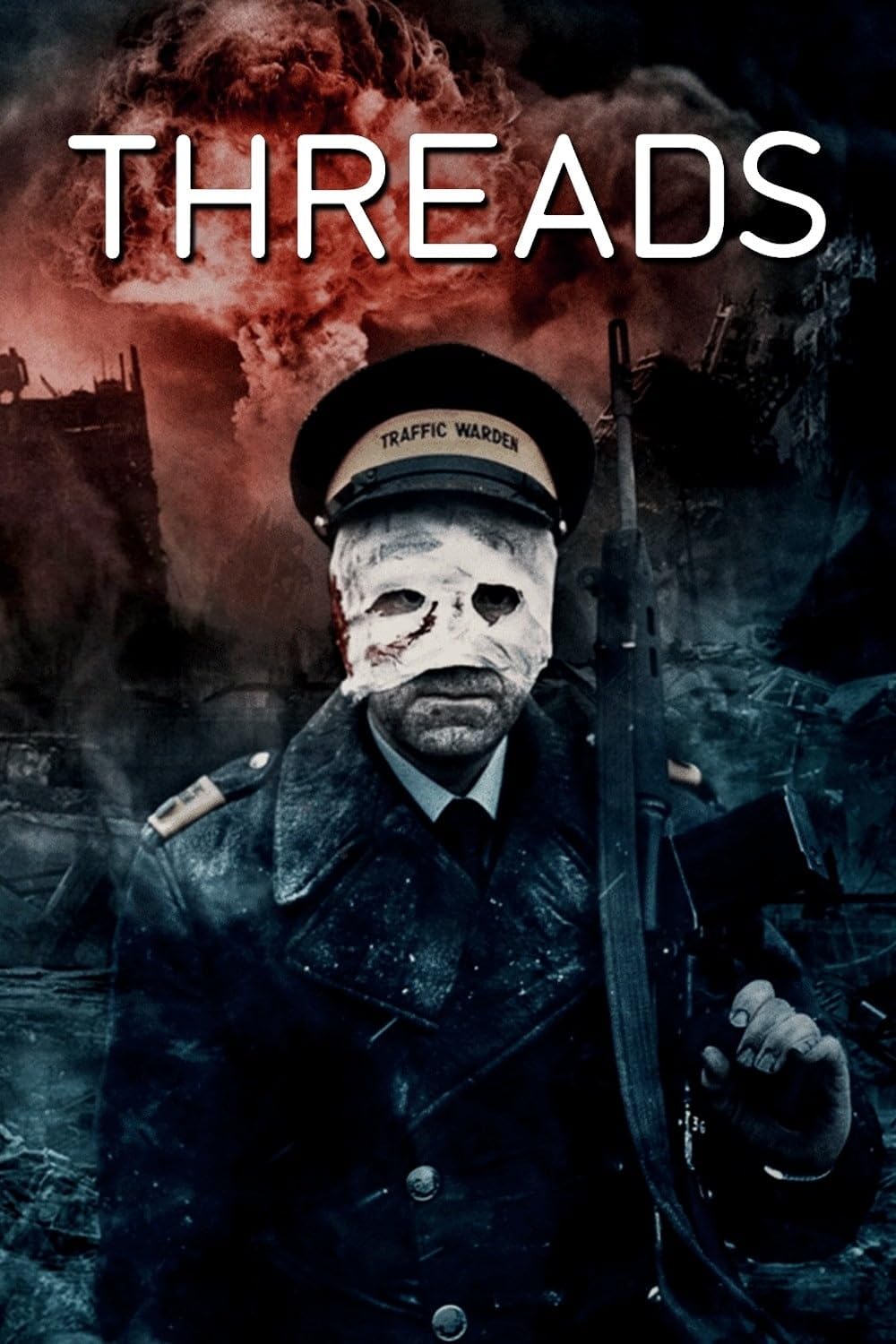
Mick Jackson’s Threads remains one of the most devastating and singular experiences in the history of horror cinema. Made for British television in 1984, it presents the end of the world without spectacle, sentiment, or escape. It is horror pared down to elemental truth—an autopsy of civilization staring directly into the void. What it reveals isn’t an invasion or a curse but something far more intimate and plausible. The apocalypse here is homemade.
The film’s dread begins in familiarity. Sheffield in the early 1980s looks ordinary, even dull. We meet young people planning families, moving furniture, going to work. Everyday life rolls forward in its small, reassuring cycles. But the news keeps playing in the background, and the background starts to change. Political tension builds quietly, buried inside the calm language of diplomacy and deterrence. The repetition of these news bulletins—so mundane at first—becomes unnerving because this is precisely how horror entered real life during the Cold War: through information, not imagination. The end of all things doesn’t announce itself with thunder or sirens. It arrives exactly the way it did in history—through headlines, warnings, updates, and comfortable denial.
What makes Threads so frightening is that it removes the supernatural shield that most horror films rely on. There are no vampires in the night, no zombies clawing at the door, no ancient curses waiting for foolish mortals to uncover. The threat here is invisible, mathematical, already built into the fabric of daily existence. The horror is bureaucratic and omnipresent: wires humming, missiles waiting, politicians rehearsing meaningless statements. Jackson’s approach traps viewers in the reality that haunted the Cold War decades—the understanding that extinction wasn’t a mythic event but a possibility hanging over breakfast tables and factory shifts alike. The monsters were human hands resting on launch buttons.
When the bombs finally fall, the destruction plays out without warning or beauty. The light is so intense it erases faces, streets, even color itself. There’s no music to prepare the viewer, nothing to stylize the moment. It looks less like cinema than an interference signal—white noise flooding the world. And when the noise fades, time stops. The air is grey and silent. This is where every cinematic idea of horror—jump scares, final girls, raging beasts—collapses. What’s left isn’t fiction but aftermath. Humanity’s extinction is not delivered by some otherworldly force. It’s the logical consequence of its own inventions.
In the post-blast silence, Sheffield turns into a landscape of wandering ghosts—ordinary people stripped of memory and meaning. The city becomes an enormous grave where speech and thought slowly decay. Threads spends the rest of its running time documenting how civilization erodes, not in minutes but in years. Crops fail, radiation poisons the newborn, and eventually language itself thins out until the survivors grunt out half-words. Watching it feels like witnessing evolution run backward. And all of it happens without villains or intent. The horror is simply that there’s no one left to blame, only ashes where institutions used to be.
That’s the heart of what makes Threads such a distinct kind of horror film. Its terror isn’t supernatural but logistical. The Cold War, for all its abstract politics, becomes the perfect horror setting because its apocalypse was designed, built, and maintained by bureaucrats and citizens who believed they were preserving peace. The film internalizes that historical anxiety and turns it against the viewer. Watching it now reveals how modern the fear remains—the quiet knowledge that our existence can still be undone by systems we built and barely understand.
This level of realism transforms ordinary images into nightmare language. The gray sky, the still streets, the cracked glass—all look completely real because they are. The production relied on weathered locations, handheld cameras, and non‑actors to erase any cinematic polish. That choice doesn’t just increase believability; it removes emotional distance. The audience isn’t safe behind the screen. It’s the same realism people felt in their bones during the Cold War years when the thought of nuclear annihilation hung above every ordinary activity—from going to school to buying groceries. Threads doesn’t invent horror; it recalls one that was already shared by millions, a psychological climate instead of a plot.
What follows after the detonation is not chaos in the traditional sense, but entropy. The world doesn’t explode; it unravels. Government collapses in slow motion, social order dissolves quietly, and hunger becomes the only law. By the time years have passed and humanity has regressed to primitive barter and suspicion, viewers understand that the true monster in Threads isn’t radiation or politics—it’s the continuity of existence stripped of meaning. The worst possible outcome is survival without civilization. Every journal entry and every voice-over that marks the passage of years feels like the universe keeping record of its own disappearance.
The film’s tone never changes. It stays cold, methodical, and precise, as if narrated by the last bureaucrat left alive. That neutrality becomes unbearable after a while, more suffocating than screaming terror. The dispassionate narration reporting the number of dead or the decline in literacy level is as unnerving as any demonic whisper. It’s the voice of civilization reduced to an algorithm, describing its own end with perfect grammar. That was perhaps the truest evocation of Cold War horror imaginable: the notion that when the world ended, it would sound exactly like a news broadcast.
For all its austerity, there’s also a strange poetry in Jackson’s imagery. The empty fields where ash falls like snow, the distant hum of wind through broken windows, the silhouettes trudging through a gray dusk—they linger like haunted photographs. It feels less like humanity has died than that it has become part of the landscape. The apocalypse in Threads isn’t theatrical fire but the slow bleaching of everything living. In a way, it makes the viewer complicit: this is what our collective imagination produced when fear became policy.
The final scene still carries the force of a psychological detonation. The young woman who has grown up in this ruin gives birth to a stillborn child, the last link of continuity severed. There’s no dialogue, no reaction—just a freeze-frame that seems to suspend time at its bleakest point. For a moment, the world stops existing altogether. Few films end so harshly, with no fade‑out or reflection, because Threads doesn’t need metaphor. It closes the loop on its own warning: the horror never came from outside, it came from within—from the quiet machinery of our collective choices and the weapons we built to enforce them.
Seen today, Threads remains deeply relevant because the foundation of its terror hasn’t disappeared. While new anxieties have replaced the Cold War, the sense of self-made extinction still lingers. Watching it feels like eavesdropping on a civilization rehearsing its own burial. Its power lies in showing that the apocalypse isn’t cinematic fantasy. It’s civic policy, historical precedent, and shared human guilt wrapped into the shape of a mushroom cloud. The film’s real horror is how close it remains.
Threads exposes the simplest and most terrifying truth of horror: that sometimes there is no invader, no contagion, no supernatural imbalance waiting for correction. There is only us. The apocalypse that consumed Sheffield was never distant or mythic. It was the reflection in the mirror, the sound on the news, the thing every citizen of that decade tried not to think about while going about ordinary life. That proximity—horror without distance—makes the film feel eternal. It tells us that the end of the world has always been near, not because of monsters waiting outside the window, but because of everything we’ve built inside it.
Today, I present to you one of the most important films in horror history. Though it wasn’t appreciated when it was first released back in 1964, The Last Man On Earth was not only the 1st Italian horror film but George Romero has also acknowledged it as an influence on his own Night of the Living Dead.
It’s easy to be a little bit dismissive of The Last Man On Earth. After all, the low-budget is obvious in every scene, the dubbing is off even by the standards of Italian horror, and just the name “Vincent Price” in the credits leads one to suspect that this will be another campy, B-movie. Perhaps that’s why I’m always surprised to rediscover that, taking all things into consideration, this is actually a pretty effective film. Price does have a few over-the-top moments but, for the most part, he gives one of his better performances here and the black-and-white images have an isolated, desolate starkness to them that go a long way towards making this film’s apocalypse a convincing one. The mass cremation scene always leaves me feeling rather uneasy.
The film is based on Richard Matheson’s I Am Legend and no, it’s nowhere as good as the book. However, it’s still a worthy adaptation and one that stays true to the tone of the text, including the fact that Price’s main tormenter was also once his neighbor and best friend. This is one of those films that just hits differently in the wake of 2020’s COVID hysteria.
And now, it’s time for The Last Man On The Earth….
Last night’s game lasted for 18 innings! You know that I was cheering for the Dodgers but, after the 17th inning, I really just wanted someone to get a run so I could get some sleep! It finally happened during the 18th inning, with the most beautiful homerun of the entire season.
The Dodgers are now leading the series 2-1! Keep going, Dodgers! Game 4 is tonight!
“Alone. Yes, that’s the key word, the most awful word in the English tongue. Murder doesn’t hold a candle to it and hell is only a poor synonym.” ― Stephen King
L.A. Guns is a band that has had a long and storied history, from their initial formation in 1983 to the brief moment when they joined with Axl Rose and became known as Guns N’ Roses to Tracii Guns leaving Guns N’ Roses after conflict with Rose and then forming a second version of L.A. Guns. At the same time that Guns N’ Roses were releasing their first music videos and making their mark on MTV, L.A. Guns released their video for One More Reason, one of the most apocalyptic looks at Los Angeles ever put on film.
Director Ralph Ziman also worked with Ozzy Osbourne, Toni Braxton, and Faith No More.




 Through the Shattered Lens