With apologies to Brad Crain, I’ve never been a basketball fan.
I’m not really a team sports fan in general but basketball truly gets on my nerves. My main issue, of course, is that all the squeaky shoes make it difficult for me to watch a game. The constant squeaking is headache-inducing. My other problem with basketball is that people who like basketball tend to really, really, really like it, to the extent that they can’t handle the fact that some of us don’t really care. Finally, I get tired of being expected to pay attention to whatever it is the coaches say after the game. How many times have I come online to see breathless stories about a basketball coach giving his thoughts on current events? Like seriously, who cares? Why would I care what a coach thinks about tariffs? Why are we even asking basketball coaches for their opinions? Aren’t basketball coaches just supposed to yell at people until they get kicked out of the game? I’ve seen Hoosiers, which I will acknowledge is a very good movie despite my feelings about the game. Gene Hackman was constantly getting kicked off the court and everyone loved him for it. Temper tantrums, that’s what we need from basketball coaches. We don’t need to know your thoughts on the cost of bread.
What’s the point of all this? Before I talk about 2022’s Nothing Is Impossible, I thought you deserved to know my own bias against the game. Nothing is Impossible is a movie that loves basketball.
Nothing is impossible? Try telling that to former basketball-star-turned-high-school-janitor Scott Beck (David A.R. White). Scott, we’re told, could have been a star in the NBA but it didn’t pan out. Instead, Scott works as a janitor and volunteers as an assistant high school coach. While NBA players and their coaches are answering questions about who they voted for in the last election, Scott is looking after his alcoholic father and regretting the fact that he left Ryan Aikins (Nadja Bjorlin) at the altar.
Ryan is now the owner of a basketball team and, when the team announces that it will be holding live tryouts for anyone who wants to try to make the team, Scott finds himself tempted to try to achieve his dream of playing in the NBA. Can Scott do it? Can he still compete at a competitive level? Actually, could he ever compete at a competitive level? Listen, I know this is a PureFlix film and David A.R. White can probably appear in any one of their films that he wants to because he’s one of the founders of the company but White is never particularly convincing as someone who could make a professional basketball team. He’s not particularly tall. He doesn’t come across as being particularly athletic. He’s middle-aged. Nothing is impossible the title tells us but the idea of an unathletic, middle-aged, 5’10 white guy dunking on a bunch of NBA superstars truly tests that claim.
The important thing, of course, is that Scott and Ryan discover that they’re still in love and White and Bjorlin manage to generate enough romantic chemistry to make a believable couple. The other important thing is that Steven Bauer shows up as a heartless executive. It’s always nice to see Bauer destroying dreams. Otherwise, the film did not change my opinion about basketball.
Seriously, those shoes are just too damn squeaky….
Welcome to Late Night Retro Television Reviews, a feature where we review some of our favorite and least favorite shows of the past! On Sunday, I will be reviewing the Canadian series, Degrassi: The Next Generation, which aired from 2001 to 2015! The series can be streamed on YouTube and Tubi.
This week, Ashley learns her father’s secret.
Episode 1.8 “Secrets & Lies”
(Dir by Bruce McDonald, originally aired on May 6th, 2002)
This is a landmark episode of Degrassi: The Next Generation for two reasons.
First off, it’s the first episode to establish that Liberty has a crush on J.T. Liberty’s unrequited crush was one of the show’s early storyline and, to be honest, it was frequently one of the more annoying storylines. Liberty was always a rather flat character and she and J.T. never really made much sense as a couple. (Yes, they did eventually become a couple.) Of course, watching this episode today, all I can think about is the fact that, in the far future, J.T. is going to die in Liberty’s arms after being stabbed in the back by a student from a rival high school. Much as with Degrassi High, knowing what the future holds adds a layer of poignance to these early episodes that they otherwise wouldn’t have.
As for this episode, J.T. tries to get Liberty to leave him alone by pretending to be gay. He gets this idea after Toby informs him that Ashley’s father, the dashing Robert Kerwin (Andrew Gillies), has come out of the closet.
The majority of this episode deals with Ashley struggling to accept that her father is gay. Again, this is another storyline that becomes far more poignant if you already know that Robert is eventually going to marry his partner Christopher and Ashley’s boyfriend is going to have a mental breakdown at the wedding.
This episode actually did a very good job of realistically portraying Ashley’s initial reaction to learning that her father’s gay. Ashley is confused and, as she was still hoping that her parents would eventually get back together, she feels betrayed. It’s an honest reaction and probably not the sort of thing you would ever see on television today, where our idealized protagonists almost always have the right response from the start. The fact that the show deals honestly with Ashley’s emotions makes her eventual acceptance of her father’s sexuality all the more poignant.
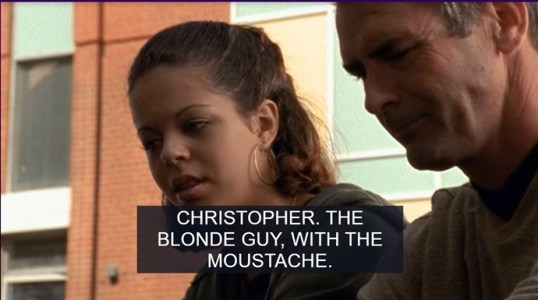
This episode deals very sensitively deals with Robert’s coming out and Andrew Gillies and Melissa McIntyre both deserve a lot of credit for their performances. (Remember, this episode aired in 2002, at a time when gay characters were almost always portrayed as either being comedy relief or helpless victims.) I do have to admit that there is one rather clunky line in this episode. It comes when Ashley asks Robert if he has a boyfriend and Robert tells her about his partner, Christopher. Ashley’s next line (and Melissa McIntyre’s overdramatic delivery of it) always makes me laugh despite myself:
Aside from that line and all of the cringey stuff involving J.T. and Liberty (and, admittedly, that is a lot to overlook), this was a sensitive and well-handled episode.
“You’re a monster!” a terrified woman shouts at the hulking, murderous figure who haunts the local abandoned cannery.
“I yam what I yam,” the Sailor Man (Jason Robert Stephens) replies before presumably killing her in some grotesque way.
The Sailor Man haunts the cannery. Some believe him to be a ghost be actually, he’s just a former sailor who has been mutated after eating too much contaminated spinach. Now, he is freakishly strong and can literally rip people into pieces with his hands. Running into the Sailor Man means that you will soon be seeing disconnected limbs, compound fractures, and split open heads. The Sailor Man’s motives aren’t always easy to figure out but, if you smell the burning of his pipe, you should probably run. With those gigantic arms and his permanent sour expression, the Sailor Man can pretty much do whatever he feels like doing. Shooting him or stabbing him won’t stop him. He’s hooked on the spinach.
Popeye The Slayer Man is one of three Popeye-themed slasher movies to be released in the wake of Popeye moving into the public domain. In this one, Dexter (Sean Michael Conway), a film student, decides that he wants to make a documentary about the Sailor Man legend so he and his friends break into the cannery. Almost everyone is killed in a bloody way and it’s hard not to notice that no one seems to be that upset about it. Dexter comes across the dead body of someone who was previously described as being his best friend since the Second Grade and he barely seems to care. Instead, he just lifts up his camera and films. I’m tempted to think that this was meant to be a satire on the callousness of aspiring documentarians but I might be giving the film too much credit. Who knows?
Obviously, you can’t take a film like this too seriously. In almost every room in the cannery, there’s at least a handful of empty spinach tins. To be honest, I actually think the film didn’t go far enough. Sure, Popeye’s killing people and there’s a character named Olivia (Elena Juliano) but where’s Bluto? Popeye is presented as a largely silent killer which, again, seems like a missed opportunity. Popeye is also presented as being rather random in his kills. He allows one person to survive for reasons that are incredibly unclear, beyond the fact that I guess the filmmakers felt that the character in question was too sympathetic to suffer the same bloody death as nearly everyone else in the film.
Other than the killer being Popeye, this is pretty much a standard low-budget slasher. I will admit that I kind of appreciated that is was pretty straight-forward about its intentions. Unlike a lot of recent slasher films, it never came across as if it was apologizing for being what it was and there’s definitely something to be said for that. The film embraces the philosophy of “I yam what I yam.” The Sailor Man would be proud.
In the fourth episode of Hammer House of Horror, Gary Bond plays a scientist whose son dies after eating some toxic proteins that just happened to be lying around the lab. The scientist’s wife (Barbara Kellerman) goes down to the local orphanage to collect a new son but this new kid turns out to be more than a little creepy.
This bizarre episode originally aired, in the UK, on October 4th, 1980. A quick warning: This episode does feature some dead rabbits. I like rabbits so that bothered me a bit, even though it made sense in the context of the story.
“He was brought across in 1228. Prayed on humans for their blood. Now, he wants to be mortal again.To repay society for his sins. To emerge from his World of Darkness. From his endless Forever Night.”
When we last left Nick Knight, Vampire Detective (Geraint Wyn Davies), he was driving through the streets of Toronto, Canada. On the radio was the voice of the Nightcrawler, a.k.a. LaCroix (Nigel Bennett), As Nick’s maker, LaCroix hates the quest for mortality that Nick’s put himself on. Following him along in dark, smoky alleyways, Nick and LaCroix make their way to a local warehouse. Despite their supernatural senses, neither of them notice Alyce trailing behind Nick in the distance.
LaCroix admits to stealing the jade cup from the museum and to the killing of the guard. The other deaths, however, are not his. When Nick accuses him of lying, LaCroix snaps. “Why would I lie?”, he says. “Give me a reason. I’ve never been afraid of killing.” LaCroix goads Nick into a fight, but easily takes him down since Nick’s been avoiding blood. Alyce arrives on the scene just in time in the rafters above to see Nick’s vampire face, causing her to scream. LaCroix quickly catches her and forces Nick to choose between the cup and Alyce. In the space it takes for the cup to fall, Nick reaches LaCroix and subdues him. LaCroix chuckles and notes, “Either way, I won.” They both watch the cup shatter into pieces on the floor a second later. Alyce heads out the door and down the building’s fire escape, with dawn quickly approaching. Nick and LaCroix get into a scuffle, which end ups with LaCroix impaled on a metal pole. We’re given a short flashback with Nick in the Dark Ages wanting to be human again, with LaCroix assuring him that the life he’s given him is a blessing. “I shall repay you.” Nick responds with contempt. Leaving LaCroix’s body, Nick runs outside into the morning sun. Smoke flows from his clothes as he makes it to his Caddy and locks himself in the trunk.
The next morning, Captain Stonetree (Gary Farmer), Nat (Catherine Disher) and Schanke (John Kapelos) are trying to figure out what happened to Nick. Schanke believes the Bloodbank has something to do the case. A call comes in, notifying the Captain that Nick’s Caddy was found and is being brought in. Schanke picks up the car and decides to ‘tool around’ in Knight’s Caddy for a while.
The “Bloodmobile” Winnebago arrives at a local hospital, and we watch a cart with blood bags make its way to the front desk. The nurse goes to accept the delivery when the phone rings. When she mentions the police (who are on the line as they are visiting), we see Dr. Fenner (Graham McPherson) brought in the blood. The fellow seems nervous at the sound of the police.
With Schanke at the front desk asking for the blood doner records, the nurse lets him know it’s confidential info. Fenner walks over to Schanke (as Schanke donated blood in the previous episode) and despite the Doctor vouching for him (and joking over the mileage of the Caddy), Schanke still can’t the nurse to hand over the records. He waves her away and promises to return with a warrant. At the same time Schanke has this conversation, Nick climbs out the Cadillac, sneaks into Fenner’s office and uses his computer. A quick call to Natalie and Nick mentions that Schanke’s hunches were correct and all of the victims were indeed blood donors.
Dr. Fenner makes a visit to the Caddy, causing Nick (in the truck again) to wonder what’s up. Schanke gets back into the car, cranks up some Polka music and backs out of the car lot, leaving behind a puddle of break fluid. On the road, he discovers he can’t slow down and panics.
Alyce tries to contact Nick via the phone, but can’t reach him. She looks up his address in the phone book, remembering their initial conversation and how Nick mentioned the numbers in the stones matched his alarm code. She writes this down on a pad and heads to Nick’s place.
At the Garage shop, Schanke and a mechanic are going over the damage to Nick’s Caddy. Before Schanke can leave, Nick comes out of hiding and confronts him. Schanke pleads for his life, describing the events of the crash, and Nick points out that not were the brake lines cut but that he was right on his hunch. Nick still wants to kill Schanke about the car, but apologizes to him for his work on the case. Schanke came through big.
“Hey, you look like death warmed over.” Schanke tells Nick, who responds that he hasn’t had anything to eat, but will get to “bite into something”. They head back to the Hospital to continue the investigation. Alyce, meanwhile heads to Nick’s place and find an injured Jeannie (Nicole De Boer). While tending to her, she calls for a doctor, asking for them to just ring the buzzer. Alyce tells Jeannie about the ambulance coming, but Jeannie freaks out. “He’ll be there! No!!” she cries out.
At the hospital, the truth comes to light. Dr. Fenner was the one who visited, his motive for the crimes being the death of his mother after a Type O blood transfusion lead to her having hepatitis. He blamed the homeless as the source of the problem. Nick quickly calls in an APB on the Doctor from the Hospital and then calls home to check his messages. Alyce picks up and tells him that Jeannie’s there, with the Ambulance on the way. Leaving the receiver open, Nick overhears Alyce’s scream and Doctor Fenner stuggling with her. Nick jumps into action, yelling to Schanke to send back up to his warehouse while leaping out of a window (outside of Schanke’s view, of course), soaring over Toronto’s busy streets.
Nick crashes through the window of his Warehouse, his apartment partially in flames. He moves to bite the Doctor, but his willpower is strong enough to keep from doing so. The doctor makes a run for it across the room, but is quickly dispatched by LaCroix, who drains him to a husk. LaCroix taunts Nick, who is too weak from not having fed. Alyce offers herself to him (a notion that LaCroix is in total support of), but Nick refuses. He instead picks up a burning piece of wood and tries to take out LaCroix, but is no real match for him. Alyce tries to run, but LaCroix catches up to her. Before he can bite her, though, Nick leaps back into action, finally impaling him with the piece of wood. LaCroix seemingly bursts into flames, leaving Nick with the unconscious Alyce as the sound of police sirens grow louder.
In the Epilogue, Natalie and Nick are back at the museum. “She wanted to live forever.” Nick says, saying that Alyce and LaCroix were the lucky ones in death. Vampirism for Nick is a life without love, but Natalie has hopes for him. “Do you really think you could bring me back over?”, he asks. “All we can do is keep trying.” she responds. As they leave the museum, Schanke makes fun over Nick’s blood transfusion (which is his). In a change from the TV film, as the trio depart the museum, we notice someone watching them from a high window. Nat and Schanke walk away, but Nick looks up briefly to find Alyce – a vampire herself now – smiling back at him before she takes flight into the night.
In 1988’s The Undertaker, a small college town is rocked by a serious of viscous, sexually-charged murders. While the professors and the students deal with their own dramas on campus, the bodies are piling up at the local funeral home. Who could the murderer be?
Well, Joe Spinell’s in the film. That really should be the only clue you need.
Spinell plays Roscoe, the town undertaker who has issues with his mother, cries at random, talks to dead bodies, watches movies featuring sacrifices, and occasionally performs what appears to be some sort of a ritual with his victims. This film was Spinell’s final film and he gives a performance that alternates between being perfunctory and being fully committed. On the one hand, there are plenty of scenes where Spinell appears to be making up his lines as he goes along, In the scenes in which he appears in his office, it’s appears that Spinell is literally reading his lines off of the papers on top of his desk. Then there are other scenes where Spinell suddenly seems to wake up and he flashes the unhinged intensity that made him such a fascinating character actor. In the 70s and 80s, there were many actors who frequently played dangerous people. Spinell was the only one who really came across like he might have actually killed someone on the way to the set. Spinell was in poor health for most of his life and he also struggled with drug addiction. In The Undertaker, he doesn’t always look particularly healthy. Even by Joe Spinell standards, he sweats a lot. And yet, in those scenes were actually commits himself to the character, we see the genius that made him so unforgettable.
As for the film itself, it’s basically Maniacbut without the New York grit that made that film memorable. Instead, it takes place in a small town and Spinell, with his rough accent and his button man mustache, seems so out-of-place that the film at times starts to feel like an accidental satire. Roscoe is obviously guilty from the first moment that we see him and yet no one else can seem to figure that out. Only his nephew suspect Roscoe but that problem is quickly taken care of. Whenever anyone dies, their body is brought to Rosco’s funeral home. Roscoe puts on his black suit, plasters down his hair, and tries to look somber. Roscoe spends a good deal of the film talking to himself. When a victim runs away from Roscoe, Spinell looks at a nearby dead body and shrugs as if saying, “What can you do, huh?”
If you’re into gore, this film has a lot of it and, for the most part, it’s pretty effective. In the 80s, even the cheapest of productions still found money to splurge on blood and flayed skin effects. If you’re looking for suspense or a coherent story, this film doesn’t really have that to offer. It does, however, offer up Joe Spinell in his final performance, sometimes bored and yet sometimes brilliant.
1979’s Apocalypse Now reimagines the Vietnam War as pop art.
Jim Morrison sings The End in the background as slow-motion helicopters pass in front of a lush jungle. The jungle erupts into flame while in a dingy hotel room, Captain Benjamin Willard (Martin Sheen) gets drunks, practices his karate moves, and smashes a mirror before collapsing to the floor in tears. The next morning, the hung-over and bandaged Willard ends up at a U.S. military base where he has a nice lunch with Lt. General Corman (G.D. Spradlin) and Col. Lucas (Harrison Ford) and a nearly silent man wearing an undone tie. Willard is asked if it’s true that he assassinated an enemy colonel. Willard replies that he did not and that the operation was classified, proving that he can both lie and follow military protocol. Willard is told that a Col. Walter Kurtz (Marlon Brando) has gone rogue and his mission is to go into Cambodia and terminate his command with “extreme” prejudice. It’s a famous scene that features G.D. Spradlin delivering a brilliant monologue about good and evil and yet it’s often missed that Willard is getting his orders from Roger Corman and George Lucas.
(Roger Corman was the mentor of director Francis Ford Coppola while the pre-Star Wars George Lucas was Coppola’s business partner. Indeed, Apocalypse Now was originally somewhat improbably planned to be a George Lucas film.)
Up the river, Willard heads on a patrol boat that is populated with characters who could have come out of an old World War II service drama. Chief (Albert Hall) is tough and no-nonsense. Lance (Sam Bottoms) is the goofy comic relief who likes to surf. Clean (Laurence Fishburne) is the kid who is obviously doomed from the minute we first see him. Chef (Fredric Forrest) is the overage, tightly-wound soldier who just wants to find mangoes in the jungle and who worries that, if he dies in a bad place, his soul won’t be able to find Heaven. The Rolling Stones are heard on the boat’s radio. Soldiers on the other patrol boats moon the boat and toss incendiary devices on the roof. It’s like a frat prank war in the middle of a war.
Colonel Bill Kilgore (Robert Duvall) is a badass calvary officer whose helicopter raids are legendary amongst the enemy and a dedicated surfer who tries to turn every night into the equivalent of an AIP Beach Party film. He’s a brilliant warrior who speaks with Malibu accent (“Charlie don’t surf!”) and who doesn’t flinch when a bomb goes off near him. “I love the smell a napalm in the morning,” he says and, for a few moments, you really wish the film would just abandon Willard so we could spend more time with Kilgore. “Some day this war is going to end,” he says with a reassuring nod, showing a non-neurotic attitude that is the opposite of Kurtz’s. Willard says that he could tell Kilgore was going to get through the war without even a scratch and it’s true. Kilgore doesn’t try to rationalize or understand things. He just accepts the reality and adjusts. He’s a true surfer.
The film grows progressively more surreal the closer the boat heads up the river and gets closer to Cambodia. A USO show turns violent as soldiers go crazy at the sight of the Playboy Bunnies, dressed in denim outfits and cowboy hats and twirling cap guns like the love interest in a John Wayne western. A visit to a bridge that is built every day and blown up every night is a neon-lit, beautiful nightmare. Who’s the commanding officer? No one knows and no one cares.
The closer Willard gets to Kurtz, the stranger the world gets. Fog covers the jungles. A tiger leaps out of nowhere. Dennis Hopper shows up as a photojournalist who rambles as if Billy from Easy Rider headed over to Vietnam instead of going to Mardi Gras. Scott Glenn stands silently in front of a temple, surrounded by dead bodies that feel as if they could have been brought over from an Italian cannibal film. Kurtz, when he shows up, is an overweight, bald behemoth who talks in riddles and who hardly seem to be the fearsome warrior that he’s been described as being. “The horror, the horror,” he says at one point in one of the few moments that links Apocalypse Now to its inspiration, Joseph Conrad’s Heart of Darkness.
Directed by near-communist Francis Ford Coppola and written by the unapologetically right-wing John Milius, Apocalypse Now is actually less about the reality of Vietnam and more about how the images of the war shaped pop culture the world over. It’s a reminder that Vietnam was known for being the first television war and that counterculture was not just made up of dropouts but also of writers, actors, and directors. Kurtz may say that Willard’s been sent by grocery store clerks but actually, he’s been sent by the B-movie producers who first employed and mentored the directors and the actors who would eventually become the mainstays of the New Hollywood. The film subverts many classic war film cliches but, at the same time, it stays true to others. Clean dying while listening to a tape recording of his mother telling him not to get shot and to come home safe is the type of manipulative, heart-tugging moment that could have appeared in any number of World War II-era films. And while Coppola has always said the film was meant to be anti-war, Col. Kilgore remains the most compelling character. Most viewers would probably happily ride along with Kilgore while he flies over Vietnam and plays Wagner. The striking images of Vietnam — the jungle, the explosions, the helicopters flying through the air — stay in the mind far more than the piles of dead bodies that appear in the background.
It’s a big, messy, and ultimately overwhelming film and, while watching it, it’s hard not to get the feeling that Coppola wasn’t totally sure what he was really trying to say. It’s a glorious mess, full of stunning visuals, haunting music, and perhaps the best performance of Robert Duvall’s legendary career. The film is too touched with genius to not be watchable but how one reacts overall to the film will probably depend on which version you see.
The original version, which was released in 1979 and was nominated for Best Picture, is relentless with its emphasis on getting up the river and finding Kurtz. Willard obsesses on Kurtz and really doesn’t have much to do with the other people on the boat. It gives the story some much-needed narrative momentum but it also makes Kurtz into such a legendary badass that it’s hard not to be disappointed when Willard actually meets him. You’re left to wonder how, if Kurtz has been living in the jungle and fighting a brutal and never-ending guerilla war against the communists, he’s managed to gain so much weight. Brando, who reportedly showed up on set unprepared and spent days improvising dialogue, gives a bizarre performance and it’s hard to view the Kurtz we meet as being the Kurtz we’ve heard about. As strong as the film is, it’s hard not to be let down by who Kurtz ultimately turns out to be.
In 2001 and 2019, Coppola released two more versions of the film, Redux and The Final Cut. These versions re-inserted a good deal of footage that was edited out of the original cut. Most of that footage deals with Willard dealing with the crew on the boat and it’s easy to see why it was cut. The scenes of Willard bonding with the crew feel out of character for both Willard and the rest of the crew. A scene where Willard arranges for Clean, Lance, and Chef to spend time with the Playboy bunnies seems to go on forever and features some truly unfortunate acting. Worst of all, Redux totally ruins Kilgore’s “I love the smell of napalm in the morning” monologue by having Willard suddenly steal his surf board. Again, it’s out of character for Willard and it actually feels a bit disrespectful to Duvall’s performance to suddenly turn Kilgore into a buffoon.
But then there are moments that do work. I actually like the lengthy French Plantation scene. By the time Willard, Lance, and Chef stumble into the plantation, the journey upriver has gotten so surreal that it makes a strange sort of sense that they would run into a large French family arguing politics while a clown tries to keep everyone distracted. The new versions of the film are undeniably disjointed but they also shift the focus off of finding Kurtz and place it more on Willard discovering how weird things are getting in Vietnam. As such, it’s less of a disappointment when Kurtz actually shows up. Much as with the French Plantation scene, the journey has become so weird that Kurtz being overweight and pretentious feels somehow appropriate.
What all the versions of the film have in common is that they’re all essentially a neon-lit dream of pop cultural horror. Is Apocalypse Now a horror film? Critic Kim Newman argued that it owed a lot to the genre. Certainly, that’s the case when Willard reaches the temple and finds himself surrounded by corpses and and detached heads. Even before that, though, there are elements of horror. The enemy is always unseen in the jungle and, when they attack, they do so quickly and without mercy. In a scene that could almost have come from a Herzog film, the boat is attacked with toy arrows until suddenly, out of nowhere, someone throws a very real spear. Until he’s revealed, Kurtz is a ghostly figure and Willard is the witch hunter, sent to root him out of his lair and set his followers on fire. If the post-60s American horror genre was shaped by the images coming out of Vietnam then Apocalypse Now definitely deserves to be considered, at the very least, horror-adjacent.
Apocalypse Now was controversial when it was released. (It’s troubled production had been the talk of Hollywood for years before Coppola finally finished his film.) It was nominated for Best Picture but lost to the far more conventional Kramer vs Kramer. Robert Duvall was the film’s sole acting nominee but he lost the award to Melvyn Douglas’s turn in Being There. Douglas was very good in Being There and I imagine giving him the Oscar was also seen as a way of honoring his entire career. That said, Duvall’s performance was amazing. In his relatively brief screen time, Duvall somehow managed to take over and ground one of the most unruly films ever made. The Oscar definitely should have gone to him.
As for the film itself, all three versions, flaws and all, are classics. It’s a film that proves that genius can be found in even the messiest of productions.
Two meteorite showers have fallen in rural England and a poacher has come across a strange plastic polyhedron at one of the sites. Brigadier General Alistair Lethbridge-Stewart (Nicholas Courtney), the head of the United Nations Intelligence Taskforce (UNIT), fears it could be the start of another alien invasion. He explains to UNIT’s skeptical scientific advisor, Dr. Liz Shaw (Caroline John), that UNIT was specifically created to protect the Earth from such invasions.
Meanwhile, a bushy-haired man has collapsed in front of an old-fashioned blue police call box. He’s been taken to a hospital, where the doctors are confounded by the fact that he appears to have two hearts. The Brigadier, hearing the news, is convinced that the man is his old friend the Doctor and heads to the hospital.
The Brigadier is right. The man (Jon Pertwee) is the Doctor but, as a result of being found guilty of stealing a TARDIS and breaking the Time Lord code of non-interference, the Doctor now looks and sounds completely different. While the Doctor works to convince the Brigadier that he is who he says he is, a tentacled alien known as the Nestene is using the Autons, a race of plastic humanoids, to do its deadly bidding.
I’ve always really liked Jon Pertwee’s interpretation of the Doctor and the reasons why are to be found in his very first adventure. While Pertwee’s Doctor was just as intelligent and egocentric as the two Doctors who came before him, he was also a man (or an alien, I guess) of action. Rather than just stay cooped up in that hospital room, the Third Doctor is constantly trying to escape. When the Autons show up and try to abduct him, the Third Doctor doesn’t go without a struggle. Unlike the first two Doctors, this Doctor has no problem commandeering a car and then demanding one just like it in return for working with UNIT. Pertwee combined intelligence with action and humor and that brought a unique feel to his five years in the role. I’ve often seen Pertwee’s Doctor compared to James Bond. I think a better comparison would be to Patrick McNee’s John Steed from The Avengers. The Third Doctor was an intelligent, erudite gentleman who dressed well and knew how to throw a punch.
The majority of the Third Doctor’s adventure would involve UNIT in some way. Exiled to Earth and with a locked-down TARDIS, the Third Doctor was the most Earth-bound of the Doctors but, as shown in Spearhead From Space, that worked well for Pertwee’s interpretation of the character. Pertwee and Nicholas Courtney were a good team and, for Pertwee’s first season, Liz Shaw was a companion who was actually the Doctor’s equal. (I had a huge crush on Caroline John when her episodes were first broadcast on PBS.) The first Auton Invasion showed why UNIT was so necessary and also why it needed the services of the Doctor.
The Autons have a reputation for being the scariest of Doctor Who’s monsters. They definitely were creepy, with their expressionless, plastic faces. Imagine mannequins that can walk and who will also shoot you on a whim and you have an idea of why the Autons inspired many bad dreams in 1970. (Like the Cyberman in Tomb of the Cybermen, the Autons were soon at the heart of a debate about whether or not Doctor Who was too scary for children.) The Autons are certainly more scary than the Nestene, which was quite obviously a puppet and not very well-put together one at that.
Spearhead from Space was a wonderful introduction to Jon Pertwee’s Doctor and it remains a classic of the original series. The first serial to be broadcast in color, it not only allows us to get to know the Third Doctor but it also introduces a classic new threat. As this story ends, the Doctor is settling to his new role as an advisor to UNIT. Waiting in the future are many more adventures and the Master.
Dr. Kobras (Donald Pleasence) has got an evil scheme. He’s going to use an ancient gold mask to take over people’s mind and eventually take over the world. Only the Pumaman, a man who has inherited God-like powers, can defeat Dr. Kobras and keep the mask from falling into the wrong hands. Unfortunately, Prof. Tony Farms (Walter George Alton) doesn’t understand that he’s the Pumaman. Vadinho (Miguel Angel Fuentes), an indigenous shaman, travels to London to convince him.
Perhaps the worst super hero movie ever made, Pumaman was an attempt to cash in on the popularity of the Superman movies. Pumaman didn’t start out in a comic book. He was created directly for the screen and his first movie was obviously meant to be the start of many adventures. It didn’t work out that way. Pumaman has plenty of fantastic powers but he’s not sure how to use them and he spends a lot of the movie complaining. He might as well just be called Whinyman. From the minute that he meets Tony, Vadinho has an expression on his face that reads as, “I’ve made a terrible mistake.” Beyond Pumaman just being plain unlikable, the movie also features some of the worst special effects that I’ve ever seen. The success of a film like that depends on whether or not you believe that a man can fly. Pumaman flies but he looks really stupid doing it. That was the failure of Pumaman.
How bad is Pumaman? Even Donald Pleasence looks embarrassed. Pleasence always made a good villain. He set the standard for Bond villains in You Only Live Twice. Pleasence also had the right sensibility for a good super hero film. If he had been born a decade or two later, he would have been equally well-cast as either Professor X or Magneto in the first X-Men film. In Pumaman, he rolls his eyes while delivering his lines. Not even he can believe this movie.
Pumaman saved the day and then disappeared. Earth already had enough heroes.
Welcome to Retro Television Reviews, a feature where we review some of our favorite and least favorite shows of the past! On Sundays, I will be reviewing Homicide: Life On The Street, which aired from 1993 to 1999, on NBC! It can be viewed on Peacock.
This week, the sniper shootings continue.
Episode 4.9 “Sniper, Part Two”
(Dir by Darnell Martin, originally aired on January 12th, 1996)
Despite the suicide of William Mariner, people in Baltimore are still falling victim to a sniper who attacks every eight hours. All of the detectives, many of whom have just returned home from spending several sleepless days and nights investigating the first sniper, are called back in. At first, Pembleton and Bayliss suspect that Mariner must have had an accomplice. However, when a strange young man named Alex Robey (David Eigenberg) just happens to be at the scene of two separate shootings, it becomes clear that the second sniper is just a copycat who is looking for attention.
It’s quite a contrast between William Mariner, who lived in an upper class neighborhood and who died without revealing his motivations, and Alex Robey, who lives in a rowhouse and who reveals that he was obsessed with Mariner’s crimes. It’s a reminder that some murderers are easier to figure out than others. The detectives will never know what caused Mariner to snap. But Robey? Robey’s just desperate for attention.
Recently demoted Megan Russert works with the Squad, despite Barnfather ordering Giardello to keep her away from the case. (Wisely, Giardello ignores Barnfather.) By pretending to be sympathetic to his resentment over being treated as a “nobody,” Russert plays a key role in Robey eventually confessing to being the sniper. The episode makes it clear that Russert is going to become the latest member of the Homicide squad. That’s fine but I do sometimes wish that this show could introduce a new detective without having them miraculously solve the big case. This season started with Kellerman displaying detective skills that he has not displayed in any episode since. This week, it was Russert’s turn to suddenly be the greatest detective this side of Frank Pembleton. It makes me miss the relative realism of the earlier seasons, where even the best detectives sometimes struggled. Bayliss failing to close the case of Adena Watson was one of the defining events of Homicide’s first season. If Adena had died during the fourth season, there’s no way the Arraber would have gotten away with it.
With Alex Robey confessing to being the second sniper, it looks like maybe the people of Baltimore are actually going to break from being shot at people on rooftops. Good for them, they deserve a break.



 Through the Shattered Lens