Late Night Retro Television Review: Friday the 13th: The Series 2.23 “The Maestro”


Welcome to Late Night Retro Television Reviews, a feature where we review some of our favorite and least favorite shows of the past! On Fridays, I will be reviewing Friday the 13th: The Series, a show which ran in syndication from 1987 to 1990. The entire series can be found on YouTube!

This week, it’s personal for Jack!

Episode 2.23 “The Maestro”

(Dir by Timothy Bond, originally aired on May 22nd, 1989)

Famed choreographer Anton Pascola (Colm Feore) is fond of saying that great art requires pain and he would know.  A former dancer, Anton was injured in an accident and now walks with a pronounced limp.  He has devoted his life to choreography and he has a small company of dancers who are devoted to him, despite his fearsome temper.  Because Anton’s dancers tend to be accident prone and also suicide-prone, there are frequent openings in his company.

Pascola’s newest dancer is Grace Cowell (Cynthia Preston).  Grace is young and naive and she thinks her dreams are about to come true.  She is also the daughter of one of Jack’s best friends.  When she takes Jack, Ryan, and Micki to a Pascola-choreographed performance of Romeo and Juliet, they are shocked to hear that the lead actors recently leapt out of a window together.  When Jack discovers that one of the cursed antiques is a Victorian music box that plays an amazing symphony but also forces the listeners to dance until they die, he realizes that Grace is in danger.

For all the time that they spend searching for cursed antiques, it’s amazing how often Jack, Ryan, and Micki just happen to stumble across one being used by someone they know.  I understand, of course, that it’s meant to add an extra personal element to their adventures.  Trying to save the daughter of his (never-seen) best friend adds something to the story that wouldn’t be there if Jack was trying to save someone he wasn’t personally close to.  But, at times, the way that this show depends on coincidence can get to be a bit much.

That said, Jack’s personal connection to this week’s antique does lead to one of the show’s most devastating endings.  Proving that he practices what he preaches, Anton dances to the music box’s symphony while an audience watches.  He dances until he dies.  Unfortunately, Grace is dancing with him and she dies as well.  This is not the first time that someone close to the main characters has died on this show.  What makes this episode unique is Jack’s reaction.  Jack has always been the wise father figure who helps to keep Micki and Ryan strong.  But when Grace dies, Jack has a breakdown.  He goes from obsessively trying to clean Grace’s blood off the music box to throwing antiques across the shop.  For once, it’s Micki and Ryan who have to calm down the distraught Jack.

The episode has more than a few plot holes and Grace’s actions often don’t make sense.  Even after she discovers that Pascola is killing his dancers, she still wants to work with him.  The implication is that she’s been brainwashed by his claims that art requires pain but there’s a difference between pushing yourself and killing yourself.  If Grace had previously acted like someone who had a death wish, the episode would not only make more sense but it would actually be a good deal more interesting.  That said, as someone who grew up going to dance classes and rehearsing and performing, I’ve certainly known my share of Anton Pascolas.  This was an episode to which I could relate.
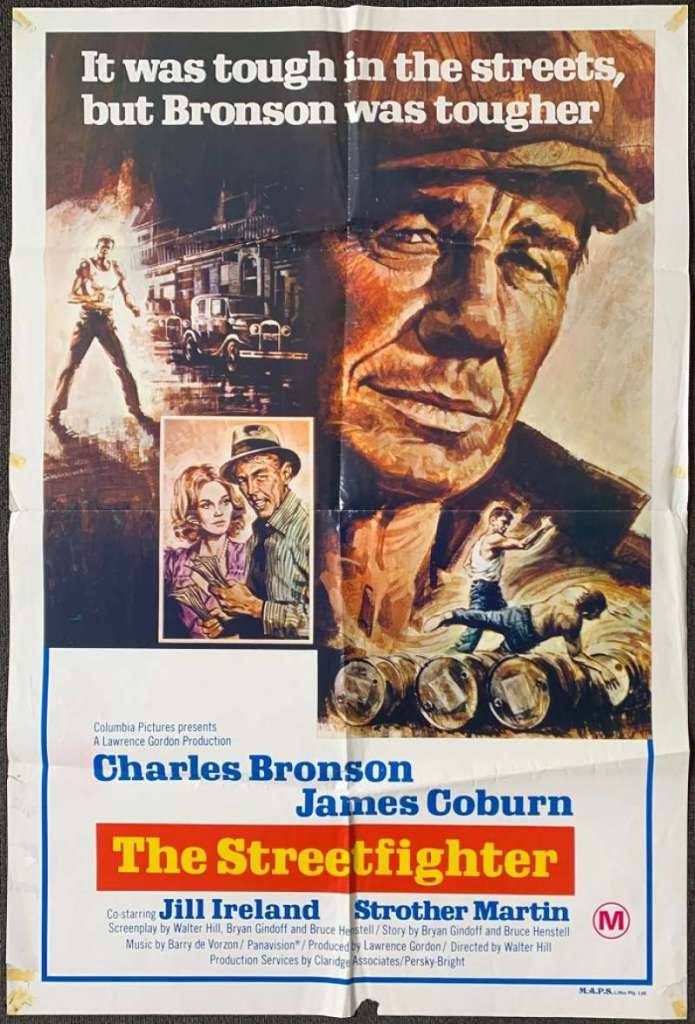
Happy Birthday to director Walter Hill, the guy who made my favorite film, HARD TIMES (1975)!


Walter Hill celebrates his 83rd birthday on January 10th, 2025. He has made so many great films in his career, but the one that stands out the most to me is his directorial debut from 1975, HARD TIMES, with Charles Bronson, James Coburn, Jill Ireland, and Strother Martin. The film was known as THE STREETFIGHTER in some parts of the world, like England, but due to Sonny Chiba’s “Street Fighter” movie from around the same time, the producers decided to go with HARD TIMES in America.

Here are a few more interesting facts about Hill’s directorial debut:

  1. Chaney (Bronson) was originally supposed to be a much younger man, with Jan-Michael Vincent being considered for the role.
  2. Charles Bronson was 52 years old when he made HARD TIMES. According to Hill, Bronson “was in remarkable physical condition for a guy his age…. He had excellent coordination, and a splendid build. His one problem was that he was a smoker, so he didn’t have a lot of stamina. I mean, he probably could have kicked anybody’s ass on that movie, but he couldn’t fight much longer than 30 or 40 seconds.”
  3. According to Hill, Charles Bronson was easier to work with than James Coburn. Hill would say “Bronson was a very angry guy who didn’t get along with a lot of people. The only reason I can tell you he and I got along well was he respected that I wrote the script. He liked the script. I didn’t try to get close to him. Kept it very business-like. I think he liked that. James Coburn, who everybody liked and got along well with, he and I did not get along well. I think he was not in a good mood about being in a movie with Charlie, it was second banana. He had been up there more, and his career was coming back a bit. I don’t think he was wild about being second banana. But Charlie was a big star… and when things had seemed to not be working well, or there was some impasse, Charlie would come down hard on my side. That was a tipping point”.
  4. Walter Hill thought the project could become more “up market” if he made it more like a Western and set it in the past. Hill incorporated elements of an earlier Western he had written, “Lloyd Williams and his Brother”. He wrote it in a style inspired by Alex Jacobs–“extremely spare, almost Haiku style. Both stage directions and dialogue.”
  5. The settings for the Capcom arcade game Street Fighter are taken right from HARD TIMES. This film is titled “The Street Fighter” in Japan, and the game designer was instructed to take inspiration from this film. He did just that and copied many of them directly.

I’m so thankful for Walter Hill and HARD TIMES. In fact, it’s my all-time favorite film, as well as the first review I ever published for The Shattered Lens.

So, if you like movies like HARD TIMES, THE DRIVER, THE WARRIORS, THE LONG RIDERS, SOUTHERN COMFORT, 48 HRS., EXTREME PREJUDICE, and RED HEAT, join us in celebrating the great director Walter Hill on his 83rd birthday. He has brought me countless hours of joy over the years!

Here’s a trailer from the Masters of Cinema for HARD TIMES…

Lisa Reviews An Oscar Nominee: A Streetcar Named Desire (dir by Elia Kazan)


Poor, tragic Blanche DuBois.

In 1951’s A Streetcar Named Desire, the emotionally fragile Blanche (played by Vivien Leigh) has come to New Orleans to live with her younger sister, Stella (Kim Hunter).  From an old and formerly wealthy Southern family, Blanche has recently lost both her job as a teacher and the plantation where she and Stella grew up.  Even before that, she lost her husband to suicide.  And now Blanche has been reduced to living with Stella in the run-down apartment that she shares with her brutish husband, Stanley Kowalksi (Marlon Brando).

Stanley is tough and blue-collar, an earthy gambler whose bad manners stand in sharp contrast to Blanche’s attempts to present herself as being an elegant Southern belle.  Stanley, who is convinced that Blanche has money that she’s hiding from her sister, goes out of his way torment Blanche.  Stella, who is pregnant, tries to keep the peace between her sister and the man who claims to love her, his family, and the Napoleonic code.  (“Stella!” Stanley yells at one point, the cry of a wounded animal who desperately needs his mate.)  Blanche ends up going on a tentative date with Mitch (Karl Malden), one of Stanley’s co-workers,  Stanley, who sees Blanche as a threat to the life that he’s created for himself, goes out of his way to destroy even that relationship.  Blanche has secrets of her own and Stanley is determined to dig them up and use them to his own advantage.  When Blanche refuses to allow Stanley to destroy the fantasy world that she’s created for herself, Stanley commits an act of unspeakable violence.

Based on the play by Tennessee Williams, A Streetcar Named Desire is a recreation of the film’s legendary Broadway production.  Elia Kazan, who directed the theatrical production, does the same for the film.  Marlon Brando, Kim Hunter, and Karl Malden recreate their stage roles and many of the minor characters are also played by the same actors who played them on stage.  The only major change to the cast is Vivien Leigh, who replaces Jessica Tandy in the role of Blanche.  Tandy had won a Tony for playing the role of Blanche but the film’s producer insisted on an actress who had more box office appeal.  After both Bette Davis and Olivia de Havilland (both of whom would have had too strong of a personality to be believably pushed around by Stanley) declined the role, Vivien Leigh was cast.  Leigh has played Blanche on the London stage and, perhaps even more importantly, her own fragile mental health mirrored much of what Blanche had gone through before moving to New Orleans.

A few changes were made to the play.  In the play, it’s made clear that Blanche’s husband committed suicide after he was caught having an affair with another man.  In the film, Blanche simply says that her husband was too sensitive.  The film also includes a few scenes that are set outside of the apartment in an attempt to open up the play.  (That said, the film still comes across as being rather stagey.)  In the play, it’s made clear what Stanley does to Blanche while Stella is at the hospital.  The film leaves it ambiguous, though still providing enough hints for the audience to figure it out on their own.  Finally, the film ends with a suggestion that Stanley will ultimately suffer for his bad behavior.  It’s hardly a happy ending but it’s still not as dark as what happens in the play.

The film definitely retains its theatrical origins.  It’s very much a filmed play and again, it can feel rather stagey.  But the performance are so strong that it really doesn’t matter.  A Streetcar Named Desire was the first film to win three of the acting awards, with Oscars going to Hunter, Malden, and Leigh.  Marlon Brando was nominated for Best Actor but did not win, largely because he was competing against Humphrey Bogart who, himself, had never won an Oscar.  (The Brando snub would be rectified when he later won for On The Waterfront.)  Brando’s performance as Stanley still holds up today.  He’s so ferociously charismatic that it’s actually a bit scary to watch him.  One can see what drew Stella to him, even though Stanley is very much not a good man.  It’s a performance that will definitely take by surprise anyone who knows Brando only from his later years, when he was known for his weight and his oft-stated boredom with acting.  A Streetcar Named Desire shows just how brilliant an actor Marlon Brando was at the start of his career.  The intensity of Brando’s method acting matches up perfectly with Vivien Leigh’s more traditional style of acting and the film becomes not just the story of a domineering brute and a fragile houseguest but also a metaphor for the death of the antebellum South.  If Blanche represents a genteel past that may have never existed, Stanley represents the brutality of the 20th Century.

Along with the similarly dark A Place In The Sun, A Streetcar named Desire was considered to be a front runner for the 1951 Best Picture Oscar.  In the end, though, the voters went for the much less depressing An American In Paris.

A Streetcar Named Desire (1951, dir by Elia Kazan, DP: Harry Stradling)

Great Moments In Television History #36: The Sopranos Premieres On HBO


On this day, 26 years ago, The Sopranos premiered on HBO and television (not to mention organized crime) would never be the same.  Today, it can be easy to forget just how revolutionary that first season of The Sopranos was.  What originally sounded like a joke — a gangster goes into therapy (a plot that had already been used in the film Analyze This) — turned out to be a powerful portrait of American society at the crossroads.

And it all started on January 10th, 1999.

Previous Moments In Television History:

  1. Planet of the Apes The TV Series
  2. Lonely Water
  3. Ghostwatch Traumatizes The UK
  4. Frasier Meets The Candidate
  5. The Autons Terrify The UK
  6. Freedom’s Last Stand
  7. Bing Crosby and David Bowie Share A Duet
  8. Apaches Traumatizes the UK
  9. Doctor Who Begins Its 100th Serial
  10. First Night 2013 With Jamie Kennedy
  11. Elvis Sings With Sinatra
  12. NBC Airs Their First Football Game
  13. The A-Team Premieres
  14. The Birth of Dr. Johnny Fever
  15. The Second NFL Pro Bowl Is Broadcast
  16. Maude Flanders Gets Hit By A T-Shirt Cannon
  17. Charles Rocket Nearly Ends SNL
  18. Frank Sinatra Wins An Oscar
  19. CHiPs Skates With The Stars
  20. Eisenhower In Color
  21. The Origin of Spider-Man
  22. Steve Martin’s Saturday Night Live Holiday Wish List
  23. Barnabas Collins Is Freed From His Coffin
  24. Siskel and Ebert Recommend Horror Films
  25. Vincent Price Meets The Muppets
  26. Siskel and Ebert Discuss Horror
  27. The Final Scene of Dark Shadows
  28. The WKRP Turkey Drop
  29. Barney Pops On National TV
  30. The Greatest American Hero Premieres
  31. Rodney Dangerfield On The Tonight Show
  32. The Doors Are Open
  33. The Thighmaster Commercial Premieres
  34. The Hosts of Real People Say “Get High On Yourself”
  35. The 33rd NFL Championship Game Is Broadcast In Color

No Holds Barred (1989, directed by Thomas J. Wright)


In No Holds Barred, Hulk Hogan plays a professional wrestler who is best-known for his mustache, his thinning blonde hair, and for ripping his shirt in half when he climbs in the ring.  Hulk Hogan is playing himself except that everyone in the movie calls him Rip Thomas.  Why is Hogan renamed Rip Thomas?  It seems strange because No Holds Barred features “Mean Gene” Okerlund and Jesse “The Body” Ventura as themselves and there’s nothing about Rip that’s any different from Hulk Hogan’s own wrestling persona.

Rip is the World Wrestling Federation Champion and is loved by fans across the globe.  Rip may be fierce in the ring but outside of the ring,  he loves children and is devoted to looking after his younger brother, Randy (Mark Pellegrino).  Tom Brell (Kurt Fuller), the evil owner of World Television Network, wants to harness the star power of Rip but, when Rip refuses to sign with WTN, Brell goes his own way and hires ex-convict Zeus (Tiny Lister) to star in The Battle Of The Tough Guys.

Rip still wants nothing to do with Brell, not even when Brell sends Samantha Moore (Joan Severance) to seduce him.  In fact, Rip is such a beacon of goodness that he brings Samantha over to his side.  But when Zeus puts Randy in the hospital, Rip has no choice but to seek revenge in the ring.

No Holds Barred is a movie with an identity crisis.  It’s a pro wrestling movie that was made to capitalize on Hulkamania and a lot of the humor was meant to appeal to the kids who were a huge part of Hogan’s fanbase but it’s also a movie in which people die, Samantha is nearly raped, and Randy is crippled by Zeus.  The movie lacks the sense of fun that has made professional wrestling a worldwide phenomena.  The most surprising thing about No Holds Barred is that Hulk Hogan has very little screen presence.  I don’t think anyone would expect him to be a great actor but he also shows little of the charisma that made him a phenomena back in the day.  Especially when compared to the ferocious Tiny Lister, Hogan is just boring.  Maybe that’s the difference between Rip Thomas and Hulk Hogan.

David Paymer has a small role in No Holds Barred, playing a nervous television executive.  Out of the cast, Paymer was the only one who later went on to be nominated for an Oscar and Jesse Ventura was the only one to later be elected governor of a state, at least so far.  Hulk Hogan’s only 71.  He’s still got time.

Retro Television Review: St. Elsewhere 1.7 “Legionnaires: Part Two”


Welcome to Retro Television Reviews, a feature where we review some of our favorite and least favorite shows of the past! On Fridays, I will be reviewing St. Elsewhere, a medical show which ran on NBC from 1982 to 1988.  The show can be found on Hulu!

This week, the hospital’s in chaos!

Episode 1.7 “Legionnaires: Part Two”

(Dir by Mark Tinker, originally aired on December 14th, 1982)

With one of the wards shut down due to a Legionnaires outbreak, the hospital is in crisis.  All of the patients from the infected ward and their doctors have been moved to a new floor and now, everyone is stressed and overworked.  Dr. Westphall insists to the Hospital Board that he has no regrets about shutting down the ward and that he did what he had to do.  Westphall is vindicated when it turns out that he was correct about the Legionnaires outbreak but he still has to admit that administrator H.J. Cummings (Christopher Guest) has a point about Westphall’s actions causing a panic.  Cummings argues that Westphall could have quietly closed the ward without alerting the media.  In the end, it doesn’t matter as Cummings explains that he’ll be the one who gets fired over the bad publicity, not Westphall.  The episode ends with Westphall returning to his small home, carrying the birthday present that he was supposed to give his son that day.  Westphall has dedicated his life to the hospital and it’s obvious that his family has often had to wait until he has time for them.

(I’m starting to understand why Westphall always seems so damn depressed.)

Some people take advantage of the chaos.  Two gang members (one of whom is played by a very young Robert Davi) hit Fiscus over the head and steal his wallet after Fiscus stitches up one of their hands.  Peter White, eager to get away from his troubled marriage, shows up to work Morrison’s shift for him.  Dr. Chandler glares at a nurse that he previously accused of unprofessional behavior.  Dr. Craig tries to find someone foolish enough to buy his old convertible from him.  And head nurse Helen Rosenthal finds herself being called over and over again to the room of patient Martha Mulvahey (Ann Bronston).

Poor Martha!  She has a reputation for being a problem patient, because she’s always calling for the nurses and asking them to do things for her, like wash her hair or raise her bed.  Only Helen is willing to put up with Martha but even Helen loses her temper when Martha asks for help putting on her makeup.  Finally, Martha breaks down and explains that her arthritis is so severe that she can barely move her hands.  She’s a librarian and she can’t even turn the pages of a book anymore.  (Excuse me, I think I have something in my eye….)  A friend is coming to visit her at the hospital and she just wants to look good for him because she doesn’t want him to remember her as someone who can’t even get out of a hospital bed.  Helen helps Martha put on her makeup.  At the end of the episode, the hospital may be in chaos but Martha gets to see her friend and that made me happy and brought even more tears to my eyes.

Meanwhile, psychiatric patient Jane Zontell (Laraine Newman) returns to the hospital and checks herself back in for treatment.  Dr. Beale (G.W. Bailey) is shocked to learn that Jane is three months pregnant.  But it’s only been two months since Jane was last a patient at St. Eligius so that father must be someone at the hospital.  Uh-oh.

(Personally, I suspect Fiscus.)

This was a good episode.  I cried for Martha.  I felt bad for Westphall.  I hope someone buys Dr. Craig’s car so he’ll stop bothering everyone else about it.  This episode was about how bad things can get at a hospital but, with Martha and Rosenthal, it offered up some hope as well.  All in all, it worked.

Brad’s Song of the Day: “BUSINESS TIME” by Flight of the Conchords (this song will change your life!)


Today, the Shattered Lens is in the business of wishing a happy birthday to Jermaine Clement, one half of the “Flight of the Conchords” musical group. And you know what that means… it’s BUSINESS TIME!

A friend of mine shared this song with me many years ago, and I still refer to it often. I just laughed my ass off watching this video again. Enjoy, my friends!

Song of the Day: Hurt Feelings/Tears of A Rapper by Flight of the Conchords


Today, the Shattered Lens wishes a happy birthday to Jermaine Clement, who is half of Flight of the Conchords.  For today’s song of the day, we have Jeremaine and Bret performing my favorite of their songs, Hurt Feelings (a.k.a. Tears of a Rapper.)

Some people say that rappers don’t have feelings
We have feelings. (We have feelings)
Some people say that we are not rappers. (We’re rappers.)
That hurts our feelings.
(Hurts our feelings when you say we’re not rappers.)
Some people say that rappers are invincible
We’re vincible. (We’re vincible.)
What you are about to hear are true stories
(Real experiences)
Autobiographical raps.
Things that happened to us, all true
Bring the rhyme!

I make a meal for my friends,
Try to make it delicious,
Try to keep it nutritious,
Create wonderful dishes.
Not one of them thinks about the way I feel
Nobody compliments the meal

I got hurt feelings, I got hurt feelings
I feel like a prize asshole
No one even mentions my casserole.
I got hurt feelings, I got hurt feelings.
You coulda said something nice about my profiteroles

Here’s a little story to bring a tear to your eye,
I was shopping for a wetsuit to scuba dive,
But every suit I tried is too big around the thighs,
And the assistant suggested I try a ladies’ size

I got hurt feelings, I got hurt feelings
I’m not gonna wear a ladies’ wetsuit I’m a man!
I got hurt feelings, I got hurt feelings
Get me a small man’s wetsuit, please

It’s my birthday, 2003
Waitin’ for a call from my family
They forgot about me

I got hurt feelings, I got hurt feelings
The day after my birthday is not my birthday, Mum

I call my friends and say, “Let’s go into town”
But they’re all too busy to go into town
So I go by myself, I go into town
Then I see all my friends, they’re all in town

I got hurt feelings, I got hurt feelings.
They’re all lined up to watch that movie
“Maid in Manhattan.”

Have you even been told that your ass is too big?
Have you ever been asked if your hair is a wig?
Have you ever been told you’re mediocre in bed?
Have you ever been told you’ve got a weird-shaped head?
Has your family ever forgotten you and driven away?
Once again, they forgot about J
Were you ever called “homo” ’cause at school you took drama?
Have you ever been told that you look like a llama?

Tears of a rapper
(don’t wanna make a rapper cry then watch what you say)
I’m crying tears of a rapper
(I pouring out the bullets of my Icannon)
Go play the tears of a rapper
(These are the tears of a rapper now)
The diamond tears of a rapper
(These are the bullet proof 24 karat of tears, of a rapper)

Songwriters: Bret Mckenzie / Jemaine Clement

Live Tweet Alert: Join #FridayNightFlix For Quick Change!


As some of our regular readers undoubtedly know, I am involved in a few weekly live tweets on Twitter and Mastodon.  I host #FridayNightFlix every Friday, I co-host #ScarySocial on Saturday, and I am one of the five hosts of #MondayActionMovie!  Every week, we get together.  We watch a movie.  We tweet our way through it.

Tonight, at 10 pm et, #FridayNightFlix presents Bill Murray in Quick Change!

If you want to join us this Friday, just hop onto twitter, start the movie at 10 pm et, and use the #FridayNightFlix hashtag!  It’s a friendly group and welcoming of newcomers so don’t be shy.

Quick Change is available on Prime!  See you there!

Scenes That I Love: “Can You Dig It?” From The Warriors


Cyrus?

He’s the one and only.

From 1979’s The Warriors (which was directed by Walter Hill, who celebrates his birthday today), here’s a scene that I love.  Playing the role of Cyrus, the man who could bring all of the gangs of New York together, is Roger Hill.  Playing the role of his assassin is the great David Patrick Kelly.

Cyrus knew what he was talking about but the world wasn’t ready for him.

Can you dig it?