In Graveyard Shift At The Riverview Motel, you have what might be the worst job in the world.
You work the graveyard shift at the Riverview Motel. The Riverview was once a quality establishment but it has since fallen on hard times. You can spend your shift sitting at the front desk or you can go outside and smoke a cigarette. If you get bored, you can step into the employee hallway and, moving the pictures on the wall aside, you can take a look in each of the six rooms and the people who are staying there.
Inside each room, a different story is playing out. Which story you get involved in depends on how involved you want to get. If you want to spend your entire shift sitting at the front desk, you can do that. You’ll get hints about some of the strange things happening in the motel but you won’t be under any obligation to pursue them. If you want to spend all of your time focusing on one room, you can do that as well. If you want to go from room to room and catch snippets of all of the stories playing out at once, you can do that too. It’s all up to you how involved you get.
Graveyard Shift at the Riverview Motel is an interactive text adventure, designed using Twine. Because of the game’s format, it can be played several times and it rewards player who have the patience to do multiple walkthroughs. The writing is clever and the sense of humor is acidic. It captures the feeling of being at work and looking for anything to possibly distract from actually having to do your job. I spent a few months working the graveyard shift to help pay for college and this game brought back some memories. All of the stories that occur in the motel pay tribute to classic horror films and they all end in a properly macabre fashion. One of my favorite aspects of the game was how blasé the desk clerk remained, regardless of what sort of strange things he was witnessing. It doesn’t matter how many people die as long as you can clock out when your shift is over.
There is a learning curve with the game. Several turns make up a minute in game time and, unfortunately, if you stay in one location (like the front desk or the parking lot) for that entire minute, then the same description is repeated over and over again until the next minute begins. So, if you’re in the front lobby and a man storms in and says something strange, remaining in the lobby means that same action will seemingly happen over and over again. When this first occurred, I thought the game itself was freezing on me and I nearly stopped playing. Eventually, I realized what the problem was and, after a while, I just made sure to keep walking from location to location until the next minute began. I think this is something that could be fixed whenever the game is updated and I hope it will be because it was really the only problem I had with this playing experience.
In 2009, the crusading newspaper publisher, J. Jonah Jameson, was elected Mayor of New York City. At least, that’s what happened in Amazing Spider-Man #591.
It didn’t turn out well, of course. Mayor Jameson spent too much time obsession on Spider-Man and not enough time fixing the subways. He was bombastic, stubborn, and refused to admit when he was wrong. That shouldn’t have taken anyone by surprise. New Yorkers knew what they were getting when they voted for him but they elected him anyway. Of course, in 2009, the idea of a buffoon like J. Jonah Jameson ever holding a major political office seemed like a fantasy. Today, Jonah would fit right in with the majority of the people in Washington.
As mayor, Jameson ended up getting manipulated by both Doctor Octopus and the Green Goblin. It’s no wonder that Mayor Jameson failed to even finish his first term before having to resign.
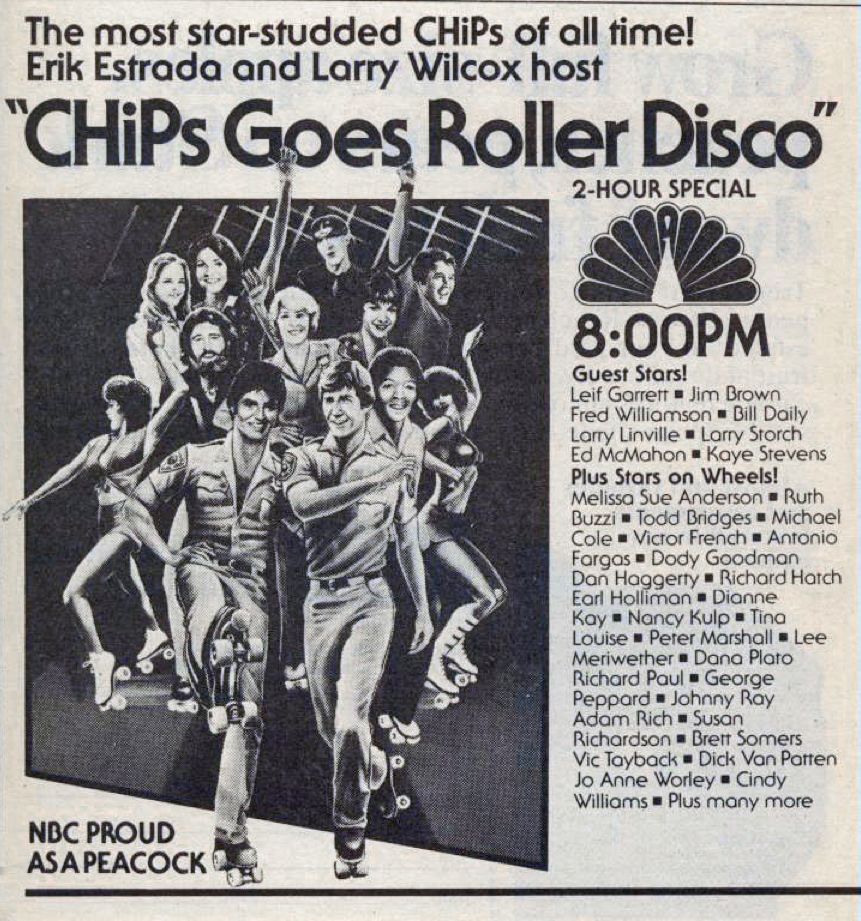
On September 22nd, 1979, NBC aired the premiere of the third season CHiPs. The show, which revolved around the hijinks of the members of the California Highway Patrol, was never a favorite of the critics but it was a hit with young audiences who didn’t know any better. For the start of the third season, the show paid those fans back with Roller Disco.
On this special, two-hour episode, Ponch (Erik Estrada) and Jon (Larry Wilcox) pursued thieves on roller skates while setting up the patrol’s annual charity benefit, which also involved roller skates. The plot was not as important as the epic finale, in which Baker and Captain Getear (Andrew Pine) greeted all of the local celebrities who showed up for the the charity roller disco. The scene is remembered for both the quality of the stars (Melissa Sue Anderson and Nancy Kulp!) and the excited announcer who spent the entire benefit shouting out names.
I don’t believe in manifesting events and I sure as heck don’t believe in the power of Twitter prayer circles.
I do believe that Lee Harvey Oswald acted alone.
That makes me a bit of a rarity in our conspiracy-crazed culture but, to me, the idea of one loser killing the most powerful man in the world makes more sense than the idea of some gigantic, complex conspiracy coming together and developing a needlessly complicated plot to kill someone who they could have just as easily blackmailed or circumvented through other methods.
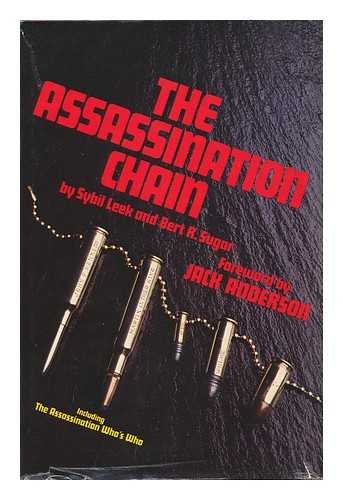
That said, just because I don’t believe in conspiracy theories doesn’t mean that I don’t find them to be oddly fascinating. Take, for instance, the 1977 conspiracy tome, The Assassination Chain.
Written by Sybil Leek and Bert R. Sugar, The Assassination Chain takes a look at the theories surrounding the assassination of John F. Kennedy. Each major theory — from Oswald acting alone to accusations against the CIA, the FBI, the Mafia, Castro, the anti-Castroites, the military-industrial complex, and various right-wing oilmen — is given its own separate chapter. With the exception of the official story, each theory is given respectful consideration. After detailing the JFK theories, The Assassination Chain features chapters about the assassinations of Martin Luther King, Jr, and Robert F. Kennedy. It even takes a look at the attempted assassination of George Wallace and suggests that both Sirhan Sirhan and Arthur Bremer were brainwashed by people who were concerned that either RFK or Wallace could keep Nixon out of the White house.
And, in conclusion, the book suggest that the guilty party was …. EVERYONE! Everyone from the CIA to the FBI to the Mafia to the Pentagon to the richest men in Texas came together in a gigantic plot to not only kill JFK but to also to kill Rev. King, RFK, and Wallace. (I think this might be the only book to suggest that MLK and George Wallace had the same enemies.) Who could stand at the controls of such a plot? Almost as an afterthought, the book accuses Howard Hughes, the famously eccentric billionaire who was later played by Leonardo DiCaprio in The Aviator.
The book’s conclusions aren’t particularly convincing but they do provide an interesting insight into the conspiracy mindset, which states that the only evidence that matters is the evidence that supports the conclusion that you’ve already reached. There’s actually far more evidence to suggest that Oswald acted alone than there is to suggest that the CIA would risk its existence by assassinating the President as opposed to just threatening to leak the details of the President’s extramarital affairs to the press. But it’s comforting to assume that the world’s events are the result of a conspiracy as opposed to just the act of one loser who was upset because his wife left him. Conspiracies provide a way to understand the whims of fate. There’s a comfort in believing that everything happens as a part of a deliberate chain as opposed to just being random events.
The thing is, though, The Assassination Chain makes for an interesting read. Regardless of whether you buy the conspiracy angle or not, it’s always interesting to explore the darker corners of the 60s and early 70s. One reason why the JFK assassination conspiracy theories are so fascinating is because they all involve shady and downright weird characters, like alcoholic ex-FBI agent Guy Bannister and his partner, a hairless pilot and amateur cancer researcher named David Ferrie. The Assassination Chain provides a tour through the fringes of the 60s and introduces to many of the characters who were made their home in those fringes. The book’s final chapter is a detailed Who’s Who of everyone who, up to that point, had been caught up in the assassinations and the theories that followed and it’s an interesting collection of eccentrics, wannabe spies, and mentally unstable blowhards.
The worn and beat-up copy of this book that I read was obviously an old library book. It reeked of cigarette smoke and, as I leafed through the book last week, I found myself imagining the previous owner, chainsmoking while trying to understand the chaotic and random nature of the world. Whomever that person was, I hope they found some sort of answer.
No sooner had I finished writing my post about the trailer for The Devil Within than another horror trailer dropped. This is for a Korean anthology film, one that features several different tales of terror.
The trailer for the upcoming horror film, The Devil Within, dropped today and….
….actually, it doesn’t look that bad.
If nothing else, the trailer seems to suggest that the film tries to put a different spin to the usual exorcism film. Does everyone get a chance at the exorcism? Do all other exorcists eventually team up, Avengers-style? Who knows? To be honest, there’s no evidence from the trailer that they do but that’s still something I would like to see. If you’re a filmmaker looking for an idea for your next horror movie, jot that down and give me “suggested by” credit. Thanks!
Well, I guess you get another live action remake of a beloved Disney classic. In this case, the remake is Pinocchio. Now before anyone rolls their eyes at another Disney remake, it should perhaps be considered that this one is being directed by Robert Zemeckis and it stars Tom Hanks as the lonely puppet maker. To be honest, this seems like a good fit for Zemeckis’s style of storytelling and Tom Hanks seems like a good fit for Geppetto and he’s got experience playing a toy so he should at least understand Pinocchio’s point of view.
The film is set to drop on Disney+ on September 8th and I know at least one member of the TSL crew will be watching. At the very least, this will probably be a little bit better than the Roberto Benigni film.
True Adventures was a pulp magazine that ran from 1955 to 1971. Each issue featured stories about manly men doing manly things and they were all supposedly true. Today, True Adventures not because of the stories but the very pulpy and often very violent covers.
Here, for our adventurous readers, is just a sampling of the covers of True Adventures:
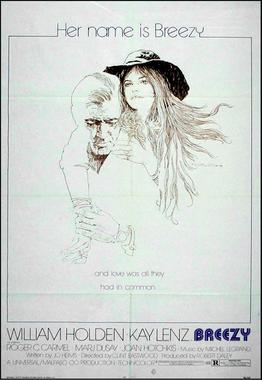
1973’s Breezy tells the story of two seemingly different people.
Breezy (Kay Lenz) is a teenage girl who moves to California after she graduates high school. Breezy is intelligent and free-spirited. She’s also practically homeless, moving from bed to bed and never getting tied down to anyone. Many people assume that Breezy is a runaway but her parents died a long time ago and her aunt approves of Breezy pursuing her own happiness. Many people also assume that Breezy is a hippie but Breezy doesn’t consider herself to be one and doesn’t even smoke weed. She may hang out with hippies and runaways but, for the most part, Breezy just wants to be herself, free of all of society’s labels and hang-ups.
Frank Harmon (William Holden) is a fifty-something real estate agent. He drives a nice car. He owns a lovely home. He has money but he’s also freshly divorced and obviously in love with his best friend, Betty (Marj Dusay). Most people would consider Frank to be a part of the establishment, though it soon becomes clear that he’s as disillusioned as any long-haired protestor. Frank has reached the point of his life where he looks at everything that he has and he asks, “Is this all there is?”
Together …. they solve crimes!
No, actually, they fall in love. Breezy ends up outside of Frank’s house after escaping a creepy man who had earlier offered her a ride. When she sees that Frank is getting into his car and driving into the city, she decides that Frank can give her a ride too. She also decides to keep hanging out near Frank’s house. Though Frank is initially annoyed by Breezy’s presumptuousness, he still allows her to spend the night when a sudden storm comes up. Frank and Breezy become unlikely friends and eventually, even more. But Frank continues to worry about the difference in their ages, especially when his friends find out that Breezy is living with him.
Really, Breezy is a film that should not work and it does run the risk of turning into a typical midlife crisis fantasy, with Breezy having no concerns beyond keeping Frank happy. That the film does work is largely a testament to the performances of William Holden and Kay Lenz and the sensitive and nonexploitive direction of Clint Eastwood. When screenwriter Jo Heims first wrote the script for Breezy, she envisioned Eastwood in the role of Frank. Reading the script, Eastwood said that he could relate to Frank’s disillusionment but that he felt he was too young for the role. Instead, Eastwood directed the film and he cast William Holden as Frank. Breezy was Eastwood’s third film as a director and the first in which he didn’t star. It was also nobody’s idea of what a Clint Eastwood film would be and it struggled at the box office. That said, it’s a film that has a legion of devoted fans. Paul Thomas Anderson is one of those fans and even worked a few references to the film into Licorice Pizza.
Holden and Lenz both give excellent performances, with Lenz playing Breezy as being free-spirited but not foolish. Holden, meanwhile, captures Frank’s boredom without giving a boring performance. (It helped that, while Holden was the right age of the role, he still retained enough of his good looks and his movie star swagger that it was believable that Breezy would find him attractive.) Wisely, the film doesn’t make the mistake of idealizing either Frank or Breezy. They’re both complex characters, with their own individual flaws and strengths. At the end of the film, one can be forgiven for having doubts about whether or not they’ll still be together in a year or two but one does definitely wish them the best, no matter what happens.
Though politically conservative, Breezy reveals that Clint Eastwood had some sympathy for the counter-culture. Eastwood has always straddled the line between being a member of establishment and being a rebel. Like Breezy and Frank, he belongs to both worlds.
The 1979 film, Escape from Alcatraz, opens with Clint Eastwood and a group of policeman taking a barge across San Francisco Bay, heading towards Alcatraz Island. As any fan of Eastwood’s 1970s film work can tell attest, this is hardly the first time that Eastwood has gone across the bay to Alcatraz. In The Enforcer, Eastwood went to Alcatraz to kill a bunch of hippies and save the Mayor of San Francisco. It wasn’t easy but, fortunately, Clint found a rocket launcher.
However, in Escape from Alcatraz, it’s hard not to notice that Clint is wearing handcuffs. And the cops beat him up while traveling to the island. And once they reach the prison …. oh my God, they’re making Clint Eastwood walk down a prison hallway naked and shoving him into a cell! Is this some early form of 60 Days In or could it be that Clint Eastwood is playing a convict? After starting the 70s in the role of Dirty Harry Callahan, Clint Eastwood ended the 70s playing one of the people who Callahan would have arrested. (Or, if we’re going to be totally honest, shot.)
Specifically, Clint Eastwood is playing Frank Morris. The real-life Morris was a career criminal. He had a genius IQ but he loved to steal and he spent most of his known life in prison. He was specifically sent to Alcatraz because he had a history of escaping from other prisons. Because Alcatraz was sitting on an island in the middle of the difficult-to-cross San Francisco Bay, it had a reputation for being inescapable and, indeed, every previous escape attempt had failed and led to someone getting gunned down by the guards. Morris, of course, immediately started to plot his escape. Working with three other prisoners, Morris managed to tunnel his way out of the prison. (Famously, Morris and his accomplices also managed to create papier-mâché dummy heads, which were left in their beds and kept the guards from realizing that they had escaped from their cells.) No one knows whether Morris and his accomplices managed to cross the bay, though I think most people would prefer to think that they made it to freedom. Our natural tendency is to root for the underdog, even if they are a group of car thieves fleeing from a federal prison.
For the most part, Escape from Alcatraz sticks to the facts of Morris’s escape. Of course, because Frank Morris is played by Clint Eastwood, there’s never really much doubt as to whether or not he’s going to figure out a way to get out of the prison. There’s not a prison in the world that could hold 70s-era Clint Eastwood!
The casting of Eastwood, however, adds another layer to the story because Eastwood, especially at the time that Escape from Alcatraz was made, was the ideal representation of individualism. From the minute the smug warden (played by Patrick McGoohan) tells Morris that it will be impossible to escape from Alcatraz, it becomes obvious why Morris has no other option but to escape. The warden thinks that he can tell the prisoners what to do, when to talk, and what to think. The warden expects his prisoners to live and act like monks who have taken a vow of silence but, instead of offering the hope of salvation, the warden is more concerned with exercising his own power. The warden doesn’t flinch at taking away the rights of the prisoners, even after his actions lead to an otherwise harmless prisoner having a mental breakdown and chopping off his own fingers. As such, Escape from Alctraz is not just another mid-budget, 70s action movie. Instead, it’s the story of the State (represented by McGoohan) vs the Individual (represented by Eastwood). It’s a film that says that yes, Frank Morris may be a criminal but he still has a right to his humanity. Society may want to forget about the prisoners in Alcatraz but Frank Morris has no intention of being forgotten,
Escape from Alcatraz was Eastwood’s final collaboration with the director Don Siegel. Siegel instinctively understood how to best use Eastwood’s laconic presence. Siegel previously directed Eastwood in Dirty Harry, another film that featured a conflict between the State and the Individual. Perhaps even more importantly, Siegel directed the original Invasion of the Body Snatchers, another film in which one man struggles to maintain his humanity and his sense of self. In many ways, both Alcatraz’s warden and the alien body snatchers are portrayed as having the same goal. They both want to eliminate free will and human emotion. In the end, the viewer doesn’t just want Morris to escape because he’s Clint Eastwood. Instead, the viewer knows that Morris has to escape before he’s robbed of his soul.
(Sadly, Siegel and Eastwood had a bit of a falling out during the direction of Escape from Alcatraz, with Siegel apparently buying the rights to the story before Eastwood could purchase them in order to make sure that Siegel and not Eastwood would be credited as the film’s producer. This led to a rift between the two men, one that was wasn’t healed before Siegel’s death in 1991. However, even after their rift, Eastwood continued to say that everything he knew about directing, he learned from watching Sergio Leone and Don Siegel. Unforgiven was dedicated to both of them.)
Escape from Alcatraz is an enjoyable and entertainingly tense action film, one that convinces us that prison is Hell and which also features one of Eastwood’s best performances. (Like many actors, Eastwood seems to have more fun playing a rule-breaking rebel as opposed to an upholder of law and order.) The supporting cast is also great, with McGoohan turning the warden into a truly hissable villain. Fred Ward, Jack Thibeau, and Larry Hankin all make good impressions as Morris’s accomplices while Roberts Blossom will break your heart as a prisoner who just wants to be allowed to paint.
Personally, I don’t know if Frank Morris survived his escape attempt but I know that Clint Eastwood definitely did.






 Through the Shattered Lens