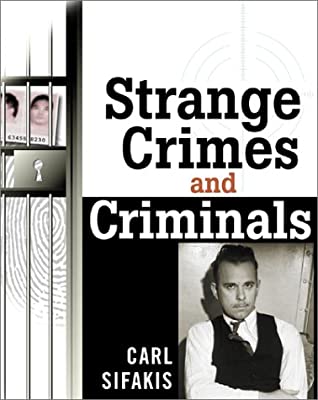
Book Review: Strange Crimes and Criminals by Carl Sifakis


Are you familiar with the Astor Palace Riots?

In 1849, an English actor was selected to play MacBeth at New York’s Astor Place Opera House.  Capt. Isiah Rynders, a politician who had built up a following by denouncing the rich as being wannabe Englishmen, claimed that an American actor should have been given the role and he led a protest outside the theater.  When the play started, his followers pelted the stage with eggs and insults and the show had to be stopped.  When another attempt was made to perform MacBeth a few days later, Rynders and his people returned.  This time, the protest led to one of New York City’s biggest riots.  At least 23 people died and over 130 were injured.  The crowd attempted to hang the actor who played MacBeth but, fortunately, he was able to catch a train to Boston and then sailed back to England.  This, of course, was not the only time that Shakespeare would be linked to violence in America.  Abraham Lincoln would be assassinated by one of the country’s most popular Shakespearean actors, with some contemporaries alleging that John Wilkes Booth was inspired by Julius Caesar.

How about the 1857 police riots, which occurred when two different groups claimed the right to police New York City and spent so much time fighting amongst themselves that criminals were often allowed to go free in the confusion?

How about Kitty Ging, who was murdered by a man who claimed that another man had hypnotized him and ordered him to commit the crime?

Or the Lady Gophers, an all-female gang who developed a reputation for being tougher and more deadly than any of their male counterparts?

Or Carter Harrison, the most corrupt mayor in the history of Chicago?  Everyone knew that Harrison was crooked but, when he was assassinated, the entire city mourned.

Speaking of Chicago, Chicago’s first official riot was in 1855, when the city ordered that saloons close on Sunday.  It was called the Lager Beer Riot and it nearly destroyed the city.

Did you know about the attempt to abduct a school bus full of children and hold them for ransom?  Did you know about Boston Corbett, the man who was celebrated for killing John Wilkes Booth but who then turned out to be a crazed religious fanatic who mysteriously vanished after performing a self-castration and then firing his pistols while standing in the gallery of the Kansas Legislature?  Speaking of disappearances, whatever happened to Judge Crater?

Everyone knows about the Hatfield-McCoy feud but what about Texas’s far bloodier Horrell-Higgins Feud?

All of these crimes and many more are discussed in Strange Crimes and Criminals, which is an encyclopedia of the odd, the bizarre, and the illegal.  Some of the entries are humorous.  Some of them are disturbing.  Some of them document man’s inhumanity to man.  Some of them celebrate the spirit of people who refuse to let something like the law get in their way.  It makes for interesting reading and, for the aspiring writer, it’s a treasure trove of inspiration.

It’s a strange world, isn’t it?
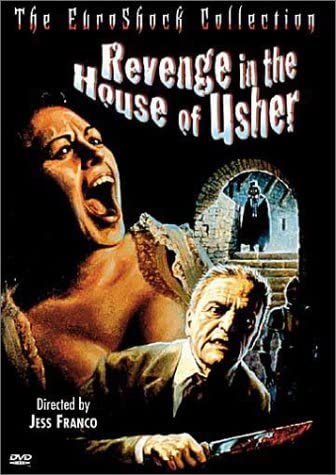
International Film Review: Revenge in the House of Usher (dir by Jess Franco)


In the 1982 Spanish horror film, Revenge in the House of Usher, Antonio Mayans plays Dr. Alan Harker.  Harker receives an invitation to visit the estate of his former mentor, Prof. Eric Usher (Howard Vernon).  Usher is elderly and in poor health.  He’s attended to by several mysterious servants, including his physician, Dr. Seward (Daniel White).  While trying to figure out what has led to Prof. Usher’s current state, Harker discovers that….

Well, here’s where it gets confusing, as things tend to do whenever one tries to discuss the later films of director Jess Franco.  There are actually three different versions of Revenge In the House of Usher and each one of them tells a totally different story.  In the first version, Usher is revealed to have been a decadent, Giles de Rais-style serial killer who has murdered hundreds of women through the years and who is now being haunted by their vengeful ghosts.  Apparently, that version didn’t go over well when it made its debut at the 1983 Festival Internacional de Madrid de Cine Imaginario y de Ciencia-ficción.  The audience booed and laughed and Franco couldn’t convince any distributors to purchase the film from him.

So, Franco filmed thee more scenes that established that Usher wasn’t just a serial killer but that he was also a vampire!  (This explains why two characters in this Edgar Allan Poe adaptation were suddenly given names from Dracula.)  This reception of this version was not considered to be much of an improvement on the reception of the version where Vernon was just a serial killer.

With the backing of Eurocine, Franco then put together a third version of the film.  This time, he turned it into another Dr. Orlof film, though Howard Vernon’s character was still referred to as being Prof. Usher.  In this version, Harker discovers that Usher and his elderly servant Morpho (Olivier Mathot) have spent years abducting women from the village and using their blood to keep Usher’s daughter alive.  This leads to a solid 15 minutes of flashbacks to Usher’s past activities, all of which are taken directly from The Awful Dr. Orlof.  Just as in the other two version of the film, Usher is haunted by the ghosts of his victims.  As his mental state deteriorates, so does his castle.

As far as I know, the third version of the film is the only one that currently exists.  The first version is now considered to be lost.  For his part, Franco claimed that the first version was a misunderstood masterpiece but he was still willing to turn it into another Orlof film so that he could at least make some money off of it.  Franco may have been an often frustrated artist but he was also a pragmatist.

Considering its production history, it’s not surprising that Revenge in the House of the Usher is a bit of a disjointed film.  It’s only 91 minutes long (and 15 of those minutes is taken up with black-and-white footage from The Awful Dr. Orlof) but this film still feels like it has several false endings.  There were so many times that I thought the film had to be over, just for it to keep going.  Watching the film, one can sense that Franco is willing to try almost anything to finally wrap the film’s somewhat incoherent story up.  That said, Howard Vernon brings the right amount of haughty decadence to the role of the decaying Usher and Franco’s decision to film in an actual castle (and to largely utilize natural light) does give the film perhaps a bit more atmosphere than one would expect.  This is a lesser Franco film but it does do a good job of capturing the bizarre logic of dreams.  The film is, at times, so incoherent that it’s actually rather fascinating.

Following this film, Vernon would play Dr. Orloff one final time, in Franco’s surprisingly entertaining Faceless.

6 Shots From 6 Horror Films: 1978


4 Or More Shots From 4 Or More Films is just what it says it is, 4 shots from 4 of our favorite films. As opposed to the reviews and recaps that we usually post, 4 Shots From 4 Films lets the visuals do the talking!

This October, I’m going to be doing something a little bit different with my contribution to 4 (or more) Shots From 4 (or more) Films.  I’m going to be taking a little chronological tour of the history of horror cinema, moving from decade to decade.

Today, we take a look at a very important year: 1978.

6 Shots from 6 Horror Films: 1978

Halloween (1978, dir by John Carpenter, DP: Dean Cudney)

Dawn of the Dead (1978, dir by George Romero, DP: Michael Gornick)

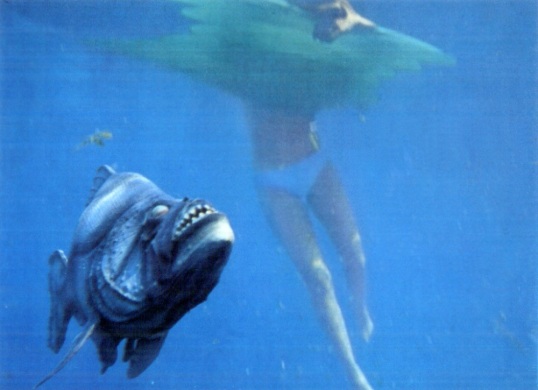
Piranha (1978, dir by Joe Dante, DP: Jamie Anderson)

Martin (1978, dir by George Romero, DP: Michael Gornick)

Blue Sunshine (1978, dir by Jeff Lieberman, DP: Don Knight)

The Grapes of Death (1978, dir by Jean Rollin)

Pulp Vampires!


by Margaret Brundage

From the beginning of the pulp era to the modern day, horror has always been a popular genre.  And with horror comes the vampires!  Vampires were a popular subject for both the writers and the readers of the pulps.  Much blood was spilt between the covers.  Here are just a few of the vampires of the pulps:

by Paul Lehman

by John Newton Howitt

by Rafael DeSoto

by Sebastia Boada

by Sebastia Boada

By CC Senf

by H. William Reusswig

by Margaret Brundage

by Robert Bonfils

by Robert Maguire

by Rudolph Belarski

Unknown Artist

It’s not really October until a vampire comes tapping at your window, asking to be invited in.

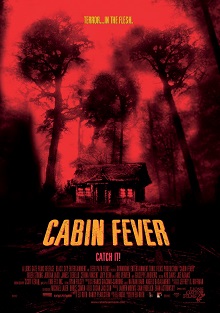
Horror Film Review: Cabin Fever (dir by Eli Roth)


When this Boy Meets World
Boy Meets World
Wandering down this road, that we call life
Is what we’re doin’
It’s good to know I have friends that will always
Stand by me
When this Boy Meets World

I imagine that I should probably apologize to Rider Strong for starting this review by quoting the theme song from the final few seasons of Boy Meets World.  I’m sure that when Strong agreed to star in the original Cabin Fever, he was hoping that the playing Paul would take him far away from his best-known role of Shawn Hunter.  But I have to admit that whenever I think of Cabin Fever (which, admittedly, is not often) I always think of it as being Boy Meets Flesh Eating Virus.

Cabin Fever tells the story of a group of stupid college students, including Rider Strong, who decide to spend Spring Break at a remote cabin in the woods.  They’ve got weed, beer, and plans for a wild, sex-fueled weekend.  Unfortunately, the majority of them also end up with a flesh-eating virus.  It turns out the virus has been infecting people and animals all around the cabin.  People are going crazy as their flesh decays and peels off of their bones.  It’s a messy virus.  With the police struggling to contain the spread, a group of locals have decided that it’s up to them to kill off anyone who is infected.

One member of the group grabs the beer and runs off so that he can spend the weekend drunk and in isolation,  The other members of the group are stranded in the cabin and the surrounding woods.  Bodies are falling apart and dogs are eating their owners.  It’s Boy Meets Pandemic.

This was Eli Roth’s directorial debut and he didn’t hold back on the gore.  While we really don’t know much about the college students in the cabin (beyond the fact that they’re all dumbasses and one of them is played by Rider Strong), we learn everything that you could possibly want to know about what that flesh-eating virus does to its victims.  The film might as well be called “Nom nom nom,” because it’s all about eating flesh.  Roth is also shameless about paying homage (or ripping off, depending on how much you like Roth) to the horror films that influenced him.  Night of the Living Dead comes to mind, especially the ending.

(Personally, I like the fact that, with his first film, Eli Roth declared himself to be a lover of horror.  Cabin Fever was released in 2002, long before the current mainstream horror boom.  Eli Roth was openly celebrating horror at a time when many critics were still writing it off.)

Cabin Fever is a hit-or-miss affair, with the emphasis on miss.  The virus is scary because it’s so nasty but the characters themselves are so boring that most viewers won’t care when they get infected.  I did like Giuseppe Andrews’s performance as a weird deputy but otherwise, no one is the cast makes much of an impression until after they’ve lost their skin.  They’re walking down this road that we call life …. and now they’re dead.

Viewed today, of course, it’s hard not to compare the flesh-eating virus to COVID or Monkeypox or whatever the latest disease is.  If Cabin Fever were made today, the gun-toting locals would have been the heroes and the college students would have been the villains for daring to try to leave the cabin.  Yesterday’s villains and today’s heroes and vice versa.  For many, walking down this road that we call life has never felt more uncertain, even without a flesh-eating virus to worry about.

Horror on the Lens: Night of the Ghouls (dir by Edward D. Wood, Jr.)


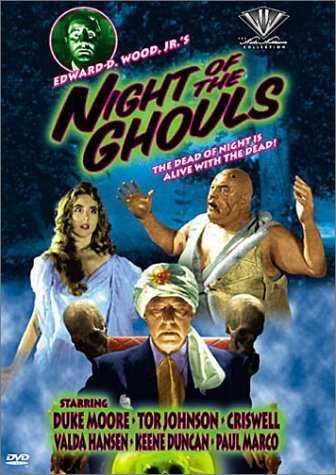
GhoulsdvdToday’s movie is Ed Wood’s sequel to Bride of the Monsters.  In Night of the Ghouls, con man Dr. Alcula (Kenne Duncan) moves into Bela Lugosi’s old mansion and pretends to talk to the dead.  What Alcula doesn’t realize is that the house is actually haunted (by Tor Johnson’s Lobo, among others) and real ghosts don’t appreciate pretend ghosts.

What can you say about a film like of Night of the Ghouls?  It’s an Ed Wood film, with all that suggests.  However, how can you resist a film that starts with Criswell sitting up in his coffin and providing commentary?

The role of Dr. Alcula was originally written for Bela Lugosi.  After Lugosi’s death, veteran actor and longtime Wood friend Kenne Duncan got the role instead.  Also of note, Wood appears twice in this film.  Not only does his picture appear on a wanted poster in the police station but Wood also plays one of the ghouls.

Music Video of The Day: The Reincarnation of Benjamin Breeg by Iron Maiden (2006, directed by ????)


When Iron Maiden released this song, they knew that their fans would try to find out who Benjamin Breeg was so they created a website about Breeg.  According to the site, Breeg was a painter of disturbing images who later found work in a cemetery and then as a paranormal investigator.  He disappeared in 1978.  Of course, this was all fictional.  There was no Benjamin Breeg.  The “Breeg” painting that was displayed on the site was actually a painting of Eddie, the band’s mascot.

The video features footage of Iron Maiden performing mixed in with a montage of early band pictures.

Enjoy!