Green Stamps were a little bit before my time but they sound like they were fun. From what I’ve been able to pick up, apparently you could get green stamps at any store and then you could exchange them for various goods at the Green Stamps distribution center. Apparently, the more you spent, the more green stamps you received. At least, that’s how I think they worked. As I said at the start of this paragraph, they were a bit before my time.
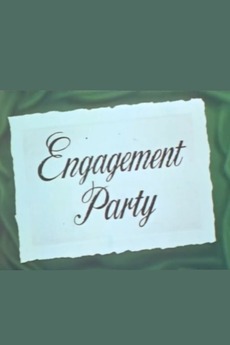
In fact, just about everything I know about Green Stamps comes from watching Engagement Party, a 30-minute film from 1956, on TCM. In Engagement Party, Carl Landis (Craig Hill) is the son of the owner of Landis Department Store. Soon, Carl will be taking over the family business. Unfortunately, the family business isn’t doing so well and, until Carl can figure out how to turn things around, Carl is reluctant to marry his girlfriend, Ellen (Gloria Talbott).
When Carl first meets Elliott Winston (Leon Ames), a friend of Ellen’s family, he rolls his eyes when Elliott mentions that he works for the people behind Green Stamps. Carl is a frequent eye roller, largely because Carl is a jerk. Carl explains that he considers Green Stamps to be a scam and there’s no way that he would allow them to be distributed in his store. Elliott takes it upon himself to show Carl the error of his ways.
Basically, this is just a 30-minute commercial for Green Stamps but, from a historical point of view, it’s an interesting little time capsule of the world of 1956. To me, the most interesting thing about this short film is the fact that Carl really is just a totally self-righteous jerk. Why would Ellen want to marry someone who simply will not stop talking about how much he hates Green Stamps? Get a life, Carl. To his credit, Elliott Winston can barely seem to hide his intense loathing for Carl. Even when Elliott’s being friendly, you can tell that he just wants to take a swing at him.
For your education and your enjoyment, here is a Blast From The Past….
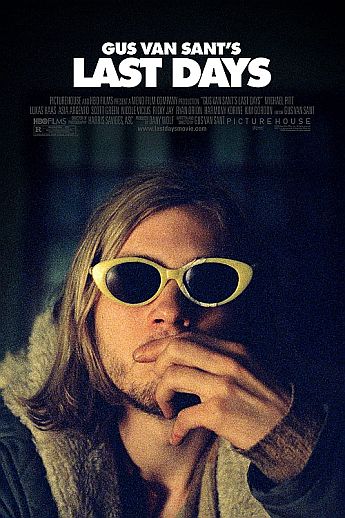
From 2002 to 2005, director Gus Van Sant offered audiences what he called his “Death Trilogy.” 2002’s Gerry followed two friends as they got lost in the desert and it featured what appeared to be a mercy killing. 2003’s Elephant was a mediation on the Columbine High School massacre and it featured several murders. Finally, with 2005’s Last Days, Van Sant ended the trilogy with a film about a suicide.
Michael Pitt plays a world-famous musician who is suffering from depression. Though the character is named Blake, no attempt is made to disguise the fact that he is meant to be Kurt Cobain. When we first see Blake, he has just escaped from a rehab clinic and is walking through a forest. There are no other human beings around and, perhaps not coincidentally, this is the only moment in the film in which Blake seems to be happy. He even sings Home on the Range, shouting the lyrics like a little kid.
When he reaches his home, Blake’s demeanor changes. He walks around the house with a rifle and pretends to shoot the four other people — Luke (Lukas Haas), Scott (Scott Patrick Green), Asia (Asia Argento), and Nicole (Nicole Vicius) — who are sleeping in his house. Later, when those people wake up and attempt to speak to him, Blake is largely unresponsive. When a detective comes to the door and asks if anyone has seen Blake, Blake hides. When a record company exec calls to tell Blake that it’s time for him to tour again and that he’ll be letting down both his band and the label if he doesn’t, Blake hangs up on her.
Who are the people staying in Blake’s house? Luke and Scott are both musicians but apparently neither one of them are in Blake’s band. When Luke asks Blake to help him finish a song, Blake can only mutter a few vague words of encouragement. Scott, meanwhile, appears to be more interested in Blake’s money. Everyone in the film wants something from Blake but Blake wants to be alone. In the one moment when Blake actually gets to work on his own music, his talent is obvious but so is his frustration. With everyone demanding something from him, when will he ever have time to create? With everyone telling him that it is now his job to be a rock star, how will he ever again feel the joy that came from performing just to perform?
As one would expect from a Van Sant film, Last Days is often visually striking, especially in the early forest scenes. In many ways, it feels like a combination of Gerry and Elephant. Like those previous two films, it is fixated on death but stubbornly refuses to provide any answers to any larger, metaphysical questions. Like Elephant, it uses a jumbled timeline to tell its story and scenes are often repeated from a different perspective. However, it eschews Elephant‘s use of an amateur cast and instead, Last Days follows Gerry’s lead of featuring familiar actors like Michael Pitt, Lukas Haas, and Asia Argento. Unfortunately, though, Last Days doesn’t work as well as either one of the two previous entries in the Death Trilogy.
Last Days runs into the same problem that afflicts many films about pop cultural icons. Kurt Cobain has become such a larger-than-life figure and his suicide is viewed as being such a momentous cultural moment that any attempt to portray it on film is going to feel inadequate. No recreation can live up to the mythology. The film itself feels as if it is somewhat intimidated by the task of doing justice to the near religious reverence that many have for Cobain. As enigmatic as Gerry and Elephant were, one could still tell that Van Sant knew where he wanted to take those films. He knew what he wanted to say and he had confidence that at least a few members of the audience would understand as well. With Last Days, Van Sant himself seems to be a bit lost when it comes to whatever it may be that he’s trying to say about Cobain. This leads to a rather embarrassing scene in which Blake’s ghost is seen literally climbing its way towards what I guess would be the immortality of being an icon. One might wonder how Cobain himself would feel about such a sentimental coda to his suicide.
Last Days is a film that I respect, even if I don’t think it really works. It does do a good job of capturing the ennui of depression and one cannot fault Van Sant for his ambition or his willingness to run the risk of alienating the audience by allowing the story to play out at its own slow and deliberate pace. But ultimately, the film cannot compete with the mythology that has sprung up around its subject.
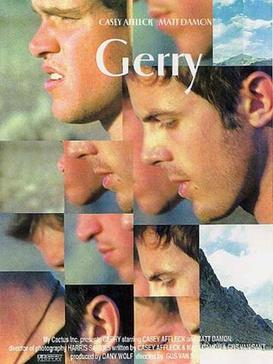
First released in 2002, Gerry tells the story of two men named Gerry, played by Matt Damon and Casey Affleck.
When we first see the two Gerrys, they’re in a car and they are driving through the desert. Neither one is speaking but they both have oddly determined looks on their faces. When they pull off to the side of the road, they talk about how they are finally going to hike the wilderness trail and see “the thing” at the end of it. They start to hike. In order to avoid a vacationing family, they step off of the trail. Soon, they are lost in the desert.
The audience doesn’t learn much about either one of the men named Gerry. It’s obvious that they’ve known each other for a while and that they have a close relationship but it’s never stated how they met or what they do with their time when they’re not lost in the desert. Nothing is learned about their family or their jobs or their significant others. Matt Damon’s Gerry seems to be the more confident of the two. Casey Affleck’s Gerry seems to be prone to pessimism. Damon’s Gerry tries to figure out the best way to find the highway. Affleck’s Gerry climbs to the top of a rock and can’t figure out how to get down. It’s tempting to try to use how the men react to being lost as a way to imagine what type of lives the two men lead outside of the desert but in the end, their lives in the real world are no longer important. What’s important is that they are both now lost in the desert, walking under the burning sun and suffering from dehydration.
The film follows Affleck and Damon as they go from being amused at being lost to being desperate to be found. The men go from joking to barely speaking at all. When they first get lost, they climb to the top of a mountain to see if they can spot the path back to the civilization. Soon, though, all they can do is keep walking forward and hope that they stumble across the highway. Interestingly, the more lost the men become, the most beautiful the desert seems. The mountains are often so majestic and strikingly formed that it becomes easier and easier to overlook the two men walking near them.
As we follow the two men, it’s tempting to wonder just why exactly they ended up getting lost. Are they being punished for trying to conquer nature or was it just a case of random bad luck that led to them going in the wrong direction? Is there a greater hand of fate guiding the Gerrys or are they responsible for their own misfortunes? Does the tragedy at the heart of Gerry truly mean anything or is it just one of those things that people try to invest with deeper meaning because otherwise, they would be forced to admit just insignificant their lives are in the grand scheme of things? Is there even a grand scheme of things? These are questions that Gerry asks but doesn’t necessarily question. The film ends with a cut to a blue screen, which is perhaps an homage to Blue, Derek Jarman’s 1993 meditation on life and death. Like Jarman’s film, Gerry is meditation that searches for answers but admits that they may not be out there.
Gerry was directed by Gus Van Sant, an experimental director who also has a side gig directing mainstream studio films. Gerry is a bit of an interesting hybrid. On the one hand, the format is definitely experimental and Van Sant often goes out of his way to alienate the audience. On the other hand, the film itself is an example of the power of old-fashioned movie star charisma. Most people who watch this film will watch because it features Matt Damon and Casey Affleck. Damon and Affleck are the reason why most viewers will be willing to tolerate a 7-minute shot of the two Gerrys stumbling through the desert. Would the viewer still care about the Gerrys if they were played by the two unknowns who Van Sant cast as the school shooters in Elephant?
Gerry may be an enigmatic and visually striking film that is full of intriguing questions that can probably never be answered but, in the end, the film does make one thing very clear. Never underestimate the importance of casting a star.
Last night, I told Tubi that I wanted to watch a movie about tennis. It recommended Retreat to Paradise.
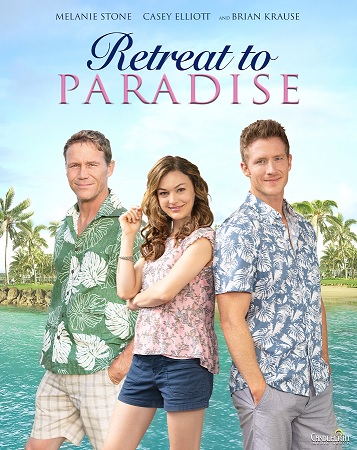
Retreat to Paradise is about Jordan (Casey Elliott), a pro tennis player who injures his shoulder in a car accident. He and his manager, Neal (Brian Krause), retreat to Fiji so that Jordan can work on his shoulder without being harassed by the press. (Are reporters not allowed to go to Fiji?) Ellie (Melanie Stone) is the latest of the many physical therapists that Neal has hired to try to help Jordan’s shoulder heal.
Ellie soon discovers why all of Jordan’s other therapists have quit. He’s a terrible patient and he feels so guilty about the accident that he doesn’t even want to play tennis anymore. Even though Jordan denies it, he would rather let his shoulder keep deteriorating until he can’t even move it because Jordan doesn’t think that he deserves to be a success. Ellie not only has to help Jordan conquer his physical pain but also help him come to terms with his mental pain. She not only forces him to exercise but she also gets him to open up and discuss his past and the accident that left him injured. Of course, with Neal’s encouragement, they start to fall in love. But Jordan’s agent, Regina (Jaclyn Hales), is also in love with Jordan and she comes across a secret from Ellie’s past.
The main impression that I got from watching Retreat to Paradise was that Fiji is a really beautiful island. Retreat to Paradise was shot on location and the island scenery is the best thing about it. The story’s sweet but predictable and there’s never any doubt that Jordan and Ellie will get together, even if they don’t like each other when they first meet. Jordan is handsome and Ellie is pretty but the two actors playing them don’t have any real chemistry. They fall in love but they also barely kiss. Retreat to Paradise earns its TV-G rating. For a movie that was recommended to me because I wanted to watch something about tennis, there wasn’t much tennis in Retreat to Paradise. Fiji is so nice to look at that it nearly makes up for all that. Jordan has the right idea. If you need to retreat to paradise, retreat to Fiji.
Today’s music video of the day comes from the soundtrack of Spider-Man 2.
While Ana Johnsson and her band wake up with the neighbors and move the furniture across the floor, clips from Spider-Man 2 are shown. This video highlights that, even more than as an action or comic book movie, Spider-Man 2 was originally advertised as being a love story. Doctor Octopus was driven made by love while Spider-Man got a chance to show his love for Mary Jane Watson. That might seem pretty simple and obvious today but, in 2004, a comic book movie trying to deal with actual human emotions was a big deal.
This music video was directed by Antti Jokinen, who has gone on to find great success as a feature film director in his native Finland.
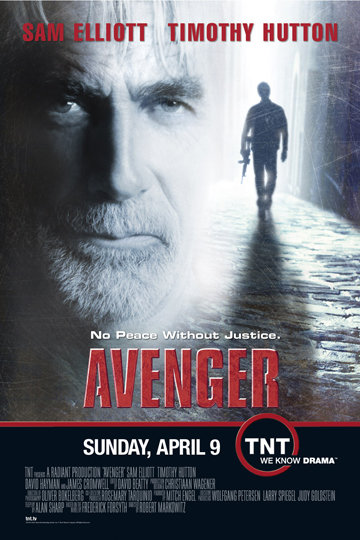
Calvin Dexter (Sam Elliott) is a former CIA agent who now works as a professional avenger. No, that doesn’t mean that he knows Iron Man or that he works with John Steed and Mrs. Peel. Instead it means that, motivated by his own feelings of hopelessness after his daughter was killed in Panama, Calvin offers his services to anyone who needs more help than the law can or will provide. Calvin Dexter is not your typical, cynical ex-spy. He is trying to make the world a better place by taking out its worst inhabitants. He is such an idealist that he even has a “No Peace Without Justice” bumper sticker on his pickup truck.
When Dexter is hired to track down Rickie, the son of an old friend, he discovers that Rickie was captured while working for a charity that was trying to help refugees in Bosnia. Rickie was tortured and murdered by men working for the Serbian warlord, Zoran Zilic (David Hayman). Dexter sets out to avenge Rickie’s death. Unfortunately, CIA director Paul Devereux (James Cromwell) considers Zilic to be a security asset. He doesn’t care how many people Zilic kills as long as he’s useful to U.S. Intelligence. Devereux sends another CIA agent, Frank McBride (Timothy Hutton), to stop Dexter by any means necessary.
Based on a novel by Fredrick Forsyth and produced for the TNT network, Avenger is one of those movies that used to show up often on late night television. I can remember it playing in the background during more than one late night study session in college. It’s the ideal film for late night viewing because there are enough twists and turns to hold your attention but the story is still easy to follow. While the movie does have an important point to make about the war crimes that took place in Bosnia and America’s role in protecting some of the worst perpetrators of those crimes, its main strength is the determined performance of Sam Elliott. Elliott is one of the few actors who has mastered the art of being both laid back and laser focused at the same time. He plays Dexter like a modern day frontier marshal, traveling to the most dangerous parts of world to dispense simple but effective justice.
Avenger is fast-paced and it will hold your attention. Sometimes, it feels like it could have been a pilot for a potential show and it is easy to imagine Dexter traveling to a different country each week and taking out a new international villain. Timothy Hutton has a few good scenes as the rival CIA agent, even if he can’t match Sam Elliott’s killer charisma. As usual, James Cromwell is well-cast as a government official who thinks that the ends can justify any means. Whenever I see a movie like this, featuring Cromwell as the epitome of what everyone hates about the establishment, I’m reminded that it’s been a long time since he played Archie Bunker’s reliably goofy best friend, Stretch Cunningham.
The history of dictatorship is littered with failed writers.
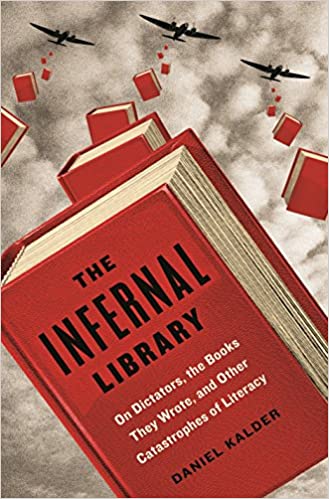
That’s one of the lessons that I learned from reading Daniel Kalder’s 2018 book, The Infernal Library. The Infernal Library takes a look at the literary output of some of the worst people who have ever lived. Some of the dictators and the books examined are to be expected. Everyone knows that Hitler wrote Mein Kampf while in prison and everyone knows that it’s a terrible book, from both a literary and a moral perspective. Many people also know that Chairman Mao was credited as authoring several books, many of which were treated as holy texts by radicals in the west who read and quoted from them while, in Mao’s own country, intellectuals were being murdered during the Cultural Revolution. And, of course, the works of Lenin and Stalin have recently found renewed popularity amongst the heirs of Walter Duranty.
But did you know that Benito Mussolini, long before he took over Italy, wrote florid novels that attacked the power of the Church? Did you know that Saddam Hussein was not only Iraq’s feared leader but also it’s most popular novelist? Did you know that Saparmurat Niyazov Turkmenbashi, leader of the nation of Turkmenistan, not only wrote his own hybrid historical-religious text but that he also sent into space so that it can be discovered and read by any intergalactic travelers who came across it?
What is up with dictators and their literary pretensions? I suppose it does make a strange sort of sense. The typical psychological profile of a writer is that they’re cynical, they’re comfortable working alone for long periods of time, they often feel alienated from mainstream and/or conventional society, and they feel that they not only have something to say but that they are the only ones who can say it. If someone who fits that profile also has talent and imagination, they’re capable of creating powerful works of art. If someone who fits that profile doesn’t have talent or imagination, then they can take over a country and force their subjects to not only read their books but to also talk about how well-written they are. As well, a literary output allows a dictator to fashion themselves as being something more than a thug. Being a published writer brings with it an aura of respectability. The more gullible assume that you must have something worth saying because otherwise, why would someone have published it?
In The Infernal Library, Daniel Kalder writes that he read these book so “you wouldn’t have to” and for that, we should perhaps be thankful. Along with often being second-rate minds, dictators are also often second-rate writers and Kalder examines their work with both a razor-sharp wit and a knowledge that the books themselves reveal much about the men who wrote them. Hitler’s paranoia, resentment, and conspiracy-fueled world-view are present on every page of Mein Kampf and, indeed, while the rest of Europe’s leaders were trying to negotiate with and contain him, they could have just read his book and discovered that their efforts would be for naught. The mix of ruthlessness and prejudice that led to Stalin starving his own citizens can be found in his own words while Saddam Hussein’s novels reveal a mind that was obsessed with a mix of preserving tradition and punishing those who have somehow failed. While some of the dictators spend more time on their ideology than others, all of them share an obsession with exposing their perceived enemies, justifying their own actions, and demanding to be respected by a world that they feel has treated them unfairly. Almost every dictator that Kadler profiles strives (often a bit too hard) to prove their literary worth while ultimately revealing the true darkness at the heart of their worldview. Indeed, only a youngish Mussolini appears to have had even the hint of any real ability as a writer, authoring sordid novels with a satirical subtext. But whatever literary talent he may have had disappeared once he gave his life over to fascism. Authoritarianism and imagination do not go well together. Indeed, imagination is perhaps the biggest enemy that the authoritarian has. The great irony is that so many dictators demanded to known as men of imagination when imagination and freedom of thought was often the first thing that they tired to stamp out upon coming to power.
The Infernal Library is an interesting and important book. Read it so you don’t have to read any of the people profiled within.
Can a film be a box office hit and win the most Oscars of the year while also ending the career of the man who was credited as directing it?
If it’s Bohemian Rhapsody, it can.
The story is well-known but it is worth repeating. From the moment that the film went into production in 2017 until it was finally released in November of 2018, the buzz was that Bohemian Rhapsody was going to be a disaster. Despite the fact that he sometimes claimed that directing a biopic about Queen lead singer Freddy Mercury was a bit of a passion project for him, reports from the set indicated that director Bryan Singer was behaving just a little bit erratically. He argued with lead actor Rami Malek. He frequently disappeared from the set. Shooting was delayed for days because no one knew where Singer was. At the same time, with the #MeToo movement at the height of its cultural power, Singer was being accused of being one of Hollywood’s worst abusers. Eventually, 20th Century Fox suspended the production, fired Bryan Singer, and brought in Dexter Fletcher to finish shooting the film. By most accounts, Fletcher did a professional and exemplary job of getting the production back on track but, due to the DGA bylaws, he wasn’t credited with directing the film. Instead, he had to settle for an executive producer credit and the opportunity to direct the Elton John biopic, Rocketman.
As such, no one was expecting much from Bohemian Rhapsody. There were, of course, reports that Rami Malek did an unusually good job as Freddy Mercury. If somehow the film could be saved in editing, Malek might even pick up an Oscar nomination. But everyone knew that Bohemian Rhapsody was going to have to overcome a lot to be a successful film. While everyone appreciated that Dexter Fletcher had finished the film after Singer flaked out, there was a lot of doubt as to whether or not Fletcher’s work would mesh with Singer’s vision.
And indeed, the initial reviews were not positive. Malek was praised by most (but certainly not all) critics but the film itself was described as being disjointed and full of clichés. The film’s historical accuracy was criticized, as was its reticence in seriously exploring Mercury’s sexuality. Bohemian Rhapsody‘s editing was also heavily criticized, with the film’s sloppiness felt to be a result of the editor trying to put a coherent story together out of scenes that were filmed by two very different directors.
Here’s the thing, though.
The critics may have dismissed the film but what about the audiences? What about the people who pay money to see a film in a theater on the weekend that it comes out? What about the people who are motivated not by the opinions of film critics but instead by the recommendations of their friends and family? Those people, they didn’t care. They flocked to see Bohemian Rhapsody and, judging by the film’s box office, quite a few people saw it more than once. After all the drama and bad publicity, Bohemian Rhapsody became a huge hit.
It also became an Oscar contender. The film received five Oscar nominations, including for Best Picture of the Year. (Among the films that were not nominated for Best Picture were Eighth Grade, First Reformed, First Man, The Ballad of Buster Scruggs, and If Beale Street Could Talk.) Though the award for Best Picture went to Green Book (another film that was more popular with audiences than with critics), Bohemian Rhapsody won the other four awards for which it was nominated. In fact, Bohemian Rhapsody won the most Oscars that year. It won more Oscars than BlackKklansman, Black Panther, A Star is Born, The Favourite, and Roma. Bohemian Rhapsody even won the Oscar for Best Editing.
Even at the time that Bohemian Rhapsody was winning all of those Oscars, people seemed to be rather embarrassed by the film’s success. (Not one winner mentioned Bryan Singer in their speech, though most did take the time to thank Dexter Fletcher.) In the years since, Bohemian Rhapsody has developed a reputation for being one of the worst films to ever be nominated for Best Picture.
So, when I rewatched the film on Hulu, the main question on my mind was, “Is Bohemian Rhapsody as bad as everyone remembers?”
Well …. it’s not great. At the same time, it’s not terrible. It’s one of those films that’s very much in the middle. All those complaints about Bohemian Rhapsody being disjointed were and are valid. The script indulges in just about every rock star biopic cliché and the other members of Queen are portrayed as being ciphers. Perhaps most surprisingly, Rami Malek’s acclaimed, Oscar-winning performance doesn’t hold up particularly well. Malek has the charisma necessary to be a believable rock star but his performance is all on the surface and you never really get any ideas as to what exactly was going on inside of Mercury’s head. This is a biopic that doesn’t seem to be sure what it wants to say about its main subject, other than “Thanks for the music.” And really, there’s nothing wrong with saying “Thanks for the music.” But that could have just as easily been said by re-releasing a Queen concert film. That said, the story moves quickly, the 70s and 80s fashion is enjoyably over the top, and the concert scenes are nicely put together. I’m not really a Queen fan but I know that I’m in the minority and there’s enough Queen music in the film to keep the majority happy. The film, after all, was made for the fans.
So, I guess my opinion is that Bohemian Rhapsody isn’t good enough to justify all of those Oscars but it’s not quite bad enough to justify all of the hate either. The film would probably have a better reputation if it hadn’t won all those Oscars. Without all of those Oscars, it would be remembered as an uneven biopic with some good musical scenes and a lot of enjoyably tacky fashion choices. Instead, it’s destined to forever be remembered as the film that won Best Editing over The Favourite. Sometimes, it’s better to not be nominated.
It will also be remembered as the film that, along with a series of serious sexual misconduct allegations, ended Bryan Singer’s career as a major filmmaker. Singer was briefly attached to direct a new version of Red Sonja but, after the resulting outcry, that project was canceled. As far as I know, he hasn’t been attached to any major films since then. With the X-Men now a part of the MCU, it’s doubtful he’ll be invited to have anything else to do with that franchise. Much as happened with Sam Peckinpah and Convoy, Bohemian Rhapsody was a box office success that made its credited director a pariah in the industry. Dexter Fletcher, meanwhile, was acclaimed for his work as director of Rocketman and he recently directed two of the better episodes of The Offer.
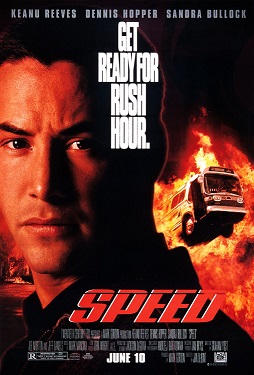
That was my main thought when I recently rewatched the 1994 film, Speed. There’s a lot of reasons why Speed remains popular 28 years after it was initially released but I think a huge (if underrated) factor is that it’s just a good love story. At this point, everyone knows that the film is about a bus that has been wired to explode if it goes under 50 miles per hour. Most people know that Dennis Hopper plays Howard, the mad bomber, Keanu Reeves plays Jack, the cop who jumps on the bus and tries to figure out how to defuse the bomb, and Sandra Bullock plays Annie, the passenger who takes over driving the bus after the driver is incapacitated. (If you’re fan of the work of John Hughes, you might also know that Speed was the film where Ferris Bueller‘s Alan Ruck broke free of his Cameron typecasting and established himself as a dependable character actor.) Most people remember what the cops do in an attempt to trick Dennis Hopper and, for that matter, they also remember the one mistake that led to Hopper figuring out their ruse.
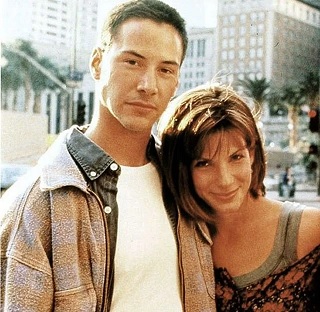
And yet, even though most viewers will know exactly what is going to happen, the film remains a fun watch because of the chemistry between Keanu Reeves and Sandra Bullock. This was one of Sandra’s first major roles. This was also one of Keanu’s earliest attempts to helm a big budget, major studio action picture. (Director Jan de Bont insisted on casting him after seeing him in the film Point Break. The studio preferred Tom Cruise.) In Speed, both Keanu and Sandra are young, likable, attractive, enthusiastic, and they have smiles that light up the screen. As soon as Sandra takes over driving and Keanu tells her that she cannot allow the bus to slow down under any circumstances, the two of them just seem to belong together. The film’s enduring popularity is about more than just watching a bus try not to go under a certain speed. The popularity of Speed is also about watching the characters played by Keanu and Sandra fall in love.
Who would have guessed it? Well, certainly not whoever put together the film’s original theatrical trailer. Check this out:
As you can see, the original trailer doesn’t feature much of Sandra Bullock. For that matter, it’s not quite as Keanu-centric as you might expect it to be. Instead, the trailer is dominated by things exploding and Dennis Hopper’s over-the-top performance as the bomber. And make no doubt about it, Dennis Hopper is definitely an entertaining part of the film. There’s not a subtle moment to be found in his performance and that makes him the perfect for the role of a man whose response to a cheap retirement present is to go on a bombing spree. That said, the film belongs to Keanu and Sandra.
That said, it would be a mistake to ignore the other people on the bus. One of the things that I like about Speed is that the other passengers on the bus come together to survive their ordeal. They may start out as weary commuters but, by the end of the film, they’ve become a family. They may get annoyed with each other but, when it comes time to climb from one bus to another, they hold on to each other and they hug one another on the other side. The bomber, like all terrorists, thought that he could turn people against each other through his threats and his violence. Instead, the people came together provided one another with comfort and protection. There’s an important lesson there, one that’s even more important in 2022 than it probably was in 1994.
(On a personal note, I’m not usually a public transportation person. However, in high school, I would occasionally catch the DART bus — that’s Dallas Area Rapid Transportation — if it was raining. The buses were often not in particularly good shape. One that I boarded actually had a hole in the floor and, since it was raining, the passengers would have to hold up their feet whenever the bus splashed through a puddle. Personally, I was kind of amused by the weirdness of it all but I think I was the only one. Would the passengers of that bus bonded together to defeat a mad bomber? One can only hope.)
Speed may be a film about a bomb on a bus but, ultimately, it’s also a film about humanity at its best. And that’s why, after all this time, it remains a classic.



 Through the Shattered Lens