Film Review: Top Gun: Maverick (dir. by Joseph Kosinski)


From the moment it was announced, I had low expectations for Top Gun: Maverick. I figured it was just Tom Cruise milking his other franchise for what it’s worth. I mean, I adore the Mission: Impossible movies, but was there ever really a need to return to the Top Gun Universe? I didn’t believe so, particularly with Joseph Kosinski being involved. I enjoyed Oblivion and I’ll die on the hill that is Tron: Legacy, but also recognize that Tron: Legacy could have been a better film if the writers just didn’t paste the original film and wipe it down with a new coat of paint. I think I may have incorrectly put that on Kosinski, rather than the writers.

Top Gun: Maverick does pretty much the same thing here. If you’ve seen the original Top Gun, you already have the blueprint for the sequel in your head. You could play both films side by side, and not counting for the pacing between them, align each scene with the sequel’s counterpart. Does that even make for a sequel? Did we learn nothing from Star Wars: The Force Awakens?

I don’t know. I didn’t hate Top Gun: Maverick at all. It’s just that odd feeling at having seen it all before and almost completely guessing what’s going to happen next. If you can get past that, it’s a good film. By the end of the movie, I wanted to buy a computer, a Thrustmaster HOTAS set and a copy of DCS to fly with.

Top Gun: Maverick continues the story of ace fighter pilot Pete “Maverick” Mitchell, once the 2nd Best at Top Gun. Now testing special aircraft, he lands himself into trouble again with the Navy, only to be sent back to Top Gun. Yes, he was an instructor there and this new film references this. However, Maverick’s return has him training a team of elite pilots on a special bombing mission requiring some unorthodox maneuvers. In training the pilots, the best will be declared the mission leader. When Maverick discovers that one of pilots is Brad Bradshaw (Miles Teller, Whiplash), son of his deceased Radar Intercept Officer (RIO) Goose, tensions erupt. Can Maverick get the team to improve and be ready for the mission?

Writing wise, Top Gun: Maverick isn’t bad. It gets in, does the job and gets right back out. No scene is drawn out too far, no storyline angle seems to be mulled on. With two main writers and three screenplay writers (including Mission: Impossible‘s Christopher McQuarrie), it’s pretty tight. Again, there’s the problem of using the same story map as the original. There doesn’t appear to be many obstacles for them to hurdle, storywise. Like Underwater, having so many familiar sites and scenes helps. What I did like was that it didn’t point many fingers at any one place. The opposing fighters are “5th Gen” craft, but you don’t really get any kind of feeling of where they’re from. Were they Russian? Serbian? Chinese? Canadian? Unless I missed something in the watch, I didn’t catch who the enemy was. They were just men in planes with missiles and guns.

I liked the cast here. Jon Hamm (Tag)makes for a good opponent to Cruise, and they have good scenes together. There’s also something of a love story to the film, though it’s light. While it would have been cool to have Kelly McGinnis back, Jennifer Connelly (Alita: Battle Angel) made for a good replacement and her character’s okay. For the young pilots, I particularly liked Lewis Pullman’s (Bad Times at the El Royale) Bob and Monica Barbero (NBCs Chicago Justice) Phoenix, along with Glen Powell’s (Everybody Wants Some!) Hangman. Each one brought some style and attitude to the mix.

By far the best entry here is Val Kilmer’s return as Tom “Iceman” Kazansky. The story was written in a way to include his issues with speech, given his cancer diagnosis. He honestly has one of most memorable moments in the film, and I loved how they tied his character back to Maverick’s. I have to give some kudos to Cruise, Kilmer and company for that. If there’s any other reason to see the film other than the planes, that was it.

Oh, the flight and fight scenes! Goodness, what a treat! I usually sit in the front row, where no one ever sits. Since the Regal RPX screen is huge (but not Lincoln Center IMAX beastly), that first row is some distance away. The sense of speed was cool and there were some fantastic shots both in cockpit and out, which had me leaning in my seat with the action with every hard left and right. While I’ve always been more of a fan of the F-14 Tomcat used in the original, there is a legitimate reason for the team to have to use the F-18 Hornet. While the main mission feels a lot like the trench run from Star Wars: A New Hope, it’s a great sequence overall. Watching Maverick make a plane dance is a sight to behold, and there is at least one scene in the film that contained an awesome thrust vectoring moment. Think of thrust vectoring like drifting a plane in midair the way you would drift a car in a turn. It’s hard to describe, but beautiful when seen.

Musically, I don’t have much to say. While Lorne Balfe (Mission: Impossible – Fallout), Hans Zimmer (Dune), Harold Faltermeyer (Top Gun) and Lady Gaga (House of Gucci) all worked on this, I can’t say that any tune other than the original Top Gun Anthem really stood out for me. Not a terrible thing at all, just not extremely memorable. At least with Fallout, I was humming the 2nd half of “Stairs and Rooftops” until I bought the album. Gaga’s “Hold My Hand” is a great piece and ties in pretty well to where it’s used.

Overall, Top Gun: Maverick is a treat, and was better than I expected. It gets a little heavy handed at following the same path of the original, the but the new story is enjoyable enough to have it stand out on it own.

Artist Profile: Stockton Mulford (1886 — 1960)


Born in Pennsylvania but raised in California and Oregon, Stockton Mulford lost his right eye in a childhood accident but he never lost his ambition to become an artist.  With a glass eye and a painter’s easel that was given to him by his father, Mulford worked part-time as a bank clerk while taking art classes during the weekend.  In 1907, deciding that it was all or nothing, Mulford moved to New York City and devoted himself full time to art.

After studying at the Art Students League,  Mulford found quick success as an illustrator and become one of the busier artists of the pulp era.  After he retired from illustrating in 1946, he moved to Connecticut and, at the age of 60, he became an expert cabinet maker and found a second career restoring furniture for local museums.  He eventually passed away in 1960, at the age of seventy-four.

Below is just a small sampling of Stockton Mulford’s work:

Scene That I Love: Christopher Lee and Peter Cushing Play Pool In The Skull


100 years ago, on this date, Christopher Lee was born in London.  After serving in the secret service during World War II and reportedly inspiring his cousin, Ian Fleming, to create the character of James Bond, Christopher Lee went on to have a legendary acting career.  Though he was best known for playing Dracula, Lee appeared in almost every genre of film and he always gave a good performance.  Even when the film was bad, Lee was good.

Yesterday, for Peter Cushing’s birthday, I shared a scene of him and Lee in The Satanic Rites of Dracula.  Today, for Lee’s birthday, I’m sharing a scene between him and Cushing in 1965’s The Skull.  Though The Skull isn’t one of the strongest films that the pair made for Amicus, it’s worth watching for the performances of Cushing and Lee.  Often cast as rivals on screen, the two were, in reality, the best of friends and Lee often said that he never really emotionally recovered from Cushing’s death.

In the scene below, Lee and Cushing are obviously having a ball trying to outact one another while playing simple game of pool and discussing slightly esoteric concerns.


A Blast From The Past: Vincent (dir by Tim Burton)


Today is Vincent Price’s birthday!

Price was born 111 years ago, in St. Louis, Missouri.  When he first began his film career in the 1930s, he was promoted as a leading man and he was even tested for the role of Ashley Wilkes in Gone With The Wind.  (Imagine that!)  However, Price would find his greatest fame as a horror icon. 

Among the fans of Price’s horror films was a young animator named Tim Burton.  In 1982, Price and Burton would work together for the first time, with Price providing the narration for a short, stop motion film that Burton had written and directed.  Called Vincent, the film was about a seven year-old boy named Vincent who wanted to be — can you guess? — Vincent Price!  The six-minute film follows Vincent as he gets involved in all sorts of macabre activities.  Of course, as Vincent’s mom points out, Vincent isn’t actually a monster or mad scientist.  He’s just a creative child with an overactive imagination.  (To say the short feels autobiographical on Burton’s part would be an understatement.)  The animation is outstanding and full of wit but it really is Vincent Price’s wonderful narration that makes this short film a classic.

Both Price and Burton would later call making this film one of the most creatively rewarding collaborations of their respective careers.

On Vincent Price’s birthday, enjoy Vincent!

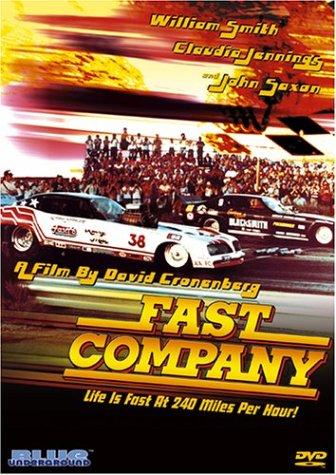
The TSL’s Grindhouse: Fast Company (dir by David Cronenberg)


Released in 1979, Fast Company is a Canadian film about fast cars and the fast-living people who drive them.  Lonnie Johnson (William Smith) is a veteran drag racer who is so good at his job that his nickname is “Lucky Man.”  He rarely loses a race.  He’s never without an adoring fan or two, though he always remains loyal to his girlfriend, Sammy (Claudia Jennings).  Lonnie is so lucky that, even when one of his cars explodes, he walks away without even a scratch.

Lonnie and his protégé, Billy (Nicholas Campbell), are being sponsored by Fast Company, an international oil consortium.  The money is okay but Lonnie is getting old and he would like to step back and spend some more quality time with Sammy.  Unfortunately, the team boss is Phil Adamson (John Saxon) and the viewers knows that Phil is a bad guy because he’s played by John Saxon and, instead of driving to the races, he pilots his own private plane.  When Lonnie starts to rebel against Phil’s management, Phil schemes to not only replace him and Billy with rival driver Gary Black (Cedric Smith) but he also plots to repossess Lonnie’s prized car!

Okay, so it’s kind of a silly and predictable film.  In fact, there’s really only two reasons why Fast Company is remembered today.  

One is because it was the last film to feature B-movie star Claudia Jennings before her death in a traffic accident. Jennings was nicknamed the “Queen of the B movies” and, over the course of her brief career, appeared in a lot of films about fast cars.  She gives a likable performance as Sammy, even if the film’s script doesn’t really give her much to do.

Secondly, this film was directed by David Cronenberg.  This was Cronenberg’s first time to direct a film that he hadn’t written.  This was his first job as a “director for hire” but, interestingly enough, it was while directing this film that Cronenberg first worked with some of his most important future collaborators, including cinematographer Mark Irwin and actor Nicholas Campbell.  Cronenberg directed Fast Company in between Rabid and The Brood and Fast Company might as well take place in a different universe from either of those films.  To be honest, there’s not much about this film that would lead anyone to suspect that it had been directed by Cronenberg if they hadn’t already seen his name in the credits.  Cronenberg’s signature style is really only evident when the camera lingers over the scenes of the mechanics working on the cars.  In those scenes, there’s a hint of the Cronenberg that everyone knows, the Cronenberg who is fascinated by both the relationship between man and machine and how things work inside the body of both the driver and the car.

For the most part, Fast Company is a typical 70s racing film, one that was made for drive-in audiences and which makes no apologies for that fact.  (Nor should it.)  There’s a lot of shots of denim-clad Canadians cheering as their favorite driver crosses the finish line.  William Smith brings a world-weary dignity to the role of Lonnie Johnson but, while John Saxon is always fun to watch, Phil Adamson is so evil that he threatens to throw the tone of the film out of whack.  The light-hearted scenes of Lonnie, Billy, and head mechanic Elder (Don Francks) don’t always seem to belong in the same movie with scenes of John Saxon scheming to cheat and risk the lives of his drivers.  

In the end, though, the important thing is that the cars are fast and so is this quickly paced movie.  I’m enough of a country girl that I have to admit that I have a weakness for fast cars that leave a cloud of dust behind them.  On that level, I enjoyed the film and really, that’s the only level that matters when it comes to a film like Fast Company.

Lisa Reviews a Palme d’Or Winner: Paris, Texas (dir by Wim Wenders)


With the 2022 Cannes Film Festival coming to a close in the next few days, I’ve been watching some of the films that previously won the prestigious Palme d’Or.  They’re an interesting group of films.  Some of them have been forgotten.  Some of them are still regarded as classics.  Some of them definitely deserve to be seen by a wider audience.  Take for the instance that winner of the 1984 Palme d’Or winner, Paris, Texas. This is a film that is well-regarded by cineastes but it definitely deserves to be seen by more people.

Though released in 1984, Paris, Texas opens with an image that will resonate for many viewers today.  A dazed man stumbles through the desert while wearing a red baseball cap.  Though the cap may not read “Make America Great Again,” the sight of it immediately identifies the owner as being a resident of what is often dismissively referred to as being flyover country, the long stretch of land that sits between the two coasts.  Travis (Harry Dean Stanton) is lost, both figuratively and literally.  After he stumbles into a bar and collapses, he’s taken to a doctor (played by German film director Bernhard Wicki) who discovers that Travis has a phone number on him.  When the doctor calls the number, he speaks to Travis’s brother, Walt (Dean Stockwell).  Walt has not seen Travis for three years and the viewer gets the feeling that Walt spent those years assuming that Travis was dead.  Walt agrees to travel to West Texas to retrieve his brother and take him back to Los Angeles.

When Walt retrieves his brother, he’s annoyed that Travis refuses to explain where he’s been for the past three years.  In fact, for the first fourth of the film, Travis doesn’t say anything.  He just stares into space.  Finally, when he does speak, it’s to tell Walt that he wants to go to Paris.  Walt tells him that going to Paris might have to wait.  Travis elaborates that he wants to go to Paris, Texas.  He owns an empty parking lot in Paris, Texas.

It takes a while to learn much about Travis’s past.  Like many of Wim Wenders’s films, Paris, Texas moves at its own deliberate pace and it features characters who tend to talk around their concerns instead of facing them head-on.  What we do eventually learn is that Travis has a son named Hunter (Hunter Black).  Travis’s wife, Jane, (played by Natassja Kinski) disappeared first.  Travis disappeared afterwards, leaving Walt and his wife (Aurore Clement) to raise his son.  At first, when Travis arrives in Los Angeles, he struggles to reconnect with Hunter but eventually, he does.  He tries to be a father but, again, he sometimes struggles because, while Travis has a good heart, he’s also out-of-step with the world.

As for Jane, we eventually learn that she’s in Houston.  She’s working in a tacky sex club, one where the customers and the strippers are separated by a one-way mirror.  The customer can see and talk to the stripper but the stripper can’t see the customers.  It’s all about manufactured intimacy.  The customer can delude themselves into thinking that the woman is stripping just for him while the woman doesn’t have to see the man who is watching her.  There are no emotions to deal with, just the illusion of a connection.

Even as Travis begins to make a life for himself in Los Angeles, he finds himself tempted to return to Houston to search for his wife….

As I said, Paris, Texas is a deliberately paced film.  With a running time of 2 hours and 20 minutes, it feels like it’s actually three films linked together.  We start with Travis and Walt traveling back to Los Angeles.  The second film deals with Travis’s attempts to bond with his son.  And the third and most powerful film is about what happens when Travis finally finds Jane.  It all comes together to form a deceptively low-key character study of a group of lost souls, all of whom are dealing with the mistakes of the past and hoping for a better future.  The film’s most memorable moment comes when Travis delivers a long and heartfelt monologue about his marriage to Jane.  Beautifully written by Sam Shephard (who co-wrote the script with L.M. Kit Carson) and wonderfully acted by Harry Dean Stanton, it’s a monologue about regret, guilt, forgiveness, and ultimately being cursed to wander.

Despite the heavy subject matter, Paris, Texas is an undeniably joyful film.  In a rare leading role, Harry Dean Stanton plays Travis as someone who is full of regrets but who, at the same time, retains a spark of hope and optimism.  Life has beaten him down but he has yet to surrender.  Once he reaches Los Angeles and Travis starts to fully come out of his fugue state, there’s a playful energy to Stanton’s performance.  The scene where he dresses up as what he thinks a dad should look like is a highlight.  For Travis, being a responsible adult starts with putting on a suit and walking his son home from school.  Stanton’s excellent performance is matched by good work from Dean Stockwell and, especially, Natassja Kinski.

Visually, the film is all about capturing the beauty and the peculiarity of the landscape of the American southwest.  Like many European directors, Wim Wenders seems to be a bit in love with the combination of rugged mountains and commercialized society that one finds while driving through the west.  In the scenes in which Stanton wanders through West Texas, the landscape almost seems like it might consume him and, later, in Los Angeles and Houston, the garishness of the city threatens to do the same.  Wherever he is, Travis is slightly out-of-place and the viewer can understand why Travis is compelled to keep wandering.  At times, it seems like Travis will never fit in anywhere but the fact that he never gives up hope is comforting.  In many ways, Travis’s own journey mirrors Stanton’s career in Hollywood.  He had the talent of a leading man but the eccentric countenance of a great character actor.  He may have never been quite fit in with mainstream Hollywood but he never stopped acting.

The film itself never visits Paris, Texas.  Travis just talks about the fact that he owns an empty lot in the town and that he would like to see it.  Still, I like to think Travis eventually reached Paris and I like to think that he did something wonderful with that lot.

AMV of the Day: Madness (Castlevania)


It’s Dracula Day, so how about a Castlevania AMV?

Anime: Castlevania

Song: Madness (by Ruelle)

Creator: Arclight Sama (as always, please consider subscribing to this creator’s YouTube channel)

Past AMVs of the Day

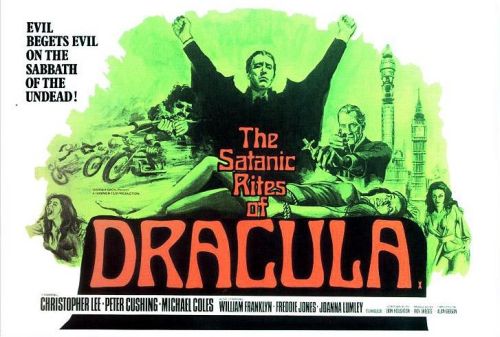
Scenes That I Love: Peter Cushing Confronts Christopher Lee in The Satanic Rites of Dracula


Today is Peter Cushing’s birthday.  Tomorrow is Christopher Lee’s.

What better way to celebrate than by sharing a scene that I love that features both of them?  1973’s The Satanic Rites of Dracula was one of Hammer’s final Dracula films and, with the action somewhat awkwardly moved to the modern day, it’s also one of the weaker entries.  But it does feature Christopher Lee and Peter Cushing, playing Dracula and the latest Van Helsing, and it’s worth watching for that reason.  

Though they often played enemies onscreen, Cushing and Lee were best friends offscreen.  Lee often said that he never really recovered from Cushing’s death in 1994.  Cushing may have spent his career playing villains and obsessive monster hunters but he was said to actually be a kind and rather shy man, an old-fashioned gentlemen who unexpectedly found his fame in horror.  Whereas Lee was a serious student of the esoteric, Cushing preferred to spend his time gardening.

In the scene below, Cushing’s Van Helsing confronts Lee’s Dracula and it’s just fun to watch these two old friends go at each other.  One gets the feeling that Cushing and Lee had a few laughs after the cameras stopped rolling.