And if your friend is just someone dressed up like a big teddy bear …. well, to quote Degrassi’s Jay Hogart: “At least there’s a party.”
This video won me over. When it started, the whole dancing teddy bear thing kind of scared me because I still have bad memories of Ted 2 and I was worried the bear was going to start speaking in Seth McFarlane’s voice. Then, when the bear was in bed, I found myself worried that we were going to enter Shining territory. (Remember the scene with the two ghosts, one of whom is dressed up like a dog?) But, no, this video is actually very cute. The members of the band are all adorable and the big teddy bear actually reminded me of this big bunny that I used to have when I was little.
To be honest, this video feels like it could be a companion piece to Saint Motel’s video for My Type. Maybe it’s because they both take place in what appears to be a rather cheap hotel room. Plus, there’s a lot of dancing in My Type as well.
As a final note, as far as Friends is concerned, I binged the whole thing last year and Rachel totally should have picked Joey.
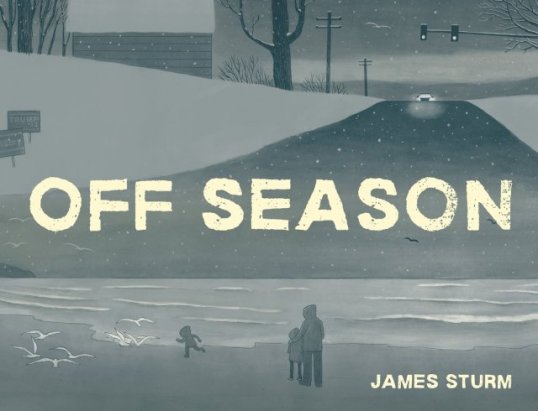
James Sturm is an important cartoonist. Why, just ask around — everybody says so. He founded CCS. He gives Ted Talks. His work is parsed over in minute detail in the pages of academic journals. Those rare occasions when he releases new material are heralded as “major” publishing “events.” What he has to say matters, you plebian rube.
Except when it doesn’t. Welcome to Off Season.
Please understand I’m not taking a deliberate “too cool for school” pose here — I’ve enjoyed some of Sturm’s previous stuff, but that was long before he started getting high off the ink of his own press clippings. I still maintain that The Cereal Killings was his finest hour (even if he did crib the ending from Alan Moore, it was an ending that Moore himself had cribbed from Robert Mayer, so — karma and shit, right?), but some of his explorations…
Ok, so it’s 1972. Rock music dominated the airwaves, until a nearly fifty year old English gent named Hurricane Smith blew into America with a British Music Hall-styled #1 hit called “Oh, Babe, What Would You Say” (take it away, Johnny Carson!):
Who was Hurricane Smith, you ask? Well, first of all, his name isn’t really Hurricane, but Norman Smith, born in 1923. Young Norman served in the RAF during WWII as a glider pilot, and upon war’s end set out to make a go of things as a jazz musician, without much success. By 1959, Norman found steady employment working as a sound engineer for Britain’s EMI Records, located on London’s Abbey Road.
In 1962, EMI signed four lads from Liverpool who had some potential. The Beatles recorded “Please Please Me”, and the song took the U.K. by storm:
The Beatles became a phenomenon in America two short years…
Set during World War II, 1984’s A Soldier’s Story opens with a murder.
On a rural road outside of a segregated army base in Louisiana, someone has gunned down Sergeant Vernon Walters (Adolph Caesar). At the time, Walters was staggering back to the base after a night of heavy drinking. Both the local authorities and Watlers’s fellow soldiers assume that the murder was the work of the Ku Klux Klan. Captain Richard Davenport (Howard Rollins) isn’t so sure.
Captain Davenport is the officer who has been assigned to investigate the murder. From the minute that he arrives at the base, the soldiers stare at him. As Cpl. Ellis (Robert Townsend) explains it, the enlisted men are shocked because they’ve never seen a black officer before. Some of the soldiers admire Davenport while other view him with suspicion, wondering what Davenport must have done or who he must have sold out to earn his commission.
Meanwhile, the other officers (who are all white) view Davenport with a combination of condescension and hostility. Col. Nivens (Trey Wilson) only allows Davenport three days to wrap up his investigation and assigns the polite but skeptical Capt. Taylor (Dennis Lipscomb) to work with him. Taylor suspects that Walters may have been murdered by the openly racist Lt. Byrd (Wings Hauser!). Davenport, however, isn’t so sure. Even though the official story is that Walters was a tough but fair sergeant who was respected by his company, Davenport suspects that one of them may have killed him.
Davenport and Taylor start to interview the soldiers who actually had to deal with Walters on a daily basis. Through the use of flashbacks, Walters is revealed to be a far more complex man than anyone knew. We see that Walters was a man who was bitterly aware of the fact that, even after a lifetime of military service, he was destined to always be treated as a second-class citizen by the nation that he served. Unable to strike out at the men who the army and society had placed over him, Walters instead struck at the men serving underneath him. While the man in Walters’s company wait for word on whether or not they’ll be allowed to serve overseas, Davenport tries to determine if one or more of them is a murderer.
A Soldier’s Story was adapted from a play but director Norman Jewison is careful to prevent the material from becoming stagey. Effortlessly transitioning from the film’s present to flashbacks of the events that led to Walters’s murder, Jewison crafts both an incendiary look at race relations and a compelling murder mystery. He’s helped by a strong cast of predominately African-American actors. In one of his earliest roles, Denzel Washington plays Pfc. Peterson with a smoldering intensity. David Alan Grier and Robert Townsend, two actors known for their comedic skills, impress in dramatic roles. Seen primarily in flashbacks, Adolph Caesar turns Walters into a complex monster.
And yet, with all the talent on display, it is Howard Rollins who ultimately steals the movie. As a character, Captain Davenport has the potential to be a rather thankless role. He spends most of the movie listening to other people talk and, because of his status as both an officer and a black man in the rural south, he’s rarely allowed to show much anger or, for that matter, any other emotion. However, Rollins gives a performance of such quiet intelligence that Davenport becomes the most interesting character in the movie. He’s the ultimate outsider. Because of his higher rank and his role as an investigator, he can’t fraternize with the enlisted men but, as an African-American, he’s still expected to remain separate from and differential to his fellow officers. As the only black officer on a segregated base, Davenport is assigned to stay in an empty barrack. One of the best scenes in the film is Davenport standing alone and surveying the stark layout of his temporary quarters. The expression on his face tells you everything you need to know.
(Towards the end of the film, when Davenport finally gets a chance to drop his rigid facade and, if just for one line, be himself, you want to cheer for him.)
A Soldier’s Story was nominated for best picture but it lost to another theatrical adaptation, Milos Forman’s Amadeus.
Other than that he was born in Pennsylvania and, like so many pulp era illustrators, studied in New York, I couldn’t find much information online about the artist Jerry Allison. (Most of the information I did find was about a different Jerry Allison, who was Buddy Holly’s drummer.) According to AskArt.com, Jerry Allison studied at the Woodstock School of the Arts Students League and, along with his work for the pulps, he also did illustrations for Reader’s Digest, General Electric, and NBC. After he retired from doing paperback covers, Allison concentrated on panting historical scene for the calendars put out by the Esso Corporation. (In the United States, Esso is now known as Exxon.) This is a case where the artist’s work will have to speak for itself.
Allison’s covers all contain the usual pulp elements of manly men, beautiful women, thirsty stares, and guns. One of the books below is called “The Lusty Men” and that’s a good way to describe most of the men who appear in Allison’s covers.
Considering that’s a fairly modern bra for a book that appears to take place in the Old West, there’s a chance that this final cover may not be historically accurate.
Today, we have another music video from our queen, the amazing Adi Ulmansky.
As for what it’s all about …. well, I don’t know. That’s the main reason I responded to the video. The more surreal and dream-like the better has always been my philosophy and this video leaves me wondering if I should go to work tomorrow or if I should hide for a few days. The sight of someone smiling while wearing clown make-up will do that to you.
Of course, it’s possible that J.W. Dunne was correct when he theorized that there is no such thing as “now” and all time may be happening all at once. In which case, I’ve either already gone to work or I’m currently hiding in my house. Of course, I may have misunderstood Dunne’s point. To be honest, for the longest time, I thought John Gregory Dunne was the one with all the theories about how time worked but then I realized that I was confusing my Dunnes. However, John Gregory Dunne did write a book called The Studio, which is the definitive portrait of Hollywood at the end of the studio system. Dunne wrote a later book about Hollywood called Monster which is interesting just because it gives you all the details about went on behind the scenes during the production of one of the most forgettable films ever made.
That was quite a week that we just went through, wasn’t it? Basically, for any future historians who have come across this post as a part of a research product, the week pretty much started out normally enough, with the President giving his annual State of the Union speech, and then, with each passing day, things all across this country just got more and more batshit crazy. This was the week that proved that it’s a strange world.
But the important thing is that we all survived!
Here’s what I did while everyone else was making escape plans last week:
This is going to be a great week, everyone! Not only do I have a lot of reviews scheduled to drop this week but it’s also almost time for the greatest holiday of all, Valentine’s Day!
(Oh hush, all you emotionally-wounded cynics! Valentine’s Day is the best!)




 Through the Shattered Lens