Music Video of the Day: Heart and Soul by T’Pau (1987, directed by ????)


In an interview with the now-defunct Kicking It Old School Blog, T’Pau’s Carol Decker explained the genesis of the song that would become Heart and Soul.  It all began when her bandmate and then-boyfriend Ron Rogers purchased a new keyboard with a built-in synthesizer:

“He was just trying to get used to the gizmos in it and while messing around with the sequencer he started the ‘bum bum buh buh bum bum bum’ of the bass riff. T’PauI started to sing a melody over it, the wafty vocal and came up with ‘more than an ocean keeps us apart.’ … The lyrics were about when I went on holiday with my parents and Ronnie couldn’t come. I missed him so much, but then I morphed the story into a fictitious one of not being loved back (which I was) … The rap was the idea of Andy Piercy, our then producer. He said the gaps needed filling, so I started these syncopated sort of nonsense noises. I then turned those noises into words which took about a week to get right.”

The song reached #4 in both the U.S. and the UK Charts.  In the UK, it became a hit after it was used in a clothing advertisement while, in America, its success was largely credited to the above music video, which was put into heavy rotation on MTV.

The song is best known for its vocal layering, with Decker’s melody lines coming in over the rap.  Stylistically, the video’s is similarly layered, resulting in a perfect synthesis of audio and visual.

Heart and Soul is song that epitomizes an era.  Personally, I have fond memories of fleeing from the Liberty City police while listening to it.

Everything’s better with a little heart and soul.

And yes, T’Pau was named after a Vulcan who appeared on an episode of Star Trek.  Before Decker saw that episode of Star Trek, the band was called Talking America.

The original T’Pau

30 Days of Noir #13: Undertow (dir by William Castle)


In the 1949 film, Undertow, Scott Brady plays Tony Reagan.  Tony used to be a member of the Chicago mob but that’s all in the past now.  He served his country in World War II and now, as he tells his old racket friend, Danny (John Russell), all Tony wants to do is settle down and run a hunting lodge in Reno.

However, before Tony can forever abandon Chicago for Nevada, he has to make peace with his future in-laws.  He’s engaged to marry Sally Lee (Dorothy Hart).  In fact, he’s so in love with her that not even meeting a single teacher named Ann McKnight (Peggy Dow) can distract Tony from his plans.  The only problem is that Sally is the niece of a Chicago gangster named Big Jim Lee and, in the past, Big Jim and Tony haven’t always been the best of friends.  In fact, the Chicago police are constantly harassing Tony because they’re convinced that he wants to start a gang war with Big Jim.  Instead, Tony just wants to make peace with Big Jim before the wedding.

Tony goes to visit Big Jim and …. well, you can guess what’s going to happen, can’t you?  If you’ve seen enough film noirs, you know that no one is every totally out of the rackets.  No one believes an ex-mobster when they say that they’re no longer interested in making trouble.  Even worse, any murder committed with automatically be blamed on anyone who says that they’re no longer a member of the rackets.  That’s what happens to Tony.  Not only does he discover that Big Jim has been shot dead but everyone thinks that he’s the one who did it.  Fleeing through the shadowy streets of Chicago, Tony finds himself not only being pursued by the police but also by the murderers.  Everyone wants to either capture or kill Tony.

In fact, the only person who seems to be on Tony’s side is Ann McKnight.  Ann lets Tony hide out at her apartment while he tries to figure out what’s going on.  Of course, Ann does have a nosy landlady who has no hesitation about letting herself into the apartment whenever she feels like it….

The plot of Undertow isn’t going to win any points for originality.  It’s not going to take you long to figure out who is setting Tony up, if just because there really aren’t enough characters in the film for there to be much suspense about who is betraying who.  But no matter!  The film is still an atmospherically shot and briskly-paced thriller.  Undertow was directed by William Castle, who is probably best known for directing campy B-movies like The Tingler and Strait-Jacket.  There’s nothing campy about Castle’s direction of Undertow.  The majority of the film was shot on location and Castle makes great use of Chicago.  When Tony tries to lose the cops that are tailing him, it helps that he’s not running across a soundstage but instead down real city streets, ones that feels alive with tension and danger.  There’s also a great chase that takes place in a long and dark corridor in an underground garage.

Scott Brady (who was the brother of tough-guy actor Lawrence Tierney) gives a sympathetic performance as Tony and he and Peggy Dow have a really likable chemistry in their scenes together.  Dorothy Hart is also well-cast as the film’s femme fatale, while Bruce Bennett has a few good scenes as a detective who is an old friend of Tony’s.  Fans of “classic” matinée idols will want to keep an eye out for Rock Hudson, making a brief appearance in his second film and credited as “Roc” Hudson.

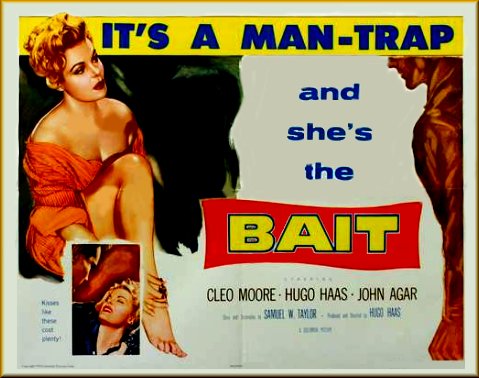
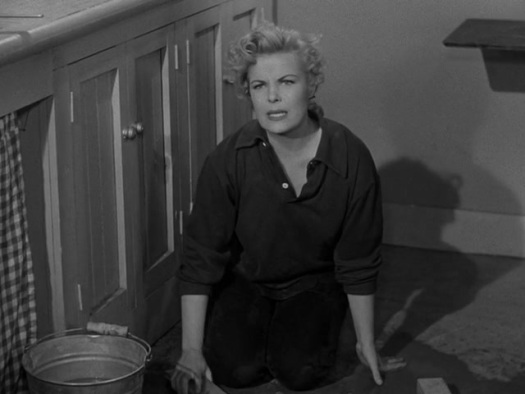
Give The Devil His Due: Hugo Haas’s BAIT (Columbia 1954)


gary loggins's avatarcracked rear viewer

Every Tuesday during the month of “Noirvember”, I’ll be spotlighting some dark genre gems. Enjoy wandering down the crooked path of film noir!

Welcome to the world of Hugo Haas, King of Low-Budget 50’s Film Noir. I’d heard about producer/director/writer/actor Haas’s films for years through Leonard Maltin’s annual Movie Guide, usually accompanied by a *1/2 to ** (or less!) rating. Of course, being a connoisseur of bad cinema, I was interested, but it wasn’t until recently I viewed my first Hugo Haas epic, 1954’s BAIT, starring Hugo’s screen muse Cleo Moore, who was featured in seven of the  maestro’s movies.

BAIT starts with a unique introduction (and some nice camerawork from DP Eddie Fitzgerald), as an elegantly dressed Sir Cedric Hardwicke plays The Devil Himself delivering a monologue expounding on his evil machinations. Then we get into the story itself (written by Samuel W. Taylor, with “additional dialog”…

View original post 527 more words

Music Video of the Day: Don’t You Want Me by The Human League (1981, directed by Steve Barron)


Inspired by a story that the Human League’s Phil Oakley read in a teen-girl’s magazine, Don’t You Want Me is a song not about love but instead a song about two people battling for control.  While the song was originally conceived as being a male solo, Oakley made the last-minute decision to turn it into a duet, with Susan Ann Sulley taking on the role of the girl who once worked in a cocktail bar but always knew she was meant for a much better life.

After the song was recorded, Oakley disliked it because he felt that the song’s sound was too “poppy” and he was not happy when Virgin decided to release Don’t You Want Me as the fourth single off of The Human League’s third studio album, Dare!  Despite Oakley’s misgivings, Don’t You Want Me went on to become the band’s biggest hit and one of its signature songs.

(As of 2014, Phil Oakley still didn’t think much of the song.  In an interview with Classic Pop Magazine, Oakley said, “‘Don’t You Want Me‘ might have shifted gazillions, but either I’ve heard it too many times or the rest of Dare! is just so far ahead that it puts it in the shade. Still, it made the band.”)

The music video was shot at a time when MTV was still in its infancy and many people weren’t even sure what a music video was supposed to be.  Filmed on a cold, rainy night in Slough, Berkshire, the video featured Phil Oakley as a director and Susan Ann Sulley as the actress who walks out on him during the filming of a murder-mystery.  Director Steve Barron used 35mm film, giving the video a richly cinematic look that was unusual for the music videos of the time.  Reportedly, Barron was influenced by Truffaut’s Day For Night, which is why the clapper board features the inscription, Le League Humain.

The video not only helped to make the song a hit but it also did the same for MTV itself.  At a time when many were still wondering if people would actually watch MTV, the popularity of this video gave them a reason to do just that.  The video proved that music videos didn’t have to just be bland performance clips.  Instead, like any film, a music video could tell a story of its very own.

Don’t You Want Me was the 1981 Christmas number one in the UK, where it has sold over 1,560,000 copies, making it the 23rd most successful single in the history of the UK Singles Chart.  In 2015, in an ITV poll, it was voted the 7th most popular number one single of all time.

30 Days of Noir #12: The Hitch-Hiker (dir by Ida Lupino)


The intense 1953 film noir, The Hitch-Hiker, begins with news of a murderer at large.

His name is Emmett Myers (William Talman).  He’s the rough-looking man who you might occasionally see standing by the side of the road, asking for a ride with his thumb outstretched.  For me, it only takes one look at Myers’s unfriendly face and his shifty eyes to know that I would never slow down to give him a ride.  However, The Hitch-Hiker takes place in a more innocent era, at a time when everyone wanted to be of help.  Anyone who gives Emmett a ride ends up dead.  He steals their cars and then drives across country, abandoning the car only when he learns that his previous murder has been discovered.  Emmett has hitchhiked from Illinois to Southern California and he’s left a trail of dead bodies behind him.

Roy Collins (Edmond O’Brien) and Gilbert Bowen (Frank Lovejoy) don’t know who Emmett is.  They’ve missed all of the reports about Emmett’s killing spree.  They haven’t read the newspapers, all of which feature a picture of Emmett on the front page and a warning to never pick him up.  Roy and Gilbert have been too busy getting ready for a long-planned fishing trip in Baja California.  When they see Emmett hitchhiking in Mexico, they pull over and offer him a ride.

Unlike other movie hitchhikers, Emmett doesn’t waste any time before revealing who he is.  As soon as he gets in the car, he pulls a gun and tells the two men that they’re going to drive him deeper into Baja California.  He’s got a boat to catch and he says that all the two men have to do is follow orders.  Of course, both Roy and Gilbert know better.  They know that Emmett’s planning on killing them as soon as they arrive at their destination.  In fact, if Emmett learns that the police are looking for the two men, he’ll kill them sooner.  Roy and Gilbert not only have to keep Emmett from flying off the handle but they also have to keep him from discovering that both of them have been reported as being missing.

As the three men drive across California, Emmett continues to taunt his prisoners.  Repeatedly, he points out that the only reason they’re in this situation is because of their loyalty to each other.  As Emmett explains it, if the two men tried to run in opposite directions, Emmett would probably only be able to kill one of them.  If the two men both attacked him, Emmett would again probably only have time to kill one before the survivor subdued him.  Will Roy and Gilbert remains loyal to each other or will they finally embrace Emmett’s philosophy of every man for himself?

Oh, how you’ll hate Emmett Myers!  As played by William Talman, Emmett is not just a criminal but a bully as well.  The enjoyment that he gets out of taunting Roy and Gilbert will make your skin crawl.  Emmett is hardly the type of witty or charming master criminal who often shows up in movies today.  Instead, The Hitch-Hiker emphasizes that Emmett’s an idiot but, because he has the gun, he has the power.  Edmond O’Brien and Frank Lovejoy are also well-cast as the two friends who are forced to choose between survival and loyalty.

The Hitch-Hiker was one of the few films to be directed by a woman in the 1950s.  (It’s generally considered to be the only film noir to have been directed by a woman.)  Ida Lupino was not only an actress but also the only female director in the old Hollywood system and she made several hard-hitting films, the majority of which dealt with the type of issues that mainstream Hollywood was still too scared to handle.  With The Hitch-Hiker, Lupino emphasizes not only Emmett’s cruelty but also the bonds of friendship between Emmett’s two hostages.  Visually, she makes the wide open desert appears as menacing and as dangerous as any shadowy city street.  If urban noirs often suggested that threats could be hiding anywhere, The Hitch-Hiker takes the opposite approach.  The threat is in the back seat of the car and there’s literally no place to hide.

The Hitch-Hiker is an intense film that holds up well today.  Watch it below and never again make the mistake of helping out a stranger.

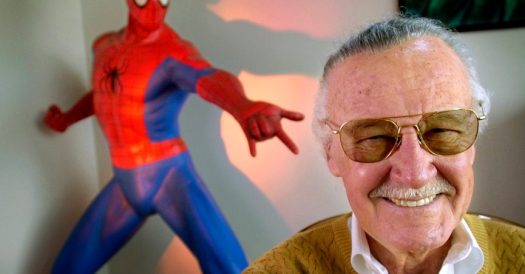
Face Front, Marvelites!: RIP Stan “The Man” Lee


gary loggins's avatarcracked rear viewer

I know it’s popular these days among a certain coterie of Comic Book Buffs to bash Stan Lee’s contributions to the medium in favor of artist/collaborators Jack Kirby and Steve Ditko . You’ll never find me in that crowd. Not ever. I learned to read (with the help of my dad) at the tender age of three through comics… simple stuff at first, funny books like YOGI BEAR and BEETLE BAILEY. As I progressed into the realm of superheroes, my vocabulary improved thanks to writers like Gardner Fox, John Broome, and especially Stan Lee, who took me to Asgard and Outer Space with Shakespearean-styled dialog and college-level words that made me keep a dictionary always at the ready. Screw you, Dr. Frederic Wertham!!

The Titanic Trio: Stan Lee, Jack Kirby, Steve Ditko

Stanley Martin Lieber was born December 28, 1922, the eldest son of immigrant parents (his younger sibling Larry…

View original post 914 more words

Rest In Peace, Stan Lee


In 1939, a 17 year-old aspiring writer named Stanley Lieber landed a job at Timely Comics in New York City.

At first, Stanley’s job was just to get coffee, make sure that the inkwells were full, and occasionally proofread copy.  In 1941, when the third issue of Captain American Comics needed a text story so that it could be shipped as a magazine instead of just as a comic book, Stanley was assigned the job.  Because the young man had an ambition to some day write the great American novel and felt that being associated with comic books would make it more difficult to convince publishers to take him seriously, Stanley Lieber wrote the story under a pseudonym, Stan Lee.

And the rest, as they say, is history.  Timely eventually became Atlas and then Atlas was rebranded Marvel and, through it all, Stan Lee remained at the company, providing continuity from one decade to another.  Ironically, for someone who originally feared being too associated with comic books, Stan Lee went on to become not only the face but, for several decades, the voice of Marvel Comics.

Among comic book historians, Stan Lee is an often divisive figure.  By his own admission, Lee loved the spotlight and it can be argued that he unfairly overshadowed his publicity-shy colleagues.  To solely give Lee the credit for creating characters like Spider-Man and the Fantastic Four does a disservice to the work of artists and writers like Jack Kirby, Steve Ditko and so many others.  As a company, Marvel has a deserved reputation for not treating its artists with the respect or the financial compensation that they deserved.  How much of the responsibility for any of that falls on Lee’s shoulders is a controversial subject and will continue to be so for years to come.

What isn’t controversial was that,  whether he hitting the college lecture circuit, recording the introductions for the animated Spider-Man and His Amazing Friends TV show, or giving interviews with publications like Playboy and Rolling Stone, there was never a bigger cheerleader for comic books than Stan Lee.  At a time when DC comics was busy imitating the campy Batman TV show, Marvel Comics were, in their own way, dealing with world in which their readers lived.  From the platform of Stan’s Soap Box, Stan Lee spoke against racism and prejudice.  When the U.S. Department of Health, Education, and Welfare approached Lee to do a story about the dangers of drug abuse, Lee did it in defiance of the Comic Codes Authority.  Three issues of Spider-Man were released without the CAA’s seal of approval, opening the way for all comic books to deal with real world issues.

Stan Lee as Mr. Fantastic in What If #11 (as drawn by Jack Kirby)

For many comic book readers who might have otherwise felt that they didn’t fit in, Stan Lee said, “Here, you do belong.”  Today, it might seem easy to poke fun at Lee’s endless enthusiasm, his cries of “excelsior,” and the way that he called Marvel readers “true believers.”  But for many readers,  there was much comfort to be found in Lee’s corny sayings.  Lee had a way of making readers feel as if they were all in it together.  Whether you were a true believer or a member of the Merry Marvel Marching Society, you belonged.  For kids who felt like outsiders, Lee was there to tell them that everyone was capable of being a hero, whether they had super powers or not.

In his twilight years, Lee was rediscovered by a new generation of fans.  Spotting Lee’s trademark cameos became one of the pleasures of watching any Marvel film.  Sometimes, he was a postman.  In Deadpool, he worked in a strip club.  More than once, he was a janitor.  I once saw him driving a bus.  In the second Guardians of the Galaxy film, he was sitting on the moon and telling the Watchers about his adventures on Earth and it just seemed like he was right where he belonged.

Stan Lee passed away today at the age of 95.

I knew I’d have to write this some day but I always hoped it wouldn’t be any time soon.

Rest in Peace, Stan Lee.


Special Veterans Day Edition: John Wayne in SANDS OF IWO JIMA (Republic 1949)


gary loggins's avatarcracked rear viewer

Critics of John Wayne gave him a lot of flak for not serving his country during World War II, especially in the turbulent 1960’s, labeling him a phony patriot and celluloid warrior. The truth is Wayne DID try to get into the war, but was stymied in his attempts on two fronts: Republic Studios boss Herbert Yates, who filed for deferments so he wouldn’t lose his cash cow, and Wayne’s first wife Josie, who failed to forward letters from OSS Chief Wild Bill Donovan’s office. Be that as it may, The Duke was no phony, and did what he could on the home front for the war effort.

SANDS OF IWO JIMA was made four years after the war as a tribute to the brave souls of the United States Marine Corps who fought against the Japanese in the South Pacific. Wayne plays the tough top kick Sgt. John Stryker…

View original post 748 more words