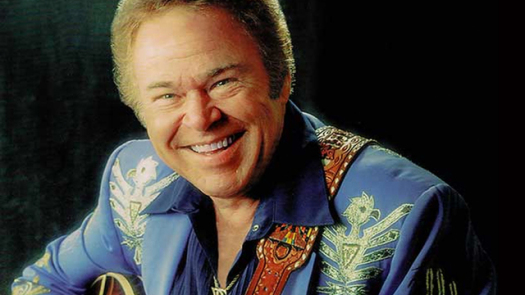
It seems like we’ve lost an old friend, one who was welcomed into homes across America for decades. Roy Clark, Country Music’s King of Strings, adept on guitar, banjo, and mandolin, and one of TV’s most Familiar Faces thanks to his 14 year gig as co-host of HEE HAW, passed away yesterday at age 85. Clark was born in Virginia on April 15, 1933, and picked up his first guitar at age 14. He was a two-time National Banjo Champion by age 15, and made his Grand Ole Opry debut at 17. Roy joined Jimmy Dean’s band in the early 50’s, but was fired for his chronic tardiness. He then began playing backup for rockabilly queen Wanda Jackson.
When Dean got a guest host spot on THE TONIGHT SHOW, he brought his old bandmate Roy on, and Clark’s expert playing, coupled with his unassuming, warm personality, tore the house down…
Yesterday, when I wrote about the video for Shout by Tears For Fears, I apparently made up a song that doesn’t actually exist. I wrote that Shout was the band’s signature song, along with Everyone Wants To Rule The World. I also wrote about the joint vocalist of Tears for Fears, Richard Orzabal. Not only did I make up a song that didn’t exist but I also created an extra member of Tears For Fears. As everyone knows, the song is called Everybody Wants To Rule The World and the singer is named Roland Orzabal. I don’t know how I screwed up those two simple facts last night. Maybe I was writing from Earth-2.
For many people, Everybody Wants To Rule The World will always be the song from Real Genius. The song actually first appeared on the 1985 album, Songs From The Big Chair, for which it was a last-minute addition. Roland Orzabal has said that he originally felt that the song was too lightweight and that it wouldn’t be a good fit with the rest of the album but producer Chris Hughes convinced Orzabal to include the song. Hughes felt that the song would chart well in America and he turned out to be correct. Would the song have been as popular if it had been called by its original title, Everybody Wants To Go To War? That’s like asking if War and Peace would have been as much of a success if Tolstoy had called it War! What Is It Good For?
As for the video, it features Curt Smith driving through the desert, people racing dune buggies, men dancing in front of gas pumps, and the Cabazon Dinosaurs. The scenes of Curt in the desert were filmed in California and Nevada while the scenes of Tears For Fears performing were shot in London. Curt Smith has said that the shooting of the video was a “disaster” and that there was a serious accident involving the dune buggies that led to a child being thrown from one of the vehicles and hitting his head on a rock, leaving him temporarily unconscious. Despite all of the difficulty involved in shooting the video, it was still placed in heavy rotation on MTV and played no small role in making the song a hit.
Everybody Wants To Rule The World spent two weeks as the number one song in the U.S. In the UK, it peaked at number two, the only thing keeping it from reach the top being the charity single, We Are The World.
The past is another country — except when it isn’t.
Noah Van Sciver has long been one of the undisputed modern masters of autobio comics, to the extent that even his most famous fictional character, Fante Bukowski (whose trilogy of books recently concluded with A Perfect Failure — reviewed a few weeks back on this very site) is obviously liberally populated with (admittedly exaggerated) people, places, and events from his own life — but a close look at one’s upbringing and how it continues to inform life right up to the present day, well, that’s quite a thematic evolution from, say, My Hot Date and similar works, is it not?
Which isn’t meant as a slight against his earlier, Ignatz-winning work, mind you — anything but! That comic more than earned its near-universal praise. But how the kid we met in its pages grew into the man we’ve seen in…
The 1951 film, The Man With My Face, tells the story of Chick Graham (Barry Nelson).
Chick’s a nice guy. He might be a little bit bland but, at the same time, he’s also never been in any real trouble. He’s the type of person who you would trust to look after your money but, at the same time, you would probably also forget to wish him a happy birthday on Facebook. He’s just one of those decent but forgettable human beings.
After serving his country in World War II, Chick moved to Puerto Rico and opened up a business with his best friend from the army, Buster Cox (John Harvey). Not only that but he also married Buster’s sister, Cora (Lynn Ainley). Of course, when he fell in love with Cora, he also abandoned his then-girlfriend, Mary (Carole Mathews). Mary’s still a little bit upset about that but you know who is really bitter about it? Mary’s brother, Walt (Jack Warden). Walt says that Chick’s no good and there’s no way that he would ever help Chick out if Chick ever got in any trouble.
But no matter! Chick’s got a nice house. He’s got a loving wife. He’s got a loyal best friend. And he’s got a dog! It’s a perfect life!
Or is it?
One day, Chick is shocked when his wife doesn’t pick him up after dropping him off in the city. When she calls his house and asks her what’s going on, she replies that she doesn’t have the slightest idea who he is. When Chick finally makes it home, both Cora and Buster continue to insist that they don’t know who he is. His own dog doesn’t even seem to know him!
However, what’s really strange is that, in Chick’s house, there’s a man who looks exactly like him. Cora, Buster, and the man all claim that he’s the real Chick Graham and that the original Chick is just a double. Fleeing his house, Chick soon discovers that his picture is on the front page of every newspaper!
Except, of course, it’s not his picture. Instead, it’s a picture of Bert Rand! Bert is a notorious criminal who recently robbed a bank in Miami. It’s rumored that he’s fled to Puerto Rico! It doesn’t take long for Chick to figure out that Bert has stolen his identity and moved into his house. But how can Chick prove it? (Remember this film was made in 1951, back when most people didn’t even know what DNA was.) Making things even worse for Chick is that he now has a crazed dog handler (Jim Boles) and a doberman chasing him all over San Juan….
As far as stolen identity films are concerned, The Man With My Face isn’t bad, though it is kind of predictable. It’s not a spoiler to say that people are conspiring against Chick but, as you watch the film, you have to wonder why these criminals would pursue such a needlessly complicated scheme. You have to admire their dedication but, at the same time, it’s seems like they could have gotten the same results with a much simpler plan. On the plus side, Barry Nelson (who you might recognize as Mr. Ullman from Kubrick’s The Shining) is a sympathetic hero and character actor Jack Warden has a nice supporting role as Mary’s world weary brother. Though Puerto Rico may seem like a strange place to set a film noir, the film’s final chase scene makes good and atmospheric use of the Fort San Cristobal. All in all, The Man With My Face is an entertaining little time waster.
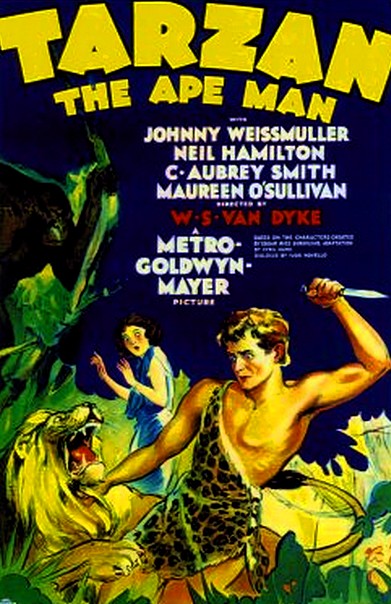
Edgar Rice Burroughs’ Lord of the Jungle first hit the screen way back in 1918 with Elmo Lincoln as Tarzan. Many actors since then have donned the loin cloth, but for me the definitive movie Tarzan remains Johnny Weissmuller , who swung from his first Hollywood vine in MGM’s TARZAN, THE APE MAN, and played the part for 16 years in 12 films.
Elderly John Parker and his young partner Harry Holt are in deepest Africa searching for the legendary “elephant’s graveyard”, which contains a fortune in ivory, but is considered sacred ground by the native tribes. Parker’s daughter Jane shows up, a spirited girl who’s no ball of fluff, but can hold her own. When Jane insists on accompanying the men on their journey, Parker scoffs, but Harry signs off because of course he’s immediately smitten with her.The jungle trek is fraught with perils, like a dangerous river crossing…
Tears For Fears frontman Roland Orzabal and keyboardist Ian Stanley were both practitioners of primal scream therapy, in which people confronted their fears and insecurities by shouting. This song was inspired by both the treatment and political protest.
The video, which was put in heavy rotation on MTV and become one of the defining videos and songs of the 1980s, features Orazbal and Curt Smith letting it all out on the cliffside at Durdle Door in Dorset. The video was one of the 300-something videos to have been directed by Nigel Dick, who has done videos for almost everyone.
Shout spend three weeks as the number one single in the US and has since become Tears for Fears signature song, along with Everybody Wants To Rule The World.
The 1947 film, Shoot to Kill (also known as Police Reporter), opens with both a bang and a crash.
The police are chasing a car down one dark and lonely road. When that car crashes, the police are shocked to discover who was inside of it. Two men and one woman, all well-dressed. The men are both dead but the woman is merely unconscious. The police identify one of the men as being the notorious gangster, Dixie Logan (Robert Kent). It makes sense that Logan would be fleeing the police but what about his two passengers, newly elected District Attorney Lawrence Dale (Edmund MacDonald) and Dale’s wife, Marian (Luana Walters)?
The police may not be able to get any answers but fortunately, there’s a reporter around! Mitch Mitchell (Russell Wade) is a crime reporter and, seeing as how he knew both Lawrence and Marian, he seems like the perfect person to get some answers. (In fact, it was Mitch who first suggested that Lawrence should hire Marian as his administrative assistant, therefore setting in motion the whirlwind romance that would end with them married.) Mitch goes to see Marian in her hospital room and he asks her what happened.
It’s flashback time! Yes, this is one of those films where almost the entire film is a flashback. That, in itself, is not surprising. Some of the best film noirs of all time were just extended flashbacks. (D.O.A, Double Indemnity, and Sunset Boulevard, to name just a few examples.) What sets Shoot to Kill apart is the fact that, occasionally, we even get characters having a second flashback while already in someone else’s flashback. We’re through the the film noir looking glass here, people.
Lawrence Dale, we’re told, was elected district attorney because he managed to secure the conviction of notorious gangster Dixie Logan, despite Logan’s insistence that he was no longer involved in the rackets. However, what we soon discover is that not only was Logan actually innocent but Dale specifically prosecuted him as a favor to some of Dale’s rival gangsters. That’s right, Lawrence Dale was on the take! It also turns out that Marian has some secrets of her own. When she first showed up at Dale’s office, she was doing more than just looking for a job. As for her marriage to Dale …. well, I really can’t tell you what the twist is here because it would spoil the entire film.
Shoot To Kill may clock in at just 64 minutes but it manages to pack a lot of twists and turns into just an hour. In fact, I’d argue that it probably tries to do a little bit too much. At times, the film is a bit difficult to follow and a few inconsistent performances don’t help matters. For instance, Russell Wade is likable as the crime reporter but he still doesn’t exactly have a dynamic screen presence. Much better cast are Luana Walters and Edmund MacDonald, who both do a good job as, respectively, a femme fatale and a sap. At the very least, history nerds like me will be amused by the fact that Edmund MacDonald was obviously made up to resemble Thomas E. Dewey, the former Manhattan District Attorney who twice lost the U.S. presidency.
The best thing about Shoot To Kill is the look of the movie. Filmed in grainy black-and-white and full of dark shadows, crooked camera angles, and men in fedoras lighting cigarettes in alleys, Shoot to Kill looks the way that a film noir is supposed to look.
Regardless of whether it was the filmmaker’s original intention, Shoot To Kill plays out like a low-budget, black-and-white fever dream. It’s definitely a flawed film but, for lovers of film noir, still worth a look.





 Through the Shattered Lens