Take a trip into the past with this selection of paperback covers, all done by the British artist James E. McConnell! Born in Bedlington, Northumberland and educated at St. Martin’s School, McConnell went freelance in 1933 and subsequently became one of the most prominent and prolific paperback artists in Britain. Though he worked in all genres, he is best remembered for his western and historical work. His western covers epitomized how many in Europe visualized the American old west, complete with manly gunslingers and the women who loved them.
Here’s a small selection of some of McConnell’s work:
Long before the financial crisis of 2007 and the Great Recession that followed, 1992 saw the collapse of several economic institutions. That was the year that the European Stock Market crashed and it was revealed that the powerful Bank of Credit and Commerce International was a massive money laundering scheme. Following the mysterious death of British tycoon Robert Maxwell, it was discovered that he had been propping his companies up by stealing from other people’s pensions. In the United States, the House banking scandal revealed that hundreds of Congresspeople were being allowed to bounce checks without being penalized by the House bank.
Be Quick or Be Dead, the first single to be released off of Iron Maiden’s Fear of the Dark, was inspired by these scandals. If there was ever any doubt, the video, which specifically calls out both BCCI and the Federal Reserve, left no doubt that the members of Iron Maiden were as pissed off as everyone else in the world.
Be Quick or Be Dead peaked at number 2 on the UK charts. It may be best remembered for the cover of its single, which featured Ed getting vengeance on a suit-wearing banker who bore a resemblance to Robert Maxwell.
At the center of the 1949 film, C-Man, is a man named Cliff Holden (Dean Jagger). When we first see Cliff, he’s cheerfully walking down the street in New York City, looking pretty happy underneath his new fedora.
And really, why shouldn’t Cliff be happy? He’s a U.S. Customs agent! He investigates crimes and tracks down smugglers and, perhaps most importantly, his best friend is a customs agent as well! Who wouldn’t want to work with their best friend, right? Anyway, Cliff eventually reaches his office and he discovers that nobody else appears to share his good mood. For that matter, Cliff’s step losing its cheerful spring when he finds out that his best friend has been …. MURDERED!
His friend was investigating the theft of a very valuable necklace. The Treasury Department has reason to believe that an international criminal named Matt Royal (Rene Paul) will be smuggling that necklace into the United States. Looking to not only avenge his friend but also protect the reputation of the United States, Cliff takes over the case. Using the name William Hannah, he flies out to Europe so that he can then board the same plane that Royal will be taking to the States.
While Cliff/William is waiting at the airport, he meets a Swiss woman, named Kathe van Bourne (Lottie Elwin), who is flying to New York so that she can be reunited with her fiancée, Joe. However, after they board the plane, Kathe is suddenly taken ill. Luckily, there’s a doctor on the plane, a courtly gentleman named Doc Spencer (John Carradine). Spencer takes Kathe to the back of the plane to examine her and, while no one’s looking, he hides the necklace underneath a bandage that he wraps around her head.
Back in New York, Royal is pulled off the plane and thoroughly searched. When it’s discovered that he doesn’t have the necklace, Cliff realizes what has happened. However, Kathe has already been taken off in an ambulance and, when Cliff goes to Joe’s apartment, he discovers that Joe has been murdered….
C-Man is a film that kind of sneaks up and takes you by surprise. That it was an extremely low-budget production is obvious from the minute the movie starts. The black-and-white images are grainy. The sets are small and sparsely furnished. The whole film has a rather cheap and ragged feel, as if it might burst into flame and dissolve at any moment. And yet, that low-budget feel works perfectly for the story that C-Man is telling. Despite the oddly cheery narration that’s provided by Dean Jagger, this is a sordid tale about people on the fringes of society. Watching C-Man feels like taking a trip to all of the places that most tourists would never want to visit during their trip to New York City. For instance, when Cliff searches for the alcoholic Doc Spenser, his search leads him from one liquor store to another and it’s obvious that some of the desperate souls that Cliff passes on the streets weren’t actors.
Gail Kubick’s pounding and relentless score adds to the film’s overall dreamlike feel and Joseph Lerner’s direction is just quirky enough to keep things interesting. (When one character is bludgeoned to death, the film suddenly starts to spin as if the viewer has become trapped in the killer’s madness.) Dean Jagger seems a bit miscast as a the tough customs agent but the actors playing the criminals are all properly menacing. Harry Landers, as the most violent of the jewel thieves, makes a particularly threatening impression.
All in all, C-Man is a surprisingly effective poverty row noir.
This week, we take a brief side-step away from our usual small-press “turf” to have a quick look at four high-profile mainstream comics now available on your LCS shelves — three are alphas, one’s an omega.
The Green Lantern #1 marks DC’s latest attempt to revive the flagging critical and commercial fortunes of their premier cosmic super-hero, and while the sort of “back-to-basics” approach being undertaken by writer Grant Morrison and artist Liam Sharp may be precisely what the character needs (not having read a contemporary GL story is probably a couple of decades I’m really not in much position to judge), a dose of some sort of ambition would probably go a long way, and this book has precisely zero of that. It’s hard to believe that the same guy responsible for such thought-through and intricate mind-fucks as The Invisibles, The Filth, Flex Mentallo, and Nameless
From the very early days of music videos (this was back when they were still called “promotional videos”), comes the much beloved video for Madness’s Night Boat To Cairo.
The video was hastily put together to help promote the release of Madness’s Work, Rest, and Play EP, which explains the video’s improvised, deliberately messy feel. The video, which featured the members of the band dressed like stereotypical British explorers, takes place in front of a chroma keyed backdrop of an Egyptian backdrop. While the band runs around the set, the lyrics of the song appear bouncing ball style. It may not be the world’s slickest music video but it feels perfect for Madness.
Night Boat To Cairo was an early hit for Madness, peaking at #6 in the UK music charts and becoming the song with which they traditionally end their shows.
Hotel Artemis, you may remember, was initially released way back in June and, at the time, it was advertised as being some sort of nonstop action thrill ride. The commercials made it look totally over-the-top and exciting, which was I wanted to see it. Of course, I didn’t see it because …. well, actually I don’t remember what was happening in June that kept me from going to the movies. But there had to have been something going on because I not only missed seeing Hotel Artemis in the theaters but I also missed Ocean’s 8 and Hereditary as well.
Well, regardless of why I missed it the first time, I did finally get a chance to watch Hotel Artemis earlier this week and, unfortunately, it turned out to not be anything special. It’s certainly not terrible. It has its moments and the film looks great but, at the same time, it’s hard not to feel somewhat let down by the film. Hotel Artemis has promise but much of its goes unrealized.
The film takes place in one of those vaguely defined futures where there’s a lot of rioting and a lot of militaristic cops. In fact, the film opens with Los Angeles in the middle of one such disturbance. The riot scenes attempt to go for a Purge-style intensity but, for the most part, they just kind of fall flat. There’s a lot of scenes of people yelling and occasionally, a police transport rolls by but, for the most part, there’s no danger to the film’s riot. It’s all just a bit too obviously choreographed. You never get the feeling that things could just randomly explode.
The Hotel Artemis is a combination of a hotel and a hospital. It’s run by Jean Thomas, who is better known as Nurse and who is played by Jodie Foster. Jean was once a doctor but, haunted by the death of her son, she became an alcoholic and lost her license to practice medicine. Severely agoraphobic, Jean has spent 22 years inside of the Hotel. She only treats criminals and other people on the fringes of society. Helping her is Everest (Dave Bautista), who helps to keep order in the often chaotic hotel.
All of Jean’s patients are given codenames, based on which room their occupying in the hotel. There’s Acapulco (Charlie Day), who is wealthy and short-tempered and who is waiting for a helicopter to come pick him up. And then there’s Nice (Sofia Boutella), an international assassin who gets to beat people while wearing this red gown that is absolutely to die for. There’s also Wakiki (Sterling K. Brown), who is a bank robber who is worried that his partner, Honolulu (Brian Tyree Henry), is going to die from the wounds that he suffered during a robbery-gone-wrong. Further complicating things is a gangster named The Wolf King (Jeff Goldblum) and Morgan (Jenny Slate), who needs Jean’s help but who also happens to be a cop. Zachary Quinto is also in this film, playing the Wolf King’s son, because you really can’t make a pretentious genre film without giving a role to Zachary Quinto.
Anyway, there’s a pretty good action sequence towards the end of the film but it takes Hotel Artemis forever to get there. Before that, you have to deal with a lot of talking but, unfortunately, none of the conversations are particularly interesting. Hotel Artemis may clock in at 94 minutes but it feels considerably longer. On the plus side, the cast is big and interesting but, on the negative side, nobody really seems to be that invested in their role. It’s fun to watch Charlie Day play a bad guy but otherwise, the majority of the actors struggle with their thinly drawn (though certainly verbose) characters. The majority of them struggle to convince us that they’re anything more than a group of talented actors slumming it in an action movie. The fact that Jodie Foster received a good deal of praise for her performance in this film has everything to do with the fact that she’s Jodie Foster and little to do with anything that actually happens in the movie.
On a positive note, the movie looks great. Visually, the Hotel Artemis is a fantastic creation that combines the decaying luxury of The Shining with the claustrophobic sterility of an underground bunker in a Romero zombie film. (I’m thinking of the original Day of the Dead in particular.) The Hotel itself is so fascinating that you can’t help but kinda resent that the film seems to be more interested in the boring people inside of the building than with the building itself.
Despite the superior production design, the film itself is slackly paced and never quite as a clever as it seems to think that it is. Hotel Artemis is not a terrible film but it is a rather forgettable one. It’s hard not to feel that it could and should have been a hundred times better than it actually was.
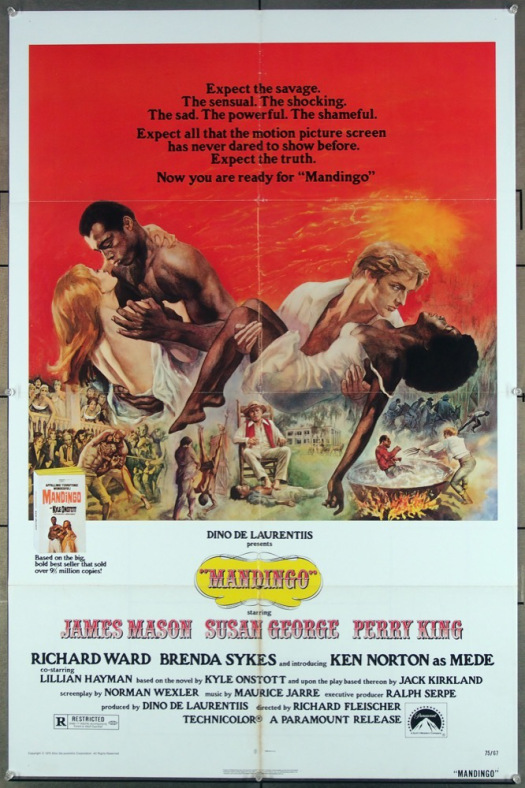
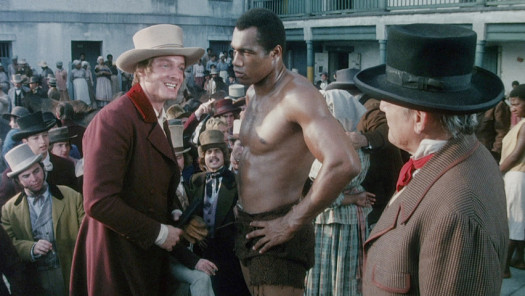
If you’ve never seen MANDINGO, be prepared for loads of gratuitous sex, violence, debauchery, depravity, racism, incest, nudity, and other such unsavory stuff! Some people today discuss the film in a scholarly manner, dissecting the sociological implications of pre-Civil War decadence in the deep South, the plight of the abused slaves, the overindulgent cruelty of the slave owners, and blah blah blah. I’m gonna talk about what the movie really is: pure, unadulterated Exploitation trash, in which some scenes will have your jaw dropping in shock, while others will leave you laughing at the exaggerated overacting and ludicrous dialog!
The movie centers around the Maxwell family and their plantation home, Falconhurst. It’s no Tara; Falconhurst is a run-down, gloomy, decrepit mansion that looks like it belongs in one of those “hillbilly horror” schlockfests of the 60’s or 70’s. Family patriarch Warren Maxwell wants a grandson to carry on the family…


 Through the Shattered Lens