Sundance Film Review: sex, lies, and videotape (dir by Steven Soderbergh)


The Sundance Film Festival is currently taking place in Utah so, for this week, I’m reviewing films that either premiered, won awards at, or otherwise made a splash at Sundance!  Today, I take a look at 1989’s sex, lies, and videotape, which won both the Audience Award at the 1989 Sundance Film Festival and the Palme d’Or at Cannes!
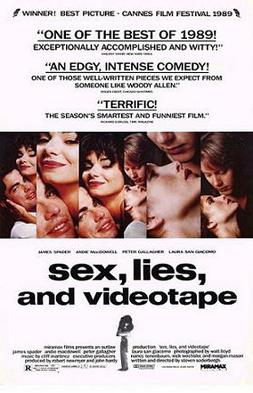
The directorial debut of Steven Soderbergh, sex, lies, and videotape is considered by many to be one of the most important independent American films ever made.  Not only was it a  success at the box office and nominated for an Oscar but it also won the Palme d’Or at Cannes.  According to Peter Biskind’s Down and Dirty Pictures, the success of sex, lies, and videotape is what convinced Hollywood that independent films could be big business.  The marketing of the film would set the template for almost every independent release that followed.

(One person who was definitely not a fan of sex, lies, and videotape was director Spike Lee.  When Lee’s Do The Right Thing lost the Palme to Soderbergh’s film, Lee was informed that the Canne jury felt Lee’s film wasn’t “socially responsible.”  “What’s so socially responsible about a pervert filming women!?” Lee reportedly responded.)

sex, lies, and videotape tells the story of four people in Baton Rouge, Louisiana.

Ann (Andie MacDowell) has a nice house, a successful husband, and an absolutely miserable marriage.  When the film opens, she’s having a session with her therapist (Ron Vawter) and talking about how unfulfilled she feels.  When the therapist asks her questions about her sex life, Ann laughs nervously.  She says that she likes sex but she doesn’t like to think about it.  She says she doesn’t see what the big deal is.  Later, she reveals that she’s never had an orgasm.

John (Peter Gallagher) is Ann’s husband.  He’s a lawyer.  He’s also a materialistic jerk and … well, that’s pretty much the sum total of John’s entire personality.

Cynthia (Laura San Giacomo) is John’s mistress.  She’s a bartender at a rather sleazy little establishment, where she apparently spends all of her time listening to a local drunk (Steven Brill) do a Marlon Brando impersonation.  She is uninhibited and fiercely sexual.  She’s the opposite of Ann, which is why John likes her.  Of course, she’s also Ann’s sister.  Cynthia and Ann have a strained relationship.  Ann describes Cynthia as being “loud.”  Cynthia views Anne as being judgmental.  Secretly, both wish that they could be more like the other.

And then there’s Graham (James Spader).  Graham was John’s friend in college, though it’s difficult to understand why.  Graham has recently returned to Baton Rouge and John, without talking to Ann, has invited Graham to visit them.  Graham is apparently a drifter.  (Ann describes him as being “arty.”)  While Ann is helping him find an apartment, Graham informs her that he’s impotent.  He can’t get an erection if anyone else in the room.

Ann subsequently discovers that Graham deals with his impotence by videotaping women discussing their sex lives.  The video camera allows Graham to keep his distance and not get emotionally involved.  (Of course, it also serves as a metaphor for directing a movie.)  Ann is freaked out by all of Graham’s tapes.  Cynthia is intrigued.  And John … well, John’s just a jerk.

sex, lies, and videotape is a film that’s largely saved by its cast.  Graham is a role that literally only James Spader could make intriguing.  Meanwhile, Peter Gallagher actually manages to bring some charm to John, who is the least developed character and who gets all of the script’s worst lines.  That said, the film really belongs to MacDowell and San Giacomo, who are totally believable as sisters and who, again, bring some needed depth to characters that, as written, could have been reduced to being mere clichés.  (In the scenes between MacDowell and San Giacomo, it was less about what they said than how they said it.)

As I already stated, this was Steven Soderbergh’s feature debut.  Soderbergh was 26 years old when he made this.  Seen today, it’s an uneven but ultimately intriguing film.  There are a few scenes where Soderbergh’s inexperience as a filmmaker comes through.  For instance, John is written as being such a complete heel (and, in his final scene, he wears a ludicrous bow tie that practically screams, “EVIL,”) that it occasionally throws the film off-balance.  You never believe that Graham would have been his friend, nor do you believe that Ann would have spent years putting up with his crap.  The film’s final scene between Cynthia and Ann also feels a bit rushed and perfunctory.  That said, this film shows that, from the start, Soderbergh was good with actors.  Visually, Soderbergh takes a low-key approach and allows the cast to be the center of attention.  It’s an actor’s film and Soderbergh wisely gets out of their way.  In particular, Spader and San Giacomo have a way of making the most heavy-handed dialogue sound totally and completely natural.

It’s hard to imagine Soderbergh directing something like sex, lies, and videotape today.  If the film were made today, Soderbergh wouldn’t be able to resist the temptation to use overexposed film stock and to give cameos to George Clooney as Ann’s therapist and Matt Damon as the drunk.  sex, lies, and videotape is a film that Soderbergh could only have made when he was young and still struggling to make his voice heard.  It’s a flawed by intriguing film.  If just for its historical significance, it’s a film that every lover of independent cinema should see at least once.

Previous Sundance Film Reviews:

  1. Blood Simple
  2. I Don’t Feel At Home In This World Anymore
  3. Circle of Power
  4. Old Enough
  5. Blue Caprice
  6. The Big Sick
  7. Alpha Dog
  8. Stranger Than Paradise

Familiar Faces #7: Jack Norton, Hollywood’s Favorite Souse


gary loggins's avatarcracked rear viewer

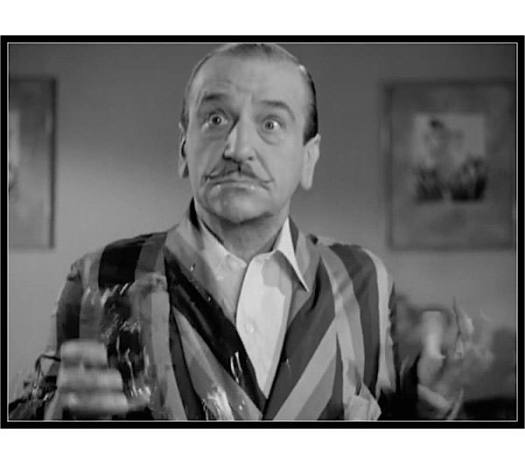
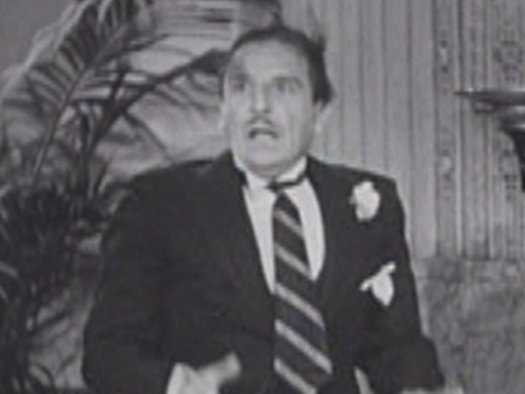
For fifteen years, whenever Hollywood producers needed a drunk, they called Jack Norton. The perpetually inebriated man with the funny moustache made a career out of playing drunken barflies, mostly in uncredited bit parts. Everyone knew they were in for a good laugh when Jack, the ultimate Familiar Face, staggered onscreen. In real life, Jack Norton was a teatottler who never touched the stuff, and learned to “play drunk” by following tipsy people around and copying their mannerisms. Now that’s dedication to your craft!

Jack in 1934’s “A Duke for a Day”

Jack Norton was born in Brooklyn in 1882, and began his show biz career in vaudeville. He soon moved to Broadway, starring in Earl Carroll’s Vanities. Coming to Hollywood in 1934, Jack played his first lush in FINISHING SCHOOL, an early effort for Frances Dee and Ginger Rogers. After that, his specialty would be in constant demand, though…

View original post 397 more words

Music Video of the Day: Shotgun Mouthwash by High Contract (2017, dir by ????)


This song can be found on the T2: Trainspotting soundtrack and the video features some clips from that film.  You might not notice because there’s a chance you’ll distracted by the audience trying to kill the lead singer.

Enjoy!

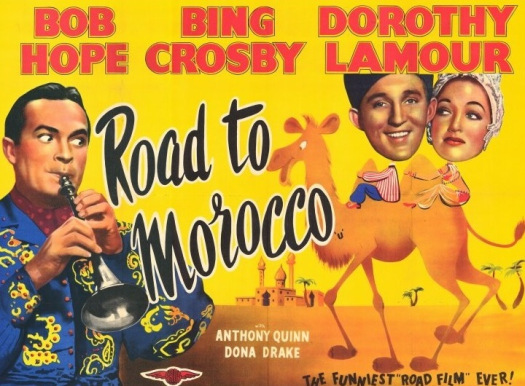
Mad Libs: Hope & Crosby on the ROAD TO MOROCCO (Paramount 1942)


gary loggins's avatarcracked rear viewer

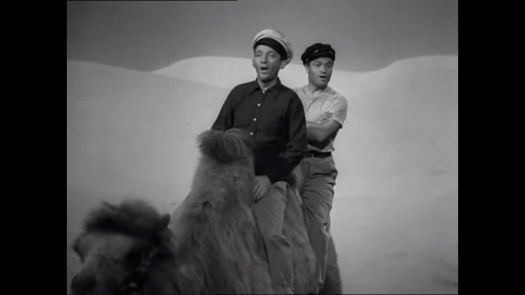
Bing Crosby and Bob Hope travel the ROAD TO MOROCCO, the third in the “Road” series and by far the funniest. The plot involves two shipwrecked Americans who wind up in an absurd Arabian Nights style adventure complete with beautiful princess Dorothy Lamour and murderous desert sheik Anthony Quinn , but you can throw all that out the window as Bing and Bob trade quips, sing, and break down the Fourth Wall to let the audience know it’s all in good fun, so sit back and enjoy the zany ride.

Bob and Bing were already established superstars when Paramount teamed them for ROAD TO SINGAPORE (1940), which was a huge box office hit and followed quickly by ROAD TO ZANZIBAR (1941). By the time they made MOROCCO, the pair had their act down pat, with Der Bingle the smooth-talking crooner who always gets the girl, and Ol’ Ski-Nose the cowardly…

View original post 429 more words

Sundance Film Review: Stranger Than Paradise (dir by Jim Jarmusch)


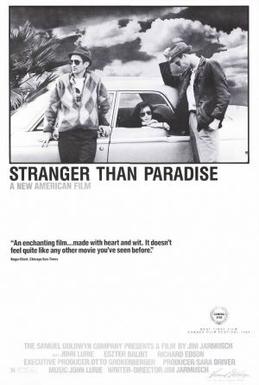
The Sundance Film Festival is currently taking place in Utah so, for this week, I’m reviewing films that either premiered, won awards at, or otherwise made a splash at Sundance!  Today, I take a look at 1984’s Stranger Than Paradise, which won the Special Jury Prize at the 1985 Sundance Film Festival.

‘You know it’s funny. You come to someplace new, and everything looks just the same.’

— Eddie in Stranger Than Paradise (1984)

Stranger Than Paradise tells the story of three friends.

Willie (John Lurie) lives in a small apartment in New York City’s Lower East Side.  He likes to go to the movies.  He likes to watch TV.  He likes to gamble, putting bets on horses and cheating at poker.  He was apparently born in Hungary, though he doesn’t speak with an accent and, whenever he has to deal with a relative, he always tells them, “Speak English.”  When his best friend asks him about why he never mentioned that he was Hungarian, Willie replies that he’s just as American as anyone.

Eva (Eszter Balint) is Willie’s cousin.  She’s travels to America from Budapest.  The plan is for her to live with her Aunt Lotte (Cecillia Stark) in Cleveland but, because Lotte is in the hospital, she begins her life in America by spending ten days in Willie’s cramped apartment.  Eva enjoys the music of Screamin’ Jay Hawkins.  When she’s walking to Willie’s apartment, I Put A Spell On You blares from the large tape player that she always carries with her.

And then there’s Eddie (Richard Edson).  Eddie may not be too smart but he’s always smiling and easy-going.  Unlike the somewhat churlish Willie, Eddie always seems to be enjoying himself.  When Eddie first meets Eva, most viewers will probably expect them to eventually become a couple.  That doesn’t happen, of course.  That’s not the type of film that this is.

The first thing you notice about Stranger Than Paradise is the look of the film.  As one might expect from a film that reportedly had a budget of $10,000, the film looks cheap but there’s a beauty in that cheapness.  The harsh black-and-white magnifies every detail of the film’s locations.  When we watch Eva walking through New York City, the street may look desolate but it’s an exquisite desolation.

Directing his second film, Jim Jarmusch shoots nearly the entire film in single long takes and refuses to indulge in any of the usual tricks that movies often use to force an audience to identify with its main characters.  The camera rarely moves and every scene ends with a blackout.  It’s a technique that casts the audience as observers.  Willie, Eva, and Eddie may all be outsiders but, while watching the film, so is the audience.  Willie, Eva, and Eddie win us over because of the charm of the actors playing them and the deadpan humor of their dialogue but, at the same time, the film never lets us forget that we’re merely watching their lives unfold.

The humor in Stranger Than Paradise comes less from what these characters do and more from what they don’t do.  When Eva arrives in New York, Willie never offers to show her around.  There’s no trip to Broadway or the Statue of Liberty or anything else that we, as an audience, have been conditioned to expect whenever a stranger comes to New York for the first time.  Instead, Willie and Eva sit in Willie’s apartment and watch TV.  When Eddie asks Eva if she wants to join him and Willie at the movies, Willie tells Eva to stay in the apartment and not go outside.  Eva eventually wins Willie over by shoplifting dinner.

During the film’s second act, Willie and Eddie decided to visit Eva in Cleveland, despite not being sure where Cleveland is.  They ask one random guy standing on a street corner how to get there.  “I’m waiting for a bus,” the guy snarls back.  Later, as they drive drown a highway, Eddie asks Willie if they’re in Ohio yet.  “I think we’re in Pennsylvania,” Willie replies.  When they finally do get to Ohio, it turns out to be a frozen wasteland.  After meeting up with Eva, Willie and Eddie spend most of their vacation watching TV with Lotte.  Eventually, they visit Lake Erie.  It’s frozen but Eva, Willie, and Eddie still dutifully stand at the railing and stare down at it while a freezing wind howls around them.

Eventually, all three of them end up in Florida.  Instead of visiting Walt Disney World or Miami, they end up sitting in a cheap motel room.  Eva goes to the beach, which — when shot in black-and-white — looks just as desolate as Ohio in winter.  Eventually, all three of them stumble into money but that’s just a set up for the film’s final joke…

It’s a deliberately slow-moving film but it’s never less than watchable.  Lurie, Edson, and Balint all give such wonderfully deadpan performances that they’re a joy to watch even when they aren’t actually doing anything.  Stranger Than Paradise was Jim Jarmusch’s second film and also one of the first independent American films to receive widespread attention and acclaim.  (The National Society of Film Critics named it the best film of the year.)  34 years after it was first released, the film is an idiosyncratic joy to behold and definitely one that needs to watched by anyone who loves cinema.

Previous Sundance Film Reviews:
  1. Blood Simple
  2. I Don’t Feel At Home In This World Anymore
  3. Circle of Power
  4. Old Enough
  5. Blue Caprice
  6. The Big Sick
  7. Alpha Dog

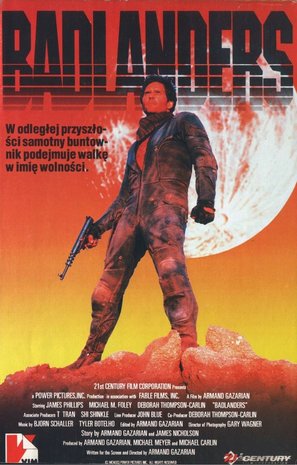
The TSL’s Grindhouse: Prison Planet (dir by Armand Gazarian)


(aka Prison Planet)

A few nights ago, I saw the no-budget 1992 sci-fi epic, Prison Planet, on television.

My immediate response after watching Prison Planet was to assume that I had just been dreaming because it was difficult for me to accept that anyone had actually made a movie this inept.  However, I then checked with the imdb and I discovered that Prison Planet not only exists but there were actually two sequels.  I was also surprised to discover that Prison Planet was an American production and not a poorly dubbed Bruno Mattei film.  Unfortunately, my attempts to google more information on the production of Prison Planet were hindered by the fact that every result I got was about Alex Jones.

Anyway, Prison Planet takes place in the far future.  2200, to be exact.  Earth is ruled by an evil dictator but that dictator’s power is being threatened by a rebel leader named Himshaw (Jack Wilcox).  When Himshaw is captured, he is promptly exiled to the planet where Earth sends all of its prisoners.  (Hence, the title.)  With Himsaw gone and perhaps dead, it now falls on Himshaw’s brother, Blaine (James Phillips) to leads the rebels.  However, instead of doing that, Blaine decides to go to the prison planet so he can discover whether or not his brother is still alive.  Blaine breaks into a government building and allows himself to be captured.

So now, Blaine has been exiled to the prison planet.  (The name of the prison planet, by the way, is Annakin.)  Blaine’s plan is to find Himshaw so that he can overthrow the dictator but, since there’s really no obvious way to get back to Earth after being dropped off on a prison planet, you have to kind of wonder whether Blaine really thought this through.  I’m assuming that he probably thought, “I’ll worry about that when I have to,” but it’s not like Earth is just the next town over or something.  It’s an entirely different planet.  You can’t just walk there.

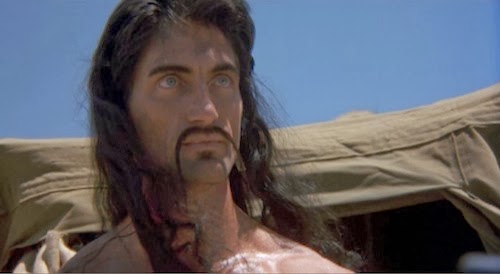
On the prison planet, the prisoners are pretty much allowed to do whatever they want.  It’s a world ruled by an evil warlord, though there are small bands of nomads and rebels in the desert.  This is what the big scary warlord looks like:

Blaine decides that he’s going to 1) overthrow the warlord and 2) rescue the virgin that the warlord is planning on sacrificing.  (Or at least, I think that’s what the warlord was plotting to do with her.  It was kind of hard to keep up with what was going on, largely because Prison Planet seemed to be making stuff up as it went along.)

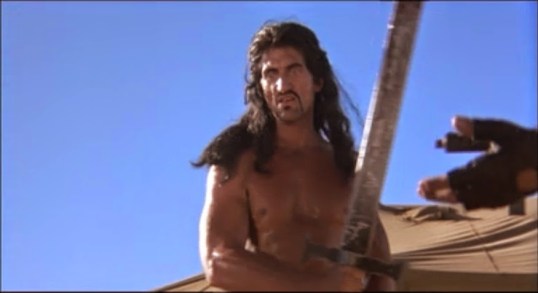
What’s odd is that, even though the film is taking place in 2200, everyone on the prison planet is driving around in cars from the 20th Century.  It’s kinda like Mad Max: Fury Road, except that it’s not very good.  But then again, who needs to worry about narrative logic when you’ve got stuff like this to deal with:

That’s the warlord, again.  You can tell why they made this dude the ruler of the planet.  He’s got a really big sword and a really thin mustache.  Plus, he doesn’t own a shirt.  He’s got the whole Conan thing going on.

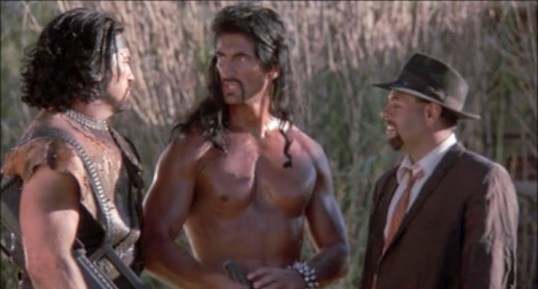
And then there’s this other guy who keeps popping up, who wears a suit, a tie, and a hat.  He spends the whole movie scurrying between the warlord and Blaine and I have to admit that I’m still not sure what exactly his role was in the movie.  He spoke in a falsetto voice and everyone was constantly threatening to kill him.

Also, one of the warlord’s henchmen wears what appears to be wearing a Spanish conquistador’s helmet.  No one ever mentions that this is odd…

Anyway, I watched the whole film and I’m not really sure what I saw.  Blaine had to overthrow the warlord and find his possibly dead brother.  It was never really clear how these two things were connected.  It was a bad movie but strange enough to occasionally be watchable.

As for the two sequels, the imdb lists them both as being comedies.  I haven’t watched either one of them but that sounds about right.  The first Prison Planet is definitely not meant to be comedy but I still had a few good laughs while watching it.

Sundance Film Review: Alpha Dog (dir by Nick Cassavetes)


The Sundance Film Festival is currently taking place in Utah so, for this week, I’m reviewing films that either premiered, won awards at, or otherwise made a splash at Sundance!  Today, I take a look at 2006’s Alpha Dog, which premiered, out of competition, at Sundance.

Sometimes, I suspect that I may be the only person who actually likes this movie.

Alpha Dog is a film about a group of stupid people who end up doing a terrible thing.  Johnny Truelove (Emile Hirsch) is a 20 year-old living in Los Angeles.  His father, Sonny (Bruce Willis) and his godfather, Cosmo (Harry Dean Stanton), are both mob-connected and keep Johnny supplied with the drugs that Johnny then sells to his friends.  It’s a pretty good deal for Johnny.  He’s got a nice house and a group of friends who are willing to literally do anything for him.  Johnny, after all, is the one who has the money.

When Johnny’s former best friend, Jake Mazursky (Ben Foster), fails to pay a drug debt, things quickly escalate.  When Johnny refuses to accept even a partial payment, Jake responds by breaking into Johnny’s house and vandalizing the place.  (Just what exactly Jake does, I’m not going to go into because it’s nasty.  Seriously, burn that house down…)  Johnny decides that the best way to force Jake to pay up is to kidnap Jake’s younger brother, Zack (Anton Yelchin, who is heartbreakingly good in this film).

It quickly turns out that Zack doesn’t mind being kidnapped.  Everyone tells Zack not to worry about anything and that he’ll be set free as soon as Jake pays his debt.  Zack decides to just enjoy his weekend.  Since Johnny is better at ordering people to commit crimes than committing them himself, he tells his friend, Frankie (Justin Timberlake), to keep an eye on Zack.

And so it goes from there.  While Johnny leaves town, Frankie introduces Zack to all of his friends.  Everyone laughs about how Zack is “stolen boy.”  Zack’s going to parties and having a good time.  However, Johnny returns and reveals that he’s been doing some thinking, as well as talking to his lawyer.  Regardless of whether Zack’s enjoying himself, both Johnny and Frankie could go to prison for kidnapping him.  Frankie argues that Zack won’t tell anyone about what happened.  Maybe they could just pay him off.  Johnny thinks it might be easier to just have him killed.  Frankie’s not a murderer but what about Elvis Schmidt (Shawn Hatosy)?  Elvis is a loser who desperately wants to be a part of Johnny’s crew and he owes Johnny almost as much money as Jake does.  How far would Elvis be willing to go?

(While this plays out, the film keeps a running tally of everyone who witnesses Zack not only being kidnapped but also held hostage.  In the end, there were at least 32 witnesses but none of them said a word.)

Alpha Dog is based on the true story of Jesse James Hollywood and the murder of 15 year-old Nicholas Markowitz.  Hollywood spent five years as a fugitive from justice, hiding out in Brazil and reportedly being protected by his wealthy family.  He was arrested shortly before the Sundance premiere of Alpha Dog.  Since it was filmed before Hollywood’s arrest and subsequent conviction, Alpha Dog changed his name to Johnny Truelove.  Johnny Truelove is a good name but it’s nowhere near as memorable as Jesse James Hollywood.

Alpha Dog sticks close to the facts of the case, providing a disturbing portrait of a group of aimless wannabe gangsters who, insulated by money and privilege, ended up getting in over their heads and committing a terrible crime.  Emile Hirsch gives one of his best performances as the sociopathic Johnny Truelove while Ben Foster is both frightening and, at times, sympathetic as Jake.  Justin Timberlake is compelling as he wrestles with his conscience while Shawn Hatosy is properly loathsome as the type of idiot that everyone knows but wish they didn’t.  The dearly missed Anton Yelchin is heartbreaking and poignant as Zack.  And finally, there’s Harry Dean Stanton.  Stanton doesn’t say a lot in this movie.  Often times, he’s just hovering in the background.  The moment when he reveals his true self is one of the best in the movie.

As I said, I sometimes feel as if I’m the only person who likes this movie.  It got mixed reviews when it was released and, in the years since, it rarely seems to ever get mentioned in a positive context.  Personally, I think it’s a well-done portrait of privilege, stupidity, and the lengths to which people will go to avoid taking a stand.  In the end, no one escapes punishment but it’s the rich guy who, at the very least, gets to spend at least a few years enjoying his freedom in Brazil.

Previous Sundance Film Reviews:

  1. Blood Simple
  2. I Don’t Feel At Home In This World Anymore
  3. Circle of Power
  4. Old Enough
  5. Blue Caprice
  6. The Big Sick