Lisa Cleans Out Her DVR: Madame Curie (dir by Mervyn LeRoy)


(Lisa is currently in the process of cleaning out her DVR!  How long is it going to take her?  Probably about as long as it took scientists to discover radiation.  Still, she’s not giving up!  She recorded the 1943 best picture nominee, Madame Curie, off of TCM on February 16th.)
It would appear that if you wanted to produce a best picture nominee in the early 40s, the easiest way to do it was to cast Walter Pidgeon and Greer Garson as husband and wife.

Consider the evidence: In 1941, Blossoms in The Dust was nominated for best picture.  Greer Garson and Walter Pidgeon played wife and husband.

In 1942, Mrs. Miniver won best picture.  Greer Garson and Walter Pidgeon played husband and wife.  Interestingly enough, Garson actually starred in another best picture nominee that year, Random Harvest.  Random Harvest is a far better picture than Mrs. Miniver and actually featured a better performance from Garson but it did not include Walter Pidgeon.  Make of that what you will.

Then, in 1943, Greer Garson and Walter Pidgeon starred in Madame Curie.  Again, they played husband and wife and, again, their film was nominated for best picture.

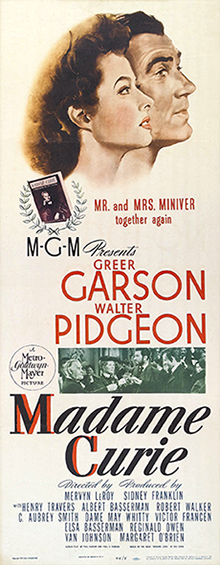
As you can tell from the poster above, Madame Curie was advertised as being “Mr. and Mrs. Miniver together again.”  Actually, Garson and Pidgeon are playing characters far different from the stalwart and very British heroes of their previous film.  Instead, they are playing the Curies, Marie and Pierre.  The film opens with Pierre meeting Marie at a party and it juggles scenes of their romance with scenes of them discovering and playing with radiation.  Of course, it’s a struggle at times.  Their colleagues are dismissive of their efforts.  Both Pierre and Marie tend to get so caught up in their research that they close themselves off from the outside world.  Their efforts pay off when they isolate radium and win the 1903 Nobel Prize.  Of course, then Pierre gets run over by a horse while out buying his wife a pair of earrings.  Can Marie continue to do their research without him?

The unfortunate thing is that the movie pretty much ends with Marie winning her first Nobel Prize, which means that it leaves out some of the most interesting aspects of her life.  For instance, during World War I, she developed mobile X-ray units and worked in field hospitals.  She was also active in the struggle for Polish independence, even naming the first element that she ever discover polonium after her native country.  She spent almost her entire career working with radioactive material, often carrying radioactive isotopes in her pockets.  In 1934, Marie died of radiation poisoning.  Her research notes and other papers are so highly radioactive that they’re kept in a lead box and I assume that they probably glow whenever the lid is shut.  If you want to study Marie Curie’s notes, you have to put on a radiation suit.  Unfortunately, none of this is discussed in the resolutely positive movie.

Judging from what I’ve seen on TCM, Greer Garson appears to have been the Meryl Streep of her day, undeniably talented but a bit too obvious in her technique and just a little boring.  The same can be said of Madame Curie, which is a very well-made but not extremely memorable movie.  It’s like a lot of the films that were nominated for best picture in the 30s and the 40s — a big, prestige picture that never exactly comes to life.  The film is probably at its strongest in the beginning, when Walter Pidgeon does a pretty good job of playing Pierre as a brilliant introvert who is almost too shy to talk to Marie.  But, as the film progresses, it just becomes another slow-moving MGM biopic.

What movie beat Madame Curie for Best Picture?

None other than Casablanca.

Lisa Cleans Out Her DVR: Wimbledon (dir by Richard Loncraine)


(Lisa is currently in the process of cleaning out her DVR!  It is probably going to take her forever.  She recorded the 2004 romantic comedy, Wimbledon, off of Cinemax on February 15th.)

I wish I could play tennis.

Actually, I guess it would be more correct for me to say that I wish I could play tennis well.  I mean, I can hold the racket and I can run around the court and I can hit the ball and sometimes, it goes over the net.  I can do all the yelling and the grunting and the jumping.  I’m pretty good at slamming my racket down on the court whenever I miss a shot.  I can play the game but I just can’t win.  I’m way too easily distracted and that’s a shame because I’ve been told that I look cute in a tennis skirt.

It’s not for lack of trying either!  There’s a tennis court a few blocks away from my house and I’ve challenged both my sister and my BFF to several matches.  And, every time, they have totally kicked my ass.  In fact, now that I think about it, the only time I’ve ever won a set was because my opponent was feeling sorry for me and they had such confidence in their own abilities that they didn’t mind throwing a game or two.

(For the record, I’ve been told that, if not for my boobs getting in the way, I would have a pretty good golf swing.  But I don’t play golf so there you go…)

Anyway, I may not be able to play tennis but that doesn’t mean that I can’t enjoy a movie about people I can.  I really like Wimbledon.  I mean — yes, it’s a totally predictable sports movie.  You know, as soon as you see the opening credits, that Kirsten Dunst and Paul Bettany are going to fall in love.  They’re the prettiest people in the movie so, of course they’re meant to be together!  And, as soon as you see Sam Neill’s name, you know that he’s going to be playing the well-intentioned but clueless authority figure who tries to keep them apart.  When James McAvoy’s name appears, you yell, “He’ll be Paul Bettany’s best mate!”  (Actually, he plays Paul’s eccentric younger brother.)  And as soon as Jon Favreau’s name appears, you’re like, “Comic relief!”

Of course, since the movie is called Wimbledon, you know that the movie is going to be about tennis and you know that Paul Bettany and Kirsten Dunst are going to be competing at Wimbledon while falling in love.  You know that one of them will make it to the finals while the other sits in the stands and provides emotional support.  It’s just a question of which one.

As I said, it’s all totally predictable and yet, that’s actually a part of the film’s appeal.  With the plot being so obvious, you’re freed up to just appreciate the film as a vehicle of movie star charisma.  Paul Bettany and Kirsten Dunst are two of my favorite actors and I think they’re both criminally underrated.  In Wimbledon, Bettany is playing the older, veteran tennis player, the one who is playing at his final Wimbledon before retiring.  When he falls in love with Kirsten, it gives him a renewed sense of focus and, for the first time, he finds that he actually has a chance to win it all.  Kirsten, meanwhile, is the up-and-coming star.  Her father (Sam Neill) worries that Kirsten’s relationship with Paul will distract her and keep her from playing her best and it turns out that he’s absolutely right.

Even if you haven’t seen the film, you know everything that is going to happen but that’s okay.  Kirsten Dunst and Paul Bettany have got a really likable chemistry.  You want things to work out for them.  You want both of them to win championships and eventually get married and have a pretty family.  Bettany, in particular, proves that he can make even the most clichéd of lines sound fresh and spontaneous.  Add to that, both Paul and Kirsten look adorable in tennis white and that’s really all that most people ask for when it comes to a film like this.

Wimbledon is an enjoyable and predictable movie, one that won’t leave you feeling depressed or questioning the meaning of existence.  It may not be perfect but it’s certainly likable and sometimes, that’s all you need.

Lisa Cleans Out Her DVR: Scorpio (dir by Michael Winner)


(Lisa is currently in the process of cleaning out her DVR!  Having recorded over 150 movies since last January, she understands that this might be an impossible task but she’s going to try anyway!  She recorded the 1973 spy thriller, Scorpio, off of Retroplex way back on January 24th!)

On the surface, Jean Laurier (Alain Delon) would appear to be the perfect man.

He’s handsome.  He looks really good in a suit.  He’s wealthy.  He’s French.  And — get this — he loves cats!  He’s the type of guy who, when he discovers a stray cat in his hotel room, immediately starts to pet it and then gives it a saucer of warm milk.  He and his girlfriend (Gayle Hunnicutt) spend their spare time looking at cats and talking about how cute they are.  At one point, even though he’s just killed a man, Jean pauses when he sees a stray cat watching…

Oh, did I mention that Jean kills people for a living?  Well, he does but I’m sure they’re all bad guys.  Seriously, he’s just so charming (and he really, really loves cats) that you really can’t hold it against him that he’s an independent contract killer.  Add to that, his code name is Scorpio.

I have to admit that the film’s title — Scorpio — is the main reason that I chose to record this movie.  I’m a scorpio myself.  In fact, I’m such a scorpio that if I believed in astrology, I would point to my existence as proof that the stars actually do determine our fate.  Seriously, you don’t want to mess with us scorpios.  We’re scorpions.  We sting.

But anyway, back to the movie.

When Scorpio is busted on a trumped-up narcotics charge (or maybe it was a legitimate narcotics charge, it was kind of hard to keep track), the CIA gives him a choice.  He can either go to prison or he can do a job for them.  Apparently, the CIA believes that Scorpio’s friend and mentor, Cross (Burt Lancaster), is a double agent who has been selling information to the Russians.  They want Cross eliminated.

Scorpio takes the job but it’s not going to be easy.  Cross is a veteran spy.  He has connections all across the world and he’s a ruthless killer, the type who forces a man to swallow a cyanide pill and then says, “You’ve got 30 seconds to live.”  In fact, the only person that Cross seems to care about is his wife (Joanne Linville) but he still doesn’t hesitate to abandon her when he realizes that their house is being watched

Cross taught Scorpio everything that he knows but there’s one lesson that Scorpio is still learning and that is to trust no one.  Is Cross actually a spy or is he being set up?  And, if Cross is being set up, what’s to prevent the same thing from happening to Scorpio?

Scorpio is probably one of the most cynical films that I’ve ever seen.  If Scorpio was a political protest, it would be full of people carrying cardboard signs reading, “Nothing Matters” and “All Is Darkness.”  Remember that annoying as Hell scene in SPECTRE where James Bond got drunk and demanded to know who a rodent was working for?  Well, imagine the disillusionment of that scene stretched out for two hours.

Fortunately, no one in Scorpio is as whiny as Daniel Craig was in SPECTRE.  In many ways, Scorpio is a triumph of old-fashioned movie star charisma.  Burt Lancaster is perfectly cast as the world-weary Cross while Alain Delon makes for a compelling Scorpio.  Both of them are believable killers and the film becomes as much about the competition between Lancaster’s old school Hollywood style of acting and Delon’s more refined (and very French) style of cool as it is about the competition between Scorpio and Cross.

Scorpio‘s a good little spy thriller, more than worth keeping an eye out for.


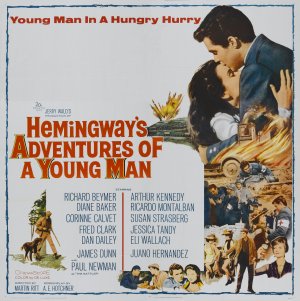
Lisa Cleans Out Her DVR: Hemingway’s Adventures Of A Young Man (dir by Martin Ritt)


(Lisa is currently in the process of cleaning out her DVR!  It’s going to take a while.  She recorded this 1962 literary adaptation off of FXM on January 30th!)

Hemingway’s Adventures Of A Young Man is one of those films that you just know was made specifically to win Oscars.  It’s a big prestige production, complete with a historical setting, an epic scope and big, all-star cast.  That most of those stars appear in relatively small roles was undoubtedly meant to evidence of the film’s importance.

“Look!” the film seems to shout at times, “This is such an important film that even Paul Newman was willing to stop by for a day’s work!”

The film is based on ten short stories by Ernest Hemingway and, loosely, A Farewell to Arms.  The stories all dealt with the early life of Nick Adams, who was a literary stand-in for Hemingway.  Since the Nick Adams stories were autobiographical (and, for that matter, so was A Farewell to Arms), the film can also be viewed as biopic.  Richard Beymer (who, a year earlier, had starred in West Side Story and who is currently playing Ben Horne on Twin Peaks) may be playing Nick Adams but the film leaves little doubt that he was actually meant to be playing Ernest Hemingway.

The film opens with Nick hunting with his father, Dr. Harold Adams (Arthur Kennedy).  He is present when his father travels to an Indian camp and helps to deliver a baby.  He respects his father but Nick wants to see the world and the film follows him as he explores America, working odd jobs and meeting colorful characters along the way.  Paul Newman shows up as a punch-drunk boxer and proceeds to overact to such an extent that he reminded me of Eric Roberts appearing in a Lifetime film.  Nick meets rich men, poor men, and everything in between.  He works as a journalist.  He works as a porter.  Eventually, when World War I breaks out, Nick enlists in the Italian army and the film turns into the 100th adaptation of A Farewell to Arms.

And really, I think it would have been an enjoyable film if it had been directed by someone like Otto Preminger, George Stevens, or maybe even Elia Kazan.  These are directors who would have embraced both the pulpy potential of the Nick Adams stories and the soapy melodrama of the war scenes.  A showman like Preminger would have had no fear of going totally and completely over the top and that’s the approach that this material needed.  Instead, Hemingway’s Adventures Of A Young Man was directed, in a painfully earnest style, by Martin Ritt.  Ritt tries to imitate Hemingway’s famously understated style with his understated direction but, cinematically, it’s just not very interesting.  Ritt portrays everything very seriously and very literally and, in the end, his direction is more than a little dull.

Sadly, the same can be said for Richard Beymer’s performance in the lead role.  Beymer comes across as being the nice guy who everyone says you should marry because he’ll be able to get a good and stable job and he’ll probably never go to jail.  Two months ago, when I watched and reviewed Twin Peaks, I really loved Beymer’s performance as Ben Horne.  He just seemed to be having so much fun being bad.  Unfortunately, in Hemingway’s Adventures Of A Young Man, he never seemed to be having any fun at all.  No wonder he temporarily put his film career on hold so that he could fully devote himself to working as a civil rights activist.

In the end, this is a movie that’s a lot more fun to look at than to actually watch.  Visually, the film is frequently quite pretty in an early 1960s prestige movie so sort of way.  And there are some good performances.  Eli Wallach, Ricardo Montalban, Susan Strasberg, Arthur Kennedy — there’s a whole host of performers doing memorable supporting work.  Unfortunately, even with all that in mind, this well-intentioned film largely falls flat.

Dance Scenes That I Love: The Locomotion from Inland Empire


Hello and welcome to martes trece!  

Now, I know that a lot of people will tell you that Friday the 13th is the most unlucky day of the year but actually, in Spain, it is well know that Tuesday the 13th is the day that you have to watch out for.  My grandmother would literally not leave the house on Tuesday the 13th.  Myself, I may leave the house today but I’ll drive very slowly and I’ll watch my step.

Now, personally, I think the best way to deal with an unlucky day is through dance!  So, allow me to bless you with a dance scene that I love.

This is from David Lynch’s 2006 film, Inland Empire.  Inland Empire, which clocks in at 3 hours, is perhaps Lynch’s most unsettling film.  However, it does feature a little dancing, as seen below:

Good luck!

Music Video of the Day: Twilight Zone by Golden Earring (1982, dir. Dick Maas)


I have to admit that until recently, I didn’t know any song by Golden Earring other than Radar Love. I didn’t even realize I had heard this song till I clicked on the video. They are good. They also put a lot of effort into their videos from the get-go with MTV.

This must have been something to see back in 1982 when this was far from the norm. Oh, and if you thought they might tone this down for later videos, then you’d be wrong. They only upped the ante. Turn The World Around has people in a concentration camp, people who have been hung, people being tortured, a black man being perpetually being beaten by cops, Jesus being crowned while Hitler is in the foreground snapping his fingers to the song, and much like this video, it has two different dimensions–the one in which the dark stuff is going on, and a bright, colorful, and otherworldly one. These videos remind me of Italian Comedy like Seven Beauties (1975). The dancers look like they belong in The Damned (1969) or The Night Porter (1974).

Here’s one tiny tangent since I mentioned Seven Beauties. I really hope Nathaniel R of The Film Experience is just ignorant of Italian Comedy and Lina Wertmüller because otherwise, getting a chance to see Seven Beauties is a “rare opportunity,” as he wrote in a recent blog post. If true, it’s a sad world when that film is a rare thing to see. That’s supposed to be reserved for things like Out 1: Spectre (1972), The Art Of Vision (1965), Douce (1943), and Rocker (1972), to name more mainstream films.

If you didn’t already know who Golden Earring is, then you might have guessed that they are from the Netherlands based on the name of the director. You’d be right. That means they did work with Anton Corbijn on a music video. It was for the song Quiet Eyes. Corbijn being the one who took credit for the singing ravens on the crucifix in the video for Heart-Shaped Box by Nirvana. He chalked it up to “Dutch humor.” I took a class in college on the history of the Netherlands. I don’t remember a section on Dutch humor.

Then again, I probably should have known, seeing as Turkish Delight (1973) has Rutger Hauer wear a pubic hair mustache and The Dark Room Of Damocles (1963) has the lowly shop merchant dragged off as a traitor to his people after WWII even though he may or may not have been led into doing missions he thought would help his people by a secret agent–who is seen at the end living the high-life. Also, Water Power (1976) didn’t have to be edited for its release in the Netherlands, whereas it was in the United States. I guess it shouldn’t come as an surprise to me that these are the kind of videos a Dutch band would make.

Nevertheless, I’m impressed. And yes, the topless nudity was censored at the time. If Wikipedia is to be believed, then the injection scene was also censored. My favorite scene is when the little girl turns toward the camera and stares at you for awhile. It’s a nice little touch.

The song itself was apparently not inspired by the TV Show. It was based off of Robert Ludum’s book The Bourne Identity. That would explain the spy storyline.

Enjoy!

30 Days Of Surrealism:

  1. Street Of Dreams by Rainbow (1983, dir. Storm Thorgerson)
  2. Rock ‘n’ Roll Children by Dio (1985, dir. Daniel Kleinman)
  3. The Thin Wall by Ultravox (1981, dir. Russell Mulcahy)
  4. Take Me Away by Blue Öyster Cult (1983, dir. Richard Casey)
  5. Here She Comes by Bonnie Tyler (1984, dir. ???)
  6. Do It Again by Wall Of Voodoo (1987, dir. ???)
  7. The Look Of Love by ABC (1982, dir. Brian Grant)
  8. Eyes Without A Face by Billy Idol (1984, dir. David Mallet)
  9. Somebody New by Joywave (2015, dir. Keith Schofield)

TSUNAMBEE: Movie Preview, Review and Trailer (Director: Milko Davis)


tsunambee

“And out of the smoke locust came down upon the Earth and were given power like that of the scorpions. They were told to destroy the people that did not bear the mark of God. They had tails and stings like scorpions. Thy looked like horses prepared for battle with crowns of gold and wings that thundered like many chariots rushing into battle [SIC]. The people would suffer the agony for five months, and then in those days men will seek death, but death will elude them…….BUT DEATH WILL ELUDE THEM…” Revelations 9: 3-10

Now that I have set the stage for you, let’s get the technical stuff out of the way so we can get on to the movie itself.

Writer and Director: Milko Davis (Raiders of the Damned, Z/Rex)

Co-Director: Thomas Martwick (Mistress of Seduction)

Stars:

Ruselis Aumeen Perry (American Ninja Warrior) as Jay B

Stacey Pederson (Roses in December, Eat) as Sheriff Lindsey Feargo

Maria DeCoste as Chica/Sherica

Shale Le Page (We do monsters, The Attica) as Jessie

Production: Wild Eye Releasing (Jurassic Prey, Shark Exorcist

Preview: 

This is gonna sting a little.

After a catastrophe strikes Los Angeles, survivors face an even greater threat, thousands of giant killer bees, ushering in the end of the world!

Writer/Director Milko Davis’s ferociously fun ode to golden age creature makes its digital debut June 13!

Review:

At this point I can not guarantee there will not be spoilers: Read ahead at your on caution!

Weighing heavily on a biblical apocalyptic theme, Milko (director) leads us into a world of turmoil and catastrophe.  Starting in the Sambisa Forest of Nigeria leading all the way to post-modern Los Angeles and beyond.

For his first major movie, Milko has a way of challenging social, economic and diversity stereotypes that could well, in a way, define him as a director (and I mean that in a good way).

What did the killer bees bring to the movie? Honestly, not a lot. The CGI was bad, but not unexpected. The acting ways way over-done, but again not unexpected.

I really was surprised with Casandra’s role. Exceptional performance from Thea Saccoliti. She has the best line of the movie. [Jessie: “Did God say anything about me?”] [Casandra: “Nope, but my teddy bear will be ok!”]

If you are looking for a different kind of review:

This movie has ZomBees in it! Literally, I can’t make this up! ZomBees!

TSUNAMBEE 2

“The multidudes [SIC] who sleep in the dust of Earth will awake! Some to everlasting life, others to shame and disgrace.”

Tsunambee will BEE (Ok, forgive that one pun) available on VOD June 13th and for DVD later this summer.


If you want to watch the trailer for Tsunambee (and you do) It is right here!


A Movie A Day #155: Out of the Fog (1941, directed by Anatole Litvak)


When two aging fishermen (Thomas Mitchell and John Qualen) attempt to buy a new boat, they run into a problem with local mobster, Harold Goff (John Garfield).  As Goff explains, if they do not pay him $5.00 a week, something bad could happen to their boat.  When one of the fisherman’s daughter (Ida Lupino) falls in love with Goff, she makes the mistake of letting him know that her father is planning on giving her $190 so that she can take a trip to Cuba.  When Goff demands the money for himself, the fishermen attempt to go to the police, just to be told that there is nothing that the authorities can do.  Goff tricked them into signing an “insurance” contract that allows him to demand whatever he wants.  The two fishermen are forced to consider taking drastic measures on their own.  Out of the Fog is an effective, early film noir, distinguished mostly be John Garfield’s sinister performance as Harold Goff.

Out of the Fog is also memorable as an example of how Hollywood dealt with adapting work with political content during the production code era.  Out of the Fog was based on The Gentle People, a play by Irwin Shaw.  In the play, which was staged by The Group Theater in 1939, Harold Goff was obviously meant to be a symbol of both European fascism and American capitalism.  In the play, the two fisherman had Jewish names and were meant to symbolize those being persecuted by the Third Reich and its allies.  In the transition for stage to film, Jonah Goodman became Jonah Goodwin and he was played by the very talented but definitely not Jewish Thomas Mitchell.   The play ended with Harold triumphant and apparently unstoppable.  Under the production code, all criminals had to be punished, which meant the ending had to be changed.  Out of the Fog is an effective 1940s crime thriller but, without any political subtext, it lacks the play’s bight.

One final note: while Out of the Fog had a good cast, with up and comer John Garfield squaring against old vets Thomas Mitchell and John Qualen, the original Broadway play’s cast was also distinguished.  Along with contemporary film stars Sylvia Sidney and Franchot Tone, the play’s cast was a who’s who of actors and directors who would go on to be prominent in the 1950 and 60s: Lee J. Cobb, Sam Jaffe, Karl Malden, Martin Ritt, and Elia Kazan all had roles.


Artist Profile: Al Rossi


All the covers below were done by Al Rossi, who painted several paperback covers in the 50s and 60s.  I haven’t been able to find much information online about Al Rossi.  Maybe someone who worked with or knew Al Rossi will come across this post and leave a comment.  It’s happened in the past.  Until then, his work will have to speak for itself: