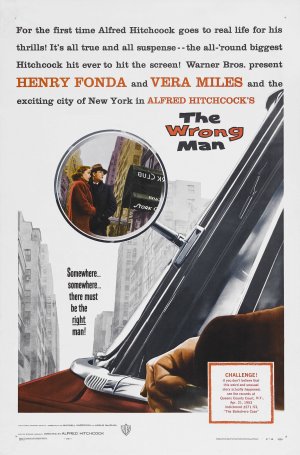
Since today is Alfred Hitchcock’s birthday, I figured why not take a few minutes to recommend one of his films that you may not have seen. First released in 1956 but still painfully relevant today, The Wrong Man is one of Hitchcock’s best but it’s also one of his most underrated.
The Wrong Man deals with a common Hitchcock theme — i.e., an innocent man has been accused of a crime and, despite all of his efforts, cannot seem to convince anyone of his innocence. The difference between The Wrong Man and something like Saboteur or Frenzy is that The Wrong Man is based on a true story.
Manny Ballestro (Henry Fonda) is a struggling musician. He makes $85 a week, playing in a small jazz club. But even though he may not be rich, he’s happy. He loves his job. He loves making music. Even more importantly, he loves his wife, Rose (Vera Miles). But Rose needs to have her wisdom teeth removed and it’s going to cost $300. (As a sign of how much things have changed, I would have been relieved if it had only cost me $300 to get my wisdom teeth taken out.) Desperate for money, Manny tries to borrow money on his wife’s life insurance plan. What Manny doesn’t know is that the insurance office has been held up twice by a man who bears a vague resemblance to him. A clerk calls the police and Manny soon finds himself being taken down to the police station.
Two detectives say that they need Manny’s help but they don’t tell him why. But Manny knows he’s innocent of any crime and he believes that the police are on his side and he agrees to help. When they tell him to walk into a liquor store, he does so. When they take him to a deli, he goes in there as well. When they demand to know why he was trying to borrow money on his wife’s life insurance, he tells them. When they ask him about his financial difficulties, he tells them about that as well. Why shouldn’t he? He’s innocent and the police are just doing their job, right? And when the cops finally ask him to copy down a few words that were used in the note that the robber slipped the clerk at the insurance company, Manny does so. And when they then ask him to take part in a line-up, he does that as well…
And when Manny is arrested and charged with a crime … well, that’s when he finally understands that the system is not on his side. His wife manages to hire a reputable attorney, Frank O’Connor (Anthony Quayle), to defend him but it quickly becomes obvious that the world has already decided that Manny is guilty. When Manny and his wife try to track down some people who could provide Manny with an alibi, they discover that two of them are dead and one of them cannot be found. For once, in a Hitchcock film, it’s not a case of conspiracy. Instead, it’s just bad luck.
And, through it all, Rose continues to blame herself. In fact, she is so wracked with guilt that she has a nervous breakdown.
It all leads to an amazingly disheartening courtroom scene. As quickly becomes obvious, the judge has little interest in what’s happening in his court. Even worse, the jury is unconcerned with the evidence. Most of them are just annoyed at the inconvenience and punishing Manny seems like the perfect way to release their own frustrations…
It’s a bleak picture of the American justice system. Watching The Wrong Man today, it’s tempting to say that the film is just a reflection of society in the 1950s and that things have changed today. But really, have they? True, the police may now be required to read someone their rights when they’re arrested. A suspect can now ask for a lawyer. We’ve got laws against entrapment and all the rest. But that doesn’t matter. We still live in a society where people are still widely presumed to be guilty, even after they’ve been found innocent in a court of law. We still live in a society where the wrong man can have his life ruined because of one mistake.
The Wrong Man doesn’t get as much attention as some of Hitchcock’s other films. In many ways, it’s an atypical example of his work. Hitchcock was notorious for his dark sense of humor and his habit of waving away most plot points as just being mere “macguffins.” With the exception of two scenes, both of which are meant to depict Manny’s mental state, The Wrong Man is filmed in a documentary style, one that occasionally seems more like Sidney Lumet than Alfred Hitchcock. There’s next to no humor, nor are there any big or flamboyant twists. In short, The Wrong Man finds the director of Psycho, Vertigo, and Rear Window at his most sincere. It takes some getting used to.
But, once you do get used to it, The Wrong Man emerges as a powerful and bleak portrait of two innocent people at the mercy of a soulless system. It’s a must see so be sure to see it!
 Through the Shattered Lens
If it helps, according to one of my favorite apps; the inflation calculator, that $300 1956 wisdom tooth procedure would cost $2,658.51 today. Ouch!
LikeLiked by 1 person
That’s a great app! What would Manny’s $85-a-week salary translate to in 2016 money?
LikeLike
It would be $753.24, according to the CPI Inflation Calculator.
http://data.bls.gov
LikeLike
Oops. That URL wasn’t correct. Try this;
http://data.bls.gov/cgi-bin/cpicalc
LikeLike
Argggh! That one doesn’t seem to work here, either. Just search for “inflation calculator.”
LikeLike
I can’t remember if I’ve seen The Wrong Man, but after reading your great review, i will definitely watch it.
Your comments about the tragedy of false arrests and convictions still being a real problem today are accurate, and scary. I’m not at all religious, but I find it interesting that most, if not all of the rules of the various religions, such as the Ten Commandments, the Koran, and others all the way back to the beginning of recorded history, all consider “bearing false witness” and the like, equally as evil as murder.
And yet when cops or prosecutors plant or lie about evidence to get a wrongful conviction, and are caught, they get little more than a slap on the wrist.
Somewhere I read about a religion or culture that had an interesting way to deal with “bearing false witness”; … anyone caught doing it, whether they were an accuser or an official, would be given the same punishment the wrongly accused would have gotten as a result of the false evidence. It didn’t matter if the punishment was five days in the stocks, or hanging; … that’s what the false witness received.
… Which would be one way to make some District Attorneys a lot more careful.
LikeLike
Pingback: Cleaning Out The DVR: Let Us Live! (dir by John Brahm) | Through the Shattered Lens
Pingback: Lisa’s Week In Review: 1/18/21 — 1/24/21 | Through the Shattered Lens
Pingback: Lisa Marie’s Week In Review — 7/31/23 — 8/6/23 | Through the Shattered Lens