
Artist Unknown
Artist Unknown
Director Jon Watts is having quite a career right now! Last year, Cop Car was released to considerable acclaim and, as a result, he was hired to direct the upcoming MCU blockbuster Spider-Man: Homecoming!
Here in America, Cop Car was pretty much sold as being Watts’s first film. However, that wasn’t really the case. Before Watts directed Cop Car, he made a movie called Clown. Clown was executive produced by Eli Roth and, though it did play in Europe in 2014, it was never released in the U.S.
Until now!
Now that Watts is about the become the next big thing, Dimension Films is going to give Clown a limited release in June.
Apparently, Clown is about a man who dresses up like a clown for his son’s birthday party and then discovers that he can’t take off the big red nose. The clown makeup is apparently demonic and it ends up possessing him.
And apparently, it’s not a comedy.
Anyway, here’s the trailer! Again, while watching this preview, consider that Clown is apparently not supposed to be a comedy…

Artist Unknown
What’s an Insomnia File? You know how some times you just can’t get any sleep and, at about three in the morning, you’ll find yourself watching whatever you can find on cable? This feature is all about those insomnia-inspired discoveries!

If, after watching Promise last night, you discovered that you were still suffering from insomnia, you could have watched the very next film that premiered on TCM. That film was the 1997 biopic, George Wallace.
Like Promise, George Wallace was originally made for television. Also, much like Promise, George Wallace is a character study of a conflicted man who makes many people uncomfortable and it’s also well-acted by a cast of veteran performers. That, however, is where the similarities end. Whereas Promise was ultimately a rather low-key and human drama, George Wallace is an epic. Clocking in at nearly 3 hours and telling a story that spans decades, George Wallace attempts to use one man’s life story as a way to tell the entire story of the civil rights movement.
That’s a tremendously ambitious undertaking, especially for a film that had to conform to the demands of 1990s television. Therefore, it’s probably not surprising that the movie, as a whole, is uneven. It’s not a bad movie but, at the same time, it doesn’t quite work.
First off, we need to talk about who the historical George Wallace was.
(Here’s where I get to show off my amazing history nerd powers. Yay!)
George Wallace served a total of four terms as governor of Alabama. A protegé of a populist known as “Big Jim” Folsom, Wallace first ran for governor in 1958. He campaigned as a moderate who supported integration and, as a result, he was defeated by the KKK’s endorsed candidate, John Patterson. (Oddly enough, a fictionalized version of Patterson was the hero of the classic and racially progressive 1955 film, The Phenix City Story.) When Wallace ran again in 1962, he ran as an outspoken segregationist and defeated his former mentor, Jim Folsom. Infamously, Wallace is the governor who stood in the schoolhouse door and announced that Alabama would never accept integration. Unable to succeed himself, Wallace arranged for his wife, Lurleen, to be elected as governor. Lurleen subsequently died in office, succumbing to cancer while Wallace was running for President as the candidate of the American Independent Party. (As of this writing, Wallace is the last third party presidential candidate to carry any states.) Reelected governor in 1970, Wallace married Folsom’s niece and made another presidential run. However, after a string of primary victories, that campaign was cut short when Wallace was shot and crippled by Arthur Bremer. (Bremer would serve as the inspiration for Robert De Niro’s Travis Bickle in Taxi Driver.) Confined to a wheelchair, Wallace served as governor until 1978 and, in 1976, ran for President one final time. After being out of office for four years, he was elected Governor for one final term in 1982. Late in life (and, it should be pointed out, long after integration had been generally accepted as the law of the land), Wallace renounced his segregationist past and publicly apologized for standing in the schoolhouse door. During his final campaign for governor, he won a majority of the black vote and he proceeded to appoint more blacks to state positions than any governor before him.
George Wallace lived a long, dramatic, and interesting life and he’s still a very controversial figure. Who was the real George Wallace? Was he a political opportunist who used racism to further his career? Was he truly a racist who saw the error of his ways and repented or did he only pretend to renounce his former beliefs once they were no longer popular? And, even if Wallace was sincere in his regret, did he deserve to be forgiven or should he always be remembered as the villainous caricature that Tim Roth portrayed in Selma? If we forgive or make excuses for the actions of a George Wallace, do we run the risk of diminishing the success and importance of the civil rights movement?
And I, honestly, have no answers to those questions. Unfortunately, neither does George Wallace. But before we get into that, let’s consider what does work about this film.
George Wallace opens in 1972 with Wallace campaigning in Maryland. Wallace is played by Gary Sinise and his second wife, Cornelia, is played by a very young Angelina Jolie. Sinise and Jolie both give brilliant performances, perhaps the best of their respective careers. Sinise plays Wallace as a calculating and charismatic politician who is also a very angry man. Throughout every second of his performance, we are aware of Wallace’s resentment that his political success in Alabama has potentially made him unelectable in the rest of the country. Watching Sinise as Wallace, you see a man who believes in himself but doesn’t necessarily like the person that he’s become. Meanwhile, Jolie plays Cornelia like a Southern Lady MacBeth and watching her, I remembered how, at one time, Angelina Jolie really did seem like a force of nature. The Angelina Jolie of George Wallace is the wild and uninhibited Jolie of the past (the one who once said, “You’re in bed, you’ve got a knife, shit happens.”), as opposed to the safe and conventional Jolie of the present, the one who is currently directing rather stodgy movies like Unbroken and By The Sea.
After Wallace is shot, the film goes into flashback mode. We watch as Wallace goes from being a liberal judge to being the segregationist governor of Alabama. Mare Winningham plays Lurleen Wallace while Joe Don Baker plays Big Jim Folsom. They all do a pretty good job but the flashback structure is so conventional (and so typical of a made-for-tv biopic) that it makes the film a bit less interesting.
There’s also a character named Archie. Played by Clarence Williams III, Archie is literally the only major black character in the entire film. He is portrayed as being a former convict who has been hired to serve as Wallace’s valet. While Wallace plots to thwart the civil rights movement, Archie stands in the background glowering. At one point, he’s even tempted to kill Wallace. However, after Wallace is shot, Archie helps to take care of him. The film suggests that being shot and subsequently cared for by Archie is what led to Wallace renouncing his racist views. (The film also suggests that Wallace was never that much of a racist to begin with and, instead, was just so seduced by power that he would say whatever he had to say to win an election in Alabama.)
At the end of the film, we’re informed that almost everyone in the film was real but that Archie was fictional. The problem, of course, is that the film is suggesting that the fictional Archie is responsible for the real-life Wallace both rejecting racism and apologizing for the all-too real consequences of racism. The film ends with the realization that the filmmakers were so convinced that audiences would not be able to accept an ambiguous portrait of a public figure that they created a fictional character so that Wallace could have a moment of redemption.
(It also doesn’t help that a film about civil rights only features one major black character and that character is a fictional valet who doesn’t get to say much.)
In the end, the film doesn’t seem to be certain what it’s trying to say about Wallace and the meaning of his dramatic life. That said, I enjoyed watching George Wallace because of the acting and because, as a history nerd, I always enjoy seeing historical figures portrayed on-screen, even if the filmmakers don’t seem to be quite sure what they’re tying to say about them.
George Wallace was directed by John Frankenheimer, a good director who, it appears, was constrained by the demands of 1990s television. If George Wallace were made today, it would probably air on HBO and would probably be allowed to take more of a firm stand one way or the other on Wallace’s character. That said, it would probably also be directed by Jay Roach who, to put it lightly, is no John Frankenheimer.
Anyway, George Wallace doesn’t quite work but it’s definitely interesting. Watch it for Gary and Angelina!
Previous Insomnia Files:
What’s an Insomnia File? You know how some times you just can’t get any sleep and, at about three in the morning, you’ll find yourself watching whatever you can find on cable? This feature is all about those insomnia-inspired discoveries!
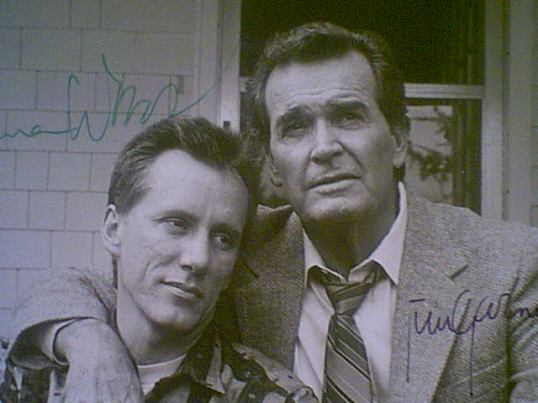
If you were awake at midnight last night and if you were watching TCM, you would have seen a 1986 film called Promise.
Promise stars James Garner as Bob Beuhler, who is one of those deceptively confident men who seems to have his entire life together. He’s made a nice little life for himself, buying and selling houses and he lives in a small town where everyone appears to know and respect him. If Promise were made today, Bob is the type of person who could probably have his own A&E reality show.
But then Bob’s mother dies and we learn of a promise that Bob made forty years ago. It turns out that Bob has a younger brother, named D.J. (James Woods). D.J. suffers from schizophrenia and he’s spent all of his life living with his mother. It quickly becomes apparent that the main driving force behind Bob’s success has been the need to prove that he’s nothing like D.J. When he doesn’t take his medication, D.J. is unpredictable and suffers from violent mood swings. Bob loves his brother but he’s also scared of him.
However, Bob made a promise and he’s going to try to honor it.
It turns out to be even more difficult than he expected. Sometimes, D.J. is calm and sweetly shy. Other times, he becomes violent. The rest of the town starts to gossip about Bob’s “crazy” brother. After one fight, Bob discovers that D.J. has become catatonic. When Bob calls an ambulance, everyone in the neighborhood lines up on Bob’s lawn to watch as D.J. is taken away.
Even though D.J. is eventually released from the hospital and returns home, Bob still is unsure of whether or not he can properly care for his brother. When they go on a trip to a cabin that they often visited as children, Bob is surprised to see how “normal” D.J. is acting. But how long will it last?
When I looked up Promise on the imdb, I was not surprised to discover that it was originally made for television. The fact that nobody in the film ever curses was a dead giveaway and the script occasionally threatens to turn into a PSA. But, with all that in mind, Promise is still a wonderfully effective and rather heartbreaking little movie. James Woods has the more showy role and does a great job with it’s the far more low-key James Garner who keeps the film grounded. Watching a film like Promise, you see that Garner was really a great actor.
Promise is a sad film but it’s definitely one worth watching.
Previous Insomnia Files:
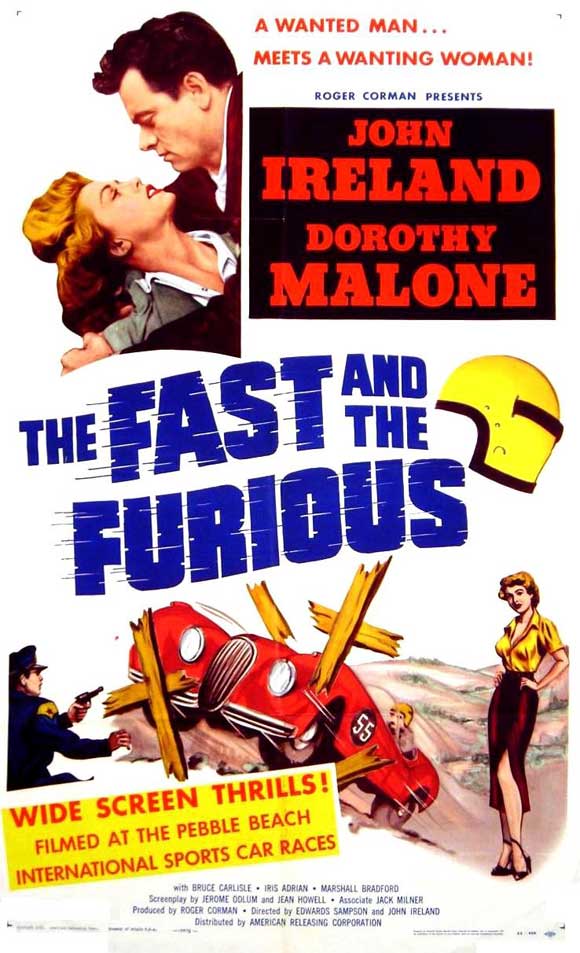
I’ve never seen any of those FAST AND FURIOUS movies with Paul Weller, Vin Diesel, and The Rock (yeah I know, Dwayne Johnson, but he’ll always be The Rock to me). Nope, not even one. I just never had much interest in them. I’d heard of the 1955 THE FAST AND THE FURIOUS, an early Roger Corman production, but never watched it either, until now. Seems I wasn’t missing anything.
THE FAST AND THE FURIOUS is Corman’s second film as producer, and first release for American International Pictures, under the moniker American Releasing Corporation. It’s an inauspicious debut for the company, to put it mildly. The story concerns escaped con Frank Webster, who kidnaps sports car racer Connie Adair and her white Jaguar (which is a nice car, by the way). They bicker with some tough-talking dialogue, as Frank plans on crossing the border to Mexico by driving the Jag in a…
View original post 241 more words

by George Gross
“All I can do is be me, whoever that is.” — Bob Dylan
Bob Dylan not only revolutionized music but he was also responsible for one of the first music videos. The video for Subterranean Homesick Blues originally appeared at the start of D.A. Pennebaker’s documentary, Don’t Look Back. It was filmed in May 8th, 1965 in the alley behind the Savoy Hotel in London and, as Bob flips those cue cards, keep an eye out for both songwriter Bob Neuwirth and the poet Allen Ginsberg in the background.
Happy birthday to Bob Dylan, who is 74 years old today.
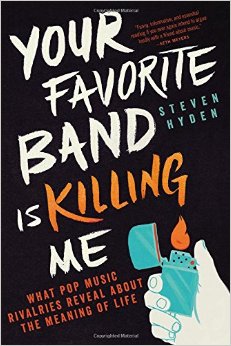 Today, I have flown from Baltimore to Chicago and, after a three-hour layover at O’Hare, from Chicago to Atlanta. Now I have to wait two hours until I board a plane to Dallas. Luckily, I have a good book to read.
Steven Hyden’s Your Favorite Band Is Killing Me takes a look at some famous pop music rivalries and what they may or may not reveal about the meaning of life. Hyden examines 19 different rivalries, everyone from Oasis vs. Blur to Neil Young vs. Lynard Skynard to the Smashing Pumpkins vs. Pavement, Beatles vs. the Rolling Stones and, naturally, Roger Waters vs. everyone else in Pink Floyd. And, of course, he also writes about Biggie vs. Tupac because, as he puts it, that’s the only rivalry that he “was required by law to write about in this book.”
The best chapter, in my opinion, is Hyden’s look at the rivalry between Jimi Hendrix’s legacy and Eric Clapton’s continued existence. He asks a very important question: If Hendrix had lived and was currently living the life of Eric Clapton, would we still consider Jimi to be the greatest guitar God of all time? A close second to the Hendrix/Clapton chapter is Hyden’s look at the rivalry between Nirvana and Pearl Jam. Hyden makes a convincing argument that not only did Kurt Cobain never really grow to like Pearl Jam but that Bruce Springsteen really does not like Chris Christie that much either.
Steven Hyden’s an opinionated guy and, reading the book, I have disagreed with him almost as much as I’ve agreed. But he is also a very good writer and he definitely knows his music. Your Favorite Band Is Killing Me has made this day of airports and flying bearable. I highly recommend it!
Born in Glasgow, Walter Brooks came to the U.S. as an infant. He studied art at the Cooper Union and served in the army during World War II. After the war ended, he pursued a career as a commercial artist. Along with painting the covers for several paperback publishers, Brooks also wrote, edited, and illustrated a series of art instruction books. From 1971 to 1972, he was President of the Society of Illustrators.
Though I couldn’t find much of his work online, I liked what I could find. Brooks’s covers had an impressionistic style that set them apart from other paperbacks.


 Through the Shattered Lens