The Fabulous Forties #9: Jungle Book (dir by Zoltan Korda)


Jungle_Book_FilmPoster

The 9th film in Mill Creek’s Fabulous Forties DVD box set was 1942’s Jungle Book.  Based on the novel by Rudyard Kipling (which was later made into an animated Disney film and of which a remake is scheduled to be released next week), Jungle Book was directed by Zoltan Korda and produced by Zoltan’s brother, Alexander.  Today, the Hungarian-born Korda Brothers are best remembered as being pioneers of the British film industry.  However, during World War II, they relocated their film making to the United States.  Jungle Book was one of the most critically and commercially successful of their American films.

Jungle Book opens in colonial India.  An elderly Indian storyteller is visited by a British woman (Faith Brook) who wants to hear a story from his youth.  The rest of the film plays out in flashback, a structure that allows Jungle Book to walk a thin line between reality and fantasy.  Is the storyteller telling the exact truth or is he exaggerating his tale?  That’s left up to the viewer to decide.  Personally, I chose to believe that he’s telling the exact truth.  It’s more magical that way.

The storyteller starts by telling the woman about the Indian jungle and the animals that live within it.  Some of the animals are kind and some of them are cruel but they all serve a purpose.  The most feared of the animals is a tiger named Shere Kahn.  When a baby disappears from a nearby village, the villagers assume that he, like his father, was killed by Shere Kahn.  What they do not know is that the baby actually wandered into the jungle and was raised by wolves.

The baby grows up to be Mowgli (Sabu), a feral young man who can talk to the animals.  When Mowgli is captured by the villagers, he is unknowing adopted by his real mother, Mesusa (Rosemary DeCamp).  At first, the wild Mowgli struggles to adapt to human ways and one of the villagers, Buldeo (Joseph Calleia), insists that Mowgli has “the evil eye.”

As Mowgli becomes a little more civilized (though he’s never exactly tamed), he starts to fall in love with a Mahala (Patricia O’Rourke).  Unfortunately, Mahala is the daughter of Buldeo and Buldeo is none to happy when Mowgli and Mahala start to spend all of their time exploring the jungle together.  However, that’s before Mowgli and Mahala come across a lost palace that is full of treasure.  When the greedy Buldeo finds out about the treasure, he demands that Mowgli tell him where the palace is.  Driven mad by Mowgli’s refusal to tell him, Buldeo goes to more and more extreme measures to find the treasure…

Jungle Book is a big epic film, one that proudly announces that it was shot in Technicolor.  The sets are big, the live animal footage (as opposed to the stock footage usually used in films like this) is impressive, and it’s just a fun movie to watch.  (Even though I was watching a typically cheap Mill Creek transfer, I was still impressed with the films visuals.)  Indian actor Sabu makes for a charismatic Sabu but the film’s best performance comes from Joseph Calleia, who brings unexpected depth to his villainous character.

(Movie lovers, like you and me, probably best know Joseph Calleia as Orson Welles’s tragic partner in Touch of Evil.)

You can watch the original Jungle Book below!

http://www.youtube.com/watch?v=MUHNtxQ82z8

(Jungle Book is in the public domain so, if the video above gets taken down — as often seems to happen with embedded YouTube videos — I would suggest just going to YouTube and doing a search for Jungle Book 1942.  You’ll find hundreds of other uploads.  I picked the one above because it did not appear to have any commercials.)

The Fabulous Forties #8: The Lady Confesses (dir by Sam Newfield)


Poster_of_the_movie_The_Lady_Confesses

After I watched The Red House, I watched the 8th film in Mill Creek’s Fabulous Forties box set, a 1945 film noir called The Lady Confesses.

Mary Beth Hughes plays Vicki McGuire, who is engaged to marry Larry Craig (Hugh Beaumont).  When we first meet Larry, he seems like a fairly normal guy.  He drinks too much but then again, this film was made in 1945 and it’s totally possible that Larry had yet to see The Lost Weekend.  Before getting engaged to Vicki, he was married to Norma Craig (Barbara Slater).  Norma disappeared seven years ago and has since been declared legally dead.  So, imagine everyone’s surprise when Norma suddenly turns up alive and knocking on Vicki’s front door!  Norma announces that there’s no way that she’s going to give up Larry.

Larry reacts to all this by going out and getting drunk.  He spends a while literally passed out at the bar and then, once he’s sobered up, he and Vicki go to visit Norma and try to talk some sense into her.  However, upon arriving at her apartment, they discover that Norma has been strangled!

The police automatically suspect Larry of being the murderer but he has an alibi.  He was drunk.  He was passed out at the bar.  And the only time he wasn’t at the bar, he was sleeping on a couch in the dressing room of singer Lucille Compton (Claudia Drake)…

Wait!  Larry was sleeping on another woman’s couch?  Well, Vicki isn’t necessarily happy to hear that but she still believes that her fiancée is innocent and she’s willing to do whatever it takes to clear his name, even if it means going undercover and working at a nightclub.  Vicki and Larry suspect that nightclub owner Lucky Brandon (Edmund MacDonald) is the murderer.  Can they prove it or, waiting around the next shadowy corner, is there another twist to the plot?

It’s not a spoiler to tell you that there’s another twist.  In fact, for a film that only runs for 64 minutes, there’s a lot of twists in The Lady Confesses.  The Lady Confesses is an entertaining film noir, one that gives B-movie mainstay Mary Beth Hughes a rare lead role.  As well, if you’ve ever seen an old episode of Leave It To Beaver, it’s quite interesting to see Hugh Beaumont playing a somewhat less than wholesome character.  Director Sam Newfield, who directed over 254 films during the course of his prolific career, keeps the action moving and provides a lot of menacing and shadowy images.

Though it may not be perfect (for one thing, we never learn why Norma disappeared in the first place), The Lady Confesses is a watchable and atmospheric film noir.  And you watch it below!

http://www.youtube.com/watch?v=Bu6VvnIkMyM


The Fabulous Forties #7: The Red House (dir by Delmer Daves)


40s

Last week, I started on my latest project — watching all 50 of the movies included in Mill Creek’s Fabulous Forties box set!  I started things off with Port of New York and then I was lucky enough to discover two excellent low-budget gems: The Black Book and Trapped.

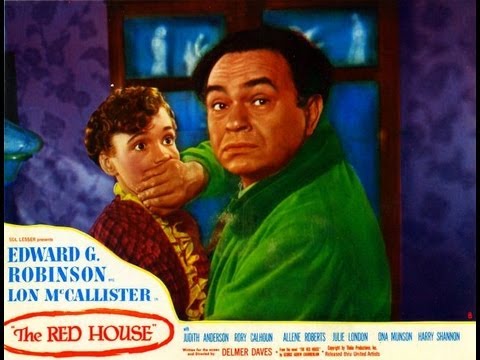
And now, we come the 7th film in the Fabulous Forties box set: 1947’s The Red House.

Redhouseposter

The Red House takes place is one of those small and seemingly idyllic country towns that always seem to harbor so many dark secrets and past crimes.  Everyone in town is friendly, cheerful, and quick to greet the world with a smile.

Well, almost everyone.

Pete Morgan (Edward G. Robinson) is the exception to the rule.  A farmer who moves with a pronounced limp, Pete lives on an isolated farm and refuses to have much to do with any of the other townspeople.  He lives with his wife, Ellen (Judith Anderson), and his niece, 17 year-old Meg (Allene Roberts).  Pete and Ellen are extremely overprotective of Meg.  Pete, especially, is always quick to tell her not to associate with any of boys in the town and not to enter the dark woods that sit next to the farm.  He tells her that there’s a red house hidden away in the woods and the house is haunted.  Going into the red house can only lead to death.

Despite Pete’s eccentricities, Meg is finally able to convince him to hire one of her classmates to help do chores around the farm.  Nath (Lon McAllister) is a good and hard worker and soon, even Pete starts to like him.  Meg, meanwhile, is falling in love with Nath.  However, Nath already has a girlfriend, the manipulative Tibby (Julie London), who cannot wait until they graduate high school so that she and Nath can leave town together.  When Nath starts to also develop feelings for Meg, Tibby responds by flirting with the local criminal, Teller (Rory Calhoun).

Though things seem to be getting better on the Morgan Farm, Nath eventually makes the mistake of admitting that, when he goes home, he takes a short cut through the old woods.  Pete angrily forbids Nath from entering the woods.  Of course, this has the opposite effect.  Soon, Nath and Meg are spending all day sneaking away into the woods so that they can look for the red house.

Once Pete learns of what they’re doing, he decides to hire Teller to keep them from even finding and entering the red house.  Needless to say, love, melodrama, murder, and tragedy all follow…

Despite the fact that the DVD suffered from a typically murky Mill Creek transfer, I enjoyed The Red House.  It’s one of those films that is just so over the top with all of the small town melodrama that you can’t help but enjoy it.  (If M. Night Shyamalan had been a 1940s filmmaker, he probably would have ended up directing The Red House.)  Nath and Meg were kind of boring but Julie London was a lot of fun as Tibby.  If I had ever starred in production of The Red House, I would want to play Tibby.

Plus, the film’s got Edward G. Robinson doing what he does best!  Robinson was an interesting actor, in that he could be both totally menacing and totally sympathetic at the same time.  He has some scary scenes as Pete but they’re also poignant because Robinson suggests that Pete hates his behavior just as much as Ellen and Meg.  Robimson was a powerhouse actor, the type who could elevate almost any film.

And that’s certainly what he does in The Red House!

red

Good Day in Hell: DUCK, YOU SUCKER (United Artists 1972)


gary loggins's avatarcracked rear viewer

duck1

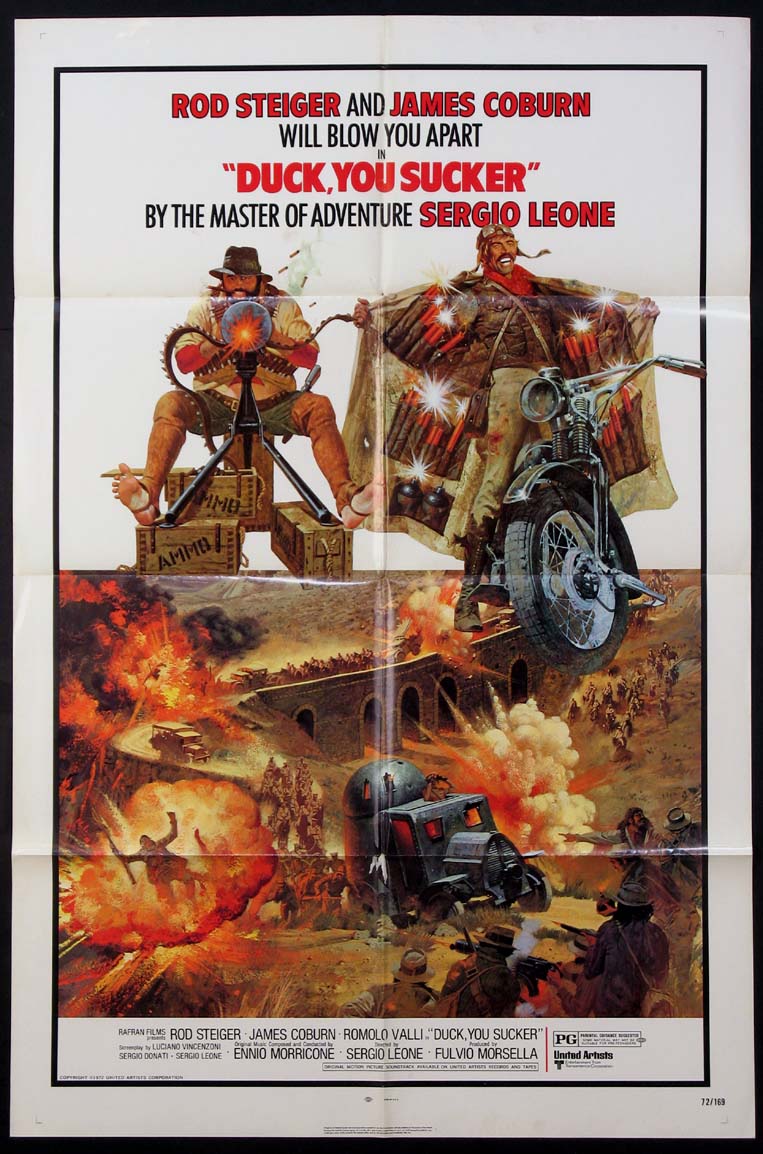
Sergio Leone’s DUCK, YOU SUCKER is the director’s most overtly political film statement. Butchered and retitled A FISTFUL OF DYNAMITE by United Artists upon its American release, the film was restored to its full glory in 2007. The print I viewed is the full 157 minute version broadcast last summer on Encore Westerns, and the result is an epic tale of revolution, the futility of war, and class struggle starring two great actors, Rod Steiger and James Coburn. Filled with violence, humor, and Leone’s signature touches, DUCK, YOU SUCKER is second only to THE GOOD, THE BAD, AND THE UGLY on my personal list of Leone favorites.

duck2

The film is essentially a buddy movie at heart. Juan Miranda (Steiger) is leader of a bandito family that robs from the rich and gives to the poor… namely themselves! They come across John H. Corbett (Coburn) riding on his motorcycle. John’s an ex-IRA…

View original post 578 more words

Let’s Play Hardcore Henry (2016, directed by Ilya Naishuller)


Hardcore_(2015_film)If you ever wondered whether a movie would ever be able to capture the excitement of watching a total stranger silently play an uninspired video game, Hardcore Henry is here to answer your question.
Filmed with a GoPro Hero 3 camera that used a specially-built rig that could be worn as a mask, Hardcore Henry is an action film that, from beginning to end, is told from a first-person perspective.  You are Henry.  When the film starts, you are having a dream where Tim Roth calls you a “pussy.”  When you wake up, a beautiful woman named Estelle (Haley Bennett) says that you are her husband and that you have amnesia because of a horrible accident.  You also lost your left arm and left leg but Estelle replaces your missing limbs with cybernetic ones.  Just before Estelle can give you a new voice, the laboratory is attacked by a telekinetic albino named Akan (Danila Kozlovsky), leaving you as mute at GTA III‘s Claude.  You spend the rest of the movie running through the streets of Moscow, trying to rescue Estelle and getting advice and side missions from Jimmy (Sharlto Copely).  Jimmy was my favorite part of the movie because every time he was killed, he would return in a different version.  Cocaine Jimmy was the best of the Jimmys.

There are a few times when the stunt work is awe-inspiring but too often watching Hardcore Henry felt like watching a Let’s Play video on YouTube, the only difference being that at least the YouTube vid would have featured a joke or two.  The problem is not that Hardcore Henry feels like a video game.  The problem is that doesn’t feel like a good video game.  It feels like a clichéd and uninspired first person shooter, right down to the scenes were Estelle and Jimmy train you on how to use your new abilities and weapons.  (When Henry visits a brothel, it’s as if he figured out how to unlock the hidden rooms in Grand Theft Auto: San Andreas.)  If Hardcore Henry had a plot that was as interesting as the first person gimmick, it would be a great action film.  But, as it is, Hardcore Henry is just an intriguing experiment that does not really work.

The Fabulous Forties #6: Trapped (dir by Richard Fleischer)


220px-Trapped_1949

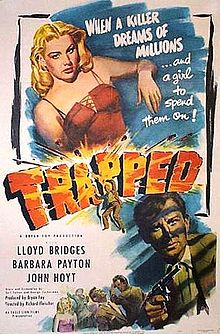
After being disappointed with Guest In The House, I decided to go ahead and watch the sixth film in Mill Creek’s Fabulous Forties box set and I’m glad that I did.  1949’s Trapped turned out to be an entertaining little discovery.

Much like Port of New York, Trapped opens with documentary footage of the government at work and an official sounding narrator explaining to us that we are about to see a film about the hardworking agents of the Treasury Department.  In fact, the narrator goes on for so long about the Treasury Department that he starts to sound downright worshipful.  There’s nothing that the Treasury Department cannot do!  Who protects the President?  The Treasury Department!  Who tracks down counterfeiters?  The Treasury Department!  Who protects the coast?  The Coast Guard but guess what? The Coast Guard is actually a part of The Treasury Department!  The tone of the narration is so worshipful that it could almost pass for a Scientology recruiting film.  Just as only the Sea Org can protect us from Evil Lord Xenu, only the Treasury Department can stop phony money pushers!

Eventually, the narration ends and the actual movie begins.  Fortunately, the rest of Trapped more than makes up for that awkward introduction.  The film opens with a bunch of Treasury agents looking over a phony twenty-dollar bill.  The bill is almost perfect and the agents believe that it was printed using plates designed by one of the world’s greatest counterfeiters, Tris Stewart (Lloyd Bridges).  The only problem is that Stewart is in prison.  Obviously, someone else has gotten their hands on Stewart’s plates.

Stewart is upset that someone is getting rich off of his work.  So, he strikes a deal with the Treasury Department.  In return for being released, he will help them track down his plates.  The Treasury Department agrees and arranges for Stewart to “escape” during a phony prison break.

However, Stewart has plans of his own.  As soon as he’s out of jail, he knocks out his handler and escapes for real.  Tris is not only planning on tracking down his plates but he’s also going to go back into business printing and passing phony money.  He also reunites with his girlfriend, nightclub hostess Meg Dixon (Barbara Payton).

When he meets Meg, he discovers that she has a new admirer.  Johnny Hackett (John Hoyt) likes to hang out whenever Meg’s working.  Even though Johnny appears to have a thing for Meg, he and Tris still become friends.  Tris is even willing to bring Johnny in on the operation but, what Tris doesn’t realize, is that Johnny Hackett is actually Treasury agent John Downey (John Hoyt)…

Needless to say, violence, betrayal, and death follows.

Shot on location in some of the seediest parts of 1940s Los Angeles, Trapped is a fast-paced and exciting film noir.  (This is one of those films, like The Black Book, where shadows are literally everywhere.)  Lloyd Bridges (who, as a young man, could have passed for Kirk Douglas’s brother) gives a great performance as the charming but ultimately cold-hearted Tris Stewart while John Hoyt does a fairly good job as the conflicted Downey.  Barbara Payton, one of the more tragic figures from Hollywood’s Golden Age, does such a good job as Meg that it’s even more tragic to consider that, just a few years after making Trapped, her career would be destroyed by alcoholism and personal scandal and she would eventually end up as a homeless prostitute on Sunset Boulevard.

Trapped was a good discovery and you can watch it below!

The Fabulous Forties #5: Guest In The House (dir by John Brahm)


Guest_in_the_House_Poster

The fifth film in Mill Creek’s Fabulous Forties box set was 1944’s Guest In The House.  Before I get around to actually reviewing the film, there two important things that I need to share.

First off, according to the imdb, when Guest In The House was released into theaters, it ran a total of 121 minutes.  The version that was released on video — the version that I watched for this review — only runs 100 minutes.  Having watched the film, it’s hard for me to guess what could have been included in those 21 minutes.  There’s no major plot holes in the 100 minute version or any unanswered questions.  It’s hard for me to imagine that there could be anything in those 21 minutes that would have made Guest In The House a better film than the version that I watched last night.  If anything, even at just 100 minutes, the version that I saw still felt too long!

Secondly, Guest In The House was re-released several times.  At one point, the title was changed to Satan In Skirts!  That has got to be one of the greatest titles ever!  Seriously, Guest In The House is such a boring and mundane title.  But Satan in Skirts — I mean, that sounds like something that you just have to watch, doesn’t it?

Anyway, Guest In The House is about a guest in the house.  Shocking, right?  Evelyn (Anne Baxter, playing a character similar to her classic role in All About Eve) is a mentally unstable woman with a heart ailment and a morbid fear of birds.  She has recently become engaged to Dr. Dan Proctor (Scott Proctor) but she spends most her time writing nasty things about him in her diary.

Dan takes her to visit his wealthy Aunt Martha (Aline MacMahon).  Also staying at Martha’s is Dan’s older brother, an artist named Douglas (Ralph Bellamy).  Douglas is married to Ann (Ruth Warrick, who also played Kane’s first wife in Citizen Kane).  Also living at the house is Douglas’s model, Miriam (Marie McDonald).

(“I used to have to hire one model for above the neck and one model for below the neck,” Douglas explains as Miriam poses for him, “But you’re the whole package!”)

When Evelyn has a panic attack upon seeing a bird, Douglas calms her down by drawing a woman on a lampshade.  (Yes, that’s exactly what he does.)  This leads to Evelyn becoming obsessed with Douglas.  Soon, she is manipulating the entire household, trying to drive away Dan and Miriam while, at the same time, try to break up Douglas and Ann’s marriage….

So, does this sound like a Lifetime film to anyone?  Well, it should because Guest In The House is basically a 1940s version of almost every film that aired on Lifetime last year.  Normally that would be a good thing but, unlike the best Lifetime films, Guest In The House isn’t any fun.  It should be fun, considering how melodramatic the storyline is.  However, Guest In The House takes a prestige approach to its story, marking this as one of those films that was made to win Oscars as opposed to actually entertaining audiences.  Other than a few time when Evelyn imagines that she’s being attacked by invisible birds, the film never allows itself to truly go over-the-top.

Lovers of The Wizard of Oz might want to note that the Wicked Witch of the West herself, Margaret Hamilton, plays a maid in this film but, in the end, Guest In The House is mostly just interesting as a precursor to Anne Baxter’s performance in All About Eve.