Every year there’s always a few horror films that seem to come out of nowhere that everyone ends up getting hyped for by word of mouth. Zombieland from several years back was one such horror film that worked both as horror and comedy.
This year it looks like Cooties may just be that one horror-comedy that has a chance to surprise an audience that’s become jaded when it comes to their horror entertainment. It definitely wears it’s comedic side on it’s sleeve in the trailer. Now whether it succeeds as a horror-comedy we shall soon find out when it comes out on Sept. 18, 2015.
I love to dance, I loved to teach others how to dance, and I love watching other people dance. If you’ve been reading my reviews for a while, then you know that I can not resist a film that features a lot of dancing. It doesn’t matter if the director is inept. It doesn’t matter if the script makes no sense. It doesn’t matter if the actors don’t have a bit of acting talent to use to their advantage. As long as the film features a lot of dancing, I’m happy.
Seriously, people, when in doubt … DANCE!
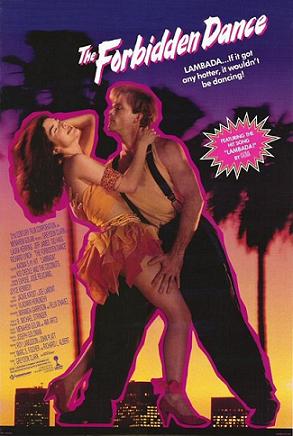
Let’s take the 1990 film The Forbidden Dance, for instance. Now, if I wanted to be nit-picky, I could probably find a lot to criticize about this film. I mean, this film even has a pro-environmental message and you know how annoyed I can get with message films. And you know what? You can do a google search and you can find all sorts of insanely negative reviews of this film.
But you know what?
I don’t really care about any of that. This is, at heart, a dance film. It features almost non-stop dancing, so I really can’t be too critical of it. Add to that, it also features memorable performances from Sid Haig and the late Richard Lynch. Unfortunately, neither Haig nor Lynch get out on the dance floor because, if they had, The Forbidden Dance would have been legendary.
The Forbidden Dance begins in the Brazilian rain forest. A tribe of Native Brazilians is happily dancing and basically not bothering anyone. As we learn later on in the film, the dance that they are doing is called the Lambada and apparently, the Brazilian government tried to ban it “because it was too sexy.”
Anyway, all the dancing and the fun is interrupted by the arrival of Benjamin Maxwell (Richard Lynch), a mercenary who works for a Big Evil Corporation. Maxwell tells the tribe that they might want to stop dancing and leave because the rain forest is going to be destroyed.
Naturally enough, the tribe’s king responds to this by sending his daughter, Nisa (Laura Harring), to America. Accompanying Nisa is Joa (Sid Haig), a witch doctor. However, Nisa and Joa’s attempts to invade the headquarters of Big Evil Corporation results in Joa being arrested.
(Incidentally, you might recognize Laura Harring from David Lynch’s Mulholland Drive, where she played a similarly mysterious character who was lost and hunted in Los Angeles.)
Left to fend for herself, Nisa gets a job working as a maid for a wealthy family. And while neither Mr. nor Mrs. Anderson has much interest in the backstory of the help, their son Jason (Jeff James) is a different story. As Jason’s mother complains, Jason doesn’t have much interest in anything other than dancing. And, when Jason spots Nisa dancing in her bedroom, he becomes intrigued with her. Ignoring the snobbish reactions of his wealthy friends, Jason asks Nisa to teach him the Lambada!
And hey! Guess what! There’s going to be a dance contest and it’s going to be televised! What better way to get a platform to protest the destruction of the Brazilian Rain Forest then by winning the contest? Standing in the way of this plan: Benjamin Maxwell (who, in one icky scene, demands that Nisa dance for him), Jason’s parents and friends, and the fact that, through a complicated series of events, Nisa ends up being forced to dance in the sleaziest club in Los Angeles.
So, look — there’s all sorts of things that I could say about The Forbidden Dance but it features a lot of dancing so I’m inclined to be generous towards the film, especially since Laura Harring and Jeff James both know how to move and look really good dancing together. I mean, the word Dance is right there in the title. The film promises dancing and it delivers. Plus, it also delivers Sid Haig and Richard Lynch at their demented best.
I had a really neat experience once in Monterey. I had never been to California before, I didn’t have a car, and I didn’t get to see much of anything getting there, so I had no idea what existed outside of the town itself. I volunteered to help in the Big Sur marathon, and we loaded up at 4am to drive to the starting point. I knew we were going around a lot of twists and turns, but it was dark and I didn’t think much of it. When the sun came up, we were in a forest, so I figured we must have traveled inland. On the way back, I realized that we’d been dangling on the edge of a cliff dropping into the Pacific ocean the whole way. We were so high up and it was so foggy that sometimes I couldn’t see the ocean at all, and it looked like we were on some floating island in the sky.
An inner city doesn’t work like that. At night, your senses are distorted by a thousand lights shining at you from every direction. Mile-high offices dot the sky like stars. Roads expand to accommodate a vast matrix where red and white atoms shift about chaotically. Black holes surround floating portals into the dimensions of designer makeup and investment banking. Nothing really ends; it just blurs into an electric haze in the distance. The daylight shrinks it all back down into something you can swallow. The cars are just cars. The billboards abandon their depth. The towers have their peaks. Without distinct points of light, they fade from your awareness. No matter how vast the sun-lit scene may be, something about it feels just a bit smaller. It’s quaint, really–a return to a simpler world where buildings are merely a thousand feet tall and bodies line the streets in self-propelled steel boxes, listlessly nodding their heads to music beamed in from outer space.
“Flim”, by the venerable Aphex Twin, appears on the 1997 Come to Daddy EP. It has the sense about it, to me at least, of opening blinds at the top of a highrise hotel and staring across a city in its mid-day bustle.
Though it may seem like a lifetime ago, it’s only been 6 weeks since I started on my latest series of reviews. I am currently in the process of reviewing, in chronological order, 126 cinematic melodramas. I started with the 1927 classic Sunrise and now, 82 reviews later, I have finally reached the 1990s.
(Of course, when I started this series of reviews, I somehow managed to convince myself that it would only take me 3 weeks to review 126 films. Instead, it looks like it’s going to take two months. So, I was only off by 5 weeks.)
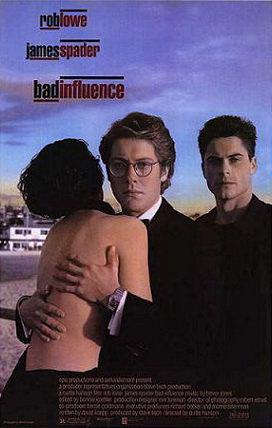
Let’s start the 90s by taking a quick look at a 1990 film called Bad Influence. I have to admit that, when I made out my list of films to review, Bad Influence was not even on my radar. I was planning on launching my look at the 90s with a review of Ghost. But then I saw The Avengers: Age of Ultron and I was so taken with James Spader’s performance as Ultron that I decided to add a few James Spader films to Embracing the Melodrama.
In Bad Influence, James Spader is cast somewhat against type. He plays Michael, who has a good job and is engaged to marry the wealthy and overbearing Ruth (who, I was surprised to learn from the end credits, was played by a pre-Desperate Housewives Marcia Cross). Michael should be happy but instead, he feels oddly dissatisfied with his life. He’s shy and meek and spends all of his time trying to do the right thing and conform to the petty demands of society.
One day, as he’s sitting in a bar, Michael makes the mistake of trying to flirt with a woman who is obviously having a bad day. When the woman’s boyfriend shows up, he tells Michael to leave. When Michael mutters that it’s a free country, the man responds by grabbing Michael. However, before the fight can go any further, handsome and charming Alex (played, somewhat inevitably, by Rob Lowe) pops up out of nowhere, smashes a bottle, and scares the man off.
Michael and Alex become fast friends, with Michael viewing the extroverted and confident Alex as being everything that he wants to be. (Meanwhile, Alex seems to appreciate the fact that Michael has money and a nice apartment.) Under the influence of Alex, Michael starts to stand up for himself and even manages to get a big promotion at work. At the same time, he also ends up cheating on his fiancée (while Alex films them) , helping Alex hold up a series of convenience stores, and beating up an obnoxious co-worker.
Ultimately, Bad Influence is a lot of sordid fun. It’s a bit like Fight Club, minus the satire and the big identity twist. (Michael and Alex are differently separate characters.) Director Curtis Hanson (who is perhaps best known for L.A. Confidential) brings a lot of style to the film’s tawdry fun and keeps the action moving quickly enough that you don’t have too much time to obsess over what doesn’t make sense.
Finally, James Spader and Rob Lowe are just a lot of fun to watch. Spader turns Michael into a sympathetic protagonist and Rob Lowe seems to be having a blast going full psycho in his role.
Bad Influence is a well-made B-movie and it’s a lot of fun. You can watch it below!
There is a common quip you’re likely to find if you read comments on Konami’s Snatcher: of all the games that I have never played, this one is my favorite. The game was ported and rehashed for much of the late 80s and 90s, appearing on the PC-8801, MSX2, PC-Engine, Sega Mega-CD, Sony Playstation, and Sega Saturn. The highly censored Sega CD port was the only English translation, and given how horribly that system flopped, you have almost certainly never played this game. That’s no fault of Konami’s. America and Europe are not exactly hot markets for menu-based graphic adventure games.
But Snatcher has a cult following of western fans regardless. Magazines reviewing the Sega CD port praised it across the board. It’s one of the earliest highly successful (in Japan at least) cyberpunk video games, and it merges this with a detective story, grasping the genre’s affinity with film noir. Its original 1988 score captured the essence of cyberpunk aesthetics, filled with jazzy melodies driven by futuristic beats where it could have easily gotten away with generic action music instead. And the game is deliciously dated: its post-apocalyptic earth–set in the oh-so-distant future of 2042–comes about as a consequence of the Soviet Union unleashing a devastating biological weapon. All of these factors make its obscurity a bit enticing. It’s not like you’ve never heard of the game because no one liked it. It’s more of a lost treasure.
The game’s western obscurity plays directly into the appeal of its genre. Learning about it, I felt like I was excavating a modern ruin from a digital trash heap, diving into long forgotten file-sharing archives and posting anonymous requests in dark corners of the internet for sources beyond Wikipedia. One of the most enjoyable stretches of my long-winded videogame music series in 2012 was the process of piecing together fragments of information to arrive at a fairly accurate break-down of the original score. It was a Konami Kukeiha Club project, which can often be a lost cause to dissect, but I dug until I found that the original PC-8801 version’s credits listed each track by individual composer. This was already complicated by the fact that it incorporated changes in the simultaneously released MSX2 port, awkwardly intermixing the staff who converted the sound. You can read my two-part entry on Snatcher below, if you’re curious:
“One Night in Neo Kobe City”, not to be confused with “Twilight of Neo Kobe City”–I had a lot of fun dealing with those sorts of naming conventions through a bad Japanese to English translator–is not original to the 1988 version of Snatcher. Motoaki Furukawa (古川もとあき) first composed it for the 1992 PC-Engine port, when greatly improved audio technology made a track like this possible. (Honestly, think about the sound quality in games you were playing in ’92. This was pretty advanced.) The song really sets the stage for the cyberpunk tech noir experience that follows. I suppose it’s not dark or foreboding, really, but when you connect this sort of sax-driven jazz to a futuristic city, the relation feels natural. When you connect it to Snatcher, it becomes cyberpunk to the core.
Hats off to Konami for letting Snatcher thrive on Youtube when so many other game producers routinely scour the net of their antiquities. (I personally had my account banned by Taito for posting some music to an obscure 80s arcade game.) I don’t know why cease and desist orders are particularly popular in the world of videogame music, but at least in my experience Konami seem to avoid that nonsense. It’s pretty cool, since the Konami Kukeiha Club doesn’t rate far behind Square-Enix’s illustrious list of composers.
When I made out my schedule of reviews for Embracing the Melodrama, I did not realize that I was setting myself up for a mini-marathon of Kiefer Sutherland movies but somehow, that’s exactly what happened! No sooner had I watched and jotted down my impressions of Bright Lights, Big Cityand 1969, then I started watching a 1988 film called Promised Land (which should not be confused with the recent Matt Damon/Jon Krasinski fracking film).
And guess who stars in this particular film?
That’s right — Kiefer Sutherland!
Now, if Bright Lights, Big City featured Kiefer as a sociopath and 1969 featured Kiefer as a blonde-haired golden boy, Promised Land features Kiefer as a prototypical outsider.
Promised Land opens at a high school basketball game. Hancock (Jason Gedrick) is the handsome and popular jock who is a star on the court and who is dating a cheerleader named Mary (Tracy Pollan). Danny (Kiefer Sutherland) is the nerdy kid who gets good grades and who is nicknamed Senator because he wants to enter politics. He has an obvious crush on Mary but also appears to have one on Hancock as well. As Hancock runs up and down the court, nobody cheers louder than Danny. Meanwhile, Hancock barely knows who Danny is.
Three years later and things have changed. Hancock, having gone to college on an athletic scholarship just to drop out and return home, is now a vaguely fascistic police officer. Mary has remained in college. When she returns home for Christmas break, Hancock tries to rekindle their relationship but Mary has moved on.
Meanwhile, Danny has dropped out of school as well. After spending a few years drifting around, he meets the lively, vivacious, and totally insane Bev (Meg Ryan). He and Bev get married in Las Vegas and decide to head back to Danny’s hometown for Christmas…
Drama, violence, and tragedy follow!
But you already guessed that, didn’t you? That’s one of the problems with Promised Land. From the minute that Bev says that she wants to meet Danny’s family, you can tell exactly how this story is going to end. And while a predictable plot can sometimes be redeemed by memorable performances, that’s not the case with Promised Land. Kiefer Sutherland and Meg Ryan both give good and dangerous performances but Jason Gedrick and Tracy Pollan make for a boring couple.
(Interestingly enough, Tracy Pollan was also in Bright Lights, Big City.)
Promised Land does have some historical significance, in that it was the first film to ever be partially funded by the Sundance Institute. Robert Redford is listed as an executive producer. But, historical significance aside, there’s really not much about Promised Land to really recommend going to the effort to try to track it down. It’s not so much bad as just very forgettable.
In 1988, the same year that he was forcing Michael J. Fox to snort cocaine in Bright Lights, Big City, Kiefer Sutherland played a far different role in the film 1969.
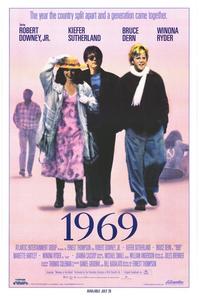
As you might guess from the film’s title, 1969 takes place in 1969. Scott (Kiefer Sutherland) and Ralph (Robert Downey, Jr.) have just graduated from high school and are facing a future that involves either going to college or going to Vietnam. Scott’s older brother, Alden (Christopher Wynne), has already enlisted in the army and has made their father, Cliff (Bruce Dern), proud in a way that Scott knows he will never be able to match.
So, Scott and Ralph make plans to go to college together and basically stay there until the war ends. But, needless to say, things don’t work out as perfectly as Scott assumed that they would. Scott and Ralph spend the summer on a road trip, during which time they meet the usual collection of hippies and fascists who always populate films like this. They also discover that they have less in common than they thought. Scott is an idealist who is convinced that he can change the world. Ralph is far more fatalistic, a cynic who hides his pain behind a constant stream of sarcasm.
When Ralph is kicked out of school (and loses his draft deferment as a result), Alden is killed in Vietnam and Scott sees his father in a potentially compromising position with Ralph’s mother (Joanne Cassidy) (on the night of the moon landing no less!), the disillusioned Scott feels that he has to take action. With the help of Ralph and Ralph’s sister, Beth (Winona Ryder), Scott breaks into the local draft office and tries to destroy all the records.
Now, if you guessed that the police arrive and that Scott and Beth eventually find themselves in a van, driving for the Canadian border, then you’ve probably seen countless other films that were set in the same year as 1969…
1969 is a rather predictable film but, at the same time, it’s likable in much the same way that a rerun of Everybody Loves Raymond is likable. It’s not something you really need to watch but, if you do watch it, you won’t necessarily be filled with regret. I imagine that one reason why 1969 tends to show up on networks like Antenna and This TV so much is precisely because it is such a thoroughly inoffensive little movie.
The film also features some above average performances. It’s not surprising that Robert Downey, Jr. and Winona Ryder both give good performances because, to a large extent, their characters mirror their own public personas. But, considering that he’s best known for playing Jack Bauer in 24, it’s still somewhat surprising to see a much younger Kiefer Sutherland playing such an essentially gentle character and being totally convincing in the role. (He already had that sexy growl of a voice, however.) And finally, the film’s best performance comes from Bruce Dern. Eternally befuddled and confused by the changes around him, Cliff is ultimately the film’s most sympathetic character, even if he wasn’t originally meant to be.
And needless to say, considering that the film is called 1969, it’s got a great soundtrack!
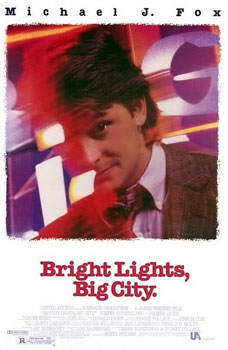
The 1988 film Bright Lights, Big City is one of the many films from the late 80s in which Kiefer Sutherland plays a demonic character. In this case, his character is so demonic that his name is — seriously, check this shit out — Tad Allagash. Nobody named Tad Allagash has ever been a good guy!
Tad is the best friend of Jamie Conway (Michael J. Fox), an aspiring writer who has moved to New York City from some middle-America farm state and who now has a job as a fact checker at the New Yorker. Jamie is still struggling to deal with both the death of his mother (played in flashbacks by Dianne Wiest) and the collapse of his marriage to Amanda (Phoebe Cates). Tad helps out his depressed little friend by taking him out to the clubs and supplying him with so much cocaine that Jamie literally spends the entire film on the verge of having a geyser of blood shoot out from his powder-coated nostrils.
And the thing is, Tad knows that he’s not a good influence on Jamie’s life but he doesn’t care. Whenever Jamie starts to get a little bit too wrapped up in his self-pity, Tad is there to make a tasteless joke. Whenever Jamie tries to argue that he and Amanda aren’t really broken up, Tad is there to remind him that Amanda wants nothing to do with him. Whenever Jamie starts to think that doing all of this cocaine is potentially ruining his life, Tad is there to cheerfully cut another line. Tad makes no apologies for being Tad Allagash. He’s too busy having a good time and it’s obvious that Sutherland’s having an even better time playing Tad. As a result, Tad Allagash becomes the perfect antihero, the bad guy that you like despite yourself.
Unfortunately, Bright Lights, Big City isn’t about Tad Allagash. You’re happy whenever Kiefer shows up but he doesn’t show up enough to actually save the film. No, Bright Lights, Big City is the story of Jamie Conway and that’s why the film is a bit of a pain to sit through. Despite having a great Irish name, Jamie Conway is one of the whiniest characters that I have ever seen in a film. From the minute he first appears on screen and starts complaining about the failure of his marriage, you want someone to just tell him to shut up. When he tells an alcoholic editor (Jason Robards) that his latest short story was autobiographical, you nod and think, “So, that’s why it hasn’t been published.”
Of course, since Jamie is the main character, everyone in the film feels sorry for him but he really is just insufferable. There’s a lengthy scene where Jamie delivers a drunken monologue to a sympathetic coworker, Megan (played by Swoosie Kurtz). And while Jamie goes on and on about how he first met Amanda and how their marriage fell apart (and how it was all her fault), poor Megan has to sit there and try to look sympathetic. Personally, I would have kicked Jamie out of my apartment after the first minute of that whiny diatribe. Megan has the patience of a saint.
There is some curiosity value to watching Michael J. Fox snort cocaine. (I wonder if contemporary audiences shouted, “McFly!” as they watched Fox sniffing up the devil’s dandruff.) But otherwise, Bright Lights, Big City is a relic of 80s cinema that can be safely forgotten.
식료품groceries definitely takes one of the more unique approaches to vaporwave that I have heard so far. The name and imagery place you in a location I rather doubt any other album has ever centered around: a fresh produce market. The new age, jazz, and softened traditional Asian (Korean?) folk melodies are a lot more naturally pleasing than what most of vaporwave samples from. I might have enjoyed some of this music in its original form. 식료품groceries colors it with 80s beats and a low-volume haze that take you to a supermarket from another world. It is futuristic, in a sense, but the 80s vibe places it firmly in the past. It is, perhaps, a nostalgic reminder of how the future used to be perceived. On 슈퍼마켓Yes! We’re Open, you relive the experience of visiting a supermarket when they were still new and novel. What other genre of music can give you that?
Listening to this, it strikes me just how different 20th century trash music is compared to what we hear in retail stores and restaurants today. Much of it was certainly contrived, copying sounds once believed to place consumers in a purchasing state of mind. Easy listening with a bit of pep, always subliminal, it was meant to make you feel empowered to buy anything that caught your eye without care for the cost. Whether that approach actually worked, eh, it’s hard to say. The Muzak corporation certainly made a lot of money pitching it. But beyond serving a capitalist agenda, the music did have inborn qualities. If it really was pure trash, it would not have been very effective. What it might lead you to buy–that was the garbage.
If you walk into pretty much any business but Panera Bread in America today, you won’t hear anything like it. You will instead catch the same 20-track rotation regardless of the store, all songs conceptualized in corporate offices and performed by talentless beauty queens. The music has become itself a product. The idea is to craft music so mind-numbing that the melody will stick in your head all the way to the check-out, where the albums are conveniently on display for you to purchase if you haven’t found them on your smart phone yet. Since most people can’t differentiate infestation from fascination and buy on impulse, it’s not a bad scheme. When the practice becomes so universal that I can’t even choose my retailers based on their lack of painfully bad audio, it’s a great scheme. (By the way, I eat at Panera Bread a lot, and not so much for their average food.) Modern society’s further descent renders classic “shopping music” an art, and vaporwave artists are reviving it as such. In a round-about way, 식료품groceries might be one of the bleaker artists I feature here. By taking what was once considered trite and revealing its relative quality compared to retail music today, it reminds us just how much more vapid and commercial our world has become.
For the longest time, whenever I would see a movie at the DFW Alamo Drafthouse, I would always found myself watching a clip that the Alamo management chose to show before the actual movie. I can’t really remember the specific reason why they were showing the clip. I imagine it was meant to advertise some special series of testosterone-fueled movies but I really couldn’t tell you for sure.
However, I will never forget the clip itself.
It basically featured Sylvester Stallone arm wrestling a bald giant with a mustache. As they both struggled to see who would slam down whose wrist first, a crowd of rednecks went wild. The bald giant growled and groaned. Meanwhile, Sylvester Stallone was busy … stalloning. Seriously, you would not believe some of the expressions that passed across Stallone’s face over the course of this one scene.
And finally, after much growling and a lot of constipated facial expressions, Stallone slammed down the guy’s wrist. The crowed went wild. Stallone stood up and did the Rocky pose with both of his arms raised in triumph.
Meanwhile, in the audience, I said, “What zee Hell did I just watch?”
(Yes, I did pronounce the with a z. It was cuter that way.)
Well, it turns out that the scene was taken from a 1987 film called Over The Top. Now, the scene itself isn’t included in the montage below but I think watching this video will still give you a general sense of what Over The Top is like.
Over The Top turns up on cable fairly regularly and that’s how, after several visits to the Alamo, that I ended up watching the actual film. Over The Top is an appropriate title because the film’s melodrama truly is over-the-top. It’s in no way good but it definitely has a “what the Hell am I watching” sort of appeal.
Stallone plays Lincoln Hawk and let’s just take a few minutes to appreciate that name. When you’ve got a name like Lincoln Hawk, you know that you’re never going to be an accountant or a teacher or … well, really, anything that a person not named Lincoln Hawk would be. Instead, when you’ve got a name like Lincoln Hawk, you become a truck driver. And you marry a rich woman (played by Susan Blakely), despite the disapproval of her judgmental father (Robert Loggia). You have a son and, if you have a sense of humor, you name him Booth Hawk. Or, in the case of this film, you name him Michael Cutler Hawk (played by David Mendenhall, who was also in Space Raiders) and send him off to military school.
When Lincoln’s wife dies, her father takes custody of Michael. Even after Lincoln rams his truck into the front of the mansion, Michael still wants to stay with his grandfather. However, Lincoln can’t spend his time mourning the loss of his family. He has big plans — like starting his own trucking company.
And how is Lincoln going to do that?
By winning the World Armwrestling Championship, of course!
(Oh come on … that makes total sense in a 1987 Sylvester Stallone movie sort of way!)
Will Lincoln win the championship? Will Michael bond with his father? Will Lincoln and his father-in-law develop a grudging respect? If you don’t know the answer, you’ve never seen the movie before…
Remember how, when I was talking about the Kevin Bacon film Quicksilver, I mentioned how some films were obviously made by people who simply could not understand that not everyone was as fascinated by some silly activity as he or she was? That’s definitely the case with Over The Top, a film that takes place in an alternative universe where everyone in the entire world is obsessed with arm wrestling.
And it’s all rather silly but it’s also very watchable, in much the same way that American Anthemwas very watchable. Over the Top is not a good film but it’s just so over the top that you owe it to yourself to see it at least once.



 Through the Shattered Lens